JSCS–4551 546.131:620.193 Original scientific paper
Amino acids as corrosion inhibitors for copper in acidic
medium: Experimental and theoretical study
INGRID MILOŠEV1*, JASMINKA PAVLINAC1**, MILAN HODOŠČEK2
and ANTONIJA LESAR1
1Jožef Stefan Institute, Department of Physical and Organic Chemistry, Jamova 39, SI-1000, Ljubljana, Slovenia and 2National Institute of Chemistry, Laboratory for Molecular
Modeling, Hajdrihova 19, SI-1000 Ljubljana, Slovenia (Received 26 November 2013)
Abstract:Experimental electrochemical methods combined with quantum che-mical calculations and molecular dynamics simulations were emplyed to inves-tigate the possibility for the use of various amino acids as “green” corrosion inhibitors for copper in 0.5 M HCl solution. Among the eleven studied amino acids, cysteine achieved the highest inhibitor effectiveness, reaching 52 % at a concentration of 10 mM. The other amino acids achieved an effectiveness of less than 25 %; some of them even acted as corrosion accelerators. Based on the experimental results, the theoretical calculations and simulations were focused on cysteine and alanine. The electronic and reactivity parameters of their protonated forms in an electrical double layer were evaluated by density functional calculations. In addition, molecular dynamic simulations were intro-duced to follow the adsorption behaviour of these two amino acids at the Cu(111) surface in the electrolyte solution. The results indicate that the orien-tation of both molecules was nearly parallel to the surface except for the ammonium group, which was directed away from the surface. Therefore, as the orientation of the cysteine and alanine molecules at the surface were similar, the thiol functional group is responsible for the superior inhibition efficiency of cysteine.
Keywords: amino acids; copper; hydrochloric acid; green inhibitors; quantum chemical calculations; molecular dynamics.
INTRODUCTION
Due to their importance in industry and wide range of applications, copper and its alloys have been the subject of numerous investigations since the 1920s.
* Corresponding author. E-mail: [email protected]
** Present address: Lek d.d.,Verovškova 57, SI-1526 Ljubljana, Slovenia.
Paper dedicated to Professor Branislav Nikolić.
These studies aimed at preventing or reducing the corrosion process in aggressive media.1–10 As corrosion inhibitors, various substances, both inorganic and
orga-nic, can be used. While inorganic inhibitors reduce the corrosion through film formation, organic compounds act mostly via adsorption processes on the metal surface and complex formation. As most efficient organic corrosion inhibitors could be toxic and thus unacceptable for the environment, contemporary studies are directed towards the search for alternative inhibitors that would be ecologi-cally acceptable, stable, non-toxic and available at a relatively low cost. These compounds, referred to as “green”, “eco-friendly”, or “environmentally-friend-ly”, comprise both organic and inorganic inhibitors.9,11–13 Among the organic
inhibitors, natural plant extracts are used – from Aloae vera to radish leaves; most of them contain hetero-atoms such as N, S, P and O and can thus form protective films.11–13 Among green inhibitors, studies on lanthanide salts, natural
polymers, such as guar gum and starch, and bio-mimicking green inhibitors, such as amino acids, were conducted.13 Amino acids are completely soluble in
aque-ous media and can be produced with high purity at low costs.
The majority of the investigations on copper were performed in acidic chlo-ride media (HCl),14–21 but also in HNO3,22,23 H2SO4,24,25 H3PO4,26 and even
non-aqueous mineral oil27 (Table I). Some copper alloys were also investigated,
including Cu-5Ni and Cu-65Ni in 0.25 M Na2SO4 + 0.05 M H2SO4,28 Cu-30Ni
in 0.5 M H2SO4,29 and bronze Cu-3Sn in 0.2 g L–1 Na2SO4 + 0.2 g L–1
NaHCO3.30,31 Among various amino acids, cysteine is the most extensively
stu-died (Table I). This is related to the fact that it contains sulphur, which is expected to beneficially affect the inhibition mechanism, as reported for various organic inhibitors.4 In HCl solution, cysteine achieved the highest inhibition
efficiency (IE) of 93 % at 15 mM.21 Other amino acids were also reported to
perform well: alanine 94 % at 1 mM,14 threonine 83 % and glutamic acid 90 % at
1 mM concentration.17 Cysteine was also effective in nitric acid.22,23
Further-more, cysteine was also effective as a corrosion inhibitor for bronze. It reached an IE of 95 % at 10 mM for Cu-3Sn bronze in 0.2 g L–1 Na2SO4 + 0.2 g L–1
NaHCO3.30 For pre-corroded Cu-6Sn samples with bronze disease, a cysteine
solution might be a better choice than benzotriazole for long-term exposure in an atmosphere of high relative humidity.31 In contrast, cysteine was poorly effective
as inhibitor for Cu-5Ni and Cu-65Ni alloys in 0.25 M Na2SO4 + 0.05 M H2SO4.28 In non-aqueous medium cysteine and histidine were not efficient
cor-rosion inhibitors for Cu.27
When comparing various amino acids, their inhibition effect in HCl depended on the type of amino acid and its concentration (Table I). Alanine outperformed aspartic acid and glutamine,14 glutamic acid was better than serine and
threo-nine,17 cysteine was better than glycine and glutamic acid,21 and glutamine was
TABLE I. Literature data for the values of the inhibition efficiency (IE) for various amino acids as inhibitors of the corrosion of Cu and Cu alloys in different media
Reference Material, medium Amino acid IE 14 Cu, 1 M HCl, 25 C Alanine
Aspartic acid Glutamine
94 % at 1 mM 52 % at 1 mM 55 % at 1mM
16 Cu, 0.6 M HCl Cysteine
Cysteine + Cu2+ 84 % at 18 mM 88 % at 18 mM
15 Cu, 0.5 M HCl Alanine
Cysteine 43 % at 0.01 mM 59 % at 0.01 mM
17 Cu, 0.5 M HCl Serine
Threonine Glutamic acid
55 % at 1 mM 83 % at 1mM 90 % at 1mM
20 Cu, 0.5 M HCl Arginine
Arginine + KI 87 % at 1 mM + 5 mM KI 63 % at 1 mM 19 Cu, 0.5 M HCl Methionine
Methionine + Zn2+ 92 % at 12 mM + 0.5 mM Zn77 % at 12 mM 2+
21 Cu, 0.5 M HCl Glycine
Glutamic acid GLY+GLU+CYS
Cysteine Glutathione
60 % at 15 mM 62 % at 15 mM 91 % at 15 mM 93 % at 15 mM 95 % at 15 mM 18 Cu, 0.5 M HCl Aspartic acid
Glutamic acid Asparagine
Glutamine Glutamine Glutamine + KI
57 % at 0.1 M 60 % at 0.1 M 65 % at 0.1 M 73 % at 0.1 M 67 % at 10 mM 94 % at 10 mM + 5 mM KI 25 Cu, 0.5 M H2SO4, 20 C Tryptophan 87 % at 10 mM
23 Cu, 1M HNO3 Cysteine 88 % at 0.1 mM
22 Cu, 0.5 M HNO3 Valine
Glycine Arginine
Lysine Cysteine
–15 % at 1 mM –4 % at 1 mM 38 % at 1 mM 54 % at 1 mM 61 % at 1 mM 29 Cu-30Ni, 0.5 M H2SO4 Cysteine 91 % at 1mM
30 Cu-3Sn,
Na2SO4+NaHCO3
Cysteine Alanine Phenyl alanine
95 % at 10 mM 82 % at 1 M 56 % at 10 mM 28 Cu-5Ni, 0.25 M
Na2SO4+0.05 M H2SO4
Glycine Alanine Leucine Lysine Histidine Glutamic acid Cysteine
12 % at 0.05 mM 25 % at 0.1 mM 39 % at 0.01 mM
outperformed lysine and arginine.22 As a corrosion inhibitor for bronze in acidic
medium, cysteine was slightly more efficient than alanine and much more efficient than phenyl alanine.30
The inhibition efficiency of amino acids was improved by the addition of anions, such as iodide, and cations, such as Zn2+ and Cu2+.19,20 The synergistic
effect of iodide ions was ascribed to a strong chemisorption of the ions on the metal surface. The columbic attraction between the chemisorbed anion and the cation of an amino acid leads to greater surface coverage and hence, greater inhibition efficiency.19,20 The synergistic effect of Cu2+ was ascribed to the
for-mation of a copper cysteinate complex (Cu(I) cysteine).16 The Cu+ formed by the
reduction of Cu2+ react with cysteine to form the Cu(I) cysteine complex which
deposit at the surface and inhibits the cathodic partial reaction. A similar effect was reported for methionine in the presence of Zn2+.19
In order to reveal the adsorption mechanism, different adsorption isotherms were tested.14,16,17,19,25,26 Taking into account a commonly accepted value of
–40 kJ mol–1 as a threshold between chemisorption and physisorption, the
col-lected data indicated that the operative mechanism of adsorption of amino acids to a copper surface is physisorption.
Amino acids generally act as cathodic inhibitors, i.e., they inhibit the catho-dic partial reaction to a larger extent than the anocatho-dic partial reac- tion.14–16,18,22,24,29,30 With increasing concentration of amino acid, the
inhi-bition efficiency generally increased,18,21,29 although deviations from this
beha-viour have been observed.16,28,30 At a given concentration, the degree of
pro-tection decreased with temperature in the range from 25 to 55 C.14 The value of
IE was noticed to increase with time of immersion.20 An accelerating effect of
some amino acids (glycine, alanine, leucine, lysine, histidine, glutamic acid and cysteine) on the corrosion was observed for the Cu–5Ni alloy in HCl solution,28
and valine and glycine for Cu in nitric acid.22
The aim of the present work was to study several amino acids as corrosion inhibitors of copper corrosion in hydrochloric acid. The experimental electroche-mical studies were supplemented with a theoretical investigation based on quan-tum chemical methods to characterize the electronic and reactivity parameters, while molecular dynamics simulations were applied to describe the adsorption behaviour of amino acid inhibitors in the electrolyte solutions at the molecular level. In this work, the investigations were focused on cysteine (CYS) and ala-nine (ALA) amino acids. Cysteine could be considered as alanine derivative in which one of the hydrogen atom of the terminal –CH3 group of alanine is
EXPERIMENTAL Amino acids
Eleven of the standard twenty -amino acids were tested. The Lewis structures, names and abbreviations of the amino acids used in this study are summarized in Fig. 1.Amino acids can be generally sorted into six main groups based on their structure and the chemical characteristics of their functional (R) groups: aliphatic, hydroxyl- or sulphur-containing, cyc-lic, aromatic, basic and acidic. In the present work the following groups were tested regarding the functional group, polarity, charge and sulphur-containing group (Fig. 1):
Group I: aliphatic, non-polar, neutral amino acids: glycine (GLY), alanine (ALA), leu-cine (LEU) and methionine (MET); among these, methionine is S-containing;
Group II: uncharged group, non-polar, neutral amino acids: threonine (THR), asparagine (ASN) and cysteine (CYS); among these the cysteine is S-containing;
Group III: charged group, polar and basic amino acids: histidine (HIS) and arginine (ARG);
Group IV: aromatic, non-polar, neutral amino acids: tryptophan (TRP) and tyrosine (TYR). All tested amino acids are L-enantiomers, except for glycine which is without a centre of chirality. Methionine and cysteine are the only ones to contain sulphur. Histidine and arginine
Fig. 1. Lewis structures, names and abbreviations of the amino acids. Roman number in the left corner denotes the group of the amino acids: I) aliphatic group, non-polar, neutral, II)
are charged polar basic acids, whilst tryptophan and tyrosine belong to aromatic acids. Among these eleven amino acids, four are classified as essential: leucine, methionine, threonine and tryptophan.
The structure of the amino acids are sensitive to the phase, the different forms of the amino acids depending on the medium are displayed in Fig. 2. At pH between 2.2 and 9.4 (mean values for 20 common amino acids), the predominant form adopted by -amino acid contains a negative carboxylate and a positive ammonium group, so has net zero charge (zwitterion form). Since amino acids have slightly different acid dissociation constants, (pKa
values), their iso-electric points, pI, are different (pI = 1/2(pKa1 + pKa2).32 Below 2.2 and
above 9.4, the net charge is positive and negative, respectively. In acidic medium, they result from –the protonation of NH2 group (–NH3+), while in alkaline medium, the –COOH group is
deprotonated (–CO2-).
Fig. 2. The scheme of the amino acid forms depending on the medium. Electrochemical measurements
Copper (99.9 %) was supplied by Goodfellow (Cambridge Ltd., UK) as 2-mm thick foil Sampleswerecutin theshapeof discsof15mmin diameter.Prior tothemeasurements,the
samplesweremechanicallyground under water usingSiCpaper successivelyupto4,000-grit
to achieve a surfacewith a uniform pattern of scratches. Thesampleswerecleaned with
ethanol in an ultrasonicbathfor twominutes, double-rinsed with double-distilled water, and
finally dried in a streamof nitrogen.
Electrochemical measurements were realised in a three-electrode corrosion cell (volume 350 mL) at room temperature. A specimen embedded in a Teflon holder, with an area of 0.785 cm2 exposed to the solution, served as the working electrode. A saturated calomel electrode
(SCE, 0.2415 V vs. saturated hydrogen electrode, SHE) was used as the reference electrode and carbon rods as the counter-electrode. Electrochemical experiments were realised using a PAR & EGG 263A potentiostat/galvanostat and controlled by Powersuite software. The measurements were performed in an aerated 0.5 M HCl (37 %) solution (Carlo Erba Reagents, Rodano, Italy). The amino acids were added to the HCl solution at a concentration of 10 mM. Prior to the measurements, the samples were allowed to stabilize for 1 h under the con-ditions of the open circuit potential, Eoc. Potentiodynamic measurements were performed
using a 1 mV s-1 potential scan rate, starting at 250 mV negative to the stabilized E
oc and then
increased in the anodic direction. The values of Ecorr and jcorr were determined from Tafel
analysis. For each sample, measurements were performed at least in duplicate. Representative polarization curves were selected for graphical presentations. The inhibition effectiveness, IE, was calculated according to the formula:
corr,inh corr corr,inh
100j j
IE
j
where jcorr,inh and jcorr are the corrosion current density in the inhibited and uninhibited
solution, respectively.
Quantum chemical calculations
The molecular behaviour of cysteine (CYS) and alanine (ALA) as corrosion inhibitors for copper metal in acidic medium was studied by the quantum electrochemical approach. Density functional theory, specifically the B3LYP functional33-35 using flexible 6-311G basis set36 containing polarization and diffuse functions, was used for the calculations of the
electronic structure and reactivity parameter. Frequency calculations for species were cal-culated to verify the minimum-energy structures. Special care was devoted to setting up a reliable model that accounted for the experiment conditions. The corrosion process occurs in the liquid phase, thus, the self-consistent reaction field (SCRF) theory,37 with the Tomasi
polarized continuum model (PCM),38 was used to perform the calculations in solution. These
methods model the solvent as a continuum of uniform dielectric constant (ε = 78.5) and define the cavity where the solute is placed as a uniform series of interlocking atomic spheres. While the inhibitory action does not occur in the bulk solution but is related to the electrical double layer (EDL) interface, i.e., the molecule–solution interface, a dielectric constant of 6.0 is more appropriate.39 While an electric field is present in the EDL, it seems reasonable to check the
effect of the EDF electric field, which was considered as a finite electric field (107 V cm-1)
along the dipole moment of molecule included in the Hamiltonian. Under these conditions, the electronic parameters, such as HOMO–LUMO energy gap and dipole moment, were cal-culated for CYS and ALA inhibitor molecules. Furthermore, the following global reactivity parameters: electronic chemical potential, global chemical hardness and the fraction of trans-ferred electron were evaluated. The local reactivity parameters were analysed by means of Fukui indices,40 calculated by the finite difference approximation approach.41 The details of
these calculations are widely available elsewhere.42 The Gaussian 09 program package43 was
used for all quantum chemical calculations. Molecular dynamics studies
Molecular dynamic simulations were applied to evaluate the interaction of the amino acid molecules with the cooper surface in acid solutions. The surface of Cu(111) was chosen to investigate the orientation and dynamics of CYS and ALA in electrolyte solutions. Cu atoms were restrained with a force constant of 50 kcal mol-1 Å-3 throughout the simulation.
The model of the solution was set up in a way to correspond a solution of 10 mM CYS (ALA) in an aqueous 0.5 M HCl solution. Two all-atom models were generated to summarize the experimental conditions. The model related to CYS in HCl medium illustrates the protonated form (CYS-PH), and also for ALA in HCl media, the protonated form (ALA-PH) is operative. Setting up the corresponding concentrations of experimental HCl electrolyte solution, 5000 water molecules were included in the orthorhombic box with the sizes 56.1, 53.1, 52.0 Å and then one molecule of amino acid was randomly added into the box. Furthermore, 45 protons randomly coupled with H2O molecules to form H3O+ were added and the same number of
chlorine anions. At constant pressure (1 atm) and temperature (300 K), the molecular dyna-mics protocol was applied in the equilibration phase of 100 ps. Then 20 ns long trajectory of the system with step-size of 1 fs and 3D periodic boundary conditions were pursued. The CHARMM program package44 was employed for the molecular dynamics simulations using
CHARMM version 36 parameter set45 for the amino acids and ions. Parameters for copper
RESULTS AND DISCUSSION
Potentiodynamic curves in hydrochloric acid with and without the addition of amino acids
The electrochemical behaviour of copper in 0.5 M HCl has been extensively studied.1 A polarization curve is presented in Fig. 3. In HCl solution, the
mecha-nism of cathodic reaction in the vicinity of the corrosion potential involves the reduction of dissolved oxygen:1
2 2
O 4H 4e 2H O (2)
Fig. 3. Potentiodynamic polarization curves recorded for Cu in blank 0.5 M HCl and in 0.5 M HCl containing 10 mM of amino acids from a) group I: glycine (GLY), alanine (ALA), leucine (LEU) and methionine (MET) and b) group II; threonine (THR), asparagine (ASP)
The anodic curve shows three distinct regions: active dissolution in the appa-rent Tafel region, a transition region with the maximum curappa-rent density and the limiting current region. It was proposed that CuCl2– complex may be formed
either through direct formation from the metal:
2
Cu 2Cl CuCl e (3)
or
Cu Cl CuCl e (4)
2
CuCl Cl CuCl (5)
The dissolution may also include dissolution of copper as the Cu+ in the first
instance:1
Cu Cu e (6)
2
Cu2Cl CuCl (7)
In the apparent Tafel region, mixed charged transfer and mass transport are usually assumed.1 The reaction is controlled by both electro-dissolution of copper
and diffusion of CuCl2– to the bulk solution.1 The linear slope close to 60 mV
denotes a one-electron transfer reaction. Film formation is reflected in the peak at –0.07 V followed by a decrease in the current density (Fig. 1). At the current minimum, the surface CuCl coverage reached its maximum. However, CuCl species do not attain sufficient protection since, due to film dissolution, reaction (5), or metal dissolution, reaction (7), the current density progressively increases. The cuprous chloride complex can further dissolve according to:
2 2,ads
CuCl Cu 2Cl e (8)
This process denotes the establishment of the limiting current region at approximately 0.4 V and continues at more positive potentials. Thus, the overall reaction for copper corrosion can be represented by:
2Cu + 4H+ + 4Cl– + O2 2Cu2+ + 4Cl– + 2H2O (9)
Polarization curves recorded in the presence of amino acids are generally similar to blank curve (Figs. 3 and 4). Depending on the type of amino acid, its effect on the corrosion process of Cu can be accelerating (increasing the jcorr
value) or inhibitory (decreasing the jcorr value), accompanied by the correspond-ing shift of the Eoc and Ecorr values. The resulting inhibition effectiveness, IE,
density of the cathodic branch (Fig. 3a). In the anodic part, the differences were almost negligible compared to the blank curve. At potentials more positive than the anodic peak, the curve for methionine differed from those of the other amino acids; it formed a current density plateau over a broad potential range.
Fig. 4. Potentiodynamic polarization curves recorded for Cu in blank 0.5 M HCl and in 0.5 M HCl containing 10 mM of amino acids from a) group III: histidine (HIS) and arginine (ARG),
and b) group (IV): tryptophan (TRP) and tyrosine (TYR). dE/dt = 1 mV s-1.
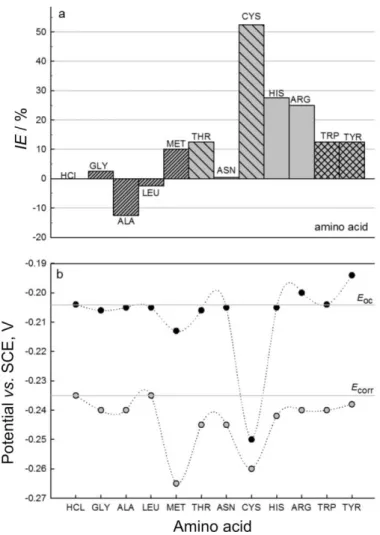
den-sity decreased by approximately half a decade and the corrosion potential shifted in negative direction by 10–30 mV. In terms of IE, asparagine produced no effect, threonine achieved a value similar to that of methionine, 12 %, whilst the
IE for cysteine was 52 % (Fig. 5a). In the anodic branch, the current densities for asparagine and threonine were slightly higher compared to the blank, whilst for cysteine, a small peak was formed at around –0.2 V. At more positive potentials, in addition to the peak at –0.07 V, ascribed to CuCl formation, another peak formed at 0.01 V, followed by a decrease in the current density and a limiting plateau region. Among the examined amino acids, the formation of two addi-tional anodic peaks, at –0.2 and 0.01 V, was unique for cysteine.
Fig. 5. a) Inhibition effectiveness, IE, deduced for copper from the values of the corrosion current density measured in 0.5 M HCl solution inhibited by various amino acids. b) Values of
the open circuit potential, Eoc, and corrosion potential, Ecorr, measured for copper in 0.5 M
Among the basic, non-polar amino acids, histidine and arginine with imi-dazole and guanidinium functional groups, histidine exhibited smaller current densities in the cathodic part (Fig. 4a). The IE values of 27 and 25 % were larger than those for aliphatic amino acids, but smaller than that for cysteine (Fig. 5a). In the region following the anodic peak, both amino acids caused a decrease in the current density. A plateau of ≈50 mV was established, which was not the case in the blank solution or in the presence of aliphatic and polar, neutral amino acids. The aromatic amino acids tryptophane and tyrosine showed similar behaviour: at potentials less negative than the anodic peak, only slight differences occurred compared to the blank curve (Fig. 4b). The resulting IE value for both was 12 % (Fig. 5a). In the region following the anodic peak, at ≈0 V, the related current density was smaller in the presence of tyrosine and, especially, of trypto-phan, which formed a plateau of 40 mV.
Inhibition effectiveness of the amino acids
Two amino acids, alanine and leucine, slightly accelerated the corrosion pro-cess (Fig. 5a). No effect was observed for asparagine. All other amino acids acted as corrosion inhibitors, with cysteine being the most effective with an IE value of 52 %. The following order was observed: CYS > HIS ≈ ARG > THR ≈ TYR ≈ ≈ TRP > MET > GLY.
It is noteworthy that the difference in the effect of cysteine and methionine was quite large (Fig. 5a) although both contain sulphur which is believed to be mainly responsible for the strong adsorption of organic molecules. The adsorp-tion achieved through thiol (S–H) group of cysteine was obviously stronger than through the methylthio (S–CH3) group of methionine (Fig. 1). Furthermore,
cys-teine acted as an inhibitor and alanine as an accelerator although they differ only in the presence of the thiol group.
The values of open circuit potential, Eoc, measured after 1 h immersion and
corrosion potential, Ecorr, determined by Tafel analysis for the blank HCl solu-tion and in the presence of various amino acids, are presented in Fig. 5b. Cys-teine showed the most negative shift of Eoc followed by methionine, while the
other amino acids showed very similar values to the blank. Among the Ecorr
values, methionine and cysteine again shifted them to the most negative values, compared to the blank.
Quantum chemical results
CYS-PH and ALA-PH. The electronic data have been calculated with the model of inhibitors in EDL and with the model of inhibitors in EDL applying a finite electric field in the z-direction. The EDL has been simulated with solvent dielec-tric constant of 6.0 and the elecdielec-tric field of 107 V cm–1 has been applied. The
B3LYP/6-311G fully optimized structures of protonated forms of CYS and
ALA molecules calculated for the EDL model are displayed in Fig. 6, where the most relevant bond distances are also stated. The bond distances calculated for the model with external field are insignificantly different from those given in the figure. The inhibitor performance was analysed by quantum chemical parameters responsible for the inhibitory action and was further addressed by evaluating the global reactivity parameters. Table II presents the HOMO–LUMO energy gap (ΔE) and dipole moment as electronic parameters and the following reactivity parameters: electronic chemical potential (μ), global chemical hardness (η) and the fraction of transferred electron (ΔN). The calculated values for both models employed are quite similar implying that the external field has small influence on the electronic as well as on the reactivity parameters of studied amino acids. Low values of energy gap are associated with effective inhibition. The ΔE results sup-port the better inhibition effectiveness of cysteine in acid media compared to ala-nine. Further, similar conclusions are confirmed by the results on electronic che-mical potential and global cheche-mical hardness.
Fig. 6. The equilibrium structures (selected B3LYP/6-311G bond distances in Å) of the protonated forms of cysteine and alanine molecules in the EDL molecule–aqueous
solution interface.
To examine the local reactivity behaviour we have calculated the Fukui indi-ces, which are summarised in Table III. The atomic sites with the maximum value of fi– are the preferred sites to which the amino acid molecule will donate
charge when attacked by an electrophilic reagent. On the other hand, a large value of fi+ is assigned to the atomic sites where the amino acid molecule will
attack. For CYS-PH C2 and O1 are the preferred sites for nucleophilic attack. On the other hand, O2 and O1 atoms of ALA-PH are the most reactive centres for an electrophilic attack. C2 and O1 atoms participate in the nucleophilic attack of ALA-PH. From Fukui analysis it can be concluded that more centres are involved in the adsorption process of the both amino acid molecules.
TABLE II. Electronic parameters (HOMO–LUMO energy gap (ΔE), dipole moment) and global reactivity parameters (electronic chemical potential (μ), global chemical hardness (η), the fraction of transferred electron (ΔN)) of protonated cysteine and alanine forms in acidic medium; a: ε = 6.0; b: ε = 6.0, with an electric field of 107 V cm-1
Species Model ΔE / eV Dipole moment, Debye μ η ΔN
CYS-PH a 6.44 7.40 –5.04 3.22 –0.01
b 6.40 6.89 –5.04 3.22 –0.01
ALA-PH a 7.85 8.70 –5.48 3.93 –0.06
b 7.81 8.97 –5.52 3.91 –0.07
TABLE III. Condensed Fukui functions (f–, f+) of protonated cysteine and alanine forms in
acidic medium. The most favourable sites for electrophilic and nucleophilic attacks are bold; a: ε = 6.0; b: ε = 6.0, with an electric field of 107 V cm-1
Species Model C1 C2 N O1 O2 C3 S
CYS-PH
f– a 0.00 0.02 –0.01 –0.04 –0.02 0.04 –0.80
b 0.00 0.01 –0.01 –0.04 –0.02 0.04 –0.80
f+ a 0.00 –0.19 –0.01 –0.14 –0.06 0.00 –0.10
b –0.01 –0.17 –0.02 –0.13 –0.06 0.00 –0.08
ALA-PH
f– a –0.06 0.00 0.00 –0.54 –0.13 –0.01 –
b –0.06 0.00 0.00 –0.54 –0.13 –0.01 – f+ a 0.00 –0.16 –0.02 –0.13 –0.06 0.00 –
b –0.03 –0.22 –0.06 –0.14 –0.07 0.01 –
Molecular dynamics results
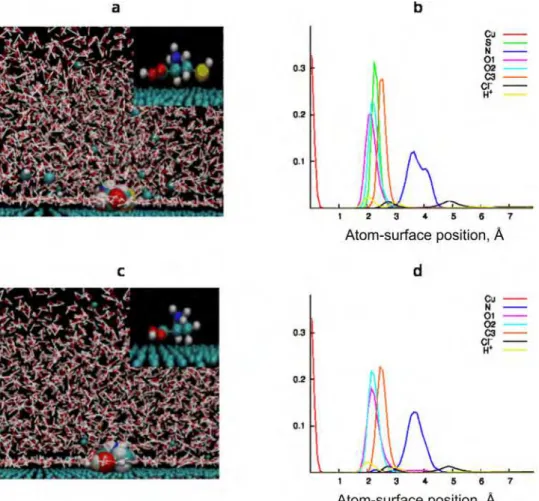
could be concluded from the figure that the protons are distributed throughout the solution and approach not less than 2.0 Å to the surface. Moreover, chlorine anions are distributed throughout the solution with minimum distance to the sur-face of 2.7 Å.
Fig. 7. Adsorption configurations (a and c panel) and normalized histograms of atomic positions relative to Cu(111) surface (b and d panel) for cysteine and alanine molecules in
acid medium. In insets the medium is excluded to present more clearly the adsorption configurations of molecules at the Cu(111) surface (green). Legend: amino acid: O (red),
N (blue), S (yellow), C (green), H (grey); medium: H2O (white), H3O+ (red), Cl (green).
at 3.7 Å above the Cu surface. It should be mentioned that an S atom is not involved in this amino acid.
CONCLUSIONS
An experimental electrochemical and a theoretical study were performed to investigate the possibility of employing various amino acids as corrosion inhi-bitors for copper in 0.5 M HCl solution. Eleven tested amino acids were divided into four groups based on the type of functional group, polarity, charge and pre-sence of sulphur. No clear relationship between the groups was noticed in terms of the inhibition effectiveness in hydrochloric acid, i.e., amino acids from the same group may act as corrosion inhibitor or corrosion accelerator. The experi-mental results confirmed that cysteine exhibited the largest inhibition effective-ness reaching about 50 % at a concentration of 10 mM. Histidine and arginine reached IE values of about 25 %, while the other amino acids yielded only mode-rate effects, not important for practical use. Alanine and leucine acted as corro-sion accelerators.
The reasons for diametrically opposed behaviour of cysteine and alanine, differing only in the presence of a thiol group, were investigated further using quantum chemical calculations and molecular dynamics simulations. The better inhibition effectiveness of cysteine compared to alanine was confirmed by the results of the HOMO–LUMO energy gap, electronic chemical potential and glo-bal chemical hardness. The calculated local reactivity parameters indicated that several atomic centres are involved in the adsorption process of both amino acid molecules. The electrophilic attack of cysteine molecule is strongly related to the S atom, while in alanine molecule, both the O1 and O2 atoms are the favourable sites. On the other hand, C2 and O1 are preferred sites for nucleophilic attack, in other words, the –C=O carbonyl group is operative in a back donation process. The molecular dynamics simulations provided a relative comparison of the orien-tation of cysteine and alanine inhibitors in 0.5 M HCl solutions at the Cu(111) surface. No significant difference could be observed for the absorption of these amino acids regarding their orientation at the metal surface. Yet, cysteine achieved high inhibition effectiveness which can be ascribed to adsorption through the thiol group. Finally, the results of global reactivity parameters and those of mole-cular dynamic simulations do not support the participation of N atom of ammo-nium group in the adsorption process.
И З В О Д
АМИНОКИСЕЛИНЕ КАО КОРОЗИОНИ ИНХИБИТОРИ ЗА БАКАР У КИСЕЛОЈ СРЕДИНИ: ЕКСПЕРИМЕНТАЛНА И ТЕОРИЈСКА СТУДИЈА
INGRID MILOŠEV1
, JASMINKA PAVLINAC1, MILAN HODOŠČEK2
и ANTONIJA LESAR1
1Jožef Stefan Institute, Department of Physical and Organic Chemistry, Jamova 39, SI-1000, Ljubljana,
Slovenia и 2National Institute of Chemistry, Laboratory for Molecular Modeling, Hajdrihova 19, SI-1000 Ljubljana, Slovenia
Коришћењем експерименталних електрохемијских метода у комбинацији са кван
-тно-хемијским израчунавањем и симулацијама молекуларне динамике проучаване су
могућности употребе различитих аминокиселина као “зелених” корозионих инхибитора
за бакар у 0,5 М раствору HCl. Између једанаест тестираних аминокиселина цистеин је
показао најбољу корозиону заштиту (52 % при концентрацији 10 mМ). Остале амино -киселине су постигле заштиту мању од 25 %; неке међу њима чак делују као акцеле
-ратори корозије. На основу добијених експерименталних резултата за теоријска израчу
-навања и симулације изабрани су цистеин и аланин. Електронски и реактивни пара -метри електрохемијског двослоја одређени су за протоноване облике аминокиселина
помоћу рачунања на основу теорије функционала густине. Симулацијом молекуларне
динамике праћена је адсорпција ових аминокиселина на Cu(111) равни у раствору елек
-тролита. Оријентација обе аминокиселине је скоро паралелна са површином са изузет
-ком амонијум групе која је усмерена од површине. Будућида је оријентација цистеина и
аланина на површини слична, може да се закључи да је тиолска група у цистеину одго
-ворна за његову супериорну корозиону заштиту уодносу на друге аминокиселине.
(Примљено 26. новембра 2013)
REFERENCES
1. G. Kaer, B. D. Barker, F. C. Walsh, Corros. Sci.46 (2004) 109
2. C. A. C. Sequeira, in Uhlig’s Corrosion Handbook, 2nd ed., R. Winston Revie, Ed., Electrochemical Society Series, Wiley-Interscience, John Wiley & Sons, Inc., Hoboken, NJ, 2006, p. 729
3. E. Rocca, F. Mirambet, in “Corrosion of metallic heritage artefacts”, P. Dillmann, G. Béranger, P. Piccardo, H. Matthieses, Eds., Woodhead Publishing in Materials, European Federation of Corrosion Publications, No. 48, Cambridge, 2007, p. 308
4. M. M. Antonijević, M. B. Petrović, Int. J. Electrochem. Sci.3 (2008) 1 5. M. M. Antonijević, M. B. Radovanović, Zaštita materijala51 (2010) 111 6. M. Finšgar, I. Milošev, Corros. Sci.52 (2010) 2737
7. N. K. Allam, A. A. Nazeer, E. A. Ashour, J. Appl. Electrochem. 39 (2009) 961 8. J. Mathiyarasu, S. S. Pathak, V. Yegnaraman, Corros. Rev.24 (2011) 307
9. D. M. Bastidas, M. Criado, S. Fajardo, V. M. La Iglesia, E. Cano, J. M. Bastidas, Inter. Mater Rev., 55 (2010) 99
10. V. S. Saji, Recent Patents Corros. Sci.2 (2010) 6
11. M. Sangeetha, S. Rajendran, T. S. Muthumegala, A. Krishnaveni, Zaštita materijala 52
(2011) 3
12. P. B. Raja, M. G. Sathuraman, Mater. Lett. 62 (2009) 113
13. D. Kesavan, M. Gopiraman, N. Sulochana, Chem. Sci. Rev. Lett. 1 (2012) 1 14. G. K. Gomma, M. H. Wahdan, Mater. Chem. Phys.39 (1994) 142
17. D.-Q. Zhang, Q.-R. Cai, L.-X. Gao, K. Y. Lee, Corros. Sci.50 (2008) 3615
18. D.-Q. Zhang, Q.-R. Cai, X.-M. He, L.-X. Gao, G.-D. Zhou, Mater. Chem. Phys. 112
(2008) 353
19. D.-Q. Zhang, Q.-R. Cai, X.-M. He, L.-X. Gao, G. S. Kim, Mater. Chem. Phys. 114 (2009) 612 20. D.-Q. Zhang, X.-M. He, Q.-R. Cai, L.-X. Gao, G. S. Kim, J. Appl. Electrochem. 39
(2009) 1193
21. D.-Q. Zhang, B. Xie, L.-X. Gao, Q.-R. Cai, H. G. Joo, K. Y. Lee, Thin Solid Films520
(2011) 356
22. K. Barouni, L. Bazzi, R. Salghi, M. Mihit, B. Hammouti, A. Albourine, S. El Issami, Mater. Lett.62 (2008) 3325
23. A. Sedik, S. Abderrahmane, A. Himour, Sensor Lett.9 (2011) 2219
24. J. B. Matos, L. P. Pereira, S. M. L. Agostinho, O. E. Barcia, G. G. O. Cordeiro, E. D'Elia, J. Electrochem. Soc.570 (2004) 91
25. G. Moretti, F. Guidi, Corros. Sci.44 (2002) 1995
26. H. H. Abdel Rahman, A. H. E. Moustafa, M. K. Awad, Int. J. Electrochem. Soc.7 (2012) 1266
27. M. Levin, P. Wiklund, C. Leygraf, Corros. Sci. 58 (2012) 104
28. W. A. Badawy, K. M. Ismail, A. M. Fathi, J. Appl. Electrochem. 35 (2005) 879
29. H. Saifi, M. C. Bernard, S. Joiret, K. Rahmouni, H. Takenuti, B. Talhi, Mater. Chem. Phys. 120 (2010) 661
30. S. Varvara, I. Roratu, M. Popa, L. M. Muresan, Rev. Roum. Chim.56 (2011) 793 31. M. Gravgaard, J. van Lanschot, J. Inst. Conserv. 35 (2012) 14
32. CRC Handbook of Chemistry and Physics, 58th ed., R. C. Weast, Ed., Section C: Organic Compounds,CRC Press, Inc., Palm Beach, FL, 1977/78, p. C-767
33. A. D. Becke, J. Chem. Phys. 98 (1993) 5648
34. C. Lee, W. Yang, R. G. Parr, Phys. Rev., B.37 (1988) 785
35. B. Miehlich, A. Savin, H. Stoll, H. Preuss, Chem. Phys. Lett.157 (1989) 200 36. A. D. McLean, G. S. Chandler, J. Chem. Phys. 72 (1980) 5639
37. M. W. Wong, M. J. Rrish, K. B. Wieberg, J. Am. Chem. Soc.113 (1991) 4776 38. M. Cossi, V. Barone, R. Cammi, J. Tomasi, Chem. Phys. Lett. 225 (1996) 327
39. J. O'M. Bockris, S. U. M. Khan, Quantum Electrochemistry, Plenum Press, New York, 1979, p. 22
40. R. G. Parr, W. Yang, J. Am. Chem. Soc.106 (1984) 4049 41. W. Yang, W. J. Mortier, J. Am. Chem. Soc.108 (1986) 5708 42. A. Lesar, I. Milošev, Chem. Phys. Lett.483 (2009) 198
43. Gaussian 09 Revision A.1, Gaussian Inc., Wallingford, CT, 2009
44. B. R. Brooks, C. L. Brooks III, A. D. Mackerell, L. Nilsson, R. J. Petrella, B. Roux, Y. Won, G. Archontis, C. Bartels, S. Boresch A. Caflisch, L. Caves, Q. Cui, A. R. Dinner, M. Feig, S. Fischer, J. Gao, M. Hodoscek, W. Im, K. Kuczera, T. Lazaridis, J. Ma, V. Ovchinnikov, E. Paci, R. W. Pastor, C. B. Post, J. Z. Pu, M. Schaefer, B. Tidor, R. M. Venable, H. L. Woodcock, X. Wu, W. Yang, D. M. York, M. Karplus, J. Comp. Chem.
30 (2009) 1545
45. A. D. MacKerell Jr., D. Bashford, M. Bellott, R. L. Dunbrack Jr., J. D. Evanseck, M. J. Field, S. Fischer, J. Gao, H. Guo, S. Ha, D. Joseph-McCarthy, L. Kuchnir, K. Kuczera, F. T. K. Lau, C. Mattos, S. Michnick, T. Ngo, D. T. Nguyen, B. Prodhom, W. E. Reiher, III, B. Roux, M. Schlenkrich, J. C. Smith, R. Stote, J. Straub, M. Watanabe, J. Wiorkiewicz-Kuczera, D. Yin, M. Karplus, J. Phys. Chem., B102 (1998) 3586