ISSN 0975-928X
Research Article
Nutrition and fatty acid composition in different botanical groups of
groundnut (
Arachis
hypogaea
. L) in ICRISAT mini core collection
Ganapati Mukri 1, 2 ,Shridevi Jakkeral1 and H.L Nadaf 1
1
Department of genetic and plant breeding, UAS, Dharwad-580005 2
Directorate of Maize Research, Pusa Campus, New Delhi-110012
(Received: 30 May 2014; Accepted: 11 Jun 2014)
Abstract
Breeding for enhanced nutritional quality is need of the hour. India not only needs increased quantity of food to feed the growing population but also quality food to mitigate hidden hunger. Oil is the major energy source of the Indian diet. Chemical composition of oil decides its edible nature. Even in edible oil fatty acid composition in general and ratio of oleic acid to linoleic acid of the oil plays major role in deciding its quality. In India, availability of breeding line to improve groundnut oil quality is limited. Screening of different botanical group may give some idea about choice of material for further crop improvement program. In present study botanical group hypogaea, found to have higher amount of oleic acid and fastigiata group recorded high protein and oil content. Growing season also matters in the expression of different fatty acid. Rainy season is found to have better for the better expression of all studied traits.
Key words:
Groundnut, oleic acid, protein, oil, botanical variety
Introduction:
Groundnut is one of the most important oilseed crops in India. It is a rich source of protein (44 – 56 %), oil (22 – 30 %), vitamins and minerals, hence it is called as poor-mans almond. Groundnut oil generally contains 45-50 per cent mono-unsaturated fatty acids, 30-35 per cent poly unsaturated fatty acids and 17-18 per cent of saturated fatty acids (Ory et al., 1992). Poly-unsaturated fatty acids have high potential of developing off-flavors due to oxidation. Oxidation of linoleic and linolenic acid is approximately 10 and 25 times higher, respectively, than that of oleic acid (Frankel, 1991, Lands, 1997). Oil with higher ratios of oleic to linoleic acid retains its quality longer in seed or as oil. Hence, fatty acid composition of groundnut oil determines its quality. Proportion of oil and protein content decides the nutritive value and usage of groundnut. Genotype with high oil content and low protein content are used in oil extraction and individuals with high protein content with low oil are preferred for confectionary purpose. Botanically cultivated groundnut can be classified in to two sub species and six botanical types or varieties. Genetic improvement is possible when we harvest the advantages of these different groups. There exists genotypic difference for nutritional and oil quality traits. By and large if breeder identifies at least botanical group which gives advantage for selecting the better genotype then program for introgression becomes very easy. Looking to the requirement and availability of the material one can plan a good breeding strategy to combine the desirable traits in single genotype. Hence, it is necessary to identify the botanical group which has oil quality advantage over other group.
Material and methods
The groundnut mini core collection, consisting of 184 germplasm accessions selected from 1704 core collection accessions, representing the global germplasm of 14,310 accessions maintained at ICRISAT gene bank (Upadhyaya et al., 2002) was utilized in the present investigation. The mini core collection consisted of 37 subsp. fastigiata var. fastigiata, 58 subsp. fastigiata var. vulgaris Harz, two subsp. fastigiata var. peruviana Krapov. & W. C. Greg., and one subsp. Fastigiata var. aequatoriana Krapov. & W. C. Greg.,85 subsp.
hypogaea var. hypogaea and one subsp. hypogaea
var. hirsuta J. Kohler. The four control cultivars used in the study were M 13, ICGS 76 (both subsp.
hypogaea var. hypogaea), ICGS 44 (subsp.
fastigiata var. vulgaris), and Gangapuri (subsp. fastigiata var. fastigiata). M 13 and Gangapuri are cultivars developed by the national research centres whereas ICGS 44 (ICGV 87128 [PI 537112]) and ICGS 76 (ICGV 87141 [PI 546372]) are high-yielding cultivars developed at ICRISAT and released for cultivation in India. These 188 genotypes were evaluated in randomized block design with two replications in the 2008 rainy and 2008/2009 post-rainy seasons at the University of Agricultural Sciences (UAS), Dharwad, India, in vertisol fields and at ICRISAT, Hyderabad in alfisol fields. The blocking within the replication was done to minimise the effect of soil heterogeneity. Geographically Dharwad is located
at 75°07’ E, 15°13’ N, and 678 m above mean sea
level, whereas, ICRISAT is located at 170 24 north, longitude of 780 12 east and altitude of 536 m above mean sea level.
ISSN 0975-928X
practices and plant protection measures against pests and diseases to raise a successful crop were followed.
Phenotyping by Near Infra-Red Spectrophotometer Total protein content, oil content and fatty acid composition were estimated using Near Infra-Red spectrophotometer (NIRS) (Panford, 1990; Mishra et al., 2000). A random sample of 100 seeds was used to record protein and oil content in percentage. A total of five randomly selected well matured kernels from each replication were used for the estimation of fatty acid composition. Eight fatty acids viz., Palmitic acid (16:0), Stearic acid (18:0), Oleic acid (18:1), Linoleic acid (18:2), Arachidic acid (20:0), Eicosenoic acid (20:1), Behenic acid (22:0) and Lignoceric acid (24:0) were quantified using NIRs. Among these Palmitic, Stearic, Arachidic, Behenic and Lignoceric acids are saturated fatty acid with no double bonds in their fatty acid chain and Oleic and Eicosenoic acids are monounsaturated fatty acids with single double bond and the Linoleic acid is the polyunsaturated fatty acid with two double bonds in their fatty acid chain. The value in the brackets indicates the number of carbon atoms and the number of double bonds in the fatty acid chain.
Oil stability indices viz., Oleic acid/Linolec acid (O/L ratio), Iodine value (IV) unsaturated/saturated (U/S) fatty acid and per cent of standard fatty acids (%S) were estimated as follows.
a) Oleic/Linoleic acid:Per cent of Oleic acid (18:1)/per cent of Linoleic acid (18:2). b) Iodine value (IV): (% Oleic acid x
0.8601) + (% Linoleic acid x 1.7321) + (% Eicosenoic acid x 0.7854) (Mozingo et al., 1988).
c) Unsaturated/saturated fatty acid (U/S): % (Oleic acid + Linoleic acid + Eicosenoic acid) % (Palmitic acid + Stearic acid + Arachidic acid + Behenic acid + Lignoceric acid).
d) Total saturated fatty acid (%): (Palmitic acid + Stearic acid + Arachidic acid + Behenic acid + Lignoceric acid) (Mozingo et al., 1988).
Results and Discussion
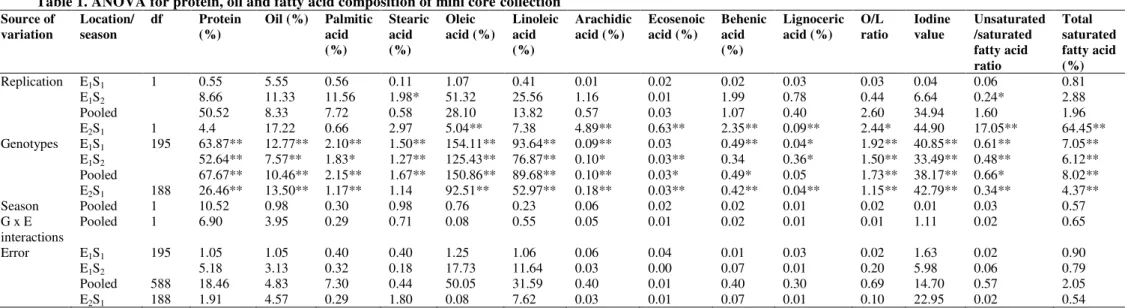
The analysis of variance for different traits revealed highly significant differences for the traits studied among the genotypes, suggesting presence of high degree of genetic variability in the material evaluated (Table 1). This could be attributed to their divergent pedigree, origin and different botanical groups of germplasm lines.
Performance of different botanical groups in mini
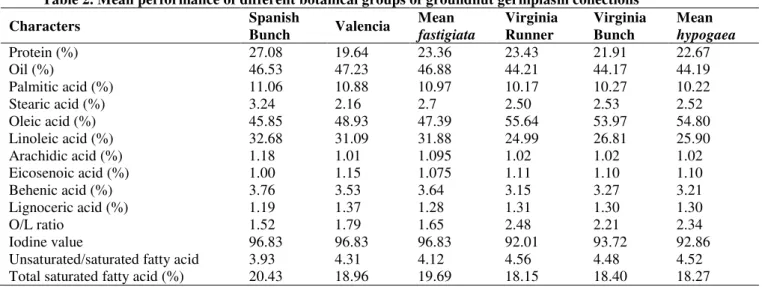
hypogaea with alternate branching and subspecies fastigiata with sequential branching habit. These subspecies have six botanical varieties, subspecies hypogaea has var. hypogaea (Virginia) and var hirsuta and subspecies fastigiata has var. fastigiata (Valencia), var. vulgaris (Spanish), var. peruviana and var. aequatoriana. To identify the botanical group suitable for exploiting desirable combination of traits, mini core collection were classified into four botanical groups viz., Spanish Bunch, Valencia, Virgina Runner and Virginia Bunch (Table 2). Spanish Bunch type recorded relatively higher protein content followed by Virginia and Valencia group. Whereas, spp. fastigiata accessions had high mean oil content compared to spp. hypogaea group (Fig. 1). Expression of these quality traits was also affected by location and season (Upadhyaya, 2003). Mean protein content of the mini core was slightly high when it was grown in Rainy season (23.87%) compared to post-rainy season (23.40%). However, at ICRISAT, Hyderabad still higher protein content (25.01%) was observed compared to UAS Dharwad location. Mean oil content was more in post-rainy season (46.28%) compared to Rainy season (45.75%). However, there was not much difference between the locations which implies the role of season on the expression of trait (Table 4).
ISSN 0975-928X
Iodine value which is the indicator of degree of saturation was more in spp. fastigiata group. Low iodine number implies the few unsaturated bonds and hence, low susceptibility to oxidative rancidity (Aruna and Nigam, 2009). Accessions belonging to spp. hypogaea had this advantage with less total saturated fatty acids compared to spp. fastigiata accessions. Seasonal effect on this trait was less compared to location effect.
Nutritional and oil quality breeding is the need of the hour to tackle growing problem of hidden hunger in India. Introgression breeding can be undertaken by choosing the genotype with high oleic acid. The information on nutritional and oil quality traits in different botanical groups gives the key idea to select the best botanical group to start genetic improvement of these traits. From the study of botanical group, Virginia found to have desirable characters and breeder can screen the genotypes of this group and utilize the best genotypes for crop improvement programs.
Referances:
Aruna, R., and Nigam, S. N., 2009, Inheritance of fatty acid content and related quality traits in groundnut (Arachis hypogeae L.). J. Oilseed Res.,26 (1) : 10-17.
Bansal, U. K., Satija, D. R., Ahuja, K. L., 1993, Oil composition of diverse groundnut (Arachis hypogeae L.) genotypes in relation to different environments. J. Sci. Food Agric.,63 (1) : 17-19.
Frankel, E. N., 1991, Recent advances in lipid oxidation.
J. Sci. Food Agri., 54: 495-511.
Lands, W. E. M, 1997, The two faces of essential fatty acids. INFORM, 8: 1141-1147.
Mishra, J. B., Ghosh, P. K., Dayal, D. and Mathur, R. S., 2000, Agronomic, nutritional and physiological characteristics of some Indian groundnut cultivars. Indian Agril. Sci., 70 : 714-746.
Mozingo, R. W., Cifflet, T. A. and Wynne, J. C., 1988, Quality evaluation of Virginia-type peanut varieties released from 1944-1985. Southern Co-operative Series Bull, 335.
Ory, R. L., Crippen, K. L. and Lovegren, N. V., 1992, Off flavors in foods and beverages, Elsevier Science Publishers, New York.
Panford, J. A., 1990, Determination of oil content of seeds by NIR influence of fatty acid composition on wave length selection. J. American Oil Chem. Sco.,67 : 1627-1634. Upadhyaya, H. D., 2003, Phenotypic diversity in
groundnut (Arachis hypogeae L.) core collection assessed by morphological and agrochemical evaluations. Genet. Res. Crop Evolution, 50 : 539-550.
ISSN 0975-928X
Table 1. ANOVA for protein, oil and fatty acid composition of mini core collection Source of
variation
Location/ season
df Protein (%)
Oil (%) Palmitic acid (%)
Stearic acid (%)
Oleic acid (%)
Linoleic acid (%)
Arachidic acid (%)
Ecosenoic acid (%)
Behenic acid (%)
Lignoceric acid (%)
O/L ratio
Iodine value
Unsaturated /saturated fatty acid ratio
Total saturated fatty acid (%)
Replication E1S1 1 0.55 5.55 0.56 0.11 1.07 0.41 0.01 0.02 0.02 0.03 0.03 0.04 0.06 0.81
E1S2 8.66 11.33 11.56 1.98* 51.32 25.56 1.16 0.01 1.99 0.78 0.44 6.64 0.24* 2.88
Pooled 50.52 8.33 7.72 0.58 28.10 13.82 0.57 0.03 1.07 0.40 2.60 34.94 1.60 1.96
E2S1 1 4.4 17.22 0.66 2.97 5.04** 7.38 4.89** 0.63** 2.35** 0.09** 2.44* 44.90 17.05** 64.45**
Genotypes E1S1 195 63.87** 12.77** 2.10** 1.50** 154.11** 93.64** 0.09** 0.03 0.49** 0.04* 1.92** 40.85** 0.61** 7.05** E1S2 52.64** 7.57** 1.83* 1.27** 125.43** 76.87** 0.10* 0.03** 0.34 0.36* 1.50** 33.49** 0.48** 6.12** Pooled 67.67** 10.46** 2.15** 1.67** 150.86** 89.68** 0.10** 0.03* 0.49* 0.05 1.73** 38.17** 0.66* 8.02** E2S1 188 26.46** 13.50** 1.17** 1.14 92.51** 52.97** 0.18** 0.03** 0.42** 0.04** 1.15** 42.79** 0.34** 4.37**
Season Pooled 1 10.52 0.98 0.30 0.98 0.76 0.23 0.06 0.02 0.02 0.01 0.02 0.01 0.03 0.57
G x E interactions
Pooled 1 6.90 3.95 0.29 0.71 0.08 0.55 0.05 0.01 0.02 0.01 0.01 1.11 0.02 0.65
Error E1S1 195 1.05 1.05 0.40 0.40 1.25 1.06 0.06 0.04 0.01 0.03 0.02 1.63 0.02 0.90
E1S2 5.18 3.13 0.32 0.18 17.73 11.64 0.03 0.00 0.07 0.01 0.20 5.98 0.06 0.79
Pooled 588 18.46 4.83 7.30 0.44 50.05 31.59 0.40 0.01 0.40 0.30 0.69 14.70 0.57 2.05
ISSN 0975-928X
Table 2. Mean performance of different botanical groups of groundnut germplasm collections
Characters Spanish
Bunch Valencia
Mean
fastigiata
Virginia Runner
Virginia Bunch
Mean
hypogaea
Protein (%) 27.08 19.64 23.36 23.43 21.91 22.67
Oil (%) 46.53 47.23 46.88 44.21 44.17 44.19
Palmitic acid (%) 11.06 10.88 10.97 10.17 10.27 10.22
Stearic acid (%) 3.24 2.16 2.7 2.50 2.53 2.52
Oleic acid (%) 45.85 48.93 47.39 55.64 53.97 54.80
Linoleic acid (%) 32.68 31.09 31.88 24.99 26.81 25.90
Arachidic acid (%) 1.18 1.01 1.095 1.02 1.02 1.02
Eicosenoic acid (%) 1.00 1.15 1.075 1.11 1.10 1.10
Behenic acid (%) 3.76 3.53 3.64 3.15 3.27 3.21
Lignoceric acid (%) 1.19 1.37 1.28 1.31 1.30 1.30
O/L ratio 1.52 1.79 1.65 2.48 2.21 2.34
Iodine value 96.83 96.83 96.83 92.01 93.72 92.86
Unsaturated/saturated fatty acid 3.93 4.31 4.12 4.56 4.48 4.52 Total saturated fatty acid (%) 20.43 18.96 19.69 18.15 18.40 18.27
Table 3.Environmental indices for mini core collection grown over three locations
Characters
UAS, Dharwad ICRISAT, Hyderabad
Rainy 2008 Post-rainy
2008-09 Rainy 2008
Protein (%) -0.264 -0.754 1.017
Oil (%) -0.329 0.232 0.097
Palmitic acid (%) 0.262 0.439 -0.701
Stearic acid (%) -0.092 -0.167 0.26
Oleic acid (%) 0.343 1.515 -1.858
Linoleic acid (%) 1.153 1.988 -3.141
Arachidic acid (%) -0.163 -0.106 0.27
Ecosenoic acid (%) 0.01 0.007 -0.016
Behenic acid (%) -0.093 -0.02 0.113
Lignoceric acid (%) -0.042 0.003 0.039
O/L ratio -0.107 0.005 0.103
Iodine value 3.307 3.744 -7.051
ISSN 0975-928X
Table 4. Mean and range for nutritional and oil quality traits in mini core collection
Mini core Protein (%) Oil (%) Palmitic acid (%) Stearic acid (%) Oleic acid (%) Linoleic acid (%) Arachidic acid (%)
Mean Range Mean Range Mean Range Mean Range Mean Range Mean Range Mean Range
UASD Rainy 2008
23.87 12.73-33.6 45.75 39.64-52.10
10.71 7.10-12.40
2.73 0.80-4.30 50.05 33.40-73.6 29.67 10.4-43.97 1.08 0.5-1.67 UASD
Post-rainy 2008-09
23.40 12.9-32.20 46.28 39.57-51.68
10.89 7.06-12.55
2.66 0.84-4.14 48.92 33.8-74.21 30.47 10.58-43.51
1.13 0.54-1.72 ICRISAT Rainy
2008
25.01 13.19-31.67
46.15 34.78-52.26
9.73 7.36-11.50
3.08 1.13-4.76 46.77 30.27-72.07
25.26 12.16-37.13
1.50 0.9-2.35
Mini core Ecosenoic acid (%)
Behenic acid (%) Lignoceric acid (%)
O/L ratio Iodine value Unsaturated/ saturated fatty acid ratio
Total saturated fatty acid (%)
Mean Range Mean Range Mean Range Mean Range Mean Range Mean Range Mean Range
UASD Rainy 2008
1.07 0.8-1.40 3.48 2.02-4.67 1.27 0.95-1.62 1.9 0.8-7.04 95.29 82.54-105.50 4.24 3.43-6.10 19.26 14.2-22.7 UASD Post-rainy
2008-09
1.07 0.8-1.34 3.55 2.34-4.60 1.31 0.96-1.66 1.79 0.8-7.11 95.70 82.46-105.50 4.16 3.42-5.66 19.54 15.03-22.84 ICRISAT Rainy
2008