Austronesian vernacular architecture and the
Ise Shrine of Japan: Is there any connection?
Ezrin Arbi
Dep artment of Architecture Faculty of Built Environment
University of Malaya
Abst ract
In spite of so many varieti es of form and detail o f const ruct ion found inSou theastA sian vern acu lar buildi ngs, the re are some re curring features and shared characte ristics that bind them together. The vast territories in which this phenomenon exists, known as the "Austronesian world", does no t includ e Japan. Howev er, there is an intriguing re semblance between the archite ctural s tyle of Japanese vernacular heritage of the earlier period with that of Austronesia. This paper is an attempt to explain the relation between the two using the findings of studiesbyarchaeolog ical, ling uistic, sociolog ical and anthropo logical ex perts based o n the linkbe tw een culture, langu age and ve rnacular architect ure .
Introduction
In order to see the link be tween lang uag e an d architec ture this pap er w ill necessarily be pr eceded wit h a brief d iscussion on the concept of culture. One of the earlier meanings wa s g iven by Tylor (1871) (in Firth ed. 1960:2), who defined culture as " tha t com plex whole which includes knowled ge, beliefs, ar t, mora ls, laws, custom s and all other capabilities and habits acquired by man as a member of a society" . An other definition given by Malinowski (1931) states that culture com prises inh erited artifacts, goods, technical processes, ideas, habits and values. He further said that social orga nizalion is also included since it can not be understood except as a part of culture (in Firth ed .1960). Obvi ously, culture encompasses all sys tems that give a society its ide ntity and distingui sh it from the o thers .
Cu lture has also been ana lyzed by scholars in terms of its form and content. According to Honi ngmann (1954) and Koentjaraningat (1985), culture may be in
the form of(i)ideas, (ii) activities and (iii) artifa cts. The first is abstract in natu re; it is not visible and exists only in the mind of those who subscribe to it. The second form is men's complex activities in the ir interaction with each other; they ar e concrete and observable. The third form of culture, which is the mo st concre te, is the result of h uman activit ies in their social intercourse that requires the creation and making of new tools, instruments, structures, bu ildings etc in order to fulfill their mu lti-various needs .Itis also know n as ' material cultu re' or ' phy sical culture'. Architectura l products suc h as dwelling house or shrine obv iously belong to the physical form of culture and at the same time they are the result of human activities, one of manifestati ons of culture.
!ollnlal ofDesigna"d ti,e BuiltEn vironment
culture anywhere in the world, regard less of its level of development or location . Koentjaraningrat (1966) took the gist out of the various existing structure of cultu ral universals and presented seven fundamental contents of every culture, comprising: (i) lan gu age, (ii) kn owled ge sys tem, (iii) social organization , (iv) facility sys tem an d tech nology, (v) income generating system, (vi) religious system and (vii) arts. Wh ile architec tu re as a cultural ar tifact is a form of physica l culture, lan gu age is a fundamen tal content of the culture th at prod uces the artifact including vernacular architecture. To conclude this brief d iscussion on the link betw een lan gu age and culture it is oppo rtune to qu ote em inent linguists' views that lan guage reflects and perpetuates the basic assump tions and orientations of a given cu lture.It not only defines but to a large extent de termines the way in which a culture views itself and the world (Whorl
& Brown in Oliver 1975:9).
The Au stronesian World
The vast numb er of lan guages spoken in the world has been gro uped by ling uists into several famili es, one of the largest of w hich is known as Au stronesian, comprising 1268 languages or about one-fifth of the known lan gu ages in the wo rld . It covers the lan guages spoken by the peopl e of insular Southeast Asia, Micronesia, Melanesia and Polynes ia in the Pacific, as well as some part of mainland Asia coveri ng the territory show n in Map I and Map 2. Both maps delineate roug hly the same areas, from which one can see tha t the Austronesia n world stretches across mor e than half-way rou nd the wo rld's circumference, from Madagascar on the extreme west, thro ugh the Malay archipelagos to Easter Island on the eas ternmost poi nt. The Malay Pen insular, some part of Vietnam, Taiwa n, Philippine Islands and certain coas tal parts of New Gu inea are also w ithin its territo ry.
The nameAus tronesiaorigina tesfrom 'auster' meaning 'so uth wind ' in Latin, plus ' nesos' wh ich is 'island' in Greek. The combination of the two words aptly describe the fact that the majority of the lan gu ages in the family are spo ken on the islan ds, with the excep tion of Ma lay and Cha mic lang uages which are indigen ou s to continental Asia.
In bo th maps previously mentioned, Japa n is no t included within the Aust ronesian bound ary. In fact in Bellwood' s map that island country does not appear at all, whil e in Fox's map Japanese archipelago is fully sho wn ma king one realizes not only how close it is actua lly from Taiwa n, but also the fact that it is almos t surroun ded by the Pacific Islanders that speak the Austrones ian languages. In the vast doma in of this lang uage family, Taiwan has a special importance. Accordi ng to lingui stic experts (Blus t 1999 an d Comrie 2001) the Au st ronesian lang uages can be subdivided int o tw o, nam ely the Malayo -Polyn esian branch scaltered all over the Pacific islands and the Formosan lan guages of Taiwan comprising 9 subgroups of Aust ron esian . This lead s the m to pos tulate that Taiwan is the ho me of the Aus tronesian langu ages. Bellwood (1997) suggests that aro und 8000 yea rs ago the ancestors of the Austronesians came across from Southern Ch ina to Taiwan, from where they spread to the entire region tha t is now covered by the Austrones ian langu ages. As Fox (2004:8) states:
Austroneeian uemacutar architectureand ti,e Ise Shrineoflapa"
Limits of the Au stronesian Lan gu age Family
MAINlAND
4...,,,.
()
" .&IJ1 IAl,UtMap 1 : Source : Waterson 1997:13.
utr..Hluod'
!i
)"-'
セ
セ
ru$
...
'"
セ
.. . '-..
K\
. . ...t-,
セ |NNLN
«;
i<,
-c' )
f'1
V\.
1&
" !t-,
..
.. ,t'k
V\{
セ
ijG セ rセ Z N"
,
...-.;
ヲ l BLセ
,
'..
,r-,
II
V
iセ G[[
ヲ セ.
セ
セ '.,.
..
lI
\
1/
Bセ1"-
.
'
...,
...'I
•
.,
II)
h
V
[,.J
1\ "'-
.. ' ..0
/
セ
V
V
t'\;
1/
ケLセ N
L----r---
;-1'---
I
II
セ
l---
IV
,I.
,
セ
JOIIYllal of DesigllandtheBuil! Environment
mainland China, especially if one were to view the early Austronesians a population of related dialect communities living in scattered coastal settlements."
Austronesian Vernacular Architecture The indigenous architecture of this particular part of the world has attracted
Waterson's (1997:xv) attention, who regards its anonymous craftsmen as having produced some of the most spectacular and beautiful wooden buildings anywhere in the world. In all their diversity and subtle variation, the architectural styles of traditional buildings found in the Austronesian world, upon a closer look show certain shared similarities that seem to indicate their common origin in the
DI
セ
L N
_ セ - - ,.:.... -=-',Ne[BBセ .
.
セ ...-
.... --11IlIT
Austronesian vemecutararchitectureandthe1seShrineofJapatl
distant past. Waterson (1997:1-11) noticed there are some recur ring features wo rthy of spe cial discussion. The mos t ap pa rent ph ysical characteristic is the raised floor suppo rted by timber piles or sti lts. In the hou se of the Dayaks in Borneo, these posts are extremely high, but ' generally they are of mo derate height makin g the space below the floor suitable for human or animal use. Only in very few cases the raised floor is so low that the space underneath is rende red unusable except for ve ntilation. Anoth er prominent feature of the style is the sad dle-backed roof, of which the ridge- line extends beyond the gable w alls. Furt hermore, the gables are us ua lly decorated wit h finials often bu t not always in the form of cross horns (Fig. 1).
Because of the perishable natu re of timbe r, the ma in material used by the Austronesians, it is not easy to reso lve archaeologically how long they have been using pile found ation for their hou ses. There is ver y scanty evide nce from pre-histori c sites to establish with confid en ce the source of these dwellings. Accord ing to Dumarcay (1990:2) there are two cases worthy of attention. First, the excava tion of pre-historic site in the Ratchaburi regio n to the west of Bangkok has un earthed the rem ains of a house that have been red uced to the positioning of its piles. From ma terials fou nd in the vicini ty of the dwelling archaeologists postu late it belongs to Neo lithic Ban Keo civilization stretching from 1800 to 1300 Be. It is interesting to note that the arrange ment of the piles is such that the dwelling could be reassemb led, just like many present typ es of dwelling in Southeast Asia. From ano ther site at Ban Chiang, in Northeast Tha iland, the positions of piles have also been d iscovered .Again, they enable experts to recon stitute the d welling which was squa re in plan, probab ly covered with split woven bamboo wa lls and plastered w ith
mu d . Although prese nt da y Thai language does no t belong to the Aus tronesian family, its proto-lan guage which Benedict calls Austro-Thai has reconst ruc ted terms that also include wo rds such as platforms / storey, hou se post, and ladder / steps lead ing up to the hou se (first qu oted in Waterson 1997:15). From the result of their studies, the lingui sts are able to throw some ligh ts on the early typ e of dwellings used by the spea kers of a langua ge.
A more concre te proof of the use of pile structure and saddle-roof d uring the early Metal Age may be obt ained from engraved images shown on bronze drums of the Dong Son culture from North Vietna m (Lewcock& Brans 1975,Bellwood 1978) (Fig. 2). This Bronze Age civilization cove ring a large pa rt of Southeas t Asia from between 600 to 400 BC till the first century AD is characterized by the use of bron ze dru ms. A number of these drums which have been found in places on the main land as well as far away island s of Ind onesia, are all decorated with desi gns in a variety of motifs, including fauna and geo metry. Of pa rticular interest is the fact that the decoration often incorporates architectural
Figure2 : Rubbing of the tympanum of a Dong Son bronze showing saddle-roofed, pile-built houses.
joumal a/Design andtheBuiltEnvironment
2
Figure 3 : Houses represented on Dong Son drums (Domenie 1980; in Waterson 1997: 19)
forms showing houses supported on piles (Fig. 3).
In some of the Javanese temples of the ninth to four teenth century, there are friezes clearly depicting several types of pile-built hou ses with extended gable line indicating the people ' s pr actise of those period s, although most buil din gs on the island nowadays di rectly sit on the gro und. While Waterson (1997:1) attr ibut es the adoption of gro und-built structures to Ind ian influence many scho lars believe it is caused by more practical cons traint, that is the scarcity of timb er as the result of rampant defo restation.Itis widely known due to rapid increase of population, the island of Java for the last few cen turies has become one of the mos t densely populated places on ear th w ith very limit ed areas for the common peo ple to access natural timber.
Blust (1976) recons truc tion of the Malayo-Polynesian lan guage subgroups include term s such as ridge-p ole, rafter, thatch, ho use pos t, storag e rack above the hearth, notched log ladder, public buildings etc. From these reconstructed ter ms Blust draws a conclusion that sp eakers of these languages already sett led
in villages whic h may have included both dwelling ho uses and some kind of public structure; that their ho uses we re raised on pos ts, the floor being reached by mea ns of a ladder; and that the roof mus t have bee n gabled because of the existence of a ridge pole.
Fro m such lingui stic reconstruction exper ts can deduce a con clusion tha t raise d floor const ruc tion might have de velope d bot h in mainland and insul ar Southeast Asia since the later Neoli thic period (Waterson 1997:14).
The earli est attempt to d raw
conclusions from similarities of
Austrol/csialluernacuiararchitectureandthe IseSluineO! Jal'flI l
Brans (1975) fur ther stu died the role of boa t as an architecturalsymboland made some in teresting ob se rvations how the features of the boat have been incorporated in to the struc tu re a nd symbolism of the hou se types. Accord ing to them, the influenc e on the d esign of build ing s is reflected at least in nin e diff erent ways. Firstly, the form of th e stored boat resembles the s pirit ho uses and com m unalrice s to res of th e Toraja peopl e in th e island of Celeb es. Secondly, th e frequent appearance of curved roof th at reminds one of a boat with upcurving stem and prow as mention ed abov e. Th e house of the Batak, Minangkabau and Pasema h people on the island of Su matra belong to this category. Thi rdly, the overall for m of the building looks like a boa t in full sa il, as in the case of the Lio district houses in Flores, in the East Ind onesian arc hipe lago. Four thly, in some eastern Indonesian islands the house is bu ilt on a p latform th at appears to be carried on tw o boa ts rem iniscent of ceremonial boat w h ich is mad e u p of tw o boats joined toge ther by a pl atfor m . Fifthly, the Nage people on the island of Flores build a woven representation o f a boat and fixed it to the rid ge of their house. Sixthly, in Tanimbar and Ende di st rict of Flores the ver nac ular ho uses have a large-r idge p iece representi ng a boat. Thi s type of ex p ression of the domina nt symbol of the boat is widespread not on ly th roughou t Southeast Asia and East Asia but as far north as China and Japan (p .112). Seventhly, the Manggarai people of West Flores build the ir house with a roof in the form of a boat upsid e down. Eightl y, also in Flores a village called Tondo ha s its ho uses a rranged in su ch a way th at the ov erall pla n looks like that of a boa t. Lastl y, in Ambon as well as some oth er eastern Indones ian islands, the meeting p lace is often sha pe d like a boat.
Beside physica l resemblances, Vroklage suppor ted his arg u ment by citing some boat vocabulary use d by nu mero us
eth nic groups in Indonesia in na ming parts of their ho uses with' m ast','sail', 'rudder' e tc, and calli ng their village heads and other important pe rsons th e equivalent of 'ship's captain', 'steersman', etc. This asp ect o f Vrok lage's argument has also been su pp or ted by Lewcock and Bran s by bringing m uch lingu istic evi dence to show th e multitude of boat symbolism in nom en clature and use. Vroklage further theor ized that stra ight ridge-line evolved as de gener ated version of the or iginally cu rved on es due to p eop le' s laziness. However, interesting as they are, a number of scholars feel the arguments are weak, while Wat erson describes it as 'dubious'.
The Jap an ese Lan guage & Culture The majority of Western sch olars believe tha t th e Jap anese language belongs to the Alta ic fam ily, together with Turk ish th e most westerly member, Azeri in A zerbaijan, Turkme n in Turkmenia, Kazak h in Khaza khsta n, Kirghi z in Kirghy stan, Uz bec in Uzbekistan, Uigu r in Western China, Mon goli an in Mongolia and Korea n in Korea. However, formany yea rs there have bee n ongoing deba tes among lingu ists abo u t its re al sta tus an d many hypotheses have been proposed that link Japanese with other languages.
[ournalof Designandthe BuiltEnoironment
Figure 4 : Picturesof houses incise d on object of bronze, Japan (From Dome nic
1980; in Waterson 1997:t6) 6 4 2
3
5
Ve rnacular Architecture of Ja pan
In the course of discussing th e boat as an architec tural symbol in Southeas t Asia that has been summarized above, Lewcock and Brans (1975: 112-5) made some reference to Chi na and Japan where according to them its provenance has been forgotten. However, they are quite emphatic tha t in the case of the Japanese there is a strong link with the Dong Son culture discussed earlier. From the early bronze bells an d the clay tom b models, both from circa 1" and 2"d century AD, it is evident th at building representation of the periods closely related to the Austronesian vernacular (Fig. 4 )
Domenig (1980) proposes a theory tha t the origins of the Austronesian style of architecture developed in Sout hern China during the Neolithic period when it was not yetculturally"Chinese", because northern Chinese in fluences on ly came to the south from the Han period (206 BC-AD 220) onward. The cu ltures of Southern China during tha t time were closer in character Japanese are beg inning to accept there
are indications tha t in the very early days the Jap anese language was influenced by Austronesian substratum. Considering the close proximity and slig h t similarity in physical appearance be tween the people of Taiwan and th e so uth -western a reas of Japa n such as the Ryu kyu Islands and Kyushu, the latter view seems to be quite plausible. Although as yet there is no conclusive archaeological evi dence, it is postulated tha t some prehistor ic cultural excha nge had taken place between speakers of proto-Austronesian and Proto-[aponic languages without significant e thnic intermixture (Bellwood 1978).
Since the 1970's a th eory th at has been gaining momen tum in Japan is that the Japanese languages are actually a mixtu rebetween Altaic and Austronesian lan guages. This theory which was first proposed by Polianov (1918) is now supported by notable Japanese lingu ists Murayama, Sakiyama and Itabas hi (Ishizawa 2007). The "hybrid" theory that accepts the relationship to the Alta ic fam ily, but also h ypothesizes influence from Austronesian langu ages is now getting increasingly stronger support (Miyagawa 2007). Briefly, they believe Japanese is a mixture between Altaic& Austronesian.
Many Japanese scientists and
Austronesianoemacutar architectureandtileIse SlIritleofJapan
•
3•
•
•
Figure 5: Domenig's proposed reconstruction of the development of pile building and the saddle roof from prehistoric pit dwellings inJapan(From Domenig 1980; in Waterson
1997:1 6)
to that of the Southeast Asian world and it was these cultures that became the source of influen ce on the Bronze Age culture of Dong Son w ith its centre in North Vietnam as we ll as the developm ents in Japa n. Domenig's theory, which is based on recon structions of Neo lithic pit dwellin gs, postulates that pile building and sad dl e roof evolved from 'a progression from a primitive tep ee-sh ap ed structure of poles set on the ground and overlap ping on the top' (Waterso n 1997:15) (Fig. 5).
In japan, the evolution of pit dwellings to becoming struc tures on piles with simple sadd le roof and later with gable roof is asso ciated wit h the Yayoi people of Honshu men tioned abov e during the late Neolithic and early Metal Age period.
Domen ig's theory opens up a new ho rizon for studie s on the link between vernacular architecture of Austronesia and Japan. In her boo k 'The Living Hous e', Waterson (1997:15) highlight s her obse rvation thatso me featu resof tradi tional Japanese architectu re are so strongly Southeast Asian and speculate there mu st hav e been so me kind of histori cal link between them. For comparative purposes the Ise Sh rine com plex has been chosen to represent an interest ing example of how the Japanese indigenous architectur e looked like befo re the ad ven t of foreign
religious and cultural influences from Chin a.
The Grand Sh rine of Ise
Journal a/Des ign and tile BuiltEnoironment
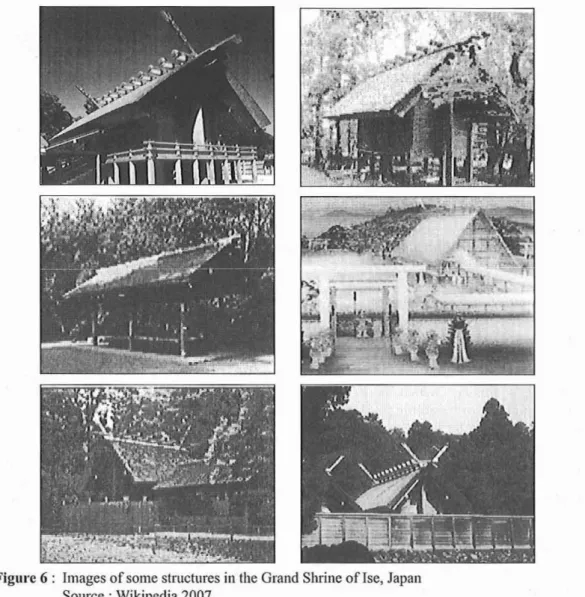
Figure 6 : Images of somestructuresin the Grand Shrine of Ise, Japan Source : Wikipedia 2007.
Trad itiona lly, every twenty years the sh rine is ren ewed by demolishing and rebuilding it with exactly the same speci fications and cons tru ction detail s (Witcombe 2007, Waterson 1997). The trad ition that wa s started in seventh centur y AD during the reign of Emp eror Ternmu, the first emperor to rule over a united Japan, ha s been faithfully practised and until now the temple has been renewed sixty times. The current buildings, restored in 1993, are the 61" repe tition to date which will be rebuilt in 2013 (Wikiped ia).
About the sh rines which are all constructed of natural wo od, WitcOlnbe (2007:2) draws our attention to the existence of a special post known asshin
Austronesian vernaculararchitecture and theleeShrine of[apan
the roof is not supported by the walls even though the rafters do rest on p ur lins, The ridge beam is carried by two free -standing columns at either end, reminding us of the Toraja indigenous house in Sulawesi and men's ceremonial ho use from Karnari, Papua New Guinea. Fur thermore, just
like in many Austronesia n houses,
the poles are buried direc tly into the ground withou t any foundat ion. Another interesting feature is the distinct ive roof bea ms which project like horn s over the ridge of the roof resembling one of the most recurring motifs of decorative gable-end finials on many houses in Southeast Asia. As observed by Lewcock and Brans ea rlier, the detail treatment of the ridge itse lf represents a boat just like in many eastern Indonesian houses, even though in japan its origi n has been forgo tten.
From the above images and deliberations, it is obv ious th at overall the architectural style of Ise Shrine build ings looks strongly reminiscent of the Austronesian vernacular architecture. This is most p robably due to the historical and cu ltural links in the early days be tween the people of Ta iwa n the or iginal home of the Austronesian and southern japan, before Northern Chinese influence profoundly permeates v ariou s aspects of the japanese culture.
Referen ces
Alfian (ed.) (1985)."PersepsiMasyarakal Telltallg
KeblldaY{/(/ll",Gramedia, Jakarta.
Bellwood, P.(1978)."Mail'SConqneetojthe Pacific:
ThePreMhis toryof Southeast Asia and Oceania"
Collins , Auc kland .
---(1985). "Prehistory of the Indo-Malaysian Archipelago"1 Academic Press,
North Ryde, New South Wales:
---(2000). "Pra-Sejarah Kepulauan Indo-Malaysia, Gramedia, Jakarta.
Chen Voon Fee (ed.), (1998)."TheEncqclopedi«
of Malaysia, Vol.5:Arcliitectl/re",Archipelago
Press, Singapore.
Dumarcey, Jacques(1990):'Tlie House illSOl/Iii
East Asia",Oxford University Press, Singapore . Firth, Raymond (ed.) (1960)."Mall and Culture",
Routledge&Kegan Pau l, London.
Fox, James J.(ed.) (1993). "Inside Austrcnesian
Houses: Perspectives 011 Domestic Designs for
Liuing",Canberra.
Gibbs, P. (1987). "Bllildillg a Malay House",
Oxford University Press, Singapore .
Ishizawa, Takeshi, (2007) "Kontroocrsi
tentong asal-uslll bnhasa jepallg: bnhasa jepnllg
ada JlIlbw lgall dengcn bahasa Allstrollesia?,
Universitas 17 Agustus (UNTAG), Surabaya. available at http://wwIV.02.246.ne.jp/ -semar
Izikowitz,KG.&Sorensen, P (ed.) (1982)."The
Houseill Enstand SoutheastAsia: Allthropological
and Architectural Aspects", Scandinavian
Ins titute of Asian Studies, Cu rzon Press, London.
Koentjaraningrat (1985) . 11Mmlllsin dan
Keblldnynnll dit ndonesin",Djambatan, Jakarta.
---(1996)."Pengcntar Alllropologi
1", RinekaCipta,Jakarta.
Lim Jee Yuan (1987). "The Malay
House. RediscoveringMalaysia 'sIndigenousShelter
System",Ins titut Masyarakat, Penang.
Lewcock R& Brans G. (1975). "The Boat as all
Architecturnl Symbol"in Oliver,P.(ed.)"Shelter,
Sign & Symbol", Berrie & Jenkins, London, pp107-116.
Oliver, P.(ed.)(1975)."Sheller, Sign mId Symbol",
Berrie& Je nkins, London.
Miyagawa, Shigeru, (2007). "The [apanese
]ol/Tllal of Design and theBuiltEtwironment
Walerson, R., (1997). "Tile Livillg HOllse: All
AII/hropology of ArchilecillreillSouih-Eas! Asia",
Oxford University Press, Singapore.
Wikipedia, the free encyclopedia (2007).
" A lIstrOtles;all ulIIguage", available at http:// e n .wl kip e di a .o rg! wiki! Austr on e sian langua ges.
Wikipedia, the free encycloped ia (2007)."Allaic
lallgllages", available at http:/ /en.wikipedia.
org / wiki/ Allaie_langu ages
Wikipedi a, the free encyclopedia (2007). "lee
Shrine", available at http://en .wikipedia.org/ wiki ! Grand_Shrine_oCIse
Witcomb e, C.L. (2007). "Shrine al tee. Japall",