Jemds.com
Case Series
Journal of Evolution of Medical and Dental Sciences/ eISSN- 2278-4802, pISSN- 2278-4748/ Vol. 4/ Issue 95/ Nov. 26, 2015 Page 16126
CORRECTION OF ALAR RETRACTION USING VARIOUS TECHNIQUES: A CASE SERIES
Dinesh Valse1, Faiz Muqtadir2, Jung Dong-Hak3
1Assistant Professor, Department of ENT, Dr. B. R. Ambedkar Medical College. 2Senior Resident, Department of ENT, ESIC Medical College, Gulbarga. 3Director, Shimmian Rhinoplasty Clinic, SEOUC, South Korea.
ABSTRACT
Alar retraction is one of the common problems seen in both primary and secondary rhinoplasty. Multiple techniques of varying
complexity have been described to treat this common and challenging problem.(1,4) The presently used techniques are associated
with scar and potential formation of crust. Thus, we attempted to overcome these shortcomings by using new grafting techniques to correct alar retraction. In this article, we describe the simplest way of correcting alar retraction by using an alar projection graft.
KEYWORDS
Alar Retraction, Extended CAP Graft, Alar Projection Graft.
HOW TO CITE THIS ARTICLE: Dinesh Valse, Faiz Muqtadir, Jung Dong-Hak. Correction of Alar Retraction Using Various
Techniques: A Case Series. Journal of Evolution of Medical and Dental Sciences ; Vol. , Issue 95, November 26;
Page: 16126-16129, DOI: 10.14260/jemds/2015/2362.
INTRODUCTION
Alar retraction is one of the common problems seen in both primary and secondary rhinoplasty. Typically, this deformity is caused by congenital malpositioning, hypoplasia or surgical weakening of the lateral crura with potential for both
functional and aesthetic ramifications.(1) Successful
correction requires precise diagnosis and meticulous planning. Multiple techniques of varying complexity have been described to treat this common and challenging
problem.(2,6) Commonly used methods to correct alar
retraction can be divided into three broad categories: Composite graft, ala rotation flap (soft tissue advancements) and rim graft. These presently used techniques are associated with scar and potential formation of crust. So we tried to overcome these shortcomings by using new grafting techniques to correct alar retraction. In this article author described simplest way to correct ala retraction by extended cap and ala projection graft. Our technique is useful in treating mild-to-moderate alar retraction, and is also useful for preventing potential postoperative alar retraction in contracted nose.
PATIENTS AND METHODS
A retrospective analysis was performed on 35 (7 men and 28 females; 4 Caucasians 31 Asians) patients who underwent extended cap graft and alar projection graft during rhinoplasty. The age of patients ranged from 22 to 55 years. Of the 35 patients, 23 cases had alar retraction due to previous rhinoplasty, 4 patients had alar asymmetry, and one was congenital cleft nose and remaining 7 are primary with short nose. Among them 28 cases we used ala projection graft (in one case we used both rim graft and ala projection graft) and 7 cases extended cap graft. Ala projection graft was used in 28 patients during rhinoplasty.
Financial or Other, Competing Interest: None. Submission 17-10-2015, Peer Review 19-10-2015, Acceptance 31-10-2015, Published 26-11-2015. Corresponding Author:
Dr. Dinesh Valse, Deartment of ENT, ESIC Medical College, Stdam Road, Gulbarga. E-mail: [email protected] DOI:10.14260/jemds/2015/2362.
Seven were primary and 21 were secondary cases. Bilateral graft put in 12 patients and unilateral in 16 pts (Rt-7, Lt 9). Most preferred graft is 7th right rib, which was used
in 15 patients and septum in 7 patients, ear and recycled cartilage in 3 each. Extended cap graft was used in 7 patients; 3 were bilateral and 4 unilateral. Two pts. had alar retraction due to previous rhinoplasty and 4 had alar asymmetry and another one had short nostril. One case was congenital.
The material used for graft is autologous cartilage harvested from right 7th costal cartilage, septal cartilage or
ear. Normally, the ala is approximately 1 to 2mm cephalic to the axis of the nostril (a line running from the anterior to the posterior end of the nostril). The extent of alar retraction is noted as the distance between the maximum acceptable location of the ala (2mm above the axis of the nostril and its actual location). Normally nostrils are pear shaped and equal size on both sides. The extent of the alar retraction varied from 3 to 5mm in nonshort nose group of patients.
OPERATIVE TECHNIQUE Extended Cap Graft
The open approach is used in all patients; skin flap elevated supraperichondrial over the cartilage and subperiosteally over the bone. In our almost all cases Alar retraction was addressed at end of the surgery. We used extended spreader graft and strut graft in all cases. Author believes that all rhinoplasty should have strong supporting framework for long-term support.
Author preferred rib cartilage as first choice of graft, reason being it is hard and holds skin in place and does not collapse. Other preferred graft is septal cartilage if rib is not harvested. Ear cartilage can also be used but author does not prefer for its soft nature. The size of the extended cap graft is based on intraoperative analysis of alar retraction and available vestibular skin for undermining the graft.
In bilateral cases we used 5-7mm extra length of graft on each side and in unilateral cases we have can use 9-12mm. and breadth varies between 7-10mm. Graft is carved in wedge shaped manner thickest being at the centre and sloping towards lateral side. We have put few hatching incisions on superior side to take shape of nostrils.
Jemds.com
Case Series
Journal of Evolution of Medical and Dental Sciences/ eISSN- 2278-4802, pISSN- 2278-4748/ Vol. 4/ Issue 95/ Nov. 26, 2015 Page 16127
of lower lateral cartilage and secured in place by 5-0 PDS suture. Then vestibular skin on lateral side undermined create pocket to hold lateral margins of graft. Once this has been done retraction to be assessed and compared with other side. Depending upon, length of graft can be adjusted. When both sides are equal and visibly no retraction, then skin can be closed by vicryl keeping in mind not to suture too tightly.
We used bilateral extended cap graft in one patient to widen size of nostril. Other patients used unilateral to correct nostril asymmetry and alar retraction.
Ala Projection Graft
Ala projection graft is modification of ala batten graft, which is used in correction of collapsed nasal valve.(7) Here author
used same technique with little modification to correct alar retraction. Author preferred using rib or septal cartilage as graft material. After harvesting grafts are carved as elongated strips. The size of graft is based on intraoperative analysis of alar retraction to be corrected and potential alar retraction in cases of short nose. Length ranges 10 to 25mm and breadth is around 3-10mm depending upon retraction. We should keep in mind that graft should not be too long, otherwise there will be problem during closing. Once graft shaped accordingly and placed over the lower lateral cartilage in paramedian position in cephalocaudal direction. The graft kept in such a way that distal edge protrudes outside the margin of cut mucosa. The protrusion of graft depends upon the alar retraction to be corrected. We usually kept 3-5mm distal to mucosal end. Graft is held in position by putting suture with 5-0 PDS. Then vestibular skin is undermined distal to the positioned graft and created pocket to accommodate this extra length of graft. Once this has been done distal end of cartilage is kept inside pocket. Skin flap is repositioned and checked for retraction. Same procedure is done on other side. After completing both sides alar retraction assessed and compared with other side, length of graft can be adjusted depending upon this. When both sides are equal and retraction visibly corrected, then skin flap closed carefully by using 5-0 vicryl.
RESULTS
Using open approach, 35 patients underwent adjunctive grafting to correct alar retraction during rhinoplasty. Among them extended cap graft used in 7 cases and ala projection graft used in 28 patients and in one patient we used both alar rim graft and ala projection graft. Followup done from 6 months to 1 year. In extended cap graft group, one patient was not happy with nostril symmetry so she had revision surgery. This is corrected by adjusting length of the graft through endonasal approach. Remaining patients did not have any problem and they are satisfied with their result.
In extended ala projection graft group two patient are unhappy with their result. One patient complained of one side longer than other side. This is done by adjusting length of cartilage by endonasal approach. Other patient was not happy with nostril shape, so he underwent revision surgery and we put little longer graft readjusted.
No infections were noted. No other complications observed. However, six patients complained of palpable graft through skin which resolved after 4-6 months. This was observed in secondary rhinoplasty cases especially in thin skin individuals.
DISCUSSION
There are various techniques described by many authors.(6,9)
to correct alar retraction. In this article, based on authors experience we tried to use new grafting techniques which are simple and accurate to correct alar retraction. These new techniques very useful to correct mild- to-moderate alar retraction and also can be used successfully in cases of potential alar retraction in short noses.
Extended cap graft and ala projection graft are the two simplest techniques author used successfully to correct alar retraction in these patients with good results and patients’ satisfaction. These grafts are best in narrow and short nose with mild-to-moderate alar notching. Other techniques such as alar rotation flap and alar spreader graft indicated in moderate to severe alar retraction.(10,12) composite grafting
indicated in for more complex deformities with skin or lining loss.(13)
The most important key element for good result in these techniques is mild to moderate alar retraction with normal vestibular lining and in secondary rhinoplasty with minimal to no vestibular lining loss. While using bilateral extended graft, we should be more cautious about length and symmetry to other side.
INDICATIONS
The primary indications for these grafts are as follows
Primary rhinoplasty patient with congenital alar
retraction.
The secondary rhinoplasty patient, mild-to-moderate
alar retraction with minimal or no vestibular lining loss.
Primary or secondary rhinoplasty patients. No evidence
of preoperative alar retraction, but with propensity for
postoperative retraction as is often revealed
intraoperatively by alar retraction.
These grafts procedure are not indicated in patients with following problems
In patients with severe alar retraction.
Significant vestibular lining loss due to previous
rhinoplasty.
In patients with vestibular scar.
No residual lower lateral cartilage remnant with alar collapse.
In primary rhinoplasty with bulbous nose tip.
Technically, these grafts correct retraction by
protruding skin forward and giving strong support for this protruded skin to hold in place. In long term, there is less chance to go for retraction. The only problem being hard palpable graft felt through the skin especially in thin skin individuals. In these cases, we kept perichondrium or alloderm over the graft to overcome this problem.
Jemds.com
Case Series
Journal of Evolution of Medical and Dental Sciences/ eISSN- 2278-4802, pISSN- 2278-4748/ Vol. 4/ Issue 95/ Nov. 26, 2015 Page 16128 CONCLUSION
To conclude, extended cap graft and alar projection grafts are effective and simple adjunctive technique to correct mild-to-moderate alar retraction and in potential cases of alar retraction in short nose. These grafts provide necessary structural support for ala rim to hold it in place, hence restoring normal anatomic contour and symmetry. Also it can be used as prophylactically in cases of having potential tendency to form alar retraction. However, in excessive nostril show and large nostril asymmetry these grafts give variable results.
REFERENCES
1. Rohrich, Rod J.; Raniere, Joseph Jr. Ha, Richard Y. The Alar Contour Graft: Correction and Prevention of Alar Rim Deformities in Rhinoplasty Plastic & Reconstructive Surgery.
109(7):2495-2505, June 2002.
2. Gruber, Ronald P.; Kryger, Gil, Chang, David The
Intercartilaginous Graft for Actual and Potential Alar
Retraction Plastic & Reconstructive Surgery.
121(5):288e-296e, May 2008.
3. Gunter, Jack P.; Friedman, Ronald M. Lateral Crural Strut
Graft: Technique and Clinical Applications in
Rhinoplasty Plastic & Reconstructive Surgery.
99(4):943-952, April 1997.
4. Adham, Mehdi N. A New Technique for Nasal Tip
Cartilage Graft in Primary Rhinoplasty Plastic & Reconstructive Surgery. 97(3):649-655, March 1996. 5. Gunter, Jack P.; Landecker, Alan; Cochran, C Spencer
Frequently Used Grafts in Rhinoplasty: Nomenclature and Analysis Plastic & Reconstructive Surgery. 118(1):14e-29e, July 2006.
6. Gunter, J. P.; Rohrich, R. J.; and Friedman, R. M.
Classification and correction of alar-columellar
discrepancies in rhinoplasty. Plast. Reconstr. Surg. 97: 643,1996.
7. Toriumi DM, Josen J, Weinberger M, Tardy ME Jr. Use of
alar batten grafts for correction of nasal valve collapse.
8. Arch Otolaryngol Head Neck Surg. 1997
Aug;123(8):802-8.
9. Adams, W. P. Jr. Rohrich, R. J., Hollier, L. H. Minoli, J. Thornton, L. K., and Gyimesi, I. Anatomic basis and clinical implications for nasal tip support in openversus closed rhinoplasty. Plast. Reconstr.
Surg. 103:255,1999.
10. Sheen, J. H. Aesthetic Rhinoplasty. St. Louis: C. V.
Mosby,1978;Pp. 264–265.
11. Gunter, J. P. and Rohrich, R. J. Correction of the pinched nasal tip with alar spreader grafts. Plast. Reconstr.Surg. 90: 821,1992.
12. Gunter, J. P, and Rohrich, R. J. External approach for secondary rhinoplasty. Plast. Reconstr.
Surg. 80:161,1987.
13. Juri, J. Juri, C. Grilli, D. A., et al. Correction of the secondary nasal tip and of alar and/or columellar collapse. Plast. Reconstr. Surg. 82: 160, 1988. Kamer, F. M. and McQuown, S. A. Minicomposite graft for nasal alar revision. Arch. Otolaryngol.
Head Neck Surg. 113: 943,1987.
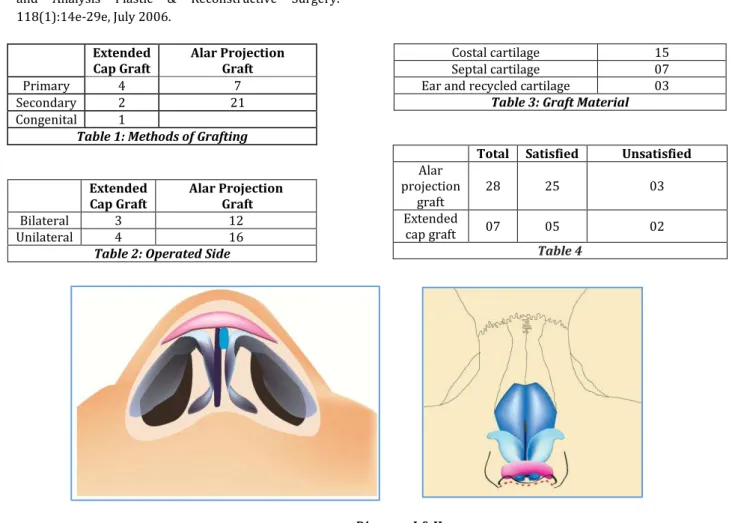
Extended Cap Graft
Alar Projection Graft
Primary 4 7
Secondary 2 21
Congenital 1
Table 1: Methods of Grafting
Extended Cap Graft
Alar Projection Graft
Bilateral 3 12
Unilateral 4 16
Table 2: Operated Side
Costal cartilage 15
Septal cartilage 07
Ear and recycled cartilage 03
Table 3: Graft Material
Total Satisfied Unsatisfied
Alar projection
graft
28 25 03
Extended
cap graft 07 05 02
Table 4
Jemds.com
Case Series
Journal of Evolution of Medical and Dental Sciences/ eISSN- 2278-4802, pISSN- 2278-4748/ Vol. 4/ Issue 95/ Nov. 26, 2015 Page 16129
Diagram III & IV
Diagram V: Preop and Postop of Extended Cap Graft
Diagram VI: Preop and Postop of Extended Ala Batten Graft