Abstract
International patents are increasingly demanded in academic circles as a sign of excellence and compete with situated genres such as projects, grants, PhD supervisions, books and journal articles, especially in hard science environments. The scarce modelling and dissemination of the genre so far, however, together with some wrong assumptions about the technical register, have helped propagate a series of “genre fallacies” that contribute to perpetuating undesirable writing practices and make the case for explicit instruction. In this paper I advocate a pedagogy of patent writing based on the deconstruction of such myths, which are basically concerned with a notion of the genre as rigid and static, highly impersonal, and exclusively descriptive. My study, based on a qualitative and corpus methodology, revolves around the crucial role of metadiscourse as evidence of flexibility in patent texts.
Keywords: engineering community, international patents, genre flexibility, metadiscourse.
Resumen
Rasgos de flexibilidad en la escritura de patentes
La demanda de patentes internacionales como signo de excelencia académica aumenta cada vez más en los círculos universitarios y es frecuente encontrar dicho género profesional entre las credenciales de los profesores, sobre todo en los entornos científico-tecnológicos, junto con proyectos, becas, direcciones de tesis doctorales, libros y artículos de investigación publicados. Sin embargo, tanto su escasa diseminación en el pasado como su ausencia generalizada en los programas de lenguas para fines específicos, han contribuido a propagar una serie de creencias erróneas y prácticas de escritura no deseables entre sus usuarios, basadas en una noción de la patente como texto estático y rígido, impersonal y exclusivamente descriptivo. Mi estudio, basado en una metodología cualitativa y de corpus, reivindica una pedagogía de la escritura de patentes y
Carmen Sancho-Guinda
subraya el papel crucial del metadiscurso como evidencia de flexibilidad del género.
Palabras clave: entornos de ingeniería, patentes internacionales, flexibilidad de género, metadiscurso.
1. Introduction: Deficiencies in polytechnic settings
Engineers at the Polytechnic University of Madrid, where I teach Academic English and Professional Communication, frequently share their concerns of the multi-layered complexity (that is, encompassing issues of vocabulary, grammar, structure, register and reader-considerateness) inherent in international patent writing. Despite the still nascent dissemination of patents in academic circles, they have gained prominent status in any (bio)technological career as the fruitful outcome of the collaboration between university and society, and compete with more situated genres such as journal articles, books or research projects. What seems to make the patent text difficult is not so much writing in English and using specific phraseologies (finally acquired by imitation) as the absence of a systematic rhetorical and metadiscursive modelling at technical faculties, either within ESP syllabi or in-service teacher seminars.
Technology teachers, in effect, concentrated as they are on modulating explicitness to claim a satisfactory property scope and on expressing the right nuances in a legal register, do not feel confident as patent users nor do they perceive the slim flexibility potential of the genre. My informants, three aeronautical engineers who had patented their inventions internationally and volunteered to be interviewed about their experiences during the process, unanimously described the genre as “rigid” in both language and format, “not allowing any personalisations and stylizations”. They considered patents strictly descriptive and overlooked their persuasive nature, although technical descriptions and empirical data may constitute cogent arguments by themselves. Sales (2006: 142) refers to this kind of factual exhortation, typical of engineering communities of practice, as “restrained persuasion”.
Nonetheless, as I have contended elsewhere (Sancho-Guinda, 2010), the patent text does provide leeway for subjectivity, idiolects and variation.
without being fully aware of the possible communicative repercussions of such action. In the hope of mitigating these problems, my objective here is to lay the basis for a “visible pedagogy”1 of patent writing, offering
guidelines useful to ESP teachers, students and professionals. In so doing I will try to deconstruct three myths on patent writing widespread in my polytechnic environment and describe the main features of the genre as I go along.
2. Methodology of the study
This article combines qualitative and quantitative methods. My qualitative study follows bhatia’s (1993) and hyland’s (2004) recommendations to implement “emic” surveys on the attitudes and practices of specialists. The three informants mentioned above underwent a structured interview (see Appendix 1) probing into their patent-writing strategies and the major difficulties faced, as well as into their notions of the genre and the feedback received from patent examiners. My quantitative research involves the corpus-supported analysis of 333 patents passed by the United States Patents and Trademark office (henceforth USPTo) between 1998 and 2009, electronically searched by means of the concordance program AntConc
3.2.1w(Anthony, 2007). The samples, some of which are listed in Appendix
2, cover electromechanical devices, substances and processes – the most common inventions in engineering environments – and total 3,041,464 tokens (words, figures and symbols) and almost 30,000 word types. Searches consisted of recurrent clusters initially noticed through manual scrutiny (“those/the skilled in the art”) and of various metadiscoursal categories potentially productive and compiled from hyland’s (2005a) appendix to
Metadiscourse. The most remarkable results obtained within each
methodological approach will be discussed to substantiate the myth deconstructions attempted below.
3. Deconstructing myths about patent writing
accurate. It is in our hands, as ESP instructors, to change this situation by teaching genres as goal-oriented and inter-related social interactions rather than as a series of rhetorical and linguistic prescriptions.
Myth 1: Writing patents requires building entirely new schemata
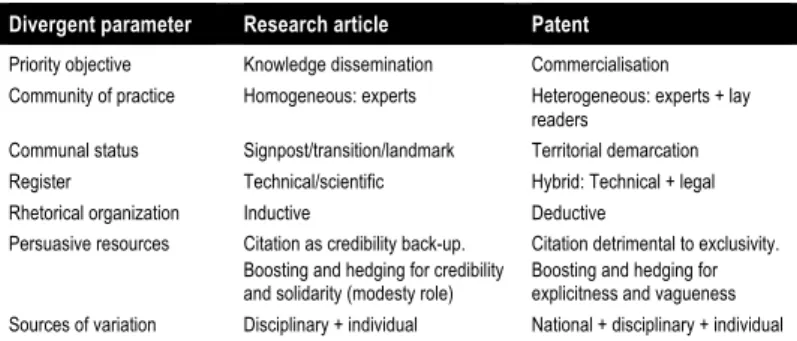
Technology professionals would probably feel less intimidated by patent writing if they realised the circular relationship between the patent and the research article (hereafter rA), a text type they handle much more often. Myers (1995) highlighted the connection between the two documents as chained genres: patents may lead to more discoveries and rAs to subsequent inventions. bearing in mind this circularity would enable practitioners to recycle their background knowledge and selectively incorporate or discard the pool of resources they employ when writing for specialised journals. Contrastive modelling proves crucial in this kind of training, which would be favoured by a task-based guided discovery aided by corpus analysis to detect lexico-grammatical and metadiscoursal patterns. In the light of Genre Theory, the major parameters of divergence between patents and rAs would be the following: “purpose”, “discourse community”, “register”, “communal status”, “rhetorical organisation”, “persuasive resources” and “variation”. Let us go through them in turn.
restricted to antecedents that are immediately left aside to give way to detailed accounts (verbal and visual) of the invention to be patented (Arinas Pellón & Sancho-Guinda, 2010). In the rA, conversely, intertexts connecting the current discovery to previous ones back up the credibility of the investigation all throughout.
Another device exploited to safeguard exclusivity is the interplay of boosting and hedging. rAs alternate assertiveness and modesty to show plausibility and win over the reader through a self-effaced and supportive writer role, and for this purpose a network of mitigated statements and metadiscoursal guidance is deployed. In patents, solidarity (through contextualisation and glossing, for instance) is a means to pre-empt litigation because of misinterpretation, and boosters and hedges do not signal the author’s assertiveness and modesty but explicitness or vagueness in the description of the patentable product. In this sense, fuzziness may prove an asset at court because, once technical feasibility has been stated, inventors tend to reveal very few details so as not to endanger exclusivity. This fuzziness is especially noticed in denominations, by which everyday appliances such as vacuum cleaners may be found as “mulchers”, “cyclonic separators” or “dust collection units”, for example.
Apart from the use of a legal register in patents, the most conspicuous difference between them and rAs is perhaps content organisation. According to Arinas Pellón (2010), the rhetorical moves in patents can be summarized into the sequence ProPErTy SCoPE→FIELD AND APPLICATIoN
→ GAPS IN ThE PrIor ArT → DETAILED PhySICAL AND FUNCTIoNAL
DESCrIPTIoN→CAUTIoNAry STATEMENTS(optional). Each move subsumes
several sections marked under different headings: for instance, the property scope, which defines and delimits the invention, comprises the abstract and the legal claims. The field-and-application move expands and stresses the information given so far by including a “brief summary of the invention”. The gaps posed by analogous patents in the past are addressed in a “background/prior/related art” subdivision, and detailed descriptions may attach tables and diagrams. The document may close with cautionary statements specifying alternatives for fabrication.
application to the ways in which it can be designed, fabricated, or arranged). Also, in a rough rhetorical comparison, the property scope, field-and-application and prior-art gaps make up a sort of prolonged rA introduction articulating the invention niche together with the criteria for its validity: utility, feasibility, and novelty. These three ruling principles do not differ much from the ones observed by hyland (2000) for rAs: relevance, credibility and novelty. Patents are relevant if useful, are credible if technically practicable, and by definition must be unprecedented designs – totally or partially. In other words, they cannot be deduced from previous patents or from the combination of their constituents, as specified in the national laws and established rules (such as the U.S. Code in Title 35 section 103a, and the U.S. Code of Federal regulations, Title 37 sections 1.71 b and c and 1.75). The detailed description and cautionary statements, by contrast, could be taken as a broad results-and-discussion move.
The sequencing of rhetorical moves in rAs and patents, as it happens with the type and rate of promotional elements and the expression of subjectivity, may vary across disciplines and even with individual preferences, always subject to the primary goal of each genre and their intended addressees (see Table 1). but the sources of variation in patents are also national, given that they must abide by the codes and regulations of each country. The samples in my corpus follow the “Consolidated Patent rules” Title 37 of the U.S. Code of Federal regulations and Title 35 of the U.S. Code.
To conclude with this first myth, one more aid to genre acquisition could be the visual reminder I am proposing in Table 1 for an instruction based on socioliteracy (Johns, 1997), guided discovery, critical thought and schema activation. Some (or all) of the cells may be left blank for trainees to
Divergent parameter Research article Patent
Priority objective Knowledge dissemination Commercialisation Community of practice Homogeneous: experts Heterogeneous: experts + lay
readers
Communal status Signpost/transition/landmark Territorial demarcation
Register Technical/scientific Hybrid: Technical + legal
Rhetorical organization Inductive Deductive
Citation as credibility back-up. Citation detrimental to exclusivity. Persuasive resources
Boosting and hedging for credibility and solidarity (modesty role)
Boosting and hedging for explicitness and vagueness
Sources of variation Disciplinary + individual National + disciplinary + individual
complete individually or through peer interaction – out of intuition, experience or after examining appropriate textual models. The table contemplates the genre parameters commented above.
Myth 2: Patent writers convince only through “restrained persuasion”
The belief that the technical and academic registers must be “aseptic” or “faceless” is rife in my polytechnic setting. Teacher and student writers, in consequence, avoid any trace of opinion, emphasis, emotion, and persuasion strategies other than “restrained” (that is, empirical). We will see that these subjective meanings, through which patent writers nevertheless may position themselves and engage with their readers, are compatible with restrained persuasion and materialise in three basic metadiscursive options: “community pointers”, “informative guides” and “stance markers”.
The first category, “community pointers”, joins items from hyland’s (2005b) stance and engagement strategies (self-mention and reader pronouns, respectively) and serves to assign roles to the writer and certain membership sectors within the collective. “Informative guides” include interactive connectives and engagement devices such as asides, directives, and markers of shared knowledge, all of them a pivotal tool for persuasion because they process technical information for lay readers by summarising, explaining and clarifying. The last option, “stance markers”,transmits the writer’s insights and affective reaction to his/her message, at the same time building intimacy with the audience and anticipating its behaviour. This option basically respects hyland’s original taxonomy and embraces boosters, hedges and attitudinal adverbials (as already mentioned, I have inserted the fourth element – self-mention pronouns – into the group of community pointers). Stance and engagement are to be understood as interlocking features: engagement is but interpersonal stance on community members and outsiders and is shaped by disciplinary practice. In the Findings and Discussion section I expand on the significance of these two writing features.
Myth 3: There is no room for vagueness in patent writing
others), Arinas Pellón (2012) underscores the compatibility between vagueness and precision in the patent text and delves into the motivation for their use. From his study we can deduce that vagueness is a regulatory communicative and linguistic device mediating between two communities of stakeholders in the patenting process: the validity and the infringement people, all of whom may be technical experts. The validity group is made up of patent examiners (who assess format and descriptive and legal requisites), some courts, and the U.S. re-examination Forum (who assesses financial feasibility). The infringement group is formed by all those affected commercially by the patent: licensees and competitors.
by covering a maximum scope of intellectual property through “communicative un-determinacy” and “semantic indeterminacy” (both Pinkal’s (1995) terms), vagueness augments the inventors’ financial potential and reduces business opportunities for competitors and licensees. Thanks to vagueness, competitors are prevented from launching patents based on uncovered claims and licensees from carrying out activities without licensing costs. Communicative un-determinacy is the deliberate provision of less information than expected in a given situation and semantic indeterminacy is the doubt about the verisimilitude of a given proposition.
Patents withhold technical details as to further embodiments and improvements that would allow for more patents of the same inventive idea and provide denotative flexibility oriented to the patentee’s self-protection. by way of illustration, the numerical or quantifying inaccuracy achieved by means of approximators in support of the inventor’s arguments (“between”, “about”, “within”, “least”, “ranging”, “several”, “certain”, “a plurality/ratio/set of ”, etc.) does not really flout Grice’s (1975) maxims of quantity and quality because the maxim of relation is primed throughout the whole patent text: whatever is disclosed is pertinent to the fabrication and proper functioning of the invention (hence it must be true), and the information provided suffices for those “skilled in the art” to make sense of the message.
Modal verbs (“can”, “may”), manner and quantifying adverbs (“selectively”, “substantially”), archaic anaphorics from the legal domain (“said”, “whereby”, “herein”, “wherein”, “thereby”, “thereof ”, etc.) are but just some of these tokens in a larger repertoire.
In earlier joint research (Arinas Pellón & Sancho-Guinda, 2010) I have largely remarked the cataphoric value of vague quantifiers – expressions of sufficiency, profusion, totality or partiality – and their importance as expectation-raisers or predictors of meaning for patent readers and writers. “Most” (536 occurrences in my corpus) suggests both amount and a restrictive focus lacking in “many” (“most” can be subsumed in “many” but “many” does not imply a majority), and arouses an expectation of novelty of the present patent by going back to the conventionality of the background art, alone or collocated with “typically”, “recent(ly)”, “common(ly)”, and “favourable/favoured”. “Many” (369 cases) equally finds a niche for patentability by referring back to the prior art, often associated to negatively-loaded nouns (“drawbacks”, “faults”) and besides advances novelty and versatility (“many suitable/alternative ways”). “Several” (429 hits) and “certain” (417) demarcate countable items through specificity, frequently in collocation with verbs introducing lists of elements or features (“claim”, “contain”, “include”, “comprise”, “be characterized by”, etc.) and categorizing nouns (“embodiment”, “factor”, “configuration”, etc.).
Two other contexts for “certain” are prepositional (“in a certain…”) and delimit some scale or range (“in a certain + angle, density, speed, distance, pressure, rate”, etc.) or formulate generalizations about the invention (“in certain + applications, areas, cases, conditions”, etc.). These two deictic formulas subtly leave an open end for patent continuation by changing or adding elements.
having reviewed the main conveyors of vagueness, the little step beyond I want to take here is to abandon trends for a while and draw attention to individual repertoires in licensed patents, which may be used pedagogically to show insecure writers valid linguistic tools at their disposal. Genres evolve, as hyland (2000) reminds us, not only because of sociocultural changes and large-scale developments in the discipline, but also through users’ manipulation of conventions within boundaries. one of those admissible manipulations is the use of “in principle” as a hedge, which I analyse in the next section.
4. Findings and discussion: A tripartite choice of
subjective meanings
As for the first of these meanings, “community pointers”, corpus analysis reveals that writers position themselves with auto-inclusive pronouns, virtually confined to the possessives “my” and “our” as there are no occurrences of first-person object pronouns. Those possessives collocate with the words “invention”, “application”, “implementation” and “example” or with more finely-tuned bases such as “machine”, “chip”, “key”, “filter”, etc. In the claims, the instances of the subjects “I” and “we” are very few (22 cases of “I claim” and 23 of “We claim”), when the number of impersonal claims is more than ten times higher (246 hits of “What is claimed is…”). The abundance of this pseudo-cleft structure might be justified by a need to emphasize the exclusivity vindicated, a function that plain cataphora (anticipatory “it-constructions”, absent in this corpus) could not fulfill. occasionally, the pronoun “we” may bring in the reader in conjunction with other engagement items (the question and the directives in example 1, my emphasis). The effect is a pedagogical overtone similar to that of textbooks, which fosters reader involvement and with it increases the probability to persuade.
(1)How do we do this? Considera state the generator may be in. Sayit has
the address of the last word we loaded. (Walmsley, USPTo Patent No. 7,557,941)
Another persuasive tactic is the assignment of authority roles to concrete sectors of the community (engineers and experts in general), roles which urge lay readers (by the way never mentioned explicitly) to follow the directives specified in the text. The four cases of the noun phrase “engineers” I found contribute to establishing the niche for the invention by introducing some prior-art gap to be bridged (example 2, again my emphasis).
(2)Engineers have addressed driveshaft and related overspeed
problems in a variety of ways. (...) The present disclosure is directed to one or more of the problems or shortcomings set forth above. (Landes, USPTo Patent No. 7,556,585)
• MoDAL vErb+ vErb oF PErCEPTIoN/INTELLECTUAL ACTIvITy+
ThAT-CLAUSE(ACTIvE or PASSIvE)
- verbs of perception: “recognize”, “appreciate”, “realize”, “see”, etc.
- verbs of intellectual activity: “know”, “understand”, “comprehend”, “interpret”, etc.
• MoDAL vErb+ To bE+ ADJECTIvE oF CErTAINTy
- Adjectives of certainty: “clear”, “apparent”, “obvious”, “evident”, etc.
These are illustrated in examples 3 and 4 (emphasis added):
(3) however, it will be understood by those skilled in the art that the present invention may be practiced without these specific details. (Zhang et al., USPTo Patent No. 7,557,055)
(4) It will be apparent to those skilled in the art,that is, to those who have knowledge or experience in this area of technology, that many uses and design variations are possible for the improved trailer brake system 10 disclosed herein. (Gill & Swanson, USPTo Patent No. 6,666,527)
With regard to informative guides, a most peculiar finding is that they at times incur tautological deduction. This way, inferential markers turn into code glosses that spell out associations customarily taken as self-evident – for instance, the correlations simplicity/economy and wear/short duration of examples 5 and 6 (emphasis added).
(5) Moreover, the production of the plate-shaped elements is simple
and therefore cost-effective. (Frobel et al., USPTo No. 6,763,741)
(6) There is hence relative little wear during operation of the system, contributing to its long lifetime. (Six, USPTo No. 6,762,524)
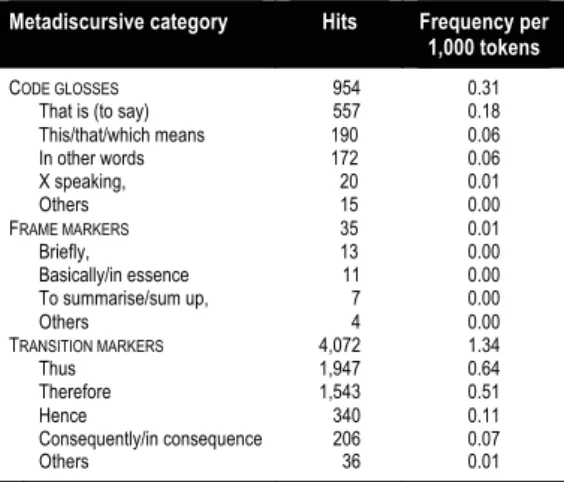
fabrication and use. on the contrary, encapsulating metadiscourse (“to sum up”, “basically”, etc.) appears as a double mark of concision within the abridged parts of the document. Precisely for this reason, and as shown in Table 2, the impact of encapsulating frame markers is predictably minor: their mission at a micro-textual level is accomplished at a macro-textual one by whole text portions devoted to epitomizing contents, such as the abstract, the “summary of the invention” and the “brief descriptions” (of the invention or the drawings).
The data displayed in Table 2 suggest that patent writers’ efforts at reader-considerateness are directed, above all, towards making clear their deductive steps, in the main expressing technical causes and effects by means of transition markers. These steps may be unknown to non-experts and need to be reiterated, paraphrased and defined through code glosses, the second devices most resorted to. All in all, patents exhibit a tension between discourse and metadiscourse that mirrors the different nature and needs of the lay and expert readerships behind the text. As potential sponsors, lay readers may be attracted into the author’s line of reasoning with textual strategies arguing for the validity of the invention but superfluous for an expert audience.
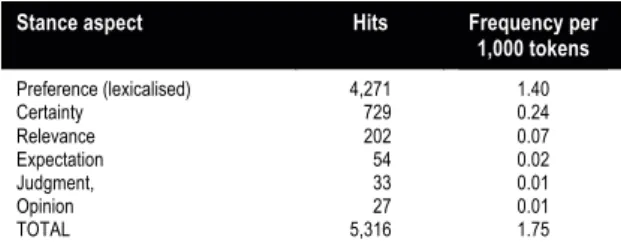
Lastly, a wide array of “stance markers” communicates preference, certainty, relevance, judgments, expectations and opinions. From the adverbials and their corresponding adjectives shown in Table 3, preference markers
Metadiscursive category Hits Frequency per
1,000 tokens
CODE GLOSSES 954 0.31
That is (to say) 557 0.18
This/that/which means 190 0.06
In other words 172 0.06
X speaking, 20 0.01
Others 15 0.00
FRAME MARKERS 35 0.01
Briefly, 13 0.00
Basically/in essence 11 0.00
To summarise/sum up, 7 0.00
Others 4 0.00
TRANSITION MARKERS 4,072 1.34
Thus 1,947 0.64
Therefore 1,543 0.51
Hence 340 0.11
Consequently/in consequence 206 0.07 Others 36 0.01
outnumber by far the rest of items owing to two reasons: one is that the words “preferably”, “preferred”, “desirable” and “desired” are mentioned by the U.S. regulations as collocates of the bases “embodiment” and “invention”, providing ready-made language chunks that, through extended use, have ended up lexicalized and constituting part of the genre phraseology. The other reason is their vague quantifying function (Arinas Pellón, 2012), preceding numerical approximators such as “about”, “at least”, “between”, “in a/the range of/from”, “within”, etc., to introduce some kind of measurement (“a preferred range of ”, “preferably between x% and y%”). The second most abundant group of stance markers is formed by those expressing certainty and relevance. They criticise the flaws of the background art and stress the benefits of the current invention while simultaneously appealing to shared knowledge to strengthen collective bonds. Items such as “obviously”, “clearly” or “evidently” are typical examples.
• PrEFErENCE ITEMS: “preferably”, “preferred desirably”, “desired”.
• CErTAINTy ITEMS: “of course”, “clearly”, “certainly”,
“obviously’”, “evidently”, “surely”, “really”, “absolutely”, “truly”, “actually”, “no doubt”, “definitely”, “indeed”, “always”, “all the time”.
• rELEvANCE ITEMS: “significantly”, “importantly”,
“remarkably/-ble”, “fundamentally”, “what is more”, “what is important is”, “what is especially to be noted is”, “it should be noted/pointed out”.
• ExPECTATIoN ITEMS: “surprisingly”, “logically”, “striking”,
“naturally”, “unexpectedly”, “understandable”.
• JUDGMENT ITEMS: “dramatically”, “(un)fortunately”, “wrongly”.
Stance aspect Hits Frequency per
1,000 tokens
Preference (lexicalised) 4,271 1.40
Certainty 729 0.24
Relevance 202 0.07
Expectation 54 0.02
Judgment, 33 0.01
Opinion 27 0.01
TOTAL 5,316 1.75
• oPINIoN ITEMS: “in our opinion”, “from this viewpoint”, “from
the standpoint of ”, “from the viewpoint of ”, “admittedly”.
The markers of expectation and judgment also optimize reader considerateness by performing evaluative and solidarity functions: besides conveying authorial views on what is informatively salient, they act as informative guides that facilitate the comprehension of contents (“significantly”, “it should be noted that…”) or underline communal “givens” (“understandably”, “logically”). This functional bivalence blending meanings of certainty and relevance with expectation and judgment justifies the higher frequencies of their markers over those of opinion, much less numerous. We should remember that through technical description and certain terms (“embodiment”) the whole document expresses the inventors’ and patent examiners’ beliefs about what is the best mode of the invention, and consequently opinions tend to appear unsignalled.
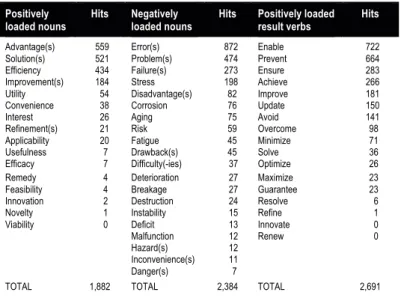
described that may be independent of the prior art (“ensure”, “achieve”, “optimize”, “guarantee”, “maximize”). The most pervasive verbs related with faults of former inventions total eight items and 1,198 hits, and those offering gains not necessarily linked to patented precedents amount to five items and 621 occurrences.
Thus far I have gone through some overt markers of stance-taking and considered the phenomenon of unmarkedness, but stance may also be marked subtly. An unobtrusive (yet profuse) stance item is “such” as a deictic and intensifier, particularly in finding a patent niche for the invention through appraisal: pointing up its innovation and advantages, expressing disapproval of the prior art, or surprise related to results and performance.
There are a number of reasons for encouraging native Spanish-speaking patent writers to notice “such” as a positioning resource:
- First, the use of its Spanish equivalents (tal, semejante, tamaño/a) entails a certain writing expertise and evokes a somewhat stilted tone that does not seem appropriate for a technical register. It is not likely, therefore, that “such” forms part of the Spanish engineers’ repertoire.
Positively
loaded nouns
Hits Negatively loaded nouns
Hits Positively loaded result verbs
Hits
Advantage(s) 559 Error(s) 872 Enable 722
Solution(s) 521 Problem(s) 474 Prevent 664
Efficiency 434 Failure(s) 273 Ensure 283
Improvement(s) Utility Convenience 184 54 38 Stress Disadvantage(s) Corrosion 198 82 76 Achieve Improve Update 266 181 150
Interest 26 Aging 75 Avoid 141
Refinement(s) 21 Risk 59 Overcome 98 Applicability Usefulness 20 7 Fatigue Drawback(s) 45 45 Minimize Solve 71 36 Efficacy 7 Difficulty(-ies) 37 Optimize 26 Remedy 4 Deterioration 27 Maximize 23 Feasibility Innovation 4 2 Breakage Destruction 27 24 Guarantee Resolve 23 6 Novelty Viability 1 0 Instability Deficit Malfunction Hazard(s) Inconvenience(s) Danger(s) 15 13 12 12 11 7 Refine Innovate Renew 1 0 0
TOTAL 1,882 TOTAL 2,384 TOTAL 2,691
- Second, it bi-functionally makes a deictic and an emphatic reference. According to Quirk et al. (1985), “such” can be paraphrased by “like this/that”, so it involves a comparative and attention-drawing component while invoking shared knowledge (“Such methods and devices are used…”).
- Third, its deictic reference is bi-directional, because it may be either anaphoric (“however, such a method requires…”) or cataphoric (“for just such a purpose as this”).
- Fourth, explicit instruction would be convenient to discriminate its syntactic collocations as a determiner (“the use of such methods”) and as an adjective (“one such mechanism”, “most such devices”) and thus become acquainted with its variants (“Many such valves”, “various such additives”, “several such mechanisms”, “similar such automatic brake valves”, “no such systems”, etc.).
- And finally, it may broaden a little the restrained persuasive techniques of the engineering community, accustomed to using “such” only to exemplify (“such as”) or set technical conditions as noun predicates (“such that...”, “in such way that...”), and occasionally to qualify nouns (“methods such as those developed for...”) or substitute them in order to avoid inelegant repetition (“as such”, “to such”).
In my corpus, “such” is a high-frequency item (5,796 instances), but nearly half of its occurrences (2,692) are cases of exemplification. The setting of premises and conditions takes 1,164 instances, whereas there are only 128 substitutional uses. Noun modifications and deictic functions, both of which do carry referential and affective (emphatic) meanings, total 1,812 hits and are interspersed among all the former, being hardly discernible for non-experienced writers.
of negatively-loaded nouns is also limited, consisting of four isolated collocations with “malfunction”, “trouble(s)”, and “twisting”, and nine with “problem(s)”, sometimes reinforced by the adjective “serious”. other accompanying adjectives found between “such” and the nominal base and denoting undesirable qualities of previous patents are “rigid” and “complex” (one isolated occurrence of each). below are some examples of “such” as marker of shared knowledge (actually working as a marker of engagement) before criticising the prior art (example 7), as a criticism signalling the faults and gaps of a previous patent (example 8), as an emphasizer of nouns beaconing positive (example 9) and negative (example 10) properties/conditions and positive and negative adjectives (examples 11 and 12, respectively).
(7) Such methods and devices are used, for example, within the scope of driving off assistance devices and/or driving off assistance methods which prevent unintentional rolling of the vehicle when it is driven off. (braeuer et al., USPTo No. 7,480,545)
(8) [S]uch a method requires a course for driving the vehicle, as well as many steps. (Chida et al., USPTo No. 7,548,811)
(9) In order to yield such an advantage, the SSA of the pre firing material powder is preferably 5 m.sup.2/g or more, as described above. (Kawada & horikawa, USPTo No. 7,504,042)
(10) This is such a serious problem that hot box detectors are located at numerous points across the rail system. (Porto,USPTo No. 6,572,313)
(11) Such a low-cost tractor can be used for specialized applications, such as pulling specialty oil production apparatus into the borehole and then leaving it in the hole. (bloom et al., USPTo No. 6,745,854)
Surprisingly, “neutral” or “unloaded” words make the most prolific bases in the collocations of “such” (162 hits), when praises of the patentable invention and disqualifications of the prior art should be automatically identified with positively and negatively loaded items. Terms like “method”, “application”, “measure”, “situation”, “case”, “layout”, “configuration”, “system”, “construction”, “constitution”, “structure”, “element”, “type”, “unit”, “value”, “use”, or “drive” incline the evaluative scale of the document to one side or another (to the criticism of former patents or to the promotion of the invention described), depending on the section where they are located (background/prior art or summary/description of the invention). Among this neutral inventory, “configuration” stands out for its multiple and nuanced praising functions (examples 13-16), and “thing” for transmitting surprise, novelty and applicability despite its vague referent (example 17). Emphases are mine in all instances.
(13) [ProbLEM-FoCUSED ADvANTAGE/SUITAbILITy] → Such a
configurationis suitable for a case in which high driving speed is
required and the driving load is light. (Nagao et al.,USPTo No. 6,763,915)
(14) [FULLy ADvANTAGEoUS vErSATILITy] → While, in the present
embodiment, a parking brake 164 is provided as an example of the vehicle movement-prohibiting device, the present invention is not necessarily limited to such a configuration. (Cook et al., USPTo No. 6,692,051)
(15) [vErSALITITy CoMbINED WITh NovELTy] → Furthermore, in each of the above embodiments, the torsion spring 15 is arranged on the front side (opposite to the cam shaft side) of the vane rotor 7. however, the embodiments are not limited to such
a configuration. The torsion spring 15 may be arranged on the rear
side (the cam shaft side) of the vane rotor 7. (Takahashi & Kuroda, USPTo No. 6,758,178)
(16) [“CAUTIoUS” vErSATILITy] → If desired, the cam 368 could be
(17) The wet primary container 212 can be used for such things as liquid fertilizer, liquid herbicide, liquid insecticide, liquid fungicide, or other such liquid crop inputs. (McQuinn & bauer, USPTo No. 6, 708,631)
My analysis of stance has been centered on adverbial, adjectival, nominal and verbal markers. however, stance may be encoded by syntactic means, such as “emphatic do” and clausal inversions. There are only 39 cases of emphatic do, 35 of which are in the present tense and 33 in the third person singular to describe the invention, especially in what concerns inherent features introduced by the verbs “have” (associated to nouns like “effect”, “ability”, “disadvantages”, “advantages”, etc., see example 18), “provide”, “offer”, “give”, “include”, “allow”, “occur”, “determine”, “require”, “make”, “concern”, “coincide”, “belong”, and “contain” (example 19). A considerably smaller group of collocates (six items) is formed by verbs of more specialized technical action such as “change”, “slide”, “start”, “set”, “enter” and “rotate”. The boosting value of emphatic do, in spite of its low use, resides in agglutinating meanings of relevance (its appearance in affirmative sentences makes information outstanding) and of certainty counter to expectations. Inversions are not productive devices either and just involve “(not) only” and “should” (14 and 38 cases respectively). both items may indistinctly enhance the applicability and versatility of the invention (examples 20 and 22) or the flaws and gaps of the prior art (examples 21 and 23). “only” serves as well as a restrictor of conditions and circumstances for the correct functioning of the invention, recounted in the description section (example 24). The emphasis is mine in all cases:
(18) Although the device exhibited in U.S. Pat. No. 5,638,777 enables good control of the phase shift between the crankshafts, it does have certain drawbacks. (hallenstvedt et al., USPTo No. 6,763,787)
(19) The piston pump 2” contains many of the same elements as piston pump 2 and 2’, but does contain alternate elements. (hunnicutt et al., USPTo No. 6,764,286)
(20) Not onlyis the present invention applicable to a process cartridge
(21) Not onlyis this an outdated process, butinefficient and costly to project owners and contractors. (Woods, USPTo No. 6,763,925)
(22) Onlywhen this has happened, does the main arbitration consider doing likewise with its current rotation. (Walmsley, USPTo No. 7,557,941)
(23) In the same cycle, having seen the re-assertion, the CPU can asynchronously turn around (…) and enable a subsequent posted write, should it wish to do so. (Walmsley, USPTo No. 7,557,941)
(24) Additionally, there may be concerns about disturbing the surrounding environment by using heavy machinery to place aggregate materials, should those materials be misplaced by the machine operator. (Woods, USPTo No. 6,763,925)
Counteracting boosting effects, hedges actively introduce vagueness, quantitatively or qualitatively. Quantitative vagueness, interestingly, manifests itself in marked patterns through imprecise quantifiers, whereas its qualitative variant is habitually instilled by omitting technical details of the invention (that is, with communicative un-determinacy) or through low-frequency and idiolectal markers. one of them, “in principle”, appears only on seven occasions and in five patent documents. Its supporting role is highly polysemic, fulfils at least six functions, and the fact that it is not listed in any metadiscoursal repository (hyland’s 2000 and 2005a) makes it an untapped resource and a potential factor of genre flexibility. Its possible meanings are collected in examples 25-30 (highlights mine):
(25) [SUFFICIENCy] →In principle, it is sufficient to identify the wheels
on the inside of the curve, since in a tilting event (…) (Schramm et al., USPTo No. 6,756,890)
(26) [INFALLIbILITy] → [T]here is at least in principle, no torque transferred to the piston 27 when the crankshaft extension 21 rotates. (hallenstvedt et al., USPTo No. 6,763,787)
(27) [vErSATILITy] → [A]ny configuration is possible in principle,
though. (becker et al., USPTo No. 6,764,054)
(28) [PErCEPTIvE EQUALITy] →(…) which is periodically calculated
(29) [JUDGED CoNvENIENCE] →[A]nd this is in principleundesirable in
mass production of such cylinders. (Macht et al., USPTo No. 7,493,849)
(30) [ShArED KNoWLEDGE/AUThorITy] → (…) so as to ensure
angular mobility, as is known in principlefrom DE 43 22 969 A1 or DE 43 31 241 A1. (Macht et al., USPTo No. 7,493,849)
The paraphrases of these instances are varied and range from modal verbs – “should” in examples (25) and (30) and may/can in example (27) – to the disclaimers “as far as we know” and “so far” (example 26) and “in my opinion” or “in most cases” (example 29), to the epistemic mitigators “apparently” or “seemingly” (example 28) and no paraphrase at all (example 30).
5. Some points for reflection
This fallacy-centred approach to patent writing, motivated by immediate needs in my academic community, should be taken as a seed for future studies, qualitatively and quantitatively more exhaustive. Patents are ubiquitous as cross-disciplinary genres and key to academic promotion and the awarding of grants, scholarships and projects by public and private entities, but have remained marginal in ESP instruction owing to their past inaccessibility before their recent digital diffusion and the complex hybrid nature of their register – both technical and legal. This marginalization has caused text cloning to become a rooted practice for some native Spanish-speaking professionals who miss specific training to verbalise their inventions in English, as is the case of my three informants, and for whom internationalization counts as an added value. Certainly, what is known as “triadic patenting” (in USA, Europe and Japan) defines a paramount commercial axis that uses English as lingua franca and is the goal of most inventors.
began to import the Anglo-Saxon model and teachers were asked to publish their work in indexed journals. Likewise, today’s growing demand for patenting in some communities of practice, such as that of engineering teachers, may trigger research into the structure and discourse of patents and this in turn may exert a beneficial didactic effect for technology professionals and academia. however, until patent-writing pedagogies start to emerge massively in courses, printed and online channels, isolated institutional initiatives will thrive in the long run only if they follow a threefold course of action:
1) The integration of the genre in ESP syllabi together with reports, commercial correspondence, research articles, etc., and the organization of monographic in-service seminars for teachers.
2) Permanent counselling by the applied linguistics departments and/or specialised centres in each institution (such as the venture Centre at the University of Michigan).
3) The development of electronic applications (ontologies, blogs and writing sites giving step-by-step guidance, prompts and tips) providing models and tools for self-assessment and autonomous learning that attend to situated practices as much as to sources for variation.
All three measures require a close collaboration between linguists and technical and legal experts, be it in the form of team-teaching or the facilitation and design of materials. My hope is that the myths I have endeavoured to dismantle in this paper and these final suggestions stimulate mutual curiosity in the disciplinary communities involved in patenting processes and a better understanding of their texts.
Acknowledgements
My deepest thanks to Professor Stephen S. brigham, from Michigan State University.
References
Carmen Sancho-Guindais a senior lecturer in the Department of Applied
Linguistics at the Polytechnic University of Madrid, where she teaches EAP, ESP and in-service seminars for engineering teachers undertaking
English-Anesa, P. (2007). “Vagueness and precision in
contracts: a close relationship”. Linguistica e
Filologia24: 7-38.
Anthony, L. (2007). AntConc 3.2.1w. URL:
http://www.antlab.sci.waseda.ac.jp/software.html [22/10/10]
Arinas Pellón, I. (2010). “How does a patent move? Genre analysis has something to say about
it” in M. Gotti & C. Williams (eds.), Legal Discourse
across Languages and Cultures, 313-334. Bern: Peter Lang.
Arinas Pellón, I. (2012). “How vague can your
patent be? Vagueness strategies in U.S. patents”.
Hermes-Journal of Language and Communication Studies 48: 1-20.
Arinas Pellón, I. & C. Sancho-Guinda (2010). “Descriptive strategies in U.S. patents” in Heine,
C. & J. Engberg (eds.), Reconceptualizing LSP.
Online proceedings of the XVII European LSP Symposium. Aarhus School of Business-Aarhus University, 17-21 August 2009. URL: http://www. asb.dk/fileadmin/www.asb.dk/isek/pellon _sancho-guinda.pdf [17/03/12]
Bernstein, B. (1975). Class and Pedagogies:
Visible and Invisible. Paris: Organisation for Economic Co-operation and Development.
Bhatia, V.K. (1993). Analysing Genre: Language
Use in Professional Settings.London: Longman.
Bhatia, V.K. (2005). “Specificity and generality in legislative expression: Two sides of the coin” in V.K. Bhatia et al. (eds.), 337-356.
Bhatia, V.K., J. Engberg, M. Gotti, & D. Heller
(eds.) (2005). Vagueness in Normative Texts.
Bern: Peter Lang.
Endicott, T. (2005). “The value of vagueness” in
V.K. Bhatia et al. (eds.), 27-48.
Engberg, J. & D. Heller (2008). “Vagueness and indeterminacy in law” in V.K. Bhatia, C.N. Candlin
& J. Engberg (eds.), Legal Discourse across
Cultures and Systems, 145-168. Hong Kong: Hong Kong University Press.
Grice, H.P. (1975). “Logic and conversation” in P.
Cole & J.L. Morgan (eds.), Syntax and Semantics,
3: 41-58. New York: Academic Press.
Hyland, K. (2000). Disciplinary Discourses. Social
Interactions in Academic Writing. London: Longman.
Hyland, K. (2004). Genre and Second Language
Writing.Ann Arbor, MI: The University of Michigan Press.
Hyland, K. (2005a). Metadiscourse. Exploring
Interaction in Writing.London: Continuum.
Hyland, K. (2005b). “Stance and engagement: A model of interaction in academic discourse”. Discourse Studies7: 173-192.
Johns, A.M. (1997). Text, Role and Context:
Developing Academic Literacies. Cambridge: Cambridge University Press.
Myers, G. (1995). “From discovery to invention:
The writing and rewriting of two patents”. Social
Studies of Science25: 57-105.
Pinkal, M. (1995). Logic and Lexicon.Dordrecht:
Kluwer.
Quirk, R., S. Greenbaum, G. Leech & J. Svartvik
(1985). A Comprehensive Grammar of the English
Language. London: Longman.
Sales, H.E. (2006). Professional Communication
in Engineering.London: Palgrave Macmillan.
Sancho-Guinda, C. (2010). “A glocal patent voice? Interactional dynamics in the engineering patents
genre”. 43th Annual Conference of the British
Association for Applied Linguistics (BAAL). University of Aberdeen, United Kingdom, 9-1 September 2010.
United States Code, Title 35 (rev. 2007). Appendix
L Patent Laws, Part II. URL: http://www. uspto.gov/web/offices/pac/mpep/consolidated_ laws. pdf [17/03/12]
United States Code of Federal Regulations, Title
37 (rev. 2010). Patents, Trademarks, and
Copyrights. Appendix R Patent Rules. URL: http:// www.uspto.gov/web/offices/pac/mpep/consolidated_ rules.pdf [17/03/12]
medium instruction. her research focus is the interdisciplinary analysis of academic and professional discourses and innovation in academic literacies.
NoTeS
1A term originally coined by bernstein in 1975 and later used by hyland (2004: 11).
Appendix 1: Interview questions to UPM teachers
Appendix 2: Patent samples
• How many international patents (written in English) have you been granted?
• What strategies did you use to write them? (literal translation, text-cloning or adaptation of similar documents, commission to experts, individual or collaborative writing)
• What major difficulties did you encounter while writing?
• What do you think is the ultimate goal of the patent text? (description, persuasion, both, others?) • Do you regard patents as rigid and faceless texts? In language? In format? In both?
• Do you draw on other professional texts to write patents? If so, on what texts and what features do you apply?
• What kind of feedback or corrections did you get from your international patent examiners? (focused on content, vocabulary and grammar, style)
• What is the format of such corrections? (conferencing, conventional symbols, error labelling, written comment, others)
• Do you find explicit instruction convenient?
Becker, B., E.R. Frohnhaus, K. Kautzner & U. Karthaus (2004, July 20). Locking device with grooved locking pins. (USPTO No. 6,764, 054).
Bloom, D., N.B. Moore & R.E. Beaufort (2004, June 8). Electrically sequenced tractor. (USPTO No. 6,745,854). Bloom, D., N.B. Moore & R. Levay (2004, Jan. 20). Tractor with improved valve system. (USPTO No. 6,679,341).
Braeuer, K., M. Schopper & D. Tondelli (2009, Jan. 20). Method and device for detecting the initiation of the driving off process by a driver of a vehicle. (USPTO No. 7,480,545).
Chida, R., K. Matsuo, H. Nakada, T. Inagawa & K. Nakamura (2009, June 16). Control apparatus of vehicle incorporating automatic transmission. (USPTO No. 7,548,811).
Cook, C.L., J.S. Corey, W.C. Kahn, & F.H. Schneck (2004, Feb. 17). Tractor-truck cab with workstation and mobile seat. (USPTO No. 6,692,051).
Frobel, T., S. Hoefig, W. Schweer & M. Siemers (2004, July 20). Adjustable foot-lever assembly. (USPTO No. 6,763,741).
Fuerst, A.G.A. & K. Matyscak (2005, Sept. 13). Bearing device for the rotor of a rotating machine. (USPTO No. 6,942,390).
Gill, G.P. & D.L. Swanson (2003, Dec. 23). Electro-hydraulic brake actuating device for a trailer. (USPTO No. 6,666,527).
Hallenstvedt, O., B. Kristiansson, S. Nilsson & A. Rydberg (2004, July 20). Device for controlling the phase angle between a first and a second crankshaft. (USPTO No. 6,763,787).
Higeta, A., S. Yasuda & T. Hoshi (2004, July 13). Process cartridge remanufacturing method. (USPTO No. 6,763,209).
Kajiwara, K. (2009, Jan. 20). Motion state estimation apparatus for vehicle and motion state control apparatus for vehicle. (USPTO No. 7,480,554).
Kawada, S. & K. Horikawa (2009, March 17). Piezoelectric ceramic composition and piezoelectric ceramic electronic component. (USPTO No. 7,504,042).
Landes, J.W. (2009, July 7). Machine drive line overspeed protection method. (USPTO No. 7,556,585). Macht, E., H. Derra, J. Ryba & D. Grimmer (2009, Feb. 24). Hydraulic cylinder in particular slave cylinder for a hydraulic clutch actuation system for motor vehicles. (USPTO No. 7,493,849).
McQuinn, C.A. & N.A. Bauer (2004, Mar. 23). Variable payload tractor vehicle with coordinated crop input management system. (USPTO No. 6,708,631).
Nagao, S., E. Morikuni & T. Matsunaga (2004, July 20). Mainspring mechanism and device having the same. (USPTO No. 6,763,915).
Porto, J.A. (2003, June 3). Freight rail wheelset handling and storage protection. (USPTO No. 6,572,313). Schramm, H., P. Dominke, K.- D. Leimbach & G. Wetzel (2004, June 29). Method and apparatus for stabilizing a vehicle in the presence of a tilt tendency. (USPTO No. 6,756,890).
Six, A. (2004, July 13). Magnetic drive system for a vehicle differential. (USPTO No. 6,762,524). Takahashi, K. & K. Kuroda (2004, July 6). Valve timing control device. (USPTO No. 6,758,178).
Walmsley, S.R. (2009, July 7). Use of variant and base keys with three or more entities. (USPTO No. 7,557,941).
Woods, J. (2004, July 20). Self propelled backfilling apparatus. (USPTO No. 6,763,925).