J Vector Borne Dis 47, March 2010, pp. 61–64
Coverage survey for assessing mass drug administration against
lymphatic filariasis in Gulbarga district, Karnataka, India
B.G. Ranganath
Department of Community Medicine, Sri Devaraj Urs Medical College, Tamaka, Kolar, India
Key words Coverage survey; Gulbarga district; lymphatic filariasis; mass drug administration
Lymphatic filariasis (LF) is endemic in 83 countries and territories, with more than a billion people at risk of infection. Some 120 million people are af-fected worldwide of whom about 40 million are in-capacitated and disfigured by the disease. It is one of the world’s leading causes of permanent and long-term disability1. In 1997, the 50th World Health As-sembly resolved that LF should be eliminated as a public health problem2. The Government of India (GOI) in 2004 began a nationwide mass drug admin-istration (MDA) campaign in all the known LF en-demic districts with an annual single dose of diethyl-carbamazine citrate (DEC) with the aim of eliminating it as a public health problem by the year 2015. In the year 2007, around 600 million people in 250 districts in 20 states/union territories of the country which are endemic for LF were covered under the cam-paign. The annual microfilaria (mf) survey for the year 2007 reports mf rate of 0.63% out of which 177 districts have rates <1% and 73 districts >1%3.
The fifth MDA campaign in the eight LF endemic districts of Karnataka state was held on 11 Novem-ber 2008, followed by mopping up activities on two successive days. A single dose of DEC and Albenda-zole tablets was distributed to households by drug distributors who were health workers, anganawadi workers, accredited social health activists (ASHAs) and student volunteers. The eligible population did not include pregnant women, children below two years of age and seriously ill persons4. An effective surveillance can help fulfill the aim of global elimina-tion of LF as a public health problem2. The purpose
of this survey in Gulbarga district of Karnataka state is to assess the coverage of MDA of single dose DEC and Albendazole and to recommend mid-course cor-rections. This evaluation survey was conducted one week after the MDA campaign over a period of five days by the author independently for the GOI.
J VECTOR BORNE DIS 47, MARCH 2010
62
individuals from each cluster. In the analysis, the numerator used for coverage is the total number of people who responded that they had consumed the dose during the recent MDA and the denominator is the total number of people for whom the data were available2. Data were entered into a spread sheet and analysed manually. The results of the survey are pre-sented as proportions. The coverage rate is prepre-sented as proportion with 95% confidence interval (CI). Chi-square (2) test was used to test the significance of difference between two proportions. Probability of <0.05 is considered statistically significant.
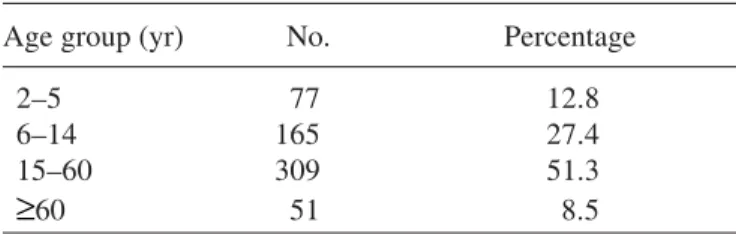
Data were collected from 602 persons (341 females and 261 males). The age distribution is presented in Table 1. About 85% of the surveyed people had re-ceived the drugs from the drug distributors. The sur-veyed coverage for DEC (consumed all the distrib-uted DEC tablets) was 32.7% (95% CI 29.4–35.9%). The surveyed coverage for DEC consumed partially is 28.4% (27.3–32.1%), for DEC consumed both partially and completely is 61.1% (57.1–65.1%), for Albendazole 44% (39.9–48%) and for both DEC and Albendazole consumption was 26.6% (22.9–30.1%). The reasons for not consuming DEC tablets in the MDA campaign are presented in Table 2. The most important reason is that it was not distributed among 90 (38.5%) of them. About 53 (22.6%) of them had not consumed it because the drug distributor had left behind the drugs with other household members in their absence. They could not ingest the drugs as they were not informed about it by other household mem-bers or the information on the dose was forgotten by them. Among the surveyed people, 62.4% in rural Gulbarga and 57.3% in the urban area had consumed
DEC either partially or completely. This difference was not statistically significant (2 = 0.829; p >0.05).
In this evaluation survey on MDA for LF, the cover-age rate of DEC was 32.7% which is much lower than the reported coverage of 89.05% by the district health authority5. The reported range of coverage rate of MDA for LF in the country and Karnataka state from 2004–07 was 60.9 to 81.4%; and 81 to 91% respectively3. It must be noted that the reported coverage of the districts was a compilation of the rates reported by the responsible drug distributors of that area. The proportion of the eligible popula-tion who were distributed with DEC was reported as coverage rates, whereas the World Health Orga-nization defines coverage rates as the proportion of those who actually consume the distributed drugs2. Over-estimates of coverage obtained by the routine reporting system are frequent6. In an independent evaluation of MDA in 2007 in Udupi district of Karnataka, 73.4% of the eligible population had re-ceived DEC and 85.6% of them had consumed it7. The drug distribution was lower in Udupi whereas the consumption rate was higher when compared to Gulbarga. An independent evaluation of the MDA campaign in 2007 was undertaken in the three en-demic districts of Chhatarpur, Datia and Tikamgarh in Madhya Pradesh state8. The DEC distribution in these districts ranged from 28.8 to 67.9% and the actual consumption among them was 61.3 to 77.4%. The drug distribution was low in Madhya Pradesh and the coverage rate was similar to Gulbarga. In the evaluation of MDA in 2006 in six districts and one town of Gujarat state, the overall drug distribu-tion rate was 85.2% and was highest in Porbander
Table 1. Age distribution of study population in the evaluation of MDA campaign at
Gulbarga district (n=602)
Age group (yr) No. Percentage
2–5 77 12.8
6–14 165 27.4
15–60 309 51.3
60 51 8.5
Table 2. Reasons for not consuming DEC in the MDA campaign at Gulbarga district (n=234)
Reason for non-consumption No. Percentage
Drug not given 90 38.5
Drug given at home but no information 53 22.6
Fear of side effect 26 11.1
Forgot to take 16 6.8
I am healthy 11 4.7
63
RANGANATH : MDA COVERAGE SURVEY IN GULBARGA, INDIA
(99.6%) and lowest in Navsari (77.3%) districts. The actual consumption of DEC in Gujarat state was 89% and was highest in Porbander (99%) and least in Navsari (72.4%) districts9. The drug distribution in Gujarat was similar to Gulbarga but the actual con-sumption of the distributed drugs was higher. The surveyed coverage rate was higher in Udupi (Karnataka) and Gujarat state but does not mention whether it included only those who consumed all the distributed DEC tablets or even included those who had consumed it partially. The surveyed coverage in Gulbarga for DEC tablets consumed both partially and completely was 61.1%.
The differences in the reported coverage by the dis-trict health authorities and the surveyed coverage in Gulbarga district can be attributed to: (i) the drug distributors left behind drugs for household mem-bers who were absent during their visit and recorded it as having consumed, presuming that the absentees would take the drugs on their return. In two of the three rural clusters surveyed there was no mopping up activities carried out on the second and third day by the drug distributors. Those who had failed to ingest the drugs distributed on the campaign day were not identified and motivated to do so on the subse-quent mopping up days; (ii) 16.4% of the persons who failed to consume the distributed drugs were children. The parents feared to give the drugs to their children. Around 11.2% of the persons had not con-sumed the drugs because of fear of side effects. The drug distributors could have ensured that the chil-dren swallowed the drugs in their presence. This would have reassured the parents; and (iii) the drug distributors did not ensure that the eligible people swallowed the drugs in their presence. Some of them had not food in the morning. Since the drugs were to be consumed after food, they forgot to take it later. Some 171 (28.4%) of them were confused with the dosage and had consumed the distributed drugs in-completely. Hence, the implementation teams were without team leaders to supervise and monitor the campaign. In two of the three rural areas surveyed Albendazole tablets were not distributed as they had not received it until the day of the campaign. As per
the plan, the drugs had to reach the implementation units seven days before the MDA campaign4. In Madhya Pradesh state, the MDA campaign of De-cember 2006 was postponed twice, as the drugs were not received on time by the districts8.
One of the strategies to eliminate lymphatic filariasis is to achieve 80% coverage (actual drug consump-tion in the eligible populaconsump-tion) in the MDA campaign conducted every year for four to six years10. With coverage rates of 32.7% reported in this survey, it might be a far reached goal. The technical advisory group on the global elimination of LF in the year 2007 noted that the delivery of drugs to people who did not consume it had an adverse effect on drug availability as well as programme impact6. As the reported coverage of MDA (89.05%) is much higher than the surveyed coverage (32.7%) it must be con-cluded that the drug distributors are incorrectly re-porting on the ingestion of the drugs. There is an urgent need to revitalize the programme implemen-tation. Corrective actions must be taken to improve the skill and motivation of the drug distributors by better training and supervision. The drug distribu-tors must ensure that the drugs are swallowed in their presence (directly-observed treatment). Mopping-up activities must be undertaken by them in the house-holds where there are absentees on the campaign day. The programme managers must ensure proper sup-ply of drugs in the stipulated time. There must be supervision and monitoring activities by the imple-menting unit team managers (medical officers). Ad-equate communication efforts should be undertaken in the community to allay the fear of side effects of drugs used in the MDA campaign.
Acknowledgement
The author is grateful to Dr K. Ravi Kumar, Chief Medical Officer, Regional Office for Health & Fam-ily Welfare, Bengaluru, for the technical advice in the survey. The technical assistance of Dr Amaresh Kotur, District Malaria Officer, Gulbarga, is acknowl-edged.
J VECTOR BORNE DIS 47, MARCH 2010
64
1. The World Health Report1998. Life in the 21st century: a vision for all. Geneva: World Health Organization 1998. 2. Lymphatic filariasis. Monitoring and epidemiological assessment of the programme to eliminate lymphatic fi-lariasis at implementation unit level. WHO/CDS/CPE/ CEE/2005.50; p.1–23.
3. Srivastava PK, Dhillon GPS. Elimination of lymphatic filariasis in India: a successful endeavour. J Indian Med Assoc 2008; 106: 673–7.
4. Operational guidelines on elimination of lymphatic filari-asis. Delhi: Directorate of National Vector Borne Disease Control Programme 2004; p. 1–36.
5. Statement of progress of MDA, November 11, 2008 and subsequent two days mopping-up in Karnataka state. Re-port of Joint Director (Malaria and Filaria). Bengaluru: Directorate of HFW, Karnataka. NVBDCP/MDA (5)/38/ 2008-09.
6. Global programme to eliminate lymphatic filariasis. WHO Wkly Epidemiol Rec 2008; 83: 333–48.
Correspondence: Dr B.G. Ranganath, Department of Community Medicine, Sri Devaraj Urs Medical College, Tamaka, Kolar–563 101, India.
E-mail: [email protected]
Received: 24 October 2009 Accepted in revised form: 31 December 2009
7. Kumar A, Kumar P, Nagaraj K, Nayak D, Ashok L, Ashok K. A study on coverage and compliance of mass drug ad-ministration programme for elimination of filariasis in Udupi district, Karnataka, India. J Vector Borne Dis 2009;
46: 237–40.
8. Lahariya C, Mishra A. Strengthening of mass drug ad-ministration implementation is required to eliminate lym-phatic filariasis from India: an evaluation study. J Vec-tor Borne Dis 2008; 45: 313–20.
9. Kumar P, Prajapati PB, Saxena D, Kavishwar AB, Kurian G. An evaluation of coverage and compliance of mass drug administration 2006 for elimination of lymphatic filariasis in endemic areas of Gujarat, India. Indian J Com-munity Med 2008; 33: 38–42.