EURO-MEDITERRANEAN INTEGRATION THROUGH
LIFELONG LEARNING (EU-MILL)
A memory of cooperation and dialogue
on Education in the Mediterranean basin
530401-TEMPUS-1-2012-1-ES-TEMPUS-SMHES (2012-2995/001-001)
Colección: Divulgación Científica
EURO-MEDITERRANEAN INTEGRATION THROUGH LIFELONG LEARNING 530401-TEMPUS-1-2012-1-ES-TEMPUS-SMHES
This project has been funded with support from the European Commission. This publication reflects the views only of the author, and the Commission cannot be held responsible for any use which may be made of the information contained therein.
Editorial Board José Beltrán Fortes
(Director de la Editorial Universidad de Sevilla) Araceli López Serena
(Subdirectora)
Concepción Barrero Rodríguez Rafael Fernández Chacón María Gracia García Martín Ana Ilundáin Larrañeta Emilio José Luque Azcona
María del Pópulo Pablo-Romero Gil-Delgado Manuel Padilla Cruz
Marta Palenque Sánchez José-Leonardo Ruiz Sánchez Antonio Tejedor Cabrera
Any reproduction extracted of this work is forbidden
Editorial Universidad de Sevilla 2017 C/ Porvenir, 27 - 41013 Sevilla.
Tlfs.: 954 487 447; 954 487 451; Fax: 954 487 443 Email: [email protected]
Web: http://www.editorial.us.es
Coordinators
© Encarnación Mellado, 2017 © Bosco Govantes, 2017
Printed in Spain-Impreso en España ISBN: 978-84-472-2104-2
Colección:
Printed in
Spain-“I don’t divide the world into the weak and the
strong, or the successes and the failures… I divide
the world into learners and non-learners.”
Contents
1. EUMILL Project presentation2. Introduction
George Anthony Abdelnour, Kamal Abouchedid, Mariano Aguayo, Mohamed Bakkali, Fawzi Baroud, Ahmed Belhani, Zoheir Benyelles, Miguel de Castro Neto, Anouar Derguech, Abdelkarim Filali-Maltouf, Bosco Govantes, Marta Gutiérrez, Hocine Hamdi, Fuad Hashwa, Farida Hobar, Ana Irimia, Raouf Jaziri, Amin Laglaoui, Michel Majdalani, Faysal Mansouri, Carmen Márquez, Mohamed Mars, Encarnación Mellado, Jorge M. Mendes, Mus-tapha Missbah El Idrissi, Asma Msougar, Sirpa Purtilo-Nieminen, Sidi Mohammed Sahel, Skander Slim, Helka Urponen, Nadia Ykhlef
2.1. Approach to the socio-political context of the participating countries 2.2. Approach to the educational system of the participating countries 2.3. Lifelong Learning on the regional context
3. General Methodology
George Anthony Abdelnour, Kamal Abouchedid, Mariano Aguayo, Mohamed Bakkali, Fawzi Baroud, Ahmed Belhani, Zoheir Benyelles, Miguel de Castro Neto, Anouar Derguech, Abdelkarim Filali-Maltouf, Bosco Govantes, Marta Gutiérrez, Hocine Hamdi, Fuad Hashwa, Farida Hobar, Ana Irimia, Raouf Jaziri, Amin Laglaoui, Michel Majdalani, Faysal Mansouri, Carmen Márquez, Mohamed Mars, Encarnación Mellado, Jorge M. Mendes, Mus-tapha Missbah El Idrissi, Asma Msougar, Sirpa Purtilo-Nieminen, Sidi Mohammed Sahel, Skander Slim, Helka Urponen, Nadia Ykhlef
3.1. Diagnosis of LLL in Partner Countries and identification of best practices 3.2. Institutional capacity building measures in Partner Countries HEIs 3.3. Extensive & multi-level networking, dissemination and exploitation of
project results
15
19
19 22 24
49
49 70 76
4. Towards recognition of LLL
George Anthony Abdelnour, Kamal Abouchedid, Mariano Aguayo, Mohamed Bakkali, Fawzi Baroud, Ahmed Belhani, Zoheir Benyelles, Miguel de Castro Neto, Anouar Derguech, Abdelkarim Filali-Maltouf, Bosco Govantes, Marta Gutiérrez, Hocine Hamdi, Fuad Hashwa, Farida Hobar, Raouf Jaziri, Amin Laglaoui, Michel Majdalani, Faysal Mansouri, Carlos Marcelo, Carmen Márquez, Mohamed Mars, Encarnación Mellado, Jorge M. Mendes, Mustapha Missbah El Idrissi, Asma Msougar, Sirpa Purtilo-Nieminen, Sidi Mohammed Sahel, Skander Slim, Helka Urponen, Nadia Ykhlef
4.1. Methodological Framework
4.2. Implementation of a Credit and Competences System 4.3. Quality Assurance System
4.4. Towards regional and national qualification frameworks
5. Enhancing an advanced distance learning model
Ahmed Belhani, Hocine Hamdi, Victor Hugo Perera, Mª Carmen Talavera, Juan Jesús Torres 5.1. The role of ICT in the Lifelong Learning
5.2. Learning Methodologies: a splash at the recent history
5.3. Implementation of distance and blended programmes through the use of ICT. Training experience
6. Main outputs and results of EUMILL project
7. Our guiding vision: Trends and recommendations
8. Concluding remarks
9. References
Annexes
Annex I. Information of EUMILL partners
Annex II. Good practices for the design of LLL programmes (EU-MILL project) Annex III. Report university enterprise meetings
79
49 92 102 109
123
123 126 129
145
157
167
173
of the activities performed in the context of the EU-MILL project:
George Anthony Abdelnour Notre Dame University-Louaize, Beirut, Lebanon Kamal Abouchedid Notre Dame University-Louaize, Beirut, Lebanon
Mariano AguayoUniversity of Seville, Seville, Spain
Mohamed Bakkali University Abdelmalek Essadi, Tétouan, Tangier, Morocco Fawzi BaroudNotre Dame University-Louaize, Beirut, Lebanon
Ahmed Belhani University of Constantine 1, Constantine, Algeria
Nard BennasNational Union of Moroccan Women, Provincial Office of Tétouan, Morocco
Zoheir Benyelles University AbouBekr Belkaid Tlemcen, Tlemcen, Algeria Mahmoud BouhafsMinistry of Higher Education and Scientific Research, Tunis, Tunisia
Djamel BoukezzataMinistry of Higher Education and Scientific Research, Algiers, Algeria
Miguel de Castro Neto University Nova of Lisbon, Lisbon, Portugal Anouar DerguechUniversity of Gabes, Gabes, Tunisia
Abdelkbir Errougui Ministry of Higher Education, Scientific Research and Training, Rabat, Morocco
Abdelkarim Filali-Maltouf Universidad Mohamed V, Rabat, Morocco Bosco GovantesUniversity of Seville, Seville, Spain
Marta Gutiérrez University of Seville, Seville, Spain
Raouf Jaziri University of Sousse, Sousse, Tunisia
Hadjira Kara Terki University AbouBekr Belkaid Tlemcen, Tlemcen, Algeria Adel Khalife Ministry of Education and Higher Education, Beirut, Lebanon Amin Laglaoui University Abdelmalek Essadi, Tétouan, Tangier, Morocco
Laayouni Loubna Ministry of Higher Education, Scientific Research and Training, Rabat, Morocco
Michel Majdalani Lebanese American University, Beirut, Lebanon Faysal Mansouri University of Sousse, Sousse, Tunisia
Carlos Marcelo University of Seville, Seville, Spain Carmen Márquez University of Seville, Seville, Spain Mohamed Mars University of Gabes, Gabes, Tunisia
Justine MartinMaghreb office of the Agence universitaire de la Francophonie, Rabat, Morocco
Encarnación Mellado University of Seville, Seville, Spain Jorge M. MendesUniversity Nova of Lisbon, Lisbon, Portugal
Mustapha Missbah El Idrissi Universidad Mohamed V, Rabat, Morocco Asma Msougar University Mohamed V, Rabat, Morocco
Abderrahim Ouabbou Ministry of Higher Education, Scientific Research and trai-ning, Rabat, Morocco
Victor Hugo PereraUniversity of Seville, Seville, Spain
Sirpa Purtilo-Nieminen University of Lapland, Rovaniemi, Finland
Cristina RobaloMaghreb office of the Agence universitaire de la Francophonie, Rabat, Morocco
Sidi Mohammed Sahel University AbouBekr Belkaid Tlemcen, Tlemcen, Algeria Skander Slim University of Sousse, Sousse, Tunisia
Benaich Souad Ministry of Higher Education, Scientific Research and Training, Rabat, Morocco
3
General Methodology
3.1. Diagnosis of LLL in Partner countries and identification
of best practices
On the following pages, it will be analyzed the situation of LLL on all partner countries, the integra-tion of LLL policies within their legal frameworks, as well as some examples of good practices in LLL on the partner countries, identified and learnt after the study visit to HEI in the European shore.
We have performed a comparative policy analysis extracted from the country reports on LLL deli-vered in the begining of project in the four southern Mediterranean partner countries (Morocco, Tunisia, Lebanon and Algeria) and in the European Union. The expected aim was to compare the different policies of these countries for implementing Lifelong Learning, in order to provide basis for a further development of Lifelong Learning policies in the four countries.
3.1.1. European Framework of Lifelong Learning
Lifelong Learning or Continuing Education has been a major reference in the European Union since the establishment of European Higher Education Area (EHEA). Arguably, the first mention of this issue by the European Council took place on the Lisbon meeting in 2000, expressing the necessity of ensuring access to training throughout life, in line with the growing importance of Information and Communication Technologies (ICT). The evolution of the Lifelong Learning commitment in Europe has been taken as a reference by the neighbor countries, including the South Mediterranean ones.
The importance of Lifelong Learning and its full incorporation into higher education has arisen from the Bologna Declaration in 1999. LLL has been present in different biennial meetings of Mi-nisters responsible for Higher Education in the European Union in Prague (2001), Berlin (2003), Ber-gen (2005), London (2007) and Leuven (2009) emphasizing the need for exchange of best practices and promoting the role of higher education in Lifelong Learning, as well as improving the recog-nition of prior learning in higher education. At each meeting, it is declared the need to establish partnerships and cooperation systems such as Lifelong Learning to develop political strategies of mobility, social inclusion, employability and personal development (Consejo de Universidades, 2010).
In the meetings of the European Ministers of Education and Training, European Commission and social partners, relief is given to training throughout life, taking into consideration the need of pro-moting cooperation with all stakeholders.
to acquire basic skills they need in a knowledge society , and to create an open learning environ-ment (OJEU, 2006). Despite previous efforts, in an analysis completed by the European Center for Development for Vocational Training (CEDEFOP, 2008) based on a research regarding the develop-ment of continuing education in 17 European regions, it was highlighted that a third of the regions had not reached the average expected participation of adults in training programs over a lifetime (9.6%, almost three points below the 12.5% established i n the Lisbon objectives).
The European University Association (2008b), in relation to learning throughout life in universities, identified a number of commitments to be achieved by themselves and by governments:
Universities Commitments:
nInclude in the institutional strategies the concepts of expanding the access to the college
and Lifelong Learning.
nProvide education and training to student population of diverse background.
nAdapt the curricula designs to ensure the participation of students and adults and to
attract new students.
nProvide guidance services for students. nRecognition of prior learning.
nAdopt Lifelong Learning in the internal quality culture.
nReinforcing the relationship between research, education and innovation from the
pers-pective of Lifelong Learning.
nConsolidate reforms to create a creative and flexible framework for learning.
nDevelop partnerships locally, regionally and nationally to offer attractive and relevant
programs.
nAct as a model institution oriented to Lifelong Learning.
Government commitments:
nRecognize the contribution of universities to training throughout life as an important
benefit for people and society.
nPromoting social equity and global learning.
nInclude objectives concerning Lifelong Learning in the mission and functions of the
nSupport the creation of appropriate guidance for the student. nRecognition of prior learning.
nRemoving legal obstacles that prevent the return or the access of potential students to higher education.
nEnsuring autonomy and develop incentives for Lifelong Learning in universities. nStrengthen regional partnerships at local authorities, employers and agencies.
nInform and encourage citizens to take advantage of the benefits of Lifelong Learning, which is offered by the universities.
3.1.2. Methodological approach to LLL situation in the SM
partner countries
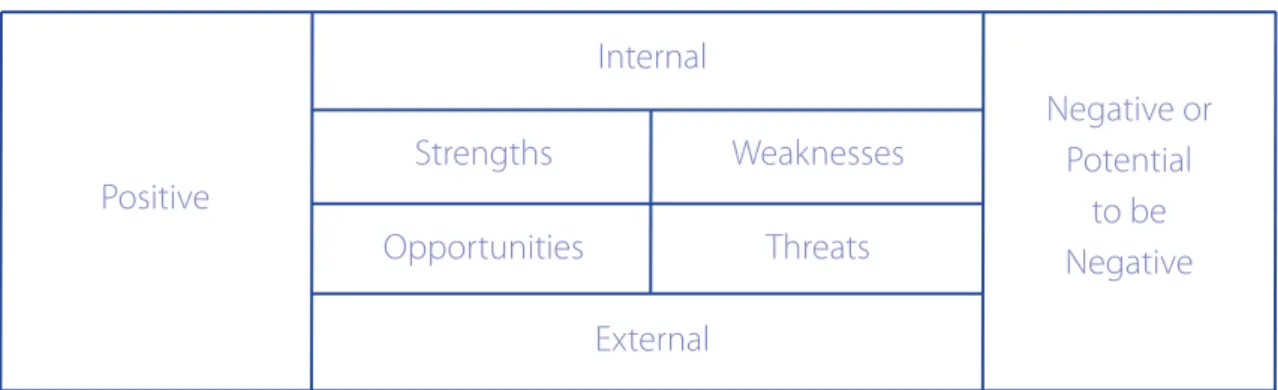
In order to get to know the current situation of LLL in the partner countries, a SWOT Analysis was implemented as a methodological strategy. SWOT is used as a planning tool to understand the Strengths, Weaknesses, Opportunities and Threats involved in the EU-MILL project partners.
During the Kick-off meeting of the project in Rabat (Morocco), a discussion took place in order to make a comparison and analysis of the current situation of development and implementation of national Lifelong Learning strategies in the partner countries, clarifying and defining the detailed tasks of this WP. These discussions were the basis for the following step, the implementation of a SWOT analysis of the national LLL Strategies and about the status of the implementation accom-plished in every partner country. The SWOT analysis for each partner country was executed at the national level (self-assessment).
Table 1. The SWOT Matrix Model
Source: Authors elaboration from Humphrey (2005)
The model of SWOT analysis was used to reflect the national situation and to make use of the results for further development.
The following pages will summarize the main findings of the SWOT analysis partner per partner.
Positive
Internal
External
Strengths
Weaknesses
Negative or
Potential
to be
Negative
Opportunities
Threats
Table 2. SWOT Analysis on the National Strategy in LLL in Algeria
Strengths
- Open to anyone who would want to enhance
their skills and professional experience either at
school or university levels: employees, job
see-kers and professionals can enroll at the university - At the request of socio-professional sector - National accreditation
- Abundant human resources - Relatively advanced technology - Popularity of university
- Extremely strong technical expertise on staff in key areas
- Desire of experts on staff to make quantum improvements (and the skills needed to do so)
Weaknesses
- LLL is not developed. In fact, over the past ten
years, the number of staff trained did not
exceed 200 belonging to local and regional
businesses
- Lack of global advanced technology
- Relatively less developed IT infrastructure
- Lack of a coordinated, articulated and
documented long term strategy
- Poor capacity in relation to data collection,
analysis, dissemination, maintenance and
updating has resulted in lack of data or
- Given the number of graduate trained each year it is quite clear that there is a real potential candidate for the development of LLL
- Management and centralized decision–making - Operation and national programs (determi-ned by the Rector)
This weakens the capacity for an accurate
monitoring activity, evaluation and research
- High cost considering the infrastructure
Opportunities
- LLL is provided by several public and private institutions
- Vast domestic market - Reforming education
- There is no text giving equivalence for training completely remote
- There is a text (ministerial order) linking incentive pay for teachers to use IT in teaching
Threats
- Accelerated expectations vs. capacity
- Inconsistencies in keeping up
- Direct competition with LLL provided by
other institutions as a parallel offer
- There is currently no specific legislation on
copyright and related rights for courses
deposited on distance learning platform.
T
abl
e
3.
SWOT Analysis on the National LLL Strategy in Lebanon
2Strengths
- Unique provider (access) - Geographic location- Certificate-based/Professional orientation - Faculty/staff
- Growth has been increasing over the past five years
- Aggregate key performance indicators have been very encouraging
- Overall enrolment doubled over the last four years, new programs have escalated
- Unparalleled capacity building in LLL faculty support has been provided by the university, along with internal LLL quality controls and assurances
- Some university style LLL programs have emerged over the past years with a separate university division within an university setting - LLL divisions at universities grant Certificates / Diplomas in response to the growing needs of the labor market for such concentrations, and as a means to bridge the gap between the traditional academic curricula versus the competitive market (both local and regional markets since many young Lebanese ready themselves in Lebanon to join the market in the Arabian Gulf )
Weaknesses
- There is no formal system for Lifelong
Learning in Lebanon and no formal legal
framework for LLL
- There is not known established university that
grants a BS / BA or Masters degree in CE / LLL
- Breadth/variety of programs
- Inadequate quality control assessment system
- Deficient distance/online platforms
- Recent studies conducted by AbouRjeili /
Abouchedid on Higher Education and the
Labor market in Lebanon revealed that more
than half of university graduates in Lebanon
end up with careers that have no relation with
their respective university majors. This has
created many informal training centers in the
country.
- Non-formal education has surfaced as an
option to train schoolteachers in the private
sector to adapt to the changes in content
and styles of pedagogy required by the new
national curriculum
- Despite the importance of training offered to
schoolteachers in the public sector, LLL is not
- The demand for programs from the private sector requires programs such Soft skills, En-glish, Engineering, Technology, entrepreneurships which prompted some LLL units, including universities, to develop programs to help bridge the knowledge gap
- Establishing separate entities dedicated to continuing education demonstrates the im portance that major private universities in Lebanon such as the American University of Beirut, the Lebanese American University, Haigazian University, St Joseph University and others to bridge the LLL gap. However, the LLL unit is to respond quicker to market needs, is more responsive to local culture and habits with a dedication for service, has flexibility in making decisions on the ground, is more entrepreneurially oriented and must have its own capacity (physical, space, financial,…), in addition to new features including new oppor-tunities for the university (new professional figures, new demands of training processes of re-qualification,…)
- Above all, it must expand the partnership zone aiming at sharing knowledge, experience, ideas and resources as well as focusing on buil-ding skills, on increasing knowledge and on developing abilities of the participating indivi-duals through specifically designed programs
yet well entrenched in the educational system
O
ppor
tunities
- Non-saturated market for LLL - Partnership opportunities- LLL is a growing field in Lebanon and many non-formal offerings of LLL are trying to fill the void, both in cities and in rural regions of the country. It is recognized junior universities, for-profit private training companies, vocational schools (public, semi-private and private), Lebanese NGO companies, funded Agencies (CNAM, USAID,), the training arms of Orders / Chambers / Syndicates, internal corporate training at large institutions and others - At the corporate level, corporate strategists generally associate a more educated, a more knowledgeable and a more skillful workforce with mobility, adaptability and better disposi-tion to changes necessitated in the workplace - For students, LLL is associated with job entry level positions, whereas for the unemployed, it is a mean to match newly acquired skills with job requirements. From these basic identifiers, we can infer that LLL is closely associated with economic and social issues concerning society at large
- The state has historically associated vocational training and vocational schooling with the ability to feed laborers into the labor market - A new ministerial decree was issued in the year 2000 (decree 31/2000 by the Council of
Threats
- Political instability- Institutional ‘stigma’
- Capacity/resources
- A new ministerial decree was issued in the
year 2000 (decree 31/2000 by the Council
of Ministers) to modernize and establish new
educational structure for vocational education
and training leading to technical higher
tion under the auspices of the higher
educa-tion framework. However, no practical steps for
implementation ever took place since
- No credit transfer or consistency in
documen-tation or transcripts exists between the general
education system and the vocational
educa-tion system
- Lack of adaptability of curricula to the job
market requirements. Indeed the VTE planning,
management and organization is
supply-side oriented that has not consupply-sider enough the
demands side of the market
- Outside the government’s legal education
box, informal and/or non-formal education
programs and opportunities are left at the
discretion of either institutions of higher
edu-cation that have centers of continuing
Ministers) to modernize and establish new educational structure for vocational education and training leading to technical higher education under the auspices of the higher education framework (3 years for Technique Superieur TS, Diplome Technique [TS+2 years], and a Masters degree)
that implement literacy programs and training
that often target the disadvantaged in rural
areas. It also exists other types of NGOs also
which appeals to government organization or
to other NGO for training (For example,
CEP@LAU has a Leadership program for
Muni-cipalities in Lebanon in partnership with
another NGO organization. Also, CEP@LAU
offers a Diploma in NGO capacity building) or
private fee-paying centers that provide training
courses to adults
- Lack of internal institutional recognition of the
merit of Lifelong Learning and the central role
that continuing education centers play in
promoting learning for life, a major threat
affec-ting everything from administrative support to
financial capacity
- Limited resources: unsustainability over the
long term, which affects planning and quality
enhancement. This requires an internal
educa-tion campaign to strengthen the support for
LLL programs
T
abl
e
4. Analysis on the National LLL Strategy in Morocco
Strengths
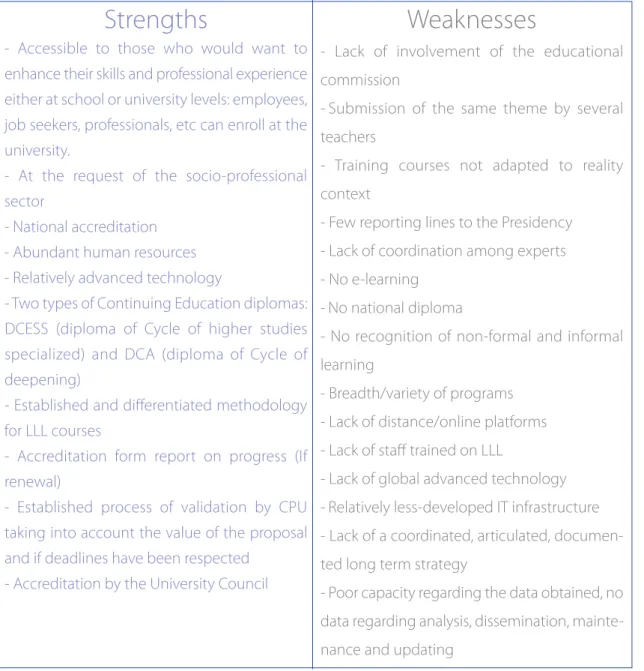
- Accessible to those who would want to enhance their skills and professional experience either at school or university levels: employees, job seekers, professionals, etc can enroll at the university.
- At the request of the socio-professional sector
- National accreditation - Abundant human resources - Relatively advanced technology
- Two types of Continuing Education diplomas: DCESS (diploma of Cycle of higher studies specialized) and DCA (diploma of Cycle of deepening)
- Established and differentiated methodology for LLL courses
- Accreditation form report on progress (If renewal)
- Established process of validation by CPU taking into account the value of the proposal and if deadlines have been respected
- Accreditation by the University Council
Weaknesses
- Lack of involvement of the educational
commission
- Submission of the same theme by several
teachers
- Training courses not adapted to reality
context
- Few reporting lines to the Presidency
- Lack of coordination among experts
- No e-learning
- No national diploma
- No recognition of non-formal and informal
learning
- Breadth/variety of programs
- Lack of distance/online platforms
- Lack of staff trained on LLL
- Lack of global advanced technology
- Relatively less-developed IT infrastructure
- Lack of a coordinated, articulated,
documen-ted long term strategy
- Poor capacity regarding the data obtained, no
data regarding analysis, dissemination,
O
pportunities
- The rapid development of the region - Diversification of sectors
- Law 01-00
• Article 3: among the main missions of the Uni-versity, initial training and continuing training • Article 8: universities may under the conditions laid down in their rules of procedure, establishing University offers in the field of initial training and continuing education. These graduates may be subject to accreditation by the Government authority of guardianship after the opinion of the national commission for the coordination of higher education above. Accredited diplomas can be recognized equivalent to national diplomas • Article 12: among the responsibilities of the Board of the University the supervision of Uni-versity continuing education
• Articles 18: the University's activities budget include State grants; fees for continuing education - LLL is a growing field in Morocco and many non-formal offerings of LLL are trying to fill the void, both in cities and in rural regions of the country - The purpose of LLL is to set a programme that enables individuals no matter at what level of their lives they are to continue their learning process throughout all their life
- Understanding of Lifelong Learning as the one proposed by the EU
- The authorities in Morocco are aware of the importance of Lifelong Learning
Threats
- Illiteracy- Low qualifications
- The training is not adequate to the necessities.
- Gender male / female
- There is a lack of adaptability of the curricula
to job market requirements. Indeed the VTE
planning, management and organization is
supply-side oriented that has not kept pace with
the needs/demands side of the market
- No credit transfer or consistency in
documen-tation or transcripts exists between the general
education system and the vocational and
tech-nical education system
- Lack of internal institutional recognition of the
merit of Lifelong Learning and the central role
that continuing education centers play in
pro-moting learning for life, a major threat affecting
everything from administrative support to
finan-cial capacity
Table
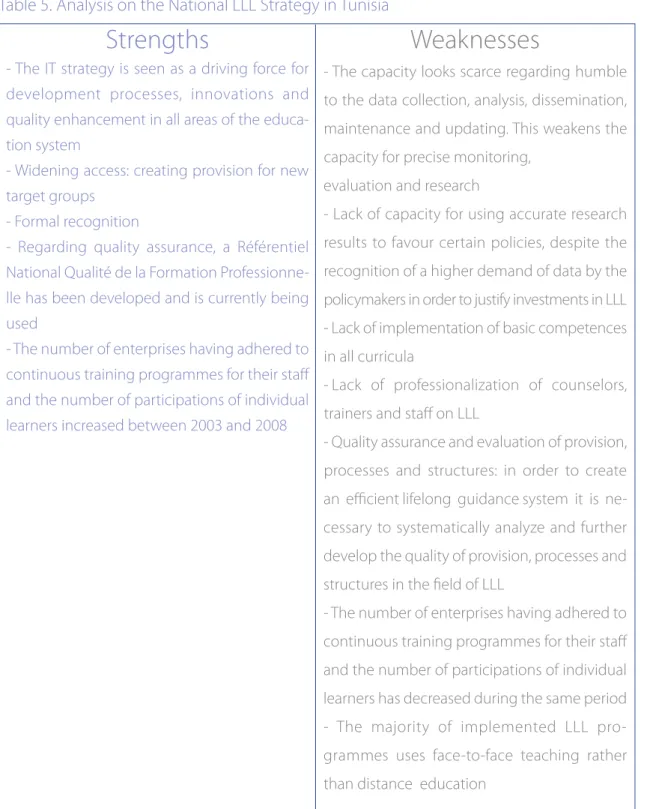
5. Analysis on the National LLL Strategy in Tunisia
Strengths
- The IT strategy is seen as a driving force for development processes, innovations and quality enhancement in all areas of the educa-tion system
- Widening access: creating provision for new target groups
- Formal recognition
- Regarding quality assurance, a Référentiel National Qualité de la Formation Professionne-lle has been developed and is currently being used
- The number of enterprises having adhered to continuous training programmes for their staff and the number of participations of individual learners increased between 2003 and 2008
Weaknesses
- The capacity looks scarce regarding humble
to the data collection, analysis, dissemination,
maintenance and updating. This weakens the
capacity for precise monitoring,
evaluation and research
- Lack of capacity for using accurate research
results to favour certain policies, despite the
recognition of a higher demand of data by the
policymakers in order to justify investments in LLL
- Lack of implementation of basic competences
in all curricula
- Lack of professionalization of counselors,
trainers and staff on LLL
- Quality assurance and evaluation of provision,
processes and structures: in order to create
an efficient lifelong guidance system it is
ne-cessary to systematically analyze and further
develop the quality of provision, processes and
structures in the field of LLL
- The number of enterprises having adhered to
continuous training programmes for their staff
and the number of participations of individual
learners has decreased during the same period
- The majority of implemented LLL
pro-grammes uses face-to-face teaching rather
- Lack of global advanced technology
- Relatively less-developed IT infrastructure
- Lack of a coordinated, articulated, documented
long term strategy
Opportunities
- Understanding of Lifelong Learning as the one proposed by the EU. The purpose of Lifelong Learning is to set a programme that enables individuals, regardless their personal situations, to continue their learning process throughout their entire lives
- In Tunisia, Lifelong Learning is seen as an essential tool for the future. The authorities in Tunisia are aware of the importance of Lifelong Learning
- It is a necessary tool for modernization to occur
- Legal framework of continuing education encloses three main dimensions: the field and the concepts of continuing education, the management of the tax of the vocational training (TFP) and the approval of certificates and Diplomas of continuing education - The Ministry of Education and Training is currently working in buildinga national quali-fication scale in partnership with the other related ministries and social partners
Threats
- Lifelong Learning is still seen as a marginal
activity in many universities but there is an
awareness for the need of its development
amongst academic staff and there are
embryo-nic or developed structures for its provision
- Structural problems of the education and
training system are its initial-oriented nature.
The possibility of reintegrating the system
com-bining access to employment and further
training is still very difficult to achieve
- The individual right to training in the Tunisian
labor law is not still embedded in terms that
favor the Lifelong Learning. Therefore, Lifelong
Learning is not yet embodied in the
Discussing and clarifying the different reports and surveys performed in every country, makes possible a comparison and analysis of the current situation of development and implementation of national Lifelong Learning strategies in each of them. Taking into consideration these discussions, SWOT analyses have been performed regarding the national LLL strategies and its status of imple-mentation processes in the partner countries. EU-MILL project partners have made an effort to find common situations among the partner countries. However, not all the strengths, weaknesses, thre-ats and opportunities listed below are presented evenly in all partner countries.
In keeping with Smidt and Surkock (2011), the results of our analysis suggests that there are many different ways to embed LLL at the university and that there are supporting factors facilitating a potential strategic development of the LLL agenda, within an institutional, national or regional agenda.
For example, according to the recent publication of the Lebanese National Qualification Framework (LNQF), Lebanon has aligned its LLL policy with that of the EU qualification framework (EQF) by re-ferencing the LNQF to the EQF. Therefore, there is a shared understanding of the wider implication of LLL on the local economy, on pathway linkages, on workforce mobility, on sharpening job skills, on quality assurances, on credibility of deliverables and on other factors. Furthermore, it would level the division between vocational training and the general higher Education system.
Also, according to the survey conducted by the University of Seville to EU-MILL partners during the study visit programme, it was shown that by adopting LLL policies such as quality assurances, path-way linkages, and education accessibility, Lebanon would be creating zones of mutual trust that would enhance the employability of individuals through the mobility factor within the country and across the European landscape with mutual benefits to the respective economies.
Other Southern Mediterranean countries have already recognized the influence of the EU Lifelong Learning experience. For example, countries like Morocco and Tunisia are developing qualifications in two economic sectors: construction (occupation: bricklayer and site supervisor) and tourism (oc-cupation: waiter and hotel receptionist).
1. Introducing concepts like Lifelong Learning and wider access in institutional strategies. 2. Adapting traditional curricula and redesign them to widen the target to include and
attract returning adult learners. 3. Recognizing prior learning.
4. Establishing sustainable external partnership with stakeholders and business organizations.
In keeping with Knight (2003), these elements are related with two new perspectives:
a. Bringing functions together, transversely through the different departments and services of the institution, including admission and student services, in order to obtain the maxi-mum added value to the Lifelong Learning agenda.
b. Operating more formally and strategically as an institution, adopting a proactive rather than responsive stance to engagement. The need to align Lifelong Learning activities and engagement vertically, from the level of individual academics, through departments, schools and faculties, to the central level.
The reports from each university concerning the current practices for LLL in the partner countries have showed that most of them are developing some LLL offers at their institutions, but none of them have adopted a LLL or continuing education strategy. Nontheless, some interesting initiatives have been detected in some of the participating universities, introducing more flexible learning path oriented to a more diverse populations. As conclusions of the SWOT analysis we identified:
Strengths
• Ongoing process of developing national LLL strategy involving all relevant stakeholders, policy makers governmental, social partner, institutions etc., also at regional and local level.
• Consultation process regarding national LLL strategy, responses, synopsis, reflection as base for further common strategy and policy processes.
W
eaknesses
• No existing, formal decided national LLL strategy.
• Long lasting process of development of papers, consultation, synopsis, reflection, communication etc.
• No common coherent concept of a national LLL strategy, still existing misunderstandings of terminology and strategic approaches, e.g. between the term “Lifelong Learning” and “Adult education”.
• Deficits in special areas of educational and strategic processes, e.g. for employed people, older workers, special groups at risk etc.
• Missing links between the fields of education, employment and labor, economics and social affairs.
• Lack of resources in some core strategic fields (e.g. guidance etc.).
Threats
• Process runs too slowly.
• Complexity in governmental structures and procedures.
• Lack of evidence and data, lack of available data of national and transnational sources.
Opportunities
• A strong opportunity is to use transnational and EU processes to give initiatives at national level through networks, projects, common conferences and interactive reflections to learn from each other.
• The crises could help finding some core approaches to the real essential aspects for future development and LLL must be an essential part of it.
• Use the increasing commitment about the importance of LLL and common processes as a base for common national Lifelong Learning strategy processes.
• Make visible the ongoing activities in several fields of LLL as existing elements of a possible common LLL strategy.
To sum up, this general situation represents a general discrete development of LLL. Instead, we have observed an improvement on the awareness level of all governments bodies participating in EU-MILL activities throughout the project’s lifetime. The ministerial representatives have shown a big interest on the LLL promotion and have understood the added value of these policies, especially those related with the development on the socio-economic field. We are aware that a new impulse on LLL is expected on their following reforms, in progress in some of our partner countries.
3.1.3. Best practices in LLL through the study visits to EU High
Education Institutions
The study visit to the three European universities implicated in EU-MILL project has been a great opportunity to get to know the activities and procedures of three HEIs deeply committed with LLL. These study visits has been valued very positively by all South Mediterranean universities on the feedback surveys.
The study visits are included in the methodology of the EU-MILL project as an opportunity to discuss the project WP2 on methodological framework for LLL curricula and projects.
Some of the main objectives of the study visits were to have a better mutual understanding of the implementation in LLL, as well as the identification of synergies and opportunities.
University of Lapland (Finland)
The first study visit took place in Rovaniemi city where the University of Lapland is located on the 6th and 7thof June 2013.
The visit was based on a free format and covered the following points:
• Overview of LLL implementation at the University of Lapland • The structure and management of LLL
• A study case: BART (Public Private Partnership in Barents Tourism) and Netour (Network for Excellence in Tourism through Organization and Universities in Russia)
• The perspective of e-learning • EU-MILL project implementation
The presence of University of Lapland LLL experts raised awareness and favored the internal recog-nition of the people and activities in Lifelong Learning as well as promoted an interesting debate among the participants.
More generally, the study visit to the University of Lapland, gave to project partners awareness on new LLL conceptions previously unknown or not taken into consideration into their perspective.
The visiting partners pointed out that the university rulers were not particularly reluctant to LLL, but more likely unaware of singularities of these activities and of the potential contibution that Lifelong Learning can make to the university overall.
University of Sevilla (Spain)
The study visit to University of Seville took place on the 7thand 8th October of 2013.
The main objective of the study visit to the University of Seville was getting to know the Lifelong Learning Center, its academic structure, administrative system, economic management and its Qua-lity Assurance System.
We can remark some of the following achievements:
• Definition of the strategy • Academic structure • Administrative structure • Types of training offered
• Administrative procedure to create new courses
• Definition of a Quality Assurance System for LLL based on the EFQM • Definition of the academic functioning of the Center
• Presentation of the main academic and economic data of the Center
• Presentation of the tools for the academic management of the LLL training sessions
The results could be considered highly interesting for the visiting partners because they were able to find common approaches to interesting subjects such as the analysis of the LLL in all SM coun-tries. The visit was certainly enriching for the visitors as well as for the USE professors.
Deepening on the LLL analysis, it was quite interesting to see how the LLL training is approached on the different countries from highly centralized models on the State to more European decen-tralized models where LLL training is offered by universities.
N
ova University of Lisbon (Portugal)
The objective of the study visit to the University NOVA of Lisbon was to collect NOVA’s experiences on Lifelong Learning, in particular its experience with distance learning programmes. Collaterally, the fundamentals of a credit system for future implementation at EU-MILL project partner univer-sities were introduced as well.
The visit was based on a free format and covering the following points:
• Strategy on NOVA’s international cooperation
• Extent of implementation of NOVA’s e-learning strategies
• Implementation of a system of credits and competencies for future mutual recognition • Identification of possible media and special formats that can be used for Lifelong Learning
purposes
• Analysis on EU funding opportunities for capacity building • Development of entrepreneurship strategies
The presence of NOVA’s experts in charge of NOVA strategy and some LLL programmes kicked the debate off on the necessary framework to implement similar programmes at partner countries uni-versities.
More generally, the study visit to the NOVA University gave the project partners the opportunity to look at a well-succeeded experience in LLL projects they had not previously experienced and inte-grated into their perspective or projects.
3.2. Institutional capacity building measures in partner countries
HEIs
Throughout the lifetime of EU-MILL project, there have been several activities developed in order to reinforce the partner countries universities capacity building in the field of LLL.
Within this context, we can remark the following activities as the most relevant and with a higher level of impact:
• Workshops and training sessions
• Elaboration and implementation of pilot courses
3.2.1. Workshops and training sessions
The workshops and training sessions have been a vital part of the functioning of EU-MILL Project. There are two categories of workshops: the Consortium workshops, organized to train the EUMILL consortium members and the partners’ workshops, organized on the South Mediterranean partner universities with the aim of extending these methodologies to their academics following a training for trainers' approach.
a) WP2 and WP4 Workshops. WP2 was devoted to design a common methodological framework for prototype models of LLL short curricula and projects, workload and learning outcomes to be implemented in the SN area.
The methodological framework used a bottom-up approach, starting from the needs identified and specific target groups to meet them through the LLL curricula and projects design, being strongly connected with the following WP’s: WP5, WP7 and WP8.
partner universities, in most cases together with a workshop for WP4 taking advantages of the synergies among both Work-Packages. A template presentation for both workshops was prepared in English and French by the EU-MILL coordination team.
These sessions succeeded in extending the impact of the methodological framework. The training sessions achieved a total number of 238 trainees.
WP4 was devoted to the design and establishment of a common system of credit validation, recognition and accumulation, paying specific attention to ensure a shared criteria based on skills, knowledge and competences acquired.
WP4 was strongly connected with the following WP’s: WP2, WP5, WP7 and WP8.
Several seminars and workshops were carried out in the context of WP4, as the workshop organized during the study visits in Lisbon, Portugal (2013) and in Constantine, Algeria (2014).
The results achieved of these workshops succeeded in extending the Credit & Competences system to the design of the courses. Most universities implemented training for trainers’ workshops, achie-ving a total number of 283 trainees.
b) WP7 and WP8 training sessions. As part of the project EU-MILL, Quality Assurance in the im-plementation and teaching of courses created on the EU-MILL platform remains a crucial and fun-damental activity for the success and relevance of the training LLL.
Within this framework, a quality assurance manual was created for LLL pilot courses. This manual describes step-by-step the development of various tools for assessing quality.
Trainers training sessions have been scheduled throughout the project in parallel with the other project activities.
quality of pilot modules as well as the internal and external valuation techniques throughout the teaching process.
Several seminars and training for trainers’ sessions have been carried out in the context of WP7.
Two face-to-face consortium workshops by Prof. Mariano Aguayo were held in Seville (Spain) in 2013 and in Djerba (Tunisia) in 2015.
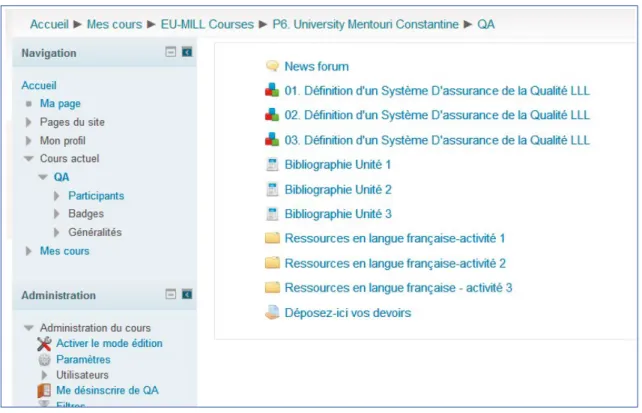
A training program for trainers was designed by Prof. Carlos Marcelo (University of Seville) and was made available for all SM partners, through the Project’s Moodle platform in order to be used for the training for trainers' sessions at their universities.
Summary of the training modules:
nQuality Assurance in University LLL training programmes nQuality Assurance in University education
nQuality Assurance system into practice
All partners have developed these sessions on the EU-MILL platform or in their own platform after replicating the courses, with the only exception of Tunisian universities which due to legal require-ments have implemented their courses through the Tunisia Virtual University platform.
Due to the close relation between WP7 and WP8 (Enhancing an advanced distance learning model), most partners celebrated the WP7 and WP8 on-site sessions together to explain the methodology of both online trainings.
The results of the achievement of those training programmes have succeeded in improving the level of awareness of the professors organizing the pilot courses (WP5) and also to make them aware of the importance of quality assessment inside a Global Quality System. The training for Qua-lity Assurance reached a total number of 236 trainees.
Source: EUMILL Consortium (2016).
Deeply related to WP7, WP8 aims to improve the access to LLL through learning. In this sense, e-learning provides a more flexible, cost-effective and educationally powerful alternative, especially for workers that have to share work and training.
This work-package aims at addressing the demotivation of the students due to the lack of time of the employed and distance from the High Education Institutions. The use of Information and Com-munication Technologies (ICT) is a powerful alternative to on-site training: E-learning and blended learning educational paths by creating the tools, methodologies and techniques to support a dis-tance learning, providing e-learning and blended learning modules aside contact-hours courses. The major result has been an open source platform where deliver the LLL modules and a series of web aiming at enhancing the interaction among participants and teaching staff.
Three consortium workshops have taken place during the lifetime of the project: in 2013 by Prof. Hugo Perera and e-learning expert Mrs Carmen Talavera at University of Seville (Spain), in 2014 by Profs. Hugo Perera and Ahmed Belhani at University of Constantine 1 (Algeria) and in 2015 by Prof. Belhani in Djerba (Tunisia) under the organization of University of Gabes.
The results achieved of these trainings sessions succeeded in extending the design of the courses in an open source e-learning platform.
nIntroduction to e-Learning nE-learning methodology nPractices on e-learning nEvaluation in e-learning
3.
2
.
2
.
E
l
a
b
o
r
a
ti
o
n an
d
im
p
l
e
me
n
t
a
ti
o
n
o
f
p
i
l
o
t
courses
The implementation of LLL curricula as piloting models pretended to achieve a mutual understan-ding and methodology on the design, implementation, evaluation and promotion of LLL curricula and projects as well as their permanent inclusion in the didactic offer of the PCs HEIs. The transfe-rability of the implemented pilot projects will contribute to a long-term sustainability of the project. The proposed programs aimed to foster dialogue among local realities (universities, regional and local governments, entrepreneurs, etc.) on entrepreneurship and local development.
The development of online courses was preceded by training courses for teaching staff. Training sessions were held by every university in order to familiarize trainees with the Moodle platform, the platform adopted by the project for the delivery of the training.
Trainees got familiarized with the importance of online courses for enhancing their professional skills and competences, a key element for the Lifelong Learning methologies. Hands-on applications on the use of Moodle were provided during the training. Overall, the training gave partners confidence that online courses could yield positive models as well as examples which might be of help in pro-moting Lifelong Learning opportunities to employees in specified productive sectors in partnering countries.
The trainers developing the pilot courses have been chosen in every university among the partici-pants of the four training sessions previously mentioned (WP2, 4, 7 and 8 in their own universities). Guidelines and a structured course-development template have been designed to ensure consis-tency in the design and delivery of online courses by and across partner universities and it was used in the training sessions.
Partners reported the development of a total of 33 LLL pilot courses with a total enrollment count of 761 participants.
courses and the different levels of prior technical knowledge for this type distance learning model. The purpose was to generate information that would help assess the overall experience of each participating university. Most partner universities were able to implement the technical design of the courses even though not all conform to the general guidelines issued by the WP5 leaders. The information provided in the various appendices gives further evidence of the extent of design and level of completion during this piloting process.
While analysis of the LLL courses developed by project partners found wide variation in their design, content and evaluation, a range of pilot courses exhibited can be considered as “best practices” in their design and subsequent development. Four courses have been selected, designed by the Lebanese American University, Notre Dame University—Louaize, University of Gabes and University of Sousse (Annex II).
3.3. Extensive & multi-level networking, dissemination and
exploitation of project results
At the beginning of the project, USE and UM5 experts have designed a dissemination and exploita-tion strategies. The purpose of these documents was to clearly define disseminaexploita-tion and exploitaexploita-tion objectives for the entire duration of the EU-MILL project, determining dissemination channels, tools and the activities required to achieve the sustainability objectives.
Several dissemination activities have been performed:
• Establishment and maintaining of an interactive permanently updated project website (www. tempus.us.es/eumill).
• Preparation and publication of three joint annual reports. • Printing and distribution of project promotional materials.
• Organization of meetings and workshops in order to present the project results.
awareness campaigns to promote results and benefits in society or the cooperation with Ministries and government bodies, etc.
During the first year of the project, the methodological design was oriented towards self-assess-ment production.
EU-MILL has produced useful documents to implement LLL programmes, which have been distribu-ted among the target stakeholders to promote the design and development of LLL programmes in the future (Best practices handbook on e-learning practices, a Credit and Competencies user’s guide, a handbook on Quality Assessment for LLL courses, a guideline to implement the LLL pilot courses).
Ministries of Education and senior partner university management staff have supported the project, helping to resolve the appearing problems: potential security problems in the PC (in case of difficul-ties, activities were relocated or implemented via video-conferences), commitment and interest of PC staff (project activities are developed in cooperation with PC institutions according to their needs).
The different meetings, activities and conferences organized through the lifetime of EUMILL have had a wide impact on the regional press.
Different dissemination documents have been produced to disseminate the results contributing to the sustainability of the project:
nTwo exploitation brochures nThree annual reports
nDifferent Executive summaries for exploitation
The Lifelong Learning in the Mediterranean Region Policies and Practices University Enterprise Conferences
Summary main Outputs and Results Conclusions, Trends and Recommendations
The partner universities have a strong commitment with the sustainability of the project achieve-ments. Thus, LLL centers have been created in Morocco and Algeria.
Furthermore, the transferability of the implemented pilot projects will certainly contribute to a long-term sustainability of the project.
In order to impulse a sustainable partnerships with a wide range of enterprises and to enhance awareness of university-enterprise partnership globally into society, different activities have been developed such as the organization of high impact activities. A good example for this approach, it has been the organization of five conferences entitled “Enterprise- University Cooperation: Knowledge and Practice” held during 2014 and 2015 and two roundtables with ministerial repre-sentatives, contributing to introduce the LLL perspective in the academic culture of the countries. These two activities have been especially relevant for the project impact, thus a full report of University-enterprises Conferences is included in Annex III of this book.
Moreover, an international Final Conference was carried out in 2016 with the objective of commu-nicating results and outcomes, to present the recommendations and share the whole experience and lessons of the 3 years of the project. Participants have been project partners, Ministrial repre-sentatives, professors, academic and administrative staff, heads of communication departments, students, enterprises representatives, chambers of commerce representatives, etc.
This conference counted with the presence of the Minister of Higher Education and Scientific Re-search of Morocco, Mr. Lahcen Daoudi, the President of the University Mohammed V in Rabat, Prof. Saaid Amzazi as well as the Presidents of both Tunisian universities, Prof. Mohammed Mars from the University of Gabes and Prof. Faysal Mansouri from the University of Sousse.