A study of the constitutive heterochromatin and nucleolus organizer regions
of
Isocopris inhiata
and
Diabroctis mimas
(Coleoptera: Scarabaeidae,
Scarabaeinae) using C-banding, AgNO
3staining and FISH techniques
Edgar Bione
1, Marjori Leiva Camparoto
1and Zilá Luz Paulino Simões
21
Universidade de São Paulo, Faculdade de Medicina de Ribeirão Preto, Ribeirão Preto, SP, Brazil.
2
Universidade de São Paulo, Escola de Filosifia, Ciências e Letras, Ribeirão Preto, SP, Brazil.
Abstract
Meiotic and mitotic chromosomes ofIsocopris inhiata and Diabroctis mimas were studied by standard staining procedures, C-banding, silver nitrate staining and FISH usingApis mellifera 28S rDNA as probe. Isocopris inhiata presented a 2n = 18 (8II+ Xyp) karyotype, composed of meta-submetacentric chromosomes with gradual reduction in
size. The karyotype ofD. mimas was 2n = 20 (9II+ Xyp), composed of meta-submetacentric (pairs 1, 2, 3, 4 and 7)
and acrocentric (pairs 5, 6, 8 and 9) chromosomes, with gradual reduction in size. Analysis of constitutive heterochromatin revealed similar C-banding patterns for both species, showing pericentromeric and telomeric bands and diphasic chromosomes. In addition, the X chromosomes of these species were found to be almost completely heterochromatic. The presence of chromocenters was checked in one or more phases of prophase I of these species. All heterochromatin reacted positively for the silver stain. By FISH analysis we were able to locate the rDNA in medium-size autosome pairs in both species and in the X chromosome ofD. mimas.
Key words: Coleoptera, heterochromatin, NORs, FISH. Received: December 19, 2003; Accepted: June 25, 2004.
Introduction
Scarabaeidae constitutes the largest family within the superfamily Scarabaeoidea, forming a cosmopolitan group and one of the richest in species number within the order Coleoptera. It comprises approximately 2,300 genera and 27,000 species of worldwide distribution. About 204 gen-era and 1,800 species have been described for Brazil (Crowson, 1967; Costaet al., 1988). The Scarabaeinae
con-stitute a highly diverse subfamily that comprises about 5,000 described species belonging to 234 genera spread widely in the world (Hanski and Cambefort, 1991).
Representatives of about 320 species comprising 21 Scarabaeidae subfamilies are cytogenetically characterized to date. The chromosome numbers and morphology in this family are highly conserved, predominantly presenting a diploid number of 2n = 20, a sex chromosome mechanism of the “parachute” Xy type (Xyp), and metacentric,
submetacentric and acrocentric chromosomes (Smith and Virkki, 1978; Yadav and Pillai, 1979; Colombaet al., 1996;
Bione, 1999; Mouraet al., 2003). This chromosome
num-ber is considered as being the most primitive within the
or-der Coleoptera. Most of the 85 Scarabaeinae species which are known cytogenetically have a chromosome number varying from 2n = 12 to 2n = 20, with the Xyptype being the
most prevalent sex chromosome determination system (Smith and Virkki, 1978; Vidal, 1984; Colomba et al.,
2000a).
The order Coleoptera has the highest species diversity within the animal kingdom, yet cytogenetic data using spe-cific banding techniques are still scarce. C-banding data have revealed a preferential localization of autosomal con-stitutive heterochromatin (CH) in the centromeric area and less so observed in interstitial and telomeric areas. Sex chromosomes also show a variable CH distribution, as it has been observed in the pericentromeric region or along the entire chromosome (Ennis, 1974; Vidal et al., 1977; Angus, 1983; Dretset al., 1983; Virkki, 1983; Juan and Petitpierre, 1989).
AgNO3staining of both mitotic and meiotic
chromo-somes of eukaryotic species has been a very useful ap-proach for the analysis of the structure and variability of nucleoli, nucleolar organizer regions (NORs) and kinetochores (Goodpasture and Bloom, 1975; Virkki and Denton, 1987; Virkkiet al., 1991). Although in Coleoptera
this technique has been considered unsuitable to identify active rDNA clusters (Colombaet al., 2000a), it is gener-www.sbg.org.br
Send correspondence to Edgar Bione. Universidade de São Paulo, Escola de Medicina de Ribeirão Preto, Departamento de Genética, Av. Bandeirantes 3900, Monte Alegre, 14049-900 Ribeirão Preto, SP, Brazil. E-mail: [email protected].
ally accepted that silver impregnation is indicative of rRNA synthesis and that it stains functionally active NORs (Miller et al., 1976; Hubbell, 1985). However, in most
genomes transcriptionally active and inactive rRNA genes usually coexist (López-Leónet al., 1999).
Recently, the FISH method has been employed in a great number of species to locate specific DNA sequences directly on the chromosomes. This approach has been used mainly for mapping different types of repetitive DNA se-quences, including ribosomal DNA (Vitturi et al., 1999;
Colombaet al., 2000a, 2000b; Moura, 2002). Due to its high
resolution, the use ofin situhybridization with a ribosomal
DNA as probe makes the precise detection of active and in-active rDNA clusters possible, even in cases with minute amounts of ribosomal genes (López-Leónet al., 1999).
In the present study, meiotic and mitotic chromo-somes of male Isocopris inhiata and Diabroctis mimas
specimens were analyzed, in order to better characterize the chromosomes of the Scarabaeinae subfamily, especially in terms of distribution and variability of CH and NORs.
Material and Methods
Meiotic chromosomes of 15 Isocopris inhiata
(Germar, 1824) and 2Diabroctis mimas(Linnaeus, 1758)
male specimens were analyzed. The material was collected in Ribeirão Preto (I. inhiata), State of São Paulo
(21°10’24”S and 47°48’24”W), and Igarassú (D. mimas),
State of Pernambuco (7°50’20’’S and 35°00’10’’W), a south-eastern and a north-eastern region of Brazil, respec-tively. The insects were anaesthetised with ether [(C2H5) 2O], and their testes were removed and fixed in
etha-nol-acetic acid (3:1), using the classic technique of testicular follicle squashing and staining with 2% lacto-acetic orcein for standard karyotype analysis.
C-banding was performed by the method described by Sumner (1972). The material was incubated with 0.2 N HCl, followed by treatment with 5% barium hydroxide and 2 x SSC at 60oC. Silver nitrate staining was performed as
described by Rufas et al. (1987), with the slides being
pre-treated with 2 x SSC at 60 °C for 10 min and stained with silver nitrate (1 g/L mL) at 70-80 °C.
FISH was performed according to the methodology described by Natarajanet al. (1998) and Sakamoto-Hojoet al. (1999). The rDNA fragment used as probe for NOR
de-tection was obtained from an Apis mellifera 28S clone
(GenBank accession number AJ302936). First this frag-ment was amplified by polymerase chain reaction (PCR) and then used as template to amplify biotinylated products by another PCR round.
Results
Standard staining and C banding
This was the first time Isocopris inhiata and Diabroctis mimaswere analyzed cytogenetically. The I.
inhiata males presented a 2n = 18 karyotype, with a meioformula of 8II + Xyp. The chromosomes of this species
were meta-submetacentric and showed a gradual reduction in size. Pair 1 was considerably larger than the other chro-mosomes (Figure 1). The chromosome number of theD. mimasmales was 2n = 20, with a meioformula of 9II + Xyp
(Figure 2). This species presented both meta-sub-metacentric (pairs 1, 2, 3, 4, and 7) and acrocentric (pairs 5, 6, 8, and 9) chromosomes, with gradual size reduction. The sex determination mechanism turned out to be of the “para-chute” type, and the y chromosome had a metacentric dot configuration in both species (Figure 1).
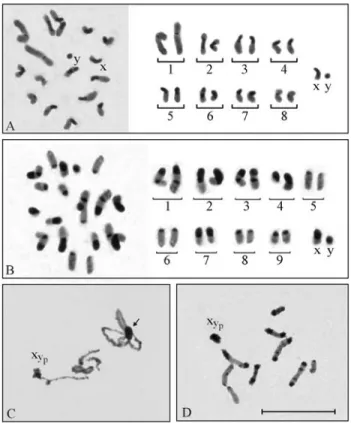
Constitutive heterochromatin (CH) analysis revealed similar C-banding patterns for both species, despite the di-phasic chromosomes, i.e., large paracentromeric blocks ob-served on each short arm of pairs 3, 4, 5 and 7 ofI. inhiata
and pairs 2, 4 and 7 ofD. mimas(Figure 1A and 1B). In
ad-dition,I. inhiatashowed telomeric blocks on pair 6 (Figure
1A), andD. mimason pairs 1 and 3 (Figure 1B). The X
chromosomes of these species were found to be almost completely heterochromatic. Non-homologous hetero-chromatic associations forming chromocenters between the bivalent autosomes were visible during the meiotic prophase and persisted until the end of pachytene (Figure 1C).
Figure 1- CH distribution pattern in spermatogonial metaphases ofI. inhiata(A) (2n = 18) andD. mimas(B) (2n = 20).AandBpresent the C-banded karyotype showing the presence of diphasic chromosomes (pairs 3, 4, 5 and 7 inA, and 2, 4 and 7 inB) and terminal bands (pair 6 in
A, and pairs 1 and 3 inB).CandDshow, respectively, pachytene and
AgNO3staining
Amorphous masses corresponding to argyrophilous proteins were observed upon AgNO3staining in the Xyp
bi-valent of the two species studied. These masses were ob-served from the beginning of prophase until the end of pachytene or the beginning of diplotene. AgNO3staining
also detected blocks similar to those observed by C-banding during the different phases of meiosis (Figures 2A and 3B).
FISH analysis revealed rDNA clusters in one autosome pair ofIsocopris inhiata(Figure 2D) and in two
autosome pairs plus in the X chromosome ofDiabroctis mimas(Figure 3C and D). In both species, these clusters
were located in chromosomes of medium size.
Discussion
The chromosome number found inD. mimaswas in accordance to that observed in most species of the suborder
Polyphaga. Therefore, the presence of acrocentric chromo-somes in this karyotype (Figure 1B) suggests the occurrence of pericentric inversions. The reduction in chromosome number and the presence of a larger pair observed in I. inhiata(Figure 1A) may be due to inversion followed by
fu-sion mechanisms between autosomes, a fact that may ex-plain the alteration in karyotype without modifying the type of sex-determining system. Such changes have been widely reported in the literature, including the karyotype evolution types proposed for Coleoptera by Yadav and Pillai (1979).
D. mimasandI. inhiatapresented an interesting
dis-tribution pattern of CH blocks, as well as a type of hetero-chromatic association forming chromocenters between some bivalent autosomes (Figure 1C). Non-homologous heterochromatic associations and chromocenter fusions in-volving various or all chromosomes seem to be a very com-mon phenomenon in insect meiosis. The heterochromatic segments of several coleopteran species present different
degrees of ectopic pairing, leading to the formation of chromocenters. This type of association seems to play an important role in nuclear organization and segregation of meiotic chromosomes in beetles (Smith and Virkki, 1978; Dretset al., 1983).
Although the CH in these species was seen mostly in pericentromeric regions, as in other beetles analyzed by the C-banding technique (Rees et al., 1976; Vidal and
Giacomozzi, 1978; Virkki, 1983; Vidal and Nocera, 1984; Postiglioni and Brum-Zorrilla, 1988; Colomba, et al.,
1996; Bione, 1999; Moura, 2002),Diabroctis mimas and Isocopris inhiata showed some telomeric blocks and
di-phasic chromosomes with one heterochromatic and one euchromatic arms (Figures 1A and 1B). According to pre-vious reports, in addition to pericentromeric C-bands, distal C-bands were also observed in the tenebrionids
Misolampus goudoti (Juan and Petitpierre, 1989) and Palembus dermestoides(Almeidaet al., 2000), while ex-clusively telomeric blocks were observed in the carabid
Bembidion minimum(Rozek and Rudek, 1992). The
addi-tional C-bands in these beetles and in D. mimas and I. inhiataprobably arose by small tandem duplications, as
proposed by King and John (1980).
Data on localization of NORs in Coleoptera suggest that an autosome pair functioning as nucleolus organiser appears to be widely distributed in this order (Virkki, 1983; Virkkiet al., 1984; Postiglioni and Brum-Zorrilla, 1988;
Colombaet al., 2000a; Mouraet al., 2003). This stands in
contrast to most Scarabaeidae, where the NOR is found in the sex bivalent (Bione, 1999; Moura, 2002)
NOR activity at the beginning of the meiotic prophase is widely observed in a large number of organ-isms, including Coleoptera species. However, this activity was observed during a restricted period of time only, de-clining rapidly and disappearing in the middle of the diplotene phase. Nevertheless, the nucleolar masses pro-duced can persist for a longer period of time, especially in species with a prolonged diplotene (Virkki and Denton, 1987; Virkkiet al., 1991). This phenomenon was clearly
observed in the two species studied here.
Studies on some curculionid beetles investigating the development and segregation of the Xypshowed that, even
when the NORs are autosomal, the lumen of the sex biva-lent is filled with a proteinaceous substance with affinity for silver, and this affinity persists from diakinesis to anaphase I. This substance is probably similar to that pres-ent in the synaptonemal complex and in the chromosome skeleton. It has been suggested that this substance may play an adhesive role, thus controlling the correct separation of the sex chromosomes (Virkkiet al., 1990, 1991). The fact
that the sex bivalents of the species analyzed here contin-ued to be labelled with silver after the disappearance of the nucleolus, as well as the high affinity of their heterochromatin for silver, suggests that the Xyp
associa-tion is not necessarily due to the NOR, but possibly to the presence of argyrophilic proteins associated with the heterochromatin of these species. These results are sup-ported by data obtained for representatives of Geotrupinae (Vitturiet al., 1999), Scarabaeinae (Colombaet al., 2000b),
Rutelinae and Dynatinae (Bione, 1999) and Melolonthinae (Moura et al., 2003) showing that the entire
heterochromatin stained by C-banding possessed high af-finity for silver, regardless of its base pair composition.
Juan et al. (1993) demonstrated that in Tenebrio molitoronly the Xypbivalent was labelled upon AgNO3
staining. However, FISH analysis using an rDNA as probe revealed 6 NORs in the mitotic metaphase chromosomes of this species, located on two different autosome pairs and on the Xpand ypchromosomes. Similarly,D. mimaspresented
two pairs of autosomes and an X chromosome carrying nu-cleolus organizer regions. On the other hand, due to the great affinity of the constitutive heterochromatin of I. InhiataandD. mimasfor the AgNO3substrate (Figures 2
and 3), we were unable to determine which NORs were ac-tive during meiosis in these species.
I. inhiataandD. mimasshowed differences in
num-ber and localization of rDNA clusters, as evidenced by the FISH method. At least forI. Inhiata, our data are in
concor-dance with the hypothesis that an autosome pair functions as nucleolus organizer in Coleoptera. The fact that the nu-cleolus organizer of D. mimas is localized in the
chromocenter could have favoured the “dislocation” of the rDNA clusters and its subsequent amplification on the other chromosomes that form the chromocenter. A plausi-ble explanation for the presence of an rDNA cluster in the X chromosome could be the occurrence of an autosome fis-sion followed by the translocation of the cluster to this chromosome.
AlthoughI. inhiataandD. mimasbelong to distinct
tribes (Coprini and Phanaeini, respectively) and present differences in their chromosome number and morphology, the data collected here show similarities between the karyo-types of these two species in respect to the amount, local-ization and behavior of the CH during meiosis, as well as to the presence of diphasic chromosomes. Our results suggest
that a similar evolutionary pathway was followed by these two species. The use of banding and FISH methods is nec-essary to establish a real karyotype overview in beetles. Further on, such studies will shed more light on the chro-mosome evolution in this subfamily.
Acknowledgments
This work was supported by grants from the Brazilian agency Fundação de Amparo à Pesquisa do Estado de São Paulo (FAPESP). We are grateful to Dr. Sérgio Ide from Instituto Biológico, São Paulo, and Fernando Vaz de Melo from Universidade Federal de Lavras (UFLA), for the taxo-nomic identification of the species used in this study. We also thank Angel Roberto Barchuk for help in preparing the rDNA probe and Dr. Adriana Mendes Nascimento and Dr. Rita de Cássia de Moura for critically reading and com-menting on a previous version of this manuscript.
References
Almeida MC, Zacaro AA and Cella DM (2000) Cytogenetic anal-ysis of Epicauta atomaria (Meloidae) and Palembus dermestoides (Tenebrionidae) with Xypsex determination
system using standard staining, C-bands, NOR and synaptonemal complex microspreading techniques. Hereditas 133:147-157.
Angus RB (1983) Separation ofHelophorus grandis,maritimus and occidentalis sp. n. (Coleoptera, Hydrophilidae) by banded chromosome analysis. Syst Entomol 8:1-13. Bione EG (1999) Citogenética de coleópteros das subfamílias
Dynastinae e Rutelinae (Polyphaga, Scarabaeoidea, Scarabaeidae). Master’s Thesis, UFPE, Brazil, 76 pp. Colomba MS, Monteresino E, Vitturi R and Zunino M (1996)
Characterisation of mitotic chromosomes of the scarab bee-tleGlyphoderus sterquilinus(Westwood) andBubas bison (L.) (Coleoptera: Scarabaeidae) using conventional and banding techniques. Biol Zentbl 115:58-70.
Colomba, MS, Vitturi R and Zunino M (2000a) Karyotype analy-sis, banding, and fluorescent in situ hybridization in the scarab beetle Gymnopleurus sturmiMcLeay (Coleoptera: Scarabaeoidea: Scarabaeidae). J Hered 91:260-264. Colomba MS, Vitturi R and Zunino M (2000b) Chromosome
analysis and rDNA FISH in the stag beetle Dorcus parallelipipedus L. (Coleoptera: Scarabaeoidea: Lucanidae). Hereditas 133:249-253.
Costa C, Vanin SA and Casari-Chen SA (1988) Larvas de coleopteros do Brasil. Museu de Zoologia, Universidade de São Paulo, Brasil, 282 pp.
Crowson RA (1967) The Natural Classification of the Families of Coleoptera. EW Classey, Middlesex, pp 213.
Drets ME, Corbella E, Panzera F and Folle GA (1983) C-banding and non-homologous association II. The “parachute” Xyp
sex bivalent and the behavior of heterochromatic segments inEpilachna paenulata. Chromosoma 88:249-255. Ennis TJ (1974) Chromosome structure in Chilocorus
Goodpasture C and Bloom SE (1975) Visualization of nucleolar organizer regions in mammalian chromosomes using silver staining. Chromosoma 53:37-50.
Hanski I and Cambefort Y (1991) Dung Beetle Ecology. Prince-ton Univ. Press, PrincePrince-ton, 481 pp.
Hubbell HR (1985) Silver staining as an indicator of active ribo-somal genes. Stain Technol 60:285-94.
Juan C and Petitpierre E (1989) C-banding and DNA content in seven species of Tenebrionidae (Coleoptera). Genome 32:834-839.
Juan C, Vazquez P, Rubio JM, Petitpierre E and Hewitt GM (1993) Presence of highly repetitive DNA sequences in Triboliumflour-beetles. Heredity 70:1-8.
King M and John B (1980) Regularities and restrictions governing C-band variation in acridoid grasshopper. Chromosoma 76:123-150.
López-León MD, Cabrero J and Camacho JP (1999). Unusually high amount of inactive ribosomal DNA in the grasshopper Stauroderus scalaris. Chromosome Res 7:83-8.
Miller DA, Dev VG, Tantravahi R and Miller OJ (1976) Suppres-sion of human nucleolus organizer activity in mouse-human somatic hybrid cells. Exp Cell Res 101:235-243.
Moura, RC (2002) Análise citogenética comparativa em coleóp-teros da familia Scarabaeidae e caracterização de polimor-fismo autossômico em Euchroma gigantea - Buprestidae (Polyphaga). Doctor’s Thesis, UFPE, Brazil, 124 pp. Moura RC, Souza MJ, Melo NF and Lira-Neto AC (2003)
Karyotypic characterization of representatives from Melolonthinae (Coleoptera: Scarabaeidae) Karyotypic anal-ysis, banding and fluorescentin situhybridization (FISH). Hereditas 138:200-206.
Natarajan AT, Santos SJ, Darroudi F, Hadjidikova V, Vermeulen S, Chatterjee S, Berg M, Grigorova M, Sakamoto-Hojo ET, Granath F, Ramalho AT and Curado MP (1998) 137Cesium-induced chromosome aberrations analyzed by fluorescencein situhybridization: Eight years follow-up of the Goiania radiation accident victims. Mutat Res 400:299-312.
Postiglioni A and Brum-Zorrilla N (1988) Non-relationship be-tween nucleolus and sex chromosomes system Xyp in
Chelymorpha variabilis Boheman (Coleoptera: Chrysomelidae). Genetica 77:134-141.
Rees RW, Fox DP and Maher EP (1976) DNA content, reiteration and satellites inDermestes. In: Jones K and Bradham PE (eds) Current Chromosome Research. Elsevier, North Hol-land, pp 33-41.
Rozek M and Rudek Z (1992) Karyotype analysis and C-banding pattern in two species of carabid (Coleoptera, Carabidae). Folia biologica 40:47-52.
Rufas JS, Giménez-Ábian J, Suja JA and Garcia de la Vega C (1987) Chromosome organisation in meiosis revealed by light microscope analysis of silver-stained “cores”. Genome 29:706-712.
Sakamoto-Hojo ET, Natarajan AT and Curado MP (1999) Chro-mosome translocations in lymphocytes from individuals ex-posed to Cs-137 7.5 years after the accident in Goiania (Brazil). Radiat Prot Dosim 86:25-32.
Smith SG and Virkki N (1978) Coleoptera. In: John B (ed) Animal Cytogenetics. Borntraeger, Berlin, Stuttgart, 366 pp. Sumner AT (1972) A simple technique for demonstrating
centromeric heterochromatin. Exp Cell Res 75:304-306. Vidal OR (1984) Coleoptera from Argentina. Genetica
65:235-239.
Vidal OR and Giaccomozzi RO (1978) Los cromosomas de la subfamilia Dynastinae (Coleoptera, Scarabaeidae). II. Las bandas C enEnema pan(Fabr.). Physis 38:113-119. Vidal OR, Giaccomozzi RO and Riva R (1977) Los cromosomas
de la subfamilia Dynastinae (Coleoptera, Scarabaeidae). I. Inversión pericéntrica en Diloboderus abderus (Sturm) 1862. Physis 37:303-309.
Vidal OR and Nocera CP (1984) Citogenética de la tribu Eucranini (Coleoptera, Scarabaeidae). Estudios convencionales y con bandeo C. Physis 42:83-90.
Virkki N (1983) Banding ofOedionychna(Coleoptera: Alticinae) chromosomes: C- and Ag-bands. J Agric Univ Puerto Rico 67:221-225.
Virkki N and Denton A (1987) Silver staining of the elements of spermatogenesis in Oedionychna (Crysomelidae: Alticinae). Hereditas 106:37-49.
Virkki N, Flores M and Escudero J (1984) Structure, orientation and segregation of the sex trivalent inPyrophorus luminosus (Coleoptera, Elateridae). Can J Genet Cytol 26:326-330. Virkki N, Mazzella C and Denton A (1990) Staining of substances
adjacent to the Xyp sex bivalent of some weevils
(Coleoptera: Curculionidae). J Agric Univ Puerto Rico 74:405-418.
Virkki N, Mazzella C and Denton A (1991) Silver staining of the coleopteran Xypsex bivalent. Cytobios 67:45-63.
Vitturi R, Colomba MS, Barbieri R and Zunino M (1999). Ribo-somal DNA location in the scarab beetle Thorectes intermedius(Costa) (Coleoptera: Geotrupidae) using band-ing and fluorescentin-situhybridization. Chromosome Re-search 7:255-260.
Yadav JS and Pillai RK (1979) Evolution of karyotypes and phylogenetic relationships in Scarabaeidae (Coleoptera). Zool Anz Jena 202:105-118.