CYP1A1
genotypes and haplotypes and risk of oral cancer:
A case-control study in South Indians
Lakshmi Balaji
1, Krishna Balaji Singh
2and Lakkakula V.K.S. Bhaskar
31
Department of Endodontics, Sri Ramachandra Dental College and Hospital,
Sri Ramachandra University, Chennai, India.
2
Department of General Surgery, Sri Ramachandra Medical College and Hospital,
Sri Ramachandra University, Chennai, India.
3Department of Biomedical Sciences, Sri Ramachandra University, Chennai, India.
Abstract
The CYP1A1 gene encodes for the enzyme, aryl hydrocarbon hydroxylase, which is involved in the biotrans-formation of various aromatic tobacco precarcinogens. In the present study, the association betweenCYP1A1 gene polymorphisms (IVS1-728G > A, Thr461Asn and Ile462Val), and the risk of oral cancer, was examined among 157 patients with oral cancer and 132 age-matched controls, in a south Indian population. The strength of the association betweenCYP1A1 variants and oral cancer was estimated by logistic regression. It was found that Thr461Asn was not polymorphic. Both IVS1-728G > A and Ile462Val frequencies were consistent with Hardy-Weinberg equilibrium in the control group. There were no significant differences in genotype or haplotype frequencies between controls and cases with oral cancer. Hence,CYP1A1 SNPs can be considered as not being associated with oral cancer at either the genotype or haplotype levels in the population studied.
Key words: CYP1A1, haplotypes, allele, oral cancer.
Received: September 7, 2011; Accepted: December 16, 2011.
Introduction
Oral squamous cell carcinoma (OSCC) is a signifi-cant global health problem with increasing incidence and mortality rates. Annually, approximately 500,000 patients are diagnosed with oral cancer worldwide (Parkinet al., 2005). Smoking is by far the major risk factor for develop-ing oral cancer. The use of alcohol and smokdevelop-ing further in-creases the risk of oral cancer, along with cancer of the lar-ynx and esophagus. About 300 carcinogens in tobacco smoke or components are known to leach from smokeless tobacco into saliva (International Agency for Research on Cancer, 1987). The most outstanding are the aromatic hy-drocarbon benzpyrene, and the tobacco-specific nitrosa-mines (TSNs), nitroso-nor-nicotine (NNN), nitrosopyr-rollidine (NPYR), nitrosodimethylamine (NDMA), and 4-(methylnitrosamino)-1-(3-pyridyl)- 1-butanone (NNK). Their metabolism usually involves oxygenation by p450 enzymes in cytochromes, followed by conjugation with the enzyme glutathione S transferase (GST) (Nakajimaet al., 1995). TheCYP1A1gene encodes for the enzyme aryl
hy-drocarbon hydroxylase, involved in the biotransformation of various aromatic tobacco precarcinogens (Nebert, 1991).
TheCYP1A1gene has seven exons and is located on chromosome 15q22-24 (Hildebrandet al., 1985). It is well established that bothCYP1A1expression and activity are inducible by PAHs through the activation of anaryl hydro-carbon receptor, a ligand activated transcription factor (Whitlock, 1999; Ma and Lu, 2007). Certain polymorphic variants ofCYP1A1genes, besides causing enhanced en-zyme activity, are also known to play a major role in the pathogenesis of several cancers (Singhet al., 2007; Wright et al., 2010; Kristiansenet al., 2011). TheseCYP1A1 poly-morphisms have been extensively studied with regard to oral cancer risk. Although some studies report increased risk in the presence of some of the mutations (Parket al., 1997; Oude Ophuiset al., 1998; Xieet al., 2004), there are many contradictory results apparently due to ethnic differ-ences (Leichsenringet al., 2006; Chatterjee et al., 2009), whereby the perception of inconsistency in findings (Zhuo et al., 2009). Since one of the major risk factors for oral cancer is tobacco use, we hypothesized that polymorphisms in genes coding for tobacco carcinogmetabolizing en-zymes may play a role in oral cancer susceptibility. There-fore, a case-control study was undertaken to extend investi-gations on specific genetic risk factors in a south Indian
www.sbg.org.br
Send correspondence to L.V.K.S. Bhaskar. Department of Biomed-ical Sciences, Sri Ramachandra University, No.1 Ramachandra Nagar, 600116 Porur, Chennai, India. E-mail: [email protected].
population, hence the evaluation of the effect ofCYP1A1 gene polymorphisms in developing this risk.
Materials and Methods
Subjects
Three ml blood samples were obtained from 157 oral-cancer patients receiving care at the Kanchipuram can-cer hospital. The mean age was 55.07±10.59 years, and in-cluded 54.8% men. Diagnosis of the oral cancer as squa-mous cell carcinoma was confirmed histopathologically. The anonymous donors, with no personal history of cancer of any organ, and which formed the control group of sub-jects, were recruited from the Sri Ramachandra Medical College. On routine questioning and examination, all the 132 control donors, with a mean age of 53.08±10.72 years and including 34.8% men, appeared healthy. For cases and controls, information regarding age, gender, occupation and details about duration, frequency, nature of the tobacco habit (smoking or smokeless), and alcohol consumption was noted through a detailed questionnaire. 54 (34.4%) of the oral-cancer patients were habitual smokers, whereas only 23 individuals (17.4%) were so in the control group. Prior to the study, all the patient-participants gave informed written-consent. The study was approved by the Ethics Committee of Sri Ramachandra University, Chennai, under the guidelines of the Ministry of Education, Culture, Sci-ence and Technology.
Genotyping
Genomic DNA was extracted from all the partici-pants, according to a published protocol (Thangarajet al., 2002). Three SNPs of theCYP1A1gene rs4646421 (Intron 1), rs1799814 (Thr461Asn) and rs1048943 (Ile462Val)
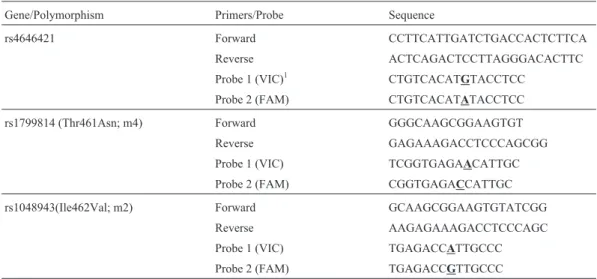
were genotyped. The primers and probes for all the SNPs (Table 1) used in this study were purchased from Applied Biosystems (Foster City, CA, USA). Each reaction con-tained 2.5 mL of TaqMan Universal PCR Master Mix, 0.125mL of TaqMan SNP Genotyping Assay, 1.375mL of distilled water and 1mL of DNA (10 ng/mL), thus reaching a final volume of 5mL. At least two non-template controls without DNA were included in each of the 384 well-plates. These plates also contained a positive control for wild-type and variant genotypes. Before DNA analysis, a pilot test was run to confirm assay-accuracy. After successful pilot testing, sample analysis was carried out with 384-well opti-cal reaction microplates (Applied Biosystem). Fluores-cence was measured with anApplied Biosystems 7900HT FastReal-Time PCR System,and analyzed with its System SDS 2.3 software version.
Statistical analysis
Allele frequencies were determined by direct gene counting. Genotype distribution of each site per sample was evaluated for Hardy-Weinberg equilibrium by using a Monte Carlo permutation test implemented in theHWSIM program (Cubells et al., 1997). Besides computing ex-pected genotype distribution according to Hardy-Weinberg proportions, HWSIM also tests for agreement between observed and expected distribution, through the usual chi-square test. In order to estimate the strength of association betweenCYP1A1variant alleles and smoking status, their interaction in causing oral cancer was assayed through logistic regression analysis. Genotype indicator variables were created by using the wild-type genotype as the reference category in regression models. As the homo-zygous Ile462Val variant trait is infrequent in the study subjects, cancer risk associated with the combined
hetero-Table 1- Primers and probes used for genotypingCYP1A1gene polymorphisms.
Gene/Polymorphism Primers/Probe Sequence
rs4646421 Forward CCTTCATTGATCTGACCACTCTTCA
Reverse ACTCAGACTCCTTAGGGACACTTC
Probe 1 (VIC)1 CTGTCACATGTACCTCC
Probe 2 (FAM) CTGTCACATATACCTCC
rs1799814 (Thr461Asn; m4) Forward GGGCAAGCGGAAGTGT
Reverse GAGAAAGACCTCCCAGCGG
Probe 1 (VIC) TCGGTGAGAACATTGC
Probe 2 (FAM) CGGTGAGACCATTGC
rs1048943(Ile462Val; m2) Forward GCAAGCGGAAGTGTATCGG
Reverse AAGAGAAAGACCTCCCAGC
Probe 1 (VIC) TGAGACCATTGCCC
Probe 2 (FAM) TGAGACCGTTGCCC
1
Probes corresponding to different alleles were labeled with VIC and FAM fluorescent dyes (Applied Biosystems).
zygous and homozygous variants in our analysis (wild-type individuals versus ‘any variant allele’) was exam-ined. The statistical package SPSS 14.0 was used for com-puting percentages, odds ratios (OR) with a 95% confidence interval and chi square tests. Linkage disequi-librium (LD) values of D’ and r2 were estimated using HaploView 3.12 (Barrettet al., 2005). The THESIAS pro-gram was also used for haplotype-phenotype analysis (Tregouet and Garelle, 2007).
Results
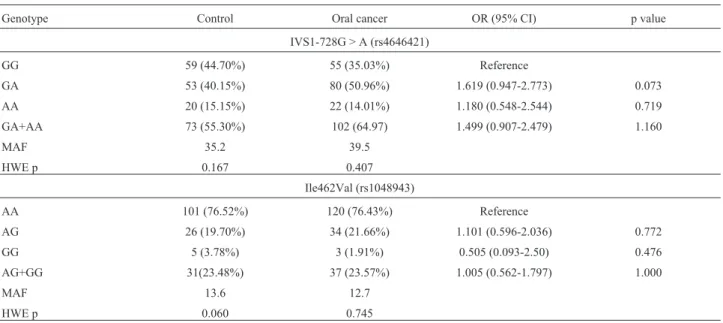
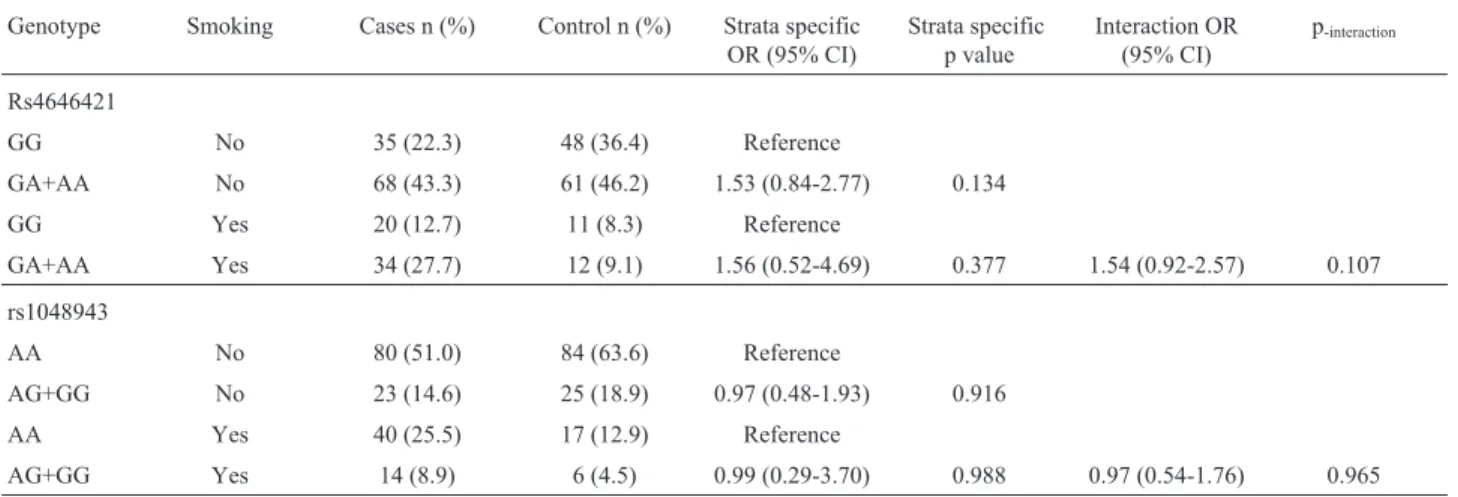
The difference between the mean ages of control and oral cancer subjects (53.08 ± 10.72 vs. 55.07 ± 10.59; p = 0.113) was insignificant. On the other hand, the per-centage of men included was 54.8% and 34.8% in oral can-cer and control groups, respectively. 54 (34.4%) of oral cancer patients of the study admitted to habitual smoking, whereas in the control group only 23 (17.4%) subjects did so. The distribution of smokers was significantly different between cases and controls (p = 0.001) with OR (CI) 2.485 (1.375-4.512). According to genotype analysis, rs1799814 was not polymorphic. Minor allele frequencies of the two polymorphisms in the control group was 35.2% and 13.6% for IVS1-728G > A and Ile462Val, respectively. For both, frequencies were consistent with Hardy-Weinberg equilib-rium in the control group (Table 2). There were no signifi-cant differences in genotype or allele frequencies of two SNPs (IVS1-728G > A and Ile462Val) between controls and cases with oral cancer (Table 2). Following stratifica-tion of the study subjects according to smoking status (non-smokers and smokers), genotype groups of both SNPS proved not to be significantly associated to oral can-cer risk. In non-smokers, observed ORs (CI) for subjects
carrying IVS1-728G > A, and Ile462Val polymorphisms were 1.529 (0.844-2.772) and 0.966 (0.483-1.930), respec-tively. As to smokers, OR (CI) values for the same geno-type groups were 1.558 (0.520-4.689) and 0.992 (0.289-3.491), respectively. Furthermore, stratified analy-sis by smoking status provided no support to either interac-tion or confounding, thereby indicating observed association to be the most precise and unbiased (Table 3). IVS1-728G > A and Ile462Val were in weak linkage dis-equilibrium (LD), D’ = 0.678; r2= 0.116. According to haplotype phenotype association analysis, there was no evi-dence of association (Table 4).
Discussion
It is well known that the induction ofCYP1A1plays a major role in the development of oral cancer and other smoking-related respiratory-tract cancers (Rendic and Guengerich, 2010). The PAHs present in tobacco smoke activate CYP1A1 gene transcription (Omiecinski et al., 1990), whereas in turn,CYP1A1enzymes convert PAHs into active carcinogens (Hechtet al., 1993). There are con-tradictory reports on the role ofCYP1A1variants in altering the levels of gene expression or mRNA stability. Ile462Val polymorphism revealed higher levels of induced or basal CYP1A1mRNA, with an increase in Val variants, whereas in purified Escherichia coli, there was no difference in benzo[a]pyrene metabolism in Ile and Val variants (Crofts et al., 1994; Zhanget al., 1996). In the present study, inves-tigation of IVS1-728G > A (rs4646421), Thr461Asn (rs1799814) and Ile462Val (rs1048943) in the CYP1A1 gene revealed only IVS1-728G > A and Ile462Val to be polymorphic in this south Indian population. Although smoking was established as a risk factor in the present
Table 2- Distribution of genotypes and the relationship between polymorphisms of the CYP1A1 gene and the risk of oral cancer.
Genotype Control Oral cancer OR (95% CI) p value
IVS1-728G > A (rs4646421)
GG 59 (44.70%) 55 (35.03%) Reference
GA 53 (40.15%) 80 (50.96%) 1.619 (0.947-2.773) 0.073
AA 20 (15.15%) 22 (14.01%) 1.180 (0.548-2.544) 0.719
GA+AA 73 (55.30%) 102 (64.97) 1.499 (0.907-2.479) 1.160
MAF 35.2 39.5
HWE p 0.167 0.407
Ile462Val (rs1048943)
AA 101 (76.52%) 120 (76.43%) Reference
AG 26 (19.70%) 34 (21.66%) 1.101 (0.596-2.036) 0.772
GG 5 (3.78%) 3 (1.91%) 0.505 (0.093-2.50) 0.476
AG+GG 31(23.48%) 37 (23.57%) 1.005 (0.562-1.797) 1.000
MAF 13.6 12.7
HWE p 0.060 0.745
study, IVS1-728G > A and Ile462Val polymorphisms of theCYP1A1gene were not associated with the risk of oral cancer. Furthermore,CYP1A1SNPs could not even be as-sociated with oral cancer at either the genotype or haplo-type levels.
Although Thr461Asn (m4), specific for Caucasians and with a frequency ranging from 3 to 6%, has also been related to greater enzyme catalytic efficiency (Schwarzet al., 2001), none of the subjects in our sample carried this variant. The famous and well studied Ile462Val (m2) vari-ant inCYP1A1, present in both Caucasians (7%) and Asians (35%), is mostly detected in linkage disequilibrium with m1 (MspI site) (Georgiadis et al., 2005). A study from North India revealed 51% and 17% of theCYP1A1m2 al-lele (462Val carriers), respectively, in oral cancer and con-trols, thus associated with increased risk (Sreelekhaet al., 2001). In another study, also of a north Indian population, the frequencies of genotypes were similar in patient and control groups, with no indication of any significant associ-ation (Sikdaret al., 2003). An analysis of Caucasian oral-cancer patients revealed almost identical heterozygous ge-notype distribution between cases and controls (6.5% oral cancer, 4.3% controls), with no association between m2 and oral cancer (Hahnet al., 2002). The Ile462Val hetero-zygous genotype is significantly associated with the earlier age of onset of OSCC than in the wild homozygous
geno-type (Kaoet al., 2002). Two independent case-control stud-ies from Puerto Rico and south Brazil, revealed that genotypes of theCYP1A1(462Val) variant were not associ-ated with oral-cancer risk (Xieet al., 2004; Leichsenringet al., 2006). Chilean individuals carrying a T to C substitu-tion at the 3’ untranslated region (CYP1A1*2A/ m1 allele/ rs4646903), are reported to be more susceptible to oral can-cer induced by environmental tobacco smoking (Corderoet al., 2010).
Although no association betweenCYP1A1genotypes and oral cancer has been reported from various geographic regions, such as Japan (Sugimura et al., 2006), Brazil (Leichsenring et al., 2006; Marques et al., 2006; Losi-Guembarovskiet al., 2008), the USA (using whites) (Buch et al., 2008), and Jakarta (Amthaet al., 2009), theCYP1A1 (m2/m2) genotype did present this association with in-creased risk, in Koreans (Chaet al., 2007). Furthermore, gene to gene interaction studies revealed that, besides oral cancer (Anantharaman et al., 2007), GSTM1 null and CYP1A1polymorphism increased the risk of head and neck cancers (Gattaset al., 2006).
In the present study, the prevalence of IVS1-728G > A, and Ile462Val polymorphisms in theCYP1A1gene in south Indian oral-cancer patients and controls, was pre-sented. Apparently there was no association between this gene and oral cancer. Although the whole range of poly-morphic genes involved in detoxification metabolism have been the base of intensive epidemiological studies over the past few years, further investigation is still called for in or-der to determine whether these or additional gene-gene in-teractions are crucial in determining the possibility of carriers ofCYP1A1alleles presenting an increased or re-duced risk of cancer.
Acknowledgments
This research work was supported by an intramural grant from Sri Ramachandra University, Chennai.
Table 3- Joint effects between genotypes and smoking status.
Genotype Smoking Cases n (%) Control n (%) Strata specific
OR (95% CI)
Strata specific p value
Interaction OR (95% CI)
p-interaction
Rs4646421
GG No 35 (22.3) 48 (36.4) Reference
GA+AA No 68 (43.3) 61 (46.2) 1.53 (0.84-2.77) 0.134
GG Yes 20 (12.7) 11 (8.3) Reference
GA+AA Yes 34 (27.7) 12 (9.1) 1.56 (0.52-4.69) 0.377 1.54 (0.92-2.57) 0.107
rs1048943
AA No 80 (51.0) 84 (63.6) Reference
AG+GG No 23 (14.6) 25 (18.9) 0.97 (0.48-1.93) 0.916
AA Yes 40 (25.5) 17 (12.9) Reference
AG+GG Yes 14 (8.9) 6 (4.5) 0.99 (0.29-3.70) 0.988 0.97 (0.54-1.76) 0.965
Abbreviations: CI, confidence interval; OR, odds ratio.
Table 4-CYP1A1gene haplotypes and oral cancer.
rs4646421 and rs1048943
Haplotype Control Case OR (95% CI) p value
GA 0.613 0.585 Reference
GG 0.034 0.02 0.511 (0.142-1.842) 0.305
AA 0.25 0.287 1.185 (0.794-1.767) 0.407
References
Amtha R, Ching CS, Zain R, Razak IA, Basuki B, Roeslan BO, Gautama W and Purwanto D (2009) GSTM1, GSTT1 and CYP1A1 polymorphisms and risk of oral cancer: A case-control study in Jakarta, Indonesia. Asian Pac J Cancer Prev 10:21-26.
Anantharaman D, Chaubal PM, Kannan S, Bhisey RA and Mahimkar MB (2007) Susceptibility to oral cancer by ge-netic polymorphisms at CYP1A1, GSTM1 and GSTT1 loci among Indians: Tobacco exposure as a risk modulator. Carcinogenesis 28:1455-1462.
Barrett JC, Fry B, Maller J and Daly MJ (2005) Haploview: Anal-ysis and visualization of LD and haplotype maps. Bioin-formatics 21:263-265.
Buch SC, Nazar-Stewart V, Weissfeld JL and Romkes M (2008) Case-control study of oral and oropharyngeal cancer in whi-tes and genetic variation in eight metabolic enzymes. Head Neck 30:1139-1147.
Cha IH, Park JY, Chung WY, Choi MA, Kim HJ and Park KK (2007) Polymorphisms of CYP1A1 and GSTM1 genes and susceptibility to oral cancer. Yonsei Med J 48:233-239. Chatterjee S, Chakrabarti S, Sengupta B, Poddar S, Biswas D,
Sengupta S and Talukder G (2009) Prevalence of CYP1A1 and GST polymorphisms in the population of northeastern India and susceptibility of oral cancer. Oncol Res 17:397-403.
Cordero K, Espinoza I, Caceres D, Roco A, Miranda C, Squic-ciarini V, Santander P, Lee K, Saavedra I and Quinones L (2010) Oral cancer susceptibility associated with the CYP1A1 and GSTM1 genotypes in Chilean individuals. Oncol Lett 1:549-553.
Crofts F, Taioli E, Trachman J, Cosma GN, Currie D, Toniolo P and Garte SJ (1994) Functional significance of different hu-man CYP1A1 genotypes. Carcinogenesis 15:2961-2963. Cubells JF, Kobayashi K, Nagatsu T, Kidd KK, Kidd JR, Calafell
F, Kranzler HR, Ichinose H and Gelernter J (1997) Popula-tion genetics of a funcPopula-tional variant of the dopamine beta-hydroxylase gene (DBH). Am J Med Genet 74:374-379. Gattas GJ, de Carvalho MB, Siraque MS, Curioni OA, Kohler P,
Eluf-Neto J and Wunsch-Filho V (2006) Genetic polymor-phisms of CYP1A1, CYP2E1, GSTM1, and GSTT1 associ-ated with head and neck cancer. Head Neck 28:819-826. Georgiadis P, Topinka J, Vlachodimitropoulos D, Stoikidou M,
Gioka M, Stephanou G, Autrup H, Demopoulos NA, Katsouyanni K, Sram R,et al.(2005) Interactions between CYP1A1 polymorphisms and exposure to environmental to-bacco smoke in the modulation of lymphocyte bulky DNA adducts and chromosomal aberrations. Carcinogenesis 26:93-101.
Hahn M, Hagedorn G, Kuhlisch E, Schackert HK and Eckelt U (2002) Genetic polymorphisms of drug-metabolizing en-zymes and susceptibility to oral cavity cancer. Oral Oncol 38:486-490.
Hecht SS, Carmella SG, Murphy SE, Foiles PG and Chung FL (1993) Carcinogen biomarkers related to smoking and upper aerodigestive tract cancer. J Cell Biochem Suppl 17F:27-35. Hildebrand CE, Gonzalez FJ, McBride OW and Nebert DW
(1985) Assignment of the human 2,3,7,8-tetrachlorodiben-zo-p-dioxin-inducible cytochrome P1-450 gene to chromo-some 15. Nucleic Acids Res 13:2009-2016.
International Agency for Research on Cancer (1987) IARC Monographs on the Evaluation of Carcinogenic Risks to Hu-mans. Supplement. Secretariat of the World Health Organi-zation distributor, Geneva, 5 pp.
Kao SY, Wu CH, Lin SC, Yap SK, Chang CS, Wong YK, Chi LY and Liu TY (2002) Genetic polymorphism of cytochrome P4501A1 and susceptibility to oral squamous cell carcinoma and oral precancer lesions associated with smoking/betel use. J Oral Pathol Med 31:505-511.
Kristiansen W, Haugen TB, Witczak O, Andersen JM, Fossa SD and Aschim EL (2011) CYP1A1, CYP3A5 and CYP3A7 polymorphisms and testicular cancer susceptibility. Int J Androl 34:77-83.
Leichsenring A, Losi-Guembarovski R, Maciel ME, Losi-Guem-barovski A, Oliveira BW, Ramos G, Cavalcanti TC, Bicalho MG, Cavalli IJ, Colus IM,et al.(2006) CYP1A1 and GSTP1 polymorphisms in an oral cancer case-control study. Braz J Med Biol Res 39:1569-1574.
Losi-Guembarovski R, Colus IM, De Menezes RP, Poliseli F, Chaves VN, Kuasne H, Leichsenring A, Guembarovski AL, Oliveira BW, Ramos G, et al.(2008) Lack of association among polymorphic xenobiotic-metabolizing enzyme geno-types and the occurrence and progression of oral carcinoma in a Brazilian population. Anticancer Res 28:1023-1028. Ma Q and Lu AY (2007) CYP1A induction and human risk
as-sessment: An evolving tale ofin vitroandin vivostudies. Drug Metab Dispos 35:1009-1016.
Marques CF, Koifman S, Koifman RJ, Boffetta P, Brennan P and Hatagima A (2006) Influence of CYP1A1, CYP2E1, GSTM3 and NAT2 genetic polymorphisms in oral cancer susceptibility: Results from a case-control study in Rio de Janeiro. Oral Oncol 42:632-637.
Nakajima T, Elovaara E, Anttila S, Hirvonen A, Camus AM, Hayes JD, Ketterer B and Vainio H (1995) Expression and polymorphism of glutathione S-transferase in human lungs: Risk factors in smoking-related lung cancer. Carcinogenesis 16:707-711.
Nebert DW (1991) Role of genetics and drug metabolism in hu-man cancer risk. Mutat Res 247:267-281.
Omiecinski CJ, Redlich CA and Costa P (1990) Induction and de-velopmental expression of cytochrome P450IA1 messenger RNA in rat and human tissues: Detection by the polymerase chain reaction. Cancer Res 50:4315-4321.
Oude Ophuis MB, van Lieshout EM, Roelofs HM, Peters WH and Manni JJ (1998) Glutathione S-transferase M1 and T1 and cytochrome P4501A1 polymorphisms in relation to the risk for benign and malignant head and neck lesions. Cancer 82:936-943.
Park JY, Muscat JE, Ren Q, Schantz SP, Harwick RD, Stern JC, Pike V, Richie Jr JP and Lazarus P (1997) CYP1A1 and GSTM1 polymorphisms and oral cancer risk. Cancer Epide-miol Biomarkers Prev 6:791-797.
Parkin DM, Bray F, Ferlay J and Pisani P (2005) Global cancer statistics, 2002. CA Cancer J Clin 55:74-108.
Rendic S and Guengerich FP (2010) Update information on drug metabolism systems-2009, part II: Summary of information on the effects of diseases and environmental factors on hu-man cytochrome P450 (CYP) enzymes and transporters. Curr Drug Metab 11:4-84.
ben-zo[a]pyrene-7,8-dihydrodiol by human CYP1A1 variants. Carcinogenesis 22:453-459.
Sikdar N, Mahmud SA, Paul RR and Roy B (2003) Polymorphism in CYP1A1 and CYP2E1 genes and susceptibility to leu-koplakia in Indian tobacco users. Cancer Lett 195:33-42.
Singh N, Mitra AK, Garg VK, Agarwal A, Sharma M, Chaturvedi R and Rath SK (2007) Association of CYP1A1 polymor-phisms with breast cancer in North Indian women. Oncol Res 16:587-597.
Sreelekha TT, Ramadas K, Pandey M, Thomas G, Nalinakumari KR and Pillai MR (2001) Genetic polymorphism of CYP1A1, GSTM1 and GSTT1 genes in Indian oral cancer. Oral Oncol 37:593-598.
Sugimura T, Kumimoto H, Tohnai I, Fukui T, Matsuo K, Tsurusako S, Mitsudo K, Ueda M, Tajima K and Ishizaki K (2006) Gene-environment interaction involved in oral carci-nogenesis: Molecular epidemiological study for metabolic and DNA repair gene polymorphisms. J Oral Pathol Med 35:11-18.
Thangaraj K, Joshi MB, Reddy AG, Gupta NJ, Chakravarty B and Singh L (2002) CAG repeat expansion in the androgen re-ceptor gene is not associated with male infertility in Indian populations. J Androl 23:815-818.
Tregouet DA and Garelle V (2007) A new JAVA interface imple-mentation of THESIAS: Testing haplotype effects in associ-ation studies. Bioinformatics 23:1038-1039.
Whitlock Jr JP (1999) Induction of cytochrome P4501A1. Annu Rev Pharmacol Toxicol 39:103-125.
Wright CM, Larsen JE, Colosimo ML, Barr JJ, Chen L, McLachlan RE, Yang IA, Bowman RV and Fong KM (2010) Genetic association study of CYP1A1 polymor-phisms identifies risk haplotypes in nonsmall cell lung can-cer. Eur Respir J 35:152-159.
Xie H, Hou L, Shields PG, Winn DM, Gridley G, Bravo-Otero E, Diehl SR, Bowman ED, Brown LM and Hayes RB (2004) Metabolic polymorphisms, smoking, and oral cancer in Puerto Rico. Oncol Res 14:315-320.
Zhang ZY, Fasco MJ, Huang L, Guengerich FP and Kaminsky LS (1996) Characterization of purified human recombinant cytochrome P4501A1-Ile462 and -Val462: Assessment of a role for the rare allele in carcinogenesis. Cancer Res 56:3926-3933.
Zhuo W, Wang Y, Zhuo X, Zhu Y, Wang W, Zhu B, Li D and Chen Z (2009) CYP1A1 and GSTM1 polymorphisms and oral cancer risk: Association studies via evidence-based meta-analyses. Cancer Invest 27:86-95.
Associate Editor: Jeremy A. Squire