www.jped.com.br
ORIGINAL
ARTICLE

-defensin-2
in
breast
milk
displays
a
broad
antimicrobial
activity
against
pathogenic
bacteria
夽
,
夽夽
Joanna
Baricelli
a,b,
Miguel
A.
Rocafull
a,b,
Desiree
Vázquez
a,b,
Betsi
Bastidas
b,c,
Estalina
Báez-Ramirez
a,b,
Luz
E.
Thomas
a,b,∗aLaboratoriodeFisiologíaMolecular,CentrodeBiofísicayBioquímica,InstitutoVenezolanodeInvestigacionesCientíficas(IVIC),
Caracas,Venezuela
bBancodeLecheHumana,HospitalUniversitariodeCaracas,Caracas,Venezuela cLaboratorioDelgadoLaunois,ClínicaLugo,Maracay,Venezuela
Received7March2014;accepted14May2014 Availableonline7September2014
KEYWORDS
Antimicrobialcationic peptides;
hBD2; Lactancy; Defensins;
Anti-infectiveagents; Breastmilk
Abstract
Objective: Todescribetheantimicrobialactivityof-defensin-2 producedinthemammary
glandandsecretedinhumanbreastmilk.
Methods: Thepeptide productionwas performed by DNA cloning. -defensin-2 levels were
quantifiedin61 colostrumsamples and39 maturemilksamples fromhealthydonors, byan indirect enzyme-linkedimmunosorbent assay (ELISA). Usinghalo inhibition assay,this study assessedactivityagainstsevenclinicalisolatesfromdiarrhealfecesofchildrenbetween0and 2yearsofage.The activityof-defensin-2against threeopportunistic pathogensthatcan causenosocomialinfectionswasdeterminedbymicrodilutiontest.
Results: The peptidelevels were higher incolostrum (n=61) thanin mature milk samples
(n=39),asfollows:medianandrange,8.52(2.6-16.3)g/mlversus0.97(0.22-3.78),p<0.0001; Mann-Whitney test. The recombinant peptide obtained showed high antimicrobial activity against a broad range of pathogenic bacteria. Its antibacterial activity was demonstrated in a disk containing between 1---4g, which produced inhibition zones ranging from 18 to 30mmagainstthreeisolatesofSalmonellaspp.andfourofE.coli.-defensin-2showed min-imuminhibitoryconcentrations (MICs)of0.25g/mLand0.5g/mLfor S.marcescenandP.
aeruginosa,respectively, whileahigher MIC (4g/mL)was obtainedagainst anisolatedof
multidrug-resistantstrainofA.baumannii.
夽 Pleasecitethisarticleas:BaricelliJ,RocafullMA,Vázquez D,BastidasB,Báez-RamirezE,ThomasLE.
-defensin-2 inbreastmilk displaysabroadantimicrobialactivityagainstpathogenicbacteria.JPediatr(RioJ).2015;91:36---43.
夽夽ThisworkwassupportedbyagrantfromInstitutoVenezolanodeInvestigacionesCientíficas(IVIC),Caracas,Venezuela. ∗Correspondingauthor.
E-mail:[email protected],[email protected](L.E.Thomas).
http://dx.doi.org/10.1016/j.jped.2014.05.006
Conclusions: Totheauthors’knowledge,thisstudyisthefirsttoreport-defensin-2levelsin LatinAmericanwomen.Theproductionandtheactivityof-defensin-2inbreastmilkprove itsimportanceasadefensemoleculeforintestinalhealthinpediatricpatients.
©2014SociedadeBrasileiradePediatria.PublishedbyElsevierEditoraLtda.Allrightsreserved.
PALAVRAS-CHAVE Peptídeoscatiônicos antimicrobianos; hBD2;
Lactac¸ão; Defensinas; Agentes
anti-infecciosos; Leitematerno
-defensina2noleitematernomostraumaamplaatividadeantimicrobianacontra bactériaspatogênicas
Resumo
Objetivo: Descrever aatividadeantimicrobiana dadefensina-beta2naglândulamamáriae
secretadanoleitematernohumano.
Métodos: Aproduc¸ãodepeptídeosfoirealizadaporclonagemdeDNA.Osníveisde
defensina-beta 2foram quantificadosem 61 amostras de colostroe 39 de leite madurode doadoras saudáveispelotesteELISAindireto.Porumensaiodehalodeinibic¸ão,avaliamosaatividade contraseteisoladosclínicosdiarreicosdecrianc¸asentre0e2anos.Aatividadedadefensina 2contratrêspatógenosoportunistasquepodemcausarinfecc¸õesnosocomiaisfoideterminada pelotestedemicrodiluic¸ão.
Resultados: Osníveisdepeptídeosestavamsignificativamentemaioresnasamostrasdecolostro
(n=61)quedeleitemaduro(n=39),comosegue:8,52(2,6-16,3g/mL)medianaefaixaem comparac¸ãoa0,97(0,22-3,78),p<0,0001;testedeMann-Whitney.Opeptídeorecombinante foiobtidodaaltaatividadeantimicrobianademonstradacontraumaamplagamadebactérias patogênicas. Sua atividadeantibacteriana foi demonstradaem um discocontendo entre 1-4g,queproduziuzonasdeinibic¸ãoentre18e30mmcontratrêsisoladosdeSalmonellaspp. equatrodeE.coli.Adefensina-beta2demonstrouconcentrac¸õesinibitóriasmínimas(CIMs)
de0,25g/mLe0,5g/mLparaS.marcescenandP.aeruginosa,aopassoqueumaCIMmaior
(4g/mL)foiobtidacontraumisoladodecepamultirresistentedeA.baumannii.
Conclusões: Atéondesabemos,esteestudoéoprimeiroarelatarníveisdedefensinaem
mul-heresdaAméricaLatina.Aproduc¸ãoeaatividadedadefensina2noleitematernocomprovam suaimportânciacomoumamoléculadedefesaparaasaúdeintestinalempacientespediátricos. ©2014SociedadeBrasileiradePediatria.PublicadoporElsevierEditoraLtda.Todososdireitos reservados.
Introduction
TheWorldHealthOrganizationreportsthat6.6million chil-dren under the age of 5 died in 2012. Moreover, 44% of those deaths occurred during the neonatal period. From theendoftheneonatalperiodthroughthefirst5yearsof life,themaincausesofdeatharepneumonia,diarrhea,and malaria. Malnutritionis theunderlying contributingfactor in approximately45% of allchild deaths, makingchildren morevulnerabletoseverediseases.1Overhalfoftheseearly
childdeathsareduetoconditionsthatcouldbeprevented ortreatedwithaccesstosimple,affordableinterventions; oneofthemisbreastfeeding.
Solelyduringlactancy,humansconfrontthechallengeof survivalbymeansofbreastmilk.Humanmilkisassociated withprotectionagainstdiarrhealdiseases,respiratory-tract infections, and necrotizing enterocolitis (NEC).2---5
Protec-tionagainstinfectioninbreastfedinfantsappearstooccur through a variety of complementary acquired and innate defensefactorsfoundinhumanmilk,including oligosaccha-ridesandtheirglycoconjugates,6andantimicrobialpeptides
(AMPs).7,8
AmongAMPs,thedefensinsfamilyconstitutesan impor-tantpartoftheinnateimmuneresponseinfluidssecretion.
Increasingevidence suggests the importanceof defensins in the immune response. Results in recent studies on the homeostatic and disease-fighting activities of human defensinspoint totheir keyrelevancein severalpediatric disorders.Forexample, high -defensin-2 (hBD2) concen-trationsreflectingstrongintestinalimmuneresponseswere associatedwithmoderatecoursesofNEC.9However,infants
with severe NEC showed no increase in fecal hBD2 con-centrations before and during the disease. These studies suggest that a specific deficiency of innate defense acti-vationinextremely-lowbirthweight(ELBW)infantsrather than an impaired intestinal epithelial barrier leads to a moresevere courseofNEC.9Inthiscontext,theintakeof
hBD2frombreastmilkgainsimportance.Notably,intestinal hBD2levelscorrespondtobothdefensininbreastmilk7,8,10
andsecretions ofintestinalepithelialcells. Thelatter are induced by catalytic antibodies contained in breast milk, actingthroughprotease-activatedreceptor-2presentinthe plasmamembrane.11
The concentrations of total and specific components of human breast milk vary between mothers, diurnally, based on infant’s gestational age, and over the course of lactation.10,12 Presence of intact hBD2 has also been
withstand the digestive processes of the gastrointestinal tract.13Indeed,ithasbeenproposedthatdefensin
quantifi-cationinfecescouldbeaneffectivebiomarkerofintestinal healthanddiseaseinpediatricpopulation.14Theresistance
ofhBD2 todigestionwouldincrease itsavailability,which wouldallow to protectthe entire mucosal surfaceof the gastrointestinaltract.
This study had a two-fold aim. First, to quantify the hBD2 in breast milk from Venezuelan donors. Second, to characterize the antimicrobial activity of BD2 against bothbacteriumassociatedwithenterocolitisininfantsand againstGram-negativebacteriaassociatedwithnosocomial infections.
Materials
and
methods
Materials
The TOPO® TA Cloning® kit for sequencing and the pET
directionalTOPO®expressionkitwerepurchasedfrom
Invi-trogen (Invitrogen Corp., Carlsbad, Califórnia, USA). All otherreagentswereofanalyticalreagentgrade.
Humanmilkcollectionandpreparation
Aninformedconsentfromalldonorsinvolvedinthisstudy wasobtainedpriortoobtainingandprocessingthesamples. Noneofthedonorsinthestudyhadhistoryofrheumatologic, respiratory,cardiovascular,orgastrointestinaldiseases.The inclusioncriteriawerehealthylactatingmotherswithterm delivery.Theexclusioncriteriaweremotherswhohadhad cesareandeliveries,werereceivingantibiotictreatmenton suspicion of infection, or with a history of autoimmune diseases. Samplesfrom day oneto day sevenafter child-birthweredenotedascolostrum,whereassamplescollected beyondthetenthdayofbirthweretermedmaturemilk.
Thisstudyobtained61colostrumand39maturesamples. All samples were collected using a standardized protocol approvedby the BioethicsCommitteeof the Clinical Uni-versityHospitalatUniversidadCentraldeVenezuela(UCV). Sampleswerecollectedfromhealthyhumanmothers(18to 30yearsold)withsupportfromthemilkbankserviceofthe ClinicalUniversityHospital.Priortoextraction,thenipples werecleanedandswabbedwithwarmsterilewater.
Sampleswerecollectedfromonebreast,andcentrifuged at4◦C(1,000×gfor15min)sothatsampleshadapelletof cellsatthebottomandafatlayeratthetop.Whey super-natant inthe middlewasaliquoted andfrozen at −80◦C. Whenreadyforuse,milkwasthawedat4◦C.
Cellscultures
Cultured SKBR3 cells (human breast adenocarcinoma cell line,HTB-30cat.,No.11965-092AmericanTypeCulture Col-lection(ATCC),Manassas,USA).
Bacterialstrains
Clinical isolates: Acinetobacter baumannii (multidrug-resistantstrainisolatedfromapatientsufferingnosocomial
infectionofCaracasUniversityHospital-UCV)waskindly pro-videdbyDr.G.Alonso(InstitutodeBiología Experimental-UCV). In total, seven enteropathogens from children’s diarrheal samples were tested, three belonging to genus
Salmonella (Salmonella paratyphi, Salmonella arizona, Salmonella sp.) and four different isolates of E. coli. All were identifiedwith standard bacteriologicalassays using aVitek® 32andGNIcard(BioMérieuxInc.,Missouri,USA).
The Pseudomonas aeruginosa ATCC 276532 strain was courtesyofDr.TakiffofMolecularGeneticsLaboratory-IVIC.
EscherichiacoliATCC25922wasobtainedfromATCC.
Animals
Five-month-oldbrownhenswereboughtfromalocalfarmer.
Reversetranscriptionpolymerasechainreaction
(RT-PCR)
SKBR3cellsweregrownto80%confluence.Cellswerethen treatedfor4hwithlipopolysaccharide(LPS)(1g/mL),as describedpreviously.11RNAwasextractedfromSKBR3cells
using Trizol® (Invitrogen,Carlsbad, CA,USA) according to the manufacturer’s instructions. BD2 cDNA was amplified byRT-PCRusingsenseandantisensehBD2primers,as pre-viouslyreported.11 Directionalcloning ofPCRproductwas
achievedusingdesignedprimerswithparticularrestriction sites.
hBD2S:CCCGGGCATGAGGGTCTTGTATCTCCTCTTC hBD2R:GAATTCGGAGCCCTTTCTGAATCCGCA;(255bp) TheresultingPCR products werepurifiedandencoding full-length genehBD2fromSKBR3cells wasclonedinpET 100vector(ChampionpETdirectionalTOPOexpressionand cloningkit,Invitrogen).Thefusionproteinswereexpressed in anE. coli(StrainBL21DE3) system accordingto manu-facturer’sinstructions.Therecombinantfusion-proteinwas usedinbothantimicrobialactivityassays.Italsowasused toproduceantibodiesfromhens’eggyolks.
Productionandpurificationofantibodiesfromegg
yolksforrecombinanthBD2
Theantigen100g(recombinanthBD2)wasdilutedinPBS (pH7.2)andemulsifiedwithanequalvolumeofincomplete Freund’s adjuvant. Suspension wasinjected subcutaneous inthe birds.Furtherinjections oftheprotein,weregiven tothe hens 7,21, 31, and42 dayslater.IgY waspurified fromindividualeggsusingacommercialChickenIgY Purifi-cationkit(PierceBiotechnology,CatN◦
44918,Illinois,USA) followingmanufacturerinstructions.Priortothe immuniza-tion,IgYwaspurifiedinordertoobtainpre-immuneIgYtobe usedasnegativecontrolintheenzyme-linked immunosor-bentassay(ELISA)standardization.
hBD2quantificationbyindirectELISA
Commercial recombinant Human BD-1 and BD-2 (Cat N◦ 300-51A and 300-49; PeprotechMéxico) were used. Stan-dards and samples were diluted into carbonate coating buffer,andplateswereblockedduring4hin200mLblocking buffer.PolyclonalIgYchickenanti-human-defensin-2was dilutedinblockingbuffer 1:1000andadded(100L).Two hours later, secondary rabbit anti-immunoglobulin Y (IgY) peroxidase-conjugate (1:5000 dilution) in blocking buffer wasadded(100L)andincubatedfor1.5h.Thecolorimetric reactionwasperformedasdescribedpreviously.11Asa
con-trol,samplesineachplate wererunwithpre-immuneIgY or without primaryantibodies toascertain any unspecific binding. The defensin concentrationof sampleswas com-putedbyinterpolatingthreestandardcurvesconstructedvia
serialtwofolddilutionsoftherecombinanthBD2.The opti-malsampledilutionwasestablishedbytitrationandvaried between donors.The controltests demonstratedthat the polyclonalusedfor-defensins-2wereselective.Thus,the IgYanti-defensin2didnotreactwith-defensin1.
Antimicrobialactivityassays
TheassayedstrainsweregrowninliquidLuria-Bertani(LB) medium to OD600 ∼1.0. The resulting suspensions were
dilutedto aconcentration of ∼104 CFU permL. A100L
aliquot of LB was dispensed into 96-well plates.15 The
antibacterial activity of hBD2 was evaluated with seri-ally diluted peptide to obtain concentrations of 8; 4; 2; 1; 0.5; 0.25 and 0.125g/mL. A growth control contain-ingnohBD2andasterilitycontrolwithout inoculumwere also included for each strain. Plates were incubated at 35◦C and measurements of turbidity at 600nm using the
SynergyHTmultidetection microplatereader(SynergyHT, Bio-TekInstruments,Vermont,USA).Inasingleexperiment, each hBD2 concentration was tested in triplicate. Each microorganismwasanalyzedinat leastthreeindependent experiments.Statisticalanalysisanddose responsecurves wereobtained usingthe K4softwareprovided bySynergy HT(Bio-TekInstruments,Vermont,USA).Minimuminhibitory concentrations (MICs) were determined from the growth inhibitionprofilescurves,measuredwithanabsorbanceof OD600nm,andrepresentthelowestconcentrationofthe hBD2thatinhibitedthebacterialgrowthby90% at24hof culture.
Antimicrobialsusceptibilitybydiskdiffusiontests
Invitrosusceptibility ofclinicalisolatestodefensincould beroughlydeterminedbydiskdiffusiontests.16 Kanamycin
wasusedasaninternalcontrol.Diskswerepreparedusing astocksolutionofantibioticaddingantimicrobialsolution toeach paperdisk, usingFilterpapersheets fromBioRad (Thick blot paper catalog No. 170-3956). They were pre-paredwithinonehourpriortotheapplicationtotheplates, allowingapproximately30minutesforantibioticabsorption. Prepareddiskswerenotstoredandweredrybefore appli-cation.
After24hofincubation,theinhibitionzoneswere mea-sured. Diameterof the areas of inhibition wasconverted tothecategoriesofsusceptible,intermediate,orresistant (S,I,orR,respectively)accordingtostandardtables.The
interpretation,breakpoints,andcategorizationscheme fol-lowedtheClinicalandLaboratoryStandardInstitute(CLSI) recommendations.17
Statisticalanalysis
Graphicalpresentationand statisticalanalysisof thedata wereperformedusingGraphPadPrism(version4.0)software
(GraphPad Software Inc., California, USA). The
Mann-WhitneyU test wasusedfor comparisonbetween groups. Statisticalsignificancewassettop<0.05.
Results
ExpressionoftherecombinanthBD2peptide
The recombinant hBD2 peptide wasproduced from
mam-maryepithelial cellcDNA based onthe knownnucleotide sequenceofhBD2(alsoknownasDEFB4A).Itsidentitywas setbyDNAsequenceanalysis.Thisrecombinantpeptidewas usedtoproducepolyclonalIgY,whoseantibodieswereused inindirectELISAfordetectionandquantificationofhuman
-defensininhumanmilksamples.
QuantificationofhBD2inhumanbreastmilk
samples
Atotalof 100 healthy Venezuelan motherswere included inthisstudy.Thepeptidelevelsweresignificantlyhigherin colostrum(8.52[2.6-16.3g/mL])thaninmaturemilk sam-ples(0.97[0.22-3.78];p<0.0001;Mann-Whitneytest).The hBD2 quantificationin human milk samplesshowed inter-individualvariability aswell asin each stageof lactation (Fig.1).
20
18
16
14
12
10
8
6
4
2
0
hBD-2 (
µ
g/ml)
Colostrum Mature
Antimicrobialactivityassays
The recombinant peptide was analyzed for
anti-enteropathogens activity. Results of these experiments areshowninTable1andFig.2.
AccordingtotheCLSI,controlofKanamycinata concen-trationof30ginthediskmustproduceaninhibitionhalo of 18-25mm against E.coli ATCC 25922.17 In the present
study,thecontrolshowedaninhibitionof20mm(Table1). There is no standard diameter measure for inhibition by defensin. However, strong bactericidal properties were observedagainstallsevenisolatesobtainedfromdiarrheal stoolwithdiametersover18mm.
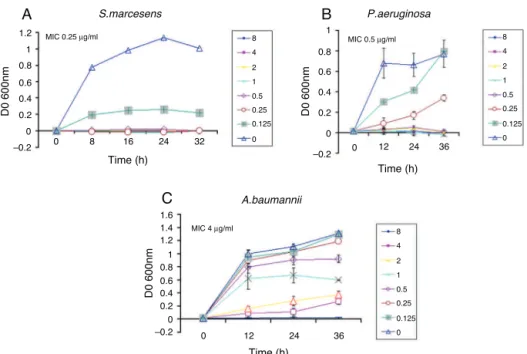
Additionally, hBD2 exhibited antimicrobial activity against three strains representative of bacterial species involvedinnosocomial infections.MICsof0.25g/mLand 0.5g/mLwereobservedforS.marcescen andP. aerugin-osa,while arelatively higherMIC(4g/mL)wasobserved
againstaclinicalisolateofamultidrug-resistantstrainofA. baumannii.
Discussion
Developmental delays in the immune system of human
infants are compensated by the mammary gland,
pro-viding the necessary protection. Lactancy provides not only nourishment but also vital protection against
envi-ronmental pathogens. Even with high interindividual
variabilityinlevelsofdifferentmilk-relatedprotecting fac-tors,breastfeedingprovidesprotectionagainstnecrotizing enterocolitis,4 gastrointestinal infection,3 and respiratory
infections2 inthenewborn.Thisarticleaddressedthe
pro-duction of hBD2 in Venezuelan breast milk donors and explored the potential protective effect of hBD2 against enteropathogensisolatesfromchildren’sdiarrhealstool.
Table1 Minimuminhibitoryconcentrationsofhumanbetadefensin-2peptideagainstsevenclinicalisolatestrainsofSalmonella
andE.coli.
Antimicrobialagent Disk content g
Bacteria strain
Diameterofinhibitionzoneinmm
Resistant Intermediate Susceptible
Kanamycin 30 EscherichiacoliATCC25922
CONTROLASSAY
13 14-17 18
0±0.5
hBD2 1 Escherichiacolispp.ISOLATE1 10±0.5
hBD2 4 16±0.4
hBD2 8 19±0.4
Kanamycin 30 22±0.3
hBD2 1 Escherichiacolispp.ISOLATE2 20±0.3
hBD2 4 23±0.4
hBD2 8 27±0.5
Kanamycin 30 29±0.6
hBD2 1 Escherichiacolispp.ISOLATE3 22±0.3
hBD2 4 24±0.5
hBD2 8 26±0.3
Kanamycin 30 27±0.3
hBD2 1 Escherichiacolispp.ISOLATE4 15±0.3
hBD2 4 18±0.5
hBD2 8 22±0.4
Kanamycin 30 30±0.6
hBD2 1 Salmonellaparatyphi
ISOLATE5
22±0.3
hBD2 4 25±0.3
hBD2 8 29±0.6
Kanamycin 30 16±0.3
hBD2 1 Salmonellaspp.
ISOLATE6
17±0.5
hBD2 4 22±0.5
hBD2 8 26±0.4
Kanamycin 30 28±0.3
hBD2 1 Salmonellaarizona
ISOLATE7
18±0.3
hBD2 4 19±0.3
hBD2 8 21±0.4
8
1 4
0.25 0.125 0 0.5 2
1.2
1
0.8
0.6
0.4
0.2
0
–0.2 0 8 16 24 32
Time (h)
MIC 0.25 µg/ml 1 MIC 0.5 µg/ml
0.8
0.6
0.4
0.2
0
–0.2 0 12 24 36
Time (h)
8
1 4
0.25 0.125 0 0.5 2
D0 600nm
8
1 4
0.25 0.125 0 0.5 2
Time (h)
0 12 24 36
MIC 4 µg/ml
1.6 1.4 1.2 1 0.8 0.6 0.4 0.2 0 –0.2
D0 600nm
S.marcesens P.aeruginosa
A.baumannii
C
A
B
D0 600nm
Figure2 Effect ofhumanbeta defensin-2on bacterialgrowth.Optical densityatdifferenttimes ofgrowthinLuria-Bertani mediumwasfollowedforthreestrains,(A)S.marcesens,(B)P.aeruginosa,and(C)A.baumannii,duringtreatmentwithserial dilutionsoftherecombinantpeptide.The higherpeptideconcentrationtested wasat8g/mL.Thetest wasperformedthree timesondifferentdays,andthemeansandstandarddeviationsareindicated.Astatisticallysignificantdifferencewasobserved (p≥0.05). The minimuminhibitory concentrations (MIC) ofdefensinfor each strain isconsideredas thelowest concentration requiredtoinhibitgrowth>90%ofthecontrol.MICvaluesareindicatedinsquarebrackets,asdeterminedafter24hofexposure tohumanbetadefensin-2.
Wang et al. reportedthat hBD2 levels in ChineseHan mothers differed between colostrum and mature milk.18
In the colostrum,the concentration ranges of hBD2 were 0.31-19.12ng/mL, comparedto52.65-182.29pg/mL found inmaturemilk.InagreementwithWangetal.,thepresent study also observed higher hBD2 levels in colostrum than inmaturemilk;however,bothgroupspresentedhigher lev-elsofhBD2thantheChineseHangroup.18 The differences
betweenthe hBD2expression levelsbetween bothstudies arestriking,consideringthatbothassessedanequalnumber ofdonors.Therefore,thesedifferencescouldbeattributed to the ethnicity of the groups involved. A recent article byBurch etal.highlighted thatrace/ethnicity appearsto haveaninfluenceonthelevelofimmunefactorsinbreast milk;19thepresentresultsappeartosupportthesefindings.
Tothebestoftheauthors’knowledge,thisstudyisthefirst reportofthecharacterizationofdefensinlevelsinhuman milkinLatinAmericanwomen,andthepresentfindingshelp toreinforcetherecommendationofexclusivebreastfeeding aimingtoprotectthe healthofat-riskchildren.Defensins havebeenfoundataconcentrationof1---10mg/mLin neu-trophilgranules20,21andatconcentrationof20---100mg/mL
in porcine tongue epithelium.22 It is believed that lower
concentrations (0.1---1mg/ml)of -defensins might induce chemotaxis;23,24thepresentresultsshowcaseasimilarrange
ofconcentration.
Inagreementwiththepresentresults,Castelloteetal.25
reported that the concentration of immune factors in colostrum samples is richer than both transitional and maturemilk.Theysuggestedthatthehighcontentofactive factorsinprematureinfantsandtheirinversecorrelationsto birthweightcouldindicatethattheirconcentrationinmilk
is modulated by theneonate’s requirements. The mecha-nismsresponsiblefordifferencesinthecompositionofmilk betweenstagesoflactationhaveyettobeestablished.
In vitro bactericidal activity of human-defensin-2 againstenteropathogens and nosocomial strains has been reported.26 Indeed,each of thebeta-defensins
character-izedtodatehastheabilitytokillorinhibitinvitroavariety ofbacteria.Thisactivityvariesparticularlywith concentra-tionsofsaltandplasmaproteinsintheassay.21Thus,direct
comparisonoftheMICcouldbenon-determinant.However, itisstrikingthattheconcentrationat whichthisdefensin shows antimicrobialactivity is thesame ashuman milk’s, highlightingitsphysiologicalfunction.
The roleof this peptide in theintestinal physiologyof thenewbornhasbeen assumedasantimicrobial.Bacterial diarrheaisoneofthemaincausesofinfectioninchildhood. Therefore,itisimportanttodeterminetheactivityofhBD2 inisolatesofdiarrheicclinicalcases.Inthepresent study, four different isolates of E.coli and three of Salmonella
spp.wereused.In allcases,an inhibitory growthactivity wasobservedwhencomparingwiththereference parame-tersoftheantibiotickanamycin(withisolatereferralstrain
E.coliATCC25922).Kapeletal.13describedelevatedfecal
levels of hBD2 in pediatric patients with both ulcerative colitis(UC)andCrohn’sdisease(CD)comparedtohealthy controls.Theyfoundathree-to-fourfoldincreaseinfecal hBD2levelsin childrenwithCD asopposedtoa>ten-fold increaseinfecalhBD2levelsforUC.Notably,Barreraetal.11
samplescorresponds to the sumof the intestinal peptide productionplusthedirectintakethroughbreastmilk. More-over, Hiratsuka etal.27 have indicated a reduced activity
of beta-defensins in cystic fibrosis, suggesting that beta-defensinsmay play an important role in the pathological process of chronic respiratory tract infection. Besides its antimicrobialactivity,otheractivities for hBD2have been reported.Findings of Gambichler et al.28 showed altered
expressionpatternsofhBD2innon-ulceratedbasalcell car-cinoma, suggesting thathBD2 may alsoplay a rolein the pathogenesisofthisnon-melanomaskincancer.Recently,Li etal.29indicatedthatgenetherapywithhBD2couldmediate
specific antitumor immunityand increase localantitumor effects. Additionally, hBD2 has shown chemotactic activ-ityformonocytes,macrophages,neutrophils,andimmature dendriccells.15
Finally, theantimicrobial activity ofrecombinant hBD2 was determined over three Gram-negative bacteria (S. marcescen,P.aeruginosa,A.baumannii)thatcanbe oppor-tunistic pathogens in humans, affecting individuals with compromised immune systems. A major factor in their prominence as pathogens is their intrinsic resistance to antibioticsanddisinfectants,whichmakesthemimportant subjects in the field of nosocomial infection. Recombi-nanthBD2showedinhibitedgrowthin alltestedbacteria. The hBD2 susceptibility showed by multidrug-resistant A. Baumannii strains is in agreement with that reported by Routsiasetal.,26whosuggestedthat,besidesmutationsthat
conferresistance tocertain antibiotics, this bacteria suf-fersmutations that affect energygeneration required for maintenanceofitsmembraneintegrityoraffectmembrane structure itself, leading to hyper-susceptibility to hBD2. The lytic action of AMPs occurs through a binding event wherebythepositivelychargedpeptidesinteractwiththe anionicplasma membranesoftargetedmicroorganisms.It hasbeenknownthattheantimicrobialactivityofhBD2and other AMPs is highlysensitive tothe presence ofdivalent cations, serum, and anionic macromolecules such as gly-cosaminoglycans.However,manyoftheseAMPsarestillable toconferprotectionundertheseconditions.Inthisregard, otherimmunomodulatoryproperties,suchascellmigration, survival,proliferation,andinductionofimmunemediators, couldprobablybemoresignificantintheirdisease-fighting mechanisms.30
The misuse of antibiotics has led to horizontal gene transferamongmicrobesandstimulatedtheirevolutionary potentialtodevelopresistanceagainstconventional antimi-crobials.Inconsequence,bacterialresistancetoantibiotics is an escalating problem in modern medicinal treatment of infectious diseases, as shown by a growing number of immunocompromised patients with nosocomial infec-tions.Newtherapeuticapproachesareneededinorderto temporarilyovercometheresistanceproblem.Since antimi-crobial peptides are products of long-term evolution in nature, the study of this peptide family could provide a feasiblesolution.
Insummary,thefemalepopulationinthisstudyhadhBD2 secretedinmilk,suggestingthatrace/ethnicitycould influ-encethelevelofimmunefactorsinbreastmilk.Highlevels of peptide found in colostrumsuggest the importance of thisinnateimmunityfactorduringthefirstdaysoflife.The hBD2peptideshowedantimicrobialactivityagainstarange
of bacteria,includingcommonpathogens thatcause diar-rhea in infants and gram-negativerelevant in nosocomial infections.TheactivityandhighhBD2contentinbreastmilk highlightthesuperiorityofbreastfeedinginthenutritionof humaninfants.
Conflicts
of
interest
Theauthorsdeclarenoconflictsofinterest.
Acknowledgements
This work was supported by a grant from Instituto Vene-zolanodeInvestigacionesCientíficas(IVIC).Thisstudywas part of Joanna Baricelli’s Master thesis at the Centro de EstudiosAvanzados(CEA-IVIC).
References
1.WorldHealthOrganization(WHO).Children:reducingmortality. In:Factsheetn.◦178.Geneva:WHO;2013.
2.JacksonS,MathewsKH,PulanicD,FalconerR,RudanI, Camp-bellH,et al.Risk factorsfor severeacutelowerrespiratory infectionsinchildren:asystematicreviewandmeta-analysis. CroatMedJ.2013;54:110---21.
3.LambertiLM,FischerWalkerCL,NoimanA,VictoraC,BlackRE. Breastfeedingandtheriskfordiarrheamorbidityandmortality. BMCPublicHealth.2011;11:S15.
4.CristofaloEA, SchanlerRJ,Blanco CL, Sullivan S,Trawoeger R,Kiechl-KohlendorferU,etal.Randomizedtrialofexclusive humanmilkversuspretermformuladietsinextremely prema-tureinfants.JPediatr.2013;163,1592.e1-1595.e1.
5.Boccolini CS, Carvalho ML, Oliveira MI, Pérez-Escamilla R. Breastfeedingduringthefirst houroflifeandneonatal mor-tality.JPediatr(RioJ).2013;89:131---6.
6.IvakhnenkoOS, NyankovskyySL. Effectofthespecific infant formula mixture of oligosaccharides on local immunity and developmentofallergicand infectiousdiseaseinyoung chil-dren:randomizedstudy.PediatriaPolska.2013;88:398---404.
7.Tunzi CR, Harper PA, Bar-Oz B, Valore EV, Semple JL, Watson-MacDonellJ,etal.Beta-defensinexpressioninhuman mammaryglandepithelia.PediatrRes.2000;48:30---5.
8.Hosea Blewett HJ, Cicalo MC, Holland CD, Field CJ. The immunologicalcomponentsofhumanmilk.AdvFoodNutrRes. 2008;54:45---80.
9.JenkeAC,ZilbauerM,PostbergJ,WirthS.Human-defensin2 expressioninELBWinfantswithseverenecrotizing enterocoli-tis.PediatrRes.2012;72:513---20.
10.ArmogidaSA,YannarasNM,MeltonAL,SrivastavaMD. Identifi-cationandquantificationofinnateimmunesystemmediators inhumanbreastmilk.AllergyAsthmaProc.2004;25:297---304.
11.BarreraGJ,PortilloR,MijaresA,RocafullMA,delCastilloJR, ThomasLE.ImmunoglobulinAwithproteaseactivitysecreted inhumanmilkactivatesPAR-2receptors,ofintestinalepithelial cellsHT-29,andpromotesbeta-defensin-2expression.Immunol Lett.2009;123:52---9.
12.BallardO,MorrowAL.Humanmilkcomposition:nutrientsand bioactivefactors.PediatrClinNorthAm.2013;60:49---74.
13.KapelN, BenahmedN,Morali A, SvahnJ, CanioniD,Goulet O,etal.Fecalbeta-defensin-2inchildrenwithinflammatory boweldiseases.JPediatrGastroenterolNutr.2009;48:117---20.
15.Becker MN, Diamond G, Verghese MW, Randell SH. CD14-dependentlipopolysaccharide-inducedbeta-defensin-2 expres-sion in human tracheobronchial epithelium. J Biol Chem. 2000;275:29731---6.
16.BrudzynskiK,AbubakerK,St-MartinL,CastleA.Re-examining theroleofhydrogenperoxideinbacteriostaticandbactericidal activitiesofhoney.FrontMicrobiol.2011;2:213.
17.DudleyMN,AmbrosePG,BhavnaniSM,Craig WA,FerraroMJ, JonesRN,etal.Backgroundandrationaleforrevisedclinical andlaboratorystandardsinstituteinterpretivecriteria (Break-points)forEnterobacteriaceaeandPseudomonasaeruginosa:I. CephalosporinsandAztreonam.ClinInfectDis.2013;56:1301---9.
18.WangXF,CaoRM,LiJ,WuJ,WuSM,ChenTX.Identificationof sociodemographicandclinicalfactorsassociatedwiththelevels ofhuman-defensin-1andhuman-defensin-2inthehuman milkofHanChinese.BrJNutr.2014;111:867---74.
19.Burch J, Karmaus W, Gangur V, Soto-Ramírez N, Yousefi M, GoetzlLM.Pre-andperinatalcharacteristicsandbreastmilk immunemarkers.PediatrRes.2013;74:615---21.
20.Ganz T. Extracellular release of antimicrobial defensins by human polymorphonuclear leukocytes. Infect Immun. 1987;55:568---71.
21.LehrerRI, LichtensteinAK, GanzT. Defensins: antimicrobial andcytotoxicpeptidesofmammaliancells.AnnuRevImmunol. 1993;11:105---28.
22.ShiJ,ZhangG,WuH,RossC,BlechaF,GanzT.Porcineepithelial beta-defensin1isexpressedinthedorsaltongueat antimicro-bialconcentrations.InfectImmun.1999;67:3121---7.
23.Yang D, Chertov O, Oppenheim JJ. The role of mammalian antimicrobial peptides and proteins in awakening of innate host defenses and adaptive immunity. Cell Mol Life Sci. 2001;58:978---89.
24.TecleT,TripathiS,HartshornKL.Review:defensinsand cathe-licidinsinlungimmunity.InnateImmun.2010;16:151---9.
25.Castellote C, Casillas R, Ramírez-Santana C, Pérez-Cano FJ, Castell M, Moretones MG, et al. Premature delivery influences the immunological composition of colostrum and transitional and mature human milk. J Nutr. 2011;141: 1181---7.
26.RoutsiasJG,KaragounisP,ParvuleskuG,LegakisNJ,TsakrisA.
Invitrobactericidalactivityofhumanbeta-defensin2against nosocomialstrains.Peptides.2010;31:1654---60.
27.Hiratsuka T, Mukae H, Iiboshi H, Ashitani J, Nabeshima K, MinematsuT,et al.Increasedconcentrationsofhuman beta-defensinsinplasmaandbronchoalveolarlavagefluidofpatients withdiffusepanbronchiolitis.Thorax.2003;58:425---30.
28.GambichlerT,SkryganM,HuynJ,BecharaFG,SandM,Altmeyer P,etal.PatternofmRNAexpressionofbeta-defensinsinbasal cellcarcinoma.BMCCancer.2006;6:163.
29.Li D, Wang W, Shi HS, Fu YJ, Chen X, Chen XC, et al. Genetherapywithbeta-defensin2 induces antitumor immu-nity and enhances localantitumor effects. Hum Gene Ther. 2014;25:63---72.