www.jped.com.br
REVIEW ARTICLE
Persistent pulmonary hypertension of the newborn: recent
advances in pathophysiology and treatment
夽
Joaquim E.B. Cabral
a,∗, Jaques Belik
baNeonatologist, Hospital São Luiz, São Paulo, SP, Brazil
bNeonatologist. Professor of Pediatrics and Physiology, University of Toronto, The Hospital for Sick Children, Toronto, Canada Received 24 October 2012; accepted 8 November 2012
Available online 26 April 2013
KEYWORDS
Pulmonary hypertension; Pulmonary vasodilators; Nitric oxide
Abstract
Objectives: Although recognized for decades, little is known about the etiology, physiopathol-ogy, and prevention of persistent pulmonary hypertension of the newborn (PPHN), and its treatment remains a major challenge for neonatologists. In this review, the clinical features and physiopathology of the syndrome will be addressed, as well as its general and specific treatments.
Data source: A review was carried out in PubMed, Cochrane Library, and MRei consult databases, searching for articles related to the syndrome and published between 1995 and 2011. Data synthesis: Risk factors and the physiopathological mechanisms of the syndrome are dis-cussed. The clinical presentation depends on the different factors involved. These are related to the etiology and physiopathology of the different forms of the disease. In addition to the measures used to allow for the decrease in pulmonary vascular resistance after birth, in some instances pulmonary vasodilators will be required. Although inhaled nitric oxide has proved effective, other vasodilators have been recently used, but clinical evidence is still lacking to demonstrate their benefits in the treatment of PPHN.
Conclusions: Despite recent technological advances and new physiopathological knowledge of this disease, mortality associated with PPHN remains at 10%. More clinical research and evidence-based experimental results are needed to prevent, treat, and reduce the morbid-ity/mortality associated with this neonatal syndrome.
© 2013 Sociedade Brasileira de Pediatria. Published by Elsevier Editora Ltda. All rights reserved.
夽 Please cite this article as: Cabral JE, Belik J. Persistent pulmonary hypertension of the newborn: recent advances in pathophysiology
and treatment. J Pediatr (Rio J). 2013;89:226---42.
∗Corresponding author.
E-mail:[email protected] (J.E.B. Cabral).
PALAVRAS-CHAVE
Hipertensão pulmonar; Vasodilatadores pulmonares; Óxido nítrico
Hipertensão pulmonar persistente neonatal: recentes avanc¸os na fisiopatologia e tratamento
Resumo
Objetivos: Embora reconhecida há décadas, ainda pouco se sabe a respeito da etiologia, fisiopa-tologia e prevenc¸ão da hipertensão pulmonar persistente neonatal (HPPN), e seu tratamento continua a ser um grande desafio para os neonatologistas. Nesta revisão, vamos abordar as car-acterísticas clínicas e os mecanismos fisiopatológicos da síndrome, assim como seu tratamento geral e específico.
Fontes de dados: Fizemos uma revisão nas bases de dados PubMed, Cochrane Library e MRei Consult, procurando por artigos relacionados à síndrome e publicados entre 1995e 2011. Síntese de dados: São discutidos os fatores de risco e os mecanismos fisiopatológicos da sín-drome. O quadro clínico depende dos diferentes fatores envolvidos, que provavelmente estão relacionados com a etiologia e o mecanismo fisiopatológico. Além das medidas utilizadas para permitir a queda da resistência vascular pulmonar após o nascimento, alguns casos necessitam de vasodilatadores pulmonares. Embora o óxido nítrico tenha se provado efetivo, recentemente, outros vasodilatadores têm sido usados, mas ainda faltam evidências clínicas para comprovar seus benefícios no tratamento da HPPN.
Conclusões: Apesar dos recentes avanc¸os tecnológicos e dos novos conhecimentos fisiopatológi-cos, a mortalidade associada à HPPN ainda é de 10%. São necessárias mais pesquisas clínicas e resultados experimentais baseados em evidências para prevenir, tratar e reduzir a morbimor-talidade associada a esta síndrome neonatal.
© 2013 Sociedade Brasileira de Pediatria. Publicado por Elsevier Editora Ltda. Todos os direitos reservados.
Introduction
Persistent pulmonary hypertension of the newborn (PPHN) is a syndrome that, although recognized for over 30 years, continues to challenge physicians, and little is known about its etiology, pathogenesis, and prevention. With the excep-tion of inhaled nitric oxide (NO), treatment is limited and the use of new drugs is based solely on experimental evi-dence, or in the treatment of adults with primary pulmonary hypertension.
The clinical features of the syndrome and its general and specific treatment were reviewed in the present study. For a better understanding of its pathogenesis and the use of certain pharmacological interventions, an overview of the factors responsible for the control of pulmonary vascu-lar tone and hemodynamic alterations during the transition from fetal to postnatal life is necessary.
Treatment consists of general measures to allow the phys-iologic decrease in pulmonary vascular resistance after birth and the use of specific therapies, when indicated. Despite the common terminology, pulmonary hypertension of the newborn and primary pulmonary hypertension in adults are quite distinct diseases. The neonatal form is much more fre-quent than the adult disease, but it has a better prognosis (Table 1).
Pulmonary vascular tone control
The control of vascular resistance to blood flow is exerted by the arterial musculature. Contraction of this muscle, present in the arterial wall middle layer, leads to reduc-tion of its lumen, increased resistance to blood flow, and
consequent decreased distal perfusion. Although both arter-ies and veins contain smooth musculature, the control of blood flow is mainly performed by small-caliber arterioles.
The pulmonary circulation is completely distinct from the systemic one. In the postnatal period, the systemic cir-culation exhibits a much higher vascular resistance than the pulmonary, and responds to stimuli such as partial oxy-gen pressure and alterations in blood differently than the pulmonary circulation. Hypoxemia dilates the systemic cir-culation, whereas the opposite is observed in the pulmonary arteries. In this review only the pulmonary circulation will be discussed, but the reader should keep in mind that the phys-iology of the two circulations is largely distinct, and this fact has important clinical implications, mainly regarding the use of vasoactive drugs.
The control of the vascular muscle is largely determined by factors produced by endothelial cells. Production of NO, prostacyclin, and vascular endothelial growth factor (VEGF) by endothelial cells leads to relaxation, whereas endothe-lin, thromboxane, and prostaglandin F2␣induce contraction
of the pulmonary vascular smooth muscle. Blood flow has a direct effect on dilation/constriction of the vessel through the shear stress phenomenon. NO is produced in propor-tion to this shear stress. Therefore, the higher the flow, greater is the shear stress and therefore, the tissue per-fusion.
Table 1 Comparison between adult and neonatal pulmonary hypertension.
Newborn Adult
Definition Increased pulmonary vascular resistance and
presence of right-left shunt at the foramen ovale and/or ductus arteriosus level
Pulmonary artery pressure > 25 or 30 mmHg during exercise and ‘‘pulmonary wedge pressure’’ < 15 mmHg.
Prevalence Idiopathic Familial
1.9/1,000 live births 2-3/million
0.2-0.3/million
Female:Male Predominance of male gender > 2:1
Patient age at onset: Neonatal period 36 years
Etiology Multifactorial Multifactorial
Genetic mutations (BMPR II)
? 75% familial; 10% to 40% idiopathic
Clinical progression Generally transient Chronic course with progressive worsening
Five-year survival 90% (15% to 20% with neurological deficit) 30% to 40% (older children); 50% (adults)
BMPR II, bone morphogenetic protein receptor II.
pulmonary circulation responds with vasodilation in the presence of alkalosis and vasoconstriction in response to acidosis.
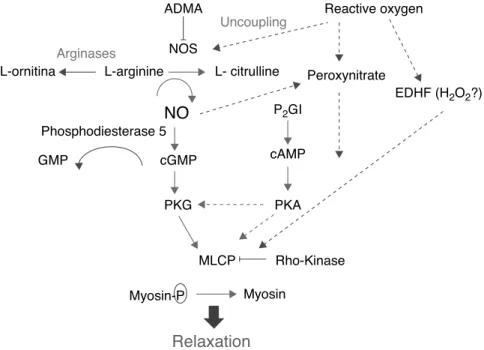
Fig. 1 shows the complexity of the cascade respon-sible for pulmonary vasodilation that depends on NO (cyclic GMP) and prostacyclin (cyclic AMP). Both lead to stimulation of the myosin light chain phosphatase, and dephosphorylation of the latter leads to relaxation of the vascular smooth muscle. Conversely, many factors have an inhibitory effect on the vasorelaxation process. Below is a summarized description of some of these factors accord-ing to their importance in different clinical presentations of this syndrome and the use of drugs that act through their modulation.
NO is synthesized by the vascular endothelium from L-arginine in response to several stimuli.1 The nitric oxide
synthase converts L-arginine to L-citrulline, releasing NO in this reaction. There are three nitric oxide synthase isoforms. The endothelial (eNOS), present in endothelial cells, and the neuronal (nNOS), present in muscle cells, are respon-sible for production of NO under physiological conditions, whereas the inducible form (iNOS) is only activated during inflammatory processes.
Based on evidence from animal models, which have demonstrated that the expression of eNOS is maximal at birth, an important role has been attributed to NO pro-duced by this enzyme in pulmonary vasodilation.2,3However,
it is currently known that an endogenous inhibitor of this
ADMA
Uncoupling
Arginases NOS
L-ornitina L-arginine L- citrulline Peroxynitrate Reactive oxygen
EDHF (H2O2?) P2GI
cAMP cGMP
PKA PKG
GMP
Phosphodiesterase 5
MLCP Rho-Kinase
Myosin Myosin-P
Relaxation
NO
Figure 1 Factors responsible for pulmonary vascular relaxation.
enzyme, asymmetric dimethylarginine (ADMA) is at much higher levels in the fetus and newborn, including humans, in comparison to adults.4This, associated with the fact that
the concentration of arginases, which are enzymes that com-pete with eNOS for the L-arginine substrate, is increased during fetal and immediate postnatal periods,5 calls into
question the importance of NO in the pulmonary vasodilation that occurs at birth.
NO stimulates the soluble guanylate cyclase (sGC) enzyme in pulmonary vascular smooth muscle cells, lead-ing to the conversion of guanosine triphosphate (GTP) nucleotide into cyclic guanosine monophosphate (cGMP). The increase in intracellular cGMP leads to a decrease in calcium influx and relaxation of smooth muscle cells by stim-ulating protein kinase G.6,7 Based on evidence obtained in
animal models, it is considered that the contents of pul-monary sGC is higher in the fetus and newborn and decreases with age.8---11The phosphodiesterase 5 (PG5) enzyme present
in the pulmonary vasculature degrades cGMP, and thus controls the degree of vasodilation.12 Factors related to
development have a great importance in the generation of cGMP. Pulmonary hypertension is associated with increased PG5 activity,13,14and inhibition of this enzyme with sildenafil
is currently one of the pharmacological interventions used in this disease.15,16
The prostaglandin (PG) system is also involved in the fetal-newborn pulmonary circulation transition. It causes vasodilatation through a parallel pathway that is comple-mentary to NO, and can thus potentiate its action (Fig. 1). Prostaglandins are synthesized from arachidonic acid, and vascular smooth muscle cells activate the adenylate cyclase enzyme, which converts adenosine triphosphate (ATP) into cyclic adenosine monophosphate (cAMP). An intracellular increase of this enzyme also results in relaxation of the vas-cular smooth musculature by decreasing the calcium influx. Prostacyclin (PGI2) is considered the most potent in this
system, although prostin (PGE1), normally used to main-tain patency of the ductus arteriosus, has also been shown to be an effective pulmonary vasodilator in newborns with pulmonary hypertension.17
The phosphodiesterase type III (PG3) enzyme degrades cAMP and controls the degree of vasodilation.18Endothelin 1
(ET-1) is a member of the endothelin family, and its effect on pulmonary vascular resistance is mediated by two receptor subtypes: ETA and ETB. Both are present in the smooth mus-cle cell and cause vasoconstriction and cell proliferation. ETB receptors are also present in the vascular endothelium, where they contribute to the regulation of pulmonary vas-cular tone through the release of NO. During fetal life, the maintenance of high pulmonary vascular tone is supported in part by ET-1, and its level is elevated in animal models of PPHN.19
Several other substances involved in the fetal circulation transition are being identified. Experimental studies sug-gest that superoxide radicals, generated by oxidative stress, decouple eNOS (Fig. 1), and compete with and inhibit the biological action of NO by generating peroxynitrite.20 This
molecule, in addition to its deleterious effects on several cell functions, also has an important vasoconstrictor effect in the newborn rat.21 Recent studies have demonstrated
that VEGF releases NO, and induces pulmonary vasodilation by increasing cGMP activity.22Pharmacological inhibition of
VEGF induces pulmonary hypertension in newborn and adult rats, showing the importance of this factor in pulmonary vascular angiogenesis.23---25The intracellular levels of cyclic
cGMP are also increased by natriuretic, atrial (ANP), and type B (BNP) peptides, which stimulate particulate guany-late cyclase, an isoform of sGC.7,26,27
Another molecule that plays an important role in the control of pulmonary vascular tone is the rho-kinase. When activated, this molecule has an inhibitory effect on the myosin light chain phosphatase, preventing the relaxation of vascular smooth muscle (Fig. 1). Rho-kinase is increased in animal models of pulmonary hypertension of the newborn, and its inhibition reduces disease severity in several animal models.28---32
Hemodynamic alterations during birth
Fetal pulmonary circulation is characterized by elevated pulmonary vascular resistance and the presence of right-to-left shunting via the ductus arteriosus and foramen ovale. These channels allow blood flow from the right atrium to reach the aorta, since only 10% of the cardiac output of the right ventricle reaches the lungs, as a result of high fetal pulmonary vascular resistance.33,34Fig. 2 outlines the
characteristics of fetal circulation.
Several mechanisms contribute to the maintenance of high pulmonary vascular resistance in the fetal period. The main mechanisms include low oxygen ten-sion, decreased production of vasodilators (such as NO and prostaglandins with vasodilator characteristic [prosta-cyclin]), and increased production of vasoconstrictive prostaglandin (thromboxane) and others such as endothe-lins.
Minutes after birth, the pulmonary arterial pressure rapidly drops to 50% of the systemic pressure, and pulmonary blood flow increases by approximately ten times with the onset of respiration. The factors responsible for this sudden decrease in vascular resistance after birth are related to the expansion and oxygenation of the alveoli, onset of continu-ous respiration, and clamping of the umbilical cord (Fig. 3). It is believed that pulmonary vascular resistance depends on the association between humoral constricting and dilating factors. During fetal life, constricting factors predominate, whereas dilating factors prevail after birth.
Definition
Aorta
Ductus arteriosus Pulmonary artery
Pulmonary vein Superior
vena cava
Pulmonary trunk
Figure 2 Fetal circulation.
Incidence and mortality
PPHN affects mainly at-term or post-term newborns, although also present in premature infants.35 The
preva-lence of PPHN in newborns is not well characterized, and is probably underestimated due to failure in its detection when associated with parenchymal pathology. A recent study in 12 major North American centers documented the
prevalence of this syndrome as 1.9/1,000 in the population of neonates born at term, with a mortality of 11%.36 In
the UK, the incidence ranged from 0.4 to 0.68/1,000 live births.37 In comparison with these international statistics,
between 2000 and 2005, Hospital São Luiz, a service with 8,000 deliveries/year and a high-complexity neonatal intensive care unit with 54 beds, recorded 2 cases/1,000 live births, and mortality rates of 11.6%.
200
100
0
Fetus Newborn Infant Adult
Newborn
Lung Alveolar expansion
+ Oxigenation
+ Ventilation Fetus
Lung
Pulmonary vascular resistance (arbitrary units)
Etiology
The etiology of PPHN is considered to be multiple. Certain maternal conditions such as obesity, diabetes, asthma, black or Asian ethnicity, and other neonatal factors such as post-maturity and neonates born large for gestational age are associated with a higher incidence of PPHN.38
The condition most commonly associated with PPHN in the United States is the meconium aspiration syndrome (42%), followed by the idiopathic (27%). Other conditions include respiratory distress syndrome, sepsis, asphyxia, and pulmonary hypoplasia secondary to congenital diaphrag-matic hernia.39
In the Hospital São Luiz, the prevalence of the idio-pathic form was 70%, much higher when compared to U.S. services.39 This is probably due to the high incidence of
cesarean delivery in Brazil. Newborns delivered by cesarean section with no labor have a significantly higher chance of developing PPHN than infants born to mothers with labor or with normal vaginal delivery.40 Labor is associated with
the interruption of production and increased resorption of alveolar fluid, thus preventing respiratory distress, char-acteristic of the transient tachypnea of the newborn.41
Other conditions associated with PPHN at Hospital São Luiz included infection, meconium aspiration syndrome, and respiratory distress syndrome (Fig. 4).
Among the drugs used by the mother, the most com-monly associated with PPHN are anti-inflammatory drugs and serotonin-reuptake inhibitors antidepressants. The anti-inflammatory drugs lead to premature closing of the ductus arteriosus by decreasing the release of prostaglandins, through the inhibition of cyclooxygenase enzymes.
In animal models, early closure of the ductus arte-riosus induces alterations in the pulmonary vasculature very similar to those observed in newborns with PPHN.42,43
Early closure of the ductus arteriosus is probably an uncommon cause of pulmonary hypertension syndrome. Fetal echocardiographic studies have shown that there is indeed a constrictive effect when inhibitors cyclooxygenase inhibitors are used, and that this effect is increased when corticosteroids are also administered.44,45 This
constrict-ing effect of cyclooxygenase inhibitors, however, may is transient even in women receiving continuous treatment.46
50%
20% 20%
5% 5%
Clin perinatol 2004; 31 : 591-611
Meconium Idiopathic Infection RDS Others 70% 20%
5% 5% 5%
HMSL 2000-2005
Figure 4 Prevalence of comorbidity associated with PPHN syndrome. Data for North America refer to the publication by Walsh-Sukys et al.,36HMSL, Hospital e Maternidade São Luiz.
More data are needed to determine the role of the early closure of the ductus arteriosus during pregnancy in the pathogenesis of PPHN.
Recent studies have demonstrated an association between antidepressants used by mothers in the third trimester of pregnancy and PPHN syndrome.47---49The
preva-lence in newborns exposed during fetal life to selective serotonin-reuptake inhibitors is four fold increased. In pregnant rats, administration of fluoxetine induces pul-monary vascular changes in the fetus, comparable to those observed in human infants with PPHN.50Recently, however,
at least one study involving 1,104 infants born to moth-ers who received antidepressants in the third trimester and an equal number of controls failed to demonstrate this association.51 More research in this area is needed to
clarify whether there is an association between PPHN and exposure during fetal life to selective serotonin-reuptake inhibitors.
Physiopathology
Considering that PPHN is a syndrome secondary to increased pulmonary vascular resistance, to the point of inducing right-left shunt, its physiopathology is related to the major factors that lead to these alterations during the peri-natal period. The following classification illustrates the different categories of diseases associated with increased pulmonary vascular resistance. A disease classified in one category often has manifestations characteristics of another form. Fig. 5 illustrates some of the forms described below.
Vasoconstriction
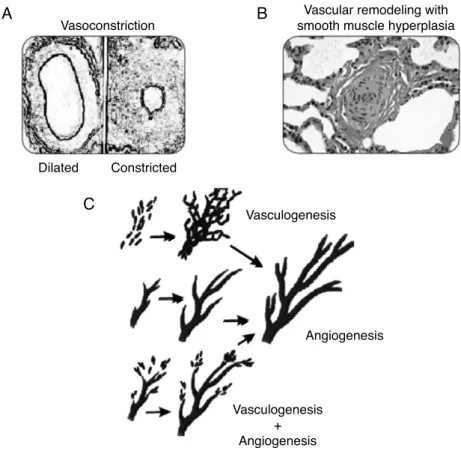
This category includes pathologies where the number of vessels, the pulmonary structure, and the pulmonary vas-cular branching are normal, but the smooth musculature of vessels responsible for the resistance to blood flow is con-stricted (Fig. 5A). These pathologies show disequilibrium in the balance of vasoactive substances, with a predominance of vasoconstrictor substances over vasodilators. This cat-egory is usually associated with diseases or conditions of acute characteristics, such as perinatal asphyxia, sepsis, or metabolic acidosis. As they are associated to vasoconstric-tion, pathologies related to this form of PPHN are amenable to treatment with vasodilators.
Pulmonary vascular remodeling
Vasoconstriction
Vascular remodeling with smooth muscle hyperplasia
Dilated Constricted
A
B
Vasculogenesis
Angiogenesis
Vasculogenesis + Angiogenesis
C
Figure 5 Pathogenesis of PPHN syndrome: vasoconstriction (A), vascular remodeling (B), angiogenesis, and vasculogenesis (C).
The pathogenesis of these conditions involves stimula-tion of a number of factors that regulate smooth muscle proliferation and extracellular matrix deposition. These dis-eases have a chronic characteristic, which develops during fetal life as in cases of placental dysfunction associated with chronic fetal hypoxemia, premature closure of the ductus arteriosus, or exposure to drugs during the fetal period. This pathological manifestation may also be present in infants who develop PPHN only after birth. It is believed that in these cases, the maintenance of pulmonary vasoconstriction with an increase in pulmonary artery pressure for a pro-longed period of time leads to vascular remodeling.52 The
response to vasodilators in neonates with pulmonary vascu-lar remodeling is limited or absent, and mortality is high.
Pulmonary vascular hypoplasia
The growth and development of the pulmonary vascula-ture depend on an actual process of generating new blood vessels (vasculogenesis) and their progressive branching (angiogenesis) to allow adequate gas exchange in lung level (Fig. 5C).
Diseases classified in this category present significant alterations in vasculogenesis or angiogenesis, resulting in hypoplasia of the pulmonary vascular bed. The increase in pulmonary vascular resistance in these diseases is related to the incapacity of the pulmonary vasculature to accom-modate right ventricular cardiac output. The alterations in PaCO2and PaO2 observed in these diseases are secondary,
not only to the right-left shunt, but also to inadequate perfusion of the lung. Examples include congenital diaphrag-matic hernia and pulmonary hypoplasia secondary to early and prolonged oligohydramnios.
Data obtained from animal models of congenital unilat-eral diaphragmatic hernia demonstrate that not only there is vascular hypoplasia in the lung affected by the hernia, but also that there is evidence of vascular remodeling in the other lung.53,54Minimal or absent response to
vasodila-tors is usually observed in diseases of this category, and the prognosis is guarded.
Obstruction
The lung in this category presents a normal number and structure of vessels. However, there is pulmonary blood flow restriction caused by alterations in blood viscosity (poly-cythemia) or by anomalous pulmonary venous drainage.
Pulmonary parenchymal pathology
affected by these diseases. To maintain gas exchange, the resistance of the vasculature involved in alveolar ventilation decreases. If the pulmonary process involves a small per-centage of the lung, the pulmonary vascular resistance is not altered. However, in the presence of extensive pulmonary disease, vascular resistance increases to the point of induc-ing right-left shunt.
Diseases in this category are erroneously classified as associated with PPHN syndrome. The primary process, how-ever, is the abnormal alveolar ventilation, with appropriate vasoconstrictor response of the pulmonary circulation.
Congenital deficiency of surfactant protein B is an exam-ple of a condition that resembles PPHN, however clearly distinct.55 Lastly, certain congenital vascular conditions,
such as capillary alveolar dysplasia, in which the presence of pulmonary hypertension has been reported,56,57 are also
best placed into this category. This congenital disease, where there is a misalignment and a drifting apart between the alveolus and its capillaries, is probably associated with hypoxic pulmonary vasoconstriction and vascular hypoplasia.
In theory, pulmonary parenchymal diseases associated with pulmonary hypertension and shunt should not be clas-sified as PPHN. However, from a practical viewpoint, it is difficult to separate this category from the others. The treat-ment of diseases in this category should be aimed at the primary lung condition and not at pulmonary vasodilation, as vasoconstriction in these cases has a protective effect on the ventilation/perfusion ratio. Data from animal models have shown that the use of a vasodilator (sildenafil) in the presence of pulmonary lobar atelectasis leads to worsening in oxygenation, by interfering with the physiological hypoxic pulmonary vasoconstriction response.58
Iatrogenic factors
A commonly overlooked factor responsible for the increase in pulmonary vascular resistance is the use of high mean pressures during mechanical ventilation. Depending on lung compliance, part of the pressure used in mechanical venti-lation can be transmitted to the lung vasculature. Failure to reduce the pressure used to ventilate infants with clinical and lung compliance improvements can lead to pulmonary hypertension. This occurs more often in infants ventilated with high frequency modes, as compared with conventional ventilation. Reducing the ventilaion mean airway pressure results in decreased pulmonary vascular resistance and abo-lition of the right-to-left shunting in some infants.
Right ventricular myocardial dysfunction
As discussed above, PPHN is characterized by right-to-left shunt and not by a specific pulmonary artery pressure. This leads to the possibility of a shunt at the level of the foramen ovale in clinical conditions where the pulmonary vascular resistance is not very high, but right ventricular contractil-ity is abnormal, resulting in a higher right, as compared with left atrial pressure. This was demonstrated in newborn pigs, where constriction of the main pulmonary artery to the point of inducing right ventricular failure leads to right-to-left shunt at the foramen ovale.59In these conditions, therapies
directed to enhancing the contractility of the right ventri-cle lead to improved oxygenation (shunt reduction), even though the pulmonary vascular resistance remains high.
Clinical features and diagnosis
The diagnosis of PPHN should be suspected when the level of hypoxemia is disproportionate to the degree of respiratory distress and pulmonary parenchymal radiological findings. Infants with PPHN exhibit oxygenation lability and progres-sive cyanosis in the first hours of life.
Cardiac auscultation shows increased intensity of the sec-ond heart sound due to pulmonary artery hypertension and systolic murmur of the tricuspid regurgitation.
Echocardiography with Doppler flow should always be performed upon suspicion of PPHN. It is a noninvasive method that not only allows the physician to assess the pres-ence of shunt at the ductus arteriosus and foramen ovale level, but also confirms the absence of congenital heart dis-ease and aids in the evaluation of myocardial contractility.
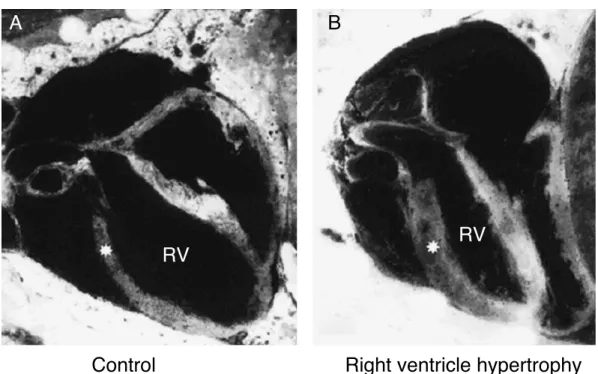
Echocardiography provides an estimate of pulmonary artery pressure by determining the peak velocity of tricus-pid regurgitation, and the pulmonary vascular resistance through by measuring the ratio of pulmonary artery acceler-ation time (ACT), and right ventricular ejection time (RVET). The lower this ratio (ACT/RVET), the higher the pulmonary vascular resistance. In the absence of tricuspid regurgita-tion, which occurs in 30% of cases, another parameter that can be used to estimate pulmonary artery pressure is the measurement of pulmonary artery flow, estimated by the velocity-time integral of the pulmonary artery (pulmonary VTI).60Fig. 6 illustrates right ventricular hypertrophy in an
animal model of PPHN induced in fetal rat after pharmaco-logical closure of the ductus arteriosus.61
The right-to-left shunt, typical of the disease when it occurs exclusively through the ductus arteriosus (50% of cases) can be demonstrated by the difference in pre-and post-ductal oxygenation. A PaO2difference > 20 mmHg
between the right radial artery (pre-ductal) and the umbili-cal artery is considered indicative of a right-to-left shunt at the ductus arteriosus level. The same measurement can be obtained noninvasively through the comparative assessment of pulse oximetry between pre- (upper right limb) and post-ductal areas (lower extremities). A difference > 5% is also indicative of shunting. It is important to remember that the absence of a difference in pre- and post- ductal oxygenation only indicates that there is no right-to-left shunt at the duc-tus arteriosus. The presence of a shunt at the foramen ovale is only diagnosed by echocardiography. Fig. 7 shows the dif-ferent scenarios illustrating that not only the presence of the shunt, but also the capacity of the right ventricle to overcome the increased vascular resistance, determines the presence and severity of disease.
Treatment
General care
Control
Right ventricle hypertrophy
A
B
RV
RV
Figure 6 Right ventricle (RV) wall hypertrophy in rat fetuses exposed to indomethacin, compared with normal rats. Data from a previously published study.61
Forame oval
Atrio direito
Atrio esquerdo
Atrio esquerdo
ventriculo esquerdo ventriculo
direito
Canal arterial Aorta Arteria
pulmonar
Resistencia pulmonar
Resistência vascular pulmonar baixa
Shunt pelo canal arterial Shunt pelo forame oval Shunt pelo canal arterial e forame oval Resistência vascular pulmonar alta
contratilidade de ventriculo direito normal
Forame oval
Atrio direito
ventriculo esquerdo ventriculo
direito
Canal arterial Aorta Arteria
pulmonar
Resistencia pulmonar
Forame oval
Atrio direito
ventriculo esquerdo ventriculo
direito
Aorta Arteria
pulmonar
Resistencia pulmonar
Forame oval
Atrio direito
ventriculo esquerdo ventriculo
direito
Canal arterial Aorta Arteria
pulmonar
Resistencia pulmonar
Forame oval
Atrio direito
ventriculo esquerdo ventriculo
direito
Aorta Arteria
pulmonar
Resistencia pulmonar
Atrio esquerdo Atrio
esquerdo Atrio
esquerdo
Canal arterial Canal arterial
pulmonary vasoconstriction and should be promptly cor-rected.
In addition to general care, the treatment strategy is to maintain systemic blood pressure at appropriate lev-els, decrease pulmonary vascular resistance, ensure oxygen release to tissues, and minimize lesions induced by oxygen and ventilation.
In the presence of parenchymal lung disease, ventila-tory assistance should have as strategy the improvement of alveolar recruitment, always preventing excessive lung inflation. When indicated (hyaline membrane disease, blood or meconium aspiration), the use of surfactant is of great therapeutic value. Continuous heart, blood pres-sure, and oxygen saturation monitoring, preferably pre- and post-ductal, are essential. Children with PPHN are extremely labile and unstable. Thus, manipulation should be minimal.
Sedatives have significant side effects, and the use of narcotics such as morphine commonly leads to hypotension. Sedation, although necessary, should be maintain at the low-est possible level and withdrawn as soon as there is clinical improvement. Muscle relaxants should be reserved only for newborns in whom there is great difficulty establishing ade-quate ventilation, and unresponsive to sedation.
Hemodynamic support
Myocardial activity is commonly compromised in this dis-ease, leading not only to a worsening in the right-to-left shunt at the foramen ovale (right ventricular dysfunction), but also to a decrease in the cardiac output due to left ven-tricular impairment. The use of inotropic agents is generally indicated.62
It is worth mentioning that the use of quick corrections with colloid or crystalloid solutions, unless there is evi-dence of intravascular depletion, is contraindicated, since the right atrial pressure is usually high (increased pulmonary vascular resistance and right ventricular dysfunction). Excessive administration of fluids in these circumstances results in further increase in right atrial pressure and exac-erbation of right-to-left shunt at the foramen ovale and hypoxemia.
Inotropic and vasopressor agents should be introduced early in an attempt to optimize cardiac function, stabi-lize systemic blood pressure, and reduce extrapulmonary shunt. Each of these drugs has a distinct effect that should be taken into account when choosing a specific therapy for each newborn (Table 2), and all of them have a sig-nificant inotropic effect. Dopamine, through its adrenergic effect, is the most effective in increasing blood pressure and therefore the most frequently used. However, there is some concern regarding a possible pulmonary vasocon-strictor effect when used at high doses. Dobutamine has an effect of reducing left ventricular overload, which together with its inotropic characteristics contribute to an increased cardiac output. Choosing the ideal vasopressor for the treat-ment of newborns with hypotension remains a subject of great debate.63---65 Attention to the cause of hypotension
and myocardial performance is of great help in therapeutic decision-making.
Epinephrine, in spite of being the drug with greatest inotropic effect, also has an adrenergic vasoconstriction effect in systemic and pulmonary circulation, which some-times leads to a significant reduction in peripheral and pulmonary blood flow. Recently, a study showed that norepi-nephrine improved oxygenation and decreased pulmonary vascular resistance in newborns with PPHN through an unknown mechanism.66 In sheep, norepinephrine decreases
pulmonary vascular tone and increases blood flow by acti-vating alpha-receptors and NO release.67,68
Pulmonary vasodilatation
In response to many vasoactive drugs, the pulmonary circu-lation has a similar behavior to that of systemic circucircu-lation. Thus, the great difficulty in the pharmacological treatment of PPHN is to dilate the pulmonary vessels without causing systemic. As the pulmonary circulation shows vasodilation with pH elevation, hyperventilation and alkalization have been widely used for the treatment of this disease in the past.69,70 Hyperventilation is no longer used due to a
significant reduction in cerebral perfusion when PaCO2 is
maintained < 25 mmHg, and pulmonary trauma. Alkalization, in turn, when appropriately used, has beneficial therapeutic effect with minimal side effects.
Inhaled NO
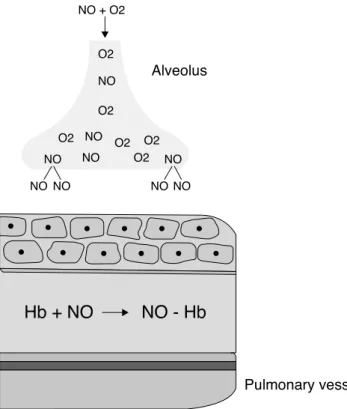
This method is currently considered the standard treatment. When administered by inhalation (iNO), it reaches the alveolar space and diffuses into vascular smooth mus-cle of the adjacent pulmonary arteries, where it causes vasodilation by increasing cGMP levels. iNO continues to dis-seminate, and in the pulmonary artery lumen, it is rapidly bound to hemoglobin, restricting its effect on the pulmonary circulation, without any effect on the systemic circulation (Fig. 8). iNO is preferably distributed to the ventilated seg-ments of the lungs, with increased perfusion in those areas. This results in an improved ventilation/perfusion ratio, decreasing intra-alveolar shunting and improving oxygen-ation. When the response is positive, improved oxygenation is evident within a few minutes.
Since 1997, several clinical trials have demonstrated a significant improvement in oxygenation, decreased need for extracorporeal membrane oxygenation (ECMO) and/or reduced mortality in neonates older than 34 weeks with severe respiratory failure.71Clinical improvement in infants
with PPHN occurs in approximately 70% of patients, and the best results are observed in the idiopathic type.72
In the past, treatment with iNO was initiated at rather late stages of the disease, usually when the oxygenation index was > 25. Such late intervention resulted the mean incidence of ECMO and/or mortality was still 40%. An earlier introduction of iNO is currently recommended, before pro-longed exposure to high concentrations of oxygen and high ventilatory occurs parameters.
Currently, the initial recommended concentration of iNO is 20 ppm. Higher concentrations are not more effective, and are associated with a higher incidence of methemoglobine-mia and formation of nitrogen dioxide.73Some studies have
Cabral
JEB,
Belik
J
Table 2 Inotropic and vasopressor drugs commonly used in pulmonary hypertension.
Drugs/Dose Action mechanism Effects Side effects
Dopamine
2.5 - 20 mcg/kg/min
Endogenous precursor of norepinephrine
Dose-dependent action 2.5 - 5 mcg/kg/min: Stimulation of dopaminergic receptors
5 - 10 mcg/kg/min:1 receptors stimulation 10 - 20 mcg/kg/min:␣
receptors stimulation
Dopa: mesenteric, kidney, brain, and spleen vasodilation
Beta: increase in myocardial contractility and coronary flow, with increase in blood pressure and cardiac output
Alpha: peripheral vasoconstriction and increased systemic vascular resistance, systemic arterial pressure, and pulmonary pressure; decreased kidney and mesenteric flow
High doses increase pulmonary and systemic vascular resistance
Dobutamine 5 - 20 mcg/kg/min
Dopamine synthetic analogue. Stimulatesreceptors, mainly
1, and has little action over
2
Improves cardiac output through1 inotropic action
Little peripheral vascular effect
Tachycardia at high doses
Epinephrine
0.05 - 2 mcg/kg/min
Endogenous catecholamine with␣andadrenergic effect, depending on the dose 0.05 ---0.5 mcg/kg/min:receptor stimulation (1>2) 0.5 - 2 mcg/kg/min: stimulation of␣receptors
Improves cardiac output through potent inotropic action
Increases systemic blood pressure
Pulmonary and systemic vasoconstriction at high doses
Norepinephrine 0,5 - 2 mcg/kg/min
Endogenous catecholamine, which stimulates1 and 2 receptors, as well as␣1 and 2 receptors
Improves cardiac output through the inotropic action of␣receptors, and increases blood pressure by peripheral action of␣receptors
Possible improvement in pulmonary blood flow secondary to the release of endothelial nitric oxide
Systemic and pulmonary vasoconstrictor
Milrinone
0.3 - 0.8 mcg/kg/min
Inhibitor of phosphodiesterase enzyme type III, which degrades cAMP
Improves cardiac output by reducing afterload
Pulmonary vasodilation by increasing intracellular cAMP
Possible systemic vasodilation at high doses
Hb + NO
NO - Hb
NO + O2
O2
NO
NO
NO NO
NO NO NO NO
NO O2
O2 O2 O2 O2
Alveolus
Pulmonary vessel
Figure 8 Inhaled NO and its binding to hemoglobin. Hb, hemoglobin; NO, nitricoxide.
improving oxygenation;74,75lower concentrations (2 ppm), in
addition to not being effective, reduce the response to the subsequent increase in concentration to 20 ppm.76
Once iniated, iNO should be gradually decreased (decrease of 5 ppm/h to 5 ppm) and withdrawn after
1 ppm/4 h. Such slow weaning is geared at preventing the phenomenon of rebound vasoconstriction, which may be related to the decreased endogenous production of NO.
During the use of inhaled NO, continuous monitoring of nitrogen dioxide (generated by the reaction of NO with oxy-gen) and daily serum levels of methemoglobin should be obtained. The methemoglobin level must be kept below 5%. Inhibition of platelet aggregation has been reported in humans; however, the occurrence of this side effect remains controversial.77,78Until this fact is clarified, the use of iNO
is not recommend in the presence of significant intracranial bleeding.
Pulmonary vasodilators
Besides NO, there are no other drugs with specific vasodila-tor effects for the pulmonary circulation. Several drugs, however, have a predominant vasodilator effect in PPHN; they are discussed below and are summarized in Table 3.
Prostaglandins
Prostacyclin is the most potent vasodilator among prostaglandins. Its intravenous use has been long-established in the treatment in adults with pulmonary hypertension. Most studies in infants have shown a similar or greater effect when compared to iNO in decreasing pulmonary artery pressure and improving oxygenation.79,80
Its use, however, requires a permanent vascular access and often leads to hypotension, as it is not a selective pul-monary vasodilator. Its administration via inhalation allows for selective pulmonary vasodilation, but with very short half-life, which makes its administration difficult.81Iloprost
Table 3 Pulmonary vasodilator agents.
Drugs Administration dose Action mechanism Use in PPHN
Nitric oxide Inhaled
5-20 ppm
Produced in the vascular endothelium, causes vasodilation through the increase in intracellular cGMP in the lung smooth muscle
Selective pulmonary vasodilator is the standard treatment
Monitor methemoglobin and NO2during use
Prostaglandins Prostacyclins
Continuous IV or inhaled administration
Iloprost: inhaled -0.5---2 mcg/kg/dose
Produced from arachidonic acid, they cause vasodilatation by increasing intracellular cAMP in lung smooth muscle
Vasodilatation through alternative and complementary pathway to nitric oxide; may enhance its action
Prostacyclin is a nonspecific pulmonary vasodilator and may have systemic effects
Sildenafil IV or oral route
0.5 --- 2 mg/kg/dose 6/6h
Inhibitor of phosphodiesterase enzyme type V, responsible for cGMP degradation
It may potentiate nitric oxide Safe and easy to administer It may worsen oxygenation due to vasodilation of unventilated areas
Milrinone IV administration
0.3---0.8 mcg/kg/m
Inhibitor of the phosphodiesterase enzyme type III, responsible for degradation of cAMP
May potentiate the action of prostaglandins
Improves right cardiac output by reduction of afterload
Bosentan OralDose: not established Non-specific antagonist A and B endothelin receptors
Very seldom used in newborns
is a longer-acting prostacyclin analogue with specific effect in pulmonary circulation.82
Some studies have shown its effectiveness, even in cases refractory to NO.83,84 It can be used in the inhaled form in
intubated patients or in the nebulized form in spontaneously breathing patients.85
Phosphodiesterase inhibitors
There are 11 isoforms of phosphodiesterases (PDEs). The most important are the PDE3 and PDE5, which preferentially degrade cAMP and cGMP, respectively.
Sildenafil produces vasodilation by inhibiting PDE5. Dipyridamole, zaprinast, and pentoxifylline are PDE5 inhibitors that are seldom used, as they have important systemic effects.
Studies in neonates with pulmonary hypertension have shown that sildenafil selectively reduces pulmonary vascu-lar resistance with few systemic effects.86---89 Its effect on
pulmonary vasculature appears to be independent from the underlying cause, and thus effective in idiopathic pulmonary hypertension associated with heart conditions, lung disease, and PPHN.90In the postoperative period of heart disease,
sil-denafil decreased pulmonary artery pressure and prevented rebound after withdrawal of NO.91
In a Cochrane meta-analysis with 37 newborns from centers that lacked NO and high frequency ventilation, sig-nificant improvement in oxygenation was observed in the group receiving sildenafil.92
Sildenafil is safe, effective, and easily administered. As discussed earlier, its vasodilator effect extends to poorly ventilated areas in the lungs, which changes the ventilation/perfusion ratio, increases the intrapulmonary shunt, and worsens oxygenation. In an animal model of neonatal lobar atelectasis, sildenafil inhibited pulmonary vasoconstriction in response to hypoxia and worsened oxygenation.58Using tadalafil, another PDE5 inhibitor in the
same animal model without lobar atelectasis, a decrease in pulmonary vascular resistance and improved oxygenation were demonstrated.93
Milrinone causes pulmonary vasodilation by inhibiting PDE3. Originally used to reduce the afterload and as an inotropic agent, it also has been shown to be effective in the treatment of neonatal pulmonary hypertension. Recently, Lakshminrusimha et al. demonstrated, in an animal model of PPHN, that pretreatment with milrinone increased the effect of prostaglandin in pulmonary artery relaxation.94
This would explain the findings of Bassller and MacNamara, who, when studying four and nine newborns, respectively, demonstrated a significant improvement in oxygenation with the use of milrinone after unsatisfactory response to iNO.95,96
Endothelin blockers
In adults, the use of bosentan, a nonspecific antagonist of receptors A and B, significantly improves symptoms and exercise capacity in patients with pulmonary hypertension. In newborns, the plasma levels of ET1 are high, with a linear correlation with disease severity.97 These data have
stim-ulated the use and publication of some case reports with
the use of bosentan in neonates with PPHN.98,99The
useful-ness of these agents in the treatment of PPHN still requires further clinical investigation before it can be recommended.
Other drugs
Other drugs have been tested in animal models with promising effects. Rho-kinase is a protein that prevents vasodilatation by inhibiting the dephosphorylation of myosin in smooth muscle cells. Fasudil and Y-27632, rho-kinase inhibitors, cause potent vasodilation in experimental models of PPHN.29,32These studies suggest that rho-kinase inhibitors
may play an important role in the treatment of PPHN. Superoxide dismutase removes superoxide radicals from circulation, generated by oxidative stress, leading to pul-monary vasoconstriction by binding and competing with NO. In animals, administration of superoxide dismutase reduces pulmonary artery pressure and improves the response to NO.100
The adenosine nucleotide and its trinucleotide ATP are potent selective pulmonary vasodilators, through intracel-lular increase of AMP. Intravenous infusion of adenosine in infants with PPHN syndrome has shown a significant improve-ment in oxygenation.101---103
Magnesium sulphate has been described in some case reports.104 However, the Cochrane meta-analysis did not
show enough evidence to recommend the use of this drug in PPHN.105
Mechanical ventilation and surfactant
Mechanical ventilation facilitates alveolar recruitment and improves ventilation/perfusion and oxygenation.
It is still debatable whether high-frequency ventilation is superior to conventional ventilation in newborns with PPHN. Some studies have shown that high-frequency ventilation improves the efficacy of inhaled NO in infants with parenchy-mal lung disease.106
Certain causes of PPHN, such as meconium aspiration syndrome and diaphragmatic hernia, are associated with surfactant deficiency or reduced activity,107 and its use
in neonates born to term with severe respiratory failure decreases the need for ECMO.108
Prevention
Funding
Canadian Institutes of Health and Research (CIHR) Grant # MOP-93710.
Conflicts of interest
The authors declare no conflicts of interest.
References
1. Klinger JR. The nitric oxide/cGMP signaling pathway in pul-monary hypertension. Clin Chest Med. 2007;28:143---67. 2. Nowicki MJ, Shi D, Cai Z, Bishop PR, May WL. Developmental
expression of endothelial nitric oxide synthase (eNOS) in the rat liver. Pediatr Res. 2003;54:732---8.
3. Parker TA, le Cras TD, Kinsella JP, Abman SH. Developmental changes in endothelial nitric oxide synthase expression and activity in ovine fetal lung. Am J Physiol Lung Cell Mol Physiol. 2000;278:L202---8.
4. Lucke T, Kanzelmeyer N, Kemper MJ, Tsikas D, Das AM. Developmental changes in the L-arginine/nitric oxide pathway from infancy to adulthood: plasma asymmetric dimethy-larginine levels decrease with age. Clin Chem Lab Med. 2007;45:1525---30.
5. Belik J, Shehnaz D, Pan J, Grasemann H. Developmental changes in arginase expression and activity in the lung. Am J Physiol Lung Cell Mol Physiol. 2008;294:L498---504.
6. Schmidt HH, Schmidt PM, Stasch JP. NO- and haem-independent soluble guanylate cyclase activators. Handb Exp Pharmacol. 2009:309---39.
7. Stasch JP, Hobbs AJ. NO-independent, haem-dependent sol-uble guanylate cyclase stimulators. Handb Exp Pharmacol. 2009:277---308.
8. Behrends S, Kempfert J, Mietens A, Koglin M, Scholz H, Mid-dendorff R. Developmental changes of nitric oxide-sensitive guanylyl cyclase expression in pulmonary arteries. Biochem Biophys Res Commun. 2001;283:883---7.
9. Behrends S, Mietens A, Kempfert J, Koglin M, Scholz H, Middendorff R. The expression pattern of nitric oxide-sensitive guanylyl cyclase in the rat heart changes during postnatal development. J Histochem Cytochem. 2002;50: 1325---32.
10. Belik J, Hehne N, Pan J, Behrends S. Soluble guanylate cyclase-dependent relaxation is reduced in the adult rat bronchial smooth muscle. Am J Physiol Lung Cell Mol Physiol. 2007;292:L699---703.
11. Bloch KD, Filippov G, Sanchez LS, Nakane M, de la Monte SM. Pulmonary soluble guanylate cyclase, a nitric oxide recep-tor, is increased during the perinatal period. Am J Physiol. 1997;272:L400---6.
12. Zhu B, Strada SJ. The novel functions of cGMP-specific phosphodiesterase 5 and its inhibitors in carcinoma cells and pulmonary/cardiovascular vessels. Curr Top Med Chem. 2007;7:437---54.
13. Patel MD, Katz SD. Phosphodiesterase 5 inhibition in chronic heart failure and pulmonary hypertension. Am J Cardiol. 2005;96:47M---51M.
14. Hanson KA, Ziegler JW, Rybalkin SD, Miller JW, Abman SH, Clarke WR. Chronic pulmonary hypertension increases fetal lung cGMP phosphodiesterase activity. Am J Physiol. 1998;275:L931---41.
15. Reffelmann T, Kloner RA. Cardiovascular effects of phos-phodiesterase 5 inhibitors. Curr Pharm Des. 2006;12: 3485---94.
16. Juliana AE, Abbad FC. Severe persistent pulmonary hyper-tension of the newborn in a setting where limited resources exclude the use of inhaled nitric oxide: suc-cessful treatment with sildenafil. Eur J Pediatr. 2005;164: 626---9.
17. Sood BG, Delaney-Black V, Aranda JV, Shankaran S. Aerosolized PGE1: a selective pulmonary vasodilator in neonatal hypoxemic respiratory failure results of a phase I/II open label clinical trial. Pediatr Res. 2004;56: 579---85.
18. Murray F, MacLean MR, Pyne NJ. Increased expression of the cGMP-inhibited cAMP-specific (PDE3) and cGMP bind-ing cGMP-specific (PDE5) phosphodiesterases in models of pulmonary hypertension. Br J Pharmacol. 2002;137: 1187---94.
19. Jankov RP, Luo X, Cabacungan J, Belcastro R, Frndova H, Lye SJ, et al. Endothelin-1 and O2-mediated pulmonary hyperten-sion in neonatal rats: a role for products of lipid peroxidation. Pediatr Res. 2000;48:289---98.
20. Munzel T, Sinning C, Post F, Warnholtz A, Schulz E. Pathophy-siology, diagnosis and prognostic implications of endothelial dysfunction. Ann Med. 2008;40:180---96.
21. Belik J, Jankov RP, Pan J, Tanswell AK. Peroxynitrite inhibits relaxation and induces pulmonary artery muscle contrac-tion in the newborn rat. Free Radic Biol Med. 2004;37: 1384---92.
22. Grover TR, Zenge JP, Parker TA, Abman SH. Vascular endothe-lial growth factor causes pulmonary vasodilation through activation of the phosphatidylinositol-3-kinase-nitric oxide pathway in the late-gestation ovine fetus. Pediatr Res. 2002;52:907---12.
23. Le Cras TD, Markham NE, Tuder RM, Voelkel NF, Abman SH. Treatment of newborn rats with a VEGF receptor inhibitor causes pulmonary hypertension and abnormal lung structure. Am J Physiol Lung Cell Mol Physiol. 2002;283: L555---62.
24. Papaioannou AI, Kostikas K, Kollia P, Gourgoulianis KI. Clinical implications for vascular endothelial growth factor in the lung: friend or foe? Respir Res. 2006;7:128.
25. Taraseviciene-Stewart L, Kasahara Y, Alger L, Hirth P, Mc MG, Waltenberger J, et al. Inhibition of the VEGF receptor 2 combined with chronic hypoxia causes cell death-dependent pulmonary endothelial cell proliferation and severe pulmonary hypertension. FASEB J. 2001;15:427---38.
26. Schermuly RT, Stasch JP, Pullamsetti SS, Middendorff R, Muller D, Schluter KD, et al. Expression and function of soluble guany-late cyclase in pulmonary arterial hypertension. Eur Respir J. 2008;32:881---91.
27. Braam B, Verhaar MC. Understanding eNOS for pharmacological modulation of endothelial function: a translational view. Curr Pharm Des. 2007;13:1727---40.
28. Belik J, Kerc E, Pato MD. Rat pulmonary arterial smooth muscle myosin light chain kinase and phosphatase activi-ties decrease with age. Am J Physiol Lung Cell Mol Physiol. 2006;290:L509---16.
29. Fagan KA, Oka M, Bauer NR, Gebb SA, Ivy DD, Morris KG, et al. Attenuation of acute hypoxic pulmonary vasoconstric-tion and hypoxic pulmonary hypertension in mice by inhibivasoconstric-tion of Rho-kinase. Am J Physiol Lung Cell Mol Physiol. 2004;287: L656---64.
30. Fukumoto Y, Tawara S, Shimokawa H. Recent progress in the treatment of pulmonary arterial hypertension: expecta-tion for rho-kinase inhibitors. Tohoku J Exp Med. 2007;211: 309---20.
32. McNamara PJ, Murthy P, Kantores C, Teixeira L, Engelberts D, van VlieT, et al. Acute vasodilator effects of Rho-kinase inhibitors in neonatal rats with pulmonary hypertension unre-sponsive to nitric oxide. Am J Physiol Lung Cell Mol Physiol. 2008;294:L205---13.
33. Cassin S, Tyler T, Wallis R. The effects of prostaglandin E on fetal pulmonary vascular resistance (38588). Proc Soc Exp Biol Med. 1975;148:584---7.
34. Leffler CW, Hessler JR, Green RS. The onset of breathing at birth stimulates pulmonary vascular prostacyclin synthesis. Pediatr Res. 1984;18:938---42.
35. Danhaive O, Margossian R, Geva T, Kourembanas S. Pulmonary hypertension and right ventricular dysfunction in growth-restricted, extremely low birth weight neonates. J Perinatol. 2005;25:495---9.
36. Walsh-Sukys MC, Tyson JE, Wright LL, Bauer CR, Korones SB, Stevenson DK, et al. Persistent pulmonary hypertension of the newborn in the era before nitric oxide: practice variation and outcomes. Pediatrics. 2000;105:14---20.
37. Boden G, Bennett C. The management of persistent pul-monary hypertension of the newborn. Current Paediatrics. 2004;14:290---7.
38. Hernández-Diaz S, Van Marter LJ, Werler MM, Louik C, Mitchell AA. Risk factors for persistent pulmonary hypertension of the newborn. Pediatrics. 2007;120:e272---82.
39. Konduri GG, Solimano A, Sokol GM, Singer J, Ehrenkranz RA, Singhal N, et al. A randomized trial of early versus standard inhaled nitric oxide therapy in term and near-term newborn infants with hypoxic respiratory failure. Pediatrics. 2004;113:559---64.
40. Ramachandrappa A, Jain L. Elective cesarean section: its impact on neonatal respiratory outcome. Clin Perinatol. 2008;35:373---93.
41. Jain L, Eaton DC. Physiology of fetal lung fluid clearance and the effect of labor. Semin Perinatol. 2006;30:34---43. 42. Belik J, Halayko AJ, Rao K, Stephens NL. Fetal ductus
arterio-sus ligation. Pulmonary vascular smooth muscle biochemical and mechanical changes. Cir Res. 1993;72:588---96.
43. Abman SH, Accurso FJ. Acute effects of partial compression of ductus arteriosus on fetal pulmonary circulation. Am J Physiol. 1989;257:H626---34.
44. Levy R, Matitiau A, Ben AA, Milman D, Or Y, Hagay Z. Indomethacin and corticosteroids: an additive constrictive effect on the fetal ductus arteriosus. Am J Perinatol. 1999;16:379---83.
45. Weiss H, Cooper B, Brook M, Schlueter M, Clyman R. Fac-tors determining reopening of the ductus arteriosus after successful clinical closure with indomethacin. J Pediatr. 1995;127:466---71.
46. Respondek M, Weil SR, Huhta JC. Fetal echocardiography during indomethacin treatment. Ultrasound Obstet Gynecol. 1995;5:86---9.
47. Wooltorton E. Persistent pulmonary hypertension of the newborn and maternal use of SSRIs. CMAJ. 2006;174: 1555---6.
48. Kallen B, Olausson PO. Maternal use of selective serotonin re-uptake inhibitors and persistent pulmonary hypertension of the newborn. Pharmacoepidemiol Drug Saf. 2008;17: 801---6.
49. Chambers CD, Hernandez-Diaz S, Van Marter LJ, Werler MM, Louik C, Jones KL, et al. Selective serotonin-reuptake inhibitors and risk of persistent pulmonary hypertension of the newborn. N Engl J Med. 2006;354:579---87.
50. Fornaro E, Li D, Pan J, Belik J. Prenatal exposure to fluoxetine induces fetal pulmonary hypertension in the rat. Am J Respir Crit Care Med. 2007;176:1035---40.
51. Ziegler JW, Ivy DD, Kinsella JP, Abman SH. The role of nitric oxide, endothelin, and prostaglandins in the
transition of the pulmonary circulation. Clin Perinatol. 1995;22:387---403.
52. Stenmark KR, Gerasimovskaya E, Nemenoff RA, Das M. Hypoxic activation of adventitial fibroblasts: role in vascular remodel-ing. Chest. 2002;122:326S---34S.
53. Keller RL, Moore P, Teitel D, Hawgood S, McQuitty J, Fine-man JR. Abnormal vascular tone in infants and children with lung hypoplasia: Findings from cardiac catheterization and the response to chronic therapy. Pediatr Crit Care Med. 2006;7:589---94.
54. Belik J, Davidge ST, Zhang W, Pan J, Greer JJ. Airway smooth muscle changes in the nitrofen-induced congenital diaphrag-matic hernia rat model. Pediatr Res. 2003;53:737---43. 55. Kunig AM, Parker TA, Nogee LM, Abman SH, Kinsella JP. ABCA3
deficiency presenting as persistent pulmonary hypertension of the newborn. J Pediatr. 2007;151:322---4.
56. Singh SA, Ibrahim T, Clark DJ, Taylor RS, George DH. Persistent pulmonary hypertension of newborn due to congen-ital capillary alveolar dysplasia. Pediatr Pulmonol. 2005;40: 349---53.
57. Plat G, Rouquette I, Marcoux MO, Bloom MC, Acar P, Dulac Y. Alveolar capillary dysplasia and persistent pul-monary hypertension of the newborn. Arch Mal Coeur Vaiss. 2007;100:458---61.
58. Tessler R, Wu S, Fiori R, Macgowan CK, Belik J. Silden-afil acutely reverses the hypoxic pulmonary vasoconstric-tion response of the newborn pig. Pediatr Res. 2008;64: 251---5.
59. Belik J, Light RB. Effect of increased afterload on right ven-tricular function in newborn pigs. J Appl Physiol. 1989;66: 863---9.
60. Peterson AL, Deatsman S, Frommelt MA, Mussatto K, Frommelt PC. Correlation of echocardiographic markers and therapy in persistent pulmonary hypertension of the newborn. Pediatr Cardiol. 2009;30:160---5.
61. Fabris VE, Pato MD, Belik J. Progressive lung and cardiac changes associated with pulmonary hypertension in the fetal rat. Pediatr Pulmonol. 2001;31:344---53.
62. Ricachinevsky CP, Amantea SL. Treatment of pulmonary arte-rial hypertension. J Pediatr (Rio J). 2006;82:S153---65. 63. Roze JC, Tohier C, Maingueneau C, Lefevre M, Mouzard A.
Response to dobutamine and dopamine in the hypotensive very preterm infant. Arch Dis Child. 1993;69:59---63.
64. Dempsey EM, Barrington KJ. Evaluation and treatment of hypotension in the preterm infant. Clin Perinatol. 2009;36:75---85.
65. Evans N. Which inotrope for which baby? Arch Dis Child Fetal Neonatal Ed. 2006;91:F213---20.
66. Tourneux P, Rakza T, Bouissou A, Krim G, Storme L. Pul-monary circulatory effects of norepinephrine in newborn infants with persistent pulmonary hypertension. J Pediatr. 2008;153:345---9.
67. Jaillard S, Houfflin-Debarge V, Riou Y, Rakza T, Klosowski S, Lequien P, et al. Effects of catecholamines on the pulmonary circulation in the ovine fetus. Am J Physiol Regul Integr Comp Physiol. 2001;281:R607---14.
68. Magnenant E, Jaillard S, Deruelle P, Houfflin-Debarge V, Riou Y, Klosowski S, et al. Role of the alpha2-adrenoceptors on the pulmonary circulation in the ovine fetus. Pediatr Res. 2003;54:44---51.
69. Drummond WH, Gregory GA, Heymann MA, Phibbs RA. The independent effects of hyperventilation, tolazoline, and dopamine on infants with persistent pulmonary hypertension. J Pediatr. 1981;98:603---11.
71. The Neonatal Inhaled Nitric Oxide Study Group. Inhaled nitric oxide in full-term and nearly full-term infants with hypoxic respiratory failure. N Engl J Med. 1997;336: 597---604.
72. Wessel DL, Adatia I, Van Marter LJ, Thompson JE, Kane JW, Stark AR, et al. Improved oxygenation in a randomized trial of inhaled nitric oxide for persistent pulmonary hypertension of the newborn. Pediatrics. 1997;100:E7.
73. Committee on Fetus and Newborn. Use of inhaled nitric oxide. Pediatrics. 2000;106:344---5.
74. Cornfield DN, Maynard RC, deRegnier RA, Guiang III SF, Bar-bato JE, Milla CE. Randomized, controlled trial of low-dose inhaled nitric oxide in the treatment of term and near-term infants with respiratory failure and pulmonary hypertension. Pediatrics. 1999;104:1089---94.
75. Davidson D, Barefield ES, Kattwinkel J, Dudell G, Damask M, Straube R, et al. Inhaled nitric oxide for the early treatment of persistent pulmonary hypertension of the term newborn: a ran-domized, double-masked, placebo-controlled, dose-response, multicenter study. The I-NO/PPHN Study Group. Pediatrics. 1998;101:325---34.
76. Clark RH, Kueser TJ, Walker MW, Southgate WM, Huck-aby JL, Perez JA, et al. Low-dose nitric oxide therapy for persistent pulmonary hypertension of the newborn. Clinical Inhaled Nitric Oxide Research Group. N Engl J Med. 2000;342: 469---74.
77. Albert J, Harbut P, Zielinski S, Ryniak S, Gillis-Haegerstrand C, Lindwall R, et al. Prolonged exposure to inhaled nitric oxide does not affect haemostasis in piglets. Intensive Care Med. 2007;33:1594---601.
78. Beghetti M, Sparling C, Cox PN, Stephens D, Adatia I. Inhaled NO inhibits platelet aggregation and elevates plasma but not intraplatelet cGMP in healthy human volunteers. Am J Physiol Heart Circ Physiol. 2003;285:H637---42.
79. Bos AP, Tibboel D, Koot VC, Hazebroek FW, Molenaar JC. Persistent pulmonary hypertension in high-risk congenital diaphragmatic hernia patients: incidence and vasodilator ther-apy. J Pediatr Surg. 1993;28:1463---5.
80. Nakayama T, Shimada H, Takatsuki S, Hoshida H, Ishikita T, Matsuura H, et al. Efficacy and limitations of continuous intravenous epoprostenol therapy for idiopathic pulmonary arterial hypertension in Japanese children. Circ J. 2007;71: 1785---90.
81. Ewert R, Schaper C, Halank M, Glaser S, Opitz CF. Inhalative iloprost - pharmacology and clinical application. Expert Opin Pharmacother. 2009;10:2195---207.
82. Leuchte HH, Behr J. Iloprost for idiopathic pulmonary arterial hypertension. Expert Rev Cardiovasc Ther. 2005;3: 215---23.
83. Ehlen M, Wiebe B. Iloprost in persistent pulmonary hyperten-sion of the newborn. Cardiol Young. 2003;13:361---3.
84. Chotigeat U, Jaratwashirakul S. Inhaled iloprost for severe per-sistent pulmonary hypertension of the newborn. J Med Assoc Thai. 2007;90:167---70.
85. Krishnan U. Management of pulmonary arterial hypertension in the neonatal unit. Cardiol Rev. 2010;18:73---5.
86. Vargas-Origel A, Gomez-Rodriguez G, Aldana-Valenzuela C, Vela-Huerta MM, Alarcon-Santos SB, Amador-Licona N. The use of sildenafil in persistent pulmonary hypertension of the new-born. Am J Perinatol. 2010;27:225---30.
87. Steinhorn RH, Kinsella JP, Pierce C, Butrous G, Dilleen M, Oakes M, et al. Intravenous sildenafil in the treatment of neonates with persistent pulmonary hypertension. J Pediatr. 2009;155:841---7.
88. Bentlin MR, Saito A, De Luca AK, Bossolan G, Bonatto RC, Martins AS, et al. Sildenafil for pulmonary hypertension treatment after cardiac surgery. J Pediatr (Rio J). 2005;81: 175---8.
89. Oliveira EC, Amaral CF. Sildenafil in the management of idiopathic pulmonary arterial hypertension in chil-dren and adolescents. J Pediatr (Rio J). 2005;81: 390---4.
90. Leibovitch L, Matok I, Paret G. Therapeutic applications of sildenafil citrate in the management of paediatric pulmonary hypertension. Drugs. 2007;67:57---73.
91. Stocker C, Penny DJ, Brizard CP, Cochrane AD, Soto R, Shek-erdemian LS. Intravenous sildenafil and inhaled nitric oxide: a randomised trial in infants after cardiac surgery. Intensive Care Med. 2003;29:1996---2003.
92. Shah P, Ohlsson A. Sildenafil for pulmonary hypertension in neonates. Cochrane Database Syst Rev. 2007:CD005494. 93. Tessler RB, Zadinello M, Fiori H, Colvero M, Belik J, Fiori
RM. Tadalafil improves oxygenation in a model of new-born pulmonary hypertension. Pediatr Crit Care Med. 2008;9: 330---2.
94. Lakshminrusimha S, Porta NF, Farrow KN, Chen B, Gugino SF, Kumar VH, et al. Milrinone enhances relaxation to prostacyclin and iloprost in pulmonary arteries isolated from lambs with persistent pulmonary hypertension of the newborn. Pediatr Crit Care Med. 2009;9:106---12.
95. McNamara PJ, Laique F, Muang-In S, Whyte HE. Milrinone improves oxygenation in neonates with severe persistent pulmonary hypertension of the newborn. J Crit Care. 2006;21:217---22.
96. Bassler D, Choong K, McNamara P, Kirpalani H. Neonatal per-sistent pulmonary hypertension treated with milrinone: four case reports. Biol Neonate. 2006;1:1---5.
97. Rosenberg AA, Kennaugh J, Koppenhafer SL, Loomis M, Chat-field BA, Abman SH. Elevated immunoreactive endothelin-1 levels in newborn infants with persistent pulmonary hyperten-sion. J Pediatr. 1993;123:109---14.
98. Goissen C, Ghyselen L, Tourneux P, Krim G, Storme L, Bou P, et al. Persistent pulmonary hypertension of the newborn with transposition of the great arteries: successful treatment with bosentan. Eur J Pediatr. 2008;167:437---40.
99. Nakwan N, Choksuchat D, Saksawad R, Thammachote P. Successful treatment of persistent pulmonary hypertension of the newborn with bosentan. Acta Paediatr. 2009;98: 1683---5.
100. Lakshminrusimha S, Russell JA, Wedgwood S, Gugino SF, Kaz-zaz JA, Davis JM, et al. Superoxide dismutase improves oxygenation and reduces oxidation in neonatal pulmonary hypertension. Am J Respir Crit Care Med. 2006;174: 1370---7.
101. Konduri GG, Garcia DC, Kazzi NJ, Shankaran S. Adenosine infu-sion improves oxygenation in term infants with respiratory failure. Pediatrics. 1996;97:295---300.
102. Ng C, Franklin O, Vaidya M, Pierce C, Petros A. Adeno-sine infusion for the management of persistent pulmonary hypertension of the newborn. Pediatr Crit Care Med. 2004;5: 10---3.
103. Motti A, Tissot C, Rimensberger PC, Prina-Rousso A, Aggoun Y, Berner M, et al. Intravenous adenosine for refractory pul-monary hypertension in a low-weight premature newborn: a potential new drug for rescue therapy. Pediatr Crit Care Med. 2006;7:380---2.
104. Raimondi F, Migliaro F, Capasso L, Ausanio G, Bisceglia M, Gilib-erti P, et al. Intravenous magnesium sulphatevs. inhaled nitric oxide for moderate, persistent pulmonary hypertension of the newborn. A multicentre, retrospective study. J Trop Pediatr. 2008;54:196---9.
105. Ho JJ, Rasa G. Magnesium sulfate for persistent pulmonary hypertension of the newborn. Cochrane Database Syst Rev. 2007:CD005588.
pulmonary hypertension of the newborn: Nitric Oxide Study Group. Chest. 1998;114:105.
107. Findlay RD, Taeusch HW, Walther FJ. Surfactant replace-ment therapy for meconium aspiration syndrome. Pediatrics. 1996;97:48---52.