Abstract
Objective: To identify factors associated with early interruption (before 4 months) of exclusive breastfeeding and late introduction (after 8 months) of complementary foods.
Methods: This is a cross-sectional study, based on a survey conducted on the first day of the National Vaccination Campaign in 2004, in Cuiabá, MT, Brazil. The sample comprised 921 children less than 1 year old, and the adult accompanying each child was interviewed and a semi-structured questionnaire filled out. Probit analysis was employed to assess consumption of liquids and solids, and logistic regression analysis was applied to identify factors associated with early introduction of liquids and with late introduction of solids.
Results: There was elevated consumption of water and teas, followed by cows milk among those less than 120 days old. Children were more likely to be being given liquids on the day of the survey if they had been consuming them on the day they were discharged from the maternity unit. Approximately 60% of the children were being given soup or the family meal by 8 months.
Conclusions: Liquids being given on the first day at home was a good predictor that they would be given for the first 4 months, emphasizing the need for intervention during prenatal care and at maternity units to counter the harm caused by this practice. After 8 months, however, it is necessary to emphasize the importance of the child participating in family meals, especially for adult mothers without higher education and primaparous mothers.
J Pediatr (Rio J). 2006;82(6):445-51: Weaning, complementary feeding, nutritional surveys, breastfeeding, infant nutrition.
O
RIGINALA
RTICLE1. Doutora em Nutrição Humana Aplicada. Professora, Instituto de Saúde Coletiva, Universidade Federal de Mato Grosso (UFMT), Cuiabá, MT, Brasil.
2. Mestre em Saúde Coletiva. Nutricionista, Secretaria Estadual de Saúde de Mato Grosso, Cuiabá, MT, Brasil.
3. Bolsista, Programa Institucional de Bolsas de Iniciação Científica (PIBIC). Estudante de Nutrição, UFMT, Cuiabá, MT, Brasil.
4. Mestre em Epidemiologia e Estatística, Instituto de Saúde, Secretaria Estadual de Saúde de São Paulo, São Paulo, SP, Brasil.
5. Doutora em Nutrição e Saúde Pública, Instituto de Saúde, Secretaria Estadual de Saúde de São Paulo, São Paulo, SP, Brasil.
Partial financial support: CAPES, CNPq (PIBIC), Secretarias Municipal e Estadual de Saúde de Mato Grosso, Brasil.
Manuscript received Dec 27 2005, accepted for publication Aug 07 2006.
Suggested citation: Brunken GS, Silva SM, França GV, Escuder MM, Venâncio SI. Risk factors for early interruption of exclusive breastfeeding and late introduction of complementary foods among infants in midw estern Brazil. J Pediatr (Rio J). 2006;82:445-51.
445
Copyright © 2006 by Sociedade Brasileira de Pediatria doi:10.2223/JPED.1569
Risk factors for early interruption of exclusive breastfeeding
and late introduction of complementary foods
among infants in midwestern Brazil
Gisela S. Brunken,1 Solanyara M. Silva,2 Giovanny V. A. França,3 Maria M. Escuder,4 Sonia I. Venâncio5
Introduction
Since the 1970s, a great deal of research has been undertaken and many advances have been achieved in relation to the promotion of breastfeeding, but, unfortunately, complementary feeding has not been
explored a great deal. In fact, opportune introduction of other foods after 6 months is just as important as the correct practice of exclusive breastfeeding up to 6 months. With this in mind, the Brazilian Health Ministry has produced a Guide to Feeding Children Under Two Years Old1 and Monte & Giugliani2 have published recommendations for the complementary feeding of breastfed children. Both emphasize that complementary feeding is an essential factor for food security and for development of populations and their countries, with healthcare professionals being responsible for providing mothers with appropriate recommendations.
at the breast.4 In addition to increased risk of infections, it is known that the administration of other foods in addition to breastmilk impacts negatively on nutrient absorption and bioavailability and can result in reduced quantities of breastmilk being consumed, leading to reduced weight gain.5
However, after 6 months breastmilk may no longer be sufficient to provide children with their nutritional requirements, with complementary foods needed to fill this lack, especially of energy and iron.1
Th e r e a r e m a n y b e n e f i t s f r o m i n t r o d u c i n g complementary feeding at the opportune moment, which, ideally, should not be before 6 months, since there are no benefits from introducing these foods early, and there may be adverse effects.3 Foods should be begun at 6 months, initially soft, pasty foods, known as transition foods, with progressive increase in consistency until the child is eating family meals, which should occur from 8 months onwards.1
This study aimed to identify factors associated with early interruption (before 4 months) of exclusive breastfeeding and late introduction (after 8 months) of complementary foods.
Methods
This is an analytical cross-sectional study, undertaken in June of 2004, in the municipality of Cuiabá, MT. A survey was made of dietary practices on the first day of the National Vaccination Campaign in 2004, as part of a partnership between the São Paulo State Health Departments Instituto de Saúde (Secretaria Estadual de Saúde), through their Breastfeeding and Municipalities project, and the Universidade Federal de Mato Grosso.
Data from the 19916 and 2000 national censuses,7 were used to estimated a projected number of children less than 1 year old in Cuiabá for 2004 of 8,129. The planned sample size was 1,040 children, which, with a 10% safety margin, was sufficient to estimate the prevalence of breastfeeding at different ages to a 5% significance level.
A two-stage cluster sampling procedure was adopted. In the first stage Vaccination Centers were selected by lots, and, in the second, children were chosen systematically from each center. The aim was to obtain a sample with balanced probability, so that larger vaccination centers had a greater chance of being drawn in the first stage, and children from smaller centers a greater chance of being selected in the second.
The selection of 29 centers and the number of children whose mothers would be approached at each center were defined based on the total of 66 vaccination centers from the previous year. The randomization procedures were
executed by the fieldwork supervisor and the interview team. On campaign D-Day (5th of June, 2004) 7,300 children presented at vaccination centers. Of these, 921 were selected for the sample.
The research instrument employed was developed by the Instituto de Saúde de São Paulo, based on World Health Organization recommendations for breastfeeding surveys.8 It was a semi-structured questionnaire, laid out in sections, containing variables related to the childs feeding, the birth (hospital and type of delivery), liquids given (water, tea or other types of milk) on the first day at home from hospital (for children under 120 days) and maternal characteristics. The section on feeding included questions on consumption of breastmilk, other types of milk, preparations such as porridge, mashes or purées (pasty meals prepared with some type of flour and/or fruit mixed with water or milk), soups (liquid or pasty savory meal, prepared especially for the child), the family meal (refers to food prepared for the whole family, which may have been mashed, shredded, chopped into small pieces, etc.), meat or beans in soup or the family meal, water, tea and fruit during the previous 24 hours. When children had been brought for vaccination by their mothers, they were asked questions about their age, primiparity, education and employment away from home, in addition to the sections above.
Complementary food was defined according to the WHO8 and the Health Ministry Guide,1 also cited by Monte & Giugliani2 as any food other than breastmilk given in the complementary feeding period. The terms used in this article to refer to infant feeding are those currently recommended by the World Health Organization8 and adopted internationally.
The questionnaires were applied by students studying Nutrition, Nursing and Medicine and who had received training in data collection. An Interviewers Manual was produced in order to standardize conduct in the field.
Adults accompanying children who were potential candidates for the sample were approached while waiting in line for vaccination and, once they had been informed of the research objectives and if they gave consent, were interviewed.
Data were double input using an ACCESS application called AMAMUNIC, which checks for consistency during data entry in addition to generating breastfeeding indicators. Once complete the twin databases were compared, using the Validate function in Epi-Info version 6.04d, and discrepancies were corrected.
Plan of analysis
Characteristics n %
Infants Sex
Male 478 51.9
Female 443 48.1
Age (days)
0 | 120 295 32.0
120 | 240 293 31.8
240 | 365 333 36.2
Birth weight (g)
< 2,500 55 6.1
2,500 | 3,000 205 22.7
≥ 3,000 644 71.2
Place of birth
Cuiabá 863 93.7
Other municipality 58 6.3
Maternal
Mother brought own child?
Yes 773 83.9
No 148 16.1
Maternal age (years)
< 20 127 16.4
≥ 20 646 83.6
Highest level of education attended (graduated or not)
Primary 265 34.3
Secondary 368 47.6
Higher Education 103 13.3
Did not say 37 4.8
Works away from home?
Yes 193 25.1
No 576 74.9
First child?
Yes 341 44.2
No 430 55.8
Type of delivery
Vaginal 386 42.2
Caesarian 529 57.8
Table 1 - Characteristics of children and mothers (Cuiabá, MT, Brazil, 2004)
greater frequency before 4 months and those foods that families were consuming, but not giving to children older than 8 months. Probit analysis9 estimates the proportion of children who will exhibit this behavior by means of weighted linear regression of probits (y) against age (x), using the maximum likelihood iterative procedure.
Univariate analyses were then performed, taking consumption of each food of interest in turn as the dependent variable and the reasons for this consumption as independent variables. For children younger than 120 days, the foods investigated were water, tea and other types of milk and, for those older than 240 days, they were soup, the family meal, meat and beans. The independent variables investigated for children under 120 days were: consumption of liquids on the first day at home, socioeconomic variables and maternal characteristics; for those older than 240 days these were: maternal characteristics and socioeconomic variables.
Logistic regression was used for the multivariate analysis model, which included all variables whose significance level had been below 20% (p < 0.20) for the outcomes under univariate analysis. The stepwise forward selection method was used, with variables retained in the model only if they had p < 0.05.
The impact of the sample design on the variances of logistic regression estimates was captured in the form of design effect, using the CSAMPLE module in Epi-Info 6.04d, which gives the ratio between variance calculated assuming a complex sample and variance assuming a simple random sample. It was found that the design effect for any given estimator was always close to one, and it was possible to conclude that the sampling plan did not have any effect on the test of significance for the coefficient associated with the variable in question, indicating that variance could be acceptably calculated assuming a simple sample.
This Project was approved by the Research Ethics Committee at the Hospital Universitário Julio Muller, in Cuiabá, MT.
Results
The sample comprised 921 children, the majority of whom had been brought by their mothers (Table 1). Considering maternal characteristics; 1/6 were younger than 20 years, one quarter had employment outside of the home and few had attended higher education, whether graduated or incomplete.
The sample studied was in equilibrium in terms of sex and distribution across age groups. Almost all of them were born in Cuiabá, with weight greater than or equal to 2,500 g and, less than half were delivered vaginally.
The adults accompanying the children less than 120 days old reported that on their first day at home they had been given non-nutritious liquids such as teas (27%), water, alone (8%) or with sugar (1%) and milk other than breastmilk (13%).
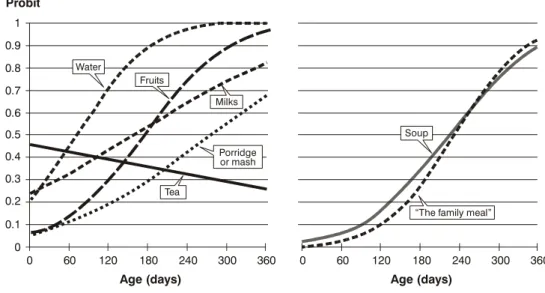
Figure 1 - Distribution graph of probits for different foods by age 0
0 0.1 0.2 0.3 0.4 0.5 0.6 0.7 0.8 0.9 1 Probit
Age (days) Age (days)
0
60 120 180 240 300 360 60 120 180 240 300 360
Milks
The family meal Water
Soup Fruits
Tea
Porridge or mash drinking tea. The third most often consumed liquid was cows milk, whether powdered or liquid, and which increased consistently as in line with age. Fruits are also introduced into the diet early on, with a significant and constant increase occurring from 3 to 9 months. However, at 12 months there were still children who were not eating fruit. The introduction of soup was identified as being concurrent with the family meal. Meat and beans have not been included in Figure 1, since their probabilities were practically superimposed over the family meal, indicating that family meals are the principal vehicle for introducing them into the diet.
At 8 months, between 50 and 60% of the children were consuming soup and the family meal (Figure 1 and Table 3).
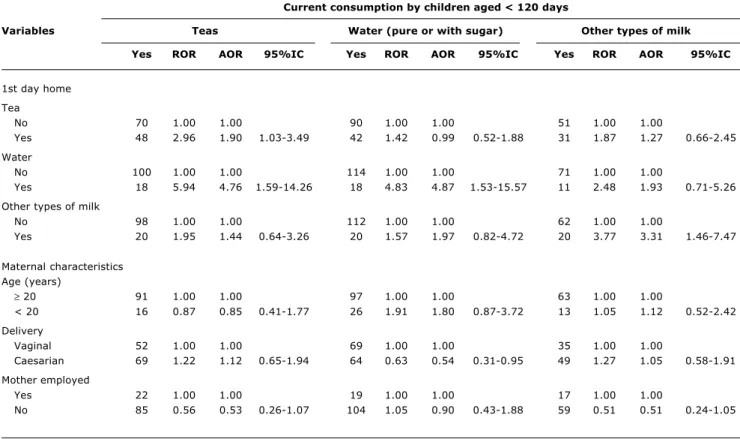
There was no difference between the characteristics of mothers who introduced water and teas before 4 months and those who didnt in the majority of parameters (Table 2). The only exception was a significant difference in the liquids given on the first day at home. The chance of children being given liquids on the day of interview was greater among those who had consumed them on the day they were discharged from the maternity unit. Those who were given teas on their first day at home were twice as likely to be drinking tea on the day of interview (OR = 1.89), and those given water the day they were discharged from the maternity unit were around 5 times more likely to be receiving teas (OR = 4.76) or water (OR = 4.87) during their first 4 months. Those given milk on their first day at home were 3 times more likely (OR = 3.31) to be receiving milk at the time of interview.
There were no differences between mothers who had not yet introduced solid or semi-solid foods by the recommended age and those who had, with the exception of the introduction of soup, where it was observed that adolescent mothers were more likely (OR = 2.64) not to offer this preparation. Mothers with primary or secondary education had a 4.3 times greater risk of not giving their children meat and primaparous mothers had almost 5 times (OR = 4.9) greater chance of not feeding their children beans by 8 months, although neither of these results attained statistical significance (Table 3).
Discussion
This research project included several precautions taken to guarantee the reliability of its results. One of these was that data collection was standardized by training interviewers and fieldwork supervisors, thus achieving a uniform method of approaching candidates in the vaccination line and of applying the questionnaire with mothers.
Table 3 - Raw and adjusted estimated odds ratios with their respective confidence intervals for not feeding children soup, the family meal, meat or beans to children ≥ 240 days old
Multivariate logistic regression model, adjusted for age of child (in days).
95%CI = 95% confidence interval; AOR = adjusted odds ratio (multivariate analysis); ROR = raw odds ratio (univariate analysis).
Children aged ≥≥≥≥≥ 240 days not currently eating
Variables Family meal Soups Meat Beans
No ROR AOR 95%IC No ROR AOR 95%IC No ROR AOR 95%IC No ROR AOR 95%IC
Age (years)
≥ 20 45 1.00 1.00 57 1.00 1.00 36 1.00 1.00 8 1.00 1.00
< 20 8 0.90 0.99 0.39-2.50 21 2.80 2.64 1.24-5.63 11 1.92 1.45 0.60-3.48 2 1.28 1.09 0.19-6.33
Education
Higher
education 10 1.00 1.00 8 1.00 1.00 2 1.00 1.00 3 1.00 1.00
School 42 0.70 0.68 0.28-1.65 68 1.77 1.34 0.55-3.25 44 4.96 4.32 0.97-9.34 7 0.36 0.42 0.09-2.01
First child?
No 29 1.00 1.00 36 1.00 1.00 22 1.00 1.00 2 1.00 1.00
Yes 24 0.90 0.89 0.46-1.74 42 1.46 1.13 0.62-2.05 25 1.36 1.24 0.61-2.54 8 4.69 4.86 0.94-24.99
Mother employed?
Yes 14 1.00 1.00 23 1.00 1.00 13 1.00 1.00 5 1.00 1.00
No 38 1.42 1.42 0.69-2.92 55 1.26 1.12 0.60-2.10 34 1.42 1.14 0.54-2.41 5 0.50 0.47 0.12-1.84 Table 2 - Raw and adjusted estimated odds ratios with their respective confidence intervals for consumption of water, tea, and other types
of by children younger than 120 days
Multivariate logistic regression model, adjusted for age of child (in days).
95%CI = 95% confidence interval; AOR = adjusted odds ratio (multivariate analysis); ROR = raw odds ratio (univariate analysis).
Current consumption by children aged < 120 days
Variables Teas Water (pure or with sugar) Other types of milk
Yes ROR AOR 95%IC Yes ROR AOR 95%IC Yes ROR AOR 95%IC
1st day home
Tea
No 70 1.00 1.00 90 1.00 1.00 51 1.00 1.00
Yes 48 2.96 1.90 1.03-3.49 42 1.42 0.99 0.52-1.88 31 1.87 1.27 0.66-2.45
Water
No 100 1.00 1.00 114 1.00 1.00 71 1.00 1.00
Yes 18 5.94 4.76 1.59-14.26 18 4.83 4.87 1.53-15.57 11 2.48 1.93 0.71-5.26
Other types of milk
No 98 1.00 1.00 112 1.00 1.00 62 1.00 1.00
Yes 20 1.95 1.44 0.64-3.26 20 1.57 1.97 0.82-4.72 20 3.77 3.31 1.46-7.47
Maternal characteristics Age (years)
≥ 20 91 1.00 1.00 97 1.00 1.00 63 1.00 1.00
< 20 16 0.87 0.85 0.41-1.77 26 1.91 1.80 0.87-3.72 13 1.05 1.12 0.52-2.42
Delivery
Vaginal 52 1.00 1.00 69 1.00 1.00 35 1.00 1.00
Caesarian 69 1.22 1.12 0.65-1.94 64 0.63 0.54 0.31-0.95 49 1.27 1.05 0.58-1.91
Mother employed
Yes 22 1.00 1.00 19 1.00 1.00 17 1.00 1.00
obtained by a simple casual process. All of these factors contributed to the quality of the results presented here.
With reference to the Feeding Guide for Children Under Two Years Old,1 it is apparent that at least four of the 10 steps to a healthy diet are not being taken by a significant proportion of the population. The first step is to give only breastmilk up until 6 months, with no water, teas or any other foods (step 1). In this study, other foods were found to be introduced very early on with great frequency, from the first day at home onwards, especially water and tea; probably as a result of the belief in Mato Grosso that it is necessary to give extra liquids because of the very hot climate.
Several different studies in Brazil have identified early introduction of complementary foods,11 confirming that, at 6 months, when they should only just be starting complementary feeding, a large number of children already consume a variety of foods.
In this study, whether children were given any liquid other than breastmilk on their first day at home was a good predictor of whether they would be given such liquids during their first 4 months of life. It is known that early introduction of liquids and solids is unnecessary and reduces the duration and frequency of breastfeeding,5,12 interfere with the absorption of important nutrients such as iron,13 reduce the efficiency of lactation to retard the next pregnancy14 and increase infant morbidity and mortality.4 Early exposure to proteins other than those found in human milk is associated with increased risk of diabetes mellitus type I 15 and atopic diseases such as asthma, the effects of which appear to last at least until the child is 10 years old, and other types of allergy.16,17 certain foods are considered especially allergenic, such as eggs, nuts and oil seeds, and cows milk, this last being responsible for 20% of food allergies and is not recommended before 9 to 12 months.15,16
The second step in the Feeding Guide recommends that from 6 months on other foods should be slowly and gradually introduced, maintaining breastmilk in the diet until two years of age or more, since from this age onwards the nutritional requirements of infants may no longer be met by human milk alone.8 Complementary foods should have a minimum density of 70 kcal/100 mL,1 which is difficult to achieve with preparations that contain a large percentage of water, such as fruit juice, soups and watery porridges.
The third and fifth steps of the Guide also deal with nutrition after 6 months and recommend that complementary foods (cereals, tubers, meat, fruit and vegetables) be given three times a day (step 3) and that complementary foods should be thick from the onset and should be given with a spoon; beginning with pasty foods (mashes/purées) and, gradually, increase the consistency until the child is eating family meals (step 5). Therefore,
by 8 months, the majority of children should already have passed through this phase of transition to family meals. In fact, however, it was observed that less than 60% of them were eating these foods at that age. Although the probabilities of soup and family meal consumption were similar, (Figure 1) at 8 months children begin to consume less soup and eat more family meals. These, being more solid, have greater nutritional density, i.e. a larger amount of nutrients per volume or weight of food.1
The fact that adolescent mothers gave their children less soup than adult mothers did may be related to its preparation, made especially for the child. There is no consensus on the differences between the diets of adolescent and adult mothers children. Vieira et al.18 found that the complementary feeding of the children of adolescents was similar to that of adult mothers children, except for lower intake of meat and greater intake of eggs, since adolescents also have lower purchasing power to be able to buy meat. In contrast, Carruth et al.19 observed that the children of adolescent mothers ate more fat, began to eat with their own hands earlier and ate cereals earlier than the children of adult mothers, without, however, differing in terms of the intake of meat, fruit and vegetables.
There was a tendency, although not a significant one, to an association between two maternal characteristics and the feeding practices of their children. Lower level of education, which probably operates as an indirect indicator of socioeconomic status, is associated with a 4 times greater chance of the child not eating meat, a food that is much more expensive than beans are, the other protein source that was investigated. The association between not feeding a child beans and that child being its mothers first may be an expression of excess zeal among primaparous mothers, who avoid giving their first child food that has certain taboos linked to it, as being rich or heavy.1
This study is limited by the fact that it did not identify food groups, but intake of foods typically prepared for infants (mashes/porridge, soups, fruit, etc), preventing the intake of important nutrients such as iron and vitamin C from being investigated. Nevertheless, it appears that fruit has a prominent role in the diet of the population of Cuiabá and, after water, it is the food that is most often added to infants diets. However, it is likely that fruit is not being eaten in sufficient quantities, nor together with meals, since there is a high anemia prevalence among children under the age of three in the region.20
Correspondence: Gisela Soares Brunken Campus UFMT
Av. Fernando Correa da Costa, s/nº CCBS III, térreo, Instituto de Saúde Coletiva CEP 78060-900 Cuiabá, MT Brazil
Tel.: +55 (65) 3615.8260, +55 (65) 3627.2664 Fax: +55 (65) 3615.8267
E-mail: [email protected]
References
1. Brasil, Ministério da Saúde. Guia alimentar para crianças menores de 2 anos. Brasília: Ministério da Saúde; 2005.
2. Monte CMG, Giugliani ERJ. Recomendações para alimentação complementar da criança em aleitamento materno. J Pediatr (Rio J). 2004;80:S131-41.
3. Kramer MS, Kakuma R. The optimal duration of exclusive breastfeeding: a systematic review. Geneva: WHO; 2002. 4. Victora CG, Vaughan JP, Lombardi C, Fuchs SMC, Gigante LP,
Smith PG, et al. Evidence for protection by breast-feeding against infant deaths from infectious diseases in Brazil. Lancet. 1987;2:317-22.
5. Organização Mundial da Saúde. Evidências científicas dos dez passos para o sucesso no aleitamento materno. Brasília: OPAS/ OMS; 2001.
6. Instituto Brasileiro de Geografia e Estatística. Resultados do Universo relativo às características da população dos domicílios n° 26; 1992.
7. Instituto Brasileiro de Geografia e Estatística. Censo demográfico. http://www.sidra.ibge.gov.br. Access: 20/06/2005. (Censo 2000: tabela 1518, município Cuiabá).
8. World Health Organization, United Nations Childrens Fund (UNICEF). Complementary feeding of young children in developing countries: a review of current scientific knowledge. Geneva: WHO; 1998.
early introduction implies. Care should also be taken with the introduction of the familys meals to the infants diet, feeding transition foods from 6 to 8 months when the infant should be partaking of the whole family meal.
Acknowledgements
Thanks are due to the Instituto de Saúde de São Paulo, for work on the study design and follow-up, to the State and Municipal Health Departments for permission to carry out the research and for funding, to the academic staff at the Nutrition, Medicine and Nursing Faculties of the Universidade Federal de Mato Grosso, for their help with data collection and to those who took part as fieldwork supervisors, to CAPES and CNPq for bursaries granted for Masters degrees and Scientific Initiative.
9. Finney DJ. Probit analysis. 3ª ed. Cambridge: Cambridge University Press; 1980.
10. Venâncio SI, Escuder MML, Kitoko P, Rea MF, Monteiro CA. Freqüência e determinantes do aleitamento materno em municípios do Estado de São Paulo. Rev Saude Publica. 2002;36:313-8.
11. Oliveira LPM, Assis AMO, Pinheiro SMC, Prado MS, Barreto ML. Alimentação complementar nos primeiros dois anos de vida. Rev Nutr. 2005;18:459-69.
12. Ashraf RN, Jalil F, Aperia A, Lindblad BS. Additional water is not needed for healthy breast-fed babies in a hot climate. Acta Paediatr. 1993;82:1007-11.
13. Abrams AS, Wen J, Stuff JF. Absorption of calcium, zinc and iron from breast-milk by five to seven-month-old infants. Pediatr Res. 1997;41:384-90.
14. Dewey KG, Cohen RJ, Rivera LL, Canahuati J, Brown KH. Effects of age at introduction of complementary foods to breast-fed infants on duration of lactational amenorrhea in Honduran women. Am J Clin Nutr 1997;65:1403-9.
15. Gerstein HC. Cows milk exposure ant type I diabetes mellitus. A critical overview of the clinical literature. Diabetes Care. 1994;17:13-9.
16. Arshad SH. Food allergen avoidance in primary prevention of food allergy. Allergy. 2001;56:113-6.
17. Van Odjik J, Kull I, Borres MP, Brandtzaeg P, Edberg U, Hanson LA, et al. Breastfeeding and allergic disease: a multidisciplinary review of the literature (1966-2001) on the mode of early feeding and its impact on later atopic manifestations. Allergy. 2003;58:833-43.
18. Vieira MLF, Silva JLCP, Barros-Filho AA. A amamentação e a alimentação complementar de filhos de mães adolescentes são diferentes das de filhos de mães adultas? J Pediatr (Rio J). 2003;79:317-24.
19. Carruth BR, Nevling W, Skinner JD. Developmental and food profiles of infants born to adolescent and adult mothers. J Adolesc Health. 1997;20:434-41.