Fisioter. Mov., Curitiba, v. 30, n. 4, p. 839-848, Oct./Dec. 2017 Licenciado sob uma Licença Creative Commons DOI: http://dx.doi.org/10.1590/1980-5918.030.004.AR02
Prevalence of temporomandibular joint disorders
and neck pain in musicians: a sytematic review
Prevalência de distúrbios da articulação temporomandibular e
cervicalgias em músicos instrumentistas: uma revisão sistemática
Bennatan Ferreira dos Santos[a], Thaís Branquinho Oliveira Fragelli[b]*
[a] Instituto Nacional do Esporte (INESP), Brasília, DF, Brazil [b] Universidade de Brasília (UnB), Brasília, DF, Brazil
Abstract
Introduction: The instrumental practice for a long time, the high performance level, the strict technique and the specific shape of each musical instrument can take musicians to overcome their physiological lim -its, giving a high prevalence of musculoskeletal injuries. Objective: Investigate the prevalence of temporo-mandibular joint disorder and neck pain in musicians. Methods: Between August and September 2015 were reviewed five databases: LILACS, SciELO, Medline / PubMed, Scopus and Web of Science. The arti -cles were read and evaluated by the criteria of the Strengthening the Reporting of Observational Studies in Epidemiology (STROBE), items, that obtained a percentage above of 50 percent, were considered in the analysis of this work. Results: 15 articles attended the inclusion criteria. Among all musicians the preva-lence of TMJ pain ranged from 10 - 81% and the prevapreva-lence of neck pain ranged from 29 - 80%. Conclusion:
In this study was observed that the musicians showed both, temporomandibular joint disorders and neck pain, watching a high prevalence especially in violinists and the horn players. In the risk factors identified in the literature for the emergence of painful symptoms in musicians, stand out the biomechanical factors involved in maintaining anti-physiologic postures.
Keywords: Temporomandibular Joint Disorders. Epidemiology. Neck Pain. Music.
* BFS: BS, email: [email protected]
840
Introduction
The term temporomandibular joint disorders (TMJD) is commonly used to describe a number of signs and symptoms that generate functional and pathologyc alterations involving the masticatory muscles, the temporomandibular joint (TMJ) and the whole stomatognathic system (1 – 3). Among the main symptoms involved are: joint pain, limitation or asymmetry of the movements, noises in the TMJ, the increased tension of the masticatory muscles, muscle fatigue, headaches and wear occlusal associ-ated with parafunctions as, for example, bruxism and dental tightening (4 – 7). This functional impairment associated with TMJD can cause anxiety, common to other chronic diseases patients, leading to negative effects on their life quality (LF) (8 – 10).
Correlations are made about the existence of signs and symptoms of neck pain in TMJD patients, for pos -tural cervical changes that alter the mandibular and condyle postures. Adding also that painful stimuli in the neck can lead to pain in the facial region. In this respect, the neck pain is multifactorial in origin and occurs frequently in the working population, espe -cially in those who perform static postures tasks, for example, in raising the upper limbs (11, 12).
For music fans this is considered as an art and emotion expression, closely associated with the lei -sure and well-being, however, when evaluating the
performative activity in musical instrument, the look on the music activity exercise as profession should be differentiated by checking that the activity requires productivity and high performance with both psy -chological as physical capabilities (13).
In this aspect, the instrumental practice for a long time, the high level of performance required, the indi-vidual strict technique and the specific format of each musical instrument can lead professionals, often to exceeding their physiological limit (13, 14). This fact associated with poor posture, constant muscle usage and the playing tendency, even in the presence of pain, exposes this population to the psychological and physical burden of considerable intensity, leading to the occurrence of so-called Repetitive Strain Injury / Musculoskeletal Disorders related to work (RSI / MSDs) as reported in the literature, among which includes neck pain and TMJD (13 – 17).
Studies show that the prevalence of RSI / MSDs, in general, is high revealing a public health problem, in addition, these dysfunctions have increasingly earlier appeared in life professionals (16). The impact is not only in the quality of life decreasing, but also in the fact that these disorders can lead to early closure of their careers (16).
Understanding that the musician activity is a working line and as such can bring physical and psychological overload documented in the litera -ture is that the present study aimed to investigate Resumo
Introdução: A prática instrumental por tempo prolongado, o alto grau de desempenho, a rigorosa técnica e o formato específico de cada instrumento musical podem levar os músicos a ultrapassarem seus limites fisio -lógicos, conferindo uma alta prevalência de lesões musculoesqueléticas. Objetivo: Investigar a prevalência de transtornos da articulação temporomandibular e de cervicalgia em músicos. Métodos: Entre agosto e setem-bro 2015 foram examinadas cinco bases de dados: LILACS, SciELO, MedLine/PubMed, Scopus e Web of Science. Os artigos foram lidos e avaliados pelos critérios do Strengthening the Reporting of Observational Studies in Epidemiology (STROBE), artigos que obtiveram um percentual acima de 50% foram considerados na análise do presente trabalho. Resultados: Atenderam aos critérios de inclusão nesse estudo 15 artigos. Dentre todos os músicos a prevalência de dor na ATM variou de 10 - 81% e a prevalência de cervicalgia variou de 29 - 80%. Conclusão: No presente estudo pôde-se verificar que os músicos apresentam tanto DTM quanto cervicalgias, observando uma alta prevalência em especial os violinistas, os violistas e os instrumentistas de sopro. Entre os fatores de risco identificados na literatura para o surgimento de sintomas dolorosos em músicos destacam-se os fatores biomecânicos envolvidos na manutenção de posturas antifisiológicas.
841
the prevalence of temporomandibular disorder and neck pain in musicians, as what is noted, are general data without specific pathologies.
Methods
Five databases were carefully examined: Latin American and Caribbean Health Sciences Literature (LILACS), Scientific Electronic Library Online (SciELO), Medical Literature Analysis and Retrieval System Online (MEDLINE / PubMed), Scopus and
Science Citation Index Expanded (Web of Science). The descriptors used were obtained in Descriptors of Health Sciences (DeHS) and Medical Subject Headings (MeSH).
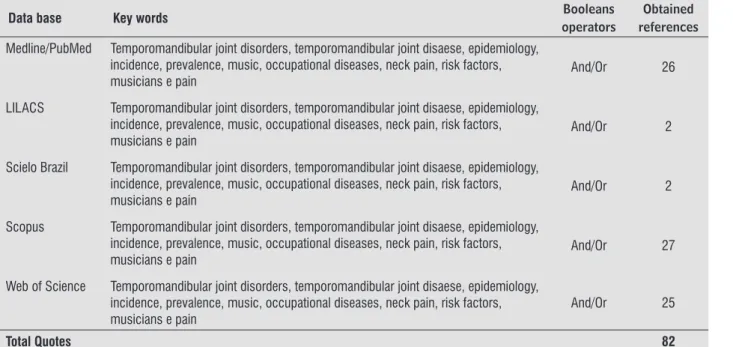
Thus, the keywords were used in the Boolean operators, “and” and “or”: temporomandibular joint disorders, temporomandibular joint disaese, epide -miology, incidence, prevalence, music, occupational diseases, neck pain, risk factors, musicians, pain. The review was conducted in August and in September 2015 and the search strategy in each base can be seen in Table 1.
Table 1 - Search strategy in electronic databases, Brasilia, 2016
Data base Key words Booleans
operators
Obtained references
Medline/PubMed Temporomandibular joint disorders, temporomandibular joint disaese, epidemiology, incidence, prevalence, music, occupational diseases, neck pain, risk factors, musicians e pain
And/Or 26
LILACS Temporomandibular joint disorders, temporomandibular joint disaese, epidemiology, incidence, prevalence, music, occupational diseases, neck pain, risk factors, musicians e pain
And/Or 2
Scielo Brazil Temporomandibular joint disorders, temporomandibular joint disaese, epidemiology, incidence, prevalence, music, occupational diseases, neck pain, risk factors, musicians e pain
And/Or 2
Scopus Temporomandibular joint disorders, temporomandibular joint disaese, epidemiology, incidence, prevalence, music, occupational diseases, neck pain, risk factors, musicians e pain
And/Or 27
Web of Science Temporomandibular joint disorders, temporomandibular joint disaese, epidemiology, incidence, prevalence, music, occupational diseases, neck pain, risk factors, musicians e pain
And/Or 25
Total Quotes 82
Selection Criteria: At first, the articles were se -lected only with the combination of descriptors, as described above. Subsequently, the abstracts of the articles were carefully read and from reading were selected those who met the following inclusion crite-ria: 1) articles that aimed to determine the prevalence of temporomandibular disorders and neck pain in musicians; 2) articles written in both Portuguese and English; 3) articles that were published in the last 10 years (2005 - 2015).
The flowchart of the search and selection of ar -ticles is shown in Figure 1.
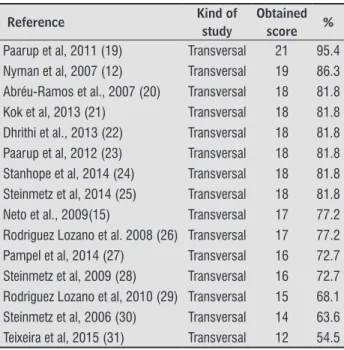
STROBE score: In a third time, to check the qual -ity of the studies found, the articles were read and evaluated by the the Strengthening the Reporting
of Observational Studies in Epidemiology criteria (STROBE) (18). Each of the 22 criteria set out by the STROBE received a score of 0 or 1 and each article would receive a final score up to 22 points. Thus, the articles were analyzed and received or not the score according to the presence of STROBE criteria.
842
Figure 1 - Flowchart of search and selection of articles.
Table 2 - Score and quality percentage of articles from the STROBE criteria, Brasilia, 2016
Reference Kind of
study
Obtained score %
Paarup et al, 2011 (19) Transversal 21 95.4
Nyman et al, 2007 (12) Transversal 19 86.3
Abréu-Ramos et al., 2007 (20) Transversal 18 81.8
Kok et al, 2013 (21) Transversal 18 81.8
Dhrithi et al., 2013 (22) Transversal 18 81.8
Paarup et al, 2012 (23) Transversal 18 81.8
Stanhope et al, 2014 (24) Transversal 18 81.8
Steinmetz et al, 2014 (25) Transversal 18 81.8
Neto et al., 2009(15) Transversal 17 77.2
Rodriguez Lozano et al. 2008 (26) Transversal 17 77.2
Pampel et al, 2014 (27) Transversal 16 72.7
Steinmetz et al, 2009 (28) Transversal 16 72.7
Rodriguez Lozano et al, 2010 (29) Transversal 15 68.1
Steinmetz et al, 2006 (30) Transversal 14 63.6
Teixeira et al, 2015 (31) Transversal 12 54.5
Results
About 15 of the selected articles met the inclu-sion criteria and had enough score, according to the STROBE. Table 3 shows the main findings of each of the 15 articles analyzed.
Among the selected studies to be part of this re-view, four were conducted in Germany, two in Brazil, two in Spain, two in Denmark. Australia, Netherlands, Puerto Rico, India and Sweden had only one study each. The age range of the sample participants ranged from 14 to 63 years.
843
Table 3 - Results of the described studies, Brasilia, 2016
Reference Country Sample Population Results
Abréu-Ramos et al.,2007 (20) Puerto Rico 82 Violin, viola, cello, contrabass,
wind instrument and percussion players.
About 10% of violinists and violists related pain symptoms in the TMJ and 64% felt neck pain.
Dhrithi et al., 2013 (22) India 66 Electric guitar players. About 29% reported neck pain.
Kok et al., 2013 (21) Netherlands 87 Music students. About 34.8% reported pain in the TMJ
and 73.1% in cervical.
Nyman et al., 2007 (12) Sweden 250 Violin, viola, cello, contrabass,
flute, trumpet, trombone, bassoon, clarinet, horn, oboe and tuba.
25.5% reported neck pain.
Paarup et al., 2011 (19) Denmark 342 Violin, viola, cello, contrabass,
flute, clarinet, oboe, bassoon, horn, trumpet, trombone, tuba and percussion.
80% reported neck pain.
Paarup et al., 2012 (23) Denmark 441 Violin, viola, cello, contrabass,
flute, clarinet, oboe, bassoon, horn, trumpet, trombone, tuba and percussion.
64.8% reported neck pain.
Pampel et al., 2014 (27) Germany 102 Wind instrument players. 86.2% had joint sounds, 100%
showed some parafunction.
Rodriguez-Lozano et al., 2008 (26) Spain 91 Violinists. 73% had bruxism.
Rodriguez-Lozano et al., 2010 (29) Spain 91 Violinists. 24.4% with TMJ pain,
29.3% limitation of mouth opening, 17.1% had already locking or blocking jaw, 26.8% had parafunctional habits, and 51.2% had TMJ sounds.
Stanhope et al., 2014 (24) Australia 14 Wind instrument players. 38% reported neck pain
Stechman Neto, et al., 2009 (15) Brazil 92 Wind instrument Interpreters
(metals and reeds), violinists and violists.
42.3% have parafunction (bruxism or clenching), 25% had TMJ pain, 42% reported TMJ sounds, 40% ear fullness and 35% tinnitus.
Steinmetz et al., 2006 (30) Germany 31 Violinists. 45% had TMJ pain, 65% pain in the
masticatory muscles, 58% wiht TMJ noise.
Steinmetz et al., 2009 (28) Germany 30 Violinists, pianists, cellists,
clarinetists, trombonists, violists, pipers, flutists.
80% had neck pain and 63% TMJ pain.
Steinmetz et al., 2014 (25) Germany 408 Violin, viola, cello, contrabass,
flute, clarinet, oboe, bassoon, horn, trumpet, trombone, tuba, percussion and piano.
About 81% had TMJ pain, 34% had bruxism or clenching the jaw.
844
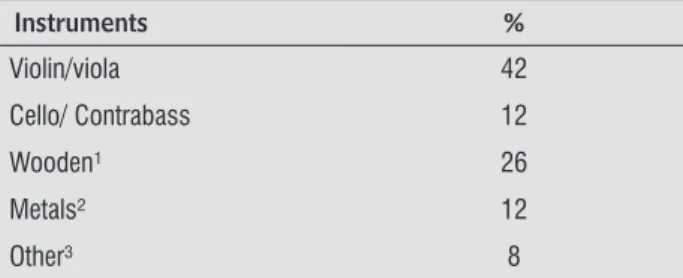
Table 4 - Percentage of instrumentalists by type of execut-ed instrument, Brasilia, 2016
Instruments %
Violin/viola 42
Cello/ Contrabass 12
Wooden¹ 26
Metals² 12
Other³ 8
Note: 1. Flauta, piccolo, Bassoon, Oboe and Clarinet, 2 Trumpet, Trombone and Tuba, 3. Piano. Guitar, Singers, Percussion and Harp.
In the studies it was found that the prevalence of TMJ pain ranged from 10 - 81%, and in violin and viola musicians it ranged from 10 - 28%. In the wind instruments musicians the change in prevalence was of 19 - 45%.
Some studies have also evaluated the presence of parafunctional habits. In these studies it was ob-served that the prevalence of habits such as bruxism and teeth clenching ranged from 26.8 to 100% in all studied instrumentalists and in the wind interpreters the prevalence was of 34 - 100%. Also in violinists was found a prevalence of parafunctional habits that ranged from 34 - 73%.
Moreover, were also reported symptoms such as locking, joint noises, maximum mouth opening diffi -culty, ear fullness, tinnitus, masticatory muscles pain. The studies found, indicated the presence of mouth locking, indicating a symptom prevalence of 17%. The prevalence of joint sounds ranged from 42 - 58%.
Also the difficulty of maximum mouth opening with a prevalence of 29.3% was reported. The feel-ing of ear fullness was observed in studies with a prevalence of 40%.
The tinnitus presence was reported with a 35% prevalence. And the presence of pain in the mastica-tory muscles showed a 65% prevalence.
The prevalence of neck pain ranged from 29 - 80% in all studied instrumentalists and in violinists and violists it ranged from 36 - 80%. Already in wind in -struments musicians ranged from 38 - 45%.
Among all the musicians surveyed the prevalence of TMJ pain ranged from 25 - 47% and the prevalence of neck pain ranged from 25 - 78%.
Regarding the gender difference, the female in-strumentalists had a higher prevalence of about 50% of neck pain, males showed a prevalence of 30% in
comparison. It has been observed that women were 2.4 times more likely to report orofacial pain.
Discussion
In this study, it was observed that the musicians have both TMJD and neck pain, observing a significant prevalence, especially in violin, viola, and wind instru -ment (metal and wood) musicians. These findings have been substantiated in the literature by the need that the musician has to acquire the musical expertise. Thus, in order to master and refine the technique, the musician faces several hours of practice and testing, running movements repetitively and in postures, often anti-physiologic, specific to each instrument, which gives an important risk factor for the appearance of osteomyoarticular injury in general (16, 31).
When it is verified in particular in case of neck pain, identified in the present study, must be considered that this may be caused by the anti-physiologic pos -tures mentioned in the literature, such as rotating the neck, anterior projection and head tilt and the static abduction posture with internal rotation of the right shoulder and external of the contralateral limb (14). Vicious posture as the shoulder protrusion for violin performance were also observed in previous stud-ies. Such postures cause a trapezius distension and favors scapulohumeral pace disarrangement, which can contribute to cervical pain complaints in the studies participants instrumentalists found (32 – 34). Another aspect that may be responsible for the prevalence of neck pain found in this study is the increased tension in trapezoid caused by the need of the violinist and violist to maintain the support of the arch (32 – 34).
845
The literature also adds that both violinists and violists as the wind instrumentalists perform the protrusion head (32 – 34). The protrusion also puts the muscles and the rear fascia in permanent tension which can help, also cervical problems, as blood pro-vision restrictions and appearance of nerve impinge-ment that may impact on the structures of distal upper limb (32 – 34). This head position maintained for long hours associated with the instrument chin support, in the case of violin and viola, in instrumental practice favors the appearance of both TMJD and neck pain, according to the findings of this review (13, 35).
Regarding the prevalence of neck pain found in this study in wind instrument players, it can be high -lighted that the presence of anti-physiologic postures as the foward projected head, the shoulders protru -sion and internal rotation, confer risk factors like ap -pearance of neck pain these professionals when com -pared to the violinist, as found in the literature (14). Authors state that the flute support, for example, is performed by a support point at the proximal phalange of the left hand index finger which presses the flute against the chin at the height of the piper lower lip (36). Another referenced point in literature is the right hand thumb that will press the flute in the opposite direction from the first point of support. These two forces have the function of balancing the instrument when the instrument is positioned between the flut -ist chin and the lower lip which favors an isometric trapezoidal region and upper limbs establishing the emergence of pains found in this study (36).
In addition, changes in temporomandibular joint can be caused in wind instruments because there is a muscular work required by the need to pump air through the nozzle. The literature suggests that there are different types of nozzles depending on the instru -ment. The trombone and trumpet have a mouthpiece like a cup in which the musician must force his lips. In the clarinet and saxophone the mouthpiece is between the lips that have to perform a sealing force so that the air does not escape with the support held at the bottom. In the flute the mouthpiece rests on the lower lip. In all cases the teeth can be affected, either by the nozzle pressure, the adjacent soft tissues or by the air column displaced, these could favor the appearance of occlusion problems, according to the literature (37).
It is added that specific training techniques for sound production. Through various nozzles, which is the position of the lips in a specific way to direct the air column against the nozzle, for producing bass,
middle and treble, as well as control of pitch and vi-brato, directly influences the complex work of the temporomandibular joint and may cause TMJD as found in this study (36).
In this aspect, it was noted in the literature that biomechanical work is required in wind instrument, not only when the player performs the training and support, but also in the air column production and in the head, neck and shoulders position. Furthermore, there are the trunk, arms, hands and lower limbs po -sitioning and maintenance of a postural balance while holding the instrument during a performance (35, 36). These anti-physiologic postures are necessary for the instrumental technique, however, these postural ar-rangements lead to muscle fatigue and, later, to the emergence of acute injuries which may become chron -ic, what corroborates the findings of this study (38). Beyond this, some postures favor the appearance of parafunctional activity of the stomatognathic system, as they require from the jaw and orofacial structures an effort beyond the physiological, important finding also evident in the present work studies (35, 39).
The literature also points out that both the musi-cians performing wind instruments as the bowed string, like the violin and viola, the upper limb elevated position for longer than three hours can cause more complaints, signs and symptoms in the cervical region (12).
Another point that may explain the symptoms found in this study is that both the flute and the violin are instruments supported completely by the musi -cian with isometric muscle strength for a long time during the performance, especially of the neck, shoul -der girdle and upper limbs and requires a certain degree of trunk and neck asymmetry posture. These postures can contribute to the emergence of chronic misalignment, disturbance of the static, joint rigidi -ties, compressions, muscle weakness and changes in fascias, contributing to the emergence of pain (36). Associated with this, the frequency of instrumental practice and the profession time also that have been directly related to the musculoskeletal complaints in such instrumentalist (40, 41).
846
to males (13). Associated with such factors the sex related hormones are also involved in pain percep-tion, causing women to become more vulnerable to the symptoms (42).
Another point that favors the appearance of more constant pain in women than in men is also due to social issues of sexual division of housework. The lit -erature reports that women generally have less time off work to activities that could shorten healthcare costs within their occupational activity (42).
Besides gender, the study showed researches where young instrumentalists also has pain complaints. The virtuosity charged in music conservatories has a direct impact on the osteomyoarticular structures of young professionals. Stringed instruments, like the violin, can influence the formation of craniofacial bones and the onset of malocclusion. The support of the instru-ment and the asymmetric position of the jaw combined with the intense practice can cause changes in the face growth of a young person, imbalances strength of the face muscle, causing joint pain during mastication, a stiffness feeling, teeth clenching, protrusion, muscle tension and deviation of the jaw (37).
Other instrumentalists, beyond the bowed string and wind instrumentalists, also had TMJD preva-lence and neck pain found in this study, as in the case of pianists and eletric guitarists. A study that evaluated the electromyographic activity of the mas -seter and temporal during the instrument execution and found that the activity of these musculature was almost four times higher compared with chewing. This fact was attributed to physical and psychosocial demands of performance and virtuosity, to concen -tration increased levels, stress and anxiety during the pianist activity (43). For guitarists, literature justifies that to run the instrument there is a shoul -der lifting generating a tension in the cervical spine, this posture sustained for long hours of instrumen-tal practice gives risk factor for the forthcoming of neck pain (44, 45).
Conclusion
The articles presented in this study reported that musicians have TMJD and neck pain complaints, par -ticularly the wind players and rubbed strings like the violin and the viola. The study also pointed out that the wind players have a tendency to experience more symptoms of temporomandibular disorders
in relation to bowed string instruments players, and the neck pain symptoms are similar between the two types of instrumentalists.
These injuries are closely related to the require -ments of the working musician, whether in work or -ganization or, more prominent, in the anti-physiologic postures required in instrumental performance.
The proposed study aims to point the need to look at the musician as a worker who has profession ad -vantages, but also the burden of overhead, unfortu-nately, a limitation of the study was the difficulty in finding population-based studies and that detailed the risk factors based on the movement biomechan -ics. Future reflections with larger populations could be developed, as well as studies based on biomechan-ical analyzes by type of instrument. In this context, this review aims to contribute to building reflections on the musician work and his demands required by their professional activity.
References
1. Lemos GA, Paulino MR, Forte FDS, Beltrão RTS, Batista AUD. Influence of temporomandibular disorder pres -ence and severity on oral health-related quality of life. Rev Dor. 2015;16:10-4.
2. Thilander B, Rubio G, Pena L, Mayorga C. Prevalence of temporomandibular dysfunction and its association with malocclusion in children and adolescents: an epidemiologic study related to specified stages of den -tal development. Angle Orthod. 2002;72(2):146-54.
3. Tvrdy P. Methods of imaging in the diagnosis of tem -poromandibular joint disorders. Biomed Pap Med. 2007;151(1):133-6.
4. Leeuw R. Dor orofacial: guia de avaliação, diagnóstico e tratamento. 4th ed. São Paulo: Quintessence Nacio-nal; 2010.
5. Winocur E, Littner D, Adams I, Gavish A. Oral hab -its and their association with signs and symptoms of temporomandibular disorders in adolescents: a gender comparison. Oral Surg Oral Med Oral Pathol Oral Radiol Endod. 2006;102(4):482-7.
847
7. Dworkin SF, Huggins K, Wilson L, Mancl L, Turner J, Massoth D, et al. A randomized clinical trial using re-search diagnostic criteria for temporomandibular dis-orders-axis II to target clinic cases for a tailored self-care TMD program. J Orofac Pain. 2002;16(1):48-63.
8. Resende CM, Alves AC, Coelho LT, Alchieri JC, Roncalli AG, Barbosa GA. Quality of life and general health in patients with temporomandibular disorders. Braz Oral Res. 2013;27(2):116-21.
9. Moreno BG, Maluf SA, Marques AP. Avaliação clínica e da qualidade de vida de indivíduos com disfunção tem-poromandibular. Rev Bras Fisioter. 2009;13(3):210-4.
10. Oliveira AS, Bermudez CC, Souza RA, Souza CMF, Dias EM, Castro CES, et al. Impacto da dor na vida de por-tadores de disfunção temporomandibular. J Appl Oral Sci. 2003;11(2):138-43.
11. Faulin EF, Guedes CG, Feltrin PP, Joffiley CMMSC. Association between temporomandibular disor-ders and abnormal head postures. Braz Oral Res. 2015;29(1):1-6.
12. Nyman T, Wiktorin C, Mulder M, Johansson YL. Work Postures and Neck–Shoulder Pain Among Orchestra Musicians. Am J Ind Med. 2007;50(5):370-6.
13. Frank A, Von Muhlen CA. Queixas musculoesqueléticas em músicos: prevalência e fatores de risco. Rev Bras Reumatol. 2007;47(3):188-96.
14. Subtil MML, Bonomo LMM. Avaliação fisioterapêutica nos músicos de uma orquestra filarmônica. Per Musi. 2012;25:85-90.
15. Stechman Neto JS, Almeida C, Bradasch ER, Corteletti LCBJ, Silvério KC, Pontes MMA, et al. Ocorrência de sinais e sintomas de disfunção temporomandibular em músicos. Rev Soc Bras Fonoaudiol. 2009;14(3):362-6.
16. Oliveira CFC, Vezzá FMG. A saúde dos músicos: dor na prática profissional de músicos de orquestra no ABCD paulista. Rev Bras Saude Ocup. 2014;35(121):33-40.
17. Fragelli TBO, Günther IA. Relação entre dor e an-tecedentes de adoecimento físico ocupacional: um estudo entre músicos instrumentistas. Per Musi. 2009;19:18-23.
18. Malta M, Cardoso LO, Bastos FI, Magnanini MMF, Silva CMFP. Iniciativa STROBE: subsídios para a comuni-cação de estudos observacionais. Rev Saude Publica. 2010;44(3):559-65.
19. Paarup HM, Baelum J, Holm JW, Manniche C, Wed -derkopp N. Prevalence and consequences of muscu -loskeletal symptoms in symphony orchestra musi -cians vary by gender: a cross-sectional study. BMC Musculoskelet Disord. 2011;12:223.
20. Abréu-Ramos AM, Micheo WF. Lifetima Prevalence of Upper-body Musculoskeletal Problems in a Profes -sional-Level Symphony Orchestra: Age, Gender, and Instrument-specific Results. Med Probl Perform Art. 2007;22(3):97-104.
21. Kok LM, Vlieland TP, Fiocco M, Nelissen RG. A com -parative study on the prevalence of musculoskeletal complaints among musicians and non-musicians. BMC Musculoskelet Disord. 2013;14:9.
22. Dhrithi MA, Agrawal PR, Aju K. Prevalence of play -ing-related musculoskeletal disorder (prmsd) among amateur young guitar players. J Musculoskelet Res. 2013;16(2):133-8.
23. Paarup HM, Baelum J, Manniche C, Holm JW, Wed -derkopp N. Occurrence and co-existence of localized musculoskeletal symptoms and findings in work-at -tending orchestra musicians - an exploratory cross-sectional study. BMC Res Notes. 2012;5:541.
24. Stanhope J, Milanese S, Grimmer K. University wood -wind students’ experiences with playing-related inju -ries and their management: a pilot study. J Pain Res. 2014;7:133-48.
25. Steinmetz A, Zeh A, Delank KS, Peroz I. Symptoms of craniomandibular dysfunction in professional orches -tra musicians. Occupat Medicine. 2014;14(64):17-22.
26. Lozano FJR, Yuguero MRS, Fenoll AB. Bruxism Re -lated to Violin Playing. Med Probl Perform Art. 2008;23:12-5.
27. Pampel M, Jakstat HA, Ahlers OM. Impact of sound production by wind instruments on the temporo -mandibular system of male instrumentalists. Work. 2014;48(1):27-35.
28. Steinmetz A, Ridder PH, Methfessel G, Muche B. Profes-sional musicians with craniomandibular dysfunctions treated with oral splints. Cranio. 2009;27(4):221-30.
848
30. Steinmetz A, Ridder PH, Reichelt A. Craniomandibu-lar Dysfuntion and Violin Playing: Prevalence and Influence of Oral Splints on Head and Neck Muscles in Violinists. Med Probl Perform Art. 2006;21:183-9.
31. Teixeira CS, Andrade RD, Kothe F, Felden ÉPG. Prática instrumental e desconforto corporal: um es-tudo com músicos de violino e viola. Mundo Saude. 2015;39(1):43-53.
32. Alves CV. Padrões físicos inadequados na performance musical de estudantes de violino [master´s thesis]. Belo Horizonte (Brazil): Universidade Federal de Minas Gerais; 2008. Portuguese.
33. Alves CV. Avaliação fisioterápica de alunos de violino durante performance musical - análise dos diagnósti-cos cinesiológidiagnósti-cos e biomecânidiagnósti-cos mais encontrados. Modus. 2011;6(8):71-88.
34. Costa C, Abrahão J. Quando o tocar dói: um ol-har ergonômico sobre o fazer musical. Per Musi. 2004;10:60-79.
35. Frias-Bulhosa J. Impactos oro-faciais associados à uti-lização de instrumentos musicais. Rev Port Estomatol Med Dent Cir Maxilofac. 2012;53(2):108-16.
36. Fonseca MPM, Cardoso F, Guimarães A. Fundamentos biomecânicos da postura e suas implicações na per-formance da flauta. Per Musi. 2015;31:86-107.
37. Głowacka A, Matthews-Kozanecka M, Kawala M, Kawala B. The impact of the long-term playing of musical instruments on the stomatognathic system - review. Adv Clin Exp Med. 2014;23(1)143-6.
38. Freitas DCV, Marques K. Prevalência da disfunção temporomandibular em violinistas e violistas da orquestra petrobras sinfonica. Rev Novo Enfoque. 2010;10:58-67.
39. Lacerda FAO. Estudo da prevalencia de desordens temporomandibulares em músicos de sopro [master´s thesis]. Porto (Portugal): Universidade Fernando Pes-soa; 2011. Portuguese.
40. Mehrparvar AH, Mostaghaci M, Gerami RF. Musculo-skeletal disorders among Iranian instrumentalists. Med Probl Perform Art. 2012;27(4):193-6.
41. Ackermann B, Driscoll T, Kenny DT. Musculoskel -etal pain and injury in professional orchestral musicians in Australia. Med Probl Perform Art. 2012;27(4):181-7.
42. Strazdins L, Bammer G. Women, work and musculo -skeletal health. Soc Sci Med. 2004;58(6):997-1005.
43. Lourenço S, Clemente M, Coimbra D, Barbosa AJP. Do pianists play with their Teeth? International Sympo -sium on Performance Science; 2009 Dec 15-18; Auck -land, New Zealand. Utrecht, The Netherlands: European Association of Conservatoires (AEC); 2009. p. 501-6.
44. Ranelli S, Straker L, Smith A. Playing-related muscu -loskeletal problems in children learning instrumental music: The association between problem location and gender, age, and music exposure factors. Med Probl Perform Art. 2011;26(3):123-39.
45. Ariëns GA, Bongers PM, Douwes M, Miedema MC, Hoogendoorn WE, Van der Wal G, et al. Are neck flex -ion, neck rotat-ion, and sitting at work risk factors for neck pain? Results of a prospective cohort study. Oc -cup Environ Med. 2001;58(3):200-7.
Received in 10/27/2015
Recebido em 27/10/2015
Approved in 08/18/2016