Fisioter. Mov., Curitiba, v. 28, n. 1, p. 23-30, Jan./Mar. 2015 Licenciado sob uma Licença Creative Commons DOI: http://dx.doi.org.10.1590/0103-5150.028.001.AO02
[T]
Effect of cryotherapy on the ankle temperature in
athletes: ice pack and cold water immersion
[I]
Efeito da crioterapia na temperatura do tornozelo
de atletas: pacote de gelo e crioimersão
[A]
Vanessa Batista da Costa Santos, Camila dos Santos Cardoso, Camila Pelegrin Figueiredo, Christiane de Souza Guerino Macedo*
Universidade Estadual de Londrina (UEL), Londrina, PR, Brazil
[R]
Abstract
Introduction: Cryotherapy is often used for rehabilitation of injured athletes. Objective: To compare the ef-fectiveness of ice pack (IP) and cold water immersion (CWI) on lowering the ankle skin surface temperature in athletes. Materials and methods: Thirteen athletes (seven women and six men), age 19.53 (± 2.9) years. IP and CWI were applied on the anterior talofibular ligament (ATFL) of the dominant leg for 30 minutes. The skin surface temperature was measured with an infrared digital thermometer prior to the application and during cryotherapy (10, 15, 20, 25 and 30 minutes) and up to two hours of rewarming. During rewarming, the athletes remained at rest and the temperature was measured every 1 minute until 10 minutes, every 5 minutes for up to an hour and every 15 minutes until 2 hours. Results: The two types of cold application were effective in lowering the skin surface temperature after the 30-minute procedure. Significant differ -ences were observed among the following temperatures: pre-application (IP = 29.8 ± 2.4 °C and CWI = 27.5 ± 3 °C – P < 0.05); after 30 minutes (IP = 5 ± 2.4 °C and CWI = 7.8 ± 3 °C – P < 0.01). For rewarming, after 25
24
minutes (IP = 20.8 ± 3.3 °C and CWI = 18.2 ± 2.7 °C – P < 0.04); after 45 minutes (IP = 24.5 ± 2.3 °C and IP = 22.1 ± 3.5 °C – P < 0.05); after 75 minutes (IP = 26.4 ± 2.2 °C and CWI = 24 ± 2.7 °C – P < 0.02). Conclusion: After the 30-minute application, both IP and CWI produced the appropriate temperature; however the ap -plication of CWI produced the lowest temperature during rewarming.
[P]
Keywords: Cryotherapy. Physiotherapy modalities. Ankle. Athletes.
[B]
Resumo
Introdução: A crioterapia é frequentemente utilizado para reabilitação de atletas lesionados. Objetivo: Objetivou-se comparar a eficácia da aplicação do pacote de gelo convencional (PG) em relação à crioimer -são (CI) na diminuição da temperatura superficial da pele do tornozelo de atletas. Materiais e métodos: A amostra foi composta por 13 atletas (sete do gênero feminino e seis do masculino), idade de 19,53 (± 2,9) anos. O PG e a CI foram aplicados sobre o ligamento talofibular anterior do tornozelo dominante, por 30 minutos. A temperatura superficial da pele foi verificada pré-aplicação e durante a crioterapia (10, 15, 20, 25 e 30 mi -nutos) e até duas horas de reaquecimento, com termômetro digital infravermelho. Para as coletas no período de reaquecimento, os atletas permaneceram em repouso, com temperatura verificada a cada 1 minuto, até 10 minutos, a cada 5 minutos, até uma hora, e a cada 15 minutos, até duas horas. Resultados: As duas formas de aplicação de crioterapia apresentaram efetividade para a redução da temperatura superficial da pele, após os 30 minutos de procedimento. Na comparação entre os grupos, houve diferença significativa nas temperaturas: pré-aplicação (PG = 29,8 ± 2,4 °C e CI = 27,5 ± 3 °C – P < 0,05); e ao fim de 30 minutos (PG = 5 ± 2,4 °C e CI = 7,8 ± 3 °C – P < 0,01). Para o reaquecimento, encontrou-se: após 15 minutos (PG = 20,8 ± 3,3 °C e CI = 18,2 ± 2,7 °C – P < 0,04); após 45 minutos (PG = 24,5 ± 2,3 °C e CI = 22,1 ± 3,5°C – P < 0,05); após 75 minutos (PG = 26,4 ± 2,2 °C e CI = 24 ± 2,7 °C – P < 0,02). Conclusão: Concluiu-se que, ao final dos 30 minutos de aplicação, PG e CI alcançaram a temperatura adequada para os benefícios da crioterapia, porém a crioimersão obteve menor temperatura no período de reaquecimento. [K]
Palavras-chave: Crioterapia. Modalidades de fisioterapia. Tornozelo. Atletas.
Introduction
Cryotherapy has been used in elite and amateur athletes to treat acute musculoskeletal injuries and to assist an athlete's recovery after strenuous exercise. The pathophysiology of soft tissue injuries is char-acterized by high cellular metabolism, hemorrhage, hyperemia, edema and local inflammation (1). It also causes muscle dysfunctions such as myofibril dis -turbance, rupture of mitochondria and sarcoplasmic reticulum, interruption of sarcolemma continuity, cellular self-digestion and cell death (2). Additionally, the response to the primary injury can lead to sec-ondary injury, which occurs from both enzymatic and hypoxic mechanisms in the cells on the periphery of the primary injury (3).
Physiological and clinical evidence suggest that the primary response of the body to cold ap-plication is the reduction in temperature of the
superficial tissues, accompanied by a reduction in the speed of nerve conduction, muscle cramp, muscle activity levels of metabolic enzymes, inhi-bition of nociceptors (4) and reduced local blood flow (5). Considering the pathophysiology of the soft tissue injuries, it was found that cryotherapy reduces the inflammatory reaction after trauma (6), slows the formation of edema (7), reduces the local metabolism and minimizes the degree of tis-sue injury (8), the secondary hypoxia injury (9) and pain (4, 10).
25 Several procedures are described for the applica
-tion of cryotherapy (gels, sprays, ice packs, immer-sion, etc). However, in clinics and hospitals and in sports medicine, ice packs are the most commonly used treatment (14). Previous studies have proved the efficacy in the reduction of tissue temperature (15-18). For cooling depth, it was demonstrated that the ice pack applied to the ankle joint for 20 minutes has caused physiological changes in at least 1 cm (14). Cryotherapy has been mainly used in athletes after sports practice to reduce the damage caused by stren-uous exercise. Gregson et al. (19) compared the im -mersion in cold water in two different temperatures (8 °C and 22 °C) and found that both temperatures produced lower rectal and skin surface temperature. These temperatures also reduced the arterial blood flow in 30% immediately after cold water immer -sion, and in 40%, 30 minutes after the procedure is complete, with more significant reductions in im -mersion at 8 °C. Systematic review studies observed that the most frequently used temperature of water immersion ranged from 10 °C and 15 °C, in 5 and 24 minutes, respectively (20, 21). It is believed that the cold water immersion is an adequate treatment for acute ankle sprain as it is able to cover the largest area of the distal end of the lower limb.
Given the widespread use of ice pack and cold wa -ter immersion in sports, further studies are necessary to compare these two types of methods and point out possible differences. Thus, the objective of this study was to analyze the effect of conventional ice pack compared to cold water immersion on decreasing the skin superficial temperature in athletes, as well as on the period of rewarming and systemic effect.
Materials and methods
This was a randomized cross-over study. Thirteen athletes (seven women and six men), mean age 19.53 (± 2.9) years, BMI between18.5 to 25 (normal index according to the World Health Organization), without injuries or complaints in the ankle of the dominant leg in the last six months participated in the study. Participants were excluded if they had above or below the average BMI normalvalue (17).
This study was approved by the Research Ethics Committee-UEL (case No 222/08). All participants were informed about the study and agreed to partici-pate by providing their free and informed consent.
The athletes underwent cryotherapy with the ap-plication of a 300 g ice pack (IP) (17) for 30 minutes over the anterior talofibular ligament (ATFL) of the dominant lower limb (14, 22, 23). Additionally, the participants immersed their ankle in a recipient with water level at 10 cm above the lateral malleolus, with the temperature ranging from 0 to 5 °C during the same time period (24). Cryotherapy procedures were developed in two sessions, with a 72-hour lapse be-tween them. There was a drawing to determine which procedure would be used on the first day (ice pack or the cold water immersion), therefore, the sequence of applications was randomized.
For data collection, each subject was instructed to sit for 20 minutes in a room with constant tempera -ture of 22 °C (± 1 °C), to stabilize skin tempera-ture, metabolism and blood flow. Meanwhile, questions were asked to obtain anthropometric and personal data (name, age, weight, height, BMI, training time, weekly workouts, spots modality, dominance, previ-ous injuries and the absence of injury in the ankle of the dominant limb).
At the end of the initial rest time, the skin tempera-ture in the ATFL of the dominant ankle was measured. CWI was applied over the anteromomedial aspect of the ankle lateral to medial malleolus (1 cm distant) and the skin temperature was recorded. The tempera-ture was measured using the Mult Temp IncotermTM portable digital infrared thermometer (Indústria de Termômetros). The temperature was measured prior to treatment, and with 10, 15, 20, 25 and 30-min -ute procedure (15). After the application ended, the athlete remained at rest for two hours, in supine position; the temperature was checked at the point marked on the ligament region every minute, up to 10 minutes and every five minutes up to an hour. After the one-hour rest, the temperature was measured every 15 minutes for two hours. The same procedure was performed on the second day of collection.
Simultaneously with the use of cryotherapy, the body pre-application temperature was recorded 15 minutes and 30 minutes, using a mercury thermom -eter under the armpit of the dominant upper limb to evaluate the systemic effect of the cryotherapy (25).
26
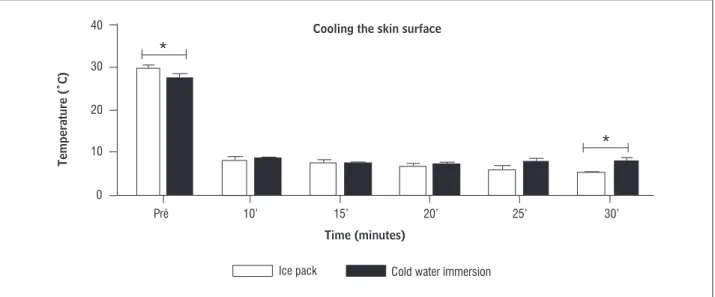
ice pack group and 27.55 °C (± 3.06), 8.70 °C (± 0.87), 7.33 °C (± 1.10), 7.06 °C (± 1.69), 7.70 °C (± 2.82) and 7.83 ºC (± 3.09) in the cold water immersion group. There was a significant different in compar-ing before and immediately after applications uscompar-ing IP (P < 0.0001) and CWI (P < 0.0001), demonstrat -ing the effectiveness of both types of cryotherapy. However, significant differences were only found between the groups for the pre-cooling (P < 0.05) and the 30-minute application values (P < 0.01), the latter with lower temperature value for the IP group (Figure 1).
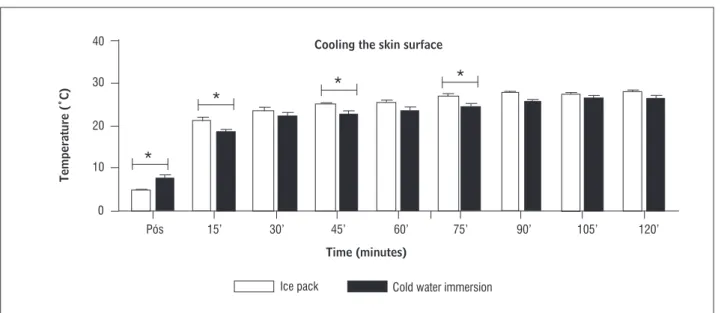
The values of the skin surface temperature after the application (during rewarming time) of the two types of cryotherapy presented significant differences between methods at 15 minutes (IP = 20.8 ± 3.3 °C and CWI = 18.2 ± 2.7 °C – P ≤ 0.04), 45 minutes (IP = 24.5 ± 2.3 °C and CWI = 22.1 ± 3.5 °C – P ≤ 0.05) and after 75 minutes (IP = 26.4 ± 2.2 °C and CWI = 24 ± 2.7 °C – P ≤ 0.02) of application. Figure 2 shows the behavior of the skin superficial temperature dur -ing rewarm-ing.
For the systemic temperature, significant differ -ence was observed between periods or cryotherapy modalities. The skin temperature measured before the application of ice pack was 36.52 °C (± 0.37), at 15 minutes, 36.50 °C (± 0.47) and at 30 minutes, 36.48 °C (± 0.50). Temperatures recorded after the application of CWI were 36.47 °C (± 0.37), 36.50 °C (± 0.34) and 36.51 °C (± 0.43), respectively.
two-way analysis of variance (ANOVA) for repeated measures and Bonferroni post hoc. The level of sig-nificance was set at 5% (p ≤ 0.05). Statistical analyses were performed using Statistical Package for Social Sciences Version 20 (SPSS Inc., Chicago, Il, USA).
Results
The mean age of participants was 19.53 (± 2.9) years and the anthropometric characteristics pre-sented weight of 67.23 (± 10.38) kg, height of 170.53 (± 11.67) cm and BMI of 23.13 (± 2.92) Kg.m-2. Among these athletes, 53.85% practiced athletics and 46.15% futsal. The training time was on average 6.65 (3.63 ±) years, 5.76 (± 1.09) times a week, 14.92 (± 2.28) hours per week. There was a 92.30% pre -dominance of right-handed -dominance. For the previ -ous injury, 76.93% of the athletes showed an injured ankle for more than a year, among these, 72.73% were sprains, followed by tendinitis of the Achilles tendon, fibula fracture and a fibula fracture associated with ankle sprain, both with 9.09%. Physiotherapy was performed in 72.73% of injuries, followed by cryo -therapy with 18.18%.
The mean temperature during the application of cryotherapy (IP and CWI) pre, 10, 15, 20, 25 and 30 minutes were respectively: 29.80 °C (± 2.47), 8.05 °C (± 3.01), 7.29 °C (± 3.25), 6.51 °C (± 3.17), 5.75 °C (± 4.07) and 5.06 °C (± 2.44) in the
Figure 1 - Mean and standard deviation of the skin temperature over the anterior talofibular ligament of the ankle measured during the application of both cryotherapy methods
Note: * P ≤ 0.05.
Cooling the skin surface
Time (minutes)
Temperature (˚C)
40
Ice pack Cold water immersion
30
20
10
0
10’
27
Figure 2 - Mean and standard deviation of the skin temperature over the anterior talofibular ligament of the ankle measured after the application of cryotherapy
Note: *P ≤ 0.05.
Cooling the skin surface
Time (minutes)
Temperature (˚C)
40
Ice pack Cold water immersion
30
20
10
0
30’ 15’
Pós 45’ 60’ 75’ 90’ 105’ 120’
Discussion
The results of this study suggest both types of ap-plication, icepack and cold water immersion, were effective in reducing the skin surface temperature of the ankle in athletes, considering that temperatures below 10 °C after 30 minutes of application were observed, which confirms the physiological effects and indication for the use of this therapeutic mo-dality. Leventhal et al. (15) reported that when ice applications are used directly on the skin, the tissue cooling is generally superficial and can range from 1 °C to 10 °C, where the effects of cryotherapy are beneficial. Previous studies have established that the analgesic effects begin after the skin temperature reaches ap-proximately 14.4 °C (26), or when it is lower than 10 °C (10) by reducing the number and speed of painful impulses sent to the brain by the peripheral nerves (4, 15). The local blood flow decreases when the tissue temperature reaches 13.8 °C (26) to help control the formation of edemas, blood leak by injured vessels (14) and tissue hemorrhage (2). A reduction of the metabolic enzyme activity in 50% occurs in tempera -tures between 10 °C and 11 °C (27). When associated with the decrease in the number of leukocytes in the injured site, this reduction can reach over 50% (8).
Even with frequent use of cryotherapy in sports injuries, however, there are still questions with re-gard to the differences in the cooling capacity of
the different methods of application, and a direct comparison between these methods becomes nec-essary. A few available studies report comparisons of the same protocol and many studies do not con-trol the heterogeneous characteristics of individuals (age, thickness of skin tissue) as well as the physical characteristics of the cold modality applied (size/ area, weight) (16).Therefore, the present study was developed with the use of 300 g ice pack (17) and CWI with water level at 10 cm above the lateral mal -leolus in all athletes with normal BMI in an attempt to reduce the interference of adipose tissue (28) in cooling and rewarming the superficial skin. It is known that individuals with thicker skin require a longer period of cold application to produce similar temperature changes (17, 29-31).
28
However, during the 2 hour rewarming period, cold water immersion was able to produce lower tem-peratures, which should be considered in the acute phase of ankle injuries in athletes.
References
1. Brancaccio N, Klein AA, Böettche GA, Colla PHS, Mach -ado DM, Moser GR, et al. Análise de lesão muscular em ratos treinados e sedentários submetidos a cri -oterapia. Fisioter Mov. 2005;18(1):59-65.
2. Matheus JPC, Milani JGPO, Gomide LB, Volpon JB, Shi -mano AC. Análise biomecânica dos efeitos da criote -rapia no tratamento da lesão muscular aguda. Rev Bras Med Esporte. 2008;14(4):373-5. doi: 10.1590/ S1517-86922008000400010.
3. Oliveira NML, Gava AD, Salvini TF. O efeito da cri -oterapia e compressão intermitente no músculo lesado de ratos: uma análise morfométrica. Rev Bras Fisioter. 2007;11(5):403-09. doi: 10.1590/ S1413-35552007000500012.
4. Algafly AA, George KP. The effect of cryotherapy on nerve conduction velocity, pain threshold and pain tolerance. Br J Sports Med. 2007;41(6):365-69.
5. Manso JMG, Matoso DR, Ruiz DR, Saa SSY, Calderón J. Effect of cold-water immersion on skeletal muscle contractile properties in soccer players. Am J Phys Med Rehabil. 2011;90(5):356-63. doi: 10.1097/ PHM.0b013e31820ff352.
6. Cameron MH, editor. Physical agents in rehabilitation: from research to practice. Philadelphia: WB Saunders; 1999.
7. Deal DN, Tipton J, Rosencrance E, Curl WW, Smith TL. Ice reduces edema. A study of microvascular permeability in rats. J Bone Joint Surg Am. 2002; 84-A(9):1573-8.
8. Capps SG, Mayberry B. Cryotherapy and intermittent pneumatic compression for soft tissue trauma. IJATT. 2009;14(1):2-4.
9. Merrick MA, Rankin JM, Andres FA, Hinman CL. A pre -liminary examination of cryotherapy and second-ary injury in skeletal muscle. Med Sci Sports Exerc. 1999;31(11):1516-21.
to cold water immersion (P ≤ 0.01), which agrees with the study of Kennet et al. (12). Additionally, Tomchuk et al. (34) analyzed the superficial and deep temperature during and after the ice pack ap-plication and concluded that immediately after the removal, the skin surface starts to rewarm, while the intramuscular temperature continues to reduce for approximately 5 to 10 minutes.
Our study has also analyzed the time of rewarm-ing and observed lower skin surface temperatures when CWI was applied after 15, 45 and 75 minutes of removal. Myrer et al. (35) compared the superficial and deep cooling and rewarming effects caused by the IP and CWI in whirlpool, and in agreement with our findings, they observed a significant reduction in skin surface temperature in the group submitted to IP. However, the cold immersion treatment reached the deeper tissues, maintaining the intramuscular cooling even after the removal, which did not occur in the group submitted to the ice pack. Moreover, Herrera et al. (16) compared the three modalities (cold water immersion ice pack and massage with ice) and concluded that these methods caused the reduction in skin temperature and in the nerve con-duction speed, nonetheless, CWI presented better results and was considered the most effective method for local analgesia.
No significant differences were found in systemic temperature values of the individuals studied, which shows that the cooling of the distal region of the lower limb did not produce effects throughout the body, only locally. Several studies have observed reduc -tions in the systemic temperature after cryotherapy, however, in these studies a greater body area was exposed to cold (19, 36), which may explain the dif -ferent results found.
Conclusion
29
21. Bleakley CM, Costello JT, Glasgow PD. Should athletes return to sport after applying ice? A systematic re-view of the effect of local cooling on functional per-formance. Sports Med. 2012;42(1):69-87.
22. Patterson SM, Udermann BE, Doberstein ST, Reineke DM. The effects of cold whirlpool on power, speed, agility, and range of motion. J Sports Sci Med. 2008; 7(3):387-94.
23. Surenzok O, Aytar A, Tüzün EH, Akman MN. Cryoter -apy impairs knee joint position sense and balance. Isokinet Exerc Sci. 2008;16(1):69-73.
24. Evans TA, Ingersoll C, Knight KL, Worrell T. Agility following the application of cold therapy. J Athl Train. 1995;30(3):231-4.
25. Khanmohammadi R, Someh M, Ghafarinejad F. The ef -fect of cryotherapy on the normal ankle joint position sense. Asian J Sports Med. 2011;2(2):91-8.
26. Starkey C. Recursos terapêuticos em fisioterapia. São Paulo: Manole; 2001.
27. Zachariassen KE. Hypothermia and cellular physiol-ogy. Arctic Med Res. 1991;50(Suppl 6):13-7.
28. Bleakley CM, Glasgow P, Webb MJ. Cooling an acute muscle injury: can basic scientific theory translate into the clinical setting? Br J Sports Med. 2012;46(4):296-8.
29. Jutte LS, Merrick MA, Ingersoll CD, Edwards JE. The relationship between intramuscular temperature, skin temperature, and adipose thickness during cryotherapy and rewarming. Arch Phys Med Rehabil. 2001;82(6):845-50.
30. Otte JW, Merrick MA, Ingersoll CD, Cordova M. Sub -cutaneous adipose tissue thickness alters cooling time during cryotherapy. Arch Phys Med Rehabil. 2002;83(11):1501-5.
31. Bleakley CM, McDonough S, MacAuley D. The use of ice in the treatment of acute soft-tissue injury : a sys-tematic review of randomized controlled trials. Am J Sports Med. 2004;32(1):251-61.
32. Carvalho AR, Medeiros DL, Souza FT, Paula GF, Barbosa PM,Vasconcellos PRO, et al. Variação de temperatura do músculo quadríceps femoral exposto a duas mo -dalidades de crioterapia por meio de termografia. Rev Bras Med Esporte. 2012;18(2):109-11.
10. Singh H, Osbahr DC, Holovacs TF, Cawley PW, Speer KP. The efficacy of continuous cryotherapy on the post -operative shoulder: a prospective, randomized inves-tigation. J Shoulder Elbow Surg. 2001;10(6):522-5.
11. Chesterton LS, Foster NE, Ross L. Skin temperature response to cryotherapy. Arch Phys Med Rehabil. 2002;83(4):543-9.
12. Kennet J, Hardaker N, Hobbs S, Selfe J. Cooling effi -ciency of 4 common cryotherapeutic agents. J Athl Train. 2007;42(3):343-8.
13. Pastre CM, Bastos FN, Netto Junior JN, Vanderlei LCM, Hoshi RA. Métodos de recuperação pós-exercí -cio: uma revisão sistemática. Rev Bras Med Esporte. 2009;15(2):138-44.
14. Enwemeka CS, Allen C, Avila P, Bina J, Konrade J, Munns S. Soft tissue thermodynamics before, dur -ing, and after cold pack therapy. Med Sci Sports Exerc. 2002;34(1):45-50.
15. Leventhal LC, Bianchi RC, Oliveira SMJV. Ensaio clínico comparando três modalidades de criote -rapia em mulheres não grávidas. Rev Esc Enferm USP. 2010;44(2):339-45. doi: 10.1590/S0080- 62342010000200014.
16. Herrera E, Sandoval MC, Camargo DM, Salvini TF. Motor and sensory nerve conduction are affected differently by ice pack, ice massage, and cold water immersion. Phys Ther. 2010;90(4):581-91.
17. Kanlayanaphotporn R, Janwantanakul P. Comparison of skin surface temperature during the application of various cryotherapy modalities. Arch Phys Med Re -habil. 2005;86(7):1411-5.
18. Fang L, Hung CH, Wu SL, Fang SH, Stocker J. The ef -fects of cryotherapy in relieving postarthroscopy pain. J Clin Nurs. 2001;21(5-6):636-43.
19. Gregson W, Black MA, Jones H, Milson J, Morton J, Dawson B, et al. Influence of cold water im -mersion on limb and cutaneous blood flow at rest. Am J Sports Med. 2011;39(6):1316-23. doi: 10.1177/0363546510395497.
30
36. Savalli L, Olave P, Sendin MIH, Laboute E, Trouvé P, Puig PL. Cryothérapie corps entier à –110 °C. Mesure des températures cutanées et centrale chez le sportif. Sci Sports. 2006;21(1):36-8. doi: 10.1016/ j.scispo.2006.01.005.
Received: 12/07/2013 Recebido: 07/12/2013
Approved: 07/15/2014 Aprovado: 05/07/2014 33. Costello JT, McInerney CD, Bleakley CM, Selfe J, Don
-nelly AE. The use of thermal imaging in assessing skin temperature following cryotherapy: a review. J Therm Biol. 2012;37(2):103-10.
34. Tomchuk D, Rubley MD, Holcomb WR, Guadagnoli M, Tarno JN. The magnitude of tissue cooling during cryo -therapy with varied types of compression. J Athl Train. 2010;45(3):230-7. doi: 10.4085/1062-6050-45.3.230.