Self-organisation in phonological development:
Templates
in
Brazilian and European Portuguese
Maria de Fátima de Almeida Baia
1, Susana Correia
2[email protected], [email protected]
1
Universidade Estadual do Sudoeste da Bahia, 2Universidade Nova de Lisboa
Abstract. This study investigates the emergence of early phonological templates, i.e. systematic shapes that facilitate the expansion of the lexicon,in the linguistic development of six children, three acquiring Brazilian Portuguese (BP) and three acquiring the European variety (EP). We follow the dynamic perspective of phonological development, which understands language development as a process of evolution characterised by variability. According to this view, although there is instability in development there are adjustments in the system due to the self-organization principle, which can be understood as a spontaneous pattern formation. The whole-word phonology/templates model is adopted in the analysis of early phonological patterns. The model claims that the organising principle in early phonological development is the whole word, not features or segments. These early word patterns are understood as templates. A preliminary longitudinal study was conducted to investigate early templates in BP and EP. We observed variability between the subjects regarding template types. In addition, we observed that instances of use and disuse of templates vary from child to child. The preliminary results suggest that there are templates operating during variability in phonological development. Also, the manifestation of a template characterises instability in the development. In instances of instability, templates are formed due to the principle of self-organisation, namely the spontaneous formation of patterns. The system organises itself due to its inherent ability to find patterns from some type of interaction.
Keywords: Brazilian and European Portuguese, dynamic systems, self-organization, templates
Introduction
This study investigates the emergence of early phonological templates in the phonological development of three children acquiring Brazilian Portuguese (BP) and three children acquiring the European variety (EP).
Within the dynamic systems theory in the study of child language, variety, flexibility and asynchrony tend to occur in the developmental process (Thelen & Smith, 1994). In this perspective, there is instability in development as there are adjustments in the system due to a self-organisation principle. Dynamic systems theory stresses the continuity between the development of phonological structure and the development of all other structures in nature (Szreder, 2012:14). Self-organisation thus appears as ‘order emerging without hierarchical pre-planning, based on the structural and functional capacities of the system’ (Davis & Bedore, 2013:134) and as a result of spontaneous pattern formation (Kelso, 1995). In an emergentist view, self-organisation does not require a blueprint or cookbook (Davis & Bedore, 2013:156).
Within the perspective of whole word/templatic phonology, the whole word is understood as the organising principle in early phonological development, not features or segments (Vihman & Croft, 2007; Vihman & Velleman, 2002). Many unusual phonological substitutions tend to occur due to ‘pattern force’ (Macken, 1979). In this perspective, some early word patterns are understood as templates, i.e. systematic shapes that facilitate the expansion of the lexicon.
articulation, articulatory planning, memory or biases/preferences. Therefore, idiosyncrasies give rise to individual differences in production. Moreover, individual templates may be similar to the target word (selected forms) or be distorted forms of the target word (adapted forms). Some examples of ‘bizarre’ forms in the acquisition of English as L1 have been reported previously (Waterson, 1971:179):
Child Production Target [ˈɲẽ.ɲẽ]/[ˈɲi.ɲi] finger
[ˈɲẽ.ɲẽ] window
[ˈɲã.ɲã] another
[ˈɲã.ɲø] Randall
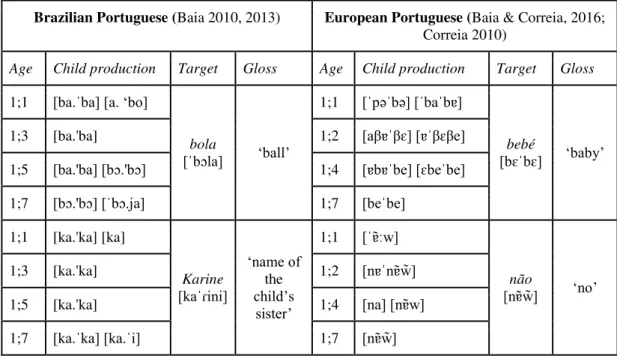
In Brazilian Portuguese, some examples of these ‘bizarre’ forms, emerging often as reduplicated syllables, have also been found. Baia (2008) names these ‘bizarre’, adapted forms produced by a child ‘lexical creations’, following Secco (1994). The same is observed in the acquisition of European Portuguese (Correia, 2010). Therefore, adapted and selected forms can, in fact, be identified in the early speech of children speaking two varieties of Portuguese, BP and EP:
Table 1. Child words in BP and EP acquisition
Brazilian Portuguese (Baia 2010, 2013) European Portuguese (Baia & Correia, 2016; Correia 2010)
Age Child production Target Gloss Age Child production Target Gloss
1;1 [ba.ˈba] [a. ‘bo]
bola
[ˈbɔla] ‘ball’
1;1 [ˈpəˈbə] [ˈbaˈbɐ]
bebé
[bɛˈbɛ] ‘baby’
1;3 [ba.'ba] 1;2 [aβɐˈβɛ] [ɐˈβɛβe]
1;5 [ba.'ba] [bɔ.'bɔ] 1;4 [ɐbɐˈbe] [ɛbeˈbe]
1;7 [bɔ.'bɔ] [ˈbɔ.ja] 1;7 [beˈbe]
1;1 [ka.'ka] [ka]
Karine [kaˈɾini]
‘name of
the
child’s sister’
1;1 [ˈɐ̃ːw]
não
[nɐ̃w̃] ‘no’
1;3 [ka.'ka] 1;2 [nɐˈnɐ̃w̃]
1;5 [ka.'ka] 1;4 [na] [nɐ̃w]
1;7 [ka.ˈka] [ka.ˈi] 1;7 [nɐ̃w̃]
The productions illustrated show that the speech of children speaking BP and EP is mainly characterized by an initial iambic pattern, although Portuguese words have stress mainly in the penultimate syllable. The authors observe similar deletion and filler sound insertion strategies in the speech of Brazilian and Portuguese children. However, different word shapes are found, both within the same child and between children, across varieties.
In this paper, we hypothesize that inter- and intravariability found in the comparison of templates in different Brazilian children (Baia, 2013) will be similar to the variability found in the comparison between Brazilian and Portuguese children. That is, we expect to find in two varieties of the same language a variable developmental path.
Method
sample of longitudinal spontaneous speech from 6 children (3 acquiring BP + 3 acquiring EP), between 0;9 and 2;0. For BP, we used the corpus A aquisição do ritmo em Português Brasileiro – Processos de Ancoragem (Santos, 2005). For EP, we used the ‘CCF’corpus, from the Acquisition of European Portuguese databank (available in
http://phonbank.talkbank.org/access/Romance/
Portuguese/CCF.html)
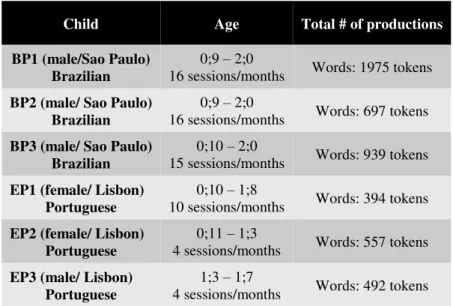
. Children’s speech was collected monthly in observational sessions of 30-45 minutes from both corpora. For the analysis, orthographic and IPA phonetic transcription were considered (with 90% inter-judge reliability; dubious 10% were excluded). To distinguish reduplicated words from babbling, we adopted the criteria proposed by Vihman and McCune (1994), i.e. the context (mother identification) and the type of vocalization (correspondence with the target word) disambiguated the child’s utterance as word or babbling. Dubious and unintelligible transcriptions and productions were disregarded from the analysis. For the template analysis, a phonological structure had to occur at least in 40% of the total number of tokens in each session to be considered a template. Table 2 summarizes the data analysed.Table 2. Data from Brazilian and Portuguese children analysed
Child Age Total # of productions
BP1 (male/Sao Paulo) Brazilian
0;9 – 2;0
16 sessions/months Words: 1975 tokens BP2 (male/ Sao Paulo)
Brazilian
0;9 – 2;0
16 sessions/months Words: 697 tokens BP3 (male/ Sao Paulo)
Brazilian
0;10 – 2;0
15 sessions/months Words: 939 tokens EP1 (female/ Lisbon)
Portuguese
0;10 – 1;8
10 sessions/months Words: 394 tokens EP2 (female/ Lisbon)
Portuguese
0;11 – 1;3
4 sessions/months Words: 557 tokens EP3 (male/ Lisbon)
Portuguese
1;3 – 1;7
4 sessions/months Words: 492 tokens
Results
Brazilian Portuguese
We observed variability between the subjects, regarding the type of template. In addition, we observed that instances of use and disuse of templatesvary from child to child.
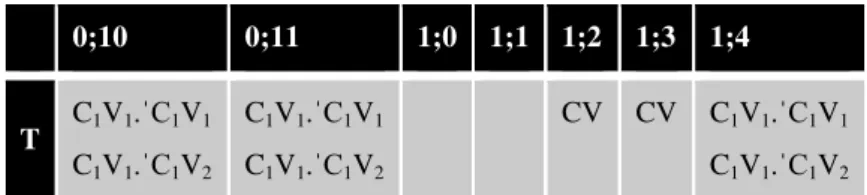
The following tables show how each template (T) was distributed along the sessions for the three Brazilian children observed. The first transcription correponds to the child’s utterance, whereas the target appears in the second transcription.
Table 3. BP1’s templates (BP)
0;10 0;11 1;0 1;1 1;2 1;3 1;4
T C1V1.ˈC1V1 C1V1.ˈC1V2
C1V1.ˈC1V1 C1V1.ˈC1V2
CV CV C1V1.ˈC1V1 C1V1.ˈC1V2
BP1: i. reduplication (C1V1.ˈC1V1 and C1V1.ˈC1V2) ii. CV
Child form / Target form [neˈne] nenê/ [neˈne] ‘baby’(selected)
[poˈpo] vovô/ [voˈvo] ‘grandfather’(selected) [kaˈka] galinha/ [gaˈlĩɲɐ] ‘hen’(adapted) [taˈta] tchau/ [tʃaʊ] ‘bye’(adapted)
Child form / Target form
[pɛ]pé/ [pɛ] ‘foot’(selected) [la] lá / [la] ‘there’(selected) [da] dado/ [ˈdadʊ] ‘dice’(adapted) [fo] flor / [floɾ] ‘flower’(adapted)
Table 4. BP2’s templates (BP)
0;9 0;10 0;11 1;3 1;4 1;5 1;6 1;8
T
C1V1.ˈC1V1
C1V1.ˈC1V2
C1V1.ˈC1V1
C1V1.ˈC1V2
V1.ˈCV1
V1.ˈCV2
C1V1.ˈC1V1
C1V1.ˈC1V2
ˈV1. CV1 ˈV1.CV2
C1V1.ˈC1V1
C1V1.ˈC1V2
C1V1.ˈC1V1
C1V1.ˈC1V2
C1V1.ˈC1V2
BP2: i. reduplication (C1V1.ˈC1V1 and C1V1.ˈC1V2) ii. ˈV.CV Child form / Target form
[kʰo'kʰo] cocô/ [koˈko] ‘poo’(selected) [pa'pa] sapato/ [saˈpatʊ] ‘shoe’(adapted)
Child form / Target form
['esɪ] esse / [ˈesɪ] ‘this’(selected) ['opa] roupa / [ˈhopɐ] ‘clothes’(adapted) iii. V.ˈCV
Child form / Target form [a'ki] aqui/ [aˈki] ‘here’(selected)
[o'kʰo] cocô/ [koˈko] ‘poo’(adapted)
Table 5. BP3’s templates (BP)
BP3: i. reduplication (C1V1.ˈC1V1 and C1V1.ˈC1V2) ii. ˈV.CV Child form / Target form
[maˈmã] mamãe / [maˈmãɪ̃] ‘mother’(selected) [poˈpo] alô / [aˈlo] ‘hello’(adapted)
Child form / Target form
['uma] uma / [ˈũmɐ] ‘one’(selected) ['ɔkʰi] óculos / [ˈɔkulʊs] ‘glasses’(adapted)
iii. CV
Child form / Target form
[da] dá / [da] ‘giveme’(selected)
[kʰa] caca / ['kakɐ] ‘poo/dirtything’(adapted)
0;11 1;0 1;1 1;2 1;3 1;4 1;5 1;6
T
CV C1V1.ˈC1V1
C1V1.ˈC1V2
ˈV1. CV1 ˈV1.CV2
C1V1.ˈC1V1 C1V1.ˈC1V2
C1V1.ˈC1V1 C1V1.ˈC1V2
C1V1.ˈC1V1 C1V1.ˈC1V2
C1V1.ˈC1V1 C1V1.ˈC1V2
1;7 1;8 1;9 1;10 1;11 2;0
T CvCv1V1.ˈCv1V1 1V1.ˈCv1V2
C1V1.ˈC1V1 C1V1.ˈC1V2
C1V1.ˈC1V1 C1V1.ˈC1V2
C1V1.ˈC1V1 C1V1.ˈC1V2
European Portuguese
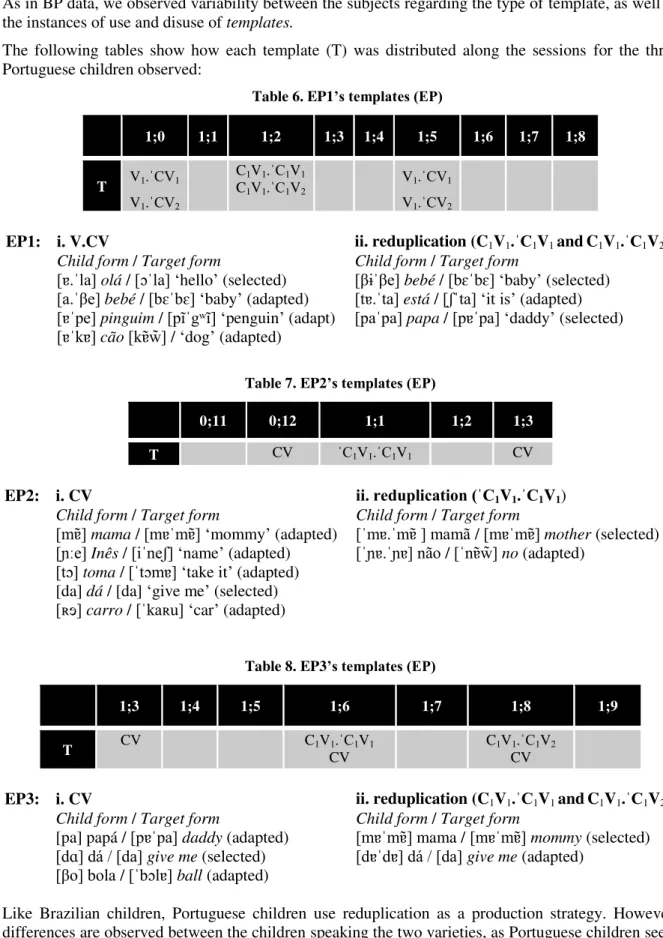
As in BP data, we observed variability between the subjects regarding the type of template, as well as the instances of use and disuse of templates.
The following tables show how each template (T) was distributed along the sessions for the three Portuguese children observed:
Table 6. EP1’s templates (EP)
1;0 1;1 1;2 1;3 1;4 1;5 1;6 1;7 1;8
T V1.ˈCV1 V1.ˈCV2
C1V1.ˈC1V1 C1V1.ˈC1V2
V
1.ˈCV1
V1.ˈCV2
EP1: i. V.CV ii. reduplication (C1V1.ˈC1V1andC1V1.ˈC1V2) Child form / Target form
[ɐ.ˈla] olá / [ɔˈla] ‘hello’(selected) [a.ˈβe] bebé / [bɛˈbɛ] ‘baby’(adapted) [ɐˈpe] pinguim / [pĩˈgʷĩ] ‘penguin’(adapt) [ɐˈkɐ] cão [kɐ̃w̃] / ‘dog’(adapted)
Child form / Target form
[βɨˈβe] bebé / [bɛˈbɛ] ‘baby’(selected) [tɐ.ˈta] está / [ʃˈta] ‘itis’(adapted) [paˈpa] papa / [pɐˈpa] ‘daddy’(selected)
Table 7. EP2’s templates (EP)
0;11 0;12 1;1 1;2 1;3
T CV ˈC1V1.ˈC1V1 CV
EP2: i. CV ii. reduplication (ˈC1V1.ˈC1V1) Child form / Target form
[mɐ̃] mama / [mɐˈmɐ̃] ‘mommy’(adapted) [ɲːe] Inês / [iˈneʃ] ‘name’(adapted) [tɔ] toma / [ˈtɔmɐ] ‘takeit’ (adapted) [da] dá / [da] ‘giveme’(selected) [ʀɘ] carro / [ˈkaʀu] ‘car’(adapted)
Child form / Target form
[ˈmɐ.ˈmɐ̃ ] mamã / [mɐˈmɐ̃] mother (selected) [ˈɲɐ.ˈɲɐ] não / [ˈnɐ̃w̃] no (adapted)
Table 8. EP3’s templates (EP)
1;3 1;4 1;5 1;6 1;7 1;8 1;9
T CV C1V1.ˈC1V1
CV
C1V1.ˈC1V2 CV
EP3: i. CV ii. reduplication (C1V1.ˈC1V1andC1V1.ˈC1V2) Child form / Target form
[pa] papá / [pɐˈpa] daddy (adapted) [dɑ] dá / [da] give me (selected) [βo] bola / [ˈbɔlɐ] ball (adapted)
Child form / Target form
[mɐˈmɐ̃] mama / [mɐˈmɐ̃] mommy (selected) [dɐˈdɐ] dá / [da] give me (adapted)
EP3). In addition to reduplication, which is a production strategy common to the Portuguese children observed, V.'CV (in EP1’s case) and CV (in EP2 and EP3’s case) are also available strategies.
As for Brazilian children, Portuguese children whose data were analysed used selected and adapted templates and that is independent of word size or word shape.
These preliminary results suggest that there are templates operating in the variability during phonological development. Not all children go through the same developmental path since variability and instability are inherent to development.
Discussion
Although children will eventually reach common ground in the phonology of their language, inter- and intra-variability are found in the way phonological development proceeds, as well as in transition instances. Portuguese and Brazilian children use the same strategy, namely reduplication, both within and between variety(ies), but word forms vary among children. Notice, however, that Brazilian children have templates during more age spans than Portuguese children due to the data collection in the corpora. Reduplication in child speech has specific forms and functions. It has been considered to be a trace of late babbling (Fee & Ingram, 1982) or ‘bits of babble’ (Lewis, 1936). Repeated syllables are interpreted as a means to facilitate the initial pronunciation (Fee & Ingram, 1982; Ferguson, 1983; Klein, 2005; Schwartz, Leonard, Wilcox, & Folgen, 1980). The production of two identical or partially identical syllables with phonological identity (Klein, 2005) has been reported previously for languages like English (e.g., [dɛdɛ] ‘bye’/ [mima] ‘grandmother’ (Schwartz et al., 1980). Repetitions of a core syllable have furthermore been associated with the production of a binary foot (Baia, 2008; Demuth, 1996; Santos 2007). In BP and EP, the production of reduplicated words with final prominence by young children is associated with the processing of iambic feet (Baia, 2008; Correia, 2010; Santos 2007). In this study, child-specific reduplication can be understood as the manifestation of a template/early articulatory routine. In sum, data from BP and EP phonological development show that children vary in the strategies they use to expand the lexicon as well as in the order of use (and disuse) of such strategies. Templates are instances of instability that characterize development and they are the result of self-organisation,that is spontaneous pattern formation.
Conclusion
Although we observed the use of reduplicated structures by Brazilian and Portuguese children, instability and variability were observed among children regarding the use and order of templates. Self-organisation instances of the phonological system differ, both within one child and between children. The system is self-organised due to its inherent capacity to form patterns from interaction. Therefore, variabilityappears as evidence of an open, dynamic and unstable phonological system.
Acknowledgments
This research was funded by Fundação para a Ciência e a Tecnologia, as part of the project of the Centro de Linguística da Universidade Nova de Lisboa – UID/LIN/03213/2013.
References
Baia, M. F. (2008). O formato prosódico inicial do Português Brasileiro: Uma questão metodológica? Revel, 6
(11).
Baia, M. F. (2010). A reduplicação fonológica na aquisição do português brasileiro: Uma comparação com outras línguas românicas. Revel, 8, 31-46.
Baia, M. F., & Correia, S. (2010). The initial prosodic template in Brazilian and European Portuguese: A methodological matter? In J. Costa, A. Castro, M. Lobo, & F. Pratas (eds.), Language acquisition and development: Proceedings of GALA 2009 (pp. 13-47). Newcastle, UK: Cambridge Scholars Publishing. Baia, M. F., & Correia, S. (2016). A auto-organização na emergência da fonologia: Templates na aquisição do
português brasileiro e europeu. Revel, 14(27).
Correia, S. (2010). The acquisition of primary word stress in European Portuguese. Unpublished PhD Thesis. University of Lisbon.
Davis, B., & Bedore, L. (2013). An emergent approach to speech acquisition: Doing and knowing. New York, NY: Psychology Press.
Demuth, K. (1996). The prosodic structure of early words. In J. Morgan & K. Demuth (eds.), Signal to syntax:
Bootstrapping from speech to grammar in early acquisition (pp. 171-184). Mahwah, NJ: Lawrence Erlbaum.
Kelso, J. (1995). Dynamical patterns: The self-organization of brain and behavior. Cambridge, MA: MIT Press. Fee, J., & Ingram, D. (1982). Reduplication as a strategy of phonological development. Journal of Child
Language, 9(1), 41-54.
Ferguson, C., & Farwell, C. (1975). Words and sounds in early language acquisition. Language, 51(2), 419-39. Ferguson, C. (1983). Reduplication in child phonology. Journal of Child Language, 10(1), 239-43.
Keren-Portnoy, T., Vihman, M. M., DePaolis, R., Bidgood, A., & McGillion, M. (2011). The effect of production templates on word learning and word recognition. Presented at 12th IASCL, Montreal.
Klein, H. (2005). Reduplication revisited: Functions, constraints, repairs, and clinical implications. American Journal of Speech-Language Pathology, 14, 71-83.
Lewis, M. M. (1936). Infant speech: A study of the beginning of language. New York: Harcourt, Brace & Co. Macken, M. (1979). Developmental reorganization of phonology: A hierarchy of basic units of acquisition.
Lingua, 49, 11-49.
Santos, R. S. (2005). A aquisição do ritmo em Português Brasileiro. Research project. University of Sao Paulo. Santos, R. S. (2007). A aquisição prosódica do português brasileiro de 1 a 3 anos: padrões de palavra e
processos de sândi externo. São Paulo: Universidade de São Paulo. Post-doctoral Dissertation.
Secco, G. (1994). Criações lexicais em uma criança de 20 meses de idade. MA Dissertation. Florianópolis: UFSC.
Schwartz, R., Leonard, L., Wilcox, M., & Folgen, K. (1980). Again and again: Reduplication in child phonology. Journal of Child Language, 7, 75-88.
Szreder, M. (2012), The acquisition of consonant clusters in Polish: A case study. In M. Vihman & T. Keren-Portnoy (eds.), The emergence of phonology: Whole-word approaches, cross-linguistic evidence (pp. 343-362) Cambridge, UK: Cambridge University Press.
Thelen, E., & Smith, L. (1994). A dynamic systems approach to the development of cognition and action.
Cambridge, MA: MIT Press.
Vihman, M., & McCune, L. (1994). When is a word a word? Journal of Child Language, 21, 517-542.
Vihman, M., & Velleman, S. (2002). Whole-word phonology and templates: Trap, bootstrap, or some of each?
Language, Speech, and Hearing Services in Schools, 33, 9-23.
Vihman, M., & Croft, W. (2007). Phonological development toward a ‘radical’ templatic phonology.
Linguistics, 45(4), 683-725.
Waterson, N. (1971). Child phonology: A prosodic view. Journal of Linguistics, 7, 179- 211.