(1) Universidade de Passo Fundo, Passo Fundo, Rio Grande do Sul, Brasil. (2) Universidade Federal do Rio Grande
do Norte, Natal, Rio Grande do Norte, Brasil.
This research was carried out at the University of Passo Fundo, Speech-Language Pathology and Audiology Course, Passo Fundo, Rio Grande do Sul, Brazil.
Research support source: This study was financed, in part, by the Coordenação de Aperfeiçoamento de Pessoal de Nível Superior (CAPES), Brazil - Finance Code 001.
Conflict of interests: Nonexistent
A comparative study on phonological
acquisition and performance in phonological
awareness by children exposed to a bilingual
or monolingual family environment
Ana Rita Brancalioni(1) Ana Paula Bogoni(1) Diane Pinto da Silva(1) Vanessa Giacchini(2)
Received on: February 2, 2018 Accepted on: September 28, 2018
Corresponding address: Vanessa Giacchini Av. Júlio Borella, 1547/202
CEP: 99150-000 - Marau, Rio Grande do Sul, Brasil
E-mail: [email protected]
ABSTRACT
Objective: to verify and compare phonological acquisition and performance in phono
-logical awareness tasks among children exposed to a bilingual (Brazilian Portuguese and German) or monolingual family environments (Brazilian Portuguese).
Methods: a sample of 32 children of both sexes aged 5 years were divided into the
bilingual group (13 children), who lived daily with people who spoke German and Portuguese, and the monolingual group (19 children), who lived daily with people who spoke only the Portuguese language. Phonological acquisition and phonological awa -reness skills were assessed using protocols standardized for Brazilian Portuguese and
statistically analyzed using the Fisher exact test and Mann-Whitney test, considering
p<0.05.
Results: the results revealed that a greater number of subjects demonstrated atypical
phonological acquisition in the bilingual group and scored worse results in the pho
-nological awareness skills evaluation. Pho-nological processes were similar in both groups. None of the results obtained were statistically significant.
Conclusion: deviant phonological acquisition was superior in the bilingual family envi
-ronment group. Phonological processes were similar for both groups. In the phono
-logical awareness tasks, children in the bilingual family environment group obtained better results only for the phonemic synthesis tasks. For other tasks, children in the monolingual family group achieved better results.
INTRODUCTION
Language is the main mean of communication between children and the world in which they live.
Through interaction with others, they develop and refine
their communication and interaction skills1. Language is
considered the first form of the socialization of children,
and it is initially developed from communication with their relatives through verbal instructions, conversa-tions, and stories.
The input is highly important in the construction of the phonological system of sounds of the mother tongue. A study2 evaluating the characteristics of phonological acquisition from a
multi-representa-tional analysis verified that linguistic aspects change
depending on the linguistic exposure of the child. In some cases, differences in development were observed because of the input children were exposed to.
An analysis guided by the theory of language acqui-sition3 revealed that children are born with an innate ability to acquire language, the Universal Grammar, as they acquire it from imperfect information. Children justify the existence of a Universal Grammar, because even when exposed to a precarious linguistic system, they are able to master their natural language in a relatively short period, even though the input comprises incomplete sentences and a limited system of constructions.
The author of the theory3 presents linguistic universals, which indicate the “principles and param-eters” before which each language is set as a deter-mined selection within the combination of available possibilities. To the linguist, grammar is formed by common principles used in all languages and by
parameters defined by the language to which one is
exposed. This causes changes between languages and within the same language. Based on universal and innate parameters, the role of children is to analyze the input received and then process it to assign the value of each parameter.
When children are exposed to a bilingual environment in the period of language acquisition and to languages with different syntactic structures, could this affect phonological acquisition and analysis of the parameters of their mother tongue? Some factors may interfere in children’s cognitive development and language acquisition, namely biological or cognitive factors resulting from affective and environmental issues or linguistic input.
Children assimilate the language of the speakers with whom they live and of the cultural environment in
which they are inserted4. As a result, a richer linguistic input environment enables the better development of important skills for phonemic discrimination. One study suggests that bilingual children are capable of developing more sophisticated perceptual skills to distinguish the different languages to which they are exposed5.
According to numerous studies6-10, bilingual children perform better in phonological awareness skills, are more precise in naming verbs and nouns, have better cognitive ability, and perform better in tasks requiring creativity and logical reasoning.
Children living in bilingual situations may develop
difficulties with speech or language and communi -cation in general, like any other child, without this being directly related to exposure to or use of two languages simultaneously11. The development of children’s
language skills reflects the quality and quantity of their
linguistic experiences11.
In general, it has been observed that the phono-logical system is typically similarly constructed among monolingual children. Studies12,13 affirm that the typical acquisition of the Brazilian Portuguese phonological system occurs from birth until approximately the age of
five years in a gradual, non-linear manner, respecting
the differences of each speaker. However, individual variations are possible in the segmental and prosodic domain. During the process of language acquisition, the
child faces a conflict between the target phonological
system (of the adult) and its production, encountering limitations in the capacity of categorization, articulation, motor planning, phonological memory, and auditory processing13,14.
Simplifications in speech, called phonological processes, must happen at specific ages during
language acquisition. However, when these processes become persistent at ages when they are no longer expected in the phonological acquisition process, without the presence of known and detectable
etiological factors such as intellectual deficit, neuro -motor disorders, or alterations in the structure of phono-articulatory organs, a phonological disorder is present13,15.
A phonological disorder is a change in speech that can be understood as the inadequate use of language phonemes, characterized by omissions and
substitu-tions that cause difficulties in speech intelligibility16. A phonological disorder occurs in the absence of
and is considered an inability to correctly employ the contractive traits of the language17,18.
Studies have evaluated phonological disorder and performance in phonological awareness tasks19-21.
Phonological awareness is defined as the ability to
identify, isolate, manipulate, combine, and mentally and deliberately segment the phonological segments of the language. Phonological awareness is developed in early childhood, and is progressive, improving over time and with literacy. The development of phono-logical awareness depends on linguistic experiences,
the cognitive ability of the child, specific characteristics
of different skills, and formal exposition of the alpha-betic system during reading and writing acquisition20-23. Phonemic awareness is the most complex level of phonological awareness and the last capacity to be developed. It is related to understanding how phonemes work within the word24. The phoneme is the smallest unit of analysis in the word, and most words consist of a set of phonemes. According to the
literature, at five years of age, children are expected to
have metaphonological abilities, as long as the tasks are adapted to their linguistic and cognitive reality, with
more difficult tasks related to phonemic awareness, as
there is still no writing support20,25.
According to one study6, with learning to read comes additional knowledge about linguistic structure. In this way, phonological awareness becomes more complex, and consequently, formal instructions explaining the rules of correspondence of speech sounds in alphabetic writing (phoneme/grapheme relations) are necessary to ensure that phonemic awareness develops afterwards20,24.
Bilingual children are known to have better metacognitive skills than monolingual children, besides presenting more expressive results in perception tests25,26. However, the following question arises: When children are not bilingual but live in an environment in which two languages are used simultaneously, is there a change in the process of acquiring the phonology of their language? Are their metacognitive skills better, worse, or similar to the skills of children living in monolingual environments?
The objective of this work is to verify and compare phonological acquisition and performance in phono-logical awareness tasks among children exposed to a bilingual (Brazilian Portuguese and German) or monolingual family environment (Brazilian Portuguese). It is important to verify if a bilingual family environment contributes to possible delays in the acquisition of
phonology for an increased use of phonological processes or worse performance in phonological awareness tasks.
METHODS
Ethical Considerations and Characteristics
of the Study
This study is a cross-sectional quantitative observa-tional study. It was developed in schools in the city of Chapada, a city colonized by Germans at the beginning of the last century. This small city is located in the Alto Uruguai region, North West of the state of Rio Grande do Sul, Brazil. Its population is approximately 9,377 inhabitants, of which 5,573 reside in urban areas and 3,804 in rural areas.
The study was approved by the Research Ethics Committee of the University of Passo Fundo, under number 23282713.5.0000.5342, of the National Commission of Ethics and Research (CONEP). It
follows all the required norms for conducting scientific
research according to resolution CNS 466/12 and its complements.
Prior to the participation of children in the research, their parents and/or guardians signed the Informed Consent Form (ICF) authorizing their participation therein. In addition, the school principals signed the Institutional Authorization Form that allowed the collection of data in the institution.
Characteristics of the sample
To develop the research, all schools in the city were contacted (one state and four municipal). The objec-tives of the work and importance in the educational context were explained to them. After institutional
authorization, all children aged five years were invited
to participate (5:0 to 5:11,29). Those responsible for the children who accepted the invitation signed the ICF and answered an objective questionnaire. The questions dealt with the development of speech and language, the child’s linguistic environment, signs of delay in language acquisition, and reports of develop-mental stuttering. There were also questions regarding
the proficiency and use of the German language in the
child’s family environment.
the naming and imitation tests, speech production and productive phonological processes were analyzed for both groups. Subsequently, the children with atypical
phonological acquisition were identified considering
the ages for the suppression of each phonological process.
The third evaluation aimed to obtain data to analyze the children’s production. It was conducted using the Phonological Awareness Test by Oral Production (PAT-OP)28, which evaluates children’s ability to manip-ulate speech sounds by orally expressing the result of this manipulation. The test has ten subtests that incor-porate the evaluation of supraphonemic and phonemic components. Training preceded each task to ensure understanding. A correct answer scored a point, an incorrect answer was assigned zero, and half a point was given when the child provided a partially correct answer.
The children’s performance in the PAT-OP28 is presented as a score or frequency of correct answers, with a maximum of 40 possible correct answers. The number of correct answers was compared with the
normative data for children aged five years, enabling a
performance evaluation of very low, low, medium, high, or very high.
Data analysis
The data collected were transcribed in the test protocols and tabulated in an electronic spreadsheet. After that, they were statistically analyzed using the Fisher exact test and Mann-Whitney test, which were
conducted in the Bioestat 5.0 software with a signifi -cance level of 5% (p<0.05).
RESULTS
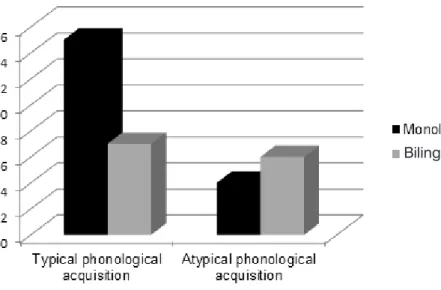
Figure 1 illustrates the distribution of children according to the phonological acquisition for the BG and MG. Atypical phonological acquisition was higher for children exposed to a bilingual environment (n = 6) than those in a monolingual environment (n = 4). However, this difference was not statistically
significant, as per the Fisher Exact test (p=0.1325).
no language delays, and demonstrated no indicative signs of neurological disorders such as syndromes,
emotional or cognitive alterations, or attention deficit
hyperactivity disorder.
Ultimately, the sample consisted of 32 children, of whom 19 were male and 13 female. They were divided into two groups: the monolingual group (MG) and bilingual group (BG). The MG was composed of 19 Brazilian Portuguese-speaking children who lived daily in their home environment with only Brazilian Portuguese speakers. The BG was composed of 13 children, who were also speakers of Brazilian Portuguese, but who lived daily in a family environment with at least one person (father, mother, brother, and/
or grandparents) who fluently spoke German with the
child.
Evaluations and collected data
All children underwent three stages for the purposes of this study, namely screening, phonological evalu-ation, and phonological awareness evaluation. The screening was performed through spontaneous speech and children’s storytelling (The Three Little Pigs, Little Red Riding Hood, and Pinocchio), in which the semantic, syntactic, and pragmatic components of the language were observed alongside the logical organization of thought, adequacy of responses, and execution of simple and complex orders.
The initial screening performed with parents who wanted their children to participate in the study consisted of a brief questionnaire asking about the child’s development.
The second stage comprised the phonological evaluation, carried out using the ABFW–Phonology Instrument27, which entails naming and imitation tests. This evaluation was performed to obtain data for the analysis and verify the children’s phonological
devel-opment. In the first test, the examiner asked the child to name the figures presented. If the child did not know, the researcher named the figure, and thereafter, presented five subsequent figures including the one the
Note: Fisher’s Exact Test p = 0.1325
Figure 1. Distribution of children according to phonological acquisition in both groups
Table 1 shows the productive phonological processes found for the sample. For both groups, the phonological processes that occurred were consonant
harmony, palatal fronting, liquid simplification, cluster
simplification, stop devoicing, and final consonant simplification. No statistically significant difference
was evident in the distribution and frequency of these processes.
Table 1. Analysis of the productive phonological processes of children in the bilingual and monolingual groups
Phonological Processes
Group B – Bilingual Environment Group M – Monolingual Environment p Occurs n (%) Does not occur
n (%) Occurs n (%)
Does not occur n (%)
Syllable Reduction 0 (0.00) 13 (100.00) 0 (0.00) 19 (100.00) #
Consonant Harmony 1 (7.69) 12 (91.31) 0 (0.00) 19 (100.00) #
Stopping of Fricatives 0 (0.00) 13 (100.00) 0 (0.00) 19 (100.00) #
Velar Posteriorization 0 (0.00) 13 (100.00) 0 (0.00) 19 (100.00) #
Palatal Posteriorization 0 (0.00) 13 (100.00) 0 (0.00) 19 (100.00) #
Velar Fronting 0 (0.00) 13 (100.00) 0 (0.00) 19 (100.00) #
Palatal Fronting 2 (15.38) 11 (84.62) 2 (10.52) 17 (89.48) 0.5419
Liquid Simplification 5 (38.46) 8 (61.34) 5 (26.32) 14 (73.68) 0.5652
Cluster Simplification 8 (61.34) 5 (38.46) 8 (42.11) 11 (57.89) 0.2363
Final Consonant Simplification 1 (7.69) 12 (91.31) 2 (10.52) 17 (89.48) #
Stop Voicing 0 (0.00) 13 (100.00) 0 (0.00) 19 (100.00) #
Fricative Voicing 0 (0.00) 13 (100.00) 0 (0.00) 19 (100.00) #
Stop Devoicing 1 (7.69) 12 (91.31) 1 (5.26) 18 (94.74) #
Fricative Devoicing 0 (0.00) 13 (100.00) 0 (0.00) 19 (100.00) #
Caption: #: without variation to carry out the statistical test Note: p: P-Value of Fisher’s Exact Test.
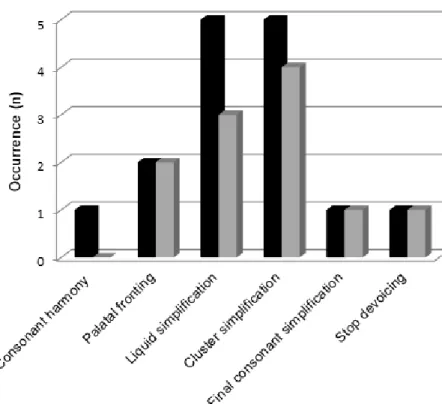
Figure 2 illustrates the productive phonological processes presented. It shows that the same phono-logical processes, with the exception of consonant
harmony, were verified for children in both the BG and
MG.
Figure 3 presents the box-plot diagram of the total number of correct answers provided by the children in the phonological awareness skills evaluation. The average score in the test, represented by the line inside the box, was lower for BG (13.12) than MG (13.87). This
difference was not statistically significant.
Figure 2. Productive phonological processes for children in both groups
Total number of
correct answers
Note: Mann-Whitney test, value of p: 0.1776.
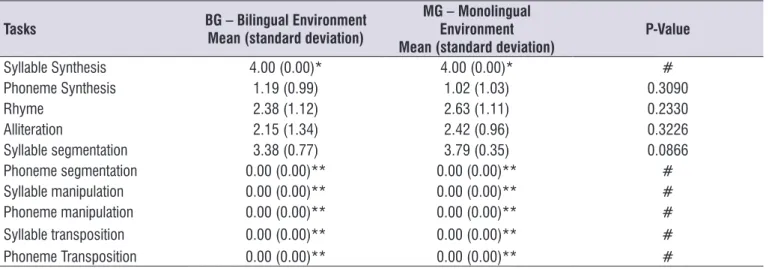
Table 2 presents performance in the phonological awareness tasks for children in the BG and MG. It shows that all children in both groups correctly performed the task of syllable synthesis. In the phoneme synthesis task, the BG children scored a higher average than did the children in the other group. Regarding tasks of
rhyme, alliteration, and syllable segmentation, the MG children achieved better results. No children in the two groups performed the tasks of phoneme segmentation, syllable manipulation, phoneme manipulation, syllable transposition, and phoneme transposition.
Table 2. Performance in the tasks of the phonological awareness test by oral production for children in the bilingual and monolingual groups
Tasks BG – Bilingual Environment Mean (standard deviation)
MG – Monolingual Environment Mean (standard deviation)
P-Value
Syllable Synthesis 4.00 (0.00)* 4.00 (0.00)* #
Phoneme Synthesis 1.19 (0.99) 1.02 (1.03) 0.3090
Rhyme 2.38 (1.12) 2.63 (1.11) 0.2330
Alliteration 2.15 (1.34) 2.42 (0.96) 0.3226
Syllable segmentation 3.38 (0.77) 3.79 (0.35) 0.0866
Phoneme segmentation 0.00 (0.00)** 0.00 (0.00)** #
Syllable manipulation 0.00 (0.00)** 0.00 (0.00)** #
Phoneme manipulation 0.00 (0.00)** 0.00 (0.00)** #
Syllable transposition 0.00 (0.00)** 0.00 (0.00)** #
Phoneme Transposition 0.00 (0.00)** 0.00 (0.00)** #
Caption: *: correct answers of all items of the test; **: incorrect answers of all items of the test; #: without variation to carry out the statistical test Note: P-Value: Significance of the Mann-Whitney Test
Figure 4 illustrates the distribution of the children’s performance based on the standard score of the phonological awareness test by oral production for
BG and MG. It shows that no child had low or very low standard scores. In addition, the highest incidence was very high for BG and high for MG.
DISCUSSION
The numerically verified difference between the analyzed groups was not statistically significant, both
in the questions involving the phonological system and those related to the development of phonological awareness skills.
The results of the present study reveal a higher incidence of atypical phonological acquisition for children exposed to a bilingual environment. This
finding agrees with some studies10,29 referring to the
existence of several phenomena that influence the
acquisition and development of language, including exposure to two languages in the family environment.
Comparing the phonological processes of children exposed to a bilingual and monolingual family
environment confirmed that they used the same
processes, regardless of environment. This corroborates a study30 of children exposed to a bilingual environment
that confirmed the same strategies of repair during
acquisition by bilingual and monolingual children. Thus, the phonological development of children exposed to a bilingual environment may differ from that for children exposed to a monolingual environment. The
differ-ences are related to superficial aspects, but in general,
the same phonological processes are used, although these are more pronounced in children exposed to a bilingual environment.
Children with atypical phonological acquisition exposed to a bilingual or monolingual environment demonstrated the same productive phonological
processes. These findings suggest that exposure to a bilingual environment has no significant influence on
phonological acquisition. A study31 affirms that phono
-logical knowledge is influenced by age, metacognitive
ability, level of schooling, proximity to written content, and type of task performed.
The most frequent productive phonological
processes were liquid simplification and cluster simpli
-fication. This mirrors the results of studies12,15,18,20 that
verified phonological processes involving the liquid
class as the most frequent in the population with phonological disorder.
Although the desonorization process is frequent
in German speakers, who have difficulties in distin -guishing between voiceless and voiced stops (both when the phoneme-grapheme (reading) association should occur and in speech), the exposure of children to a bilingual environment (Portuguese Brazilian and
German) does not influence the occurrence of this
process in their speech. As such, other factors such
as the presence of otitis32, difficulty in auditory discrimi -nation24, and severity of phonological deviation33,34 may affect the presence of the devoicing process.
Regarding the performance of phonological awareness, the data from the present study reveal that children exposed to a bilingual family environment scored fewer correct answers on average in the test28, but no statistical difference was evident. Such data cannot be compared with the literature, since no studies were found that evaluated performance in the phonological awareness task of monolingual children exposed to a bilingual environment. However, one study30 reported that children simultaneously exposed to two languages (English and Brazilian Portuguese) during the period of language acquisition and development demonstrated good performance in phonological awareness tasks, indicating that the simultaneous acquisition of two languages does not impair the phonological awareness of Portuguese.
Furthermore, studies6,7,35,36 that evaluated the performance of bilingual and monolingual children in phonological awareness tasks revealed the superior performance of children in the bilingual group. However, these studies contrast other research in the literature5,37 that did not confirm their superior language performance compared to monolingual speakers.
Evidence points out that the verbal abilities of bilingual children are lower than those of monolingual children5. The vocabulary of bilingual children (analyzing only one language) is smaller than that of monolingual children of the language analyzed. In naming tasks, bilingual children may present slower and less accurate results than their monolingual peers20,23.
Another study38 highlighted that bilingual children had higher scores than monolinguals in cognitive skills tests. They also have advantages in terms of under-standing the communication needs of their conver-sation partners. Research5 analyzing the effect of bilingualism on cognition in adulthood found that
bilin-gualism has little or no influence, but has an important
role in old age, helping in the cognitive reserve.
In this study, the sample, namely children exposed to a bilingual environment, obtained better results in phoneme synthesis tasks than did children exposed to a monolingual environment. A similar result was observed in other studies6,7, in which the group of bilingual children performed better than the monolingual group
in a phoneme synthesis task. However, this finding
bilingual children demonstrated inferior performance in the task of phonemic awareness.
Considering the tasks of rhyme, alliteration, and syllable segmentation, children exposed to a monolingual environment obtained a better result. This result is similar to that in a study6 in which the group of monolingual children performed better in the syllable segmentation task. According to the authors, this is associated with the sound characteristics of Brazilian Portuguese, which is a syllabic language in which syllables are easily recognized.
The study sample did not provide answers regarding the tasks of phoneme segmentation, phoneme manip-ulation, and phoneme transposition. This can be explained by the fact that phonemic awareness tasks require further analysis. They have a higher degree of complexity and are directly dependent on the alpha-betic code6,7,22. Another study40, based on the results of phonological awareness tests of pre-school children, revealed that the task of phoneme segmentation was easier than that of syllable segmentation.
Analyzing the results of this study in general, the
bilingual environment did not significantly affect phono -logical acquisition and performance in phono-logical
awareness skills. Before such findings, it was possible
to infer that exposure to bilingual environments has no negative or positive impact on the development of phonology and phonological awareness skills.
According to one study38, in the early stages of second language acquisition, children may experience delayed development compared to monolingual children. However, most bilingual children do not have a lower or higher capacity than monolingual children in any of the areas of language acquisition. The observed delays are small and do not last very long. It is important to verify the interference of another language in the acquisition of the target language phonology, even when the acquisition of a new language is not analyzed.
CONCLUSION
Although there was no statistically signif-icant difference between the groups, the preva-lence of atypical phonological acquisition was numerically higher for children exposed to a bilingual family environment. The phonological processes found were similar for children exposed to the bilingual and monolingual environment.
In phonological awareness tasks, children exposed to the bilingual environment obtained better results only in the task of phoneme synthesis. In the other
phonological awareness tasks, children exposed to the monolingual environment achieved better results.
However, none of the results of the present study
were statistically significant. Thus, for the sample in
this study, it is concluded that the bilingual family
environment does not significantly interfere in phono -logical acquisition and performance in phono-logical awareness skills. Therefore, further studies on the
influence of different linguistic inputs during the period
of language acquisition are necessary.
REFERENCES
1. Hubner EP, Ardengui LG. Input materno e aquisição da linguagem: análise das dádes comunicativas
entre mães e filhos. Bol Psicol [Internet]. 2010 [cited 2017 Jul 14];LX:029-43. Available from:
http://pepsic.bvsalud.org/pdf/bolpsi/v60n132/ v60n132a04.pdf
2. Cristófaro TS, Abreu CG. Aquisição fonológica na perpectiva multirepresentacional. Rev Let Hoje
[Internet]. 2007 [cited 2017 Jul 13];42(1):179-91.
Available from: http://revistaseletronicas.pucrs.br/ ojs/index.php/fale/article/viewFile/679/493
3. Chomsky N. Knowledge of language: its nature,
origin, and use [Internet]. Praeger; 1986 [cited 2017 Jul 14]. 307 p. Available from: https://
books.google.com.br/books?id=b0VZPtZDL8k C&pg=PR3&hl=pt-BR&source=gbs_selected_ pages&cad=2#v=onepage&q&f=false
4. Yule G. The stufy of language [Internet]. 4th ed.
Cambridge; 2010 [cited 2017 Jul 13]. 340 p.
Available from: http://faculty.mu.edu.sa/public/ uploads/1378843468.6083The Study Of Language (4th Edition(.pdf
5. Bialystok E, Craik F, Luk G. Bilingualism: consequences for mind and brain. Trends Cogn Sci. 2012;16(4):240-50.
6. Souza LBR, Leite AGC. Profile of phonological awareness in bilingual and monolingual
children. CoDAS [Internet]. 2014 [cited 2017 Jul 14];26(1):61-7. Available from: http://www.scielo.br/
pdf/codas/v26n1/2317-1782-codas-26-01-00061. pdf
7. Lasch SS, Mota HB, Cielo CA. Consciência fonológica: o desempenho de meninos e meninas
bilíngues e monolíngues. Rev. CEFAC [Internet]. 2010 [cited 2017 Jul 14];12(2):202-9. Available
8. Marian V, Faroqi-Shah Y, Kaushanskaya M, Blumenfeld HK, Sheng L. Bilingualism: consequences for language, cognition, development, and the brain. ASHA Leader. 2009.
9. Mendonça PV da CF, Fleith D de S. Relationship between monoliguals and bilinguals’ creativity, inteligence, and self-concept. Psicol Esc e Educ
[Internet]. 2005 [cited 2017 Jul 14];9(1):59-70.
Available from: http://www.scielo.br/pdf/pee/ v9n1/9n1a06.pdf
10. Saliby CKA, dos Santos C, Hreich EK, Messarra C. Assessing lebanese bilingual children: the use of cross-linguistic lexical tasks in lebanese arabic. Clin
Linguist Phon [Internet]. 2017 [cited 2017 Jul 21]
31(11-12):874-92. Available from: https://www.ncbi. nlm.nih.gov/pubmed/28441074.
11. Hoff E, Core C. Input and language development in bilingually developing children. Semin Speech
Lang [Internet]. 2013 Nov [cited 2017 Jul 14];34(4):215-26. Available from: http://www.ncbi.
nlm.nih.gov/pubmed/24297614
12. Silva MK da, Ferrante C, Borsel J Van, Perreira MM de B. Phonological acquisition of brazilian
portuguese in children from Rio de Janeiro. J Soc Bras Fonoaudiol [Internet]. 2012 [cited 2017 Jul 17];24(3):248-54. Available from: http://www.scielo.
br/scielo.php?script=sci_arttext&pid=S2179-64912012000300010&lng=en. http://dx.doi. org/10.1590/S2179-64912012000300010.
13. Ceron MI, Gubiani MB, de Oliveira CR,
Keske-Soares M. Factors influencing consonant
acquisition in brazilian portuguese–speaking
children. J Speech Lang Hear Res [Internet]. 2017 Apr 14 [cited 2017 Dec 6];60(4):759.
Available from: http://jslhr.pubs.asha.org/article.
aspx?doi=10.1044/2016_JSLHR-S-15-0208
14. Mezzomo CL, Giacchini V, Dias RF, Luiz SW, Lopes SG. Aquisição da coda simples e complexa com /S/ em crianças com desvio fonológico. Rev. CEFAC. 2013;(2):17-24.
15. Mezzomo CL, Vargas DZ, Dias RF. Strategies used by children with typical and atypical phonological development during the blocked
syllable acquisition. Rev. CEFAC [Internet]. 2015 [cited 2017 Jul 17];17(Supl1):27-34. Available from:
http://revistaseletronicas.pucrs.br/ojs/index.php/ letronica/article/view/7097
16. Rosado IM, Donicht G, De Simoni SN, Pagliarin KC, Keske-Soares M. Perception of the intelligibility and severity level of speech sound disorders by speech language pathologists and non-professionals.
Rev. CEFAC [Internet]. 2017 [cited 2017 Jul 17];19(2):233-41. Available from: http://www.scielo.
br/pdf/rcefac/v19n2/1982-0216-rcefac-19-02-00233. pdf
17. Giacchini V, Mota HB, Lazzarotto-Volcão C. Standard model of structures and contrast acquisition – proposal for phonological evaluation
in the brazilian portuguese. J Child Lang Acquis
Dev. 2016;4(3):78-97.
18. Schneider GB, Dias RF, Mezzomo CL. Analysis of the distinctive features and of the phonetic and phonological systems in different severities of
phonological disorder. Rev. CEFAC [Internet]. 2014 [cited 2017 Jul 17];16(6):1850-9. Available from:
http://www.scielo.br/pdf/rcefac/v16n6/1982-0216-rcefac-16-06-01850.pdf
19. Giacchini V, Mota HB, Mezzomo CL. The details in the therapeutic process to the consonant clusters acquisition in the speech of children with phonological disorder. Rev. CEFAC. 2012;(2):17-23. 20. Ribas LP, Bartz DW, Rodrigues G, Silva D, Vieira
Peruch C, Zencke K et al. Consciência fonológica em crianças com desvio fonológico. Domínios
de Lingu@gem [Internet]. 2013 [cited 2017 Jul 17];7(2):1-10. Available from: http://www.seer.
ufu.br/index.php/dominiosdelinguagem/article/ viewFile/23506/13587
21. Stefanini MR, Oliveira BV de, Marcelino FC, Maximino LP. Performance in phonological awareness of children with phonological disorder: comparison of two instruments. Rev. CEFAC
[Internet]. 2013 [cited 2017 Jul 17] 15(5):1227-35.
Available from: http://www.scielo.br/pdf/ rcefac/2013nahead/171-11.pdf
22. Bigochinski E, Eckstein MPW. A importância do trabalho com a com a consciência fonológica para a aprendizagem da leitura e da escrita. Rev Eletrônica do Curso Pedagog das Faculdades
OPET [Internet]. 2016 [cited 2017 Jul 17]; Available
from: http://www.opet.com.br/faculdade/revista-pedagogia/pdf/n11/artigo4.pdf
23. Guedes MCR, Gomes CA. Consciência fonológica em período pré e pós-alfabetização. Cad Let da
UFF - Dossiê Let e cognição [Internet]. 2010 [cited 2017 Jul 17];41:263-81. Available from: http://www.
24. Marchetti PT, Mezzomo CL, Cielo CA. Desempenho em consciência silábica e fonêmica em crianças com desenvolvimento de fala normal e desviante.
Rev. CEFAC [Internet]. 2010 [cited 2017 Jul 17];12(1):12-20. Available from: http://www.scielo.
br/pdf/rcefac/v12n1/121-08.pdf
25. Scarpino SE, Lawrence FR, Davison MD, Hammer CS. Predicting bilingual spanish-english children’s phonological awareness abilities from their
preschool english and spanish oral language. J Res Read [Internet]. 2011 Feb 1 [cited 2017 Jul 17];34(1):77-93. Available from: http://www.ncbi.
nlm.nih.gov/pubmed/23258945
26. Yeung SSS, Siegel LS, Chan CKK. Effects of a phonological awareness program on english reading and spelling among Hong Kong Chinese
ESL children. Read Writ [Internet]. 2013 May [cited 2017 Jul 17];26(5):681-704. Available from: http://
www.ncbi.nlm.nih.gov/pubmed/23626405
27. Wertzner HF. Fonologia. In: Andrade CRF,
Befi-Lopes DM, Fernandes FDM, Wertzner HF
(orgs). ABFW Teste de linguagem infantil nas áreas
de fonologia, vocabulário, fluência e pragmática.
2ed.rev. ampl. e atual. Barueri (SP): Pró-Fono, 2004. Cap. 1, Anexo 5. 1 CD Rom.
28. Seabra AG, Capovilla FC. Prova de consciência fonológica por produção oral. In: Seabra AG, Dias NM (orgs). Avaliação neuropsicológica cognitiva: Linguagem oral. Vol. 2. São Paulo: Memnon, 2012. p. 116-20.
29. Hambly H, Wren Y, McLeod S, Roulstone S. The
influence of bilingualism on speech production: a systematic review. Int J Lang Commun Disord [Internet]. 2013 Jan [cited 2017 Jul 22];48(1):1-24.
Available from: http://www.ncbi.nlm.nih.gov/ pubmed/23317381
30. Genaro KLX de. Desempenho fonológico de um grupo de crianças brasileiras que frequentam
escola bilingue [Internet]. [Dissertação]: São Paulo
(SP): Pontifícia Universidade Católica de São Paulo;
2013 [cited 2017 Jul 28]. Available from: https://
sapientia.pucsp.br/bitstream/handle/11962/1/Karin
Luzia Ximenes de Genaro.pdf
31. Cunha VLO, Capellini SA. Habilidades metalinguísticas no processo de alfabetização de escolares com transtorno de aprendizagem.
Rev Psicopedag [Internet]. 2011 [cited 2017 Jul 28];28(85):85-96. Available from: http://pepsic.
bvsalud.org/scielo.php?script=sci_arttext& pid=S0103-84862011000100009
32. Wertzner HF, Pagan L de O, Galea DE dos S, Papp ACCS. Características fonológicas de crianças com transtorno fonológico com e sem histórico de otite
média. Rev da Soc Bras Fonoaudiol [Internet]. 2007 Mar [cited 2017 Jul 28];12(1):41-7. Available
from: http://www.scielo.br/scielo.php?script=sci_ arttext&pid=S1516-80342007000100009&lng=pt& tlng=pt
33. Mota HB, Berticelli A, Costa C da C, Wiethan FM, Melo RM. Occurrence of devoicing in phonological disorders: relationship with most affected phonemes, severity of the disorder and
age. Rev da Soc Bras Fonoaudiol [Internet]. 2012 Dec [cited 2017 Jul 28];17(4):430-4. Available
from: http://www.scielo.br/scielo.php?script=sci_ arttext&pid=S1516-80342012000400011&lng=pt& tlng=pt
34. Souza APR de, Mezzomo CL, Scotti LMC, Dias
RF, Giacchini V. A influência da variável tonicidade
na produção de sonoras. Distúrb Comun. 2013;25(1):57-63.
35. Loizou M, Stuart M. Phonological awareness in monolingual and bilingual english and greek
five-year-olds. J Res Read. 2003;26(1):3-18.
36. Marinova-Todd SH, Zhao J, Bernhardt M. Phonological awareness skills in the two languages of mandarin-english bilingual children. Clin Linguist
Phon [Internet]. 2010 [cited 2017 Jul
28];24(4-5):387-400. Available from: http://www.ncbi.nlm. nih.gov/pubmed/20345266
37. Mckay KL. Phonological awareness skill of segmenting in bilingual english/spanish speaking
4-and 5-year-old children [Internet]. Missoula. [Thesis Master of Science] Montana 5USA): University of Montana; 2012 [cited 2017 Jul 31].
Available from: http://scholarworks.umt.edu/etd
38. Nicoladis E, Charbonnier M, Popescu A. Second language/bilingualism at an early age with emphasis on its impact on early socio-cognitive and socio-emotional development. Encycopedia
Early Child Dev [Internet]. 2016 [cited 2017 Jul 31];1(1):1-5. Available from: http://www.child-encyclopedia.com/sites/default/files/textes-experts/
en/614/second-languagebilingualism-at-an-early- age-with-emphasis-on-its-impact-on-early-socio-cognitive-and-socio-emotional-development.pdf
39. Bruck M, Genesee F. Phonological awareness in
young second language learners. J Child Lang.
40. Labanca L, Alves CRL, Bragança LLC, Dorim DDR, Alvim CG, Lemos SMA. Language evaluation protocol for children aged 2 months to 23 months:
analysis of sensitivity and specificity. CoDAS [Internet]. 2015 [cited 2017 Jul 26];27(2):119-27.