Stability of
XIST
repression in relation to
genomic imprinting following
global genome demethylation in
a human cell line
E.S.S. de Arau´jo
1,2, L.R. Vasques
1, R. Stabellini
1,2, A.C.V. Krepischi
1,2and L.V. Pereira
11Departamento de Gene´tica e Biologia Evolutiva, Instituto de Biocieˆncias, Universidade de Sa˜o Paulo, Sa˜o Paulo, SP, Brasil 2Centro Internacional de Pesquisa, A.C. Camargo Cancer Center, Sa˜o Paulo, SP, Brasil
Abstract
DNA methylation is essential in X chromosome inactivation and genomic imprinting, maintaining repression ofXIST in the active X chromosome and monoallelic repression of imprinted genes. Disruption of the DNA methyltransferase genesDNMT1
andDNMT3Bin the HCT116 cell line (DKO cells) leads to global DNA hypomethylation and biallelic expression of the imprinted geneIGF2but does not lead to reactivation of XISTexpression, suggesting thatXISTrepression is due to a more stable epigenetic mark than imprinting. To test this hypothesis, we induced acute hypomethylation in HCT116 cells by 5-aza-29 -deoxycytidine (5-aza-CdR) treatment (HCT116-5-aza-CdR) and compared that to DKO cells, evaluating DNA methylation by microarray and monitoring the expression ofXISTand imprinted genesIGF2,H19, andPEG10. Whereas imprinted genes showed biallelic expression in HCT116-5-aza-CdR and DKO cells, theXISTlocus was hypomethylated and weakly expressed only under acute hypomethylation conditions, indicating the importance ofXISTrepression in the active X to cell survival. Given that DNMT3A is the only active DNMT in DKO cells, it may be responsible for ensuring the repression ofXISTin those cells. Taken together, our data suggest thatXISTrepression is more tightly controlled than genomic imprinting and, at least in part, is due to DNMT3A.
Key words:XIST; Imprinted genes; DNA methylation; 5-aza-29-deoxycytidine; Human cell line
Introduction
Two striking epigenetic phenomena in mammalians are X chromosome inactivation (XCI) and genomic imprinting. XCI triggers the transcriptional silencing of most genes in all but one X chromosome in females (1), while genomic imprinting is a process that leads to monoallelic gene expression based on parental origin (2). DNA methylation, a covalent modification catalyzed by DNA methyltransferases (DNMTs) (3), is a key player of XCI and genomic imprinting. This and other epigenetic marks, such as histone modifica-tions (4), are responsible for gene silencing in the inactive X chromosome and maintenance ofXISTrepression in the active X chromosome (5-8), and the monoallelic repression of imprinted genes is ensured by DNA methylation at either imprinting center regions (ICRs) or other cytosine-phosphate-guanine (CpG) controlling regions (9-12).
In the human male cancer cell line HCT116, disruption of theDNMT1and DNMT3Bgenes leads to global DNA hypomethylation and biallelic expression of the imprinted
geneIGF2(13). In contrast,XISTrepression is maintained when there is a decrease in DNMT1 and DNMT3B activity (14), suggesting that XIST repression is more tightly controlled than the allele-specific expression of imprinted genes. It has been shown that ectopic expression ofXIST leads to inactivation of the transgene-containing autosome in male human cells (15). Thus, expression ofXISTin a 46,XY cell may be detrimental, since it might silence the only X chromosome present in the cell. Therefore, lack of XIST expression in the DKO cell line could be due to selection during the relatively long process of knocking out theDNMT1andDNMT3Bgenes in HCT116 cells.
With the aim to test this hypothesis, we acutely induced DNA hypomethylation in parental HCT116 cells using 5-aza-29-deoxycytidine (5-aza-CdR) and investigated the DNA methylation profile of theXISTlocus and all imprinted genes described so far, as well as the expression ofXIST and the three imprinted genesIGF2,H19, andPEG10.
Correspondence: L.V. Pereira:,[email protected].
Material and Methods
Cell culture
The parental and double-knockout of DNMT1 and DNMT3B(DKO) HCT116 cell lines were kindly provided by Drs. B. Vogelstein and K. Schuebel (13). Cells were cultured in McCoy media supplemented with 10% fetal calf serum and penicillin-streptomycin (Invitrogen, USA) at 376C and 5% CO2. Cells at the mid-log phase in 100-mm culture dishes were supplemented with fresh media containing 0.5 to 10mM 5-aza-CdR in order to obtain the concentration that causes DNA hypomethylation similar to that seen in DKO. Fresh media with 5-aza-CdR was added every 24 h for 96 h, after which DNA and RNA were immediately extracted. The cell culture state was mon-itored visually throughout the treatments (Supplementary Figure S1).
Analysis of global methylation after 5-aza-CdR treatment
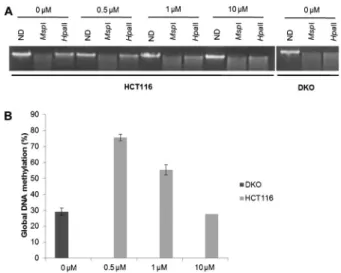
Genomic DNA (1mg) was extracted with a FlexiGene DNA kit (Qiagen, Germany) and digested by 1 unit ofMspI or HpaII (FastDigest, Fermentas, Germany) at 376C overnight and resolved on 1% agarose gel. The intensity of non-digested (ND) or digested DNA bands was quantified by the ImageJ software (National Institutes of Health, USA). The percentage of Global DNA methylation was estimated as follows: % Methylation = (HpaII ––MspI) ?100%/ND.
Genome-wide DNA methylation profile
A total of 1mg of genomic DNA extracted from HCT116 and HCT116 cells treated with 10mM 5-aza-CdR was bisulfite-converted using an EZ DNA methylation kit (Zymo Research, USA). The bisulfite-modified DNA samples were hybridized onto Infinium HumanMethylation450K BeadChip (Illumina, USA) following the manufacturer’s instructions. The level of DNA methylation of each CpG was measured inb-values ranging from 0 to 1 [b=intensity of the methylated allele (M)/intensity of the unmethylated allele (U)++intensity of M++100] using the GenomeStudio methylation module software (Illumina). DNA methylation data from the DKO cell line using the same platform (Infinium HumanMethylation450K BeadChip, Illumina) were retrieved from Gene Expression Omnibus (http://www.ncbi. nlm.nih.gov/geo/; accession number GSE29290, sample GSM815139).
The CpG probes related to imprinted genes, X chromosome, andXIST were retrieved from full data of the 450K microarrays and used for methylation analysis. Only probes with detection values of P#0.01 andb-values for all samples were used for subsequent analysis. The list of human imprinted genes was built based on the Catalogue of Imprinted Genes (http://igc.otago.ac.nz) and Geneimprinting (www.geneimprint.com/) databases (Supplementary Table S1). For statistical analysis, we
used the Kruskal-Wallis test at P#0.05 and Dunn’s multiple comparison test forpost hocanalysis; both were performed using the GraphPad PRISM statistics software package (USA).
Analysis ofXISTexpression
Real-time reverse transcriptase-polymerase chain reaction (real-time RT-PCR). Total RNA was extracted using RNeasy (Qiagen, Germany) and treated with DNase Turbo DNA-Free (Ambion, USA) to avoid DNA contamina-tion. One to two micrograms of total DNase-treated RNA were reverse transcribed using the SuperScript III first-strand synthesis system (Invitrogen, USA), and theXISTRNA level was determined by real-time RT-PCR (7500FAST Sequence Detection System; Applied Biosystems, USA) using the probe XIST (ID Hs01079824_m1; Applied Biosystems). XIST expression was normalized with the expression of YWAHZ[forward (F): TCCTTTGCTTGCATCCCA; reverse (R): AAGGCAGACAATGACAGACCA], described as a stable reference in the HCT116 cell line exposed to 5-aza-CdR (16). RNA fold expression was determined as previously described by Livak and Schmittgen (17). Two technical replicates of each reaction were performed.
RNA fluorescence in situ hybridization (RNA FISH). HCT116 cells were cultured and treated with 10mM 5-aza-CdR for 96 h on Lab-Tek coverslips (Nunc, USA), and was followed by the modified RNA FISH protocol that was performed similar to that described by Chaumeil et al. (18). TheXISTprobe used is a 2.5 kb XISTcDNA containing exons 2, 3, 4, and 5, and was provided by Dr. Huntington
Figure 1. Global DNA methylation analysis. A, One percent agarose gel staining with ethidium bromide showing non-digested DNA (ND) and DNA digested with MspI or HpaII, which is an isoschizomer ofMspI methylation sensitive enzyme, at different media concentrations of 5-aza-29-deoxycytidine (5-aza-CdR; 0, 0.5, 1.0, and 10mM).B, Percentage of DNA methylation of each
Willard (Case Western University, Cleveland, OH, USA). A total of 100 nuclei were analyzed.
Analysis of imprinted genes
Single nucleotide polymorphism (SNP) selection. Based on the National Center for Biotechnology Informa-tion (USA) dbSNP BUILD 129 (http://www.ncbi.nlm.nih.gov/ SNP), we selected three imprinted genes that are expressed in human colorectal tumor, encompassing 13 SNPs located in coding regions (Supplementary Table S2). Primers for IGF2 (F: 59-CCTAGTCGTGGCTCTCCATC-39; R: 59-TTA AAGACAAAACCCAAGCATG-39) and H19 (F: 59-AGCC CAACATCAAAGACACC-39; R: 59-AATGGAATGCTTGAA GGCTG-39) were designed using Primer-Blast (http://www. ncbi.nlm.nih.gov/tools/primer-blast/); PEG10 primers were described in Kim et al. (19).
Genotyping and analysis of allele-specific gene expression. DNA from HCT116 cells was extracted using a FlexiGene DNA kit (Qiagen). An aliquot of 100 ng of DNA was used as a template for PCR amplification of the region encompassing each SNP, in order to select the informative ones.
Synthesis of cDNA from HCT116, HCT116 5-aza-CdR-treated and DKO cells was performed as described above and used as templates for PCR amplification of the region encompassing each SNP. To control for DNA contamination, cDNA synthesis was performed in the presence or absence of reverse transcriptase. PCR products were resolved by 6% polyacrylamide gel electro-phoresis and visualized by silver staining. Sequencing was carried out using the BigDye Terminator v3.1 cycle sequencing kit (Applied Biosystems), and analyzed by an ABI PrismH 3100 genetic analyzer, following the manufac-turer’s instructions (Applied Biosystems). At least two independent replicates were performed for each SNP.
Results
With the purpose of reaching the DNA methylation level similar to that achieved in DKO cells, we exposed HCT116 cells to increasing concentrations of 5-aza-CdR. We determined that 10mM 5-aza-CdR for 96 h showed levels of hypomethylation comparable to those in DKO cells (Figure 1).
DNA methylation patterns of all known imprinted human genes were investigated using the 450K platform, where 3369 CpGs sites associated with them were queried. HCT116 5-aza-CdR-treated cells exhibited a statistically significant decrease in methylation levels of these sites compared to untreated cells (Supplementary Table S2 and Figure 2A and B). Likewise, DKO cells showed a hypomethylated pattern at imprinted genes, equivalent to HCT116 5-aza-CdR-treated cells (Figure 2A and B). However, the ICR ofIGF2andH19covered by eight probes (cg00237904, cg06765785, cg25821896, cg25574978, cg18454954, cg25579157, cg02886509, and cg02657360) showed a methylation pattern not significantly different between 5-aza-CdR-treated HCT116 cells and their untreated counterparts, but significantly different from DKO (Figure 2C). It is worth noting that the decrease in DNA methylation produced by 5-aza-CdR treatment or DNMT disruption is not similar among the chromosomes. At chromosomes 2 and 4, the 5-aza-CdR treatment leads to a DNA hypomethylation level not reached by DNMT disruption (P,0.0001). Conversely, chromosome 8 is less methylated in the DKO cells than in the 5-aza-CdR-treated HCT116 cells (P,0.0001).
To evaluate the expression pattern of the 3 selected imprinted genes (IGF2,H19, andPEG10), the HCT116 cell line was genotyped, and at least one informative SNP
was identified in the expressed sequences of each gene (Supplementary Table S3). These imprinted genes showed monoallelic expression in HCT116 cells, but biallelic expression after 5-aza-CdR treatment, even under meth-ylation levels not statistically different at ICR1 (Figures 3 and 2C).
XISTexpression was evaluated by real-time RT-PCR. While HCT116 did not have detectable expression ofXIST, 5-aza-CdR-treated HCT116 cells exhibited XIST expres-sion, albeit approximately 25 times lower than female fibroblasts (Figure 4A). These data are consistent with RNA FISH analysis (Figure 4B), in which a XIST cloud was detected in only 2 of 100 analyzed nuclei from 5-aza-CdR-treated HCT116 cells. Despite the lowXISTexpression, 5-aza-CdR-treated HCT116 cells exhibited hypomethylation of theXISTlocus (Figure 4C and Supplementary Table S4). In contrast, DKO cells do not show significantly different hypomethylation at the XISTlocus compared to HCT116 cells, and they sustained XIST repression (Figure 4C). Additionally, the DNA methylation profile of the X chromo-some was analyzed using the 450K platform, and a total of 10,966 CpGs sites investigated showed that 5-aza-CdR-treated cells were significantly less methylated than DKO cells in that chromosome (Figure 4D and Supplementary Table S5).
Discussion
Our aim was to verify ifXISTrepression is a more stable epigenetic mark than genomic imprinting under two different DNA hypomethylation conditions: a long-term loss of DNMT1 and DNMT3B activity (DKO cell line) and an acute loss of DNMT activity (HCT116-5-aza-CdR). While HCT116-5-aza-CdR cells showed patterns of decreased methylation at CpGs associated with XIST and imprinted genes, DKO cells exhibited hypomethylation only in imprinted genes. Consistent with this result, XIST is repressed in DKO cells and is weakly expressed in HCT116-5-aza-CdR; the imprinted genes PEG10, IGF2, and H19were biallelically expressed in both methylation-deficient cell lines.
The presence of XIST expression from the only X chromosome in the 5-aza-CdR-treated HCT116 cell line was previously reported by our group (14). Here, we extended this analysis showing that XISTwas activated in only a few HCT116-5-aza-CdR cells, despite theXIST gene being hypomethylated. These findings may indicate that other epigenetic marks, such as histone modifica-tions, are repressing XISTin this short-term assay (20). However, hypomethylated HCT116 cells in culture for long periods (DKO cells) showed DNA methylation levels at the XIST locus similar to untreated HCT116 cells, suggesting that DNMTs other than DNMT1 and DNMT3B might be responsible for XIST repression in DKO cells. Accordingly, there is evidence that Dnmt3a is responsible for both inactivation and maintenance of Xistrepression Figure 3.Expression pattern of the selected imprinted genes in
the HCT116 cell line after 5-aza-29-deoxycytidine (5-aza-CdR) treatment. Electropherograms of cDNA sequences of PEG10,
in murine ES cells and that it may help to keep global DNA methylation (21-23). Therefore, the absence of XIST expression in DKO cells might be due to the presence of DNMT3A.
In contrast, despite the importance of DNMT3A for the establishment of genomic imprinting during gametogenesis (24), this enzyme is not sufficient to keep monoallelic expression of imprinted genes, since DKO cells showed hypomethylation at imprinted genes and loss of imprinting (LOI). WhereasXISTexpression and the consequent XCI could lead to the death of male cells, LOI may provide an advantage during cell proliferation, because it is a common feature in many types of cancer (25). Supporting this idea, biallelic expression of the imprinted genesPEG10,IGF2, andH19in the HCT116 cell line treated with 5-aza-CdR is also seen in DKO cells, even without any significant decrease in methylation of ICR1. Additionally, there is widespread hypomethylation in several CpG sites related to imprinted genes in DKO cells and in HCT116 after 5-aza-CdR exposure; thus, it is possible that other imprinted genes also show biallelic expression in HCT116 hypomethylated cells.
Therefore, our data suggest that XIST repression is more tightly controlled than the allele-specific expression of imprinted genes in a long-term loss of global DNA methylation. It is not known whether there is specific machinery forXISTrepression or whether there is only cell selection against XIST-expressing cells; however, the control ofXISTexpression is more important for cell survival than the control of genomic imprinting. Nonetheless, our data indicate that DNMT3A might be responsible forXIST silencing in DKO cells, since DNA methylation levels are increased at the XIST locus in these cells, despite the absence of any other known active DNA methyltransferase. It is interesting to note that chromosomes 2, 4, and X are more methylated in DKO cells compared to 5-aza-CdR-treated HCT116 cells, suggesting that DNMT3A is involved in the repression of other genes in those chromosomes that may be important for long-term cell survival in culture.
Additionally, 5-aza-CdR treatment induces other effects than DNA hypomethylation. This drug is able to reduce the levels of G9A protein, decreasing H3K9me2, and resulting in gene activation (26). Also, 5-aza-CdR exposure can lead Figure 4.XISTexpression.A, Relative expression levels of XIST RNA in HCT116 and a female cell line. The expression ofYWAHZ
was used as a reference.B, XIST RNA FISH in female cell line (i) and male HCT116 cell line treated with 10mM 5-aza-CdR (5-aza-29 -deoxycytidine) for 96 h (ii). Nuclei were counterstained with DAPI (blue) and XIST RNA signals are red. The scale bar corresponds to 10mm.C,XISTDNA methylation pattern by 8 CpGs (cytosine-phosphate-guanine) sites of 450K platform (cg15319295, cg12653510,
to activation of the DNA damage response pathway, allowing pRb pocket protein degradation and a decrease in repressive posttranslational histone modifications (27). Thus, these additional effects of 5-aza-CdR can contribute to divergences in gene expression compared with DKO cells.
Finally, it is important to mention that these phenom-ena can occur in different ways in normal cells. Cancer cells have epigenomes very different from normal cells (28), making them susceptible to modifying agents of epigenetic marks, as demonstrated in several studies (29-33). Additional analyses will be important for comparing the maintenance of epigenetic controls associated with
XCI and genomic imprinting in normal and transformed human cells.
Supplementary Material
Click here to view [pdf].
Acknowledgments
We gratefully acknowledge our colleagues Joana C.M. de Mello, Ana Maria Fraga, Simone A. Fonseca, Gustavo R. Fernandes, and Giovana C. Pirolla for their assistance. Research supported by FAPESP (#2008/07370-0).
References
1. Lyon MF. Gene action in the X-chromosome of the mouse (Mus musculusL.).Nature1961; 190: 372-373, doi: 10.1038/ 190372a0.
2. Ferguson-Smith AC. Genomic imprinting: the emergence of an epigenetic paradigm.Nat Rev Genet2011; 12: 565-575, doi: 10.1038/nrg3032.
3. Goll MG, Bestor TH. Eukaryotic cytosine methyltransferases.
Annu Rev Biochem2005; 74: 481-514, doi: 10.1146/annurev. biochem.74.010904.153721.
4. Escamilla-Del-Arenal M, da Rocha ST, Heard E. Evolutionary diversity and developmental regulation of X-chromosome inactivation.Hum Genet2011; 130: 307-327, doi: 10.1007/ s00439-011-1029-2.
5. Hendrich BD, Brown CJ, Willard HF. Evolutionary conserva-tion of possible funcconserva-tional domains of the human and murine
XISTgenes.Hum Mol Genet1993; 2: 663-672, doi: 10.1093/ hmg/2.6.663.
6. Norris DP, Patel D, Kay GF, Penny GD, Brockdorff N, Sheardown SA, et al. Evidence that random and imprinted Xist expression is controlled by preemptive methylation.Cell
1994; 77: 41-51, doi: 10.1016/0092-8674(94)90233-X. 7. Panning B, Jaenisch R. DNA hypomethylation can activate
Xist expression and silence X-linked genes. Genes Dev
1996; 10: 1991-2002, doi: 10.1101/gad.10.16.1991. 8. Tinker AV, Brown CJ. Induction of XIST expression from the
human active X chromosome in mouse/human somatic cell hybrids by DNA demethylation.Nucleic Acids Res1998; 26: 2935-2940, doi: 10.1093/nar/26.12.2935.
9. Fitzpatrick GV, Soloway PD, Higgins MJ. Regional loss of imprinting and growth deficiency in mice with a targeted deletion of KvDMR1. Nat Genet 2002; 32: 426-431, doi: 10.1038/ng988.
10. Stoger R, Kubicka P, Liu CG, Kafri T, Razin A, Cedar H, et al. Maternal-specific methylation of the imprinted mouse Igf2r locus identifies the expressed locus as carrying the imprint-ing signal.Cell1993; 73: 61-71, doi: 10.1016/0092-8674(93) 90160-R.
11. Thorvaldsen JL, Duran KL, Bartolomei MS. Deletion of the H19 differentially methylated domain results in loss of imprinted expression of H19 and Igf2. Genes Dev 1998; 12: 3693-3702, doi: 10.1101/gad.12.23.3693.
12. Williamson CM, Turner MD, Ball ST, Nottingham WT, Glenister P, Fray M, et al. Identification of an imprinting control
region affecting the expression of all transcripts in the Gnas cluster.Nat Genet2006; 38: 350-355, doi: 10.1038/ng1731. 13. Rhee I, Bachman KE, Park BH, Jair KW, Yen RW, Schuebel
KE, et al. DNMT1 and DNMT3b cooperate to silence genes in human cancer cells.Nature2002; 416: 552-556, doi: 10.1038/ 416552a.
14. Vasques LR, Stabellini R, Xue F, Tian XC, Soukoyan M, Pereira LV. XIST repression in the absence of DNMT1 and DNMT3B.DNA Res2005; 12: 373-378, doi: 10.1093/dnares/ dsi013.
15. Hall LL, Byron M, Sakai K, Carrel L, Willard HF, Lawrence JB. An ectopic human XIST gene can induce chromosome inactivation in postdifferentiation human HT-1080 cells.Proc Natl Acad Sci U S A2002; 99: 8677-8682, doi: 10.1073/ pnas.132468999.
16. Chua SL, See Too WC, Khoo BY, Few LL. UBC and YWHAZ as suitable reference genes for accurate normalisation of gene expression using MCF7, HCT116 and HepG2 cell lines.
Cytotechnology 2011; 63: 645-654, doi: 10.1007/s10616-011-9383-4.
17. Livak KJ, Schmittgen TD. Analysis of relative gene expression data using real-time quantitative PCR and the 2(-Delta Delta C(T)) Method.Methods2001; 25: 402-408, doi: 10.1006/meth.2001.1262.
18. Chaumeil J, Le Baccon P, Wutz A, Heard E. A novel role for Xist RNA in the formation of a repressive nuclear compart-ment into which genes are recruited when silenced.Genes Dev2006; 20: 2223-2237, doi: 10.1101/gad.380906. 19. Kim KP, Thurston A, Mummery C, Ward-van Oostwaard D,
Priddle H, Allegrucci C, et al. Gene-specific vulnerability to imprinting variability in human embryonic stem cell lines.
Genome Res2007; 17: 1731-1742, doi: 10.1101/gr.6609207. 20. Morey C, Avner P. The demoiselle of X-inactivation: 50 years old and as trendy and mesmerising as ever.PLoS Genet
2011; 7: e1002212, doi: 10.1371/journal.pgen.1002212. 21. Chen T, Ueda Y, Dodge JE, Wang Z, Li E. Establishment and
maintenance of genomic methylation patterns in mouse embryonic stem cells by Dnmt3a and Dnmt3b.Mol Cell Biol
2003; 23: 5594-5605, doi: 10.1128/MCB.23.16.5594-5605. 2003.
23. Okano M, Bell DW, Haber DA, Li E. DNA methyltrans-ferases Dnmt3a and Dnmt3b are essential for de novo methylation and mammalian development. Cell 1999; 99: 247-257, doi: 10.1016/S0092-8674(00)81656-6.
24. Kaneda M, Okano M, Hata K, Sado T, Tsujimoto N, Li E, et al. Essential role for de novo DNA methyltransferase Dnmt3a in paternal and maternal imprinting.Nature2004; 429: 900-903, doi: 10.1038/nature02633.
25. Uribe-Lewis S, Woodfine K, Stojic L, Murrell A. Molecular mechanisms of genomic imprinting and clinical implications for cancer.Expert Rev Mol Med2011; 13: e2, doi: 10.1017/ S1462399410001717.
26. Wozniak RJ, Klimecki WT, Lau SS, Feinstein Y, Futscher BW. 5-Aza-29-deoxycytidine-mediated reductions in G9A histone methyltransferase and histone H3 K9 di-methylation levels are linked to tumor suppressor gene reactivation.
Oncogene2007; 26: 77-90, doi: 10.1038/sj.onc.1209763. 27. Zheng Z, Li L, Liu X, Wang D, Tu B, Wang L, et al. 5-Aza-29
-deoxycytidine reactivates gene expression via degradation of pRb pocket proteins.FASEB J2012; 26: 449-459, doi: 10.1096/fj.11-190025.
28. Baylin SB, Jones PA. A decade of exploring the cancer
epigenome - biological and translational implications.Nat Rev Cancer2011; 11: 726-734, doi: 10.1038/nrc3130. 29. Atadja P, Gao L, Kwon P, Trogani N, Walker H, Hsu M, et al.
Selective growth inhibition of tumor cells by a novel histone deacetylase inhibitor, NVP-LAQ824.Cancer Res2004; 64: 689-695, doi: 10.1158/0008-5472.CAN-03-2043.
30. Bender CM, Pao MM, Jones PA. Inhibition of DNA methyla-tion by 5-aza-29-deoxycytidine suppresses the growth of human tumor cell lines.Cancer Res1998; 58: 95-101. 31. Lee JH, Choy ML, Ngo L, Venta-Perez G, Marks PA. Role of
checkpoint kinase 1 (Chk1) in the mechanisms of resistance to histone deacetylase inhibitors.Proc Natl Acad Sci U S A
2011; 108: 19629-19634, doi: 10.1073/pnas.1117544108. 32. Liang G, Gonzales FA, Jones PA, Orntoft TF, Thykjaer T.
Analysis of gene induction in human fibroblasts and bladder cancer cells exposed to the methylation inhibitor 5-aza-29 -deoxycytidine.Cancer Res2002; 62: 961-966.
33. Ungerstedt JS, Sowa Y, Xu WS, Shao Y, Dokmanovic M, Perez G, et al. Role of thioredoxin in the response of normal and transformed cells to histone deacetylase inhibitors.