SHORT COMMUNICATION / COMUNICAÇÃO
Biological, serological and molecular comparison between
isolates of
Cowpea severe mosaic virus
Rosa Felicia E. Araújo Camarço1, Aline K. Queiroz do Nascimento1, Eduardo C. de Andrade2 & José Albersio A. Lima1
1Laboratório de Virologia Vegetal, Departamento de Fitotecnia, Universidade Federal Ceará, 60360 842, Fortaleza, CE, Brazil; 2Embrapa Mandioca e Fruticultura, 44380 000, Cruz das Almas, BA, Brazil
Author for correspondence: José Albérsio A. Lima, e-mail: [email protected]
Part of the Doctoral Thesis of the first author. Universidade Federal do Ceará. Fortaleza CE. 2007.
ABSTRACT
Cowpea, Vigna unguiculata, can be affected by several diseases, and those caused by viruses are considered of great importance.
Cowpea severe mosaic virus (CPSMV), which belongs to the family Comoviridae, genus Comovirus, stands out for its severity and degree of incidence. Its genetic variability can give rise to different strains around the world, including in Brazil. The objective of the present research was to establish a biological, serological and molecular comparison between five CPSMV isolates obtained from naturally infected plants in different States of the Northeast of Brazil. Isolates were obtained from cowpea: CPSMV-AL (State of Alagoas), CPSMV- CE (Ceará); CPSMV-MC (Piauí), CPSMV-PE (Pernambuco) and an isolate obtained from Crotalaria paulinea, in the State of Maranhão - CPSMV-CROT. A host range study evidenced biological differences among the virus isolates, especially in cowpea genotypes. The isolates were showed to be serologically and molecularly related by polymerase chain reaction �� PCR, using degenerated primers which amplified two conserved regions in the coat protein and in the replicase genes. Cloning and sequence of CPSMV-PE made possible its comparison with other CPSMV isolates and other virus species from the genus Comovirus.
Keywords: Vigna unguiculata, Comovirus, CPSMV, molecular differentiation. RESUMO
Comparação biológica, sorológica e molecular de isolados de Cowpea severe mosaic virus
O feijão caupi, Vigna unguiculata,pode ser afetado por várias moléstias, entre as quais, destacam-se as viroses, cuja incidência e severidade variam, dependendo do hospedeiro, do vetor e da fonte do inóculo no campo. O vírus do mosaico severo do caupi (Cowpea severe mosaicvirus, CPSMV) é o único vírus pertencente ao gênero Comovirus já identificado no Brasil infetando o feijão caupi. A presente pesquisa teve por objetivo estudar e comparar as características biológicas, sorológicas e moleculares de cinco isolados do CPSMV originários de diferentes estados do Nordeste: Isolados de feijão caupi em Alagoas (CPSMV-AL), no Ceará (CPSMV-CE); no Piauí (CPSMV-MC), em Pernambuco (CPSMV-PE) e o isolado obtido de Crotalaria paulinea no Maranhão (CPSMV-CROT). Os estudos de gama de hospedeiro evidenciaram diferenças biológicas entre os isolados, sobretudo em genótipos de caupi. As análise sorológicas em dupla difusão em agar confirmaram o forte relacionamento entre os isolados, e os estudos moleculares pela reação em cadeia da polimerase - PCR, utilizando oligonucleotídeos degenerados que amplificam seqüências conservadas dos genes do capsídeo e da replicase, não permitiram nenhuma diferenciação entre os isolados. A clonagem e o sequenciamento do CPSMV-PE possibilitaram sua comparação com outros isolados de CPSMV e outras espécies de vírus do gênero Comovirus.
Palavras-chave:Vigna unguiculata, Comovirus, CPSMV, Diferenciação molecular.
Cowpea, Vigna unguiculata (L.) Walp. susp.
unguiculata is an important legume crop, with great capacity to supply the population with protein and carbohydrates in the Northeast of Brazil. The most important viruses that infect cowpea in Brazil belong to the following families and genera: family Comoviridae, genus Comovirus; family Potyviridae,genus Potyvirus; family Bromoviridae,
genus Cucumovirus, and family Geminiviridade, genus
Begomovirus (Lima et al., 2005a). Cowpea severe mosaic
virus (CPSMV), which belongs to the family Comoviridae
was immune to all the CPSMV isolates obtained in Brazil up to that period (Lima et al., 1998). Other virus isolates obtained from Canavalia brasiliensis, C. ensiformis,
Crotalaria paulinea and Macroptilium lathyroides were also biologically and serologically characterized and identified as strains of CPSMV (Lima & Souza, 1980; Lima et al., 2005a, b).
The present paper has the objective of developing comparative studies involving biological, serological and molecular characteristics of five CPSMV isolates obtained in the Northeast of Brazil. Isolates were obtained from cowpea: CPSMV-AL (State of Alagoas), CPSMV- CE (Ceará); CPSMV-MC (Piauí), CPSMV-PE (Pernambuco) and one isolate was obtained from C. paulinea, in the State of Maranhão - CPSMV-CROT. Each isolate was maintained in a separate anti-aphid screen cage with temperature varying from 26ºto 32ºC. All isolates were mechanically inoculated in the plant species from the families Chenopodiaceae (Chenopodium amaranticolor, C. murale and C. quinoa;Leguminosae (Cassia occidentalis, Clitoria ternatea, Leucaena leucocephala, Phaseolus vulgaris) and 20 genotypes of cowpea, and Solanaceae (Nicotiana benthamiana and N. tabacum)
The isolates CPSMV-PE, CPSMV-CROT and CPSMV-AL were purified based on the method used by Lima & Nelson (1974) with some modifications. The purified preparations were used to prepare polyclonal antisera by rabbit immunizations, and the specificity of each antiserum was evaluated in double immune diffusion tests. Antisera for the isolates CPSMV-CE and CPSMV-MC were previously produced by Lima & Nelson (1974) and Lima et al.(1998). The serological relationship among the virus isolates was studied by reciprocal double immune diffusion tests with the respective antisera and antigens.
For molecular characterization, total RNA was extracted from infected leaf samples of each virus isolate using the protocol developed by Rott & Jelkmann (2001), and used for synthesis of correspondent complementary DNA (cDNA). Two PCR methods were used to amplify genomic fragments: PCR 1 and nested PCR 2. The first method followed the standard technique using degenerated primers corresponding to a conserved genome sequence specific for the coat protein gene from the genus Comovirus:
5’�� YTCRAAWCCVYTRTTKGGMCCACA-3’ �� R and 5’-GCATGGTCCACWCAGGT-3’ �� F. The amplification was performed according to the program: initial heating at 94ºC for 5 min and 25 cycles involving denaturation (94ºC/1 min), annealing (41ºC/2 min) and extension (72ºC/3 min), followed by a final extension at 72ºC for 7 min. The amplified products were visualized in a 1% agarose gel treated with ethidium bromide, under ultra violet light. In the nested PCR-2 method the first step of reverse transcription was performed according to Maliogka et al. (2004) to obtain the cDNA for each virus isolate. PCR with the obtained cDNAs was carried out using a pair of degenerated primers corresponding to a nucleotide sequence from the replicase
gene specific for the genus Comovirus. The primers COM F1 (5’��ACIWSIGARGGITWYCC��3’) and COM R2 (5’��AVRTTRTCRTCICCRTA��3’) were selected to initiate the PCR and the reactions were performed according to the program described above. The primers COM NeF3 (5’��TACGWSGGARGGGTWYCC��3’), COM NeR4 (5’�� ARRTTRTCRTCGCCRTAIAC��3’) and COM NeR5 (5’�� AVRTTRTCRTCGCCRTAIGT��3’) were used to continue the nested PCR according to the following sequence of cycles: PCR a �� Initial heating at 94ºC for 2 min; five cycles of segmented steps: 95ºC for 30 s; 40ºC for 10 s; 37ºC for 5 s and 72ºC for 30 s, followed by 35 segmented cycles: 95ºC for 30 s; 42ºC for 30 s and 72ºC for 25 s, followed by a final extension at 72ºC for 2 min. For nested PCR b a denaturation step at 94ºC for 2 min; three cycles of segmented steps: 95ºC for 30 s, 48ºC for 30 s and 72ºC for 20 s, followed by 35 segmented cycles with the following steps: 95ºC for 30 s; 50ºC for 30 s; 72ºC for 25 s and a final extension at 72ºC for 2 min. The amplified products were visualized in 1.5% agarose gel (w/v) treated with ethidium bromide under ultra violet light (Maliogka et al., 2004).
The amplified PCR-1 products with estimated size of 593 bp from all CPSMV isolates were cloned using the pGEM-T® Vector System I (Promega, Madison, WI) according to the manufacturer’s instructions. Competent cells of Escherichia coli XL1 were used for transformation.
E. coli plasmid DNA was purified as described (Rott & Jelkmann, 2001) and was digested with Eco RI to liberate the insert. Inserts were sequenced using the BigDye Terminator Cycle Sequencing Ready Reaction Kit (Perkin-Elmer), according to the manufacturer’s instructions.
The nucleotide sequence corresponding to the coat protein gene from CPSMV-PE was compared with the nucleotide sequences of other virus species from the genus
Comovirus. Sequences were analyzed using the programs DNAMAN 4.0 and Blastn (www.ncbi.nlm.nih.gov/blast). The sequences were further aligned using the program Clustal W (www.ebi.ac.uk/clustalw) and the phylogenetic tree was construed using the MEGA v. 4.0 program.
Although CPSMV presents a large biological variability with a wide host range in the leguminous family (Lima et al., 2005a), neither isolate studied infected C.
Family/Species/Genotype S ymptoms and SerologicalResults
CPSMV-AL CPSMV- CE CPSMV- CROT CPSMV- MC CPSMV -PE
C henopodiaceae
Chenopodium amaranticolor NeLl NeLl NeLl NeLl NeLl
Chenopodium murale NeLl NeLl NeLl NeLl NeLl
Chenopodium quinoa NeLl NeLl NeLl NeLl NeLl
Leguminosae
Cassia occidentalis nS/ (-) nS/(-) nS/ (-) nS/ (-) nS/ (-)
Clitoria ternate a nS/ (-) nS/ (-) nS/ (-) nS/ (-) nS/ (-)
Leucaenasp. nS/ (–) nS/ (-) nS/ (-) nS/ (-) nS/ (-)
Phaseolus vulgaris nS/ (-) nS/ (-) nS/ (-) nS/ (-) nS/ (-)
Vigna unguiculata
CE 08 sM;Ld/(+) mM/(+) mM/(+) mM/(+) mM/(+)
CE 13 mM/(+) nS/(+) mM/(+) mM/(+) mM/(+)
CE 36 mM/(+) sM/(+) mM/(+) mM/(+) sM/(+)
CE 45 sM;Ld/(+) sM;Ld/(+) sM;Ld/(+) mM/(+) M;Ld/(+)
CE 46 sM;Ld/(+) sM/;Ld/(+) sM;Ld/(+) mM/(+) M;Ld/(+)
CE 49 sM;Ld/(+) sM;Ld/(+) sM;Ld/(+) mM/(+) M;Ld/(+)
CE 85 sM;Ld/(+) sM;Ld/(+) sM;Ld/(+) mM/(+) sM;Ld/(+)
CE 97 M/(+) sM;Ld/(+) sM;Ld/(+) mM/(+) sM;Ld/(+)
CE 144 sM;Ld/(+) sM;Ld/(+) sM;Ld/(+) mM/(+) M;Ld/(+)
CE 315 M/(+) sM/(+) M/(+) mM/(+) M/(+)
CE 440 sM;Ld/(+) sM;Ld/(+) sM;Ld/(+) mM/(+) sM;Ld;Pd t/(+)
CE 877 nS/(-) nS/(-) nS/(-) nS/(-) nS/(-)
CE 923 sM/(+) sM/(+) mM/(+) mM/(+) sM/(+)
CE 924 mM/(+) sM/(+) M/(+) mM/(+) mM/(+)
CE 929 M/(+) mM/(+) mM/(+) nS/(-) mM/(+)
Epace 10 M/(+) M;Ld/(+) M;Ld/(+) mM/(+) mM/(+)
Pitiuba mM/(+) sM;Ld/(+) M;Ld/(+) mM/(+) M;Ld/(+)
Roxinho M;Ld/(+) sM;Ld/(+) M;Ld/(+) mM/(+) M;Ld/(+)
Setentão M/(+) M;Ld/(+) M;Ld/(+) mM/(+) M;Ld/(+)
Macaibo nS/(-) nS/ (-) nS/ (-) M;Ld/(+) nS/ (-)
Solanaceae
Nicotiana benthamiana nS/ (-) nS/ (-) nS/ (-) nS/ (-) nS/ (-)
Nicotianatabacum nS/ (-) nS/ (-) nS/(-) nS/ (-) nS/ (-)
TABLE 1 - Symptoms and serology of plant species inoculated with five isolates of Cowpea severe mosaic virus (CPSMV): CPSMV-AL; CPSMV-CE; CPSMV-CROT; CPSMV-MC e CPSMV-PE
*Ld �� leaf distortion / NeLl �� necrotic local lesions / mM �� mild mosaic / M �� mosaic / Pdt �� plant death / sM �� severe mosaic /
nS �� no symptoms / (+) �� positive in serology / (-) �� negative in serology.
CPSMV-MC; ‘CE-923’ showed severe mosaic upon infection by CPSMV-AL, CPSMV-CE and CPSMV-PE, but only mild mosaic upon infection by CPSMV-CROT
other hand, the genotype ‘CE-877’ showed resistance to all virus isolates (Table 1). The genotype CE-659 was showed to be resistant to CPSMV-CE (the most severe isolate) and to CPSMV-MC (the least severe isolate). Based on the symptoms, the virus isolate severity decreased in the following order: CE, CROT, CPSMV-PE, CPSMV-AL and CPSMV-MC. The immunity of cv. Macaibo to CPSMV-AL, CPSMV-CE, CPSMV-CROT and CPSMV-PE, but not to CPSMV-MC, confirmed its importance for CPSMV-MC differentiation. These results represent the first biological criteria for differentiation of CPSMV isolates.
The purified preparations of AL, CPSMV-CROT and CPSMV-PE showed ultra violet spectra typical of polyhedral virus particles and the final virus concentrations (33 mg of virus/Kg of infected tissue) were compatible for CPSMV (Lima & Nelson, 1974; Lima et al., 1998; Lima et al., 2005a). The absence of spur formation between the different virus isolates in double immune diffusion is an indication of their serological identity. Similar results had been already obtained for some CPSMV isolates, but Lima et al. (1998) also found serological differences between CPSMV-MC and another CPSMV isolate obtained from soybean (Glycine max) in Paraná State (Bertacini et al., 1994).
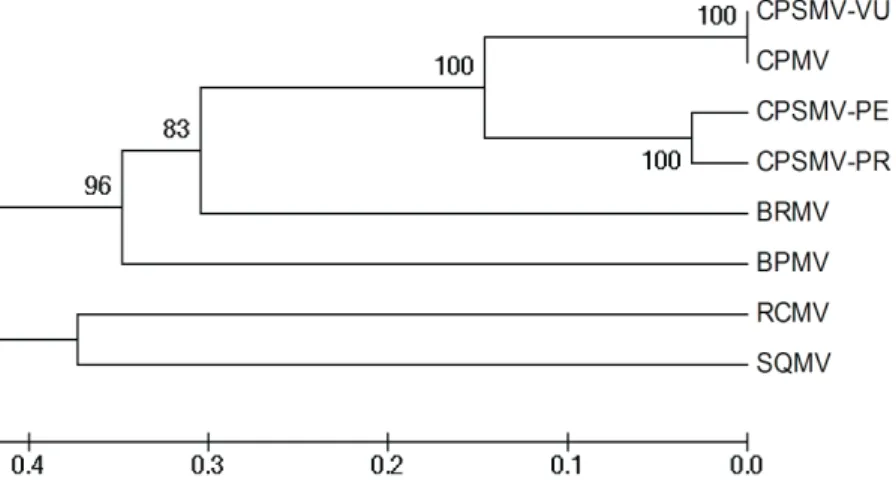
The amplified products by PCR 1 and PCR 2 did not show any difference among the CPSMV isolates (Figure 1). The results involving the replicase gene, considered a conserved protein for ssRNA viruses (Dovas & Kátis, 2003a, b), demonstrate potential for detection of unknown viruses from the family Comoviridae. The possible molecular difference among the CPSMV isolates could, probably, be detected when the whole polyprotein was sequenced and analyzed (Dovas & Katis, 2003a; Maliogka et al., 2004). Amplified DNA fragments with estimated size of 593 bp from the CPSMV isolates were cloned and the fragments from the CPSMV-PE isolate showed a small difference in size (Figure 1C), indicating a possible molecular difference in this virus isolate. The sequence of the CPSMV-PE genome fragment (Figure 2) was compared with virus sequences deposited in the GenBank, and the comparative analysis revealed a similarity of 93% with the sequence of a CPSMV isolate obtained in the State of Paraná, CPSMV-PR (Bertacini et al., 1994). The results are consistent with previous data obtained for other CPSMV isolates and are in accordance with ICTV rules (Fauquet et al., 2005), confirming that CPSMV-PE and CPSMV-PR are closely related. Lima et al.(1998) also found serological differences between CPSMV-MC and CPSMV-PR, and in this study CPSMV-PE was showed to be serologically identical to MC. The molecular comparison between CPSMV-PE and Cowpea mosaic virus (CPMV), a different but related virus species from the genus Comovirus (Swaans & Kammen, 1973), showed a close relationship between them (Figure 2). The occurrence of CPMV has not yet been reported in Brazil (Lima & Nelson, 1974, 1977; Lin et al.,
Ladder CE Crot PE AL MC SQ Healthy
Ladder AL Crot CE PE MC Healthy
Ladder CE AL PE MC Crot
A
B
C 500 bp
700 bp 500 bp
300 bp
593 bp
740 bp
3900 bp 3000 bp
FIGURE 1 - Amplified genomic fragments of Cowpea severe
mosaic virus isolates: CPSMV-AL, CPSMV-CE, CPSMV-MC, CPSMV-PE and CPSMV-CROT in 1% agarose gel. A. Genomic fragments from CPSMV and Squash mosaic virus (SqMV) isolates amplified by polymerase chain reaction (PCR-1) using degenerated primers for the coat protein gene; B. Genomic fragments from CPSMV isolates amplified by PCR (nested PCR-2) using degenerated primers for the replicase gene and C. Genomic fragments, of the coat protein gene, from CPSMV clones upon digestion with Eco RI. The first lanes were loaded with a 1kb
DNA ladder.
FIGURE 2 - Phylogenetic tree based on the capsid protein gene (nucleotide sequences) showing the relationship between CPSMV-PE (GQ229416) and other viruses from the genus Comovirus using the UPGMA method. The numbers of each
branch represent bootstrap values (1,000 replications). BPMV (AY744933) - Bean pod mottle virus;BRMV (AF263548) - Bean rugose mosaic virus;CPSMV-Cowpea severe mosaic virus: CPSMV-PR (AF263549) isolate from Paraná �� Brazil and CPSMV-VU (M83309) obtained in Central America; CPMV (X00729) - Cowpea mosaic virus;RCMV (M14913) - Red clover mottle virus andSQMV (AB054689)
- Squash mosaic virus. Horizontal distances are proportional to the genetic distances between the isolates.
significant genetic difference that could be attributed to geographic localization. In the phylogenetic tree (Figure 2), isolates CPSMV-PE and CPSMV-PR clustered together, confirming their close relationship. Furthermore, isolate CPSMV-VU clustered with CPMV, indicating that its identification as CPSMV is incorrect.
The close serological relationship observed among the CPSMV isolates could explain the strong similarity in the obtained PCR products for the coat protein gene. Although closely related serologically and molecularly, the CPSMV isolates showed biological differences when inoculated in cowpea genotypes, which need to be considered in breeding programs to produce resistant varieties. The appearance of a CPSMV strain with the ability to infect a cowpea genotype (Macaibo) immune to all other virus isolates is evidence that new strains can be developed by genetic mutation, rearrangement of genome components and adaptation to new cowpea cultivars or leguminous species over the years.
REFERENCES
Bertacini PV, Almeida AMR, Chagas CM, Lima, JAA (1994) Ocorrência natural do vírus do mosaico severo do caupi infectando soja e caupi no Estado do Paraná. Fitopatologia Brasileira 19:271.Fitopatologia Brasileira 19:271. (Resumo)
Dovas CI, Katis NI (2003b) A spot multiplex nested RT-PCR for the simultaneous and generic detection of viruses involved in the etiology of grapevine leafroll and rugose wood of grapevine. Journal of Virological Methods109:217-226.
Dovas CI, Katis NI (2003a) A spot nested RT-PCR method for the simultaneous detection of members of the vitivirus and fabavirus genera in grapevine. Journal of Virological Methods 107:99-106. Fauquet CM, Mayo MA, Maniloff J, Desselberger U, Ball LA (Eds.) (2005) Virus Taxonomy. Report of the International Committee on Taxonomy of Viruses. San Diego CA. Elsevier Academic Press.
Jager C P (1979) Cowpea severe mosaic virus. In: Descriptions of Plant Viruses N° 209Kew Surrey, England. Commonwealth Mycological Institute and Association of Applied Biologists. Kammen AV, Jager CP (1978) Cowpea mosaic virus. Description of Plant Viruses, N° 47 Kew, Surrey, England. Commonwealth Mycological Institute and Association of Applied Biologist. Lima JAA, Lima RCA, Gonçalves MAR, Sittolin IM (1998) Biological and serological characteristics of a genetically different cowpea severe mosaic virus strain. Virus: Reviews and ResearchVirus: Reviews and Research 3:57-65.
Lima JAA, Nascimento AKQ, Silva GS, Camarço RFEA, Gonçalves MFB (2005a) Crotalaria paulinea, novo hospedeiro natural do vírus do mosaico severo do caupi. Fitopatologia Brasileira 30:429-433.
Lima JAA, Nelson MR (1977) Etiology and epidemiology of mosaic of cowpea in Ceará. Plant Disease 61:864-867.Plant Disease 61:864-867.
Lima JAA, Sittolin IM, Lima RCA (2005b) Diagnose e estratégias de controle de doenças ocasionadas por vírus. In: Freire Filho FR, Lima JAA, Ribeiro VQ (Org.). Feijão-Caupi Avanços Tecnológicos. 1 ed. Brasília DF. Embrapa Informação Tecnológica. pp. 403-459.
Lima JAA, Souza CAU (1980) Comovirus do subgrupo severo “cowpea mosaic virus” isolado de Canavalia ensiformis no Ceará. Fitopatologia Brasileira 5:417. (Resumo)
Lin MT, Kitajima EW, Rios GP (1981b) Serological identification of several cowpea viruses in Central Brazil. Fitopatologia Brasileira 6:73-85.
Maliogka V, Dovas CI, Efthimiou K, Katis NI (2004) Detection and differentiation of Comoviridae species using a semi-nested RT-PCR and phylogenetic analysis based on the polymerase protein. Journal of Phytopathology 157:404-419.
Rott ME, Jelkmann W (2001) Characterization and detection of several filamentous viruses of cherry: Adaptation of an alternative cloning method (DOP-PCR) and modification of a PCR extraction protocol. European Journal of Plant Pathology 107:411-420. Swaans H, Kammen AV (1973) Reconsideration of the distinction between the severe and yellow strain of cowpea mosaic virus. Netherlands Journal of Plant Pathology 79:257-265.