Inequalities associated with lack
of mammography in
Teresina-Piauí-Brazil, 2010-2011
Desigualdades associadas à não
realização de mamograia na zona
urbana de Teresina-Piauí-Brasil,
2010-2011
Rafael Bandeira Lages
Giuliano da Paz Oliveira
Valter Morais Simeão Filho
Felipe Melo Nogueira
João Batista Mendes Teles
Sabas Carlos Vieira
All authors are from the School of Medicine of the Federal University of Piauí – UFPI.* Medical Students of the Federal University of Piauí (UFPI).
* The irst four authors are medical students; João Batista Mendes Teles has a degree in Statistics from the Federal University of Ceará (UFC) and specialization in epidemiology from UFPI, where he is the professor; Sabas Carlos Vieira has a PhD from the State University of Campinas (UNICAMP), he is faculty at UFPI and an oncology surgeon.
The present study was developed at the Internal Medicine Department of the School of Medicine of the Federal University of Piauí.
Disclosures: None.
Correspondence to: Sabas Carlos Vieira. Rua Félix Pacheco 2.159, sala 305, Centro/Sul. Teresina, PI CEP 64001-160. E-mail: [email protected]
Abstract
Introduction: Randomized studies have shown that screening for breast cancer with mammography reduces the breast cancer mortality. However there are signs of a great inequality in access to mammo-graphy in Brazil. Objectives: To analyze the percentage of women who did not undergo mammography according to socioeconomic and demographic variables in women aged from 40 to 69 years in Teresina, Piauí State, Brazil. Methods: This was a cross-sectional population-based study in women aged 40-69 years in Teresina-Piauí in 2010/2011. The sampling was randomly conducted in five stages. The data were processed by SPSS 19.0 and it was performed univariate and multivariate analysis. Results: Among 433 women who answered the questionnaire, 75,3% had a mammography and 17,2% of these women had not a mammography over the last two years. The lack of breast cancer screening was associated with non-white skin color (p = 0,030), never being married (p = 0,041), low levels of education (p = 0,010), low family income (p < 0,001), smoking (p = 0,006), having no private health insurance (p < 0,001). The Unified National Health System (SUS) performed 56,3% of reported mammograms. Conclusion: About 24.7% of women in the sample never had a mammo-graphy. According to the findings, the lack of breast cancer screening is associated with social and racial inequalities.
Resumo
Fundamentos: Estudos demonstram que a realização da mamografia em programas de rastreamento diminui a mortalidade do câncer de mama. Entretanto, há indícios de grande desigualdade no acesso à realização deste exame no Brasil. Objetivos: Analisar o percentual de mulheres que não realizaram mamografia segundo variáveis socioeconô-micas e demográficas em mulheres de 40 a 69 anos de Teresina-PI. Métodos: Estudo transversal realizado em 2010/2011, com amostragem multifásica em cinco etapas, realizando-se entrevista face a face com cada mulher sorteada. Processou-se os dados com programa SPSS 19.0, realizando--se análise uni e multivariada. Resultados:
Dentre as 433 mulheres que responderam o questionário, a taxa de realização de mamo-grafia foi de 75,3%,sendo que, destas, 17,2% a haviam realizado há mais de dois anos. A não realização de mamografia esteve rela-cionada com raça parda/negra (p = 0,030), ausência de companheiro (p = 0,041), menor grau de instrução (p = 0,010), menor renda (p < 0,001), tabagismo (p = 0,006), não pos-suir plano ou seguro de saúde (p < 0,001). O Sistema Único de Saúde (SUS) foi respon-sável por realizar 56,3% das mamografias.
Conclusão: 24,7% das mulheres teresinen-ses nunca haviam realizado mamografia e 37,9% não a haviam realizado nos últimos dois anos. A não realização deste exame foi associada à existência de desigualdades racial e socioeconômica.
Palavras-chave: Neoplasias da mama. Prevenção de câncer de mama. Programas de rastreamento. Mamografia. Desigualdades em saúde. Iniquidade social.
Introduction
Breast cancer is the most common form of cancer among women, accounting for approximately 22% of new neoplasm cases in women every year. According to the National Institute of Cancer (INCA), in 2012 there will be 52,680 new cases in Brazil, with an estimated risk of 52 cases per 100 thousand women. In Teresina (Piauí, Brazil), the overall incidence rate per 100 thousand inhabitants is estimated at 40.76, and 180 new cases are expected this year1. Mortality rates are also high, having increased by approximately 20% between 1995 and 2005 in Brazil2.
Early detection to attain better prognosis has been the objective of several public he-alth programs. There is evidence that mam-mograms have an efficacy of approximately 23% in the reduction of mortality by breast cancer among women from 50 to 69 years old. From 40 to 49 years old, however, using mammograms for screening is controver-sial, because the incidence of breast cancer is lower in this group and the test has lower sensitivity, resulting in a higher number of false positives3.
The Brazilian Society of Mastology (SBM), in turn, recommends that asympto-matic women have mammograms annually as of 40 years old, high risk women after they turn 35, and those genetically predisposed should start at 25 years of age 2.
Therefore, considering the high inci-dence and mortality rates of breast cancer and the need for early detection in Brazil 1,2, we believe it is necessary to assess the pre-ventive practices for this condition. To this end, the present study focused on analyzing the percentage of women aged 40 to 69 that did not have a mammogram in Teresina-PI, taking into consideration socioeconomic and demographic variables. We thus hope to offer data for public managers to implement strategies that can guide health services towards universality and equity in women’s health care.
Methods
This cross-sectional study was con-ducted in the 2010-2011 period among the population of women aged 40 and 69, living in the municipality of Teresina. According to estimates from the MS/SE/Datasus, the city had 106,602 individuals in this group in the referred period9. The Home Inquiry on Risk Behaviors and Referred Morbidity of Diseases and Non-Transmissible Conditions of the Ministry of Health10 assessed 16 Brazilian cities (not including Teresina) and found percentages between 46.9% and 52.3% for mammograms in other cities of Northeast Brazil. Based on these data, we assumed the prevalence of women that did not have a mammogram as about 50% and, using a 95% confidence level and error of 5%, and we defined the size of the sample at 384 women.
Sampling was performed in five stages. Initially, districts were grouped into five ad-ministrative regions according to the IBGE (Brazilian Institute of Statistics), which on average works with regions comprising 23 districts. The first stage consisted of drawing 20% of the districts in each administrative region, corresponding to the 23 districts of
Teresina. District selection in each region followed the proportionality of the number of households in the region districts.
In the second stage, 10% of the census sectors in the district were selected. If the district drawn in the first stage had less than ten sectors, one sector among the existing ones would be drawn. The selection of sec-tors within the district was also proportional to the number of households in each sector.
The third stage focused on choosing a block inside the sector. Blocks were numbe-red to facilitate selection and then five blo-cks were drawn. Sectors with less than five blocks had all blocks included in the study. When the block drawn was not residential, a new draw was performed.
The fourth stage consisted of a random choice of the household. This choice follo-wed a systematic sampling, in which the systematization interval (k) was the result of the number of households existing in the district divided by the number of hou-seholds in the sector. If the site selected was a non-residential home or a collective residence, we alternated our choice between the household immediately before or after it. We drew one of the block corners to start systematization. As from the corner drawn, the random beginning of the interval was the number drawn between 1 (correspon-ding to the household of the corner drawn) and k.
The fifth and last stage was the choi-ce of women. The choichoi-ce of this unit of analysis inside the household focused on the closest birth date among those women aged 40 to 69 years that lived there. If there were no women in the age group object of the study in the household, we alternately chose the following household to the right or to the left.
for data collection, and if the woman drawn was absent after we returned to the hou-sehold on three different occasions.
The dependent variable considered in the present study was never having had a mammogram. The independent variables analyzed were:
• Socioeconomic and demographic: age
group, color/race (self-referred), marital status, number of children, schooling, monthly family income and occupa-tion. The minimum wage in effect in the country at the time of the study was used to calculate family income;
• Life habits: regular physical activity and
smoking status: smoker, former smoker and non-smoker;
• Co-morbidities: hypertension, diabetes,
overweight;
• Family and personal history of breast
cancer; and
• Use of health services: having healthcare
insurance or plan to finance the mam-mogram.
Duly filled out questionnaires were su-pervised and checked and then processed in the SPSS 19.0 program (SPSS Inc., Chicago, United States). Descriptive and analytical statistical analysis was performed. The descriptive analysis distributed absolute and relative frequencies for category varia-bles and means, with standard deviations for continuous variables. The analytical approach applied univariate analysis, using the Pearson Chi-square test (considering a 5% level of significance), and multivariate logistic regression, using ‘never having had
a mammogram’ as the dependent variable and all the others as independent ones. We used the overall and adjusted odds ratio (OR) for the other variables to measure association, considering a 95% confidence interval (95% CI).
The present study was approved by the Ethics and Research Committee of the Federal University of Piauí (UFPI).
Results
Altogether, 460 women were drawn for the study. The non-response rate accoun-ted for 5.9%. Considering the 433 women that agreed to answer the questionnaire, the mean age was 51.8 years, 88.4% had children (mean number of children = 3.1), 56.1% had completed elementary school only, 57.7% had a partner, 63.3% referred themselves as brown (mulatto), 54.3% had income below two minimum wages, 59.8% had never smoked, 73.9% were sedentary, 64.9% did not have any kind of healthcare insurance or plan, 6.2% had a first degree relative with a history of breast cancer and 0.7% had a personal history of breast cancer.
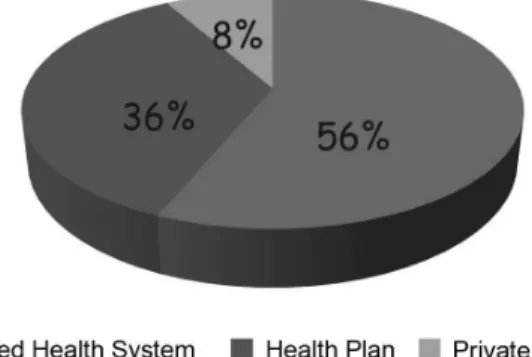
We observed in the present study that 107 (24.7%) of the total women interviewed had never had a mammogram. Among the 326 (75.3%) who said they had had it, it was over two years ago for 17.5%, and in the past year for 66.6% (Table 1). Thus, we observed that 62.1% of all respondents had taken the test in the past two years. Of the tests per-formed, 56.3% were paid by the SUS, 35.4% by healthcare insurance or plan and 8.3% by patients themselves (Chart 1).
Table 1 -Time elapsed since the last mammography among 326 women who had undergone mammography in Teresina-PI, 2010-2011.
Tabela 1 - Tempo decorrido desde a realização da última mamograia entre 326 mulheres que já haviam realizado mamograia em Teresina-PI, 2010-2011.
Time elapsed N Frequency of having
test (%)
Accumulated Frequency (%)
Past 6 months 103 31.6 31.6
More than 6 months and less than 1 year 114 35.0 66.6
More than 1 year and less than 2 years 52 16.0 82.5
Table 2 shows that not having a mam-mogram had a statistically significant as-sociation with age, with lower rates in the interval between 50 and 59 years old (p < 0.001). In addition, we also observed a sig-nificant association between not having the test and: mulatto/black women (p = 0.030), absence of a partner (p = 0.041), smoking (p = 0.006), low level of schooling (p = 0.010), low family income (p < 0.001) and absence of healthcare insurance or plan (p < 0.001).
The values attained in the multivaria-te analysis, with their respective overall/ adjusted OR and 95% confidence intervals are also in Table 2. We observed that the likelihood of not having a mammogram among those that were self-referred as bla-ck and mulatto was, respectively, 3.22 and 3.58 times higher than among whites. As for marital status, singles were 2.09 times more likely to not having had the test than those with a partner. With regard to schooling, the likelihood of illiterate women not having a mammogram was 6.89 times higher than for college graduates. Having an income below two minimum wages, in turn, was 5.97 times more likely than for income above six minimum wages, and not having a healthcare plan 3.19 more likely than for those who have one. When we adjusted the Odds Ratio for all variables in Table 2, we observed that such associations attenuated or disappeared.
When the 107 women who had not had a
mammogram were asked about the reasons for not having ever taken the test, the most frequent answers included no physician had ever requested the test before (55.1%) and that they had never felt anything wrong with their breast (51.4%), as detailed in Table 3.
Discussion
The present study enabled us to verify that 24.7% of women between 40 and 69 years old living in urban Teresina had never had a mammogram before and 37.9% had not had one in the past two years. In terms of comparison, the coverage found is higher than in Campinas (47.9% had not had the test in the past two years), but lower, for example, to that of Pelotas (31.1% in the past two years)11,12. According to data attained in the inquiry performed by the National Institute of Cancer (INCA) between 2002 and 2003, the prevalence of not having mammograms in the past two years in Teresina are also lower than those observed in the cities of Manaus, Belém, Fortaleza, Natal, João Pessoa, Recife, Aracaju, Campo Grande, the Federal District, Rio de Janeiro, São Paulo and Curitiba, but higher than those observed in Belo Horizonte, Vitória, Florianópolis and Porto Alegre10.
In comparison to studies from other countries, mammogram coverage in Teresina is also higher than in Barcelona (where 40.7% never had a mammogram
Graphic 1 - Funding of mammography among 326 women who had undergone mammography
in Teresina, Piauí, 2010-2011.
Table 2 -Prevalence and factors associated with the non-utilization of mammography in women aged between 40 and 69 years of Teresina, Piauí, 2010-2011.
Tabela 2 - Prevalência e fatores associados a não realização da mamograia em mulheres com idade entre 40 e 69 anos de Teresina-Piauí, 2010-2011.
Variables N
Prevalence of not having
test (%)
p* Overall OR 95% CI Adjusted
OR ** IC 95%
Age (in years) <,001
40-49 193 33.2 3.20 1.83-5.59 3.03 1.12-8.22
50-59 149 13.4 1.00 1.00
60-69 91 25.3 2.18 1.12-4.25 5.00 0.97-25.81
Race .030
White 62 9.7 1.00 1.00
Yellow 19 26.3 3.33 0.89-12.52 1.72 0.37-7.93
Brown 274 27.7 3.58 1.48-8.66 2.37 0.85-6.62
Black 78 25.6 3.22 1.20-8.61 2.05 0.54-7.73
Marital status .041
Single 74 36.5 2.09 1.19-3.65 1.89 0.99-3.65
Widow 53 18.9 0.84 0.39-1.79 0.69 0.28-1.69
Divorced 56 28.6 1.45 0.76-2.79 2.01 0.91-4.42
With a companion 250 21.6 1.00 1.00
Smoking .006
Never smoked 259 26.6 0.66 0.36-1.20 0.54 0.16-1.82
Former smoker 114 14.9 0.32 0.15-0.67 0.33 0.09-0.79
Smoker 59 35.6 1.00 1.00
Exercising .458
Yes 113 22.1 0.83 0.49-1.37 0.89 0.36-2.19
No 320 25.6 1.00 1.00
Schooling .010
Illiterate 40 40.0 6.89 1.79-26.39 1.65 0.32-8.43
Incomplete elementary school 146 31.5 4.75 1.38-16.35 1.36 0.33-5.53
Complete elementary school 57 19.3 2.47 0.64-9.58 1.14 0.25-5.16
Incomplete High School 31 25.8 3.59 0.86-15.05 0.95 0.15-6.22
Complete High School 106 18.9 2.40 0.67-8.65 0.91 0.22-3.87
Incomplete College Degree 19 15.8 1.93 0.35-10.72 1.89 0.28-12.91
Complete College Degree 34 8.8 1.00 1.00
Family income (minimum wages) <.001
<2 235 32.8 5.97 2.08-17.15 2.33 0.77-7.03
2-4 111 19.8 3.03 0.99-9.29 1.61 0.53-4.89
4-6 34 11.8 1.63 0.38-7.02 0.95 0.21-4.39
>6 53 7.5 1.00 1.00
Health plan <.001
Yes 152 12.5 1.00 1.00
No 281 31.3 3.19 1.86-5.49 1.57 0.75-3.27
Family history of breast cancer .441
Yes 27 18.5 1.00 1.00
No 406 25.1 1.48 0.55-3.99 1.51 0.46-4.94
*Qui-quadrado / *chi-square
before and 65.9% did not have one in the past year), than in Turkey (where 56% of individuals had never heard or read about mammograms and only 25% of women had ever had the test once in life), than in Mexico (where only 14.8% had a mammogram in the past two years) and, than in Australia (where 49%, 25%, and 33% of women of 40-49 years old, 50-59 years old and 69-69 years old, respectively, never had a mam-mogram) 13-16.
Despite showing higher mammogram rates in the past two years than in many Brazilian and international cities, the cove-rage observed of 62.1% is still below the goal of 70% established in the Healthy People do-cument of 2010 and much below the goal of 76.8% established for 202017,18.Considering that in Northeast Brazil, in general more than half the mammogram equipment is found in the capital, we can assume that, due to an uneven distribution of equipment, mammogram coverage in the state of Piauí is probably even more insufficient than that presented in Teresina19.
As for distribution in age groups, not having a mammogram was significantly lower in the group from 50 to 59 years old (13.4%), supporting data from the National Household Sample Survey (PNAD) of 2003, in which the 40-49 and 50-59 age groups were strongly associated with having had the test and also data from an Australian
study, in which not having a mammogram was significantly lower (p < 0.01) among women between 50 and 5916,20. Considering that the Ministry of Health recommends asymptomatic women to start mammogram screening as of 50 years old, the 40 to 49 year-old group is really expected to have a higher rate of not having the test than the group from 50 to 597.
Some authors have discussed that there is an excess of tests without recommendation, since, according to the Ministry of Health, only 10% of women from 40 to 49 years old may have alterations in their clinical breast examination that would indicate having a mammogram. In our study, 66.8% of women in this age group had already had the scree-ning21. Despite the current recommendation of the Brazilian Society of Mastology for screening to be started as of 40 years old, this is quite a controversial subject in the li-terature2,3. A recent analysis published by the Cochrane Database System Review showed that regular mammogram screening achieves an absolute risk reduction of 0.05%. A conse-quence of this was a 30% over diagnosis and excessive treatment, which challenges whe-ther the age group for such procedure should not be more strictly limited22.Analyses from programs in the United Kingdom and Sweden, in turn, estimated that, for each case over diagnosed, approximately 2 to 2.5 lives are saved by early identification23.
Table 3 -Reasons to justify non-utilization of mammography among 107 patients who had never performed this exam in Teresina, Piauí, 2010-2011.
Tabela 3 - Motivos relatados para justiicar a não realização da mamograia dentre 107 pacientes que nunca izeram o referido exame em Teresina-Piauí, 2010-2011.
Reason N Frequency (%)
Because no physician requested the test before 59 55.1
Because never felt anything wrong with breast 55 51.4
The test was already requested, but I was afraid to do it 6 5.6
It was very diicult to get an appointment for the test 14 13.1
I did not know at what age I should begin doing it 10 9.3
Because I think it must be uncomfortable 5 4.7
When we analyze women’s skin color, we observed a significantly lower rate of not having a mammogram for those self--referred as white (only 9.7%). Mulatto and black women were, respectively, 3.58 and 3.22 times more likely to not having the test. This was also observed in other studies, like the one conducted in Campinas, where non-test rates in the past two years among white women were 45.8% and among mu-latto/black women, 71.7%11.According to Oliveira et al.19, however, there is a trend toward reducing inequalities: the Brazilian population that declares to be black or mulatto showed the highest increase in access to mammograms, with a growth of, respectively, 32% and 40% from 2003-2008
The marital status variable showed there is a significantly higher rate of not having the test (36.5%) among single women, who were 2.09 times more likely to not having the test than those with a partner, which slightly diverges from the literature. In the study performed in Campinas, for example, there was no statistically significant difference, but those without partners showed a higher rate of not having the test11. In a Mexican study, in turn, there was a significant diffe-rence, but in that study single women had a higher rate of having the test (23.8% of single women had had the test against 11.9% of married women). A possible cause for such would be the difficulty faced by those with a partner to keep up with all expenses and care with the children and the household15.
Smoking was strongly associated with higher rates of not having a mammogram, in that the lowest rates were found among former smokers, probably reflecting higher concern with their own health. Thus, former women smokers showed a decreased chan-ce of not having a mammogram (OR = 0.32, IC 95% = 0.15-0.67), which was maintained even after OR adjustment for the other table variables. Nevertheless, physical exercising, which could also show a higher concern with health, did not show a significant as-sociation in the present study.
Although women without a family his-tory of breast cancer were 1.48 more likely
to not having a mammogram (25.1% against 18.5% among those with history), such difference was not statistically significant in our study. Rutten & Iannotti (2003)24 say that women with a positive family history adherent to screening report higher benefits in mammograms and higher perception of the importance of family history than those with a negative history. In a North-American study, most Afro-American women with a family history of breast cancer were adhe-rent to recommendations for mammogra-ms (75%) and clinical breast examination (93%), in that 41% of them also performed self-breast examination excessively.25
As for socioeconomic variables, the pre-valence of not having the mammograms de-creased according to the level of schooling, from 40.0% to 8.8%, and was significantly lower among those with high level of edu-cation. An illiterate woman, for example, is 6.89 times more likely to not have a mam-mogram than one that has graduated from college. A very strong significant relation was also found with regard to family income: 38.5% of those women with family income below two minimum wages had never had a mammogram, compared to only 7.5% of those with income above six minimum wages who never had had the test, which represents a chance 5.97 times higher than the first group. We can thus see the deep socioeconomic inequalities associated with having the test in our city, which is also verified throughout Brazil and in several countries in the world10,11,14-17,19,26-28. Social status not only influences the perception of risk and behavioral factors that play a role in the decision to seek for care, but also is determinant in access to the test19.
Adjusting the Odds Ratio for all the study variables (Table 2), we observed that the relations between not having a mammo-gram and race, schooling and family income proved to be attenuated or nonexistent. This fact can be justified by considering that such variables are interrelated19.
one have much less mammograms (3.19 times more likely of not having the test), which is compatible to data from several studies11,17,20,27. Such fact possibly reflects the difficulty of those that do not have healthcare insurance or plan to be able to have the test at the SUS. It is important to note that private healthcare coverage in Teresina is 15.53% and that, therefore, more than four fifths of the population has to pay for the test on their own (price ranges from $ 60 to 100 Brazilian reais in the city) or become dependent of a small amount of public establishments available to have the mammogram29.A recent study shows that Northeast Brazil is one of the regions that has the highest proportion of women that live far from a mammogram (more than 50 kilometers), thus posing additional difficul-ty in taking the test19.
Since a substantial part of the popula-tion does not have healthcare insurance or plan, it is justifiable that most women sought public services to have the test and that, therefore, SUS was the main source of funding for the 326 women who had already had a mammogram in Teresina, accounting for 56.3% of tests (Figure 1). According to the National Registry of Health Establishments (CNES), Teresina-PI has sixteen establish-ments with simple command mammogram machines and nine are stereotaxic, of which, only four and one, respectively, are pu-blic30. Knowing that the female population of Teresina in the 40 to 69 age group is of approximately 106 thousand, we can rea-lize the incapacity of this small amount of public establishments with mammograms to meet the needs of not only those women
who do not have a healthcare plan, but also the demand of the population from several cities in the state inland where there are no mammograms.9
When women that have never had a mammogram are asked why they had not done so, most answered that no physician had asked for the test before (55.1%) and/ or that they had never felt anything in their breasts before (51.4%). The concerning report that no physician had asked for the test before corroborates data from other studies26 and poses a question: would our physicians be really disregarding breast cancer screening or would these women not be going regularly to health services? Some authors say the preventive and breast cancer screening measures adopted by non oncologists in relation to adopted guideli-nes are unsuitable31. Other less mentioned reasons were the difficulty in scheduling the test (13.1%) and lack of information about the age to start having it (9.3%).
Conclusions
Awareness of sociodemographic varia-bles in breast cancer screening can help identify population groups at risk for not ha-ving tests. We observed that approximately one fourth of women in Teresina had never had a mammogram and that only 62.1% had had one in the past two years. Not having the test was associated with socioeconomic inequalities. SUS was the major source of funding for the test, but proved to be inca-pable of meeting existing needs.
References
1. Instituto Nacional de Câncer José Alencar Gomes da Silva. Estimativas 2012: Incidência de Câncer no Brasil. Rio de Janeiro: INCA; 2011.
2. Sociedade Brasileira de Mastologia. Recomendações da X Reunião Nacional de Consenso da Sociedade Brasileira de Mastologia, rastreamento do câncer de mama na mulher brasileira. São Paulo, 28 de novembro
de 2008. Disponível em: http://www.sbmastologia. com.br/downloads/reuniao_de_consenso_2008.pdf [Acessado em 20 de abril de 2011].
4. Boulos S, Gadallah M, Neguib S, Essam EA, Youssef A, Costa A et al. Breast screening in the emerging world: High prevalence of breast cancer in Cairo. Breast 2005; 14: 340-6.
5. Tice JA, Kerlikowske K. Screening and Prevention of breast cancer in primary care. Prim Care Clin Office Pract 2009; 36: 533-58.
6. Thuler LCS, Mendonça GA. Estadiamento inicial dos casos de câncer de mama e colo de útero em mulheres brasileiras. Rev Bras Ginecol Obstet 2005; 27(11): 656-60.
7. Ministério da Saúde. Instituto Nacional de Câncer. Parâmetros para o rastreamento do câncer de mama: recomendações para gestores estaduais e municipais. Rio de Janeiro: INCA; 2010.
8. Jelinski SE, Maxwell CJ, Onysko J, Bancej CM. The influence of breast self-examination on sub sequent mammography participation. Am J Public Health 2005; 95(3): 506-11.
9. Instituto Brasileiro de Geografia e Estatística. Censos demográficos e contagem populacional para os anos intercensitários: estimativas preliminares dos totais populacionais, estratificadas por idade e sexo pelo MS/SE/ DATASUS. Disponível em http://tabnet.datasus.gov.br/ cgi/deftohtm.exe?ibge/cnv/poppi.def [Acessado em 20 de abril de 2011].
10. Brasil. Ministério da Saúde. Inquérito domiciliar sobre comportamento de risco e morbidade referida de doenças e agravos não transmissíveis: Brasil, 15 capitais e Distrito Federal, 2002-2003. Rio de Janeiro: Instituto Nacional de Câncer; 2004.
11. Amorim VMSL, Barros MBA, César CLG, Carandina L, Goldbaum M. Fatores associados a não realização de mamografia e do exame clínico das mamas: um estudo de base populacional em Campinas, São Paulo, Brasil. Cad Saúde Pública 2008; 24(11): 2623-32.
12. Sclowitz ML, Menezes AMB, Gigante DP, Tessaro S. Condutas na prevenção secundária do câncer de mama e fatores associados. Rev Saúde Pública 2005; 39: 340-9.
13. Segura JM, Castells X, Casamitjana M, Macià F, Ferrer F. Utilization of screening mammography as a preventive practice prior to initiating a population-based breast cancer screening program. J Clin Epidemiol 2000; 53(6): 595-603.
14. Secginli S, Nahcivan NO. Factors associated with breast cancer screening behaviours in a sample of Turkish women: a questionnaire survey. Int J Nurs Stud 2006; 43(2): 161-71.
15. Couture MC, Nguyen CT, Alvarado BE, Velasquez LD, Zunzunegui MV. Inequalities in breast and cervical cancer screening among urban Mexican women. Prev Med 2008; 47(5): 471-6.
16. Siahpush M, Singh GK. Sociodemographic variations in breast cancer screening behavior among Australian women: results from the 1995 National Health Survey. Prev Med 2002; 35(2): 174-80.
17. Lima-Costa MF, Matos DL. Prevalência e fatores associados à realização da mamografia na faixa etária de 50-69 anos: um estudo baseado na Pesquisa Nacional por Amostra de Domicílios (2003). Cad Saúde Pública 2007; 23(7): 1665-73.
18. Centers for Disease Control and Prevention. Healthy people 2020. Disponível em http://www.healthypeople. gov [Acessado em 30 de abril de 2011).
19. Oliveira EXG, Pinheiro RS, Melo ECP, Carvalho MS. Condicionantes socioeconômicos e geográficos do acesso à mamografia no Brasil, 2003-2008. Ciênc Saúde Coletiva 2011; 16(9):3649-64.
20. Novaes HMD, Braga PE, Schout D. Fatores associados à realização de exames preventivos para câncer nas mulheres brasileiras, PNAD 2003. Ciênc Saúde Coletiva 2006; 11(4): 1023-35.
21. Silva GA. O aumento de acesso à mamografia e os desafios para a política de controle do câncer de mama no Brasil. Ciênc Saúde Coletiva 2011; 16(9): 3665-6.
22. Gotzche PC, Nielsen M. Screening for breast cancer with mammography. Cochrane Database Syst Rev 2011; 19(1): Art No CD001877.
23. Duffy SW, Tabar L, Olsen AH, Vitak B, Allgood PC, Chen THH et al. Absolute numbers of lives saved and overdiagnosis in breast cancer screening, from a randomized trial and from the Breast Screening Programme in England. J Med Screen 2010; 17: 25-30.
24. Rutten LJF, Iannotti RJ. Health beliefs, salience of breast cancer family history, and involvement with breast cancer issues: adherence to annual mammography screening recommendations. Cancer Detect Prev 2003; 27(5): 353-9.
25. Halbert CH, Kessler L, Wileyto EP, Weathers B, Stopfer J, Domchek S et al. Breast cancer screening behaviors among African American women with a strong family history of breast cancer. Prev Med 2006; 43(5): 385-8.
26. Marinho LAB, Cecatti JG, Osis MJD, Gurgel MSC. Conhecimento, atitude e prática da mamografia entre usuárias do serviço público de saúde. Rev Saúde Pública 2008; 42(2): 200-7.
27. González P, Borrayo EA. The role of physician involvement in Latinas’ mammography screening adherence. Womens Health Issues 2011; 21(2): 165-70.
28. Marchi AA. Rastreamento do câncer mamário: características de utilização da mamografia em serviços de saúde públicos e privados [dissertação de mestrado]. Campinas: Universidade Estadual de Campinas; 2004.
30. CnesWeb – Cadastro de Estabelecimentos de Saúde. Disponível em http://cnes.datasus.gov.br/ [Acessado em 30 de abril de 2011].
31. Tucunduva LTCM, Sá VHLC, Koshimura ET, Prudente FVB, Santos AF, Samano EST et al. Estudo da atitude e do conhecimento dos médicos não oncologistas em relação às medidas de prevenção e rastreamento do câncer. Rev Assoc Med Bras 2004; 50(3): 257-62.