AR
TIGO ORIGINAL / ORIGINAL AR
TICLE
INTRODUCTION
The bile is a lipid-rich sterile solution produced in the liver(2) and it may be colonized by bactibilia,
through the ascending path, due to the breakdown of human defense mechanisms during surgery or endoscopy(13,27). The presence of these bacteria may
be associated with the presence of any foreign body inserted in the biliary system such as a biliary catheter. The bacteria may also come through the hematogenic path(27). Furthermore, the chronic biliary obstruction
may negatively inluence the body defense mechanisms by increasing the pressure within the biliary ducts. Consequently, this obstruction becomes an important risk factor for the development of cholangitis(27).
Moreover, bactibilia may have other consequences such as higher postoperative complication inci-dence(1,7,8,15,20,24), mainly of infectious complications.
Thus, they lead to prolonged hospitalization, to the need for antibiotics-based therapy and, consequently,
MICROBIOLOGICAL ANALYSIS OF BILE IN
PATIENTS WITH
BENIGN
AND
MALIGNANT
BILIOPANCREATIC DISEASES AND ITS
CONSEQUENCES
José Roberto
ALVES
1, Rodrigo do Carmo
SILVA
2, Sâmea Costa Pinheiro
GUERRA
2,
Tiago Tavares de
FREITAS
2, Dyego Leandro Bezerra de
SOUZA
3and Enio Campos
AMICO
1Received 27/12/2015 Accepted 22/3/2016
ABSTRACT - Background - Bactibilia has several consequences to human health. Objetive - Assessing the bile microbiology of patients with biliopancreatic diseases in order to identify bacteria and their possible infectious complications. Methods - Retrospective study of 30 bile culture samples from patients with benign and malignant biliopancreatic diseases. The samples were assessed to set the bile microbiological lora and to search for its possible link with comorbidity, carcinogenesis and postoperative infectious complications.
Results - Thirty bile samples from patients at mean age ≈57.7 years, mostly female (n=18), were assessed. Bactibilia was found in 12 cases, mostly in patients with benign diseases (n=8), older than 50 years (n=23) and female (n=10). Adenocarcinoma of the duodenal papilla (n=9) and cholelithiasis (n=8) were the most common diseases. Escherichia coli (n=5) and Klebsiella sp (n=3) were predominantly found in patients with benign diseases; and Klebsiella sp (n=2) and Streptococcus sp (n=2) were prevalent in cancer patients. There were postoperative infectious complications in seven cases, ive of them in bactibilia-associated patients (P=0.084).
Conclusion - Bactibilia was found in 12 samples and Escherichia coli and Klebsiella sp were most often identiied in patients with benign diseases, as well as Streptococcus sp and Klebsiella sp in cancer patients. There was a trend of higher postoperative infectious complication incidence in patients with bactibilia.
HEADINGS - Microbiology. Bile. Cholecystectomy. Postoperative complications. Carcinogenesis.
Declared conflict of interest of all authors: none Disclosure of funding: no funding received
1 Departamento de Medicina Integrada, Faculdade de Medicina, Universidade Federal do Rio Grande do Norte, RN, Brasil; 2 Faculdade de Medicina, Universidade Federal do Rio Grande do Norte, RN, Brasil; 3 Saúde Coletiva, Universidade Federal do Rio Grande do Norte, RN, Brasil.
Correspondence: José Roberto Alves. Departamento de Medicina Integrada, Faculdade de Medicina, Universidade Federal do Rio Grande do Norte. Av. Nilo Peçanha, 620. Petrópolis – CEP: 59012-300 – Natal, RN, Brasil. E-mail: [email protected]
to higher costs(7,8,20,24). Thus, the antibiotic prophylaxis
helps lowering the postoperative infectious complica-tion rates(15,20).
Likewise, patients with comorbidities such as dia-betes mellitus are prone to bactibilia, since diadia-betes could increase the risk of infection in patients with biliopancreatic diseases(5).
Finally, some studies have shown a possible link between bactibilia and the emergence of malignant neoplasms or cancer, i.e., carcinogenesis(6,9,10,16,17,25,26).
Nevertheless, the current medical literature shows little deinite information about this bacteria(16,25). In theory,
the presence of bacteria in the bile associated with the carcinogenesis process may result from chronic inlammation(10,16,26), as well as from the toxins and
me-tabolites produced by microorganisms; therefore, the presence of these bacteria would result in malignant epithelial transformation(12,16,22). Besides, such process
which are associated with gallbladder cancer(12,16,17,22,23,25), as
well as Helicobacter pylori, which are associated with cancer in the pancreas(18,29) and in the bile ducts(16,29,30). This process
may also be associated with unknown factors that have not yet been explained or understood(12,25).
Thus, the aim of the current study is to set the bacterial lora of patients with biliopancreatic diseases in order to search for possible consequences caused by the presence of bactibilia.
METHODS
The present retrospective study analyzed the microbio-logical test results from 93 bile samples collected through gallbladder wall puncture using Jelco® (Becton, Dickinson
and Company, BD, Brazilian branches), 14-gauge size. The procedure was performed during the intraoperative period, right before the performance of elective cholecystectomies (by laparotomy or videolaparoscopy), required for patients with benign and malignant biliopancreatic diseases (i.e., dis-eases of the gallbladder, bile ducts, pancreas and duodenal papilla). The patients with choledocholithiasis or cancer had their bile collected right before the cholecystectomy, as well as before the responsible surgeon proceeded with the other surgical procedures necessary to treat these biliopancreatic diseases, namely: choledochotomy, partial gastrectomy, duodenectomy, partial pancreatectomy, among others. The bile samples were collected from March 2007 to March 2015 and sent to the clinical analysis laboratory of Onofre Lopes University Hospital (HUOL) at Federal University of Rio Grande do Norte (UFRN), in Natal County, Rio Grande do Norte State, Brazil. The bile samples that met the inclu-sion and excluinclu-sion criteria were used to select patients from different age groups and genders.
The inclusion criteria were: individuals older than 18 years; the need for bile sample collection during the intra-operative period (i.e., just before cholecystectomy and prior to other associated surgical procedures) as well as the need for immediately sending these samples to microbiological analysis and antibiogram. The exclusion criteria were: the occurrence of emergency surgery; bile sample collected from immunocompromised patients or from patients using im-munosuppressive drugs; patients with history of abdominal surgery or of endoscopic interventional procedure in the biliary tract, gallbladder, pancreas or duodenum; and medical records containing incomplete information or information considered insuficient to meet the aim of the current study. Thirty medical records met the inclusion and exclusion criteria, and the patients had their respective bile samples collected and analyzed through microbiological examination (culture) and antibiogram. Information about the presence of comorbidities, the natural history of diseases and the occurrence of postoperative complications in these medical records was collected.
Patients were divided in two groups, as follows:
• Group of benign diseases (group 1): patients with chronic (calculous and acalculous) cholecystopathy and choledocholithiasis;
• Group of malignant diseases (group 2): patients with duodenal papilla, pancreas, gallbladder and extrahepatic bile duct cancer.
The axillary body temperature equal to or higher than 37.8°C was considered fever according to the parameters adopted in the current study. Furthermore, postoperative infectious complications were characterized by fever of known- (determined) or unknown origin (undetermined) detected from the postoperative period until the patient was discharged. Individuals whose medical development – complementary serum, urinary laboratory tests and image tests (for etiological research) - did not allow identifying the origin of the infection focus were considered to have fever of undetermined origin. Moreover, cases with at least one type of bacterium in the culture were recorded as bactibilia. The bacteria resistant to two or more different classes of antibiotics, including the beta-lactam antibiotics, during the microbiological examination and the antibiogram were considered to be multiresistant bacteria(14).
The current study was submitted to the Research Ethics Committee of HUOL at UFRN. It was approved under protocol number 925073, since it complied with the Resolu-tion 466/12 of the Brazilian NaResolu-tional Health Council, and preserved the complete anonymity of all the individuals participating in the research.
Methodology of the bile microbiological study
The bile samples were sent to the Laboratory of HUOL at UFRN and subsequently seeded according to the protocol of the Brazilian National Health Surveillance Agency(3), in three culture media, namely: blood agar,
MacConkey agar and Mannitol agar. The containers holding the seeded culture media were incubated in an oven at 37°C, from 24 to 48 hours (only if there was no evidence of bacterial growth in the irst 24 hours) after the sowing and stored in containers with microaerophil-ia(3). A microscopic examination was conducted after
Gram staining whenever there was bacterial growth as well as other standard biochemical tests (Triple sugar iron; Citrate; Sulfur, indol and motility; Phenyl; Lysine; Ornithine and Malonate), which were manually performed according to the culture medium. Then, an antibiogram was performed using the disk diffusion method or the “Vitek 2 Compact” apparatus, which presents the anti-biogram results through the analysis of the minimum inhibitory concentration. The laboratory procedures, from the culture to the inal microbiological report with proile resistance, were carried out according to speciic protocols and manuals(3,11,21) available in the Laboratory
of HUOL at UFRN.
Statistical analysis
RESULTS
Thirty out of the 93 assessed bile samples were selected after the inclusion and exclusion criteria were applied. These samples came from 30 individuals at mean age ≈57.7 years (SD=15.6, range=22-87), mostly women (n=18) and older than 50 years (n=23). Most of these 30 patients was subjected to laparotomy through abdominal cavity approach (n=28) (Figure 1).
Twelve out of the 30 selected bile samples were collected from patients with benign diseases (group 1) and 18 from patients with malignant diseases (group 2). Adenocarcinoma of the duodenal papilla (n=9) and chronic calculous chol-ecystopathy or cholelithiasis (n=8) were the most frequent biliopancreatic diseases (basic conditions) (Figure 1).
Twelve bile samples showed bactibilia, most of them were identiied in patients with benign biliopancreatic diseases (8/12; P=0.024). Most of these 12 samples were collected
from women (10/12, p = 0.058) as well as from individuals aged over 50 years (11/12; P=0.202) (Figure 1).
Eighteen bacteria species were identiied in the 12 bile sam-ples that showed positive culture; a single bacteria species was identiied in 7 cases, 4 cases showed the simultaneous growth of 2 different bacteria, and 1 case showed the simultaneous growth of 3 different bacteria species. Escherichia coli (n = 5) and Klebsiella sp (n=3) were the most prevalent bacteria in 8 patients with benign disease; and Klebsiella sp. (n=2) and Streptococcus sp. (n=2) were predominant in 4 patients with malignant diseases. Three bile samples showed multiresistant bacteria. No bacterial growth was observed in bile samples from patients with pancreatic adenocarcinoma (Table 1).
The cholecystectomy was performed after the gallbladder wall was punctured in order to collect the bile samples, which were sent for microbiological examination. Subsequently, other associated surgical procedures were conducted in 22 cases. The procedures performed after the bile collection
N G Ag. Underlying diseases Type of surgicalapproach Identiied bacteria
GROUP 1
1 F 69 Acalculous CC Laparotomy
-2 F 87 Calculous CCa Laparotomy E. coli + Enterococcus sp.
3 F 51 Calculous CCa Videolaparoscopy Enterobacter spb + Nonfermenter
GNB
4 F 53 Choledochal cyst and calculous CC Laparotomy E. coli + Streptococcus sp
5 F 81 Choledocolithiasis Videolaparoscopy E. coli b
6 F 75 Calculous CCa Laparotomy
-7 M 83 Choledocolithiasis Laparotomy Klebsiella sp ProteusVulgari b + E. coli + b
8 M 52 Calculous CC Laparotomy
-9 F 22 Calculous CC Laparotomy Enterobacter sp.
10c F 55 Choledocolithiasis Laparotomy E. coli + Klebsiella sp
11 F 61 Calculous CC Laparotomy Klebsiella sp.
12 F 29 Calculous CCa Laparotomy
- GROUP 2
13 F 63 Adenocarcinoma of the duodenal papilla Laparotomy Klebsiella sp.
14 M 44 Adenocarcinoma of the duodenal papilla Laparotomy
-15 M 35 Adenocarcinoma of the duodenal papilla Laparotomy
-16 F 51 Adenocarcinoma of the duodenal papilla Laparotomy Klebsiella sp.
17 M 61 Adenocarcinoma of the duodenal papilla Laparotomy Streptococcus sp.
18 M 65 Adenocarcinoma of the duodenal papilla Laparotomy
-19 F 42 Adenocarcinoma of the duodenal papilla Laparotomy
-20 F 56 Adenocarcinoma of the duodenal papilla Laparotomy
-21 M 66 Adenocarcinoma of the duodenal papilla Laparotomy
-22 M 43 Cholangiocarcinoma in the distal part of the common bile duct Laparotomy
-23 M 69 Adenocarcinoma of the pancreas Laparotomy
-24 M 74 Adenocarcinoma of the pancreas Laparotomy
-25 M 52 Adenocarcinoma of the pancreas Laparotomy
-26c F 51 Adenocarcinoma of the pancreas Laparotomy
-27 F 69 Adenocarcinoma of the pancreas Laparotomy
-28 M 71 Adenocarcinoma of the pancreas Laparotomy
-29 F 41 Cholangiocarcinoma of the middle third of the common bile duct Laparotomy
-30 F 60 Gallbladder adenocarcinoma (advanced stage) Laparotomy Streptococcus sp.
FIGURE 1. Distribution of the 30 patients into groups according to gender, age, underlying diseases (biliopancreatic diseases), type of surgical approach and the bacteria species identiied in the bile.
N: patient identiication; G: gender; Ag.: age in years; CC: chronic cholecystopathy; GNB: gram-negative bacilli; E. coli: Escherichia coli; - : no bacterial
growth. a Patients with history of repeated biliary colic crises (more than one episode). b Multiresistant bacteria(14). c Patients on hormone replacement
and the cholecystectomy showed no statistically signiicant inluence on the incidence of postoperative infectious com-plications (P=1.0) (Figure 2).
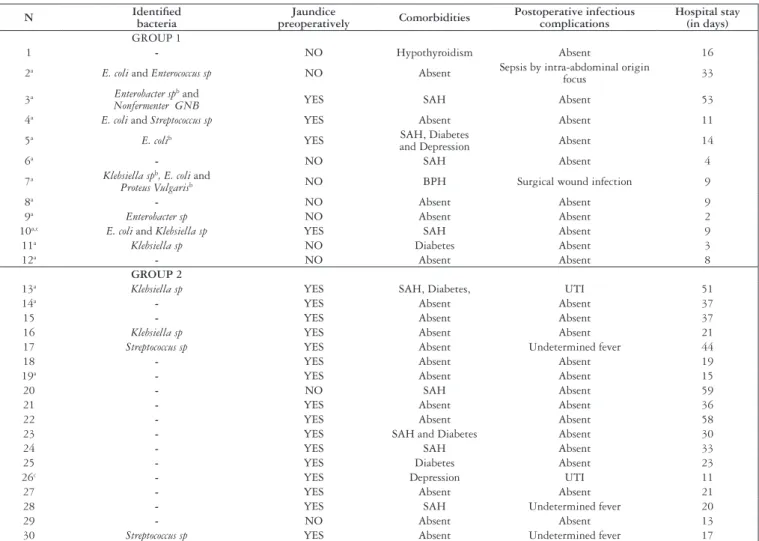
Seven patients showed some type of postoperative infec-tious complications during the postoperative period, and the fever of unknown origin was the most common complica-tion (n=3). There was no explicit statistically signiicant link between bactibilia and the higher postoperative infectious complication incidence (P=0.084) (Figure 3).
Fourteen out of the 30 patients showed one or more comorbidities. Two cases showed both high blood pressure and diabetes. One case showed hypertension, diabetes and depression, all at once. However, there was no statistically signiicant difference in bacteria identiication in bile samples from patients with and without comorbidities (P=0.654). Hypertension (n=9) and type 2 diabetes mellitus (n=5) were the most common comorbidities (Figure 3), they were identiied during the preoperative assessment complaint or the clinical jaundice manifestation in 4 patients of group 1 (with 3 individuals with choledocholithiasis) and 16 patients of group 2 (Figure 3).
Fourteen out of the 30 patients in the sampling group showed calculi inside the gallbladder; 11 of them belonged to group 1 (Figure 3). Nine of these 14 patients with gallstones showed concomitant bactibilia, although there was no ap-parent statistically signiicant link between the presence of gallstones and bactibilia (P=0.073).
The medical records of 11 patients (represented by numbers 2, 5, 11, 14, 16, 19, 21, 22, 23, 27 and 28) from the total sampling group presented upper digestive endoscopy results. Only one patient (no. 11) presented Helicobacter pylori in the urease test.
TABLE 1. Distribution of bacteria identiied in 12 bile samples with positive bile culture, according to patient groups
Identiied Bacteria Group 1 Group 2 Total
Escherichia coli 5 0 5
Klebsiella sp. 3 2 5
Enterobacter sp. 2 0 2
Enterococcus sp. 1 0 1
Streptococcus sp. 1 2 3
Nonfermenter GNB 1 0 1
Proteus Vulgaris 1 0 1
Total 14 4 18
GROUPS N ASSOCIATED SURGICAL PROCEDURES PERFORMED AFTER BILE COLLECTION AND CHOLECYSTECTOMY
1 No procedure associated with CCT
2 No procedure associated with CCT
3 No procedure associated with CCT
4 Cyst resection in the common bile duct and intrahepatic biliodigestive anastomosis (hepatic-jejunal)
5 Choledochotomy + biliodigestive anastomosis (hepatoduodenal)
GROUP 1 6 No procedure associated with CCT
7 Choledochotomy + biliodigestive anastomosis (choledochusduodenal)
8 No procedure associated with CCT
9 No procedure associated with CCT
10 Choledochotomy, suture of common bile duct and placement of Kehr’s drain
11 No procedure associated with CCT
12 No procedure associated with CCT
13 GDP and abdominal cavity draininga
14 GDP, liver biopsy and abdominal cavity draininga
15 GDP and abdominal cavity draininga
16 GDP and abdominal cavity draininga
17 GDP and abdominal cavity draininga
18 GDP and abdominal cavity draininga
19 GDP and abdominal cavity draininga
20 GDP and abdominal cavity draininga
GROUP 2 21 GDP and abdominal cavity draininga
22 GDP, liver biopsy and abdominal cavity draininga
23 GDP and abdominal cavity draininga
24 GDP and abdominal cavity draininga
25 GDP and abdominal cavity draininga
26 GDP and abdominal cavity draininga
27 GDP and abdominal cavity draininga
28 GDP and abdominal cavity draininga
29 Tumor resection in the middle third of the biliary tract
and biliodigestive anastomosis (choledochojejunostomy)
30 Resection of the biliary tract and biliodigestive anastomosis
(choledochojejunostomy)
FIGURE 2. Distribution of associated surgical procedures performed after bile collection and cholecystectomy.
N: patient identiication; CCT: cholecystectomy; GDP: Gastroduodenopancreatectomy or Whipple procedure. a Abdominal cavity draining by means
of two siliconized tubular-laminar drains.
report tries to link the existence of bacteremia caused by Streptococcus bovis to gallbladder cancer formation, it was not possible to consolidate evidences to infer or suggest any signiicant association between them(19). On the other hand, Escherichia coli and Klebsiella sp were the most common bacteria in patients with benign biliopancreatic diseases. Three bile samples showed multiresistant bacteria (Figure 1).
Nine out of the 14 patients with gallstones showed con-comitant bactibilia (Figure 3). It is worth highlighting that the absence of bactibilia in patients with gallstones may have been inluenced by the bacteria ability of forming bioilms in the periphery of the gallstones, as well as by their habit of keeping on colonizing just the gallbladder wall without dispersing into the bile. Such feature may have generated some false negative results. This process could explain why the bile cultures showed no bacterial growth in patients with gallstones(28).
DISCUSSION
Bactibilia was identiied in the bile culture of 12 patients. Most of these patients had benign diseases. Bactibilia is uncommon in patients with biliopancreatic cancers and it is particularly absent in pancreatic adenocarcinoma cases. Although bactibilia was identiied in four patients with ma-lignant diseases, the sample size did not allow associating the presence of any bacteria in the bile to biliopancreatic cancer, despite the attempt in other studies to demonstrate such an association(6,12,16-19,22,23,25,28,30), mainly between gallbladder
cancer and the presence of Salmonella typhi(16,17,22,23,25) and/
or Salmonella paratyphi(17,23,22). Moreover, as for the present
study, the predominant bacterial lora identiied in patients with malignant neoplasia was a bit different from that of patients with benign diseases. There was Streptococcus sp predominance in patients with cancer. Although a rare case
N Identiiedbacteria preoperativelyJaundice Comorbidities Postoperative infectiouscomplications Hospital stay(in days)
GROUP 1
1 - NO Hypothyroidism Absent 16
2a E. coli and Enterococcus sp NO Absent Sepsis by intra-abdominal origin
focus 33
3a Enterobacter spband
Nonfermenter GNB YES SAH Absent 53
4a E. coli and Streptococcus sp YES Absent Absent 11
5a E. colib YES SAH, Diabetes
and Depression Absent 14
6a - NO SAH Absent 4
7a Klebsiella spb, E. coli and
Proteus Vulgarisb NO BPH Surgical wound infection 9
8a - NO Absent Absent 9
9a Enterobacter sp NO Absent Absent 2
10a,c E. coli and Klebsiella sp YES SAH Absent 9
11a Klebsiella sp NO Diabetes Absent 3
12a - NO Absent Absent 8
GROUP 2
13a Klebsiella sp YES SAH, Diabetes, UTI 51
14a
- YES Absent Absent 37
15 - YES Absent Absent 37
16 Klebsiella sp YES Absent Absent 21
17 Streptococcus sp YES Absent Undetermined fever 44
18 - YES Absent Absent 19
19a - YES Absent Absent 15
20 - NO SAH Absent 59
21 - YES Absent Absent 36
22 - YES Absent Absent 58
23 - YES SAH and Diabetes Absent 30
24 - YES SAH Absent 33
25 - YES Diabetes Absent 23
26c
- YES Depression UTI 11
27 - YES Absent Absent 21
28 - YES SAH Undetermined fever 20
29 - NO Absent Absent 13
30 Streptococcus sp YES Absent Undetermined fever 17
FIGURE 3. Distribution of the 30 patients per group, bacteria identiied in the bile, presence of jaundice in the preoperative period, comorbidities, occurrence of postoperative infectious complications and time of hospital stay.
N: patient identiication; - : no bacterial growth; GNB: Gram-negative bacilli; E. coli: Escherichia coli; SAH: systemic arterial hypertension; Diabetes: type 2
diabetes mellitus; BPH: benign prostatic hyperplasia; UTI: urinary-tract-originated infection. a Patients with gallstones. b Multiresistant bacteria.
Comorbidities were found in 14 patients and bactibilia was identiied in six cases, in the current study. Systemic arterial hypertension and type 2 diabetes mellitus were the most common comorbidities found in these six individuals. Contrary to what some studies have tried to suggest, none of the herein observed comorbidities represented a signiicant risk of bactibilia incidence increase(5).
Five out of the seven patients who showed postoperative infectious complications in the present study had bactibilia. It may suggest that patients tend to have higher incidence of these complications when there are bacteria in their bile, although there was no statistical signiicance to prove it in the current study (P=0.084). Such concept is justiied if one considers a conidence level of 90%, although our study did not show sta-tistically signiicant evidence at 95% conidence level (P<0.05). This result (P<0.10) would be statistically signiicant and re-inforced if the research was done using larger samples (larger N). In this case, we would have reached signiicant values at 95% conidence level as it was evidenced in other studies(7,8,24).
The aforementioned trend may be strengthened by some signiicant results shown in other studies(1,7,8,24), although
most of these studies are restricted to patients with acute lithiasic cholecystitis(1,8,24). The present study could have
found a signiicant link between bactibilia and the presence of postoperative infectious complications if a larger sample had been used(7). However, it is noteworthy that half of the
sample was composed of individuals aged 60 years or older and this alone could have inluenced the incidence of bacti-bilia(6,8,20,24) and, consequently, the occurrence of
postopera-tive infectious complications(8,24).
Moreover, it is worth emphasizing that the current study found that women tend to present higher bactibilia incidence
(P=0.058), and it corroborates the results from other studies(9,10).
However, it should be taken into account that gallstone incidence in women is two-to-three-times higher due to the estrogenic activity, which could favor the occurrence of bactibilia among women(4). Therefore, one may assume the
possibility of developing a microbiological study of the bile in over-50-year-old women subjected to cholecystectomy due to biliopancreatic diseases as a way to improve the antibiotic prophylaxis and the antibiotic therapy, as well as to prevent possible postoperative infectious complications in the future, particularly those associated with multiresistant bacteria.
CONCLUSION
Bactibilia was found in 12 samples and the most identiied bacteria in patients with benign diseases were Escherichia coli and Klebsiella sp. Streptococcus sp and Klebsiella sp were prevalent in cancer patients. There was a trend for higher postoperative infectious complication incidence in patients with bactibilia.
Authors’ contributions
Alves JR mentored medical students in the literature review and data collection, and he was the inal reviewer of the article writing, and responsible for the translation into English, as well as for the text formatting and for the process of submitting the article. Amico EC contributed to the revision of the article writing. Souza DLB performed the statistical analysis and contributed to the inal revision. Silva RC, Guerra SCP and Freitas TT conducted a literature review and participated in the writing of the manuscript. All authors read and approved the inal version of the article.
Alves JR, Silva RC, Guerra SCP, Freitas TT, Souza DLB, Amico EC. Análise microbiológica da bile em pacientes com doenças biliopancreáticas benignas e malignas e suas consequências. Arq Gastroenterol. 2016,53(3):156-62.
RESUMO - Contexto - Bacteriobilia pode produzir várias consequências para a saúde humana. Objetivo - Avaliar a microbiologia da bile de pacientes com doenças biliopancreáticas para identiicar bactérias e possíveis consequências. Métodos- Estudo retrospectivo microbiológico. Trinta amostras de bile de pacientes com doenças biliopancreáticas benignas e malignas foram avaliadas para determinar a lora microbiológica da bile e procurar alguma possível relação dessa com comorbidades, carcinogênese e complicações infecciosas pós-operatórias. Resultados- As amostras de bile foram avaliadas em pacientes, com idade média ≈57,7 anos, a maioria mulheres (n=18). Evidenciou-se bacteriobilia em 12 casos, a maioria em pacientes com doenças benignas (n=8); pacientes com mais de 50 anos (n=23) e mulheres (n=10). As doenças mais comuns foram o adenocarcinoma de papila duodenal (n=9) e a colelitíase (n=8). Escherichia coli (n=5) e Klebsiella sp (n=5) foram as bactérias mais identiicadas em pacientes com doenças benignas; sendo a Klebsiella sp (n=2) e o Streptococcus sp (n=2) as que predominaram nos pacientes com cânceres. As complicações pós-operatórias exclusivamente infecciosas ocorreram em sete casos, sendo em cinco desses associados à bacteriobilia (P=0,084). Conclusão- Bacteriobilia foi evidenciada em 12 amostras, sendo as bactérias mais identiicadas Escherichia coli e Klebsiella sp em pacientes com doenças benignas; e Streptococcus sp e Klebsiella sp nos pacientes com câncer. Existiu uma tendência a maior incidência de complicações infecciosas pós-operatórias em pacientes com bacteriobilia.
REFERENCES
1. Baitello AL, Colleoni NR, Herani FB, Cordeiro JA, Machado AMO, Godoy MF, et al. Bacteremia – prevalence and associated factors in patients with acute calculous cholecystitis. Rev Assoc Med Bras. 2004;50:373-9.
2. Barrett KE. Fisiologia Gastrointestinal. 2ª ed. Ed. AMGH Editora Ltda, Porto Alegre – RS. 2015.
3. Brasil. Agência Nacional de Vigilância Sanitária. Manual de Microbiologia Clínica para controle de infecção relacionada ao sistema de saúde. Módulo 4: Procedimen-tos laboratoriais: da requisição do exame à análise microbiológica e laudo inal. Brasília: Anvisa; 2013.
4. Brow AC, Wrenn SP, Suresh N, Meyers WC, Abedin MC. Gender differences in cholesterol nucleation in native bile: Estrogen is a potential contributory factor. J Membr Biol. 2009;232:35-45.
5. Chao CM, Lai CC, Tang HJ, Ko WC, Hsueh PR. Biliary tract infections caused by Aeromonas species. Eur J Clin Microbiol Infect Dis. 2013;32:245-51.
6. Csendes A, Becerra M, Burdiles P, Demian I, Bancalari K, Csendes P. Bacteri-ological studies of bile from the gallbladder in patients with carcinoma of the gallbladder, cholelithiasis, common bile duct stones and no gallstones disease. Eur J Surg. 1994;160:363-7.
7. Darkahi B, Sandblom G, Lijeholm H, Videhult P, Melhus A, Rasmussen IC. Biliary microlora in patients undergoing cholecystectomy. Surg Infect. 2014; 15:262-5. 8. Galili O, Eldar S Jr, Matter I, Madi H, Brodsky A, Galis I, et al. The effect of
bactibilia on the course and outcome of laparoscopic cholecystectomy. Eur J Clin Microbiol Infect Dis. 2008;27:797–803.
9. Kai K, Aishima S, Miyazaki K. Gallbladder cancer: Clinical and pathological approach. World J Clin Cases. 2014;2:515-21.
10. Kianmanesh R, Scaringi S, Castel B, Flamant Y, Msika S. Precancerous lesions of the gallbladder. J Chir (Paris). 2007;144:278-86.
11. Koneman EW, Allen SD, Janda WM, Schreckenberger PC, Winn Jr. WC. Diag-nóstico microbiológico: texto e atlas colorido. 5. ed. São Paulo: Medsi editora; 2001. 12. Lax AJ, Thomas W. How bacteria could cause cancer: one step at a time. Trends
in Microbiol. 2002;10:293-9.
13. Losada H, Manterola D, Pineda V, Vialg M. Recuento bacteriano em bilis de pacientes com colangitis aguda: Reporte preliminar. Rev Chil Cir. 2006;58:35-9. 14. Mattos AA, Costabeber AM, Lionço LC, Tovo CV. Multi-resistant bacteria in
spontaneous bacterial peritonitis: A new step in management? World J Gastroen-terol. 2014;20:14079–86.
15. Mohammed S, Evans C, VanBuren G,Hodges SE, Silberfein E, Artinyan A, et al. Treatment of bacteriobilia decreases wound infection rates after pancreaticoduo-denectomy. HPB (Oxford). 2014;16:592–8.
16. Nath G, Gulati AK, Shukla VK. Role of bacteria in carcinogenesis, with special reference to carcinoma of the gallbladder. World J Gastroenterol. 2010;16:5395-404.
17. Nath G, Singh H, Shukla VK. Chronic typhoid carriage and carcinoma of the gall bladder. Eur J Cancer Prev. 1997;6:557-9.
18. Nilsson HO, Stenram U, Ihse I, Wadstrom T. Helicobacter species ribosomal DNA in the pancreas, stomach and duodenum of pancreatic cancer patients. World J Gastroenterol. 2006;12:3038-43.
19. O’Brien B, Dyer B, DeLuca J, Richmond BK. Streptococcus bovis bactere-mia as the initial presentation of carcinoma of the gallbladder. W V Med J. 2014;110:32-3.
20. Ohdan H, Oshiro H, Yamamoto Y, Tanaka I, Inagaki K, Sumimoto K, et al. Bacteriological investigation of bile in patients with cholelithiasis. Surg Today. 1993;23:390–5.
21. Oplustil CP, Zoccoli CM, Tobouti NR, Sinto SI. Procedimentos básicos em microbiologia clínica. 3. ed. São Paulo: Sarvier editora; 2010.
22. Pilgrim CH, Groeschl RT, Christians KK, Gamblin TC. Modern perspectives on factor predisposing to the development of gallbladder cancer. HPB (Ox-ford). 2013;15:839-44.
23. Randi G, Franceschi S, La Vecchia C. Gallbladder cancer worldwide: geograph-ical distribution and risk factors. Int J Cancer. 2006;118:1591-602.
24. Rico RC, Linares JRS, Polo FC, Vázquez MTP, Rojas JLV, Estévez MD, et al. Bacteriologic indings as a prognostic factor in the course of acute cholecystitis. Rev Esp Enferm Apar Dig. 1989;76:465–70.
25. Samaras V, Rafailidis PI, Mourtzoukou EG, Peppas G, Falagas ME. Chronic bacterial and parasitic infections and cancer: a review. J Infect Dev Ctries. 2010;4:267-81.
26. Sharma V, Chauhan VS, Nath G, Kumar A, Shukla VK. Role of bile bacteria in gallbladder carcinoma. Hepatogastroenterology. 2007; 54:1622-1625. 27. Sung JY, Costerton JW, Shaffer EA. Defense system in the biliary
tract against bacterial infection. Dig Dis Sci. 1992;37:689-96.
28. Swidsinski A, Lee SP. The role of bacteria in gallstone pathogenesis. Front Biosci. 2001;1:e93-103.
29. World Health Organization, International Agency for Research on Cancer. A review of human carcinogens. IARC Monogr Eval Carcinog Risks Hum, Part B: Biological agents; 2009. p.402-3.