394
Short Communication
Rev Bras Hematol Hemoter. 2012;34(5):394-5
Leukocyte superoxide dismutase activity in patients with chronic myeloid leukemia
Introduction
Chronic myeloid leukaemia (CML) is a myeloproliferative disorder of the hematopoietic cell and is associated with a characteristic chromosomal translocation called the Philadelphia chromosome. Clinically, CML is often divided into three phases; CML typically begins in the chronic phase (CML-CP) and in the absence of intervention and over the course of several years progresses to an accelerated phase (CML-AP) and ultimately to blast crisis. Blast crisis is the terminal phase of CML and clinically behaves like acute leukemia(1). Free radicals can be key contributory agents in a number of human diseases, including cancer and leukaemia(2,3). These free radicals can be generated within the cell not only by external sources of radiation but also within the body as a by-product of normal metabolic processes which include the electron transport chain, drugs, pollutants, and chemicals including toxins, collectively termed as xenobiotics. Thus, antioxidants which balance the oxidative stress state represent a major line of defense in regulating the overall true state of health(2). Antioxidant enzymes such as superoxide dismutase (SOD) can directly counter the oxidants and may protect cells against oxidative stress. Studies show that cancer cells have abnormal activities of SOD enzymes when compared to an appropriate normal counterpart. There are no available publications regarding the relationship between leukocyte SOD enzyme activity in CML and its progression. The present study was planned to propose leukocyte SOD activity as a possible biomarker for oxidative stress in CML and its correlation with the progressive phases of CML.
Methods
This study included 83 CML patients and 50 age- and gender-matched healthy volunteers. Leukocyte SOD activity was measured by the spectrophotometric method(4).
Results
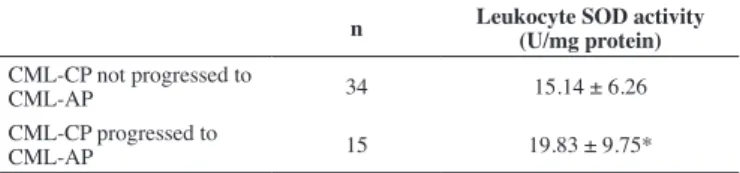
At the time of diagnosis, the mean leukocyte SOD activity in CML, CML-CP and CML-AP were signiicantly higher (p-value < 0.001, p-value < 0.01 and p-value < 0.001, respectively) than in healthy volunteers (Table 1). CML-CP patients who converted into CML-AP had signiicantly higher (p-value < 0.05) leukocyte SOD activity than CML-CP patients who did not convert into CML-AP (Table 2).
Rizwan Ahmad Ranjana Singh Anil Kumar Tripathi Raj Kumar Singh
King George’s Medical University, Chowk, Lucknow, India
Conlict-of-interest disclosure:
The authors declare no competing inancial interest
Submitted: 8/31/2012 Accepted: 9/4/2012
Corresponding author: Raj Kumar Singh
Biochemistry Department, Shri Guru
Ram Rai Institute of Medical & Health
Sciences, Patel Nagar
248001 Dehradun, Uttarakhand, India [email protected]
www.rbhh.org or www.scielo.br/rbhh
DOI: 10.5581/1516-8484.20120097
Table 1 - Leukocyte superoxide dismutase activity in CML, CML-CP, CML-AP patients and healthy subjects
Groups n Leukocyte SOD activity (U/mg protein)
Healthy Subjects 50 11.69 ± 4.34
CML 83 16.99 ± 7.61**
CML-CP 62 15.94 ± 7.52***
CML-AP 21 19.94 ± 7.26**
CML: Chronic myeloid leukaemia; CML-CP: Chronic myeloid leukaemia - chronic phase; CML-AP: Chronic myeloid leukaemia - accelerated phase; SOD: superoxide dismutase
395 Short Communication
Rev Bras Hematol Hemoter. 2012;34(5):394-5
xxx Discussion and conclusion
The mean leukocyte SOD activity was signiicantly different in CML, CML-CP and CML-AP patients when compared to controls (Table 1). CP patients who converted into CML-AP had higher leukocyte SOD activity than CML-CP patients who did not convert into CML-AP (Table 2). Superoxide dismutase is a major cellular defense device against superoxides in the cells(5). A SOD enzyme is dimeric antioxidant enzyme responsible for the quenching of superoxide radicals which are released in various metabolite pathways. Altered leukocyte SOD activity has been
reported in various cancers including leukemias(2,3,6). The elevated leukocyte SOD activity may be due to altered gene expression in hematopoietic cells. It could be concluded that leukocyte SOD activity relects oxidative stress in CML patients, and may be used as an indicator for oxidative stress related to disease progression. Further studies are needed to conirm the precise role of the SOD enzyme in oxidative stress in CML pathobiology and its progression.
References
1. Kurzrock R, Kantarjian HM, Druker BJ, Talpaz M. Philadelphia chromosome–Positive leukemias: From basic mechanisms to molecular therapeutics. Ann Intern Med. 2003; 138(10):819-30.
2. Irshad M, Chaudhuri PS. Oxidant-antioxidant system: role and
signiicance in human body. Ind J Exp Biol. 2002;40(11):1233-9.
3. Valko M, Leibfritz D, Moncol J, Cronin MT, Mazur M, Telser J. Free radicals and antioxidants in normal physiological functions and human disease. Int J Biochem Cell Biol. 2007;39(1):44-84.
4. McCord JM, Fridovich I. Superoxide dismutase: an enzymic function for erythrocuprein (hemocuprein). J Biol Chem. 1969;244(22):6049-55.
5. Ray G, Husain SA. Oxidants, antioxidants and carcinogenesis. Ind J Exp
Biol. 2002;40(11):1213-32.
6. Kokaglu E, Aktuglu G, Belce A. Leukocytes superoxide dismutase levels
in acute and chronic leukemias. Leuk Res. 1989;13(6):457-8. Table 2 - Progression of CML-CP patients to CML-AP and leukocyte
superoxide dismutase activity
n Leukocyte SOD activity (U/mg protein)
CML-CP not progressed to
CML-AP 34 15.14 ± 6.26
CML-CP progressed to
CML-AP 15 19.83 ± 9.75*
CML: Chronic myeloid leukaemia; CML-CP: Chronic myeloid leukaemia - chronic phase; CML-AP: Chronic myeloid leukaemia - accelerated phase; SOD: superoxide dismutase