Suicide among elderly: a systematic review
Veroˆnica de Medeiros Alves,IAna Claudia C. de Ornelas Maia,IIAntonio Egidio NardiIII
IPhD, Institute of Psychiatry, Universidade Federal do Rio de Janeiro, INCT Translational Medicine, Rio de Janeiro, Brazil. Assistant Teacher at the Federal
University of Alagoas, BrazilIIPhD, Institute of Psychiatry, Universidade Federal do Rio de Janeiro, INCT Translational Medicine, Rio de Janeiro, Brazil IIIPostdoc in the Laboratory of Physiology of Respiration at Institute of Biophysics Carlos Chagas Filho. Panic & Respiration Laboratory. Institute of
Psychiatry, Federal University of Rio de Janeiro. National Institute for Translational Medicine (INCT-TM), Rio de Janeiro, Brazil
This article aimed to perform a systematic review of suicide among the elderly. The literature review was conducted using three databases (SCOPUS, Medline/Pubmed and ISI Web of Science) using the termssuicide and elderly,suicide and older adultandsuicide attempt. The publication dates were restricted between 2008 and 2013. Review or theoretical articles were excluded; only epidemiologic studies were selected. A total of 1613 references were found, but only seven met the inclusion criteria, namely articles that assessed the prevalence of suicide in elderly through retrospective cohort studies. The average study period was 7.9 years. The following average annual suicide rates were calculated: Italy (173/cases-year), New York (118.1/cases-year and 51 cases/ year – two studies), Ireland (92/cases-year), Finland (12.9/cases-year), Turkey (3.5/cases-year) and England (3/cases-year). All of the studies reported that elderly males had a higher rate of death by suicide compared to elderly females. Hanging, shooting by firearms, drowning and jumping from high places were prevalent suicide methods. Three articles reported that death by suicide was associated with the presence of psychiatric disorders, psychoactive substance use, and physical illnesses, as well as economic and emotional reasons. This review determined that the topic of suicide among the elderly is rarely discussed and that little is known about influences, causes, or prevalence of suicide among the elderly. Moreover, neither the type of health monitoring nor the medications that are used as interventions for eventual suicide victims are commonly reported in elderly populations.
KEYWORDS: Suicide; Elderly; Primary Care.
Alves VM, Maia ACCO, Nardi AE. Suicide among elderly: a systematic review. MEDICALEXPRESS. 2014;1(1):9-13.
Received for publication onJanuary 4 2014;First review completed onJanuary 8 2014;Accepted for publication onJanuary 28 2014
E-mail: [email protected]
’ INTRODUCTION
Despite the global increase in the elderly population, little is known about how suicide presents itself among this group. Epidemiological studies on suicide in the elderly are scarce, but show an increase in incidence. Knowledge regarding the profile of suicide attempts may help in the development of strategies for the prevention of attempts and of suicidal acts themselves. Studies have shown that the presence of depression among the elderly is one factor that is associated with suicidal ideation and suicide attempt, and consequently, with the act of suicide.1,2
Studies profiling elderly individuals who have attempted suicide are necessary for developing preventive care plans for this vulnerable group. In addition, the education of primary care providers in diagnosing and treating depres-sion is an evidence-based suicide prevention practice.3
When undiagnosed and untreated, depression — a common psychiatric disease among the elderly4 — can cause physical, social and functional impairment, thereby contributing to decreased quality of life and, at more severe degrees, to suicide.1 Suicide among the elderly is a global
public health problem that is expected to worsen as society ages.5Consequently, health professionals must be attentive to the signs and symptoms of depression and the risk factors that can trigger depression.
Suicide assessment and prevention is one component of optimal care for patients who present with depression. Primary care professionals must be competently prepared and trained in the procedures of suicide assessment and prevention and must be familiar with the patient and provider factors that can influence this process.6 Primary care is likely to be the most suitable setting in which to implement a strategy for suicide prevention for the elderly, especially because more people visit primary care clinics than secondary care clinics prior to committing suicide.7
Thus, due to the need for primary care planning aimed at suicide prevention among the elderly, this article sought to perform a systematic review of suicide among the elderly.
’ MATERIALS AND METHODS
The literature review was conducted in three databases (SCOPUS, Medline/Pubmed and ISI Web of Science) using terms suicide and elderly, suicide and older adult andsuicide attempt.
The publication dates were restricted to the period between January 1, 2008 and December 31, 2013. Review DOI:
Conflicts of Interest and Source of Funding: None.
9 Copyrightß2014 MEDICALEXPRESS. This is an open access article distributed under the terms of the creative commons attribution
or theoretical articles were excluded; only epidemiological studies were selected for this review. Repeated references were excluded.
’ RESULTS
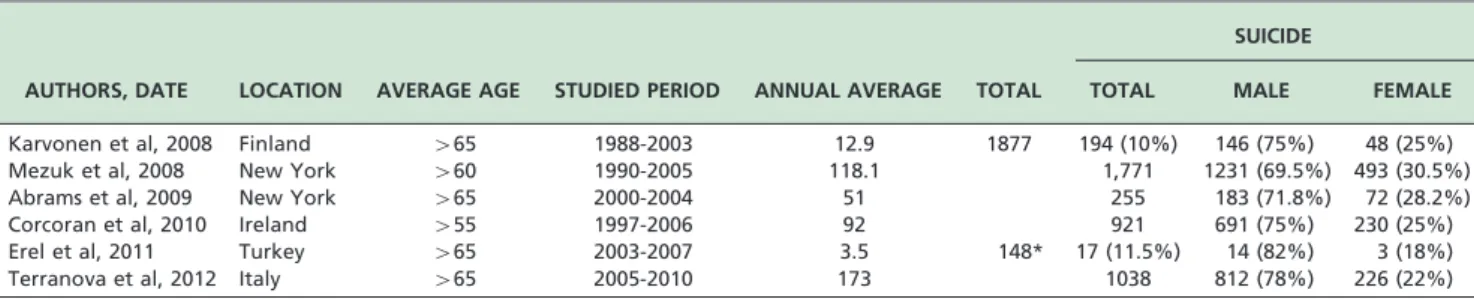
A total of 1613 references were found (viz., 110 in SCOPUS, 1083 in Medline/Pubmed, and 420 in ISI Web of Knowledge). Of these, 498 were duplicate references. The remaining 704 references underwent abstract analysis, and 349 were excluded. Sixty-three articles were short-listed for full-text reading. Following this process, only seven articles met the inclusion criteria of articles that assessed the prevalence of suicide in elderly or older adults. These articles included retrospective cohort studies. Figure 1 illustrates the selection process. The data from the seven studies found on this subject are shown in Table 1. Four studies were conducted with people over 65 years of age, whereas two studies were conducted with individuals over 60 years and one with individuals over 55 years.
All of the studies observed that elderly males had a higher rate of death by suicide compared to elderly females (above 70%), as shown in Table 1.
Hanging,5,8-12shooting by firearms,5,8-12drowning5,8,10,11 and jumping from high places5,9-11 were the prevalent suicide methods among the elderly as shown in Table 2.
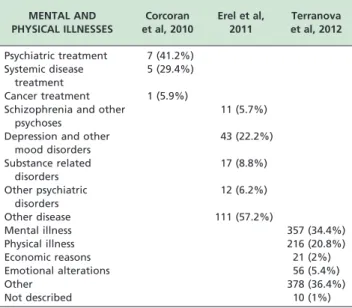
Three articles did not address the issue of psychiatric disorders associated with suicide. The remaining articles reported that deaths by suicide were related to the presence of a psychiatric disorder (e.g., depression, schizophrenia, mood disorder), psychoactive substance use, or a physical illnesses (e.g., cancer, systemic disease), as well as economic or emotional reasons. Only one study11 presented data about the presence of psychiatric treatment among the elderly. None of the studies cited psychological accompaniment (Table 3).
The study populations described in the articles evaluating suicide among the elderly varied between localities: Ire-land,11 Turkey,12 Finland,8 New York,9,10 England13 and Italy,5as shown in Table 1.
The studies reporting deaths by suicide considered the period of time from 1988 to 2010. The average study period was 7.9 years. After accounting for differences in the study periods between localities, the following average annual suicide rates were calculated: Italy (173/cases-year), New York (118.1/cases-year), Ireland (92/cases-year), New York (51/cases-year), Finland (12.9/cases-year), Turkey (3.5/ cases-year) and England (3/cases-year) (Table 1).
’ DISCUSSION
This review shows that few epidemiological studies have focused on suicide among the elderly. Most extant articles consider the psychosocial aspects of suicide in the family of the elderly individual; these articles were excluded from this study. Only seven articles retrospectively presented cohort results.5,8-12
Half of the identified studies did not cite the presence of a disease related to suicide. Among the articles that did cite the influence of disease, psychiatric disorders were most commonly identified. Only one study directly associated depression with suicide.12 Other studies identified depressive symptoms14 and major depression15 as being related to suicidal ideation. Studies on suicide attempts among the elderly showed correlations with major, unipolar, bipolar and minor depression.16-19 With respect to the psychiatric diseases related to suicide, research on drug and psychological treatments would be interesting when evaluating the importance of treatment in the prevention of suicide among the elderly.
A large proportion of suicides among elderly males was found. In the literature, this phenomenon has been observed in all age groups.20Several factors may influence such high
rates, including loss, loneliness and physical disease. These factors should be considered warning signs of suicidal behavior.12 The standard patriarchal features that still prevail among men are reflected in suicidal behavior. It is essential to give special attention to men during the transition from working life to retirement, in the loss of status, in situations of familial losses, upon diagnoses of chronic degenerative diseases that cause disabilities, in the loss of autonomy or upon the onset of sexual impotence.21
Suicidal ideation is present in a significant proportion of depressed primary care patients but is rarely discussed. Men, who carry the highest risk for suicide, are unlikely to be asked about or disclose such. The existence of patient-centered communications and a positive healthcare climate do not appear to increase the likelihood of suicide-related discussions. Health professionals should be encouraged to ask about suicidal ideation in their depressed patients and, when disclosure occurs, facilitate discussion and develop targeted treatment plans.22
Men over 65 years are more affected by illness, the death of spouse, and loneliness, because they have not prepared for it due to differing socialization roles.4One study in Japan showed that administering programs in the prevention of suicide and impulsivity would be effective for older men.23 Depression is more prevalent among women across the lifespan, but these differences diminish above the age of 65 years. It is important to diagnose depression in this age group to aid suicide prevention,4as was demonstrated by a Japanese study that showed that implementation of suicide prevention programs may be effective for older women.23
Prevention measures for the elderly — and, specifically, elderly males — should be implemented through primary health care. Such measures can include health education
Table 2 -Description of the means used in suicide in the elderly
AUTHORS Karvonen et al, 2008
Mezuk et al, 2008
Abrams
et al, 2009 Corcoran et al, 2010 Erel et al, 2011 Terranova et al, 2012
MEANS USED Male Female Total Total Male Female Male Female Male Female
Hanging 72 (49.3%) 16 (33.3%) 503 (28.4) 64 (25.1%) 280 (40.6%) 6 (42.9%) 2 (66.7%) 327 (40.3%) 46 (20.3%)
Firearms 36 (24.7%) 0 (0%) 286 (16.1) 38 (14.9%) 62 (9%) 1 (0.3%) 3 (21.4%) 152 (18.7%) 1 (0.4%)
Drowning 18 (12.3%) 15 (31.3%) 5 (2%) 198 (28.7%) 90 (39%) 40 (4.9%) 25 (11.1%)
Jumping 533 (30.1) 98 (38.4%) 2 (14.3%) 189 (23.3%) 98 (43.4%)
Drug overdose 224 (7.0) 18 (7.1%) 52 (7.6%) 57 (25%)
Poisoning 2 (14.3%) 1 (33.3%) 8 (1%) 16 (7.1%)
Cutting 81 (4.6) 23 (2.8%) 7 (3.1%)
Killed by motor vehicle or train
10 (3.9%) 12 (1.5%) 1 (0.4%)
Burning 1 (7.1%)
Other 20 (13.7%) 17 (35.4%) 143 (8.1) 22 (8.6%) 61 (7.5%) 32 (14.2%)
Table 1 -Local description, average age, analysis time and frequency of suicide in elderly
AUTHORS, DATE LOCATION AVERAGE AGE STUDIED PERIOD ANNUAL AVERAGE TOTAL
SUICIDE
TOTAL MALE FEMALE
Karvonen et al, 2008 Finland 465 1988-2003 12.9 1877 194 (10%) 146 (75%) 48 (25%)
Mezuk et al, 2008 New York 460 1990-2005 118.1 1,771 1231 (69.5%) 493 (30.5%)
Abrams et al, 2009 New York 465 2000-2004 51 255 183 (71.8%) 72 (28.2%)
Corcoran et al, 2010 Ireland 455 1997-2006 92 921 691 (75%) 230 (25%)
Erel et al, 2011 Turkey 465 2003-2007 3.5 148* 17 (11.5%) 14 (82%) 3 (18%)
Terranova et al, 2012 Italy 465 2005-2010 173 1038 812 (78%) 226 (22%)
programs aimed at sensitizing the elderly to the importance of healthy living habits, including physical and leisure activities. Accordingly, strategic locations already existing in the community (e.g., the spaces to be used for these activities) should be leveraged to favor social interactions and expand support networks among the elderly.1
Hanging, shooting by firearms, drowning and jumping from high places are considered to be violent methods of suicide. Primary health care strategies for limiting access to these methods should be implemented.24,25 Moreover, families should be aware of the risks of suicide commission among the elderly, and they should become allies in the prevention of suicide attempts and, consequently, of suicide completion.
One of the problems faced when attending to the elderly is that some signals and symptoms of depression are common at this stage of life. In some cases, elderly individuals cease to express their wishes, fears and thoughts because they do not have anyone with whom to talk. Consequently, these elderly individuals may become lonely. This phenomenon, among other factors, may contribute to the emergence of depression. Primary care may help to reduce suffering and dependency; social programs that assist elderly people in establishing social interactions in their communities and achieving dignity at the end of life should be encouraged.2 Motivating the elderly to fulfill activities that go beyond distraction, and instead promote social interactions, provides the highest level of wellbeing, keeps them active, and improves quality of life while also reducing depressive symptoms.1
The articles reviewed, and corrected for the period of time analyzed, suggest that Italy and New York present the highest annual rates of suicide among the studied locations. A six-year cohort study, which was conducted in Italy,5 identified 1,038 deaths by suicide among the elderly (males: n=812; females: n=226). Another 15-year cohort study, which was conducted in New York,9found 1,171 deaths by suicide among the elderly (males: n=1,231; females: n=493).
Among the studied locations, the lowest annual rate of suicide among the elderly was observed for Turkey and
England (Oxford, Manchester and Derby). We have dis-cussed a five-year cohort study,12 reporting 17 deaths by suicide among among an elderly population of 148 autopsies (males: n=14; females: n=3) in Turkey. Twenty four deaths by suicide were detected in England in an eight year study.
The populations studied were limited to countries in North America (specifically, New York City), Europe (Ireland, Italy, England and Finland) and Eurasia (Turkey). These locations present varied social structures, economics and geographies. No cohort study was drawn from Latin America. Among the locations identified in the study, Turkey was the single developing country, which demands reflection on the low rates of suicide reported in that study. This value may be accurate or underestimated; alternatively, it may be that cities in the developing world are not so strongly influenced by the increases in suicide rates linked to the developed world. One study performed in Brazil offers evidence that violence itself occurs in micro-regions with low levels of poverty,26which supports the idea that developing countries should experience high rates of suicide.
Many elderly individuals who die by suicide have had recent contact with a primary care physician. Because risk-assessment and referral processes for suicide are not readily comparable to procedures for other high-risk behaviors, it is important to identify areas of care that require quality improvement.27
Primary care professionals must be competently pre-pared and trained in the suicide assessment and prevention process, and they must be familiar with age-related factors that may influence this process and the presenting sympto-matology.6 An approach to aging that is both comprehensive and systemic must focus on personal welfare and must recognize the importance of vigilant and effective services that promote life-saving behaviors and counteract suicide.28Therefore, a decrease in suicide cases would be expected to accompany greater attention taken by managers and health professionals toward the support offered to the elderly through health services. The management of suicide risk includes: A) understanding the difference between risk factors and warning signs, B) developing a suicide risk assessment, C) and managing suicidal crises in a practical manner.28
’ CONCLUSION
This review exposes that little is known about the causes, influences, and prevalence of suicide among the elderly. Moreover, neither the type of health monitoring that eventual suicide victims receive nor the medications that are used as interventions are commonly reported. Finally, no health care focus on the prevention of suicide, particularly for elderly males, was identified.
Family participation in suicide prevention is of para-mount importance to the elderly, who often live alone or feel abandoned by family and society. Health centers that focus on primary care should pay special attention to this group and act as a link between families and the elderly. It is necessary to regard the elderly as individuals who are vulnerable not only to physical illness but also to mental illness.
Table 3 -Description of mental and physical illnesses
related to suicide in the elderly
MENTAL AND PHYSICAL ILLNESSES
Corcoran et al, 2010
Erel et al, 2011
Terranova et al, 2012
Psychiatric treatment 7 (41.2%) Systemic disease
treatment
5 (29.4%)
Cancer treatment 1 (5.9%)
Schizophrenia and other psychoses
11 (5.7%)
Depression and other mood disorders
43 (22.2%)
Substance related disorders
17 (8.8%)
Other psychiatric disorders
12 (6.2%)
Other disease 111 (57.2%)
Mental illness 357 (34.4%)
Physical illness 216 (20.8%)
Economic reasons 21 (2%)
Emotional alterations 56 (5.4%)
Other 378 (36.4%)
’ RESUMO
Este artigo teve como objetivo realizar uma revisa˜o sistema´tica sobre suicı´dio entre os idosos. A revisa˜o da literatura foi feita utilizando treˆs bancos de dados (Medline/Pubmed, SCOPUS e ISI Web of Science) usando os termos suicide and elderly,suicide and older adultandsuicide attempt. A publicac¸a˜o se restringe entre 2008 e 2013. Revisa˜o ou artigos teo´ricos foram excluı´dos; apenas estudos epidemiolo´gicos foram selecionados para esta revisa˜o. Um total de 1613 refereˆncias foram encontradas e apenas sete preencheram os crite´rios de inclusa˜o de artigos que avaliou a prevaleˆncia de suicı´dio em idosos. Estes artigos incluı´am estudos de coorte retrospectivo. O perı´odo me´dio de estudo foi de 7.9 anos. Calculou-se as seguintes taxas de suicı´dio anual me´dia: Ita´lia (173 casos/ano), Nova Iorque (118 casos/ano e 51 casos por ano, dois estudos), Irlanda (92 casos/ano), Nova Iorque (51 casos/ano), Finlaˆndia (12.9 casos/ano), Turquia (3.5 casos/ano) e Inglaterra (3 casos/ ano). Todos os estudos observaram que homens idosos tinham uma maior
taxa de morte por suicı´dio, em comparac¸a˜o com mulheres idosas.
Enforcamento, arma de fogo, afogamento e saltar de lugares altos foram os me´todos de suicı´dio prevalentes entre os idosos. Treˆs artigos relataram que a
morte por suicı´dio estava associada com a presenc¸a de transtornos
psiquia´tricos, uso de substaˆncias psicoativas e doenc¸as fı´sicas, bem como com causas econoˆmicas e emocionais. Esta revisa˜o determinou que o tema do suicı´dio entre os idosos e´ raramente discutido e que pouco se sabe sobre as influeˆncias, causas ou prevaleˆncia entre os idosos. Ale´m disso, o tipo de acompanhamento recebido, bem como os medicamentos sa˜o usados para suicidas eventuais sa˜o comumente relatados
’ REFERENCES
1. Ferreira PCS, Tavares DMS, Martins NPF, Rodrigues RL, Ferreira LA. Caracterı´sticas sociodemogra´ficas e ha´bitos de vida de idosos com e sem indicativo de depressa˜o.Rev Eletr Enf. 2013;15(1):197-204.
2. Minayo MCS, Cavalcante FG. Suicı´dio entre pessoas idosas: revisa˜o da literatura.Rev Sau´de Pu´blica. 2010;44:750-7.
3. Besˇkovnik L, Juricˇicˇ NK, Svab V. Suicide index reduction in Slovenia: the
impact of primary care provision.Ment Health Fam Med. 2011;8(1):51-5.
4. Monteso´ P, Ferre C, Lleixa M, Albacar N, Aguilar C, Sanchez A,et al.
Depression in the elderly: study in a rural city in southern Catalonia.J Psychiatr Ment Health Nurs. 2012;19(5):426-9.
5. Terranova C, Cardin F, Bruttocao A, Militello C. Analysis of suicide in the elderly in Italy. Risk factors and prevention of suicidal behavior. Aging Clin Exp Res. 2012;24(3 Suppl):20-3.
6. Hooper LM, Epstein SA, Weinfurt KP, DeCoster J, Qu L, Hannah NJ. Predictors of primary care physicians’ self-reported intention to conduct suicide risk assessments.J Behav Health Serv Res. 2012;39(2):103-15. 7. Tadros G, Salib E. Elderly suicide in primary care.Int J Geriatr Psychiatry.
2007;22(8):750-6.
8. Karvonen K, Ra¨sa¨nen P, Hakko H, Timonen M, Meyer-Rochow VB, Sa¨rkioja T,et al. Suicide after hospitalization in the elderly: a population
based study of suicides in Northern Finland between 1988-2003.Int J
Geriatr Psychiatry. 2008;23(2):135-41.
9. Mezuk B, Prescott MR, Tardiff K, Vlahov D, Galea S. Suicide in older adults in long-term care: 1990 to 2005.J Am Geriatr Soc. 2008;56(11):2107-11. 10. Abrams RC, Leon AC, Tardiff K, Marzuk PM, Li C, Galea S.
Anti-depressant use in elderly suicide victims in New York city: an analysis of 255 cases.J Clin Psychiatry. 2009;70(3):312-7.
11. Corcoran P, Reulbach U, Perry IJ, Arensman E. Suicide and deliberate self harm in older Irish adults.Int Psychogeriatr. 2010;22(8):1327-36. 12. Erel O, Aydin-Demiragˇ S, Katkici U. Homicide and suicide in the elderly:
Data from Aydin.Turk Geriatri Dergisi. 2011;14(4):306-10.
13. Murphy E, Kapur N, Webb R, Purandare N, Hawton K, Bergen H,et al.
Risk factors for repetition and suicide following self-harm in older adults: multicentre cohort study.Br J Psychiatry. 2012;200(5):399-404. 14. Chan H-L. Prevalence and association of suicide ideation among
Tai-wanese elderly-a population-based cross-sectional study.Chang Gung
Med J. 2011;34(2):197-204.
15. Corna LM, Cairney J, Streiner DL. Suicide Ideation in Older Adults:
Relationship to Mental Health Problems and Service Use.Gerontologist.
2010;50(6):785-97.
16. Wiktorsson S, Runeson B, Skoog I, Ostling S, Waern M. Attempted sui-cide in the elderly: characteristics of suisui-cide attempters 70 years and
older and a general population comparison group. Am J Geriatr
Psy-chiatry. 2010;18(1):57-67.
17. Kim YR, Choi KH, Oh Y, Lee HK, Kweon YS, Lee CT, Lee KU. Elderly
suicide attempters by self-poisoning in Korea. Int Psychogeriatr.
2011;23(6):979-85.
18. Gheshlaghi F, Salehi MJ. Suicide attempts by self-poisoning in elderly. Journal of Research in Medical Sciences. 2012;17:S273-6.
19. Kato K, Akama F, Yamada K, Maehara M, Saito M, Kimoto K,et al.
Frequency and clinical features of suicide attempts in elderly patients in Japan.Psychiatry Clin Neurosci. 2013;67(2):119-22.
20. Minayo MC, Pinto LW, Assis SG, Cavalcante FG, Mangas RM. Trends in
suicide mortality among Brazilian adults and elderly, 1980-2006. Rev
Saude Publica. 2012;46(2):300-9.
21. Minayo MCS, Meneghel SN, Cavalcante SG. Suicı´dio de homens idosos no Brasil.Cieˆncia e Sau´de Coletiva. 2012b;17:2665-74.
22. Vannoy SD, Tai-Seale M, Duberstein P, Eaton LJ, Cook MA. Now what should I do? Primary care physicians’ responses to older adults expressing thoughts of suicide.J Gen Intern Med. 2011;26(9):1005-11. 23. Oyama H, Goto M, Fujita M, Shibuya H, Sakashita T. Preventing elderly
suicide through primary care by community-based screening for depression in rural Japan.Crisis. 2006;27(2):58-65.
24. Ougrin D, Banarsee R, Dunn-Toroosian V, Majeed A. Suicide survey in a
London borough: primary care and public health perspectives.J Public
Health (Oxf). 2011;33(3):385-91.
25. Pinto LW, Silva CM, Pires Tde O, Assis SG. Fatores associados com a mortalidade por suicı´dio de idosos nos municı´pios brasileiros no perı´odo de 2005-2007.Cieˆncia & Sau´de Coletiva. 2012;17(8):2003-9.
26. Gonc¸alves LRC, Gonc¸alves E, Oliveira Ju´nior LB. Determinantes espa-ciais e socioeconoˆmicos do suicı´dio no Brasil: uma abordagem regional. Nova Economia Belo Horizonte. 2011;21:281-316.
27. Vannoy SD, Robins LS. Suicide-related discussions with depressed pri-mary care patients in the USA: gender and quality gaps. A mixed
methods analysis.BMJ Open. 2011;1(2):e000198.
28. McDowell AK, Lineberry TW, Bostwick M. Practical Suicide – Risk
Management for the Primary Care Physician. Mayo Clin Proc.