ORIGINAL ARTICLE
Add-on Treatment with Curcumin Has Antidepressive Effects
in Thai Patients with Major Depression: Results of a Randomized
Double-Blind Placebo-Controlled Study
Buranee Kanchanatawan1&Sookjaroen Tangwongchai1&Atapol Sughondhabhirom1&Siriluck Suppapitiporn1& Solaphat Hemrunrojn1&André F. Carvalho2&Michael Maes1,3,4
Received: 7 November 2017 / Revised: 19 December 2017 / Accepted: 20 December 2017 / Published online: 11 January 2018 #Springer Science+Business Media, LLC, part of Springer Nature 2018
Abstract
Activation of immune-inflammatory and oxidative-nitrosative (IO&NS) stress pathways plays a role in major depres-sion (MDD). Evidence suggests that curcumin (500–1000 mg/day), a polyphenol with strong anti-IO&NS properties, may have efficacy either as monotherapy or as an adjunctive treatment for depression. Further controlled trials with extended treatment periods (> 8 weeks) and higher curcumin doses are warranted. This 12-week study was carried out to examine the effects of adjunctive curcumin for the treatment of MDD. In this double-blind, placebo-controlled trial, 65 participants with MDD were randomized to receive either adjunctive curcumin (increasing dose from 500 to 1500 mg/day) or placebo for 12 weeks. Four weeks after the active treatment phase, a follow-up visit was conducted at week 16. Assessments of the primary, i.e., the Montgomery-Asberg Depression Rating Scale (MADRS), and secondary, i.e., the Hamilton Anxiety Rating Scale (HAM-A), outcome measures were rated at baseline and 2, 4, 8, 12, and 16 weeks later. Curcumin was more efficacious than placebo in improving MADRS scores with signif-icant differences between curcumin and placebo emerging at weeks 12 and 16. The effects of curcumin were more pronounced in males compared to females. There were no statistically significant treatment-emerging adverse effects and no significant effects of curcumin on blood chemistry and ECG measurements. Adjunctive curcumin has significant antidepressant effects in participants with MDD as evidenced by significant benefits occurring 12 and 16 weeks after treatment initiation. Curcumin administration was safe and well-tolerated even when combined with antidepressants. Future trials should include treatment-by-sex interactions to examine putative antidepressant effects of immune-modifying compounds.
Keywords Depression . Oxidative and nitrosative stress . Immune . Inflammation
* Michael Maes
[email protected];http://scholar.google.co.th/ citations?user=1wzMZ7UAAAAJ&hl=th&oi=ao
Buranee Kanchanatawan [email protected]
Sookjaroen Tangwongchai [email protected]
Atapol Sughondhabhirom [email protected]
Siriluck Suppapitiporn [email protected]
Solaphat Hemrunrojn [email protected]
André F. Carvalho [email protected]
1
Department of Psychiatry, Faculty of Medicine, Chulalongkorn University, Bangkok 10330, Thailand
2
Translational Psychiatry Research Group and Department of Clinical Medicine, Faculty of Medicine, Federal University of Ceará, Fortaleza, CE, Brazil
3 Department of Psychiatry, Medical University Plovdiv, Plovdiv, Bulgaria
4 IMPACT Strategic Research Center, Barwon Health, Deakin University, Geelong, VIC, Australia
Introduction
An emerging body of evidence indicates that activation of neuro-oxidative, neuro-nitrosative, and neuro-immune path-ways may underpin the pathophysiology of major depressive disorder (Maes et al.2009,2011a; Moylan et al.2013). Firstly, depression is characterized by lowered levels of antioxidants, which protect against oxidative damage, including high-density lipoprotein (HDL) cholesterol, lecithin–cholesterol acyltransferase (LCAT) and paraoxonase 1 (PON1) activities, and vitamin E, coupled with oxidative damage to lipids, pro-teins, and DNA (Maes et al.1994,1997,1999,2000,2011a; Peet et al.1998; Bilici et al.2001; Sobczak et al.2004; Tsuboi et al.2006; Bortolasci et al. 2014; Gomes et al. 2017; Roomruangwong et al.2017). A recent meta-analysis has con-firmed disorders in neuro-oxidative pathways in major depres-sion (Liu et al.2015). Secondly, major depression is accom-panied by indicants of nitrosative stress as indicated by in-creased inducible nitric oxide (NO) synthase activity and ni-tration and nitrosylation of proteins (Gałecki et al.2012; Maes 2008; Maes et al.2011b,c; Liu et al. 2015). In depression, both neuro-oxidative and neuro-nitrosative pathways may cause neuroprogression, namely the neuronal dysfunctions caused by oxidative pathways leading to increased neurotox-icity and cytotoxneurotox-icity coupled with disorders in synaptic plas-ticity and lowered neuroprotection (Maes et al.2009,2011a,c; Moylan et al.2013).
Thirdly, there is also evidence that activated neuro-immune pathways may play a key role in depression and the neuroprogressive pathways accompanying the illness (Maes 2008; Maes et al.2009; Leonard and Maes 2012; Moylan et al.2013). For example, activation of cell-mediated immune (CMI) and mild inflammatory responses are consistently found in major depression (Maes et al.1990; Maes 1995), including increased levels of neurotoxic and cytotoxic cyto-kines, such as interleukin (IL)-1, IL-6, and IL-17 (Maes1995; Rizavi et al.2016). These findings are now confirmed in dif-ferent meta-analyses (Howren et al.2009; Liu et al. 2012; Valkanova et al.2013; Köhler et al. 2017a,b). Secondary pathways, activated by immune and oxidative responses in-cluding the tryptophan catabolite pathway (TRYCAT), may further fuel the neurotoxic burden in patients with major de-pression (Maes et al.2011b; Anderson and Maes2014). In depression, lowered levels of key antioxidants, including HDL-cholesterol, PON1, vitamin E, coenzyme Q10, and the glutathione system, not only increase oxidative burden but also neuro-immune and inflammatory responses (Maes et al. 2011a; Leonard and Maes 2012; Moylan et al. 2013). Interestingly, immune responses to environmental stress and immune-serotonin responses to inflammatory stressors may be greater in women than men, while men appear to present higher levels of reactive oxygen species than women (Maes et al.2011a,b).
Since 2001, we treat patients with major depression with high-dose antioxidants and ω3 polyunsaturated fatty acids (PUFAs) based on the knowledge that treatments with these compounds may attenuate oxidative and neuro-immune pathways (Maes2005; Maes et al.2012). We have argued that selected, high-dose natural anti-inflammatory and a n t i o x i d a n t s u b st a n c e s ( N A I O S s ) m a y ta rg e t s i x pathophysiologically guided drug targets, which are associat-ed with the pathophysiology of major depression, namely (1) activation of CMI pathways, (2) inflammation, (3) increased oxidative and nitrosative stress, (4) lowered antioxidant de-fenses, (5) secondary damage to mitochondria, and (6) neuroprogression including lowered neuroprotection (Maes et al.2012; de Melo et al.2017).
Curcumin, a food additive in Indian culinary and a plant polyphenol, is one of those NAIOSs that may possess clinical efficacy by targeting these six pathophysiologically guided drug targets (Maes et al.2012; Lopresti et al.2012; Lopresti 2017). An early randomized controlled trial (RCT) showed that curcumin, taken orally, was significantly more effective than placebo in improving depressive symptoms (Lopresti et al.2014). Two recent meta-analyses that included six stud-ies showed that treatment of depression with curcumin (orally 500–1000 mg/day) significantly improves depressive and anxiety symptoms (Al-Karawi et al. 2016; Ng et al.2017). Nevertheless, more investigations with treatment periods lon-ger than 8 weeks and with higher curcumin dosages are re-quired (Lopresti et al.2014). Moreover, approved antidepres-sant agents supposedly act through the modulation of seroto-nergic pathways, but evidence indicates that only approxi-mately a third of patients with major depression achieve re-mission after a trial with a first-line antidepressant agent (Carvalho et al.2014). Therefore, the discovery of mechanis-tically novel antidepressants is a priority in the field of psychiatry.
Thus, the aim of the study was to conduct a 12–16-week RCT to examine the clinical efficacy of a higher dose of curcumin (orally, 1500 mg/day) versus placebo as an add-on treatment for major depression. The a priori hypothesis was that add-on treatment with this higher dose of curcumin would be significantly more effective than placebo in reducing de-pressive symptoms and that after discontinuation the clinical effects of curcumin would be maintained until 1 month later. The secondary hypothesis is that adjunctive treatment with curcumin would be superior to placebo for reducing anxiety.
Experimental Procedures
Participants
All participants were outpatients admitted to the Department of Psychiatry, King Chulalongkorn Hospital, Bangkok, Thailand. This study was a 12-week RCT (see Fig.1). We included male and female patients, ages 18 to 63 years, with a major depressive episode as assessed using the Mini International Neuropsychiatric Interview 6.0 (MINI 6.0) (Sheehan et al. 1998) in a validated Thai translation (Kittirathanapaiboon and Khamwongpin2005). The diagno-ses were made by BK, a senior research psychiatrist. Patients were eligible when they showed a baseline Montgomery-Asberg Depression Rating Scale (MADRS; Montgomery and Asberg1979) score > 20. Exclusion criteria were axis 1 DSM-IV-TR diagnoses other than major depression, including but not limited to bipolar disorder, anxiety disorders, schizo-phrenia, psycho-organic syndromes, eating disorders, sub-stance abuse, or dependence disorders. We also excluded par-ticipants with major depression with psychotic features and patients who had a significant risk of suicide (as assessed with a score > 6 on item suicidal thoughts of the MADRS), preg-nant women, women who were breastfeeding, or women who intended to fall pregnant. Also participants suffering from major medical illness were excluded to participate, includ-ing neurodegenerative/neuroinflammatory disorders, such as Alzheimer’s disease, stroke, Parkinson’s disease, or multiple sclerosis, autoimmune disorders, diabetes, in-flammatory bowel disease, chronic obstructive pulmonary disease, etc. We also excluded subjects who were treated with glucocorticoids, antibiotics, anticoagulant medica-tions, antioxidant supplements (including curcumin), herbal supplements, or ω3 polyunsaturated fatty acids. Use of analgesics (once a week) or contraceptive pills was permissible.
All participants were treated with care as usual, that is, fluoxetine (n= 12; 10–50 mg/day), other selective seroto-nin reuptake inhibitors (SSRIs, n= 13), mainly sertraline
(40–125 mg/day), other antidepressants (including mianserin, trazodone) combined or not with psychothera-py, and mood stabilizers (five subjects were treated with sodium valproate 200–1000 mg/day and one patient with lamotrigine 200 mg/day). First-line approved antidepres-sants as well as their dosages were stable for at least 8 weeks prior to trial initiation and during the study. Likewise, psychotherapy was started at least 8 weeks prior to the study and continued during the study. No additional treatments were provided during the study period. One pa-tient was treated with propranolol (20 mg/day) and one patient with enalapril (5 mg/day).
Moreover, all women recruited to participate in the study had urine pregnancy tests and were excluded when positive. All patients had blood tests at baseline for the number of white blood cells (WBC) and platelets, hematocrit (Hct), hemoglo-bin (Hb), creatinine, aspartate aminotransferase (AST), ala-nine aminotransferase (ALT), alkaline phosphatase (AlkP), total (TBil) and direct bilirubin (DBil), and blood urea nitro-gen (BUN) as well as ECG measurements, including heart rate and PR and QRS interval. Patients with abnormal results on those tests were excluded from the study.
This project was registered at Thai Clinical Trial Registry (TCTR), clinicaltrials.govTCTR ID: TCTR20170803002. All participants gave written informed consent prior to participation in this study. The study was conducted according to Thai and international ethics and privacy laws. Approval for the study was obtained from the Institutional Review Board of the Faculty of Medicine, Chulalongkorn University, Bangkok, Thailand (IRB ID298/57). The study was conducted in compliance with the International Guideline for Human Research protection as required by the Declaration of Helsinki, The Belmont Report, CIOMS Guideline, and International Conference on Harmonization in Good Clinical Practice.
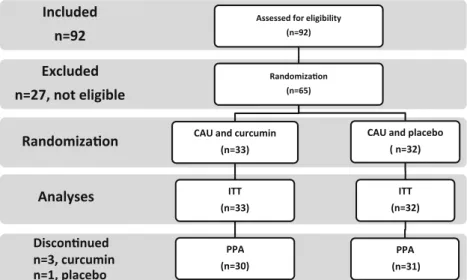
RandomizaƟon Excluded
n=27, not eligible Included
n=92
Assessed for eligibility (n=92)
RandomizaƟon (n=65)
CAU and curcumin (n=33)
ITT (n=33)
PPA (n=30)
CAU and placebo ( n=32)
ITT (n=32)
PPA (n=31)
DisconƟnued n=3, curcumin n=1, placebo
Analyses Fig. 1 CONSORT flow diagram.
Procedures
Randomization
Curcumin was supplied by the Government Pharmaceutical Organization (GPO), Bangkok, Thailand. Curcumin was de-livered in 250-mg capsules together with indistinguishable placebo capsules. The GPO compound preparation consisted of curcuminoids 100%, namely curcumin 77%, demethoxy-curcumin 17%, and bisdemethoxydemethoxy-curcumin 6%. The trial pharmacist labeled the 250-mg curcumin capsules, which were identical in appearance as the placebo (cellulose) cap-sules, by code numbers and packed the capsules in identical containers. Curcumin was used at a dose of 500–1500 mg/day. At baseline, patients were directed to take one capsule, 250 mg curcumin, or indistinguishable placebo twice a day, one before breakfast and one before dinner for 1 week. After this, they were asked to increase the dose every week by 250 mg/day (before breakfast or dinner). Thus, after 4 weeks (t4), patients were taking 1500 mg curcumin/day or placebo. Patients were randomly and equally assigned to treatment with curcumin or placebo in a double-blind fashion. A random allocation sequence was performed by the trial pharmacist according to CONSORT guidelines and using a block ran-domization method. The trial pharmacist kept the treatment code double-blinded and supplied the trial medication to the outpatient clinic and clinical psychiatrist. Returned medica-tion containers were audited to measure medicamedica-tion compli-ance and checked with volunteer-reported pill count at t4, t8, and t12. As such, patients were randomized in two treatment groups: (a) the active intervention group treated with curcumin + care as usual and (b) the control group treated with placebo and care as usual.
Assessments
Assessments were made by the principal investigator, a senior clinical psychiatrist (BK) and a research psychologist (ST), using semistructured interviews. At baseline (t0) socio-demographic (including age, sex, education, social status, in-come) and clinical (including age at onset, smoking behavior, use of antidepressants) data were collected by BK, while the research psychologist (ST) scored two efficacy measurements, namely the MADRS (primary outcome measurement) (Montgomery and Asberg 1979) and Hamilton Anxiety Rating Scale (HAM-A) (secondary outcome measurement; Hamilton1959) rating scales. The same rater (ST) completed the MADRS and HAM-A at baseline (t0) and weeks 2 (t2), 4 (t4), 8 (t8), 12 (t12), and 16 (t16, namely 4 weeks after dis-continuation of treatment). At t2, t4, t8, t12, and t16, BK also measured putative treatment-related adverse effects (see Table4for the adverse effects rated in this study). In addition, BK recorded any other treatment-emergent adverse events,
defined as newly emerging side effects or adverse effects worsening the pretreatment status. At t0, we measured body mass index (BMI) as weight (kg) / squared length (meters).
Biological Measurements
Fasting blood samples were taken at 8.00–8.30 a.m. at t0 and t12 for the assay of WBCs, platelets, Hct, Hb, creatinine, AST, ALT, AlkP, TBil, DBil, and BUN. ECG measurements were performed to assess heart rate and PR and QRS intervals. The number of WBCs, platelets, Hct, and Hb was assayed by the Central Laboratory, Department of Laboratory Medicine, King Chulalongkorn Memorial Hospital, Bangkok, Thailand, using the MindRay-BC-6800 (Auto Hematology Analyzer; Nanshan, Shenzhen 518057, People’s Republic of China). Creatinine, AST, ALT, AlkP, TBil, DBil, and BUN were assayed by the clinical biochemistry laboratory of the same university hospital using the Architect C16000 (Abbott Laboratories, Abbott Park, IL, USA). All inter-assay CV values were < 5.7%. Resting ECG measurements, including PR and QRS interval, were measured using the electrocardio-graph ECG-2250 (Nihon Kohden, Irvine, CA, USA).
Statistics
ideation and current smoking. This statistical method al-lows us to control for the effects of relevant covariates and interactions when examining treatment effects at the sub-ject level, while minimizing biased imputations due to in-complete assessments. Adverse effects were compared be-tween the two treatment groups at t2, t4, t8, t12, and t16 using the phi coefficient for nominal by nominal data. The differences in the sums of all positive adverse effects be-tween curcumin and placebo were examined using a LMM repeated measures analysis including a fixed categorical effect of treatment, assessment time, time-by-treatment in-teraction, sex and sex-by-treatment inin-teraction, care as usual groups, use of clonazepam and clorazepate, and one continuous fixed covariate, namely age. Differences in blood assays and ECG measurements between t0 and t12 were examined using repeated measurement design ANOVAs with blood assays or ECG measurements as de-pendent variables and the time-by-treatment interaction as outcome variable (including other effects as described above). Tests were two-tailed and ap value of 0.05 was used for statistical significance. All statistical analyses were performed using IBM SPSS Windows version 22. Statistical analyses were conducted in accordance with the International Conference on Harmonisation E9 statisti-cal principles (November 2005). Using a two-tailed test at α= 0.05 and assuming a power of 0.80 and an effect size of
0.48, it is indicated that the required sample size is around 130 participants and therefore the protocol included 130 subjects. Unfortunately, the study was stopped before we were able to recruit 130 participants because grant support was limited in time. Therefore, no new patients could be randomized, although enrolled patients completed the study.
Results
CONSORT Flow Diagram
Figure1shows the CONSORT flow diagram with the prog-ress of the patients through the RCT. Of the 92 patients in-cluded in the study, 12 cases were exin-cluded because of abnor-mal baseline blood tests or because they did not have a t0 MDRS > 20, while 15 patients declined to participate in the study, most of them being unable to follow the study schedule for practical reasons. Therefore, 65 patients were randomized to enter the study and were treated with care as usual and curcumin or placebo. One patient belonging to the placebo group and three patients allocated to the active intervention group discontinued the study. Finally, 61 patients completed the study without any violations of the study protocol. Accordingly, we analyzed data of 33 participants treated with curcumin and 32 with placebo using a classical ITT analysis
and 30 participants treated with curcumin and 31 with placebo using a PPA, with ITT and PPA showing similar results. Here we show the ITT results.
Baseline Characteristics of the Curcumin and Placebo
Treatment Groups
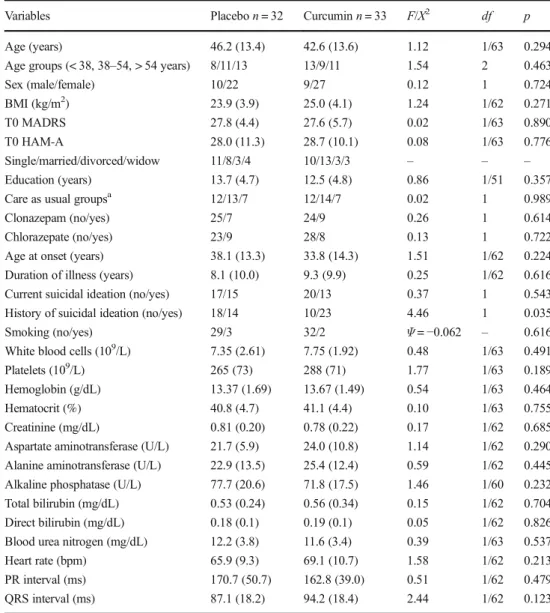
Table 1 compares the socio-demographic and clinical data between the curcumin and placebo group. We found no sig-nificant differences between both treatment groups in age, sex, BMI, education, t0 MADRS, t0 HAM-A, care as usual, clo-nazepam, chlorazepate, age at onset of illness, duration of illness, smoking, or current suicidal ideation, although there was a modest difference in past suicidal ideation. There were no significant differences in any of the blood measurements, heart rate, and PR and QRS intervals between patients treated with curcumin versus placebo.
Effects of Curcumin on MADRS
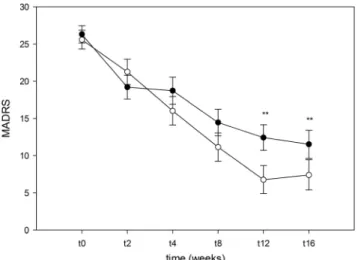
Table2(LMM no. 1) shows the outcome of the primary LMM analysis with MADRS as dependent variable and treatment, assessment time (t2, t4, t8, t12, and t16), time-by-treatment interaction, sex, sex-by-treatment and sex-by-treatment-by-time interactions, care as usual groups, use of clonazepam, and use of chlorazepate as fixed categorical effects and t0 MADRS and age and age at onset as continuous fixed covar-iates. We found significant effects of trial drugs (mean ± SE MADRS in placebo = 14.8 ± 1.1 versus curcumin 12.6 ± 1.3), t0 MADRS, time, time-by-treatment, and sex-by-treatment. Figure2displays that curcumin treatment induces an improve-ment in MADRS score over time from t0 to t12 and that it is maintained at t16. We reran the same analysis but without care as usual groups, use of clonazepam and clorazepate, and age at onset and found similar results. LMM no. 4 and no. 5 show a significant effect of current and past suicidal ideation on MADRS responsivity with higher mean ± SE MADRS values in patient with current (15.3 ± 1.3 versus 12.7 ± 1.2) and past suicidal ideation (15.2 ± 1.2 versus 12.2 ± 1.2) versus those without suicidal ideation. There were no significant effects of suicidal-ideation-by-treatment interaction, age groups (LMM no. 2), BMI (LMM no. 3), or smoking (LMM no. 6) on MADRS responsivity.
The secondary analyses showed the following results. Firstly, repeated measurement design ANOVA (tests for within-subject effects) showed a significant effect of time-by-treatment (F= 2.80,df= 5/105,p= 0.017) but no signifi-cant effects of time-by-sex (F= 0.27,df= 5/15,p= 0.928) or time-by-treatment-by-sex (F= 1.98, df= 5/74, p= 0.082). Secondly, univariate GLM analyses with t0 MADRS as co-variate showed a significantly greater reduction inΔt12–t2 MADRS (means ± SE =−14.1 ± 1.6 versus −8.6 ± 1.6;
± SE =−18.7∀1.8 versus −12.9 ± 1.7; F= 4.67, df= 1/56,
p= 0.035) in patients treated with curcumin versus those treat-ed with placebo. No such differences were detecttreat-ed at the other time points. Nevertheless, introduction of the treatment-by-sex interaction (e.g., forΔt12–t2, t0 covaried) shows significant effects of treatment (F= 10.60, df= 1/54,
p= 0.002) as well as the interaction (F= 4.35,df= 1/54,p= 0.042). Analyses of simple effects showed a significant effect in males (F= 10.42,df= 1/54,p= 0.002) but not in females (F= 1.05,df= 1/54,p= 0.311). In males treated with placebo, the Δ MADRS is −5.1 (± 2.6) and in males treated with curcumin−17.6 (± 2.9), whereas in females treated with pla-cebo, the∆was−10.3 (± 1.83) and in females treated with curcumin−12.9 (± 1.8).
Effects of Curcumin on HAM-A
Table3(LMM no. 1) shows the outcome of a LMM analysis with the HAM-A as a dependent variable. We found signifi-cant effects of time, sex-by-trial drug interaction, and T0 HAM-A. The sex-by-treatment interaction showed that in males, curcumin decreased HAM-A scores more than placebo (mean ± SE HAM-A levels =−9.1 ± 4.4 versus−5.5 ± 3.9), whereas in females, curcumin increased HAM-A scores more than the placebo (mean ± SE HAM-A levels =−4.4 ± 2.8 ver-sus−7.4 ± 2.8). Nevertheless, the secondary statistical tests (including repeated measures GLM and univariate GLM anal-ysis) did not show any significant effects of treatment or sex-by-treatment interactions.
Table 1 Socio-demographic and baseline clinical and biological data in participants allocated to the active intervention (curcumin) and control (placebo) study groups
Variables Placebon= 32 Curcuminn= 33 F/Χ2 df p
Age (years) 46.2 (13.4) 42.6 (13.6) 1.12 1/63 0.294
Age groups (< 38, 38–54, > 54 years) 8/11/13 13/9/11 1.54 2 0.463
Sex (male/female) 10/22 9/27 0.12 1 0.724
BMI (kg/m2) 23.9 (3.9) 25.0 (4.1) 1.24 1/62 0.271
T0 MADRS 27.8 (4.4) 27.6 (5.7) 0.02 1/63 0.890
T0 HAM-A 28.0 (11.3) 28.7 (10.1) 0.08 1/63 0.776
Single/married/divorced/widow 11/8/3/4 10/13/3/3 – – –
Education (years) 13.7 (4.7) 12.5 (4.8) 0.86 1/51 0.357
Care as usual groupsa 12/13/7 12/14/7 0.02 1 0.989
Clonazepam (no/yes) 25/7 24/9 0.26 1 0.614
Chlorazepate (no/yes) 23/9 28/8 0.13 1 0.722
Age at onset (years) 38.1 (13.3) 33.8 (14.3) 1.51 1/62 0.224 Duration of illness (years) 8.1 (10.0) 9.3 (9.9) 0.25 1/62 0.616
Current suicidal ideation (no/yes) 17/15 20/13 0.37 1 0.543
History of suicidal ideation (no/yes) 18/14 10/23 4.46 1 0.035
Smoking (no/yes) 29/3 32/2 Ψ=−0.062 – 0.616
White blood cells (109/L) 7.35 (2.61) 7.75 (1.92) 0.48 1/63 0.491
Platelets (109/L) 265 (73) 288 (71) 1.77 1/63 0.189
Hemoglobin (g/dL) 13.37 (1.69) 13.67 (1.49) 0.54 1/63 0.464
Hematocrit (%) 40.8 (4.7) 41.1 (4.4) 0.10 1/63 0.755
Creatinine (mg/dL) 0.81 (0.20) 0.78 (0.22) 0.17 1/62 0.685
Aspartate aminotransferase (U/L) 21.7 (5.9) 24.0 (10.8) 1.14 1/62 0.290 Alanine aminotransferase (U/L) 22.9 (13.5) 25.4 (12.4) 0.59 1/62 0.445 Alkaline phosphatase (U/L) 77.7 (20.6) 71.8 (17.5) 1.46 1/60 0.232 Total bilirubin (mg/dL) 0.53 (0.24) 0.56 (0.34) 0.15 1/62 0.704 Direct bilirubin (mg/dL) 0.18 (0.1) 0.19 (0.1) 0.05 1/62 0.826 Blood urea nitrogen (mg/dL) 12.2 (3.8) 11.6 (3.4) 0.39 1/63 0.537
Heart rate (bpm) 65.9 (9.3) 69.1 (10.7) 1.58 1/62 0.213
PR interval (ms) 170.7 (50.7) 162.8 (39.0) 0.51 1/62 0.479
QRS interval (ms) 87.1 (18.2) 94.2 (18.4) 2.44 1/62 0.123
All data are shown as mean (±SD)
Fresults of analyses of variance,X2 results of analyses of contingency tables,Ψphi coefficient for nominal by nominal data
a
Putative Adverse Effects
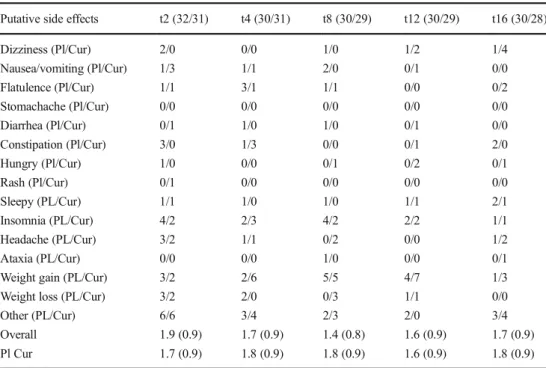
We did not observe any treatment-emergent adverse events. Table4shows putative adverse effects at t2, t4, t8, t12, and t16. There were no significant differences in incidence in any of the side effects between curcumin and placebo at any of the time points using phi coefficient for nominal by nominal data performed at thep= 0.05 level withoutpcorrections. Table4
shows also the total number of possible side effects at the different time points in both patient groups. LMM repeated measures analysis (with treatment, assessment time, time-by-treatment interaction, sex, sex-by-time-by-treatment, and fluoxetine-by-treatment interactions as fixed categorical variables and age as fixed continuous covariate) showed that there were no significant differences in total numbers of possible adverse effects among those treated with curcumin or placebo (F= 0.01,df= 1/262,p= 0.925; mean ± SE for placebo = 1.60 ± 0.13 and for curcumin = 1.59 ± 0.14).
Table5shows the measurements of blood assays and ECG at t0 and t12. Repeated measurement design ANOVAs with blood assays or ECG measurements as dependent variables and the time-by-treatment interaction as primary outcome var-iable showed that there were no significant effects of the in-teraction on any of the blood or ECG variables (not even at the
p= 0.05 levels even without adjustment for multiple testing).
Discussion
The first major finding of this randomized study is that add-on treatment with curcumin significantly improved the MADRS score and that this effect was significant 12 weeks after starting treatment and that, after discontinuation of curcumin, the improvement was maintained 4 weeks later. Importantly, the outcome of the primary LMM and secondary GLM anal-ysis reached the same conclusions thereby increasing confi-dence in the results that curcumin significantly improves pressive symptoms. Moreover, the effects of curcumin on de-pressive symptoms are greater in males than females, although the primary LMM and secondary GLM analyses are not con-cordant with regard to this interaction.
Table 2 Results of Linear Mixed Model (LMM) analyses with MADRS (t2, t4, t8, t12, t16) as dependent variables and treatment modality as primary explanatory variable, while adjusting for age, sex, and other putative confounding variables
LMM Explanatory variables Wald df p
LMM no. 1 Trial drugs 7.52 1/183 0.007
Time 28.80 4/90 < 0.001
Time-by-treatment 3.20 4/90 0.017 Sex-by-treatment 13.69 1/201 < 0.001
Sex 0.88 1/183 0.351
Time-by-sex-by-treatment 1.44 8/90 0.190 T0 MADRS 43.03 1/156 < 0.001
Age 1.65 1/155 0.200
Age at onset 2.54 1/157 0.113
Care-as-usual 1.58 2/156 0.209
Clonazepam 0.68 1/149 0.413
Clorazepate 1.74 1/154 0.189
LMM
No. 2 Age groups (instead of age) 1.45 1/154 0.238
No. 3 BMI 0.04 1/161 0.834
No. 4 Past suicidal ideation 6.07 1/157 0.015 No. 5 Current suicidal ideation 6.59 1/153 0.011
No. 6 Smoking 3.11 1/155 0.080
Table 3 Results of Linear Mixed Model (LMM) analyses with HAM-A (t2, t4, t8, t12, t16) as dependent variables and treatment modality as primary explanatory variable, while adjusting for age, sex, and other putative confounding variables
LMM Explanatory variables Wald df p
LMM no. 1 Trial drugs 0.11 1/202 0.144
Time 5.92 1/86 < 0.001
Time-by-treatment 0.87 1/87 0.488 Sex-by-treatment 10.04 2/219 0.002
Sex 0.00 1/212 0.997
Time-by-sex-by-treatment 0.79 8/86 0.609 T0 HAM-A 120.06 1/201 < 0.001
Age 0.73 1/202 0.238
Age at onset 0.16 1/201 0.393
Care-as-usual 0.16 2/203 0.850
Clonazepam 0.07 1/196 0.795
Clorazepate 0.49 1/199 0.487
The results extend those of previous open-label, single-blind, or double-blind add-on studies indicating that curcumin (500–1000 mg/day) may augment the efficacy of antidepressants (Yu et al. 2015; Panahi et al. 2015; Sanmukhani et al.2014). Our results also extend the results of Lopresti et al. (2014) who reported that monotherapy with curcumin may have antidepressant effects in major depressive disorder as detected by benefits occurring 4 to 8 weeks after starting add-on treatment. More recently, Lopresti and Drummond (2017) reported the outcome of an RCT with four treatment arms in major depressed pa-tients, namely placebo, low-dose curcumin extract
(500 mg/day), higher dose curcumin (1000 mg/day), or combined low-dose curcumin + saffron (30 mg/day). They found that all active curcumin treatments significant-ly improved severity of depression although there were no significant differences between the three active treatment conditions. In another study, Esmaily et al. (2015) reported that monotherapy with curcumin had no significant effects on depression in a 4-week trial performed in obese subjects with depression. Recently, a mini meta-analysis of curcumin treatment in depression showed that curcumin administration significantly reduced depression (Al-Karawi et al. 2016). Another meta-analysis performed on Table 4 List and frequency of
adverse events at different time points in individuals treated with curcumin (Cur) and placebo (Pl)
Putative side effects t2 (32/31) t4 (30/31) t8 (30/29) t12 (30/29) t16 (30/28)
Dizziness (Pl/Cur) 2/0 0/0 1/0 1/2 1/4
Nausea/vomiting (Pl/Cur) 1/3 1/1 2/0 0/1 0/0
Flatulence (Pl/Cur) 1/1 3/1 1/1 0/0 0/2
Stomachache (Pl/Cur) 0/0 0/0 0/0 0/0 0/0
Diarrhea (Pl/Cur) 0/1 1/0 1/0 0/1 0/0
Constipation (Pl/Cur) 3/0 1/3 0/0 0/1 2/0
Hungry (Pl/Cur) 1/0 0/0 0/1 0/2 0/1
Rash (Pl/Cur) 0/1 0/0 0/0 0/0 0/0
Sleepy (PL/Cur) 1/1 1/0 1/0 1/1 2/1
Insomnia (PL/Cur) 4/2 2/3 4/2 2/2 1/1
Headache (PL/Cur) 3/2 1/1 0/2 0/0 1/2
Ataxia (PL/Cur) 0/0 0/0 1/0 0/0 0/1
Weight gain (PL/Cur) 3/2 2/6 5/5 4/7 1/3
Weight loss (PL/Cur) 3/2 2/0 0/3 1/1 0/0
Other (PL/Cur) 6/6 3/4 2/3 2/0 3/4
Overall Pl Cur
1.9 (0.9) 1.7 (0.9)
1.7 (0.9) 1.8 (0.9)
1.4 (0.8) 1.8 (0.9)
1.6 (0.9) 1.6 (0.9)
1.7 (0.9) 1.8 (0.9)
Table 5 Putative side effects of the trial drug on blood tests: results of Repeated
Measurements Design Analyses of Variance (RMA)
Dependent variables t0 t12 Fa Df p
White blood cells (109/L) 7.41 (2.28) 7.21 (2.00) 0.36 1/57 0.552
Platelets (109/L) 275 (73) 265 (58) 1.80 1/57 0.185
Hemoglobin (g/dL) 13.58 (1.62) 13.23 (1.60) 1.02 1/57 0.317
Hematocrit (%) 41.13 (4.60) 40.58 (4.47) 0.01 1/57 0.909
Creatinine (mg/dL) 0.80 (0.22) 0.81 (0.19) 1.13 1/56 0.293
Aspartate aminotransferase (U/L) 22.1 (6.0) 21.5 (5.9) 0.00 1/56 0.980 Alanine aminotransferase (U/L) 23.7 (11.8) 21.4 (11.9) 1.72 1/56 0.195 Alkaline phosphatase (U/L) 72.4 (19.3) 68.4 (23.7) 2.35 1/53 0.134 Total bilirubin (mg/dL) 0.55 (0.31) 0.48 (0.24) 0.28 1/56 0.596 Direct bilirubin (mg/dL) 0.18 (0.09) 0.18 (0.1) 0.38 1/56 0.543 Blood urea nitrogen (mg/dL) 12.1 (3.6) 11.7 (3.7) 0.02 1/57 0.882
Heart rate (bpm) 68.3 (10.1) 66.3 (14.7) 0.01 1/55 0.920
PR interval (ms) 167.6 (50.0) 169.7 (42.9) 0.19 1/55 0.663
QRS interval (ms) 91.2 (19.01) 92.7 (14.6) 1.55 1/55 0.218
a
6 studies and 377 patients showed that curcumin has sig-nificant clinical efficacy in major depression (Ng et al. 2017).
While putative treatment-by-sex interactions, indicating a greater effect on depression in men than women, were not reported in previous studies, our primary outcome LMM anal-yses also found a significant treatment-by-sex interaction ef-fect on the HAM-A. Thus, in men, there is a very modest curcumin effect on the HAM-A, while this effect is reversed in women. Nevertheless, this interaction could not be validat-ed in secondary GLM analyses and thus these results have lower confidence. The meta-analysis by Ng et al. (2017) re-ported that a significant anti-anxiety effect of curcumin was detected in three of the six trials. For example, the 4-week RCT in obese adults showed that curcumin had significantly more efficacy in reducing anxiety than placebo, while there were less pronounced effects on depressive symptoms (Esmaily et al.2015). Lopresti and Drummond (2017) showed that curcumin treatment has anti-anxiety effects, while Lopresti et al. (2014) found a trend toward a significant effect of curcumin on anxiety levels as measured with the another anxiety rating scale. Overall, the effects of curcumin on anx-iety may be less pronounced than its effects on depression.
Lopresti (2017) reviewed the effects of 41 animal studies showing that curcumin administration, oral or intraperitoneal, and alone or in combination with antidepressants, attenuates depressive- and anxiety-like behaviors induced by a variety of stressors, including chronic mild stress, forced swimming test, and administration of glucocorticoids and lipopolysaccha-rides. As reviewed previously, curcumin has a broad spectrum of activities which could explain its clinical efficacy (Maes et al.2012; Kaufmann et al. 2016; Farooqui2016; Lopresti 2017). These activities targeted at the six pathophysiologically guided drug targets described in the introduction comprise: (1) attenuation of activated CMI as indicated by lowered produc-tion of interferon-γand IL-12 and increased IL-10 production; (2) strong anti-inflammatory properties targeting nuclear fac-tor κB (NFκB) and production of pro-inflammatory cyto-kines, including IL-1, IL-6, and IL-17; (3) protection against lipid, protein, and DNA oxidation and increased nitric oxide production thereby attenuating nitro-oxidative and nitrosative stress; (4) enhancing antioxidant defenses through effects on antioxidants and antioxidant enzymes, including HDL functionality-associated enzymes, such as PON1 and LCAT, catalase, glutathioneS-transferase, glutathione, and nuclear factor (erythroid-derived 2)-like 2 (Nrf2); (5) restoring mito-chondrial functions and dynamics; and (6) suppression of neuroprogression by activating neurotrophic effects thereby promoting neuroprotection and neuronal growth, while atten-uating neurotoxic effects of immune and neuro-oxidative pathways including IFNγ-induced activation of indoleamine 2,3-dioxygenase (IDO) and thus the synthesis of neurotoxic TRYCATs (Jeong et al.2009; Jurrmann et al.
2005; Maes et al.2012; Kaufmann et al.2016; Farooqui2016; Lopresti 2017; Banji et al.2013; Ghandadi and Sahebkar 2017; Slyepchenko et al.2016; Ciftci et al.2015; González-Reyes et al.2013; Ganjali et al.2017; Soto-Urquieta et al. 2014; de Oliveira et al.2016). A recent meta-analysis suggests that approved antidepressants decrease peripheral levels of pro-inflammatory cytokines and chemokines although the role of immune activation in treatment responsivity remains un-clear (Köhler et al.2017a,b). Furthermore, available evidence indicates that a subgroup of patients with depression may benefit from anti-inflammatory agents (Köhler et al.2014). The gender-related differences in curcumin responsivity found in the current study could perhaps be explained by sex-related differences in immune functions as reviewed in the introduction. On the other hand, men show increased pro-duction of reactive oxygen species as compared to women, although damage biomarkers do not differ between both sexes (Maes et al.2011a). Future research should consider possible treatment-by-sex interactions on IO&NS biomarkers in asso-ciation with the clinical response.
In humans, there are only few studies that examined bio-marker predictors of a good clinical response to curcumin treatment and the effects of curcumin on these biomarkers. For example, increased levels of plasma endothelin-1 and lep-tin are associated with greater reductions in depression sever-ity in patients treated with curcumin (Lopresti et al.2015). Yu et al. (2015) observed that the clinical activity of curcumin is accompanied by decreases in plasma levels of IL-1β and TNF-αand with increased plasma levels of brain-derived neu-rotrophic factor. These findings suggest that the effects of curcumin may be related to changes in leptin resistance and attenuation of immune-inflammatory and oxidative processes (for which ET-1 is a biomarker) (Lopresti et al.2015; Yu et al. 2015). Future studies should examine the potential antidepres-sant mechanisms of action of curcumin, including its effects on biomarkers of CMI pathways, inflammation, increased ox-idative and nitrosative stress, mitochondrial functions, and neuroprotection. These measurements may also help to clarify the biomarker features of curcumin treatment responders.
suicidal ideation and a history of past suicidal ideation were associated with a lower responsitivity to curcumin, suggesting that when suicidal ideation is present, a more severe patho-physiology may interfere with the clinical response to treat-ment. Previously, it was indeed shown that suicidal ideation in depressed patients is accompanied by increased oxidative stress (Vargas et al.2013). On the other hand, we could not find any significant effects of age at onset of depression, care as usual type (psychotherapy versus SSRIs), current use of benzodiazepines, BMI, and smoking on the responsivity to treatment. Also, part of our patients could be treatment resis-tant at least to an initial treatment. Therefore, future research should examine the effects of curcumin in drug-resistant depression.
In this study, we have also evaluated the safety and tolera-bility of curcumin treatment as well as treatment-emergent side effects. We observed that curcumin when combined with antidepressants is a very safe and well-tolerated treatment without any unwanted reactions or potential side effects, in-cluding diarrhea, upset stomach and nausea, rash, dizziness, ataxia, headache, sleep disorders, or weight gain/loss, while no allergic reactions were observed. Moreover, we could not find any effects of curcumin on blood chemistry and ECG measurements. This extends the meta-analysis results of Ng et al. (2017) reporting that curcumin is safe and well-tolerated in depressed patients.
Another important point is the ideal dosage for curcumin as previous studies investigated doses of 500 to 1000 mg/day for 5–8 weeks, while we used a higher dose for a longer period (up to 1500 mg/day, 12 weeks). Nevertheless, in our study, curcumin dose was increased after week 1 and continued to increase until 4 weeks later. Therefore, we cannot conclude whether an increase in curcumin dose was necessary to obtain a maximal response at week 12. Another limitation of curcumin is its poor oral bioavailability and short retention time in the body due to its rapid breakdown in the liver (Ng et al.2017; Hewlings and Kalman2017). Therefore, curcumin is often combined with piperine or formulated as a patented combination of curcuminoids and turmeric essential oils (Ng et al.2017). As a consequence, there are unresolved concerns surrounding the use of curcumin with regard to appropriate dose, duration of effect, and effects of variation in preparations.
A limitation of the study is that we had to stop the study earlier than planned after randomizing 50% of the computed sample size. A recent systematic review and meta-regression analysis shows that early termination of RCTs may overesti-mate clinical efficacy in trials stopped early for benefit (Bassler et al.2010). Nevertheless, we did not stop the study based on early beneficial treatment effects of the trial drug. Truncated trials stopped for reasons that are independently of the clinical findings are unlikely to introduce bias in the results (Psaty and Rennie2003). The sample size was rather small
and did not achieve adequate power. Most available clinical trials on curcumin are also hampered by small sample sizes. In addition, we did not collect data on treatments received during previous episodes.
In conclusion, curcumin was significantly more effective than placebo in improving depressive symptoms in major de-pression with significant differences between curcumin and placebo at weeks 12 and 16. A greater efficacy of curcumin is found in males as compared with females. The effects of curcumin on anxiety rating are less clear. There are no signif-icant differences in safety and tolerability between curcumin treatment and placebo, while no treatment-emergent side ef-fects were registered.
Acknowledgements This research has been supported by the Agricultural Research Developmental Agency (ARDA), Bangkok, Thailand. The funding agency played no role in dada reporting. The authors would like to thank Supaksorn Thika (ST) for her valuable help completing the rating scales.
Author’s Contributions All the contributing authors have participated in the manuscript. BK and MM designed the study. BK recruited patients and completed diagnostic interviews. All authors contributed to interpre-tation of the data and writing of the manuscript. MM carried out the statistical analyses.
Compliance with Ethical Standards
Conflict of Interest The authors have no conflict of interest with any commercial or other association in connection with the submitted article.
References
Al-Karawi D, Al Mamoori DA, Tayyar Y (2016) The role of curcumin administration in patients with major depressive disorder: Mini meta-analysis of clinical trials. Phytother Res 30(2):175–183.
https://doi.org/10.1002/ptr.5524
Anderson G, Maes M (2014) TRYCAT pathways link peripheral inflam-mation, nicotine, somatization and depression in the etiology and course of Parkinson's disease. CNS Neurol Disord Drug Targets 13(1):137–149.https://doi.org/10.2174/18715273113129990082
Banji D, Banji OJ, Dasaroju S, Kranthi KC (2013) Curcumin and piperine abrogate lipid and protein oxidation induced by D-galactose in rat brain. Brain Res 1515:1–11.https://doi.org/10.1016/j.brainres.2013. 03.023
Bilici M, Efe H, Köroğlu MA, Uydu HA, Bekaroğlu M, Değer O (2001) Antioxidative enzyme activities and lipid peroxidation in major de-pression: alterations by antidepressant treatments. J Affect Disord 64(1):43–51.https://doi.org/10.1016/S0165-0327(00)00199-3
Bortolasci CC, Vargas HO, Souza-Nogueira A, Barbosa DS, Moreira EG, Nunes SO, Berk M, Dodd S, Maes M (2014) Lowered plasma par-aoxonase (PON)1 activity is a trait marker of major depression and PON1 Q192R gene polymorphism-smoking interactions differen-tially predict the odds of major depression and bipolar disorder. J Affect Disord 159:23–30.https://doi.org/10.1016/j.jad.2014.02.018
Carvalho AF, Berk M, Hyphantis TN, McIntyre RS (2014) The integra-tive management of treatment-resistant depression: a comprehensive review and perspectives. Psychother Psychosom 83(2):70–88.
https://doi.org/10.1159/000357500
Ciftci G, Aksoy A, Cenesiz S, Sogut MU, Yarim GF, Nisbet C, Guvenc D, Ertekin A (2015) Therapeutic role of curcumin in oxidative DNA damage caused by formaldehyde. Microsc Res Tech 78(5):391–395.
https://doi.org/10.1002/jemt.22485
de Melo LGP, Nunes SOV, Anderson G, Vargas HO, Barbosa DS, Galecki P, Carvalho AF, Maes M (2017) Shared metabolic and im-mune-inflammatory, oxidative and nitrosative stress pathways in the metabolic syndrome and mood disorders. Prog Neuro-Psychopharmacol Biol Psychiatry 78:34–50. https://doi.org/10. 1016/j.pnpbp.2017.04.027
de Oliveira MR, Jardim FR, Setzer WN, Nabavi SM, Nabavi SF (2016) Curcumin, mitochondrial biogenesis, and mitophagy: exploring re-cent data and indicating future needs. Biotechnol Adv 34(5):813– 826.https://doi.org/10.1016/j.biotechadv.2016.04.004
Esmaily H, Sahebkar A, Iranshahi M, Ganjali S, Mohammadi A, Ferns G, Ghayour-Mobarhan M (2015) An investigation of the effects of curcumin on anxiety and depression in obese individuals: a random-ized controlled trial. Chin J Integr Med 21(5):332–338.https://doi. org/10.1007/s11655-015-2160-z
Farooqui AA (2016) Therapeutic potentials of curcumin for Alzheimer disease. Springer, Berlin. https://doi.org/10.1007/978-3-319-15889-1
Gałecki P, Gałecka E, Maes M, Chamielec M, Orzechowska A, Bobińska K, Lewiński A, Szemraj J (2012) The expression of genes encoding for COX-2, MPO, iNOS, and sPLA2-IIA in patients with recurrent depressive disorder. J Affect Disord 138(3):360–366.https://doi. org/10.1016/j.jad.2012.01.016
Ganjali S, Blesso CN, Banach M, Pirro M, Majeed M, Sahebkar A (2017) Effects of curcumin on HDL functionality. Pharmacol Res 119:208– 218.https://doi.org/10.1016/j.phrs.2017.02.008
Ghandadi M, Sahebkar A (2017) Curcumin: an effective inhibitor of interleukin-6. Curr Pharm Des 23(6):921–931.https://doi.org/10. 2174/1381612822666161006151605
Gomes C, Martinho FC, Barbosa DS, Antunes LS, Póvoa HCC, Baltus THL, Morelli NR, Vargas HO, Nunes SOV, Anderson G, Maes M (2017) Increased root canal endotoxin levels are associated with chronic apical periodontitis, increased oxidative and nitrosative stress, major depression, severity of depression, and a lowered qual-ity of life. Mol Neurobiol. https://doi.org/10.1007/s12035-017-0545-z
González-Reyes S, Guzmán-Beltrán S, Medina-Campos ON, Pedraza-Chaverri J (2013) Curcumin pretreatment induces Nrf2 and an anti-oxidant response and prevents hemin-induced toxicity in primary cultures of cerebellar granule neurons of rats. Oxidative Med Cell 2013:801418
Hamilton M (1959) The assessment of anxiety states by rating. Br J Med Psychol 32(1):50–55.https://doi.org/10.1111/j.2044-8341.1959. tb00467.x
Hewlings SJ, Kalman DS (2017) Curcumin: a review of Its’effects on human health. Foods 6(10).https://doi.org/10.3390/foods6100092
Howren MB, Lamkin DM, Suls J (2009) Associations of depression with C-reactive protein, IL-1, and IL-6: a meta-analysis. Psychosom Med 71(2):171–186.https://doi.org/10.1097/PSY.0b013e3181907c1b
Jeong YI, Kim SW, Jung ID, Lee JS, Chang JH, Lee CM, Chun SH, Yoon MS, Kim GT, Ryu SW, Kim JS, Shin YK, Lee WS, Shin HK, Lee JD, Park YM (2009) Curcumin suppresses the induction of indoleamine 2,3-dioxygenase by blocking the Janus-activated ki-nase-protein kinase Cdelta-STAT1 signaling pathway in interferon-gamma-stimulated murine dendritic cells. J Biol Chem 284(6): 3700–3708.https://doi.org/10.1074/jbc.M807328200
Jurrmann N, Brigelius-Flohé R, Böl GF (2005) Curcumin blocks interleukin-1 (IL-1) signaling by inhibiting the recruitment of the IL-1 receptor-associated kinase IRAK in murine thymoma EL-4 cells. J Nutr 135(8):1859–1864
Kaufmann FN, Gazal M, Bastos CR, Kaster MP, Ghisleni G (2016) Curcumin in depressive disorders: an overview of potential mecha-nisms, preclinical and clinical findings. Eur J Pharmacol 784:192– 198.https://doi.org/10.1016/j.ejphar.2016.05.026
Kittirathanapaiboon P, Khamwongpin M (2005) The validity of the Mini International Neuropsychiatric Interview (M.I.N.I.) Thai version. Suanprung Hospital, Department of Mental Health
Köhler O, Benros ME, Nordentoft M, Farkouh ME, Iyengar RL, Mors O, Krogh J (2014) Effect of anti-inflammatory treatment on depression, depressive symptoms, and adverse effects: a systematic review and meta-analysis of randomized clinical trials. JAMA Psychiatry 71(12):1381–1391.https://doi.org/10.1001/jamapsychiatry.2014. 1611
Köhler CA, Freitas TH, Maes M, de Andrade NQ, Liu CS, Fernandes BS, Stubbs B, Solmi M, Veronese N, Herrmann N, Raison CL, Miller BJ, Lanctôt KL, Carvalho AF (2017a) Peripheral cytokine and che-mokine alterations in depression: a meta-analysis of 82 studies. Acta Psychiatr Scand 135(5):373–387.https://doi.org/10.1111/acps. 12698
Köhler CA, Freitas TH, Stubbs B, Maes M, Solmi M, Veronese N, de Andrade NQ, Morris G, Fernandes BS, Brunoni AR, Herrmann N, Raison CL, Miller BJ, Lanctôt KL, Carvalho AF (2017b) Peripheral alterations in cytokine and chemokine levels after antidepressant drug treatment for major depressive disorder: systematic review and meta-analysis. Mol Neurobiol. https://doi.org/10.1007/s12035-017-0632-1
Leonard B, Maes M (2012) Mechanistic explanations how cell-mediated immune activation, inflammation and oxidative and nitrosative stress pathways and their sequels and concomitants play a role in the pathophysiology of unipolar depression. Neurosci Biobehav Rev 36(2):764–785.https://doi.org/10.1016/j.neubiorev.2011.12.005
Liu Y, Ho RC, Mak A (2012) Interleukin (IL)-6, tumour necrosis factor alpha (TNF-α) and soluble interleukin-2 receptors (sIL-2R) are ele-vated in patients with major depressive disorder: a meta-analysis and meta-regression. J Affect Disord 139(3):230–239.https://doi.org/ 10.1016/j.jad.2011.08.003
Liu T, Zhong S, Liao X, Chen J, He T, Lai S, Jia Y (2015) A meta-analysis of oxidative stress markers in depression. PLoS One 10(10):e0138904.https://doi.org/10.1371/journal.pone.0138904
Lopresti AL (2017) Curcumin for neuropsychiatric disorders: a review of in vitro, animal and human studies. J Psychopharmacol 31(3):287– 302.https://doi.org/10.1177/0269881116686883
Lopresti AL, Drummond PD (2017) Efficacy of curcumin, and a saffron/ curcumin combination for the treatment of major depression: a randomised, double-blind, placebo-controlled study. J Affect Disord 207:188–196.https://doi.org/10.1016/j.jad.2016.09.047
Lopresti AL, Maes M, Maker GL, Hood SD, Drummond PD (2014) Curcumin for the treatment of major depression: a randomised, dou-ble-blind, placebo controlled study. J Affect Disord 167:368–375.
https://doi.org/10.1016/j.jad.2014.06.001
Lopresti AL, Maes M, Meddens MJ, Maker GL, Arnoldussen E, Drummond PD (2015) Curcumin and major depression: a randomised, double-blind, placebo-controlled trial investigating the potential of peripheral biomarkers to predict treatment response a n d a n t i d e p r e s s a n t m e c h a n i s m s o f c h a n g e . E u r Neuropsychopharmacol 25(1):38–50. https://doi.org/10.1016/j. euroneuro.2014.11.015
Maes M (1995) Evidence for an immune response in major depression: a review and hypothesis. Prog Neuro-Psychopharmacol Biol Psychiatry 19(1):11–38. https://doi.org/10.1016/0278-5846(94) 00101-M
Maes M (2005) Van Freud tot omega-3, 2005. Standaard Uitgeverij, Antwerpen, 240 pagina's, 9789002214813
Maes M (2008) The cytokine hypothesis of depression: inflammation, oxidative & nitrosative stress (IO&NS) and leaky gut as new targets for adjunctive treatments in depression. Neuro Endocrinol Lett 29(3):287–291
Maes M, Bosmans E, Suy E, Vandervorst C, De Jonckheere C, Raus J (1990) Immune disturbances during major depression: upregulated expression of interleukin-2 receptors. Neuropsychobiology 24(3): 115–120.https://doi.org/10.1159/000119472
Maes M, Delanghe J, Meltzer HY, Scharpé S, D'Hondt P, Cosyns P (1994) Lower degree of esterification of serum cholesterol in depres-sion: relevance for depression and suicide research. Acta Psychiatr Scand 90(4):252–258.https://doi.org/10.1111/j.1600-0447.1994. tb01589.x
Maes M, Smith R, Christophe A, Vandoolaeghe E, Van Gastel A, Neels H, Demedts P, Wauters A, Meltzer HY (1997) Lower serum high-density lipoprotein cholesterol (HDL-C) in major depression and in depressed men with serious suicidal attempts: relationship with immune-inflammatory markers. Acta Psychiatr Scand 95(3):212– 221
Maes M, Christophe A, Delanghe J, Altamura C, Neels H, Meltzer HY (1999) Lowered omega3 polyunsaturated fatty acids in serum phos-pholipids and cholesteryl esters of depressed patients. Psychiatry Res 85(3):275–291. https://doi.org/10.1016/S0165-1781(99) 00014-1
Maes M, De Vos N, Pioli R, Demedts P, Wauters A, Neels H, Christophe A (2000) Lower serum vitamin E concentrations in major depres-sion. Another marker of lowered antioxidant defenses in that illness. J Affect Disord 58(3):241–246. https://doi.org/10.1016/S0165-0327(99)00121-4
Maes M, Yirmyia R, Noraberg J, Brene S, Hibbeln J, Perini G, Kubera M, Bob P, Lerer B, Maj M (2009) The inflammatory & neurodegener-ative (I&ND) hypothesis of depression: leads for future research and new drug developments in depression. Metab Brain Dis 24(1):27– 53.https://doi.org/10.1007/s11011-008-9118-1
Maes M, Galecki P, Chang YS, Berk M (2011a) A review on the oxida-tive and nitrosaoxida-tive stress (O&NS) pathways in major depression and their possible contribution to the (neuro)degenerative processes in that illness. Prog Neuro-Psychopharmacol Biol Psychiatry 35(3): 676–692.https://doi.org/10.1016/j.pnpbp.2010.05.004
Maes M, Leonard BE, Myint AM, Kubera M, Verkerk R (2011b) The new '5-HT' hypothesis of depression: cell-mediated immune activa-tion induces indoleamine 2,3-dioxygenase, which leads to lower plasma tryptophan and an increased synthesis of detrimental trypto-phan catabolites (TRYCATs), both of which contribute to the onset of depression. Prog Neuro-Psychopharmacol Biol Psychiatry 35(3): 702–721
Maes M, Mihaylova I, Kubera M, Leunis JC, Geffard M (2011c) IgM-mediated autoimmune responses directed against multiple neoepitopes in depression: new pathways that underpin the
inflammatory and neuroprogressive pathophysiology. J Affect Disord 135(1–3):414–418.https://doi.org/10.1016/j.jad.2011.08. 023
Maes M, Fišar Z, Medina M, Scapagnini G, Nowak G, Berk M (2012) New drug targets in depression: inflammatory, cell-mediated im-mune, oxidative and nitrosative stress, mitochondrial, antioxidant, and neuroprogressive pathways. And new drug candidates–Nrf2 activators and GSK-3 inhibitors. Inflammopharmacology 20(3): 127–150.https://doi.org/10.1007/s10787-011-0111-7
Montgomery SA, Asberg M (1979) A new depression scale designed to be sensitive to change. Brit J Psychiatry 134(4):382–389.https://doi. org/10.1192/bjp.134.4.382
Moylan S, Maes M, Wray NR, Berk M (2013) The neuroprogressive nature of major depressive disorder: pathways to disease evolution and resistance, and therapeutic implications. Mol Psychiatry 18(5): 595–606.https://doi.org/10.1038/mp.2012.33
Ng QX, Koh SSH, Chan HW, Ho CYX (2017) Clinical use of curcumin in depression: a meta-analysis. J Am Med Dir Assoc 18(6):503–508.
https://doi.org/10.1016/j.jamda.2016.12.071
Panahi Y, Badeli R, Karami GR, Sahebkar A (2015) Investigation of the efficacy of adjunctive therapy with bioavailability-boosted curcumi-noids in major depressive disorder. Phytother Res 29(1):17–21.
https://doi.org/10.1002/ptr.5211
Peet M, Murphy B, Shay J, Horrobin D (1998) Depletion of omega-3 fatty acid levels in red blood cell membranes of depressive patients. Biol Psychiatry 43(5):315–319. https://doi.org/10.1016/S0006-3223(97)00206-0
Psaty BM, Rennie D (2003) Stopping medical research to save money: a broken pact with researchers and patients. JAMA 289(16):2128– 2131.https://doi.org/10.1001/jama.289.16.2128
Rizavi HS, Ren X, Zhang H, Bhaumik R, Pandey GN (2016) Abnormal gene expression of proinflammatory cytokines and their membrane-bound receptors in the lymphocytes of depressed patients. Psychiatry Res 240:314–320.https://doi.org/10.1016/j.psychres. 2016.04.049
Roomruangwong C, Barbosa DS, Matsumoto AK, Nogueira AS, Kanchanatawan B, Sirivichayakul S, Carvalho AF, Duleu S, Geffard M, Moreira EG, Maes M (2017) Activated neuro-oxidative and neuro-nitrosative pathways at the end of term are associated with inflammation and physio-somatic and depression symptoms, while predicting outcome characteristics in mother and baby. J Affect Disord 223:49–58.https://doi.org/10.1016/j.jad.2017. 07.002
Sanmukhani J, Satodia V, Trivedi J, Patel T, Tiwari D, Panchal B, Goel A, Tripathi CB (2014) Efficacy and safety of curcumin in major depres-sive disorder: a randomized controlled trial. Phytother Res 28(4): 579–585.https://doi.org/10.1002/ptr.5025
Sheehan DV, Lecrubier Y, Sheehan KH, Amorim P, Janavs J, Weiller E et al (1998) The Mini-International Neuropsychiatric Interview (M.I.N.I.): the development and validation of a structured diagnostic psychiatric interview for DSM-IV and ICD-10. J Clin Psychiatry 59(Suppl 20):22–23
Slyepchenko A, Maes M, Köhler CA, Anderson G, Quevedo J, Alves GS, Berk M, Fernandes BS, Carvalho AF (2016) T helper 17 cells may drive neuroprogression in major depressive disorder: proposal of an integrative model. Neurosci Biobehav Rev 64:83–100.https:// doi.org/10.1016/j.neubiorev.2016.02.002
Sobczak S, Honig A, Christophe A, Maes M, Helsdingen RW, De Vriese SA, Riedel WJ (2004) Lower high-density lipoprotein cholesterol and increased omega-6 polyunsaturated fatty acids in first-degree relatives of bipolar patients. Psychol Med 34(1):103–112.https:// doi.org/10.1017/S0033291703001090
peroxidation in liver and kidneys of diabetic db/db mice. Biol Res 47(1):74.https://doi.org/10.1186/0717-6287-47-74
Tsuboi H, Tatsumi A, Yamamoto K, Kobayashi F, Shimoi K, Kinae N (2006) Possible connections among job stress, depressive symp-toms, lipid modulation and antioxidants. J Affect Disord 91(1):63– 70.https://doi.org/10.1016/j.jad.2005.12.010
Valkanova V, Ebmeier KP, Allan CL (2013) CRP, IL-6 and depression: a systematic review and meta-analysis of longitudinal studies. J Affect Disord 150(3):736–744.https://doi.org/10.1016/j.jad.2013.06.004
Vargas HO, Nunes SO, Pizzo de Castro M, Bortolasci CC, Sabbatini Barbosa D, Kaminami Morimoto H, Venugopal K, Dodd S, Maes M, Berk M (2013) Oxidative stress and lowered total antioxidant status are associated with a history of suicide attempts. J Affect Disord 150(3):923–930.https://doi.org/10.1016/j.jad.2013.05.016