184
Rev Bras Psiquiatr 2003;25(3):184-7
Background: mood disorders and the need for novel therapies
Major depression and bipolar disorder are serious illnesses that combined may afflict as many as 10 to 15% of the popula-tion. These disorders are associated with substantial costs to individuals, their families and society through suicide, lost pro-ductivity, and elevated rates of service utilization. Depression and bipolar disorder have been ranked first and sixth as world-wide causes of disability adjusted life years (DALYs) among people ages 15 to 44.1 Despite advances in psychotherapies, pharmacotherapy and other biological approaches, the treat-ments for these elusive illnesses continue to hit multiple stum-bling blocks. With limited efficacy, frequent side effects, and poor adherence affecting many patients, the need for novel pharmacological approaches to the treatment of these debili-tating illnesses is a priority area for research.
Present medication regiments for depression have limited efficacy. As a class, the Serotonin Selective Reuptake Inhibi-tors (SSRI’s) are the most widely prescribed, yet reduce depressives symptoms by 50% in less than half of patients who start them, and by less than 60% of those who complete a full course.2 Other antidepressants, such as the tricyclic antidepres-sants and norepinephrine reuptake inhibitors have similar over-all efficacy. It has also been demonstrated that in clinical trials, close to 30% of patients will stop treatment, due to limited
atualização
Omega-3 fatty acids in mood disorders: an overview
Omega-3 em transtornos do humor: revisão
Christopher Young and Andrés Martin
Child Study Center. Yale University School of Medicine. New Haven, Connecticut, USA
None financial support and conflict of interests. Received on 7/11/2002. Approved on 4/6/2003.
This review addresses the potential role of omega-3 fatty acids in mood disorders, from the biochemical rationale for their use to the growing body of data supporting their clinical efficacy.
Omega-3. Mood disorders. Treatment.
Essa revisão aborda o papel potencial que o ácido graxo Omega-3 tem no tratamento dos transtornos do humor. Parte da fundamentação bioquímica para o corpo de evidências que tem sustentado a eficácia clínica desse procedimento.
Omega-3. Transtornos do humor. Tratamento. Abstract
Keywords
Resumo
Descritores
efficacy, troublesome side effects, or a combination of both. Similarly, standard treatments of bipolar disorder have lim-ited efficacy and are fraught with potential adverse events. Lithium, a major break through treatment, has been associated with a 20-40% rate of treatment failure. For rapid cycling and mixed episodes, a presentation more common in youth, the failure rates may be even higher. A high incidence of tremor, thyroid dysfunction, polyuria, weight gain and acne can lead to low rates of adherence. Valproate has also demonstrated ef-ficacy in the acute treatment and management of bipolar disor-der, with one study showing as many as 48% of individuals experiencing marked improvement in bipolar symptoms. The agent is likely more effective than lithium for the treatment of mixed and rapid cycling states, yet like all other mood stabiliz-ers, it is associated with potentially serious side effects. Tremor, gastrointestinal distress, hair thinning, hepatitis, pancreatitis and weight gain are some of the potential side effects that ef-fect patient compliance. Additionally, these mood stabilizers require monitoring of blood levels and specific tests to track liver, thyroid and renal function. With refractory forms of both major depression and bipolar disorder often requiring augmen-tation strategies and polypharmacy, there is a clear need for novel, safe and effective treatment alternatives.
185 Omega 3 fatty acids in mood disorders Young C & Martin A
Rev Bras Psiquiatr 2003;25(3):184-7
and the exploration of newer biological treatments such as transcranial magnetic stimulation, vagal nerve stimulation and bright light therapy continues. The focus of this article will be to review the potential contribution of an essential dietary sub-stance, omega-3 fatty acids, in the armamentarium of potential treatments for the mood disorders.
Something fishy: a dietary connection?
Lipids, which comprise roughly 60% of the solid mass of the brain, are essential for normal brain structure and function. The majority of lipids are phospholipids made up of an unsaturated fatty acid attached to a 3-carbon glycerol structure. Within this configuration, the two most common types of unsaturated fatty acids are omega-3 and omega-6. The main omega-3 fatty acid is docosahexaenoic acid, and the main omega-6 fatty acid is arachidonic acid, respectively touted in the lay press as ‘good’ and ‘bad’ fats. Both of these fatty acids are essential substances, meaning that they can not be manufactured in the body and so must be ingested through food sources. The omega-3’s typi-cally come from fish such as salmon, cod, and tuna, as well as from flax seed oil and some nuts. By comparsion, omega-6’s are primarily found in vegetable oils, like those derived from corn or sunflower seed.
It has been suggested that changes in the refining processes of foods, as well as the process of cultural dietary selection, particularly in industrialized nations, has led to a decrease in the consumption of omega-3 fatty acids, with a corresponding relative increase in the consumption of omega-6 fatty acids. The ensuing elevated ratio of omega-6 to omega-3 fatty acids is thought to be linked to increased production of inflamma-tory cytokines, changes in turn associated to medical and psy-chiatric disorders at least partly mediated through chronic in-flammatory changes. Taken together, these dietary changes as etiologically relevant factors have been referred to as the phos-pholipid deficiency hypothesis.
Within the central nervous system, phospholipids that are composed of omega-3 and omega-6 fatty acids have important functions in neuronal signal transduction, as in nerve cell mem-brane integrity and fluidity. These roles allow for the position-ing and function of proteins such as neurotransmitter receptors and protein kinases, both of which are vital for cell signaling systems. The correct balance of omega-3 and omega-6 fatty acids within phospholipids is ultimately essential for normal neuronal function. Research has indicated that a disrupted bal-ance of these fatty acids within the phospholipid structures may be linked to depression.
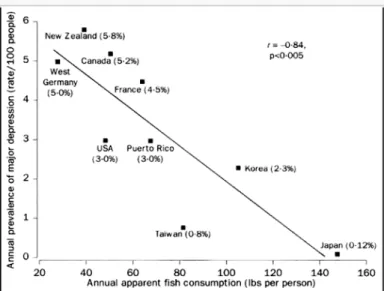
The annual prevalence of major depression is reported to vary as much as 60-fold across nations. Some investigators have noted a similar cross-national pattern in mortality rates by coronary artery disease (CAD). Citing the established rela-tionship of CAD to dietary factors, similar cross-national pat-terns of CAD and depression have led to the suggestion that dietary risk factors may be of significance in depression.3
Epidemiological studies examining the dietary habits of sev-eral countries have noted that places with higher rates of omega-3 consumption, where fish is a core part of the diet, have lower
rates of depressive disorders.4 Indirect evidence from dietary research has further demonstrated a lowering of omega-3 fatty acids in Western diets over the past century in comparison to the prior, or to other countries.5 In countries such as Japan, where annual fish consumption rates are close to 150lbs per person, prevalence rates of depression are 0.12%, compared to Germany, where annual fish consumption is less than 30lbs per person and the prevalence rate of depression is 5% (Figure).
A rationale for use: omega-3 mechanisms of action
Depression and suicide have repeatedly been associated with low levels of cerebrospinal fluid 5-hydroxyindolacetic acid (CSF 5-HIAA), a marker of brain serotonin, evidence that par-tially led to the development of the SSRIs. It has also been suggested that abnormal cell membrane fatty acid composi-tion may be associated with depression. For example, low con-centrations of the omega-3 fatty acid docosahexaenoic acid predict low concentrations of CSF 5-HIAA.6
Further studies have looked at omega-3 fatty acids, a crucial component of synaptic cell membranes, by measuring red blood cell membrane fatty acids in a group of depressed patients com-pared to matched healthy control group.7 A negative correla-tion between depressive severity and RBC membrane omega-3 levels has been described.8 Peet et al9 similarly reported on depleted omega-3 fatty acid levels in the red blood cell mem-branes of depressed patients. Among others, Maes et al8 have put forth the theoretical grounds for a connection between fatty acid intake and existing receptor and neurotransmitter theories of depression. This is largely based on changes seen in seroto-nin receptor and function associated with changes in polyun-saturated fatty acids.
Rev Bras Psiquiatr 2003;25(3):184-7
186
Omega 3 fatty acids in mood disorders Young C & Martin A
fects on neuronal signal transduction are through antikindling activity as well as inhibition of the phosphatidylinositol sys-tem.11,12 Kindling, initially proposed as a mechanism in epi-lepsy, refers to a series of minimum stimuli eventually leading to an ‘afterdischarge’ which may then lead in vulnerable brain regions to a seizure.13 Post14 further advanced the theory of kindling to bipolar disorder highlighting similar features be-tween the two disease states, suggesting potential similari-ties in pathophysiology and pharmacology. Omega-3 fatty acids, much like lithium and valproate, have antikindling prop-erties that have been demonstrated in animal models.10,15 Simi-larly, the standard mood stabilizers lithium and valproate have been found to reduce the overactive signaling of the phosphatidylinositol system that has been linked to rapid Ca2+ release and activation of multiple cellular processes associ-ated with mania.16 Finally, in animal models, omega-3 fatty acids have shown modulation and suppression of voltage-gated Ca2+ channels.17,18 The initial idea of using omega-3 fatty acids as mood stabilizers was developed with the knowl-edge of those biochemical mechanisms.5
From theory to clinical application
Bipolar disorder
In a preliminary double-blind, placebo-controlled trial, Stoll et al19 compared omega-3 fatty acids (9.6 g/d) to placebo in addition to usual treatment over a 4-month study period. In survival analysis of the cohort, the patient group treated with additional omega-3 fatty acids had a significantly longer pe-riod of remission than the placebo group. Additionally, the omega-3 treated group performed better on secondary outcome measures. The findings were in fact so robust that the trial was prematurely terminated as it was deemed unethical to with-hold treatment from the placebo group.
Open label experience has been reported as well for a plant-based oil. Flaxseed oil contains a-linolenic acid, a
shorter-chain omega-3 fatty acid, and is more palatable than standard commercial fish oil.20 Stoll et al19 have reported on the ben-efits to 18 of 22 bipolar patients treated with flaxseed oil. Many patients have described mood elevation on flaxseed oil and elected to remain on it as a long term adjunct to their mood stabilizer regimens.
Major depression
A recent, randomized, double-blind, dose-ranging study of the effects of ethyl-eicosapentanoate in 70 patients with on-going depression despite apparently adequate treatment with standard drugs found significant improvements over placebo across three depression scales for the low dose group21 (1 g/ d; in a maintenance study Nemets et al22) found significant benefits from augmentation with omega-3’s in patients with depression already receiving antidepressants. The trial was a four weeks, parallel groups design, where twenty patients participated in the double-blind addition of either placebo or ethyl ester of eicosapentaenoic acid (E-EPA) to ongoing anti-depressant therapy. Six of 10 patients receiving E-EPA had a
greater than 50% drop in Hamilton depression score, while only one of 10 receiving placebo achieved a significant re-duction in Hamilton scores. Few side effects were reported in either of these studies, nor in another of omega-3 use in pa-tients with behavioral disorders.23
In a letter to the editor, Puri et al24 report one of the first cases of omega-3 fatty acids in the successful treatment of uni-polar depression. In their account, a 21 year old male with a 7-year history of unremitting depressive symptoms without re-sponse to antidepressants and augmenting strategies had a posi-tive response to the omega-3 fatty acid eicosapentaenoic acid, as evidenced by a significant Montgomery-Asberg Depression Rating Scale (MADRS) drop from 32 to 0 over one month.
Dosing and monitoring
Dosing has varied over the few studies that have been re-ported. In the placebo-controlled bipolar trial, 9.6 g/d of omega-3 fatty acids were used, while in the Nemets trial augmenting maintenance medications, omega-3’s were dosed at a much lower 2 g/d. Nemets’ group based their decision on anecdotal reports of successful clinical uses at lower doses. In Stoll’s study few people reported side effects, with the most common one being mild gastrointestinal distress characterized by loose stools. In the depression study no relevant side effects were reported, including fishy tastes or sensations. Because of the relatively low potency of the available preparations, a relatively large number of capsules are required daily, a consideration that may affect compliance and provide to be limiting among certain patients – particularly very young or elderly ones.
Comment
In recent years there has been a significant increase in the use of complimentary medical services, including natural treatments, which has outpaced the limited number of rigor-ous trials to support their safety and efficacy.25 With the in-creasing need for new treatments, the omega-3 fatty acids may prove promising as additional agents in the armamen-tarium of treatments for mood disorders. Several factors have come to light in the early stages of their study. Omega-3’s may show benefit for both unipolar depression and bipolar disorder. There also appears to be evidence that their mecha-nism of action may be similar to some other mood stabilizers and anticonvulsant agents that are being studied for efficacy in bipolar disorder.
187 Omega 3 fatty acids in mood disorders Young C & Martin A
Rev Bras Psiquiatr 2003;25(3):184-7
References
1. Woods SW. The economic burden of bipolar disease. J Clin Psychiatry 2000;61 Suppl 13:42-57.
2. Beech P, Cialdella P, Haugh MC, Birkett MA, Hours A, Boissel JP, Tollefson GD. Meta-ananalysis of randomized controlled trials of fluoxetine v. placebo and tricyclic antidepressants in the short-term treatment of ma-jor depression. Br J Psychiatry 2000;176:421-8.
3. Hibbeln JR. Fish consumption and major depression. Lancet 1998;351:1213.
4. Hibbeln JR, Salem N. Dietary polyunsaturated fatty acids and depression: when cholesterol does not satisfy. Am J Clin Nutr 1995;62:1-9. 5. Stoll AL, Locke CA, Marangell LB, Severus WE. Omega-3 fatty acids
and bipolar disorder: a review. Prostaglandins Leukotrienes Essential Fatty Acids 1999;60(5,6):329-37.
6. Hibbeln JR, Umhau JC, George DT, Salem N Jr. Do plasma polyunsaturates predict hostility and violence? World Rev Nutr Diet 1996;82:175-86. 7. Edwards R, Peet M, Shay J, Horrobin D. Omega-3 polyunsaturated fatty
acid levels in the diet and in red blood cell membranes of depressed patients. J Affect Disord 1998;48:149-55.
8. Maes M, Smith R, Christophe A, Coysns P, Desnyder R, Meltzer H. Fatty acid composition in major depression: decreased w3 fractions in cholesteryl esters and increased C20:4w6/C20:5w3 ratio in cholesteryl esters and phospholipids. J Affect Disord 1996;38:35-46.
9. Peet M, Murphy B, Shay J, Horrobin D. Depletion of omega-3 fatty acid levels in red blood cell membranes of depressive patients. Biol Psychiatry 1998;43:315-9.
10. Stoll AL, Severus WE. Mood stabilizers: shared mechanisms of action at post synaptic signal transduction and kindling processes. Harvard Rev Psychiatr 1996;4:77-89.
11. Leviel V, Naquet R. A study of the action of valproic acid on the kindling effect. Epilepsia 1997;18:229-34.
12. Sanders-Bush E, Tsutsumi M, Burris K. Serotonin receptors and phosphatidylinositol turnover. Ann NY Acad Sci 1990;600:224-35. 13. Goddard GV, McIntyre DC, Leech CK. A permanent change in brain
function resulting from daily electrical stimulation. Exp Neurol 1969;25:295-330.
14. Post RM. Transduction of psychosocial stress into the neurobiology of recurrent affective disorder. Am J Psychiatry 1992;149:999-1110. 15. Carrasso YS, Mostofsky DI. Essential fatty acid preparation (SR-3) raises
the seizure threshold in rats. Eur J Pharmacol 1994;254:193-8. 16. Dubovsky SL, Thomas M, Hijazi A, Murphy J. Intracellular calcium
signaling in peripheral cells of patients with bipolar affective disorder. Eur Arch Psychiatry Clin Neurosci 1994;243:229-34.
17. Xiao YF, Gomez AM, Morgan JP, Lederer WJ, Leaf A. Suppression of voltage-gated L-type Ca+2, currents by polyunsaturated fatty acids in adult and neonatal rat ventricular myocytes. Proc Natl Acad Sci USA 1997;98(8):4182-7.
18. Pepe S, Bogdanov K, Hallaq H, Spurgeon H, Leaf A, Lakatta E. Omeg-3 polyunsaturated fatty acid modulates dihydropyridine effects on L-type Ca+ channels, cystolic Ca+, and contraction in adult rat myocytes. Proc Natl Acad Sci USA 1994;91:8832-6.
19. Stoll AL, Severus WE, Freeman MP, Reuter S, Zboyan HA, Diamond E et al. Omega 3 fatty acids and bipolar disorder. Arch Gen Psychiatry 1999;56:407-12.
20. Cunnane SC, Hamadeh MJ, Liede AC, Thompson LU, Woleves TM, Jenkins DJ. Nutritional attributes of traditional flaxseed in healthy young adults. Am J Clin Nutr 1995;61:62-8.
21. Peet M, Horrobin DF. A dose-ranging study of the effects of ethyl-eicosapentaenoate in patients with ongoing depression despite apparently adequate treatment with standard drugs. Arch Gen Psychiatry 2002;59:913-9.
22. Nemets B, Stahl Z, Belmaker RH. Addition of omega-3 fatty acid to maintenance medication treatment for recurrent unipolar depressive disorder. Am J Psychiatry 2002;159:477-9.
23. Hamazaki T, Sawazaki S, Itomura M, Asaoka E, Nagao Y, Nishimura N et al. The effect of docosahexaenoic acid on aggression in young adults. A placebo-controlled double-blind study. J Clin Invest 1996;97(4):1129-33. 24. Puri BK, Counsell SJ, Richardson AJ, Horrobin DF. Eicosapentaenoic acid
in treatment-resistant depression. Arch Gen Psychiatry 2002;59:91-2. 25. Druss BG, Rosenheck RA. Use of practitioner-based complementary
therapies by persons reporting mental conditions in the United States. Arch Gen Psychiatry 2000;57(7):708-14.
Correspondence:
Christopher Young
Child Study Center - Yale University School of Medicine 230 South Frontage Road
P.O. Box 207900