© 2016. Al Ameen Charitable Fund Trust, Bangalore 139 A l A m e e n J M e d S c i 2 0 1 6 ; 9 ( 2 ) : 1 3 9 - 1 4 2 US National Library of Medicine enlisted journal I S S N 0 9 7 4 - 1 1 4 3 S H O R T C O M M U N I C A T I O N C O D E N : A A J M B G
Study of feasibility of daycare surgery in tertiary health center
J.B. Hedawoo* and Amrin Sheikh
Department of Surgery, Government Medical College, Near Hanuman Nagar, Nagpur-440009, Maharashtra, India
Abstract: Aim: To study the feasibility of daycare surgery in a tertiary care center. Background: Day care surgery is advantageous to patient in terms of early recovery less hospital stay, less rate of complications. Now a-days number of day care surgeries has increased and nearly 50 percent surgeries in western countries are done on daycare basis. Methods: This is Hospital Based observational study carried out in Department of Surgery in tertiary care center over the period from August 2013 to November 2015. Results: 300 patients selected for day care surgery in our institute. Among the 300 patients, males were 284(94.7%), females were 16 (5.3%). All patients discharge within 23 hr of surgery and follow up on 3rd day, 7th day, 1 month and 6 month. Age ranged from 1 to 80 years and mean age was 32.68+/-21.94 years. The procedures performed included surgery for inguinal hernia in 103(34.3%), appendicitis in 49 (16.3%), hydrocele in 45(15%), surgery for congenital hernia in 46(15.3%) and phimosis in 40(13.3%) patients. On evaluation of complications assessed at follow-up after 3 days, 8 patients had infection, on 7th day 1 patient had infection and 1 had reinfection, none of the patients required re-admission. Conclusions: Our study showed that daycare surgery is feasible in tertiary health center and advantageous to patient with low rates of complications.
Keywords: Daycare surgery, feasibility, tertiary care center.
Introduction
Day surgery implies that the patient is admitted, operated on and discharged on the same working day. However, the day surgery concept is ambiguous and a 23-hour stay may be regarded as a day surgery procedure in some countries [1] (e.g. the US and the UK). “True” day-surgery patients are those who require full operating theatre facilities. A surgical day case is a patient who is admitted for an operation on a planned non-resident basis and who nonetheless requires facilities for recovery.
The earliest reference for day care surgery is mentioned as early as beginning of the 19th Century by James Nicoll, a Glassgow surgeon who performed almost 9000 out patient operations on children in 1903 [2] Day surgery is regarded as an important medical reform in terms of resource utilization, customer satisfaction and value for money. However, it is not a new idea. In fact, successful paediatric day surgery was described early in the previous century [2]. However, his report led to little immediate progress, mostly owing to professional inertia and opposition (Jarrett and Staniszewski 2006). The situation has, however, changed and an
impressive growth in day surgery has been recorded during the last two decades, following the development of short-acting anesthetics and new surgical techniques. Day surgery is now a high-quality, safe and cost-effective approaches to surgical health care, enjoying a high rate of patient satisfaction. It is fast becoming the norm for nearly all elective surgeries.
Our study focuses on feasibility and advantages of daycare surgery in tertiary health center. All patients were pre informed regarding the daycare surgery.
Material and Methods
The present study is carried out in Department of Surgery in Government Medical College and Hospital, Nagpur from August 2013 to November 2015.
Study Type: Hospital Based Observational
study.
Study Population: 300 patients were found to
Al Ameen J Med Sci; Volume 9, No.2, 2016 Hedawoo JB & Sheikh A
© 2016. Al Ameen Charitable Fund Trust, Bangalore 140
Methodology:
Inclusion Criteria:
Procedure criteria:
Minimal physiological trespass.
Not associated with excessive blood loss.
Very low risk of post-operation
complications.
Duration of surgery up to 2 hours maximum. Pain must be controlled with oral analgesics after discharge.
Social Criteria:
• Responsible adult should be present to escort
the patient at home.
• Patient must live within one-hour drive
maximum from hospital. .
Exclusion Criteria:
i) Medical
a. Unfit ASA IV, ASA III
b. Obese : Body mass index > 35
ii) Patient
a. Concept of day care surgery unacceptable to
the patient.
b. Psychologically unstable
c. If patient lives far away from the hospital
d. Infants <3 months of age and preterm babies.
iii) Social
a. No competent relative or friend to look after him or her at home for the next 24-48 hrs.
Patients are referred to the pre-anesthesia clinic (run by anesthesiologists 6 days a week) by the surgeons after getting the investigations done. A senior anesthesiologist reviews the patient and advises further investigations / consultations as and when applicable. Necessary preoperative instructions / premedications are advised. The patient is instructed to come at morning on the day of surgery and depending upon the anesthetic technique / surgical procedure, the patient is observed in the recovery room postoperatively.
In paediatric age group routine hemoglobin (Hb) evaluation and urine examination were done. In adults above 40 years, in addition to Hb and urine, ECG is also required. In older patients (patients>50 years), chest X-ray and serum
glucose are also advised. After the operation, vital signs are monitored till the patients are ready to be discharged according to Discharge criteria. A detailed discharge slip is given, including the details of the procedure / postoperative analgesia, when to remove sutures and about follow up.
Antibiotic policy: Patients who were day cases
each received a dose of inj. Cefotaxim
preoperatively just before incision
(prophylactic antibiotic) then postoperatively 1 dose of inj. Cefotaxim and one dose of inj. Diclofenac as a stat dose. On discharge tab. Amoxiclav and tab. Ibuprofen given and if required tab. Tramadol. All Day care patients were called on post operation day 3 for
dressing change followed by 7th post operation
day, one month and six months depending on the type of surgery performed.
Results
A hospital based prospective non randomized study was conducted with the aim to study the feasibility, advantages, conditions in which day care surgery is possible in tertiary care hospital in India. A total of 300 consecutive patients fulfilling the eligibility criteria were included in the study after informed consent.
The patients were followed up on 3RD day, 7TH
day, 1 month and 6 months depending on surgery done.
• Mean age of study subjects was 32.68 ±
21.94years with most of the patients were
between 1-10 years of age (24%) (Table no 1).
• Gender distribution which indicates male
predominance as compared to female.
• Indication of surgery among the study
population, amongst them most common was inguinal hernia (34.3) followed by appendicitis (16.3) and hydrocele (16) (Table no 2).
• ASA physical status classification system
category distribution in which most common was category 1 (90%).
• Type of Anesthesia performed in the
Al Ameen J Med Sci; Volume 9, No.2, 2016 Hedawoo JB & Sheikh A
© 2016. Al Ameen Charitable Fund Trust, Bangalore 141
• Type of complications - there were no
complications in 97% of patients, 3% patients had wound infection (Table no 3).
• There was no case of readmission and
emergency follow up in any of the patients.
• No complication at 1st and 6th month.
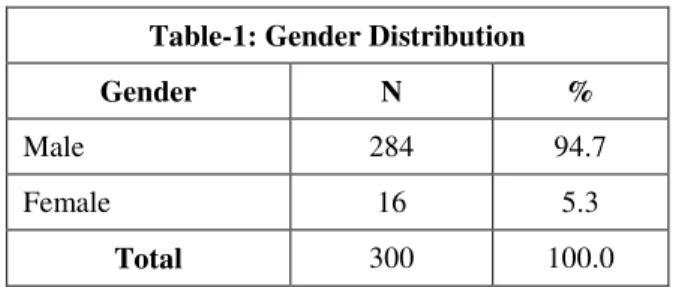
Table-1: Gender Distribution
Gender N %
Male 284 94.7
Female 16 5.3
Total 300 100.0
Table no 1 shows gender distribution which indicates male predominance as compared to female.
Table-2: Indication for surgery in study participants
Diagnosis Frequency Percent
Appendicitis 49 16.3
Congenital Hernia 46 15.3
Grade 4 Hemorrhoid 1 0.3
Hydrocele 48 16.0
Inguinal Hernia 103 34.3
Multiple Sebaceous cyst
of scrotum 1 0.3
Phimosis 40 13.3
Rt Phylloids Tumor 1 0.3
Stricture Urethra 7 2.3
Undescended testis 4 1.3
Total 300 100.0
Table no 2 shows various diseases among the study population, amongst them most common was inguinal hernia (34.3) followed by appendicitis (16.3) and hydrocele (16).
Table-3: Rate of complications after surgery
Complications Percentage
Infection 3
No complications 97
Table no 3 shows 97% patients had no complications.
Discussion
The impetus has increased in the last few decades due to rising cost of surgical treatment, insurance liability and increased costs of hospitalization. Day Case Surgery (DCS) has been found to be safe and effective for patients especially infants and children while maintaining the same level of quality of patient care (Postuma R et al., 1987) [3]. It is also becoming famous in developing countries as it is cost effective (Ramyil VM ey al., 1999) [4].
As per the demographic data obtained from patients of day care surgery, out of 300 patients, Maximum patients (24%) were of age 1-10 years of age. The mean age of study population was 32.68 ± 21.94. Male predominance (94.7%) was observed in the study. This is in accordance with study done by Amidyala Lingaiah et al [5] in 2015, in which 61.2% patients were males and 31.6% were females and the mean age of study population was 45.6±4.5.
In the present study most common indication for day care surgery was inguinal hernia (34.3) followed by appendicitis (16.3) and hydrocele (16). In the similar study conducted by Amidyala Lingaiah [5] et al 2015 excision
biopsy/ cyst excision(29%) was the
commonest indication for day care surgery followed by inguinal hernia 40(25.8%).
In our study we found lower rate of over all complication at follow-ups (3%) without any mortality after day care surgery. There was no case of readmission and emergency follow up in any of the patients. This was advocated by Ramyil et al who also compared and found lesser complication in day care surgeries compared to in-patients surgery [Ramyil et al., 2000] [6].
Al Ameen J Med Sci; Volume 9, No.2, 2016 Hedawoo JB & Sheikh A
© 2016. Al Ameen Charitable Fund Trust, Bangalore 142 it is recommended to have day care surgery unit
in hospital like ours or any tertiary health center and such type of facility may be extended up to
civil hospital/district hospital for the benefit of the patient.
References
1. Gandhimani P, Jackson I.UK Guidelines for day surgery, Surgery 2006; 24:346-9.
2. Nicoll JH. The surgery of infancy. Br Med J 1909; 2:753.
3. Postuma R, Ferguson CC, Stanwick RS, Horne JM. Pediatric day-care surgery: a 30-year hospital experience. J Pediatr Surg. 1987; 22(4):304-307. 4. Ramyil VM, Dakum NK, Ogbona BC, Iya D. Cost
effectiveness of day surgery for inguinal hernia. Nig J Surg. 1999; 6(2):44-46.
5. Amidyala Lingaiah, Padam Venugopal, K. Rukmini Mridula, Sriniwasana Bhandaru. Types of Various Surgeries in day care: A study from South India Ambulatory. Surgery 2015; 21(1):10-13.
6. Ramyil VM, Iya D. Ogbonna BC, Dakum NK. Safety of day care hernia repair in JOS Nigeria. East African Medical Journal. 2000; 77:326-328.