ORIGINAL ARTICLE
A COMMUNITY BASED STUDY ON BREASTFEEDING
PRACTICES IN A RURAL AREA OF UTTARAKHAND
Vyas Shaili1, Sharma Parul2, Kandpal S D3, Semwal Jayanti4, Srivastava Anurag5, Nautiyal Vipul6
1Assistant Professor, 5Associate Professor, Department of Community Medicine, SRMSIMS, Bareilly, 2Assistant Professor, Department of Community Medicine, Subharti Medical College, Meerut, 3Professor & HOD, Department Of Community Medicine, HIHT, Dehradun, 4Professor, Department
of Community Medicine, HIHT, Dehradun, 6Resident Final Year, SGPGIMS, Lucknow.
ABSTRACT
Background: Breast feeding is the safest, least allergic and best infant feeding method. It has nutritional, immunological, behavioral and economic benefits and also provide desirable mother infant bonding. Despite the demonstrated benefits of breastfeeding, breastfeeding prevalence and duration in many countries are still lower than the international recommendation of exclusive breastfeeding for the first six months of life .
Objective: To know breast feeding practices of mothers with a view to strengthen these practices for improving the health of infants.
Materials & methods: Community Based Cross sectional study was conducted in the field practice area of Rural Health Training Centre. 500 mothers having children between 0-3years age group were included in the study .Self administered questionnaire was used to collect information on breastfeeding practices in the initial six months of birth of the child.
Results: The study findings revealed that majority of children were breastfed (93.6%). Initiation of breastfeeding within an hour was practiced by only a few mothers (21.37%). Only 5.13% babies were exclusively breastfed till six months. Prelacteal feeds & colostrum was given to most of them i.e. 66.03% & 87.18%.
Conclusion: This shows that undesirable cultural practices such as giving pre-lacteals, late initiation of breast feeding are still prevalent among the community & these should be discouraged by proper BCC activities. For successful feeding, mothers need active support, care & privacy during pregnancy & following birth, not only of their families & communities but also of the entire health system.
Keywords: Prelacteal feeds, Colostrum, Exclusive Breastfeeding, BCC, Community
INTRODUCTION
Appropriate feeding is crucial for the healthy growth and development of the infant. Breastmilk is the natural first food for babies. It continues to provide upto half or more of the child’s nutritional needs during the second half of the first year, and upto one third during the second year of life1. Breast feeding is the safest,
least allergic and best infant feeding method. It has nutritional, immunological, behavioral and economic benefits and also provide desirable mother infant bonding.
It is now established that the breast feeding practices adopted in terms of duration, frequency and exclusiveness is essential for our understanding of impact of breast feeding on complete physical, mental and psycho-social development of the child. Despite the demonstrated benefits of breastfeeding, breastfeeding prevalence and duration in many countries are still lower than the international recommendation of exclusive breastfeeding for the first six months of life (WHO, 2002)2
beneficial effects of breastfeeding depend on time of breastfeeding initiation, its duration and the age at which the breastfed child is weaned3.
Breastfeeding practices vary among different regions and communities. A study of prevalent breast feeding practices is essential before formulation of any need based intervention programme and to outline trends in breastfeeding pattern. Though, there are reports on health and nutritional aspects of hilly regions of Uttarakhand however, very few studies exists on breastfeeding practices from the villages of this state. Hence, an effort was made to study the breast feeding practices in rural areas of Uttarakhand with respect to pattern of breastfeeding in the initial 6 months in children less than 3 years of age with reference to breastfeeding indicators of the WHO.
MATERIAL & METHODS
The present cross-sectional study was conducted amongst mothers having children between 0-36 months of age group in the field practice area of Rural Health Training Centre(RHTC) of Department of Community Medicine, Himalayan Institute of Medical Sciences, Dehradun.This centre is situated at about 5 kms from the Medical College and caters to a population of about 12,500 from 8 villages. All the mothers of children less than 36 months old were included in the study. A total of 500 mothers had children less than 36months of age, of which, 468 mothers everbreastfed their infants & hence data pertaining to breastfeeding practices was asked in detail from mothers of babies who were breastfedi.e.468. A house to house survey was conducted and the researcher herself filled the pre-tested closed ended structured questionnaire. Informed verbal consent was taken from each of the participants. The related information regarding appropriate breastfeeding practices in the initial six months was taken for example, initiation & frequency of breastfeeding, colostrum feeding, exclusive breastfeeding. Structured questionnaire required 20 min. to half an hour. The study was carried out for a period of one year i.e. May 2009 till April 2010. The terms and definitions for Infant and Young Child Feeding Practices were according to National Guidelines on Infant and Young Child Feeding4. The information thus
obtained were compiled, tabulated and analyzed statistically to draw out observations and meaningful conclusions.
RESULTS
Out of total 500 children, 258(51.6%) were males and 242(48.4%) were females. In our study 93.6 % of the sample mothers have ever breastfed their infants, of which almost equal no of male (50.85%) & female babies (49.15%) were being fed. (Table 1). Our study pointed out that 100(21%) babies born were put on breast within first hour of life in line with the WHO recommendation out of which majority (55%) of babies were female & 45% male, although the difference between the two was not statistically significant. Almost equal no of newborn (21.6%) received breast milk 1-6hr of birth & Breast-feeding on the second-third day was observed in 26% of the women & equal no of newborn got breast milk after a lapse of three days of birth(Table2).
Table 1: Distribution according to Ever breastfed children (n=500)
Ever breastfed
Distribution of children Total(%) Male(%) Female(%)
Yes 238 (50.85) 230 (49.15) 468 (93.60) No 20 (62.50) 12 (37.50) 32 (6.40) Total 258 (51.60) 242 (48.40) 500 (100.0)
Table 2: Distribution according to breastfeeding initiation time (n=468)
Initiation of Breastfeeding
Distribution of children Total (%) Z-test (p-value) Male (%) Female (%)
<1hr 45(45.00) 55(55.00) 100(21.37)
1.32 (p>0.05)
1hr-6hr 54(53.47) 47(46.54) 101(21.58)
7hr-24hr 11(55.00) 9(45.00) 20(4.27)
>24hrs 128(51.82) 119(48.18) 247(52.78)
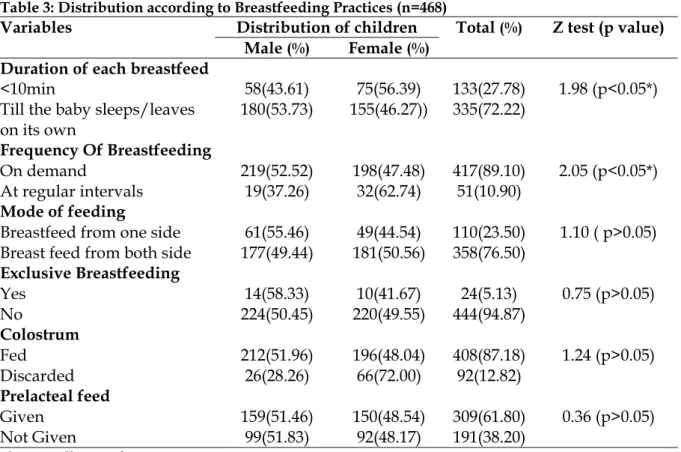
Table 3: Distribution according to Breastfeeding Practices (n=468)
Variables Distribution of children Total (%) Z test (p value)
Male (%) Female (%)
Duration of each breastfeed
<10min 58(43.61) 75(56.39) 133(27.78) 1.98 (p<0.05*)
Till the baby sleeps/leaves on its own
180(53.73) 155(46.27)) 335(72.22)
Frequency Of Breastfeeding
On demand 219(52.52) 198(47.48) 417(89.10) 2.05 (p<0.05*)
At regular intervals 19(37.26) 32(62.74) 51(10.90)
Mode of feeding
Breastfeed from one side 61(55.46) 49(44.54) 110(23.50) 1.10 ( p>0.05)
Breast feed from both side 177(49.44) 181(50.56) 358(76.50)
Exclusive Breastfeeding
Yes 14(58.33) 10(41.67) 24(5.13) 0.75 (p>0.05)
No 224(50.45) 220(49.55) 444(94.87)
Colostrum
Fed 212(51.96) 196(48.04) 408(87.18) 1.24 (p>0.05)
Discarded 26(28.26) 66(72.00) 92(12.82)
Prelacteal feed
Given 159(51.46) 150(48.54) 309(61.80) 0.36 (p>0.05)
Not Given 99(51.83) 92(48.17) 191(38.20)
*Statistically significant
DISCUSSION
According to NFHS-3 (India)5 the percentage of
children who were ever breastfed is almost universal in every state, with a slightly lower percentage in Uttaranchal (90%) which matches well with our study in which 93.6% children were ever breastfed. However positive influences and support could help and negative influences could hinder the process of lactation. Similar findings were reported by Kumar et al6
where 93.40% infants were given breast milk as their first food.
According to IYCF (2006) guidelines4,
Government of India recommends that initiation of breastfeeding should begin immediately after birth, preferably within one hour. Practice of late initiation of breastfeeding may be due to mother’s illiteracy, low socioeconomic class, and majority of deliveries taking place at home. Other reasons could be wrong customs &
feed; baby was sleeping.This reflects that the mothers were not motivated adequately for early initiation of breastfeeding. In contrast to other studies, this study shows that delayed breast-feeding(>1hr) is still practicedin the rural areas of Uttarakhand. In our study, although the first hour feeding rates was less but almost half of the babies(47.22%) were breastfed with in the first 24hrs,which compares well with the findings of NFHS-3 (India)5, Takalkar etal7 &
Kar et al8. In contrast to our findings
breastfeeding within 1hr & 24 hr was lower in study by Kumar et al9 & Chatterjee et al10where
breastfeeding within 1 hour was only 6.3% & 14.54% and 32.6% within 24 hours. These differences may be due to the timings when study was conducted, regional differences and sampling techniques.
et al11 & Takalkar et al7 & Parmar et al12 .In
contrast to our findings, in a study in U.P.13
11.8% of the women gave colostrum to their infants & Taja et al. (2001) 14 in a district of MP
found that only 22.7% of mothers had given it to their baby. This variation was mainly due to different types of customs prevalent in India and presence of greater awareness regarding colostrum among our study subjects may be due to greater awareness of health workers in our area.
Regarding Prelacteal feeds our figures are in corroboration with NFHS-3 5which states that
60% newborns received Prelacteal feed. In our study, the prevalence of prelacteal feeding was higher (66.03%) than other studies, and most important reason cited was family customs and relatives’ advice. It is a very common belief that, child takes/looks after the person who gives prelacteal feed to the child. Not only grandparents but the young people, also believed this. This suggest that population of rural areas of Uttarakhand believe more in customs and religion. Honey and "Gur ghutti' was the most popular prelacteal feed used. Exclusive breastfeeding was practiced only by 5.13% mothers in this study. Anonymous findings were reported by a study in Orissa15
where only 8.6% mothers continued with EBF whereas, according to a study by Benjamin et al (1993) at Punjab16 & Aggarwal et al at Delhi17, it
was 57.7% & 63.50% respectively. But in this study majority (69.8%) had received water as their parents or relatives thought that child needs water during summer season. This is a very important message which needs to be conveyed to mothers that breast milk itself would suffice the thirst of the infants for the first six months. Findings indicate that the practice of exclusively breastfeeding as recommended by the international organizations is far away & more efforts has to be made for increasing the exclusive breast feeding in the rural areas of Uttarakhand.
Feeding on demand was found in majority (89%) of mothers. Similarly it was found to be 84.1% in a study in Bengal18. In yet another
study at Kanpur19 it was found to be only 38%.
Demand feeding has earlier been reported to be a common practice in India, a factor, which has a positive influence on breast-feeding. This is also recognized as one of the ten steps to successful breast-feeding as recommended by WHO / UNICEF.
CONCLUSION
Thus it can be concluded from the results that breast feeding was popular in rural women though their knowledge about the same needs to be improved. Since their perceptions regarding the feeding practices directly influence the health of the child therefore false beliefs & myths attached to child’s feeding deeply rooted in all strata of community need to be replaced by sound & scientific messages.
REFERENCES
1. WHO/breastfeeding.http://www.who.int/entity/chil d_adolescent_health/topics/prevention_care/child/nu trition/breastfeeding/en.Accessed 14 Oct, 2009. 2. World Health Organization, Regional Office for
South-East Asia. The Optimal Duration of Exclusive Breastfeeding: A Systematic Review. World Health Organization, Geneva: 2002. . Availableat: http://www.who.int/nutrition/publicatio
ns/optimal_duration_of_exc_bfeeding_review_eng.pdf 3. Victoria CG, Smith PG ,Vaughan JP , Nobre LC,
Lombardi C, Teixeira Am, et al. Evidence for protection
by breastfeeding against infant deaths from infectious diseases in Brazil. Lancet 1987; 2:319-322.
4. Ministry of Human Resource development. National
Guidelines for Infant and Young Child Feeding.New Delhi: Department of Women and Child DevelopmentGovernment of India;2004. Available at http://wcd.nic.in/nationalguidelines.pdf.
5. National Family Health Survey 2005-2006 (NFHS-3). Mumbai: International Institute of Population Sciences.Available from: http://www.nfhsindia.org. 6. Kumar S. Malnutrition in backward states of India and
the ICDS Programme.
7. Takalkar AA, Saiprasad GS, Tarun K, Madhekar NS. Breastfeeding Practices in Rural Community of Andhra Pradesh. IJMCH.2010;12(2):2-8.
8. Kar M, De R. Breast feeding practices- impression from an urban community. Indian J Public Health 1991; 35(4):93-5.
9. Kumar D, Agrawal N, Swami H. M., Sociodemographic correlates of breastfeeding in urban slums of Chandigarh, Indian journal Med. Science, 2006; 60; 461-6
10. Chatterjee Saurav , Saha Sandhita: A study on KP of mothers regarding infant feeding and nutritional status of Under 5 children attending immunization clinic of Medical college, The Internet Journal Nutrition and Wellness. 2008;5(1).
11. Thakur N, Kumar A. Breastfeeding Practices among the Ganda Women Of Raipur Slums. IJMCH.2010;12(3):2-7. 12. Parmar RV, Salaria M, Poddar B, Singh K, Ghotra H,
13. Bhardwaj N, Hasan SB, Zaheer M. Breast-Feeding and Weaning Practices - A Rural Study in Uttar Pradesh. The Journal of Family Welfare.1991; 39(1):23-29.
14. Taja Verma P, Gupta N. Feeding practices and
malnutrition in infants of Bhil tribe in Jhalva district of M.P. Ind J Nutrition and Dietetics. 2001;38:160.
15. Pathi S, Das BC. Breast Feeding Practices in a Rural ICDS Block of Khallikote, South Orissa. Indian Journal of Community Medicine.2005;.30(4) .
16. Benjamin AI, Zachariah P. Nutritional status and feeding practices in under-3 years old children in the rural community in Ludhiana, Punjab. Health and Population- Perspectives and Issues. 1993; 16 (1&2): 3-21
17. Aggarwal A,Verma S, Faridi M.M.A. Complementary
feeding-Reasons for Inappropriateness in Timing,
Quantity & Consistency. Indian Journal of Pediatrics.
2008; 75(1): 49-53
18. Bandyopadhyay SK, Chaudhary N, Mukopadhyaya BB. Breast Feeding Practices in rural areas of West Bengal. Indian J Public Health 2000; 44:137-8.
19. Srivastava A, Srivastava P,Shrotriya VP, Martolia DS. Breast feeding Practices in Women from Urban and Rural Areas –A Comparative Study. IJMCH.2010;12(2):2-10.
Correspondence Dr. Shaili Vyas Assistant Professor,