Are ethnic restaurants a solution to dine out for the
young local population?
Codru
ţ
a Adina B LTESCU
1, Dana BO
Ş
COR
2Abstract: Ethnic restaurants are a component of a tourist destination offer. Through their profile, the menus, ambiance and environment, ethnic restaurants are targeting mainly the visitors. This article analyses to what extent these restaurants can attract local population, and especially, young population. In this respect it was conducted a quantitative marketing research among students of the Faculty of Economic Sciences and Business Administration from Brasov. The conclusions obtained highlight which are the attraction elements and features which determine young people to eat in an ethnic restaurant, in their place of residence or at a holiday destination.
Key-words: ethnic tourism, ethnic restaurants, young local population, authenticity
1. Introduction
The first use of the term, ‘‘ethnic tourism’’, is attributed to Smith, who defined it as tourism ‘‘marketed to the public in terms of the ‘quaint’ customs of indigenous and often exotic peoples’’ (Smith, 1977 cited in Yang, 2010, p. 562). Today, ethnic tourism generally refers to tourism motivated by a tourist’s search for exotic cultural experiences: visiting ethnic villages, ethnic theme parks, being involved in ethnic events and festivals, watching traditional dances or ceremonies, or merely shopping for ethnic handicrafts and souvenirs (Yang, Wall, and Smith, 2008 cited in Yang, 2010) and has been promoted and widely adopted as a strategy for regional socioeconomic development (McIntosh and Johnson, 2005).
Food is considered a cultural symbol and among numerous cultural factors representing national identity, food is a significant element (Edles, 2004 cited in Jang, Ha and Park, 2012, p.990). Ethnic food market is one of the fastest growing industries globally (Ha and Jang, 2010; Jang, Ha, & Silkes, 2009). Ethnic restaurants are distinct from general restaurants. All the managerial aspects are based on their own culture and, generally, appeal to visitors. There are some specific factors customers considered when they dined out at an ethnic restaurant: food, service,
1
Transilvania University of Braşov, [email protected] 2
atmospherics, dining environments, authenticity being critical factors (Ha and Jang, 2010; Liu and Jang, 2009; Tsai and Lu, 2012). Jang, Ha and Park (2012, p.991) stated that food, service, and atmospherics play a critical role in inducing positive emotions and leading to favorable future intentions toward a restaurant, therefore most customers dining at an ethnic restaurant would like to have exotic and unique foods and experience different cultures through the dining experience.
Ethnic restaurants usually focus on targeting nationals of the country the restaurant is located in rather than those of the home culture, aspect described as subjective authenticity (Lego et al., 2002 cited in Jang, Ha and Park, 2012, p.993). Ethnic restaurant operators create distinctive dining environments by emphasizing authentic atmospherics that create meaningful dining and entertainment experiences, such as interior design, decorations, or music (Ebster and Guist, 2004). At the same time, ethnic food is the core of managerial efforts and refers to food expressing the characteristics of a particular region or cultural traditions.
As Jang, Ha and Park (2012, p.1001) demonstrated the general dining environment had the strongest effect on positive emotions; in terms of the value of the overall dining experience, service quality and food-related factors, including overall food quality and authentic aspects of the food. For the Romanian consumers, the most important elements which motivate the selection of a restaurant are the quality of food, prices used, promptness of service and restaurant’s location (B ltescu and Boşcor, 2013, p.374).
Previous studies analyzed the differences between lunch and dinner served in ethnic restaurants. As Bu, Kim and Son (2013, p.987) argued, for lunch time, facilitating atmospheres, menus, and promotional events for more culturally fit feeling can generate higher satisfaction. On the other hand, services for the dinner can be quite different. Regardless of culture, providing detailed information about ingredient, history of the dishes, how it is cooked, and so on can lead to higher satisfaction since high involvement consumers in any culture tend to have more interest in the food itself.
2. Research method
The aim of the quantitative marketing is to identify the attitudes, opinions and behaviors of young population from Brasov regarding the dining-out experience in local ethnic restaurants.
The research method chosen was the survey based on questionnaires, and the sample included 228 students from the Faculty of Economic Sciences and Business Administration of Braşov. The objectives of the research were the following:
• Identification of dining-out behavior;
• The assessment of the preferences for ethnic restaurants;
• Identification of the factors that determine the success for ethnic restaurants.
3. Results and Discussions
It was analyzed the frequency of dining out at restaurants for the respondents. Out of 228 interviewed persons, 40% eat at the restaurant at least once in two weeks, 30% at least once in a month, 19% 2-3 times a week, and the lowest percentage, 11% was recorded for the respondents who have mentioned to eat at the restaurant only when they are away from home.
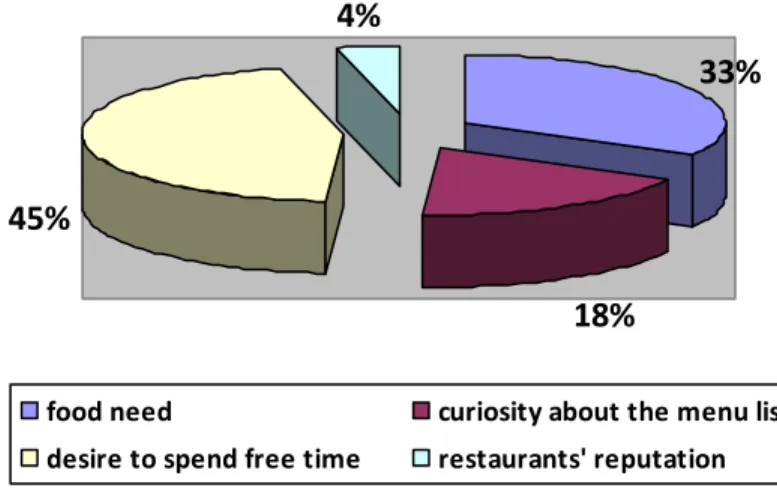
Further, there were identified the reasons underlying the decisions to dine out at the restaurant. Being a multiple choice question, the number of answers recorded was 364, and the percentage distribution is presented in figure 1.
33%
18% 45%
4%
food need curiosity about the menu list
desire to spend free time restaurants' reputation
It can be noticed that, most of the answers, namely 45%, showed the fact that the main reason of the desire to dine out at the restaurant is the willingness to spend free time in a pleasant manner, often together with friends, being followed by the desire to satisfy the food need (33%), 18% of the opinions have shown that they are linked to the curiosity regarding the content of the restaurant’s menu, the lowest percentage, namely 4%, being identified for the restaurant’s reputation.
The members of the sample have mentioned which is the main reason from those previously analyzed. The results obtained show that the desire to satisfy food needs and the one regarding the pleasant way to spend free time are the main reasons which drive them to dine out at the restaurant.
Another question has shown the respondents’ preference for ethnic restaurants. The restaurants that serve international menus have recorded 14% of the respondents’ preferences, the restaurants that serve food like at home are chosen by 26% of them, while the majority, namely 60%, has expressed the preference for ethnic restaurants.
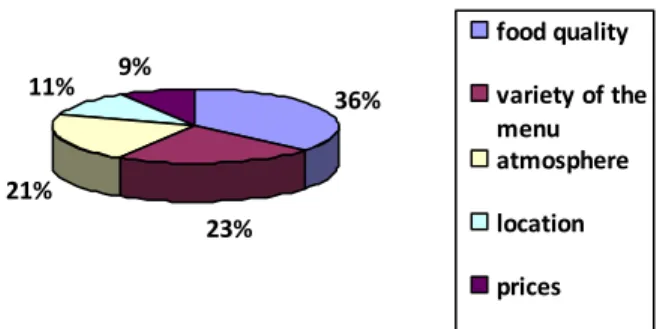
The factors that determine the success of ethnic restaurants, as resulted from the research, are: curiosity to know as many culinary customs as possible (53%), the desire to eat varied food (40%), and the reputation of the restaurant having again a low percentage, namely, 7% of the expressed opinions. There were also analyzed the main elements appreciated underlying decision to dine out in an ethnic restaurant. The results obtained are shown in figure 2.
36%
23% 21%
11% 9%
food quality
variety of the menu atmosphere
location
prices
Fig. 1. The criteria for assessing an ethnic restaurant
atmosphere from the restaurant is an important element of the assessments (21%), while location (11%) and prices (9%) are considered the least relevant when consumers take decision to dine out in an ethnic restaurant.
Another question has shown the respondents’ preference regarding dining out in an ethnic restaurant when they visit a tourist destination. It was highlighted the fact that 70% of the respondents are inclined to dine in ethnic restaurants, while 19% prefer fast food restaurants and 11% dine out in restaurants with international cuisine.
There were further shown the aspects considered as barriers for the decision to dine out in ethnic restaurants. The respondents have shown, in a percentage of 58% that they prefer to serve dishes they are used to, 23% of them do not want to have a negative experience, while 19% show that the price level is high in ethnic restaurants.
4. Conclusions
The results obtained are very encouraging for these ethnic restaurants. Therefore, more than half of the respondents, namely 59% have mentioned that they frequently dine out in restaurants. At the same time, is worth mentioning that in Brasov County ethnic restaurants did not succeed to create a consolidated image on the market, their reputation being mentioned as a reason for choosing a restaurant by only 4% of the given answers.
Taking into account the fact that the main reasons who drive respondents to dine out in a restaurant are the food need and the desire to spend free time in a pleasant manner, the restaurants’ management should give a special attention to the type, quality and variety of culinary dishes served, and also to ambiance and general atmosphere from the restaurant.
Highly relevant is the fact, that, in the case of ethnic restaurants, elements as location and price are the least important when respondents take the decision to dine out in these units, while the quality of food, variety and atmosphere are essential aspects to assess and make decisions.
5. References
B ltescu, C.A. and Boşcor, D., 2013. Customers' Opinions Regarding Eating-Out in National Type Restaurants. Ovidius University Annals, XIII(2), pp. 370-374. Bu, K., Kim, D. and Son, J., 2013. Is the culture-emotion fit always important?
Self-regulatory emotions in ethnic food consumption. Journal of Business Research, 66, pp. 983-988.
Chitu, I.B. and Albu, R.G., 2013. Aspects Regarding The Use Of Facebook Within The Hospitality Industry – A Case Study in Romania. Bulletin of the Transilvania University of Braşov, Vol. 6(55), Series V, No. 1, pp. 97-102. Ebster, C. and Guist, I., 2004. The role of authenticity in ethnic theme restaurants.
Journal of Foodservice Business Research, 7 (2), pp. 41–52.
Ha, J. and Jang, S., 2010. Perceived values, satisfaction, and behavioral intentions: the role of familiarity in Korean restaurants. International Journal of Hospitality Management, 29(1), pp.2-13.
Jang, S., Ha, A. and Silkes, A., 2009. Perceived attributes of Asian foods: from the perspective of the American customers. International Journal of Hospitality Management, 28, pp. 63–70.
Jang, S., Ha, J. and Park, K., 2012. Effects of ethnic authenticity: Investigating Korean restaurants customers in the U.S. International Journal of Hospitality Management, 31, pp. 990-1003.
Liu, Y. and Jang, S., 2009. Perceptions of Chinese restaurants in the US: what affects customer satisfaction and behavioral intentions? International Journal of Hospitality Management, 28(3), pp. 338-348.
McIntosh, A. J. and Johnson, H., 2005. Exploring the nature of the Maori experience in New Zealand: views from hosts and tourists. Tourism, 52(2), pp. 117–129.
Tsai, C.T. and Lu, P.H., 2012. Authentic dining experiences in ethnic rheme restaurants.
International Journal of Hospitality Management, 31(1), pp. 304-306.
Yang, L., 2010. Ethnic Tourism and Cultural Representation. Annals of Tourism Research, 38(2), pp. 561-585.