AR
TICLE
1 Departamento de Saúde Coletiva, Faculdade de Ciências da Saúde, Universidade de Brasília. Campus Universitário Darcy Ribeiro, Asa Norte. 70510-900 Brasília DF Brasil. [email protected]
Evaluation of user satisfaction and service responsiveness
in municipalities enrolled in the
Mais Médicos
(More Doctors) Program
Abstract The Mais Médicos (More Doctors)
Program (PMM) addresses shortages of doctors, one of whose objectives is to reduce regional ine-qualities in access to health care. This descriptive cross-sectional study evaluated service respon-siveness and user satisfaction with PMM doctors among 263 users of the public health system in 32 municipalities with 20% or more of extreme pov-erty. Questionnaires of open and closed questions were used. Users were satisfied with patient-doc-tor relationships, information about diseases and treatment and the clarity and comprehensibility of medical indications. The doctors’ technical and humanised conduct helped ensure satisfaction among users, who stressed the importance of the programme’s continuance. As regards responsive-ness, most users were pleased with the non-medi-cal aspects of care: prompt scheduling of appoint-ments, waiting times of less than one hour and privacy. Users suggested improving infrastructure and making more medicines and more doctors available, which should be considered by SUS managers to help ensure access to the right to health guaranteed in Brazil’s constitution.
Key words Distribution of doctors, Primary health care, Patient satisfaction, Health care qual-ity, access, and evaluation
Yamila Comes 1
Josélia de Souza Trindade 1
Helena Eri Shimizu 1
Edgar Merchan Hamann 1
Florencia Bargioni 1
Loana Ramirez 1
Mauro Niskier Sanchez 1
C
omes Y
Introduction
Inequalities in the distribution of doctors are a problem in many countries, including Brazil. Studies up to 2013 have revealed inequalities in access to medical care between people living in different regions of Brazil. The primary health care personnel shortage index (Índice de Escassez de Profissionais de Saúde na Atenção Primária) developed by the Estação de Pesquisa de Sinais de Mercado demonstrated that populations in Bra-zil’s North and Northeast regions were greatly affected by severe shortages of doctors; the in-equities were also striking when comparing den-sities of doctors between state capitals and the interior1,2.
Equity, one of the guiding principles of Bra-zil’s unified public health system (Sistema Único de Saúde, SUS), is intended to compensate for unfair, avoidable and unnecessary inequalities3.
The unequal distribution of doctors worsens in-equity and, accordingly, should be corrected.
The More Doctors Programme (Programa Mais Médicos, PMM) was set up in 2013 in re-sponse to the problem of shortages of medical professionals, especially in rural and remote are-as of Brazil. The policy agenda had its beginnings in a public rally by the National Front of Mayors (Frente Nacional de Prefeitos, FNP), which led a movement on 4 February 2013 titled “Where’s the doctor?” (Cadê o médico?) and organised a petition for more doctors in the SUS. Demand-ing a response from the federal government, the front called for immediate measures to engage doctors trained in other countries4. In June that
same year, widespread street protests called for improvements to public services, particularly ed-ucation and health5.
The Ministry of Health was aware that the na-tional mean rate of doctors per 1,000 population was lower than needed by Brazil, which required larger numbers of health personnel in several re-gions. The North and Northeast regions were the most underserved in this distribution of doctors: parts of some states and municipalities had much less than one doctor per thousand population6.
The Mais Médicos Programme (PMM) was instituted on 8 July 2013. In order to gain priority in receiving doctors under the programme, mu-nicipalities had to display at least one of the fol-lowing characteristics: at least 20% of their pop-ulation living in conditions of extreme poverty; population greater than 80,000 and with low socioeconomic status; and/or be a state capital or metropolitan region containing census tracts
where high percentages of the population lived in conditions of extreme poverty. Priority was also given to placing doctors in Special Indigenous Health Districts (Distritos Sanitários Especiais In-dígenas, DSEIs).
The government recruited for the PMM by publishing public service announcements in order to give priority to Brazilian doctors with qualifications valid in Brazil. Second priority was given to Brazilians trained at foreign universities and qualified to practise medicine abroad. The last option was for foreign doctors qualified to practise medicine abroad.
Official Ministry of Health figures for July 2014 record 14,462 doctors placed in 3,785 mu-nicipalities and 34 DSEIs. Provision of doctors was intended to comply with what were consid-ered to be the principles and guidelines of the SUS, in an endeavour to assure the right to health for all Brazilians, with Primary Health Care (PHC) as the system gateway. Since the Alma-Ata Conference, PHC has been understood to be cen-tral and organisational to health systems and to integrate the care process with promotion, pre-vention and rehabilitation7.
Macinko & Lima showed the association be-tween Brazil’s Family Health Strategy ( Estraté-gia Saúde da Família, ESF) and improved access to, use of, and satisfaction with, PHC services in Brazil8. Rapid expansion of the ESF brought
to light the poor distribution of doctors across Brazil, to which the country responded with the PMM. That measure was recently acknowledged in an article published in The New England Jour-nal of Medicine as being one of the Brazilian gov-ernment’s largest programmes in response to the protests voicing the need for greater investment in the health sector9.
User satisfaction: concepts and definitions
In this article, user satisfaction is considered to be a dimension of quality of care. As expressed by Barbara Starfield10, the concept of quality has
e C
ole
tiv
a,
21(9):2749-2759,
2016
types of services that themselves influence health status.
Donabedian11 defines satisfaction as a
meas-ure of the outcome of interaction between doctor and patient. The concept of user satisfaction has come to prominence since the 1960s, accompany-ing the development of health service evaluation12.
Note that the idea of patient satisfaction defines users as agents of practices and regards them as being in a position to evaluate certain attributes that are considered important in care. That val-uing of patients’ opinions grants them pride of place as subjects of rights, and directly and indi-rectly strengthens the culture of participation13.
Studies of user satisfaction generally com-prise quantitative and qualitative methodological strategies. There is a wide variety of satisfaction studies using quantitative and qualitative meth-odologies, each with strong points and limita-tions12. One of the aspects most highlighted by
researchers questioning the validity of satisfac-tion studies are the high levels of satisfacsatisfac-tion found by applying instruments from a variety of different methodological traditions, signalling a limitation known as gratitude bias14 and often
described in the literature as a satisfaction rate el-evation effect12. Feelings of gratitude can cloud a
more critical appraisal of care, thus introducing gratitude bias14.
Health service responsiveness
In order to give quality, health services have to achieve good performance, which entails respect-ing users in all senses: respectrespect-ing the confidenti-ality of clinical data; respecting dignity, including humanised treatment and user decision-making autonomy; and offering quality installations and infrastructure. The World Health Organisation (WHO) refers to this proper health system per-formance as response capacity or responsive-ness15.
The WHO then incorporated the concept of ‘responsiveness’ to complement ‘user satisfaction’, which it had used since the 1960s. ‘Satisfaction’ contemplates the various dimensions involved in health care, from the doctor-patient relationship to quality of clinical care and of health person-nel14. In contrast, ‘responsiveness’ is a concept
that relates to non-medical aspects of care. The concept relates to how health systems recognise and respond to individuals’ expectations regard-ing non-medical aspects of care. The WHO in-troduced the concept to refer to components not
directly connected with health status, consider-ing that in addition to promotconsider-ing and maintain-ing people’s health, health systems should treat users with dignity, facilitate their participation in decisions on medical procedures, encourage clear communication between health personnel and users and guarantee the confidentiality of patients’ medical data16.
Vaitsman & Andrade14 operationalised the
concept of responsiveness with the following variables: quality of installations; access to pa-tient social support networks; freedom to choose the health service; and respect for people, com-prising respect for dignity, confidentiality of user health information, autonomy to participate in health-related decisions and client guidance, including prompt care, with the possibility to choose according to needs. Studies of respon-siveness differ from user satisfaction studies, be-cause they evaluate the health system as a whole, to encompass both the non-medical aspects of care and individual perceptions regarding users’ universally legitimate expectations. By contrast, studies of satisfaction are more subjective and evaluate users and their relations with health professionals and workers, clinical interactions between doctors and users and individually per-ceived needs14.
For this study, the contributions of Vaitsman & Andrade14 will be used. ‘User satisfaction’ is
considered to reflect the medical aspects of care, while ‘responsiveness’ contemplates aspects that are not related to direct care, but which a health system should guarantee, such as respect on the part of health system professionals and workers, waiting times and the health services’ cleanliness and comfort15.
Methodology
Goals, methods, sampling and data collection and analysis
C
omes Y
extreme poverty registered in the PMM by region and by state. That process resulted in 32 munici-palities from all regions of Brazil: 14 in the North region, 12 in the Northeast, 3 in the Southeast, 2 in the Mid-West and 1 in the South.
A questionnaire of open and closed ques-tions was developed and pre-tested, drawing on a previously published instrument for evaluating user satisfaction and service responsiveness13. The
variables contained in the questionnaire cor-responded to the following dimensions of user satisfaction: satisfaction with the PMM doctor’s conduct, with the information provided, with the understanding of the explanation and an overall satisfaction index measured on a facial hedon-ic scale. The variables for responsiveness were: prompt scheduling of appointment, waiting time on day of appointment, duration of appointment, privacy, home visits and suggestions for improv-ing the PMM. In addition, data were collected on interviewees’ demographic characteristics, socio-economic status and schooling.
The field work was carried out between No-vember 2014 and June 2015 in visits to the health facilities in the municipalities selected. Patients were approached either when waiting for, or when leaving, their medical appointment. In all, 263 questionnaires were applied to 50 Family Health Teams in the 32 municipalities.
The quantitative analysis was performed us-ing descriptive statistics procedures (mean, medi-an, mode and frequency) and the study variables were examined against social and demographic variables. Responses to the open questions on the questionnaire were analysed using content anal-ysis techniques. Some qualitative data were rep-resented in the form of words clouds using the free software, WORDLE (available at http://www. wordle.net).
The Municipal Human Development Index (Índice de Desenvolvimento Humano Municipal, IDHM) and Municipal Human Development In-dices for Education, Income and Longevity, were categorised using criteria from the Atlas Brasil17.
This analysis forms part of a research project to evaluate the effectiveness of the Mais Médicos programme in realising the universal right to health and establishing health service systems (“Avaliação da efetividade do Mais Médicos Pro-gramme na realização do direito universal à saúde e na consolidação das redes de serviços em saúde”). The study was approved by the Ethics Commit-tee of the Faculdade de Ciências da Saúde, Uni-versidade de Brasília – CEP/FS-UNB (Opinion 399.461/ 2013).
This study is limited by methodological bi-ases proper to health service evaluations based exclusively on user subjectivities. However, using the instrument to evaluate responsiveness did in part reduce the subjectivity of the service quality assessment. This characteristic is inherent to the method, which measures care performance more objectively, eliminating user value judgement, which may vary in similar situations. Nonethe-less, some type of bias may have occurred. One important consideration has to do with the phenomenon that some studies term the “sat-isfaction paradox”18,which has to do with the
perception bias that occurs when, despite health services’ suffering from problems of structure, organisation and access, users express a high degree of satisfaction. In this study, such bias – gratitude bias or feeling grateful – may derive from the possibility of accessing health services provided by the PMM to populations previously completely excluded from the system or even for-gotten, because they live in remote areas that are difficult to access.
Results
Characterising the municipalities
The 32 municipalities selected had popula-tions of 4,000 to 50,000 (mean = 14,500; medi-an = 11,200). IDHM rmedi-anged from 0.496 to 0.643 (mean = 0.576; median = 0.572) and was gener-ally considered low. Distribution of the munici-palities by IDHM revealed that only one had an IDHM categorised as very low, 22 had IDHMs considered low and nine had medium IDHMs. IDHM-Education values, which ranged from 0.317 to 0.550 (mean = 0.454; median = 0.440), were considered very low in all the municipali-ties selected. IDHM-Income ranged from 0.470 to 0.658, that is, from very low to medium (me-dian = 0.553; mean = 0.549). IDHM-Longevity showed life expectancy at birth of 68.4 to 75.8 years (mean = 71; median = 70.8).
e C
ole
tiv
a,
21(9):2749-2759,
2016
white (46; 17.5) and black (32; 12.2%). Levels of schooling proved rather low, mostly incomplete middle schooling (97 cases; 37.5%), followed by complete middle schooling (63 cases; 24%). However, most people (215; 83%) reported be-ing able to read a text or newspaper well. Occu-pations included a high number of rural workers (48; 18.5 %), housewives (48; 18.5%), civil serv-ants (32; 12.3%) and house maids (19; 7.3%).
User satisfaction with the Mais Médicos Program
User satisfaction was generally high (Table 1). More specifically as regards medical care and the doctor-patient relationship, the great majority of users (98.1%) considered that the doctor lis-tened carefully to all their complaints and 95.8% reported that they received all the necessary in-formation. In addition, 93.5% of users declared that they received all the information on the treatment and 87% said they understood the rec-ommendations they were to follow.
Even though the great majority understood the recommendations they received, communi-cation with the foreign (Cuban) doctors, who spoke Spanish, was assessed as difficult by some: 57.5% of users interviewed reported some diffi-culty in understanding the indications given by the doctor.
Overall satisfaction with the doctor of the Mais Médicos Programme was high. The great majority (94.6%) selected good or very good as their level of satisfaction.
In the data obtained by the open questions, the main comments centred on being well at-tended to by the doctors. Second among the arguments for high levels of overall satisfaction was that there had been no doctor before the PMM, which had meant travelling to other mu-nicipalities. Other users’ responses were based on favourable remarks about the doctors’ posture or attitude, describing them as always smiling, attentive, modest and polite. Another set of users remarked favourably on their experience dur-ing the appointment, either at the surgery or at
%
98.1 1.1 0.8 100.0 95.8 2.7 1.5 100.0 93.5 3.8 2.7 100.0 87.0 11.1 1.9 100.0 26.7 30.8 42.5 100.0 1.9 0.8 2.7 39.5 55.1 100.0
Dimensions of user satisfaction
During the appointment, did the doctor listen carefully to all your complaints?
During the appointment, did the doctor you give all the information you needed?
During the appointment, did the doctor explain all your treatment clearly?
Did you understand the explanations and indications given by the doctor?
Did you have any difficulty understanding the indications given because the doctor was foreign?
I would like you to choose the face that shows how satisfied you are with the doctor of the Mais Médicos Program at this facility.
Table 1. Aspects of user satisfaction examined in 32 selected municipalities with 20% or more poverty, registered with the Mais Médicos Program – Brazil, 2014-15.
Values
Yes Partly No Total Yes Partly No Total Yes Partly No Total Yes Partly No Total Yes Partly No Total Very bad Bad Indifferent Good Very good Total
N
257 3 2 262 251 7 4 262 243 10 7 260 227 29 5 261 64 74 102 240 5 2 7 104 145 263
C
omes Y
home, pointing out that they were treated well, felt treated considerately, and that the doctors were interested in their lives. One user’s remark, which is representative of a good number of the declarations, was that they touch us and are not disgusted by us.
Figure 1, in the form of a word cloud, shows the analysis of the open question responses on overall satisfaction. It emphasises the words used most often to describe the group’s shared eval-uation of the phenomenon. Note that the most conspicuous words are: well, people, doctor, at-tend to, care, good (bem, gente, medico, atende, atenção, bom).
Service responsiveness where PMM doctors work
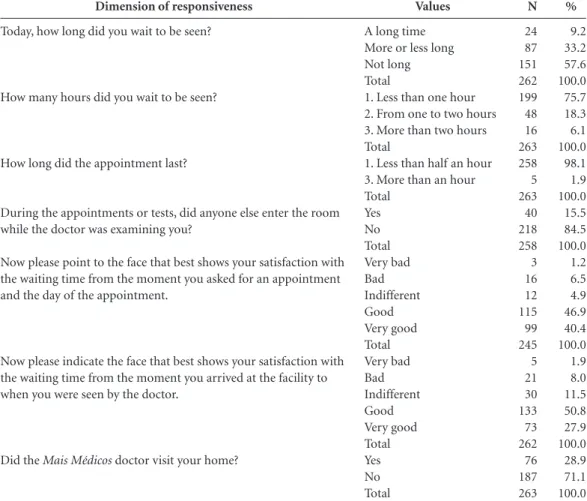
The results for the dimensions of service re-sponsiveness are given in Table 2. Waiting time on the day of the appointment was less than one hour for 75.7% of users (mean = 59.8 minutes; median = 30 minutes) and evaluated as ‘not long’ by 57.6% and ‘more or less long’ by 33.2%. When asked to choose a face to show their satisfaction with waiting time between arriving at the facili-ty and being seen by the doctor, 78.7% of users’ evaluations were ‘good’ or ‘very good’. Note that, when asked by open questions about difficulties, some users reported difficulties in accessing lab-oratory and diagnostic test results.
As regards the duration of the appointment, most users (98.1%) reported that it lasted less than half an hour, in fact, varying from 2 to 60 minutes (mean = 21 minutes; median = 20).
The great majority (84.5%) of users had their privacy respected during the medical appoint-ment or tests. However, 15.5% of users stated that they were interrupted by another person’s entering during the medical procedure; of these, 69.6% declared having agreed to the person’s en-tering. Lack of privacy was reported by 16% of the people who could read and 9% of those who could not.
When asked about home visits, 28.9% of us-ers reported that they had received a home visit from the doctor and most of these (71.6%) eval-uated the visit as satisfactory. The population vis-ited were mostly older adults, the disabled, preg-nant mothers with complications and children with an acute disorder. The visits served as ap-pointments, for taking blood pressure and giving guidance on self-care and caring for relatives and, occasionally for the environment with a view to preventing disease.
Waiting time from the moment the user re-quested an appointment to the day when they were seen was evaluated as very good or good by 87.3% of users, demonstrating easy access to ap-pointments after introduction of the PMM.
Figure 2 shows the word cloud for words in the responses to open questions on waiting time
Figure 1. How often each word appears in user comments on overall satisfaction in 32 selected municipalities with 20% or more poverty registered with the Mais Médicos Program – Brazil, 2014-2015.
e C
ole
tiv
a,
21(9):2749-2759,
2016
responsiveness. The words repeated most fre-quently were: day, seen, appointment, time, delay (dia, atendida, consulta, tempo, demora).
When asked for suggestions on how to im-prove the programme’s responsiveness, most users replied that there was nothing to improve, because the PMM was good the way it was. Those who offered suggestions said they wanted improvements in infrastructure, more medicines made available, More Doctors (more doctors en-rolled in the Mais Médicos Programme), more support from the municipality for the doctors, im-provements in transport for easier access by rural and remote communities and more specialists. Others said they wanted the programme to con-tinue.
Discussion
The users who participated in this study came from small, poor and remote municipalities. Many of these municipalities have been without proper health services for a long time, due mainly to a lack of qualified health personnel, especially doctors. That situation has resulted from the un-equal geographical distribution of health profes-sionals, who are concentrated in urban centres, and from encouragement for the trend towards specialised medical training, centred on the hos-pital and sophisticated technologies out of tune with the population’s health needs and with the needs of the health system19.
In that context, it can be inferred that these are people who live a very long way from urban
%
9.2 33.2 57.6 100.0 75.7 18.3 6.1 100.0 98.1 1.9 100.0 15.5 84.5 100.0 1.2 6.5 4.9 46.9 40.4 100.0 1.9 8.0 11.5 50.8 27.9 100.0 28.9 71.1 100.0
Dimension of responsiveness
Today, how long did you wait to be seen?
How many hours did you wait to be seen?
How long did the appointment last?
During the appointments or tests, did anyone else enter the room while the doctor was examining you?
Now please point to the face that best shows your satisfaction with the waiting time from the moment you asked for an appointment and the day of the appointment.
Now please indicate the face that best shows your satisfaction with the waiting time from the moment you arrived at the facility to when you were seen by the doctor.
Did the Mais Médicos doctor visit your home?
Table 2. Dimensions of service responsiveness in 32 selected municipalities with 20% or more poverty, registered with the Mais Médicos Programme – Brazil, 2014-2015.
Values
A long time More or less long Not long Total
1. Less than one hour 2. From one to two hours 3. More than two hours Total
1. Less than half an hour 3. More than an hour Total
Yes No Total Very bad Bad Indifferent Good Very good Total Very bad Bad Indifferent Good Very good Total Yes No Total
N
24 87 151 262 199 48 16 263 258 5 263 40 218 258 3 16 12 115 99 245 5 21 30 133 73 262 76 187 263
C
omes Y
centres and, accordingly, need a doctor closer to their domicile in order to guarantee access to the SUS. As already mentioned, the PMM was set up to close that gap. However, the Brazilian doctors who enrolled in the programme generally did not choose the poorer and more distant municipal-ities and, as a result, the municipalmunicipal-ities studied here were provided almost exclusively with coop-erating Cuban doctors.
Profiling of the users at the facilities served by the PMM found them to be predominantly female, adults and with little schooling. The in-terviewees were in employment requiring little vocational qualification. The larger numbers of women who approach health services has been demonstrated by several studies20,21, the
expla-nation being the importance they give to health services and for care for themselves and their families.
User satisfaction with the doctor-patient re-lationship specifically was high, because the doc-tors demonstrated the capacity to listen atten-tively to all the users’ needs. Attentive listening is fundamental to good communication, by which it is possible to understand patients’ different individual physical, psychological and social di-mensions, and contributes to closing the distanc-es between doctors and users22. This finding is
similar to that of the 2010 study of PHC in major Brazilian cities, in which satisfaction with rela-tionships and communication with health
per-sonnel was the most strikingly positive feature23.
Communication was also perceived as satis-factory because the doctors endeavoured to offer all the information and explanations necessary about the disease and treatment and to settle all doubts. The extent to which this information was understood may have been limited by language difference between most of the doctors, who speak Spanish, and the users, who speak Por-tuguese. Almost half the users reported finding some difficulty in understanding the indications they received. This, however, did not seem to im-pair effective communication, understood as ob-taining objective information about the disease and subjective information, such as the impli-cations of illness for the routines of family and patient, and the fears and concerns raised by the clinical complaint22.
The dimensions that scored highest were the clarity and completeness of the information and explanations given by the doctor. That finding is similar to those of Brandão et al., where these two dimensions also scored highest23.
Starfield10 points to the importance of
us-ers’ expressing their evaluation of services. She argues that analysing satisfaction means of en-tering users’ field of subjectivity, of the interper-sonal relations between users and health person-nel that are entailed by care and go beyond the technical procedures. In this study, the qualita-tive data show that users were very well cared for
Figure 2. Number of appearances of each word in user responses on waiting time responsiveness in 32 selected municipalities with 20% or more poverty registered in the Mais Médicos Program – Brazil 2014-2015.
e C
ole
tiv
a,
21(9):2749-2759,
2016
in the health services. The doctors’ attention to users during appointments appears to modulate that positive evaluation. In both this study and another in a suburban district of Fortaleza, users’ subjective qualitative evaluation was observed to be “good”24. In the study in Fortaleza, however,
the same population showed the ability to rec-ognise when the health services were “not good”. That situation was not tested with the reference population of this present study. With those find-ings as evidence, the authors warn that caution should be exercised in further analysis and that these results cannot be generalised24. Other
stud-ies in Brazil have also emphasised the importance of good doctor-user relations, which go beyond merely technical aspects to strengthen confiden-tiality, dignity and humanised care25.
As regards service responsiveness, most users evaluated access to PHC positively, particularly because they managed to be seen promptly by the doctor, nearly always on the same day. It is possible to meet spontaneous demand, even with no prior appointment, which breaks down the institutional barriers raised by the need for prior appointment, besides cutting waiting times. It is possible that, in addition to the greater availabil-ity of doctors, the fact that most of the munici-palities were small, and thus had little repressed demand, contributed to shorter waiting times. In this study, the services were seen to attempt to provide care promptly, nearly always on the same day. This availability on the part of the person-nel to attend to users when approached certainly contributed to increasing the degree of satisfac-tion and of service responsiveness. Difficulty in accessing PHC services has been confirmed to be one factor influencing the degree of responsive-ness in Europe and in Africa26,27.
Waiting times for appointments were about 30 minutes in the services studied and thus with-in the time recommended by students of health service quality10,11. Waiting times have been
as-sessed in other studies in Brazil and the findings have generally been unfavourable. Complaints observed in this dimension related to the need to receive care more promptly28, to long waiting
times29 and to difficulties in scheduling
appoint-ments23.
Appointments lasted a mean of 20 minutes, which is considered reasonable for an appoint-ment at a PHC facility. In this respect, it should be noted that the appointment is a key moment in the process of diagnosis and therapy, requiring an understanding of the user’s individual subjec-tivity and of how psychosocial, cultural, religious
and other considerations influence clinical com-plaints. On a user-centred model, the duration of the appointment should allow time to address: the doctor’s agenda as regards symptoms and disease; the user’s agenda, which includes con-cerns, fears and the experience of falling ill; and to integrate between the two agendas22.
Although only a small number of users re-ported their privacy being invaded during the appointments and procedures, this does point to a need for PHC services to improve in this regard, which involves the ethical dimension of care, be-cause all users are entitled to confidentiality14. In
that regard, not only should the services’ physi-cal infrastructure provide private rooms or sur-geries, but health personnel should be properly trained to keep information confidential18. These
findings and the difficulties reported in accessing diagnostic tests indicate a need for greater invest-ment in improving infrastructure and equipping PHC facilities, in addition to introducing health services at other levels of complexity in the mu-nicipalities and corresponding regions. These are territories with enormous care voids, due to his-torically low levels of financial investment.
Around one third of users had received a home visit from PMM health personnel. Users expressed considerable satisfaction with the doc-tors’ home visits, especially the attention they gave to the more fragile and dependent (older adults, the disabled, pregnant women and people with mental disorders). This activity enabled the doctors to see the user population’s needs closer at hand, as well as bringing a broader approach to bear, directed to identifying health-related environmental conditions. Studies have shown that, in recent years, the situations health per-sonnel have to address in the living territory are so complex that doctors have increasingly ceased making home visits, preferring to delegate them to community health workers (CHWs) and occa-sionally to nurses21.
Conclusions
C
omes Y
community. Their availability and sensitivity and the respect and dignity with which they treated patients led the user population to reiterate the importance of continuing the programme. From that perspective, the doctors’ technical and hu-manised performance contributed to guarantee-ing access and the right to health.
Users also evaluated the health services’ re-sponsiveness favourably. Contributing to that result were the facts that, in nearly all cases, users: managed to be seen quickly, even with no prior appointment; experienced waiting times and ap-pointment durations considered reasonable for PHC services; and had their privacy respected during the appointments and medical proce-dures and their confidentiality preserved.
How-ever, the infrastructure of PHC services is still deficient, pointing to a need for more investment in order to equip facilities better, in addition to the need to offer health services at other levels of complexity in the municipalities and their corre-sponding regions.
Users’ suggestions for improving the respon-siveness of the programme, such as customising infrastructure, making more medicines avail-able, having more doctors enrolled in the Mais Médicos Programme, more specialists and more transport support for access by rural and remote communities, should all be taken into consider-ation by federal and municipal managers of the SUS in order to contribute to assuring access and the constitutional right to health.
Collaborations
We declare that the author Y Comes contributed to the research project design and study plan-ning, analysis and interpretation of the results, drafting of the manuscript and critical review of content; JS Trindade, to analysis and interpre-tation of the results, drafting of the manuscript and critical review of content; HE Shimizu, to research project design and study planning, de-velopment of the discussion and critical review of content; EM Hamann, to research project design and study planning, development of re-search findings and critical review of content; F Bargioni and L Ramirez, to the introduction and to analysis and interpretation of results; MN San-chez, to research project design, study planning and critical review of content; and LMP Santos, to research project design and study planning, drafting of the manuscript and critical review of content. All authors approved the final version of the manuscript.
Acknowledgment
e C ole tiv a, 21(9):2749-2759, 2016
Silva A. A framework for measuring responsiveness. Geneva: World Health Organization; 2000. (GPE Dis-cussion Paper Series, n. 32). [acessado 2015 jun 8]. Disponível em: http://www.who.int/responsiveness/ papers/paper32.pdf?ua = 1
Programa das Nações Unidas para o Desenvolvimento. Atlas do Desenvolvimento Humano dos municípios bra-sileiros, 2013. [acessado 2015 out 13]. Disponível em: http://www.atlasbrasil.org.br/2013/
Serapioni MG, Silva CD. Avaliação da qualidade do programa Saúde da Família em municípios do Ceará: uma abordagem multidimensional. Cien Saude Co-let 2011; 16(11):4315-4326.
Carvalho MD, Santos NRD, Campos GWDS. A cons-trução do SUS e o planejamento da força de trabalho em saúde no Brasil: breve trajetória histórica. Saúde em debate 2013; 37(98):372-387.
Azevedo ALM, Costa AM. A estreita porta de entrada do Sistema Único de Saúde (SUS): uma avaliação do acesso na Estratégia de Saúde da Família. Interface (Bo-tucatu) 2010; 14(35):1-14.
Cunha MS, Sá MC. A visita domiciliar na estratégia de saúde da família: os desafios de se mover no território. Interface (Botucatu) 2013; 17(44):61-63.
Ballester D, Zuccolotto SMC, Gannam SDSA, Escobar AMU. A inclusão da perspectiva do paciente na con-sulta médica: um desafio na formação do médico. Rev. bras. educ. med. 2010; 34(4):598-606.
Brandão ALRBS, Giovanella L, Campos CEA. Avaliação da atenção básica pela perspectiva dos usuários : adapta-ção do instrumento EUROPEP para grandes centros ur-banos brasileiros. Cien Saude Colet 2013; 18(1):103-114. Aguiar ACS, Moura ERF. Percepção do usuário sobre a atuação da equipe de saúde da família de um distrito de Caucaia-.CE. Rev Bras em Promoção da Saúde 2004; 17(4):163-169.
Santiago RF, Mendes ADCG, Miranda GMD, Duar-te PO, Furtado BMASM, Souza WVD. Qualidade do atendimento nas unidades de saúde da Família no mu-nicípio de Recife: a percepção dos usuários. Cien Saude Colet 2013; 18(1):35-44.
Mohammed S, Bermejo JL, Souares A, Sauerborn R, Dong H. Assessing responsiveness of health care ser-vices within a health insurance scheme in Nigeria: us-ers’ perspectives. BMC Health Serv Res 2013; 13:502. Sánchez-Piedra CA, Prado-Galbarro FJ. Factors associ-ated with patient satisfaction with primary care in Eu-rope: results from the EUprimecare project. Qual prim care 2014; 22(3):147-155.
Moimaz SAS, Marques JAM, Saliba O, Garbin CAS, Zina, GL, Saliba NA. Satisfação e percepção do usuário do SUS Sobre o Serviço Público De Saúde. Physis 2010; 20(04):1419-1440.
Schwartz TD, Ferreira JTB, Maciel ELN, Lima RDCD. Estratégia Saúde da Família: avaliando o acesso ao SUS a partir da percepção dos usuários da Unidade de Saúde de Resistência, na região de São Pedro, no município de Vitória (ES). Cien Saude Colet 2010; 15(4):2145-2154.
Article submitted 07/03/2016 Approved 15/06/2016
Final version submitted 17/06/2016 16. 17. 18. 19. 20. 21. 22. 23. 24. 25. 26. 27. 28. 29. References
Universidade Federal de Minas Gerais (UFMG). Esta-ção de Pesquisa de Sinais de Mercado (EPSM). Cons-trução do índice de escassez de profissionais de saúde para apoio à Política Nacional de Promoção da Segurança As-sistencial em Saúde. Belo Horizonte: EPSM/NESCON/ FM/UFMG; 2010. [acessado 2015 jul 3]. Disponível em: https://www.nescon.medicina.ufmg.br/biblioteca/ imagem/2443.pdf
Estação de Pesquisa de Sinais de Mercado/ UFMG. Identificação de Áreas de Escassez de Recursos Huma-nos em Saúde no Brasil. Belo Horizonte: EPSM/NES-CON/FM/UFMG; 2012. [acessado 2015 jul 3]. Dispo-nível em: http://epsm.nescon.medicina.ufmg.br/epsm/ Relate_Pesquisa/Identifica%C3%A7%C3%A3o%20 de%20%C3%A1reas%20de%20escassez%20de%20 RHS%20no%20Brasil.pdf
Whitehead M, Dahlgren G. Concepts and principles for
tacking social inequities in health: levelling up part 1.
Copenhagen: WHO; 2006.
Frente Nacional de Prefeitos. Petição Cadê o Médico? Frente Nacional de Prefeitos promove petição eletrô-nica por mais médicos no SUS.[acessado 2015 out 13]. Disponível em: http://cadeomedico.blogspot.com. br/p/peticao.html
Antunes R, Braga R. Dias que abalaram o Brasil; as rebeliões de junho, julho de 2013. R. Pol. Públ. 2014; N Especial:41-47. [acessado 2015 jun 18]. Disponível: http://www.periodicoseletronicos.ufma.br/index.php/ rppublica/article/viewFile/2694/720
Brasil. Ministério da Saúde (MS). Pacto Nacional pela Saúde. Brasília: MS; 2013. [acessado 2015 out 5]. Dis-ponível em: http://bvsms.saude.gov.br/bvs/publicaco-es/pacto_nacional_saude_mais_medicos.pdf
Giovanella L. Atenção Primária à Saúde seletiva ou abrangente? Cad Saude Publica 2008; 24(Supl. 1):s21-s23. Macinko J, Lima MFC. Access to, use of and satisfaction with health services among adults enrolled in Brazil’s Family Health Strategy: evidence from the 2008 Na-tional Household Survey. Trop Med Int Health 2012; 17(1):36-42.
Macinko J, Harris MB. Brazil’s Family Health Strategy: delivering Community-Based Primary Care in a Uni-versal Health System. N Engl J Med 2015; 372(23):2177-2181.
Starfield B. Atención primaria: Equilibrio entre necesi-dades de salud, servicios y tecnología. Barcelona: Mas-son; 2004.
Donabedian A. The seven pillars of quality. Arch. Pathol. Lab Med. 1990; 114(11):1115-1118.
Esperidião M, Trad L. Avaliação de satisfação de usuá-rios. Cien Saude Colet 2005; 10(Supl.):303-312. Hollanda E, Siqueira SAVD, Andrade GRBD, Molinaro A, Vaitsman J. Satisfação e responsividade em serviços de atenção à saúde da Fundação Oswaldo Cruz. Cien Saude Colet 2012; 17(12):3343-3352.
Vaitsman J, Andrade GRBD. Satisfação e Responsivida-de: formas de medir a qualidade e a humanização da as-sistência à saúde. Cien Saude Colet 2005; 10(3):599-613. Organización Mundial de la Salud (OMS). Informe sobre la salud en el mundo. Mejorar el desempeño de los sistemas de salud. Cap.2 ¿Cuán bueno es el desem-peño de los sistemas de salud? 2000. [acessado 2015 jun 4]. Disponível em: http://www.who.int/whr/2000/en/ whr00_es.pdf?ua = 1