CLINICAL SCIENCE
Metallo-beta-lactamases among imipenem-resistant
Pseudomonas aeruginosa in a
brazilian university
hospital
Maria Renata Gomes Franco,IHe´lio Hehl Caiaffa-Filho,II Marcelo Nascimento Burattini,III Fla´via RossiI
IDivisa˜o de Laborato´rio Central, Microbiologia, Hospital das Clı´nicas da Faculdade de Medicina da Universidade de Sa˜o Paulo, Sa˜o Paulo, SP, Brazil. II
Divisa˜o de Laborato´rio Central, Biologia Molecular, Hospital das Clı´nicas da Faculdade de Medicina da Universidade de Sa˜o Paulo, Sa˜o Paulo, SP, Brazil. III
Patologia, Faculdade de Medicina da Universidade de Sa˜o Paulo, Sa˜o Paulo, SP, Brazil.
INTRODUCTION: Imipenem-resistant Pseudomonas aeruginosa resulting from metallo-b-lactamases has been reported to be an important cause of nosocomial infection and is a critical therapeutic problem worldwide, especially in the case of bacteremia.
OBJECTIVES: To determine the frequency of metallo-b-lactamases among imipenem-resistant Pseudomonas aeruginosaisolates and to compare methods of phenotypic and molecular detection.
METHODS:During 2006, 69 imipenem-resistantPseudomonas aeruginosasamples were isolated from blood and tested for metallo-b-lactamase production using phenotypic methods. Minimal Inhibitory Concentratrions (MIC) (mg/mL) was determined with commercial microdilution panels. Pulsed Field Gel Electrophoresis (PFGE) was
performed among metallo-b-lactamase producers.
RESULTS:Of all the blood isolates, 34.5% were found to be imipenem-resistantPseudomonas aeruginosa. Positive phenotypic tests for metallo-b-lactamases ranged from 28%-77%, and Polymerase Chain Reaction (PCR) were positive in 30% (of note, 81% of those samples wereblaSPM-1and 19% wereblaVIM-2). Ethylenediamine tetracetic acid (EDTA) combinations for the detected enzymes had low kappa values; thus, care should be taken when use it as a phenotypic indicator of MBL. Despite a very resistant antibiogram, four isolates demonstrated the worrisome finding of a colistin MIC in the resistant range. PFGE showed a clonal pattern.
CONCLUSION:Metallo-b-lactamases among imipenem-resistant Pseudomonas aeruginosawere detected in 30.4% of imipenem-resistantPseudomonas aeruginosaisolates. This number might have been higher if other genes were included. SPM-1 was the predominant enzyme found. Phenotypic tests with low kappa values could be misleading when testing for metallo-b-lactamases. Polymerase Chain Reaction detection remains the gold standard.
KEYWORDS: Pseudomonas aeruginosa; imipenem resistance; metallo-b-lactamases (MBL); MBL detection; SPM-1.
Franco MRG, Caiaffa-Filho HH, Burattini MN, Rossi F. Metallo-beta-lactamases among imipenem-resistantPseudomonas aeruginosain a brazilian university hospital. Clinics. 2010;65(9):825-829.
Received for publication onMarch 4, 2010;First review completed on publicationMarch 4, 2010;Accepted for publication onMarch 5, 2010
E-mail: [email protected]
Tel.: 55 11 3069-6348
INTRODUCTION
Among theb-lactams, carbapenems are potent agents for serious treatment of gram-negative bacterial infections. These antibiotics are well-suited to this use because of their broad spectrum activity and resistance to hydrolysis by most b-lactamases, including the extended-spectrum b -lactamases (ESBL).1These properties have led to an increase in the use of carbapenems, especially in hospitals in which
ESBLs are highly prevalent, including many hospitals in Brazil.2 Metallo-b-lactamase (MBL) production is increas-ingly reported as a cause of high-level carbapenem resistance amongPseudomonas aeruginosa(PA), an important nosocomial pathogen that is notorious for multi-drug resistance.3,4
MBL, an Ambler class B enzyme, is characterized by its ability to hydrolyze carbapenems, its resistance to all commercially available b-lactamase inhibitors and its inhibition by metal ion chelators. The substrate spectrum of this enzyme is quite broad, as it can hydrolyze penicillins, cephalosporins and carbapenems, but it lacks the ability to hydrolyze aztreonam.5
Chromosomal MBL was first detected in environmental and opportunistic pathogenic bacteria such as Bacillus Copyrightß2010CLINICS– This is an Open Access article distributed under
cereus, Aeromonas spp., and Stenotrophomonas maltophilia. Lately, there has been a dramatic increase in the detection and spread of acquired and transferable families of these metallo-enzymes (IMP, VIM, SPM, GIM, SIM and AIM enzymes).5 Brazilian surveillance studies among PA MBL producers show SPM-1 as the most prevalent enzyme.4 Prior to the present study, we did not have information on enzyme prevalence in our institution.
MBL standardization tests using routine phenotypic detection are still controversial. This study aimed to deter-mine the MBL frequency among IRPA isolates in our institu-tion and to compare phenotypic and molecular methods of detection.
METHODS
This study was carried out at the Hospital das Clı´nicas da Universidade de Sa˜o Paulo, a 2500-bed university hospital located in Sa˜o Paulo, Brazil. All patients for whom blood culture (BACTEC 9240H- Becton DickinsonH, USA) results were positive for IRPA in 2006 were eligible for inclusion in the study. Each patient was included only once. Antimicrobial Susceptibility Testing (AST) was performed by the disk diffusion method, following Clinical and Laboratory Standards Institute (CLSI) recommendations.6,7
All IRPAs were stored at -70
˚
C in TSB glycerol. MIC was determined with Microscan Neg Combo Panel Type 32 (Dade BehringH, USA), and the following drugs were analyzed: aztreonam, ceftazidime, cefepime, amikacin, gentamicin, tobramycin, imipenem, meropenem, ciproflox-acin, piperacilin, piperacilin/tazobactam and ticarcilin/ clavulanic acid. MICs were read manually according to CLSI recommendations.8 Colistin MICs (mg/mL) were
determined by EtestH (AB BiodiskH, USA) and were also interpreted according to CLSI recommendations.9 Agar dilution was performed in the case of MIC$2mg/mL.
Pseudomonas aeruginosaATCC 27853,Escherichia coliATCC 25922 and Enterococcus faecalis ATCC 29212 were used as quality controls, again according to CLSI recommendations.6
MBL phenotypic tests
Phenotypic tests for MBL were performed using three methods:
1. Double Disk Synergy (DDS) was performed according
to Arakawaet al.10with slight modifications taken from Mendes et al.11 The inoculum was adjusted to a 0.5
McFarland standard, and a 150-mm Mueller-Hinton (MH) agar plate (OXOIDH, USA) was inoculated. Three blank filter paper disks were treated with 3 mL of
mercaptoacetic acid (MAA), 3mL of
2-mercaptopropio-nic acid (MPA) (both using an undiluted solution), and 5mL of EDTA (100 mM) and placed on the center of the
MH plate. Imipenem (10 mg) and ceftazidime (10 mg)
disks (OXOIDH, USA) were placed 20 mm away from the MPA and MAA disks and 10 mm away from the EDTA disk (measured center-to-center). After overnight incubation at 35
˚
C, any synergistic inhibition zone was interpreted to be positive by the MBL screening test. 2. EtestHMBL commercial strips (AB BiodiskH, USA) witha wide range of imipenem concentrations (MICs: 4–
256 mg/ml) were overlaid with a constant EDTA
concentration (MICs: 1-64 mg/ml). The EtestH strips
were placed onto 150-mm MH plates that had
pre-viously been inoculated and incubated at 35
˚
C over-night. The test was considered MBL positive when the MIC ratio of imipenem/imipenem plus EDTA was$8. The presence of a phantom zone or a deformation of the imipenem ellipse was also considered a positive result.123. The Modified Hodge Test (MHT) was performed as described by Leeet al.13The surface of a 150-mm MH agar plate (OXOIDH, USA) was inoculated overnight with a suspension of Escherichia coli ATCC 25922, adjusted to a 0.5 McFarland standard. After a brief drying period, a 10-mg imipenem disk (OXOIDH, USA)
was placed at the center of the plate, and the PA test isolate was streaked heavily from the edge of the disk toward the edge of the plate. The MHT was considered positive if E. coli growth was observed within the inhibition zone of the imipenem disk, giving a distorted zone and interpreted as carbapenemase production;
For all three methods above, SPM-1-producing Pseudo-monas aeruginosa(48-1997A) and IMP-1-producingKlebsiella pneumoniae(Kp-Br1) strains were used as positive controls, and Pseudomonas aeruginosa ATCC 27853 was used as the negative control. All MBL phenotypic methods were assessed twice by different raters.
MBL molecular detection
Polymerase Chain Reaction (PCR) analysis was per-formed forblaSPM-1, blaIMP-1, blaIMP-2, blaVIM-1and blaVIM-2.
The primers used were:
blaSPM-1 (forward: 59 CCTACAATCTAACGGCGACC 39,
reverse: 59TCGCCGTGTCCAGGTATAAC 39),
blaIMP-1 (forward: 59 TGAGCAAGTTATCTGTATTC 39,
reverse: 59TTAGTTGCTTGGTTTTGATG 39),
blaIMP-2 (forward: 59 GGCAGTCGCCCTAAAACAAA 39,
reverse: 59TAGTTACTTGGCTGTGATGG 39),
blaVIM-1 (forward: 59 TTATGGAGCAGCAACCGATGT 39,
reverse: 59CAAAAGTCCCGCTCCAACGA 39)
blaVIM-2 (forward: 59 AAAGTTATGCCGCACTCACC 39,
reverse: 59TGCAACTTCATGTTATGCCG 39) as described previously.14,15
First, the bacterial cells were boiled to lyse the cell wall and extract the DNA, then PCR was performed. The cycling parameters for the blaSPM-1 gene were: 95
˚
C for 5 min,followed by 30 cycles of denaturation at 95
˚
C for 1 min, annealing at 40˚
C for 1 min, extension at 68˚
C for 1 min and a final extension at 68˚
C for 5 min.16The parameters used for theblaIMP-1, blaIMP-2,blaVIM-1 andblaVIM-2 genes were: 94˚
Cfor 3 min, followed by 35 cycles of denaturation at 94
˚
C for 1 min, annealing at 55˚
C for 1 min, extension at 72˚
C for 2 min and a final extension at 72˚
C for 7 min.14The PCR products were loaded into a 2.0% agarose gel, stained with 1% ethidium bromide, electrophoresed and visualized under UV light. Positive controls were the MBL-producing strains SPM-1 (Pseudomonas aeruginosa48-1997-A), IMP-1 (Klebsiella pneumoniaeKp-Br1), IMP-2 (Acinetobacter baumanniiAC-54/ 97), VIM-1 (Pseudomonas aeruginosa VR-143/97) and VIM-2 (Pseudomonas aeruginosa 98/10/U1315).Pseudomonas aerugi-nosaATCC 27853 was the negative control.phenotypic methods were calculated according to Ilstrup.17 The kappa value was calculated in order to measure the level of agreement between methods.18
Pulsed Field Gel Electrophoresis (PFGE)
MBL-positive isolates were genotyped using DNA macro-restriction followed by pulsed-field gel electrophoresis (PFGE) as described by Kaufmann.19 In brief, a bacterial cell suspension was made in 100 mM Tris - 100 mM EDTA buffer. An agarose gel block was prepared from 250mL of
this suspension and 250 mL of 2% LPM agarose and was
then placed in lysis buffer (0.4 M EDTA – pH 9.4, sarcosil 1%, 100mL proteinase K) and incubated overnight at 50
˚
C.The plugs were washed five times in CHEF-TE buffer (0.1 M Tris, pH 7.5, 0.1 M EDTA). The DNA was digested withSpeI
(New England BioLabsH, EUA) at 37
˚
C for 12 to 20 hours and run on a 1% agarose gel with CHEF-DRII (BioRadH, EUA) at 14˚
C and 6 V/cm, with pulse times of 5 and 90 seconds for 24 hours. The gels were visualized with ethidium bromide, and the results were visually analyzed according to the criteria of Tenoveret al.20RESULTS
In the study period, 238 PA blood isolates were analyzed, and 82 (34.5%) were found to be resistant to imipenem
(IRPA). Thirteen IRPA isolates were excluded due to loss of viability; thus, 69 IRPA samples were included in the study. MIC (mg/mL) determinations confirmed the 100%
imipe-nem resistance that was initially suggested by disk diffu-sion.
DDS results were positive in at least one of the inhibitor-substrate combinations among 53 strains (76.8%). Individual combinations of substrate and inhibitor showed distinct positivity, as can be seen in Table 1, with variable performance among the different combinations. The MBL EtestHwas positive in 53 isolates (76.8%), and the MHT was positive in 19 isolates (27.5%).
PCR detection of MBL was positive in 21 strains (30.4%), 17 (81%) of which were positive forblaSPM-1and 4 (19%) of
which were positive forblaVIM-2. The other genes (blaIMP-1,
blaIMP-2,blaVIM-1) were not detected.
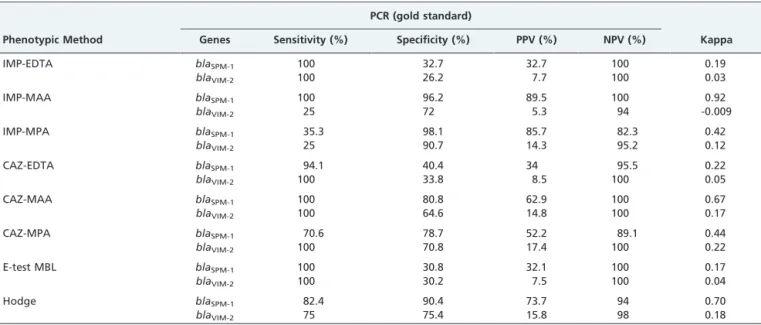
Table 2 summarizes the sensitivity, specificity, PPV, NPV and kappa values of the phenotypic tests for theblaSPM-1and
blaVIM-2genes according to the PCR results of the present
study.
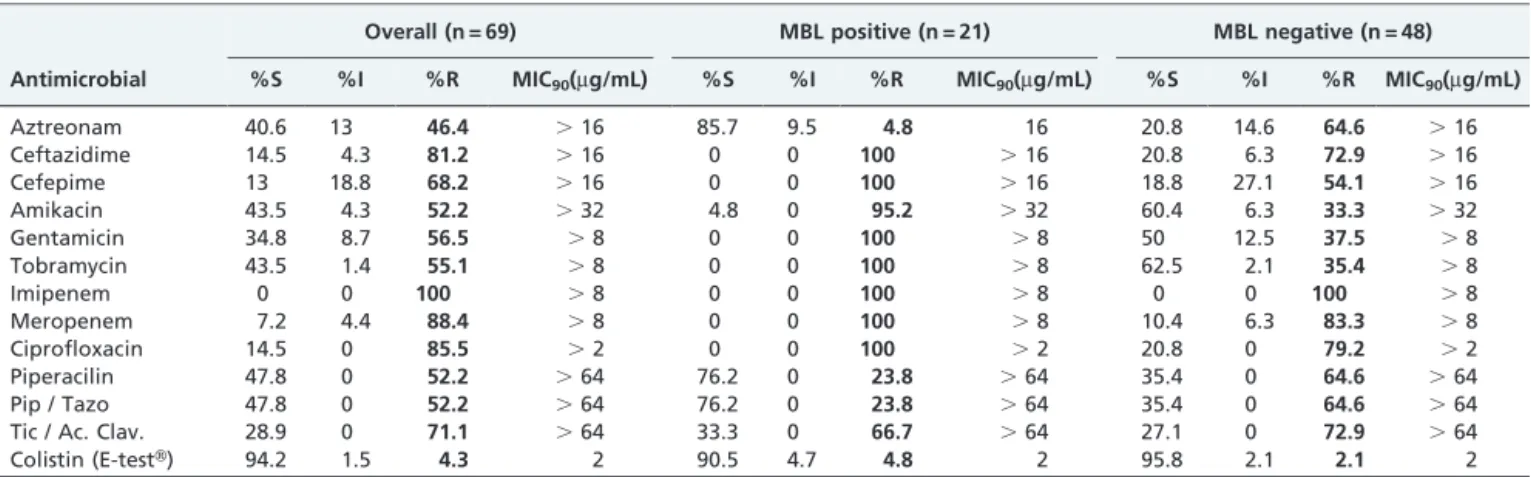
MBL-producing strains detected by PCR showed 100% resistance to ceftazidime, cefepime, gentamycin, tobramy-cin, ciprofloxacin and meropenem. Colistin appeared to be the most active antimicrobial agent, with MIC90being 2mg/
mL (only two isolates had MICs of 4 and 6mg/mL). This
result was confirmed by agar dilution. Antibiogram and MIC90off all IRPA and its analysis according to MBL PCR
detection were summarized in Table 3. The PFGE patterns of the SPM-1 and VIM-2 isolates were distinct. Among 17 SPM-1 isolates, 5 were indistinguishable, 11 were closely related, and 1 was possibly related. Among 4 VIM-2 isolates, 2 were indistinguishable, 1 was closely related, and 1 was different.
DISCUSSION
Imipenem-resistant Pseudomonas aeruginosa (IRPA) is a current and significant concern, especially because of the limited therapeutic options for this pathogen. MBL enzymes
Table 1 -Positivity of inhibitor-substrate combinations on DDS used for detecting MBL among 69 IRPA isolates.
Combinations N˚of positive strains %
IMP / MAA 19/53 35.8%
IMP / MPA 7/53 13.2%
IMP / EDTA 52/53 98.1%
CAZ / MAA 27/53 50.9%
CAZ / MPA 23/53 43.4%
CAZ / EDTA 47/53 88.7%
IMP: imipenem; CAZ: ceftazidime; EDTA: etilenodiaminotetracetic acid; MAA: mercaptoacetic acid; MPA: 2-mercaptopropionic acid.
Table 2– Performance of phenotypic methods for detecting SPM-1 and VIM-2 enzymes.
PCR (gold standard)
Phenotypic Method Genes Sensitivity (%) Specificity (%) PPV (%) NPV (%) Kappa
IMP-EDTA blaSPM-1 100 32.7 32.7 100 0.19
blaVIM-2 100 26.2 7.7 100 0.03
IMP-MAA blaSPM-1 100 96.2 89.5 100 0.92
blaVIM-2 25 72 5.3 94 -0.009
IMP-MPA blaSPM-1 35.3 98.1 85.7 82.3 0.42
blaVIM-2 25 90.7 14.3 95.2 0.12
CAZ-EDTA blaSPM-1 94.1 40.4 34 95.5 0.22
blaVIM-2 100 33.8 8.5 100 0.05
CAZ-MAA blaSPM-1 100 80.8 62.9 100 0.67
blaVIM-2 100 64.6 14.8 100 0.17
CAZ-MPA blaSPM-1 70.6 78.7 52.2 89.1 0.44
blaVIM-2 100 70.8 17.4 100 0.22
E-test MBL blaSPM-1 100 30.8 32.1 100 0.17
blaVIM-2 100 30.2 7.5 100 0.04
Hodge blaSPM-1 82.4 90.4 73.7 94 0.70
blaVIM-2 75 75.4 15.8 98 0.18
may play a critical role in IRPA, given that there is a high possibility of these carbapenemases being spread among nosocomial isolates. The prevalence of MBLs has been increasing significantly. MBLs now account for up to 40% of worldwide IRPA cases; furthermore, enzyme types may vary by regional areas.21,22In the present study, 30.4% of the IRPA isolates were MBL positive, with 81% positive for SPM-1 and 19% positive for VIM-2. SPM-1 (Sa˜o Paulo metallo-b-lactamase), initially described by Tolemanet al.in a 2002 case report from Sa˜o Paulo, is now by far the most prevalent MBL in Brazil.16,23Intriguingly, it is still restricted to Brazil. VIM-2 has been identified in other Latin American countries, such as Argentina, Chile, Colombia and Venezuela.5,16,4,24 The blaIMP-1 gene was not detected in
our study, but it has previously been found in other Brazilian hospitals.24,25,26 Primers for very rare MBL
enzymes that have not yet been described in our region were not included in the present study.4,24
The prevalence of MBL-PA among other Brazilian studies has ranged from 7.5% - 44%4,16,25,26,27 in different geo-graphic regions. Vieiraet al.reported the lowest prevalence in the northern region.27 In 2005, Sader et al. reported a 19.7% MBL prevalence among PA isolates, and a 43.9% IRPA prevalence, of which 55.6% were SPM-1, 30.6% were VIM-2, and 8.3% were IMP-1.4
Phenotypic tests for MBL have not been nationally or internationally standardized. A consensus methodology for this routine laboratory method remains to be defined, and questions regarding the timing and method of MBL detection remain to be answered. Ultimately, guidelines for the reporting of such results are needed.
DDS is a feasible option for routine laboratory testing, but there is a need for different inhibitor combinations tests and performance may varies among different enzymes. In our study, MAA demonstrated the best sensitivity and specifi-city for detecting the SPM-1 enzyme. MPA demonstrated the best performance for detecting VIM-2. Even in the case of the EtestHMBL strip, EDTA showed a high sensitivity but low specificity for detecting both enzymes.
In a Brazilian study, Pica˜o et al. published very similar results for the sensitivity and specificity of DDS phenotypic tests, using disk-inhibitor combinations among IRPA-MBL producing strains.28
In another recent Brazilian study, Marra et al. found a 69.6% false MBL detection rate with EDTA.26Chuet al.also reported that methods using EDTA are highly sensitive but not specific, as we observed.29These findings suggest that caution must be taken in using only EDTA as the inhibitor agent when analyzing MBL production, as this method may lead to false positive results. Some authors have stated that the EDTA concentration is critical and that this compound may have its own bactericidal activity that leads to expanded inhibition zones (synergy) of carbapenems that are not associated with true MBL production. EDTA may also act on membrane permeability, increasing susceptibility to several antimicrobials including imipenem, which would also lead to false interpretations of MBL synergy tests.30As another possibility of false MBL phenotypic detection, OXA enzymes that act like carbapenemases may also be affected by the EDTA inhibitory effect.31This poor EDTA specificity is worrisome given that EtestHMBL is a practical method for routine testing for MBL in a standard laboratory. Tests with low specificity may have a negative impact on the range of therapeutic options available and could increase the costs of nosocomial isolation precautions. False negative results of EtestHfor MBL have also been reported in isolates with an imipenem MIC,4mg/mL,12but this possibility could not
be assessed in our study because our isolates were all imipenem resistant (MIC.16mg/mL).
The positive Modified Hodge Test (MHT) is a carbape-nemase-based indicator, not a MBL-specific test. That said, it may indicate enzyme production. In the present study, the MHT demonstrated good sensitivity and specificity for SPM-1 and VIM-2, reinforcing the opinions of other authors,32The MHT is a feasible test for flagging possible
production of MBL.
The IRPA strains studied had a multi-drug-resistant phenotype, and colistin was the most effective antimicro-bial. In our hospital, colistin is considered a first-line drug for many severe nosocomial infections; thus, a selective pressure might explain why we found four isolates with MICs.2mg/mL.
Aztreonam was the second most active drug, but 14.3% of the MBL-producing isolates were not susceptible to aztreo-nam, suggesting a possible association with other resistance mechanisms similar to Group A enzymes.33Toleman et al. Table 3- Susceptibility profile and MIC90of 69 IRPA samples and the analysis according to MBL production.
Overall (n = 69) MBL positive (n = 21) MBL negative (n = 48)
Antimicrobial %S %I %R MIC90(mg/mL) %S %I %R MIC90(mg/mL) %S %I %R MIC90(mg/mL)
Aztreonam 40.6 13 46.4 .16 85.7 9.5 4.8 16 20.8 14.6 64.6 .16
Ceftazidime 14.5 4.3 81.2 .16 0 0 100 .16 20.8 6.3 72.9 .16
Cefepime 13 18.8 68.2 .16 0 0 100 .16 18.8 27.1 54.1 .16
Amikacin 43.5 4.3 52.2 .32 4.8 0 95.2 .32 60.4 6.3 33.3 .32
Gentamicin 34.8 8.7 56.5 .8 0 0 100 .8 50 12.5 37.5 .8
Tobramycin 43.5 1.4 55.1 .8 0 0 100 .8 62.5 2.1 35.4 .8
Imipenem 0 0 100 .8 0 0 100 .8 0 0 100 .8
Meropenem 7.2 4.4 88.4 .8 0 0 100 .8 10.4 6.3 83.3 .8
Ciprofloxacin 14.5 0 85.5 .2 0 0 100 .2 20.8 0 79.2 .2
Piperacilin 47.8 0 52.2 .64 76.2 0 23.8 .64 35.4 0 64.6 .64
Pip / Tazo 47.8 0 52.2 .64 76.2 0 23.8 .64 35.4 0 64.6 .64
Tic / Ac. Clav. 28.9 0 71.1 .64 33.3 0 66.7 .64 27.1 0 72.9 .64
Colistin (E-testH) 94.2 1.5 4.3 2 90.5 4.7 4.8 2 95.8 2.1 2.1 2
demonstrated that a large proportion of MBL genes are associated with one or more aminoglycoside- or b -lactam-resistant genes,34 partially explaining multi-drug-resistant cases.
MBL-PFGE showed a clonal-predominant genotype, reinforcing the importance of interventions to reduce cross-infection, especially once the majority of MBL-coding genes are in high-mobility genetic elements. The continued spread of such pathogens would be a clinical catastrophe, as outlined by other commentators.35
CONCLUSION
A high prevalence of MBL amongPseudomonas aeruginosa
is a critical problem representing a practical therapeutic challenge. Even though early recognition of MBL through routine laboratory testing is desirable, care should be taken when phenotypic tests are interpreted based on inhibitor synergy. In such cases, PCR should also be done to validate such results. The best method for MBL screening should be based on local factors such as bacterial type, MBL enzyme prevalence and the technical abilities of relevant facilities.
REFERENCES
1. Bush K, Jacoby GA, Medeiros AA. A functional classification scheme for
b-lactamases and its correlation with molecular structure. Antimicrobial Agents Chemother. 1995;39:1211-33.
2. Marra AR, Wey SB, Castelo A, Gales AC, Cal RG, Filho JR, et al. Nosocomial bloodstream infections caused by Klebsiella pneumoniae: impact of extended-spectrum beta-lactamase (ESBL) production on clinical outcome in a hospital with high ESBL prevalence. BMC Infect Dis. 2006;14:6-24.
3. Livermore DM. Multiple mechanisms of antimicrobial resistance in Pseudomonas aeruginosa: our worst nightmare? Clin Infect Dis. 2002; 34:634-40, doi: 10.1086/338782.
4. Sader HS, Reis AO, Silbert S, Gales AC. IMPs, VIMs and SPMs: the diversity of metallo-b-lactamases produced by carbapenem-resistant Pseudomonas aeruginosa in a Brazilian hospital. Clin Microbiol Infect. 2005;11:73-6, doi: 10.1111/j.1469-0691.2004.01031.x.
5. Queenan AM, Bush K. Carbapenemases: the Versatileb-lactamases. Clin Microbiol Rev. 2007;20:440-58, doi: 10.1128/CMR.00001-07.
6. Clinical and Laboratory Standards Institute. Performance Standards for Antimicrobial Disk Susceptibility Tests: Aprovved Standard – Eighth Edition. CLSI document M2-A8, Wayne, PA, USA.
7. Clinical and Laboratory Standards Institute. Performance Standards for antimicrobial susceptibility testing. CLSI document M100-S15, Wayne, PA, USA, 2005.
8. Clinical and Laboratory Standards Institute. Performance Standards for antimicrobial susceptibility testing. CLSI document M100-S16, Wayne, PA, USA, 2006.
9. Clinical and Laboratory Standards Institute. Performance Standards for antimicrobial susceptibility testing. CLSI document M100-S17, Wayne, PA, USA, 2007.
10. Arakawa Y, Shibata N, Shibayama K, Kurokawa H, Yagi T, Fujiwara H, et al. Convenient test for screening metallo-b-lactamase-producing gram-negative bacteria by using thiol compounds. J Clin Microbiol. 2000;38: 40-3.
11. Mendes RE, Castanheira M, Pignatari AC, Gales AC. Metallo-b -lactamases. J Bras Patol Med Lab. 2006;42:103-13, doi: 10.1590/S1676-24442006000200007.
12. Walsh TR, Bolmstorm A, Qwarnstorm A, Gales AC. Evaluation of a new E-test for detecting metallo-b-lactamases in routine clinical testing. J Clin Microbiol. 2002;40:2755-9, doi: 10.1128/JCM.40.8.2755-2759.2002. 13. Lee K, Chong Y, Shin HB, Kim YA, Yong D, Yum JH. Modified Hodge
and EDTA-disk synergy tests to screen metallo-b-lactamase producing strains ofPseudomonasandAcinetobacterspecies. Clin Microbiol Infect. 2001;7:88-91, doi: 10.1046/j.1469-0691.2001.00204.x.
14. Yan JJ, Hsueh PR, Ko WC, Luh KT, Tsai SH, Wu HM, et al. Metallo-b -lactamases in ClinicalPseudomonasisolates in Taiwan and identification of VIM-3, a novel variant of the VIM-2 enzyme. Antimicrob Agents Chemother. 2001;45:2224-8, doi: 10.1128/AAC.45.8.2224-2228.2001.
15. Castanheira M, Toleman MA, Jones RN, Schmidt FJ, Walsh TR. Molecular characterization of ab-lactamase gene,blaGIM-1, encoding a new subclass of metallo-b-lactamase. Antimicrob Agents Chemother. 2004;48:4654-61, doi: 10.1128/AAC.48.12.4654-4661.2004.
16. Gales AC, Menezes LC, Silbert S, Sader HS. Dissemination in distinct Brazilian regions of an epidemic carbapenem-resistant Pseudomonas aeruginosaproducing SPM metallo-b-lactamase. J Antimicrob Chemoter. 2003;52:699-702, doi: 10.1093/jac/dkg416.
17. Ilstrup DM. Statistical Methods in Microbiology. Clin Microbiol Rev. 1990;3:219-26.
18. Viera AJ, Garrett JM. Understanding interobserver agreement: The Kappa statistic. Fam Med. 2005;37:360-3.
19. Kaufmann ME. Pulsed Field Gel Electrophoresis. In: Woodford N, Johnson AP, editors. Molecular Bacteriology: Protocols and Clinial Applications. 1st ed. New Jersey: Ed. Humana Press; 1998. Cap.15, p.33-50.
20. Tenover FC, Arbeit RD, Goering RV, Mickelsen PA, Murray BE, Persing DH, Swaminathan B. Interpreting chromosomal DNA restriction patterns produced by pulsed-field gel electrophoresis: criteria for bacterial strain typing. J Clin Microbiol. 1995;33:2233-9.
21. Livermore DM. Interplay of impermeability and chromosomal b -lactamase activity in imipenem-resistant Pseudomonas aeruginosa. Antimicrob Agents Chemoter. 1992;36:2046-8.
22. Livermore DM. Pseudomonas, porins, pumps, and carbapenens. J Antimicrob Chemoter. 2001;47:247-50, doi: 10.1093/jac/47.3.247. 23. Toleman MA, Simm AM, Murphy TA, Gales AC, Biedenbach DJ, Jones
RN, et al. Molecular characterization of SPM-1, a novel metallo-b -lactamase isolated in Latin America: report from the SENTRY anti-microbial surveillance programme. J Antimicrob Chemother. 2002;50:673-9, doi: 10.1093/jac/dkf210.
24. Sader HS, Castanheira M, Mendes RE, Toleman M, Walsh TR, Jones RN. Dissemination and diversity of metallo-b-lactamases in Latin America: report from the SENTRY Antimicrobial Surveillance Program. Int J Antimicrob Agents. 2005;25:57-61, doi: 10.1016/j.ijantimicag.2004. 08.013.
25. Martins AF, Zavascki AP, Gaspareto PB, Barth AL. Dissemination of Pseudomonas aeruginosaproducing SPM-1-like and IMP-1-like metallo-b -lactamases in Hospitals from Southern Brazil. Infection. 2007;35:457-60, doi: 10.1007/s15010-007-6289-3.
26. Marra AR, Pereira CAP, Gales AC, Menezes LC, Cal RGR, Souza JMA, et al. Bloodstream infections with metallo-b-lactamase producing Pseudomonas aeruginosa: Epidemiology, Microbiology, and Clinical Outcomes. Antimicrob Agents Chemother. 2006;50:388-90, doi: 10. 1128/AAC.50.1.388-390.2006.
27. Vieira VV, Fonseca EL, Vicente AC. Metallo-b-lactamases produced by carbapenem-resistant Pseudomonas aeruginosa in Brazil [letter] Clin Microbiol Infect. 2005.
28. Pica˜o RC, Andrade SS, Nicoletti AG, Campana EH, Moraes GC, Mendes RE, et al. Metallo-b-lactamase detection: Comparative evaluation of Double-Disk Synergy versus Combined Disk Tests for IMP-, GIM-, SIM-, SPM- or VIM-producing isolates. J Clin Microbiol. 2008;46:2028-37, doi: 10.1128/JCM.00818-07.
29. Chu YW, Cheung TK, Ngan JYW, Kam KM. EDTA susceptibility leading to false detection of metallo-b-lactamase inPseudomonas aeruginosaby E-test and an imipenem–EDTA disk method. Int J Antimicrob Agents. 2005;26:340-1, doi: 10.1016/j.ijantimicag.2005.07.004.
30. Denny B, West P, Panigrahi D. Effects of permeabilizers on antimicrobial susceptibility of Stenotrophomonas maltophilia and Acinetobacter spp. J Microbiol Immunol Infect. 2003;36:72-6.
31. Danel F, Paetzel M, Strynadka NC. Effect of divalent metal cations on the dimerization of OXA-10 and -14 class Db-lactamases fromPseudomonas aeruginosa. Biochemistry. 2001;40:9412-20, doi: 10.1021/bi0025969. 32. Lee K, Lim YS, Yong D, Yum JH, Chong Y. Evaluation of the hodge test
and the imipenem-EDTA double-disk synergy test for differentiating metallo-b-lactamase producing isolates of Pseudomonas sp. and Acinetobacterspp. J Clin Microbiol. 2003;41:4623-9, doi: 10.1128/JCM.41. 10.4623-4629.2003.
33. Toleman MA, Simm AM, Murphy TA, Gales AC, Biedenbach DJ, Jones RN, et al. Molecular characterization of SPM-1, a novel metallo-b -lactamase isolated in Latin America: report from the SENTRY anti-microbial surveillance programme. J Antimicrob Chemother. 2002;50: 673-9, doi: 10.1093/jac/dkf210.
34. Toleman MA, Biedenbach D, Bennett DMC, Jones RN, Walsh TR. Italian metallo-b-lactamases: a national problem? Report from the SENTRY Antimicrobial Surveillance Programme. J Antimicrob Chemother. 2005;55:61-70, doi: 10.1093/jac/dkh512.