Original Article
Artigo Original
Nouns and verbs used by preschoolers
with language impairment
Uso de substantivos e verbos por
pré-escolares com alteração específica
de linguagem
Marianne Querido Verreschi1Ana Manhani Cáceres-Assenço1
Debora Maria Befi-Lopes1
Keywords
Child Language Language Disorders Vocabulary Speech, Language and Hearing
Sciences Language Development
Descritores
Linguagem Infantil Transtornos da Linguagem Vocabulário Fonoaudiologia Desenvolvimento da Linguagem
Correspondence address:
Debora Maria Bei-Lopes
Universidade de São Paulo – USP Rua Cipotânea, 51, Cidade
Universitária, São Paulo (SP), Brazil, CEP: 05360-160.
E-mail: [email protected]
Received: March 24, 2015
Study carried out at the Laboratório de Investigação Fonoaudiológica em Desenvolvimento da Linguagem e suas Alterações of the Faculdade de Medicina Universidade de São Paulo – USP - São Paulo (SP), Brazil.
1 Curso de Fonoaudiologia, Faculdade de Medicina, Universidade de São Paulo – USP - São Paulo (SP), Brazil. Financial support: Fundação de Amparo à Pesquisa do Estado de São Paulo (FAPESP) - process No. 2013/07032-5. Conlict of interests: nothing to declare.
ABSTRACT
Purpose: To compare the functional use of verbs and nouns by Brazilian Portuguese-speaking children with language impairment (LI) and to verify whether their use of these word classes is different from that of children with typical language development (TLD). This study also aimed to compare the use of each verb type between groups. Methods: Participants were 80 preschool children, 20 of them diagnosed with LI and 60 with TLD. The age ranges of participants were 3 to 6 years for children with LI and 2 to 4 years for children with TLD. Individuals were paired based on their expressive language age. Ludic interaction was used to elicit the speech sample from which nouns and verbs were selected from spontaneous speech. All nouns and verbs were tabulated
and verbs were classiied. Results: Preschoolers with LI use verbs more often than nouns in their production of spontaneous speech. The use of nouns presented no difference between the groups, but verb use frequency was higher in children with LI for the 3-year-old subgroup. The verbs most frequently used by children with LI were copula, intransitive, and transitive direct. Comparison between the groups revealed few differences regarding the use of transitive direct, bitransitive, and copular verbs. Only transitive circumstantial verbs were more often used by children with TLD at all ages. Conclusion: The use of nouns and verbs by children with LI complies with the typical development standard, but it occurs more slowly. The use of verbs with fewer complements is predominant in these children.
RESUMO
Objetivos: Comparar o uso funcional de verbos e substantivos por crianças com alterações especíicas de
linguagem (AEL) falantes do Português Brasileiro e investigar se o uso desses tipos de palavras difere daquele das crianças em desenvolvimento típico de linguagem (DTL). Além disso, comparar a utilização de cada tipo de verbo entre os grupos. Método: Participaram do estudo 80 pré-escolares, 20 com AEL e 60 com DTL. A faixa etária dos sujeitos com AEL variou entre 3 e 6 anos e do grupo com DTL variou entre 2 e 4 anos. O pareamento dos sujeitos foi baseado na idade linguística expressiva. A amostra de fala foi eliciada por meio de interação lúdica, e dessa amostra foram selecionados os substantivos e verbos produzidos. Resultados: Os pré-escolares com AEL utilizaram mais verbos do que substantivos em fala espontânea. O uso de substantivos não diferiu entre os grupos, mas nos verbos o subgrupo de 3 anos com AEL os utilizou com mais frequência que seus pares. Os tipos de verbos mais utilizados por sujeitos com AEL foram de ligação, intransitivo e transitivo direto. A comparação entre os grupos neste aspecto diferiu pontualmente para os verbos transitivo direto, bitransitivo e de ligação; apenas o verbo transitivo circunstancial foi mais utilizado pelos sujeitos em DTL para todas as idades.
INTRODUCTION
Language acquisition occurs from the interaction between the child and the surrounding environment. Children use their cognitive and social skills to categorize, organize, and combine everything they learn separately through the stimuli they receive in the family environment. Children produce
their irst words when they are approximately one year old(1).
Learning a word is a multifactorial process which begins with the association between a phonetic input and a
corresponding action or object in the environment. This irst
association is named fast mapping, and it involves an incomplete representation of the word. The continuous exposition to this word creates a robust association, which occurs in the slow mapping phase(2).
Open-class words (adjectives, adverbs, nouns, verbs, interjections) bear more robust references than closed-class words (articles, conjunctions, numerals, prepositions, pronouns)
and, therefore, are the irst to be acquired during language
development. This occurs especially with nouns, which are relatively easy to be learned by children and open the way for the learning of words with less obvious relationships, or with more complex morphological structures. Verbs, in turn,
are acquired later due to the initial dificulty children have
to detect their conceptual and semantic components, or to understand how they are combined(3).
Verbs function as organizing elements of the syntactic structure and of the correct use of other word classes(4). There are
several clues (morphological and syntactic) involving language that may help identify a word as a verb. Morphological clues
help deine the part of speech that is unknown to the child
(for example, verb termination). Syntactic clues show that a sentence is structured around a verb by predetermined rules(5).
In Brazilian Portuguese, children with typical development begin their language acquisition with nouns, but from the second year of life they present a slightly greater amount of verbs compared to nouns, which can be observed throughout preschool life. Verbs are predominantly acquired in the following order: intransitive, copula, transitive direct, transitive circumstantial, and transitive indirect(6).
However, some children may present dificulty in language
development which results in differences in the way they acquire and use word classes. That is the case of children with
language impairment (LI), characterized by speciic dificulties
in language aspects, with absence of factors such as hearing loss, neurological and cognitive development disorders, emotional problems, and environment deprivation(7,8).
LI comprises two major language frameworks: language
delay and speciic language impairment. The irst refers to a
generalized delay in receptive and expressive language, but follows the same sequence of typical language development. The latter refers to atypical development of language skills
due to speciic problems in two or more language aspects(9).
Due to the age range studied, we have chosen to use the general term language impairment (LI), considering that
differentiation between the frameworks of delay and speciic impairment by maintenance of language deicits after therapeutic
intervention could only be used when all individuals were
over ive years old.
Children with LI present limited language processing ability, which interferes with the acquisition and processing of language in real time. Thus complex linguistic operations can overload their capacity, resulting in competition for resources between the different language processing stages,
so that their early stages are beneited(10).
Among the many linguistic dificulties that may be manifested
in this group, impairment in the use of verbs is commonly
identiied as a characteristic aspect(11). The development
of grammar morphology in this population tends to fall short compared with that observed in children with typical
development. This dificulty is evidenced by late acquisition
of grammatical morphemes and maintenance of primitive grammar structures(12), which may occur because of possible
deicits in word processing owing to phonological or working
memory impairment(13).
Children with LI are more dependent on the frequency of stimulation and lexical-semantic information(14) and less
able to retain new verbs than younger children with typical language development(15). Therefore, they need a greater variety
of verbs stored in their lexicon to abstract the morphological rules of their language and thus develop a more widespread knowledge of verbs(11), in addition to being less likely to vary
the choices of their verbs, matching younger children paired by vocabulary(16).
Nevertheless, language interferes with the nature of the
dificulties that the speaker with LI will face when using verbs. In English, it is observed that this dificulty occurs with
respect to its diversity and the correct use of morphology, which remains throughout schooling(17), and it can be considered one
of its clinical signs(3).
In Spanish, there are reports of difference in the pattern of eye movements for verbs with different number of arguments, with
greater dificulty in recognizing those with three arguments(18).
Frequent use of ininitive verb forms is reported for speakers
of Catalan and Spanish(19), as well as of English(20). Such a
fact is justiied because this verb mode shows no variation in
grammatical agreement, which reduces its linguistic processing demand(19).
In Brazilian Portuguese, there are indings that indicate some dificulty associated with the identiication of how many and
which complements are required by a verb so that its meaning is complete and understood(4).
with typical language development (TLD). This study also aimed to compare the use of each verb type between groups.
METHODS
This study was approved by the Research Ethics Committee of the aforementioned institution under number 1159/09. All individuals had their Informed Consent Forms signed by their parents or guardians.
Participants
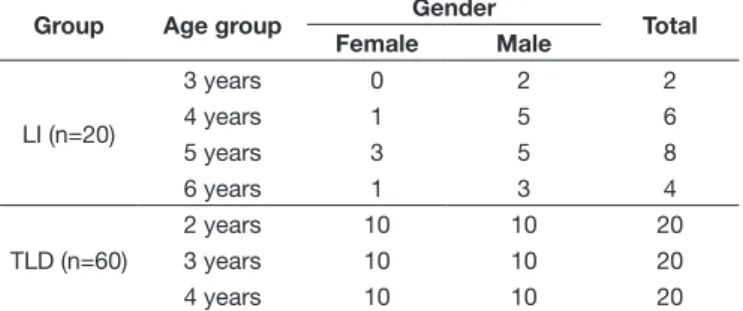
The LI group was composed of 20 preschoolers who were undergoing speech therapy weekly at the Laboratory of Speech-language Pathology Investigation on Language Development at the Department of Physiotherapy, Speech-language Pathology and Occupational Therapy of the School of Medicine at the Universidade de Sao Paulo - USP. The individuals’ age ranged between 3 years and 2 months and 6 years and 10 months (Table 1).
Exclusion criteria established in the literature(7) were used in
this study. Inclusion criteria comprised performance in expressive language below expectations in at least two standardized tests: vocabulary(21), speech-language pathology(22), or mean length
of utterance (MLU)(4), as well as receptive and/or expressive
language age below chronological age based on the third edition of the Test of Early Language Development (TELD-3)(23)
adapted to Brazilian Portuguese(24).
It should be noted that, due to age range, it was not possible to conduct the Non-verbal Intelligence Test (Non-verbal IQ), thus children with altered neuropsychomotor development history (delay greater than six months in relation to the expected in typical development to sit, walk, and control the head and sphincters) were not included. However, it is worth mentioning that, as these children were under speech therapy when they reached the age to be included in the study, all of them underwent evaluation to verify intellectual performance, and no impairment was found in any of the cases.
The TLD group consisted of 60 preschoolers aged 2 to 4 years (Table 1). Data collection occurred in a public elementary education institution in the city of Sao Paulo. Individuals were paired according to expressive language age, for example, a child with LI with expressive language age equivalent to
four years was matched to the control group of 4-year-olds. In total, two individuals had expressive language age equivalent to 2 years, seven individuals presented expressive language age equivalent to 3 years, and 11 individuals had expressive language age equivalent to 4 years.
Material and methods
For data collection, a room was previously prepared with a camcorder on a tripod and some toys on a carpet. During collection, the child was encouraged to interact with the speech therapist for a period of 30 minutes. The evaluator asked open questions aiming to propitiate the child’s best communicative initiative situation.
Considering the age groups studied and the need to obtain spontaneous speech, speech samples were collected from both groups through ludic interaction using the following toys: animal farm, transportation, food, kitchen utensils, and two dolls. The interactions were video recorded using a digital camcorder.
It is worth mentioning that, in the case of children with LI, the interactions occurred with the speech therapist who was attending the child in order to guarantee a familiar situation. In the control group, the same researcher interacted with all the children in the educational environment; however, this researcher had interacted with all individuals before data collection, and was, therefore, familiarized with them(6).
All speech therapists received the same training and were supervised by one of the study authors during the collection of speech samples.
From the data collected, 100 segments were transcribed from the most intense communicative interaction period established with the individuals within the 30 minutes recorded, as proposed by Brown(25). After transcription, all nouns and verbs present
in the selected speech sample were tabulated. All verbs were
classiied according to Lima(26) in intransitive, transitive direct,
transitive indirect, transitive relative, transitive circumstantial, and bitransitive.
Importantly, the classiication of verbs occurred in
accordance with the use determined by each speaker. Therefore, a transitive direct verb used without a complement was
classiied as intransitive. Similarly, a transitive indirect verb used with a complement without a preposition was classiied
as transitive direct.
Data analysis
Duly tabulated data were submitted to statistical treatment using the software SPSS 18 (distribution type; descriptive and inferential analysis). Normality of data distribution was observed only for the LI group; therefore, the Paired t-test was used for intragroup comparisons between the number of nouns and verbs and the Mann-Whitney test was applied for analysis
between the groups. A statistical signiicance level of 5% was adopted and signiicant results were marked with an asterisk.
Table 1. Distribution of individuals according to age group and gender
Group Age group Gender Total
Female Male
LI (n=20)
3 years 0 2 2
4 years 1 5 6
5 years 3 5 8
6 years 1 3 4
TLD (n=60)
2 years 10 10 20
3 years 10 10 20
4 years 10 10 20
RESULTS
Use of nouns and verbs
Preschoolers with LI use verbs more frequently than nouns in their production of spontaneous speech (Graph 1). Comparison between the performance of individuals with LI and TLD showed that the use of nouns cannot be distinguished between these groups regardless of expressive language age. Regarding the use of verbs, no distinction was observed in the 2 and 4-year-old subgroups, but 3-year-old individuals with LI produced more verbs than their peers (Table 2).
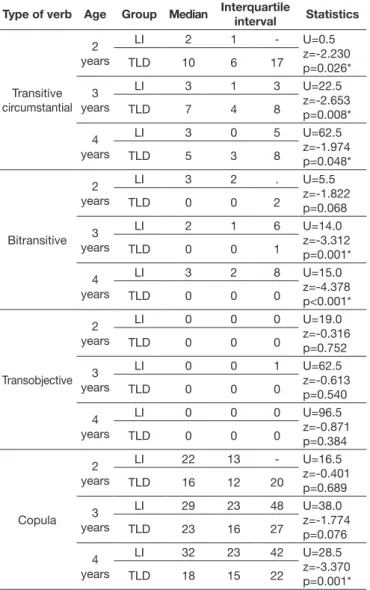
transitive direct verbs more often than their peers in the 2 and 3-year-old subgroups; bitransitive verbs in the 3 and 4-year-old subgroups; and copular verbs in 4-year-old subgroup. Finally, individuals with TLD used transitive circumstantial verbs more frequently than their peers in all age groups (Table 3).
Table 2. Comparison of use of each word class between groups paired by expressive language age
Age Group Median Interquartile
interval p
Noun
2 years LI 76 72 - 0.109
TLD 53 34 64
3 years LI 64 38 83 0.203
TLD 52 46 62
4 years LI 63 49 80 0.409
TLD 62 47 73
Verb
2 years LI 95 49 - 1.000
TLD 68 60 77
3 years LI 103 94 130 0.003*
TLD 80 67 88
4 years LI 116 86 137 0.111
TLD 100 90 106
* statistical difference p<0.05 – Mann-Whitney test
Caption: LI = language impairment; TLD = typical language development Caption: * statistical difference p<0.05 – Paired t-test
Graph 1. Comparison of use of nouns and verbs in the LI group
Types of verbs used
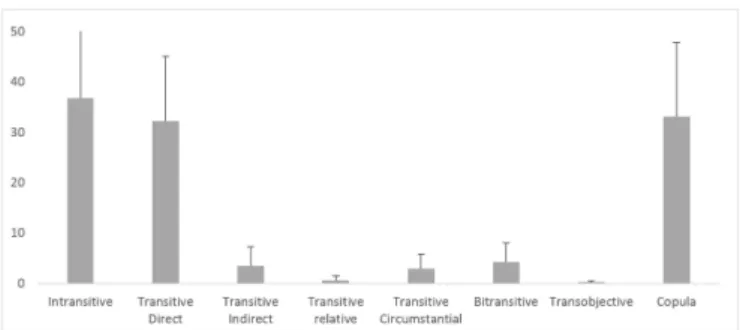
The verbs most commonly used by children with LI were copula, intransitive, and transitive direct (Graph 2).
Comparison between individuals with LI and TLD with respect to the use of verbs did not show difference between intransitive, transitive indirect, transitive relative, and transobjective verbs produced at all ages. Nevertheless, individuals with LI used
Graph 2. Average of use for each type of verb in the LI group
Table 3. Comparison of use of each verb type between groups paired by expressive language age
Type of verb Age Group Median Interquartile
interval Statistics
Intransitive 2 years
LI 37 13 - U=20.0
z=0.0 p=1.000
TLD 25 22 33
3 years
LI 27 24 39 U=49.0
z=-1.163 p=0.245
TLD 27 21 36
4 years
LI 41 26 49 U=86.0
z=-0.992 p=0.321
TLD 33 29 42
Transitive direct
2 years
LI 29 18 - U=2.0
z=-2.062 p=0.039*
TLD 10 7 14
3 years
LI 31 25 35 U=19.5
z=-2.798 p=0.005*
TLD 20 14 24
4 years
LI 27 22 46 U=101.5
z=-0.352 p=0.725
TLD 32 22 36
Transitive indirect
2 years
LI 3 1 - U=7.0
z=-1.598 p=0.110
TLD 0 0 2
3 years
LI 1 0 4 U=67.5
z=-0.142 p=0.887
TLD 1 0 3
4 years
LI 2 1 8 U=106.0
z=-0.166 p=0.868
TLD 4 2 7
Transitive relative
2 years
LI 0 0 0 U=16.0
z=-0.680 p=0.497
TLD 0 0 0
3 years
LI 0 0 1 U=67.5
z=-0.154 p=0.877
TLD 0 0 1
4 years
LI 0 0 1 U=77.5
z=-1.428 p=0.153
TLD 1 0 2
* statistical difference p<0.05 – Mann-Whitney test
DISCUSSION
The aim of this study was to investigate the use of nouns and verbs by preschool children with language impairment (LI) and to compare their performance with that of their peers with typical language development (TLD).
Regarding the quantitative comparison between nouns and verbs used by individuals with LI, the results show that these preschoolers used verbs more often than nouns in their production (Graph 1). This inding differs from the results obtained in international studies which report that English-speaking individuals with LI showed better performance in the use of nouns compared with verbs(5,13,18,27).
English-speaking children with LI show slower verb learning(13), as well as dificulties in rapid mapping(5) and linguistic
processing(18). However, these differences may result from the
language spoken, as our indings reproduce what has been
observed in Brazilian preschoolers with typical development(6).
Interestingly, no differences were found between individuals with LI and their peers with respect to expressive language age for the use of nouns (Table 2). This shows that children in the LI group use nouns similarly to their peers, but in a slower way, which is a characteristic of this language impairment(4).
Therefore, it is important to emphasize that the individuals in the LI group had higher chronological age than their peers, which evidences this delay.
When this comparison considered the verbs, there was no difference in the 2 and 4-year-old subgroups, but individuals with LI in the 3-year-old subgroup produced more verbs than their peers (Table 2). LI individuals show a gap between their chronological and language ages; therefore, although they were paired by expressive language age, they have been exposed to language longer, and thus may have used more verbs than their language peers. Moreover, considering their more advanced chronological age, it is possible that they have been less uniform
in their language development, so that speciic differences such
as these would be understandable.
These indings may differ from the results obtained for
English language, because English verbs are ‘tight’ and suffer few variations in person, tense, and mode. In contrast, verbs in Brazilian Portuguese and Roman languages in general, present many variations in person, number, tense, and mode(19). Such
variations allow the same verb to be exposed in different forms to speakers; therefore, the higher the frequency of a verb in a
stimulus, the more often and lexibly it may occur in children’s
speech, facilitating its learning(6).
Regarding the classiication of type of verbs produced by
the preschoolers with LI, the most commonly used verbs were intransitive, copula, and transitive direct (Graph 2). Our results
corroborate international indings in English on the dificulties
regarding the use of verb arguments by individuals with LI(10,19,20,28). Children with LI use verbs omitting their arguments
because their learning process is dificult and is related to verb
complexity(28,29).
Comparison between individuals with LI and their peers according to expressive language age allowed the observation of
speciic differences: higher frequency of use of transitive direct
verbs at 2 and 3 years old, bitransitive verbs at 3 and 4 years old, and copular verbs at 4 years old by individuals with LI (Table 3). Once again, the gap between chronological and language ages may have contributed to these differences, especially regarding copular verbs; individuals at the language age of 4 years may have already realized that this type of verb is of simple use and, therefore, use them more frequently.
However, as for transitive circumstantial verbs, the opposite standard was observed at all ages, that is, the group with TLD used this type of verb more often than children with LI (Table 3). As this type of verb demands a complement that may or may not be prepositional, its use requires that the speakers have more comprehensive language skills in grammar structure, which could explain its less frequent use by individuals with LI(26).
In summary, frequent omission of verb complements is
observed, which justiies the large number of intransitive verbs
Table 3. Continued...
Type of verb Age Group Median Interquartile
interval Statistics
Transitive circumstantial
2 years
LI 2 1 - U=0.5
z=-2.230 p=0.026*
TLD 10 6 17
3 years
LI 3 1 3 U=22.5
z=-2.653 p=0.008*
TLD 7 4 8
4 years
LI 3 0 5 U=62.5
z=-1.974 p=0.048*
TLD 5 3 8
Bitransitive 2 years
LI 3 2 . U=5.5
z=-1.822 p=0.068
TLD 0 0 2
3 years
LI 2 1 6 U=14.0
z=-3.312 p=0.001*
TLD 0 0 1
4 years
LI 3 2 8 U=15.0
z=-4.378 p<0.001*
TLD 0 0 0
Transobjective 2 years
LI 0 0 0 U=19.0
z=-0.316 p=0.752
TLD 0 0 0
3 years
LI 0 0 1 U=62.5
z=-0.613 p=0.540
TLD 0 0 0
4 years
LI 0 0 0 U=96.5
z=-0.871 p=0.384
TLD 0 0 0
Copula 2 years
LI 22 13 - U=16.5
z=-0.401 p=0.689
TLD 16 12 20
3 years
LI 29 23 48 U=38.0
z=-1.774 p=0.076
TLD 23 16 27
4 years
LI 32 23 42 U=28.5
z=-3.370 p=0.001*
TLD 18 15 22
* statistical difference p<0.05 – Mann-Whitney test
used per speaker. This demonstrates the dificulty in grammar
structuring experienced by individuals with LI. As verbs belong
to a word class of signiicant syntactic and semantic value,
the individuals may have reduced their sentences to their use, because they already express meaning within them but require
smaller linguistic reinement. Thus they may have opted for
verbs of easier use, considering that intransitive verbs do not require arguments; and that transitive direct verbs, despite the need for arguments, do not require prepositions - a class
of words that is dificult for individuals with LI due to its low
robustness(30); and that copular verbs, in turn, have only the
function to link the predicate to the subject.
It’s worth mentioning that some factors may have limited the results of our study. The task composed by spontaneous
speech allowed the veriication of the functional use of language
and grammar classes of nouns and verbs by individuals with LI, demonstrating their real language and communicative skills. However, it also contributed to questioning involving
the context, as a possible inluence to the omission of verb
arguments. Therefore, although spontaneous speech is an important sample on the effective use of language and valuable from the standpoint of evaluation and rehabilitation, it may be useful to conduct a study with a design more focused on verb complementation in order to clarify our objectives.
In addition, the current study included a small number of individuals with LI, which became even smaller samples when divided by expressive language ages. Aware of this factor, we highlight that, even though our statistical results are reliable, a larger sample could show more robust data for the study of language development and acquisition and use of verbs by children with LI.
However, we emphasize the validity of our indings to
speech-language pathology clinical practice, because this analysis clearly and objectively provides important clues about the functional use of language and allows accurate measurements on these different word classes in the sequence of spontaneous speech. Similarly, it enables the tracing of therapeutic strategies directed to morphosyntax based on the expressive language age of each subject, following the standard expected for typical development at this stage.
Finally, in order to investigate the production and grammatical use of verbs, we suggest that further studies be conducted with analyses on the variability of verb production of individuals with LI. This way, we believe that it will be possible to infer more consistently about the effect of time exposure to language on the use of verbs, as well as whether the amount of verbs produced by a subject could be indicative of greater or lesser language maturity.
CONCLUSION
Brazilian Portuguese-speaking preschoolers with language impairment use verbs more frequently than nouns in spontaneous speech activity. The use of nouns did not differ between individuals in the LI group and their peers with typical language
development, but the use of verbs at 3 years of age was higher in the LI group.
Regarding the types of verbs, individuals with LI use copular, intransitive, and transitive direct verbs more often. Comparison between the groups revealed few differences in the use of transitive direct, bitransitive, and copular verbs; only transitive circumstantial verbs were used more often by children with TLD at all ages.
REFERENCES
1. Gândara JP. Aquisição lexical no desenvolvimento normal e alterado de linguagem: um estudo experimental. São Paulo: Universidade de São Paulo; 2008.
2. Alt M, Suddarth R. Learning novel words: detail and vulnerability of initial representations for children with specific language impairment and typically developing peers. J Commun Disord. 2012;45(2):84-97. http:// dx.doi.org/10.1016/j.jcomdis.2011.12.003. PMid:22225571.
3. Gentner D. Why verbs are hard to learn. In: Hirsh-Pasek K, Golinkoff R, editores. Action meets word: how children learn verbs. Oxford: Oxford University Press; 2006. p. 544-64. http://dx.doi.org/10.1093/acprof:o so/9780195170009.003.0022.
4. Araujo K. Desempenho gramatical de criança em desenvolvimento normal e com distúrbio específico de linguagem. São Paulo: Universidade de São Paulo; 2007.
5. Johnson VE, Villiers JG. Syntactic frames in fast mapping verbs: effect of age, dialect, and clinical status. J Speech Lang Hear Res. 2009;52(3):610-22. http://dx.doi.org/10.1044/1092-4388(2008/07-0135). PMid:19474395.
6. Befi-Lopes DM, Cáceres AM, Araújo K. Aquisição de verbos em pré-escolares falantes do português brasileiro. Revista CEFAC. 2007;9(4):444-52. http://dx.doi.org/10.1590/S1516-18462007000400003.
7. Bishop DV. What causes specific language impairment in children? Curr Dir Psychol Sci. 2006;15(5):217-21. http://dx.doi.org/10.1111/j.1467-8721.2006.00439.x. PMid:19009045.
8. Bishop DV. Ten questions about terminology for children with unexplained language problems. Int J Lang Commun Disord. 2014;49(4):381-415. http://dx.doi.org/10.1111/1460-6984.12101. PMid:25142090.
9. Befi-Lopes D. Avaliação diagnóstica e aspectos terapêuticos nos distúrbios específicos de linguagem. In: Fernandes F, Mendes B, Navas A, editores. Tratado de Fonoaudiologia. 2. ed. São Paulo: Roca; 2011. p. 314-22.
10. Pizzioli F, Schelstraete MA. The argument-structure complexity effect in children with specific language impairment: evidence from the use of grammatical morphemes in French. J Speech Lang Hear Res. 2008;51(3):706-21. http://dx.doi.org/10.1044/1092-4388(2008/050). PMid:18506045.
11. Windfuhr KL, Faragher B, Conti-Ramsden G. Lexical learning skills in young children with specific language impairment (SLI). Int J Lang Commun Disord. 2002;37(4):415-32. http://dx.doi.org/10.1080/136828 2021000007758. PMid:12396842.
13. Conti-Ramsden G, Windfuhr K. Productivity with word order and morphology: a comparative look at children with SLI and children with normal language abilities. Int J Lang Commun Disord. 2002;37(1):17-30. http://dx.doi.org/10.1080/13682820110089380. PMid:11852456.
14. Pizzioli F, Schelstraete MA. Lexico-semantic processing in children with specific language impairment: the overactivation hypothesis. J Commun Disord. 2011;44(1):75-90. http://dx.doi.org/10.1016/j.jcomdis.2010.07.004. PMid:20739027.
15. Riches NG, Tomasello M, Conti-Ramsden G. Verb learning in children with SLI: frequency and spacing effects. J Speech Lang Hear Res. 2005;48(6):1397-411. http://dx.doi.org/10.1044/1092-4388(2005/097). PMid:16478379.
16. Owen Van Horne AJ, Lin S. Cognitive state verbs and complement clauses in children with SLI and their typically developing peers. Clin Linguist Phon. 2011;25(10):881-98. http://dx.doi.org/10.3109/02699206.2011.58 2226. PMid:21728829.
17. Ebbels SH, van der Lely HK, Dockrell JE. Intervention for verb argument structure in children with persistent SLI: a randomized control trial. J Speech Lang Hear Res. 2007;50(5):1330-49. http://dx.doi.org/10.1044/1092-4388(2007/093). PMid:17905915.
18. Andreu L, Sanz-Torrent M, Guàrdia-Olmos J. Auditory word recognition of nouns and verbs in children with Specific Language Impairment (SLI). J Commun Disord. 2012;45(1):20-34. http://dx.doi.org/10.1016/j. jcomdis.2011.09.003. PMid:22055614.
19. Sanz-Torrent M, Serrat E, Andreu L, Serra M. Verb morphology in Catalan and Spanish in children with specific language impairment: a developmental study. Clin Linguist Phon. 2008;22(6):459-74. http:// dx.doi.org/10.1080/02699200801892959. PMid:18484285.
20. Arndt KB, Schuele CM. Production of infinitival complements by children with specific language impairment. Clin Linguist Phon. 2012;26(1):1-17. http://dx.doi.org/10.3109/02699206.2011.584137. PMid:21728831.
21. Befi-Lopes DM. Vocabulário. In: Andrade CRF, Befi-Lopes DM, Fernandes FDM, Wertzner HF, editores. ABFW: teste de linguagem infantil nas areas de fonologia, vocabulário, fluência e pragmática. 2. ed. Barueri: Pró-Fono; 2004. p. 33-50.
22. Wertzner HF. Fonologia. In: Andrade CRF, Befi-Lopes DM, Fernandes FDM, Wertzner HF, editores. ABFW: teste de linguagem infantil nas áreas de fonologia, vocabulário, fluência e pragmática. 2. ed. Barueri: Pró-Fono; 2004. p. 5-32.
23. Hresko W, Reid D, Hammill D. Test of Early Language Developmental (TELD). 3. ed. Austin: PRO-ED; 1999.
24. Giusti E, Befi-Lopes DM. Performance of Brazilian Portuguese and English speaking subjects on the test of early language development. Pro Fono. 2008;20(1):13-8. http://dx.doi.org/10.1590/S0104-56872008000100003. PMid:18408858.
25. Brown R. A first language: the Early Stages. Cambridge: Harvard University Press; 1973. http://dx.doi.org/10.4159/harvard.9780674732469.
26. Lima R. Gramática normativa da Língua Portuguesa. 22. ed: José Olympio; 1982.
27. Kambanaros M. Does verb type affect action naming in specific language impairment (SLI)? Evidence from instrumentality and name relation. J Neurolinguist. 2012;26(1):160-77. http://dx.doi.org/10.1016/j. jneuroling.2012.07.003.
28. Skipp A, Windfuhr KL, Conti-Ramsden G. Children’s grammatical categories of verb and noun: a comparative look at children with specific language impairment (SLI) and normal language (NL). Int J Lang Commun Disord. 2002;37(3):253-71. http://dx.doi.org/10.1080/13682820110119214. PMid:12201977.
29. Grela BG. The omission of subject arguments in children with specific language impairment. Clin Linguist Phon. 2003;17(2):153-69. http:// dx.doi.org/10.1080/0269920031000061812. PMid:12762209.
30. Puglisi ML, Befi-Lopes DM, Takiuchi N. Utilização e compreensão de preposições por crianças com distúrbio específico de linguagem. Pró-Fono. 2005;17(3):331-44. http://dx.doi.org/10.1590/S0104-56872005000300007. PMid:16389790.
Author contributions