Effect of schooling in auditory lexical decision
Fernanda Naito
1, Vivian Leyne Uessugue
1, Renata Amparado Cabral
1,
Márcia Radanovic
2, Letícia Lessa Mansur
3Abstract – The task of lexical decision demands the functioning of the phonological loop to identify and dis-criminate strings of sounds and lexical knowledge to identify if this string can be taken as a real word or pseudo-word. Objective: To verify the effect of schooling on the performance of healthy elderly in lexical decision tasks, in the auditory modality. Methods: 23 Participants, aged sixty years or older were divided into two groups: 1-8 years and greater than 8 years of schooling. The PALPA lexical decision subtest containing words and pseudo-words was applied. Results: There was no significant difference between the groups in identifying words and pseudo-words. Errors in pseudo-words predominated in both groups. Total scoring of the groups differed with worse performance in the group with less schooling. There was a tendency toward statistically significant difference. The errors in words occurred predominantly in words of low-imageability, especially in the lower educated group. In this group, there was a positive correlation between schooling and errors in pseudo-words. Conclusion: There was a mild effect of schooling in this task. Studies on lexical decision with larger samples could offer an important contribution for estimating pre-morbid skills and contribute to understanding pathological conditions.
Key words: lexical decision, cognition, schooling, aged, language.
Efeito da escolaridade em tarefas de decisão lexical auditiva
Resumo – A tarefa de decisão lexical demanda o funcionamento da alça fonológica para identificação e discrimi-nação de seqüências de sons e o conhecimento lexical, para identificar se essa seqüência é ou não uma palavra da língua.Objetivo: Verificar o efeito da escolaridade no desempenho de idosos sadios em tarefa de decisão lexical na modalidade auditiva. Métodos: Participaram deste estudo 23 idosos, com idade igual ou acima de 60 anos dividi-dos em dois grupos segundo a escolaridade (1-8 anos e acima de 8 anos). Foi aplicado o sub-teste de decisão lexi-cal da bateria PALPA, contendo palavras e pseudopalavras. Resultados: Não houve diferenças significativas entre os grupos, na identificação de palavras e pseudo-palavras. Predominaram nos dois grupos, erros em não-palavras. A pontuação total (decisão lexical) dos grupos diferiu, com pior desempenho do grupo menos escolarizado. Houve tendência à expressão estatística, nessa diferença. Os raros erros em palavras ocorreram predominantemente em itens de baixa imageabilidade, especialmente no grupo menos escolarizado. Nesse grupo, houve correlação posi-tiva entre escolaridade e erros em pseudo-palavras. Conclusão: Houve discretoefeito de escolaridade, na amostra estudada. Estudos sobre decisão lexical com amostras expandidas, podem proporcionar importante contribuição para a estimativa de habilidades pré-mórbidas e contribuir para o entendimento de condições patológicas.
Palavras-chave: decisão lexical, cognição, escolaridade, idosos, linguagem.
1Speech Pathologist, Specialist in Neurolinguistics - Department of Physiotherapy, Speech Pathology and Occupational Therapy - University of Sao Paulo
School of Medicine. 2MD, PhD, Department of Neurology - University of Sao Paulo School of Medicine. 3Associate Professor - Department of
Physio-therapy, Speech Pathology and Occupational Therapy - University of Sao Paulo School of Medicine
Dra. Letícia Lessa Mansur – Rua Cipotânea, 51 - 05360-160 São Paulo SP - Brasil. Received March 20, 2008. Accepted in final form May 16, 2008.
The lexical decision task consists of determining if a sequence of sounds or letters can be identified as a lexical unit belonging to a given language or if it is merely a mean-ingless sequence. The task can be accomplished in a visual or auditory modality. The latter case demands the integ-rity of the phonological loop to identify and discriminate the sequence of sounds and lexical knowledge to identify if the sequence is a real word. The phonological loop, a
sub-component of Baddeley´s working memory model, was assumed to be capable of holding speech-based and possibly purely acoustic information in a temporary store1
until they can be checked against stores of familiar spoken words that constitute the phonological input lexicons.2
(spoken, written, pictorially represented objects, gestures). Sensory input activates and triggers cognitive mechanisms in the central nervous system for processing and reacting to this input. Subsequently, peripheral motor processes allow for planning and executing a response to the stimulus in the form of speech, writing or gesture.2
Typical cognitive models are conceived in a cascade fashion, based on serial mechanisms of processing. The serial mechanism stresses the relevance of sensorial infor-mation where the words are first recognized through the aggregation of phonological units perceived by the audi-tory system (bottom-up analysis) that are then sent on to the lexical and semantic processing stage.
The parallel mechanism proposes the existence of si-multaneous information processing (bottom-up and top-down):3 the knowledge of stored words induces analysis at
a prelexical level, and the selection of items according to their frequency in the language and the degree of percep-tion of the speech signal; as soon as the first acoustic ele-ments of the words are presented a process of recruiting all the adequate available lexical options begins and becomes activated according to linguistic criteria. This parallel pro-cessing would assist in proper coarticulation (a shift in the category boundary for a particular phoneme distinction based on the preceding phonetic context) or a misarticula-tion of a word.4 Thus, these two approaches differ basically
on the time of activation of each component of the model and its role in each phase of processing.
It is important to highlight that it is through learning that an individual becomes increasingly able to discern sounds pertaining to the native language. Thus, the skills to identify phonological strings and lexical recognition are influenced by exposure to culture. The auditory cortex is modeled in accordance with this experience which permits the distinguishing of the specific stimuli of each language.5
In this regard, schooling is one of the most significant cultural experiences. Kolinsky6 emphasizes that schooling
can present consequences concerning various cognitive and meta-cognitive skills related to word comprehension and recognition, lexical judgment and short-term memory language-related tasks. Lack of or restricted schooling can also be related to other inabilities such as difficulty in visual treatment of the information and lower scores in tests that measure global intelligence.
Another variable to be considered when performing lexical decision tests is ageing. Throughout the ageing pro-cess the auditory propro-cess is modified as a consequence of peripheral and central alterations which can create difficul-ties for lexical discrimination and identification.
The stimuli used in the studies of lexical decision differ in construction and presentation. From the point of view
of construction, they vary in relation to the proximity and the distance of the semantic targets belonging to a given language. There are tests constructed with stimuli based on a lexical item where only a single syllable is changed and others where the intention of the sound sequence is only to be “pronounceable” in the language, a situation in which the constructed pseudo-word does not present any superposition in relation to the lexical items of the language. These conditions of test construction have an impact on cognitive demand.7 Pseudo-words more distant
from a real word recruit the phonological loop, while those presenting a greater similarity to real words activate lexical knowledge.
The stimuli that comprise the lexical decision task of the PALPA – Psycholinguistic Assessments of Language Processing in Aphasia8 – are constructed in such a way as
to differentiate words from pseudo-words based on mini-mal contrasts, in only one syllable. The words and pseudo-words are balanced in the number of syllables: prevailing disyllables, tri-syllables. Besides the original English version, there is also a Spanish9 and a European Portuguese version
(PALPA-P).10 In these languages, it is possible to control the
effects of imageability and the frequency of occurrence of the words in the language. There is not yet a standard ver-sion for this material in Brazilian Portuguese.
Lexical decision tasks have been used in language eval-uations aiming to characterize language disturbances in aphasia and dementia.11-13 Furthermore, these tests are used
to infer semantic knowledge14 and pre-morbid functional
linguistic-cognitive skills,15 information necessary when
evaluating patients with cognitive impairments and in the context of ageing.
Neurological diseases frequently present language al-terations during their course which are prevalent in the older population who generally have less schooling than younger people, thus justifying the interest in studying the effects of formal education in the aged.
Methods
ParticipantsTwenty-three healthy elderly participants, aged 60 years and older, participated in this study. These individuals were chosen randomly from among spouses, relatives or compan-ions of patients. Additionally, volunteers from community were evaluated. The inclusion criteria was based upon the reference of normality for the Brazilian population, deter-mined by the Mini Mental State Examination (MMSE),16 the
Geriatric Depression Scale GDS-30,17 a semantic verbal
flu-ency (animal) task (VF),18 Informant Questionnaire about
Functional Independence (Pfeffer)19 and Informant
evaluation, and prior to the administration of lexical decision tasks, the examiner observed the functionality of hearing. For the MMSE, the subjects had to score within the nor-mal range according to schooling level.16 In the Pfeffer
ques-tionnaire19 the subjects could not have a score greater than
1; on the GDS17 the cut off score was 10; on VF, the cut off
score was 12;18 on the IQCode they could not obtain a score
exceeding 1.5 standard-deviations below the score pro-posed by Bustamante et al., corrected for schooling level.21
The informants and participants where questioned regard-ing the use of drugs in doses that could interfere in cogni-tion (either chronically or in the week prior to the evalua-tion), about previous neurological and psychiatric diseases and about sensorial (visual and hearing) limitations. All of them were functional in their auditory and visual abilities. These exclusion criteria are based on the MOANS study.22
Participants were separated into two groups: G1 (13 participants, with schooling between 1 and 8 years) and G2 (10 participants, with schooling greater than 8 years). This criteria was based on a previous study about language performance of Brazilian population.23 The subjects of the
study were oriented about the objectives and procedures and signed a consent form prior to enrollment in the study.
Material and procedures
The lexical decision subtest of the PALPA battery was applied. It contains 80 words and 80 pseudo-words, which were translated and adapted to Brazilian Portuguese by Mansur and Radanovic (Appendix). The phonological similarity of pseudo-words was manipulated by chang-ing only minimal contrasts in one syllable of the target-word, thus respecting the criteria of the original version for the construction of pseudo-words. The characteristics of stimuli imageability were maintained. However, it was not possible to control the effect of frequency due to the lack of this information in Brazilian Portuguese.
The researcher (FN), while preventing lip reading,
asked the participant to decide if a spoken emission was a word or pseudo-word. The examiner read a list of words and pseudowords randomly sequenced at normal rate and stress. The sequence of presentation was the same for all participants. The organization of the sequences of words-pseudowords was random with the restriction of no more than four repetitions of words/pseudowords sequences.
All the answers were transcribed, in canonical form, immediately after the subject’s emission. A maximum delay of five seconds was allowed for each answer and none of the participants exceeded this limit. The following instruc-tions were given to the participants: “I want you to listen to what I say. When you recognize a word, say YES. Listen care-fully, though, because sometimes what I say will be a
made-up word. When it’s a made-made-up word, say NO”. Subjects were
tested in a quiet room, in the presence of the examiner alone. One point was given for each correct answer.
The scores obtained in groups G1 and G2 were com-pared using the Student’s t test for parametric variables) and the Mann- Whitney’s test (for non-parametric variables); Spearman’s correlation test was used to verify a possible association between schooling and the performance of sub-jects in the lexical decision task. A significance level of 0.05 was adopted. All analyses were performed using SPSS ( Sta-tistical Package for Social Sciences) software, version 13.0.
Results
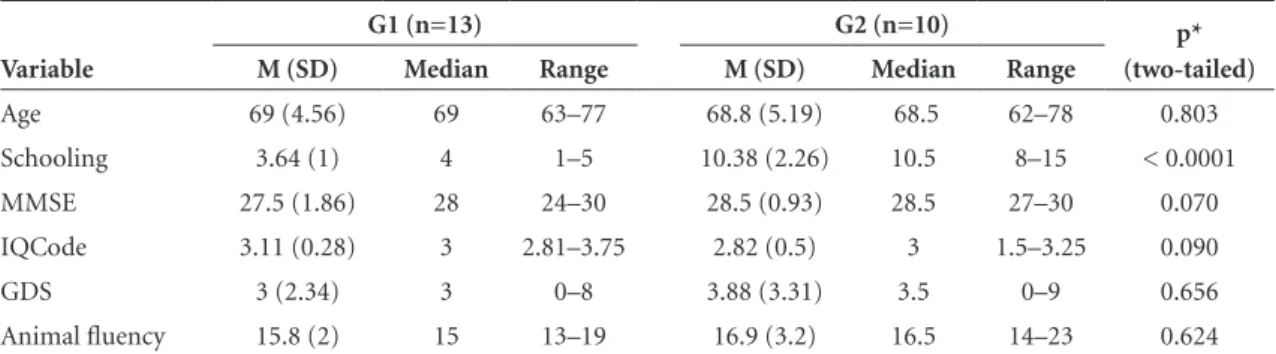
There were no differences between the two groups re-garding the performance on the MMSE, VF, GDS, Pfeffer and IQCode. The two groups differed in schooling (Table 1).
There were no significant differences between G1 and G2 in the identification of words and pseudo-words. In both groups there was a predominance of errors in pseudo-words (Table 2). The total scoring (decision on pseudo-words and pseudo-words) of the groups differed, with G1 perform-ing worse, with a tendency toward statistical significance. Moreover, none of the G1 subjects reached the total score in
Table 1. Demographic, cognitive and functional characteristics of the sample.
Variable
G1 (n=13) G2 (n=10) p*
(two-tailed)
M (SD) Median Range M (SD) Median Range
Age 69 (4.56) 69 63–77 68.8 (5.19) 68.5 62–78 0.803 Schooling 3.64 (1) 4 1–5 10.38 (2.26) 10.5 8–15 < 0.0001 MMSE 27.5 (1.86) 28 24–30 28.5 (0.93) 28.5 27–30 0.070 IQCode 3.11 (0.28) 3 2.81–3.75 2.82 (0.5) 3 1.5–3.25 0.090
GDS 3 (2.34) 3 0–8 3.88 (3.31) 3.5 0–9 0.656
Animal fluency 15.8 (2) 15 13–19 16.9 (3.2) 16.5 14–23 0.624
deciding on pseudo-words while the G1 group as a whole presented larger standard-deviations than G2.
In the rare errors in words, there was a predominance of items with low imageability, especially in the group with low schooling (Table 3). In G1, there was a positive corre-lation between schooling and correct answers in pseudo-words (Table 4).
Discussion
The auditory lexical decision can be extensively sup-ported by phonological lexical input. This is not the rule however, we tend to search for and rely on meaning, but the phonological support can help in cases of items that are not very familiar and in pseudo-words. Therefore the bal-ance between both processes (phonological and semantic) depends on our cultural (including schooling) experience and phonological support.
In this study, the participants presented very few errors on words, even though they did not understand the mean-ing of some of them, which they reported to the evaluator. These errors were mostly related to the low imageability of the stimuli. An influential hypothesis regarding the neural basis of the mental lexicon is that semantic representations are neurally implemented as distributed networks carrying
sensory, motor and/or more abstract functional informa-tion. Thus, it is possible that the stimuli that can be “imag-ined” comprise a more robust network of information of a visual modality. Our observations differ from those of Cortese and Khanna.26 These authors studied imageability
among 22 other variables, and found that this variable was not a predictor of good results in the lexical decision test.
A limitation of our study is the lack of availability of data on word frequency in Brazilian Portuguese. It is rea-sonable to assume the existence of an interaction of image-ability and frequency effects in our results.
According to Kay et al.,8 poor performances in the
lexi-cal decision task can be characterized by a large number of false positives for pseudo-words, as the participants establish a response using random criteria. In a previous study the occurrence of 15 or more false positives was considered as criteria for abnormality.13 In this study, there were more
er-rors in the deciding of pseudo-words, especially in G1; three subjects in this group (1 to 8 years of schooling) presented more than 15 false positives. The tendency toward a statisti-cally significant difference between the two groups for total score suggests the need to increase the sample. Additional in-vestigations might explain other processing difficulties, e.g. auditory difficulties, especially in the less educated group. Table 2. Scores on the lexical decision task.
Variable
G1 (n=13) G2 (n=10) p**
(two-tailed)
M (SD) Median Range M (SD) Median Range
Words 79.3 (0.92) 80 77-80 79.8 (0.63) 80 78-80 0.108 Pseudo-words 70.3 (15.3) 77 31-79 78.1 (1.46) 78 76-80 0.202 Total 149.7 (15) 156 111-159 158.1 (1.46) 158 156-160 0.055
**Mann-Whitney test; M: Mean; SD: Standard-Deviation.
Table 3. Lexicality and imageability effects.
Variables
Groups
Total
G1 (n=13) G2 (n=10)
Pseudo-words 111 (80.43%) 27 (19.56%) 138
Words Low-imageability 12 (92%) 1 (7%) 13
Words High-imageability 1(50%) 1(50%) 2
Total errors G1=124 (81.04%) Total errors G2 = 29 (18.95%) 153
Table 4. Correlation between schooling and performance of subjects on the lexical decision task***.
Variable G1(n=13) G2 (n=10) Total
Words 0.341 (p=0.218) –0.243 (p=0.466) 0.372 (p=0.074) Total 0.754 (p=0.006) 0.093 (p=0.780) 0.568 (p=0.006)
Language tasks are influenced by exposure to formal in-struction. Illiteracy alone is not a determinant of poor per-formance in these evaluations, but positive correlations can be established between the number of years of schooling and performance in tasks of a semantic and phonologic na-ture.23,27 In adults, the different degrees of exposure to social
and work activities should not be overlooked as they might explain the greater standard-deviation observed in G1.
The task of lexical decision demands skills in the inter-face of lexical and semantic processing. It depends on the extent of vocabulary and knowledge, for which formal edu-cation plays an important role. In comparing two similar items (words and pseudo-words), such as those compris-ing our study, less-educated subjects displayed the limita-tion in their vocabulary knowledge. It is worth noting that these subjects were examined in a meta-cognitive situation, where semantic and phonologic knowledge (phonologic consciousness) was explicitly solicited.
Other studies have shown the influence of meta-cog-nitive performance on lexical decision tasks25 in literate
subjects. We noted that this apparently simple test, akin to other language tests, can be influenced not only by an extreme degree of illiteracy but also by reduced exposure to formal education.23,25
One last aspect which warrants discussion is ageing and its possible impact on performance in tasks of lexical decision. Our study was aimed at the younger aged, where marked differences in relation to young participants were not expected. Other studies on performance of the older aged in lexical decision tasks have indicated that this group presents a greater reaction time when there is competitive presentation of the stimuli27 and greater dependence in
terms of semantic context.28,29
Concluding, there was a mild effect of schooling on the studied sample. Knowledge of the influence of schooling in healthy populations can contribute to the understanding of cognitive impairment. It is possible that extended samples can contribute to estimating pre-morbid skills as well as the severity of dementia, such as Alzheimer’s disease. The clinical applicability is particularly useful in the mild stages, when semantic impairment is not yet exuberantly notable.
References
1. Baddeley A. Introduction and overview. In: Baddeley A, edi-tor. Working Memory, Thought and Action. Oxford Univer-sity Press. Oxford; 2007:1-13.
2. Raymer A, Rothi LJG. Cognitive approaches to impairments of word comprehension and production. In: Chapey R, edi-tor. Language intervention strategies in aphasia and related neurogenic communication Disorders. 4th ed., Philadelphia:
Lippincott Williams and Wilkins; 2001:524-550.
3. Segui J. La perception du langage parlé : donnés et théories. In: Lambert J, Nespoulous JL, editors. Perception auditive et compréhension du langage : état initial, état stable et patholo-gie. Marseille. Ed Solal; 1997:15-23.
4. Cutler A, Clifton Jr C. Comprehending spoken language: a blueprint of the listener. In: Brown CM, Hargoort P, editors. The neurorecognition of language. Oxford University Press. Oxford; 2000:123-166.
5. Joseph R. The Left Cerebral Hemisphere – Language, aphasia, apraxia, alexia, agraphia, psychosis, the evolution of reading and writing, and the origin of thought. In: Joseph R, editor. Neuropsychiatry, neuropsychology and clinical neuroscience. 2nd ed., Baltimore: Williams and Wilkins; ,1996:119-158
6. Kolinsky R. Conséquences cognitives de I´illettrisme. In: Carbonel S, Gillet PMD, Martory MD, Valdois S, editors. Ap-proche cognitive des troubles de lecture et de I´écriture chez I´enfant et I´adulte. Marseille. Collection Neuropsychologie. Solal; 1996:291-304.
7. Raettig T, Kotz SA. Auditory processing of different types of pseudo-words: an event related fMRI study. Neuroimage 2007;39:1420-1428.
8. Kay J, Coltheart M, Lesser R. Psycholinguistic Assessments of Language Processing in Aphasia. Hove: Lawrence Erlbaum Associates;1992.
9. Valle F, Cuetos F. EPLA: Evaluación del Procesamiento Lingüístico en la Afasia. In: Valle F, Cuetos F, editors. Hove. UK: Lawrence Erlbaum Associates.1995.
10. Castro SL, Caló S, Gomes I, Kay J, Lesser R, Coltheart M. PALPA-P, Provas de Avaliação da Linguagem e da Afasia em Português [Tasks for the assessment of language processing and aphasia in Portuguese, PALPA-P]. Lisboa: CEGOC; 2007. 11. McFarlane J, Welch J, Rodgers J. Severity of Alzheimer’s dis-ease and effect on premorbid measures of intelligence. Br J Clin Psychol. 2006;45:453-463.
12. Rogers SL, Friedman RB. The underlying mechanisms of semantic memory loss in Alzheimer’s disease and semantic dementia. Neuropsychologia. 2008;46:12-21.
13. Misiurski C, Blumstein SE, Rissman J, Berman D. The role of lexical competition and acoustic-phonetic structure in lexi-cal processing: evidence from normal subjects and aphasic patients. Brain Lang 2005;93:64-78.
14. Davis C, Kim J, Forster KI. Being forward not backward: Lexi-cal limits to masked priming. Cognition. 2008;107:673-684. 15. Almkvist O, Adveen M, Henning L, Tallberg IM. Estimation
of premorbid cognitive function based on word knowledge: the Swedish Lexical Decision Test (SLDT). Scand J Psychol 2007;48:271-279.
vali-dation of a geriatric depression screening scale: a preliminary report. J Psychiatr Res 1983;17:37-49.
18. Brucki SM, Malheiros SM, Okamoto IH, Bertolucci PH. Nor-mative data on the verbal fluency test in the animal category in our milieu. Arq Neuropsiquiatr 1997;55:56-61.
19. Pfeffer RI, Kurosaki TT, Harrah CH, Chance JM, Filos S. Measurement of functional activities in older adults in the community. J Gerontol.1982;37:323-329.
20. Jorm AF, Jacomb PA. Informant Questionnaire on Cognitive Decline in the Elderly. In: Burns A, Lawlor BE, Craig S, edi-tors. Assessment scales in old age psychiatry. Londres: Martin Dunitz; 1999:260-261.
21. Bustamante SEZ, Bottino CMC, Lopes MA, et al. Instrumen-tos combinados na avaliação de demência de idosos. Arq Neu-ropsiquiatr 2003;61:601-606.
22. Smith GE, Ivnik RJ. Normative neuropsychology. In: Petersen RC, editor. Mild Cognitive Impairment, New York: Oxford; 2003:63-88.
23. Radanovic M, Mansur LL, Scaff M. Normative data for the Brazilian population in the Boston Diagnostic Aphasia
Ex-amination: influence of schooling. Braz J Med Biol Res 2004; 37:1731-1738.
24. Kosmidis MH, Tsapkini K, Folia V, Vlahou CH, Kiosseoglou G. Semantic and phonological processing in illiteracy. J Int Neuropsychol Soc 2004;10:818-827.
25. Kosmidis MH, Tsapkini K, Folia V. Lexical processing in illiter-acy: effect of literacy or education? Cortex 2006;42:1021-1027. 26. Cortese MJ, Khanna MM. Age of acquisition predicts nam-ing and lexical-decision performance above and beyond 22 other predictor variables: an analysis of 2,342 words. Q J Exp Psychol 2007;60:1072-1082.
27. Simpson GB, Kellas G, Ferraro FR. Age and the allocation of attention across the time course of word recognition. J Gen Psychol 1999;126:119-133.
28. Stine-Morrow EA, Soederberg Miller LM, Nevin JA. The ef-fects of context and feedback on age differences in spoken word recognition. J Gerontol B Psychol Sci Soc Sci. 1999; 54: 125-134.
29. Cohen G, Faulkner D. Word recognition: age differences in contextual facilitation effects. Br J Psychol 1983;74:239-251.
Appendix. Sample of lexical decision test.
Target Imageability Lexicality
1 episode (episódio) LI W
2 theory (teoria) LI W
3 elbow (cotovelo) HI W
4 moneira PW
5 hotel (hotel) HI W
6 potato (batata) HI W
7 jemela PW
8 pucto PW
9 church (igreja) HI W
10 tramanho PW