Knowledge of healthcare professionals
about rights of patient’s images
Conhecimento dos profissionais de saúde sobre os direitos de imagem do paciente
Bianca Rodrigues Caires1, Maria Carolina Barbosa Teixeira Lopes1, Meiry Fernanda Pinto Okuno1,
Cássia Regina Vancini-Campanharo1, Ruth Ester Assayag Batista1
1 Universidade Federal de São Paulo, São Paulo, SP, Brazil.
Corresponding author: Maria Carolina Barbosa Teixeira Lopes – Escola Paulista de Enfermagem, Universidade Federal de São Paulo – Rua Napoleão de Barros, 754 – Vila Clementino – Zip code: 04024-002 São Paulo, SP, Brazil – Phone: (55 11) 5576-4000 – E-mail: [email protected]
Received on: June 26, 2014 – Accepted on: Sep 30, 2014
Conflicts of interest: none.
DOI: 10.1590/S1679-45082015AO3207
ABSTRACT
Objective: To assess knowledge of healthcare professionals about capture and reproduction of images of patients in a hospital setting.
Methods: A cross-sectional and observational study among 360 healthcare professionals (nursing staff, physical therapists, and physicians), working at a teaching hospital in the city of São Paulo (SP). A questionnaire with sociodemographic information was distributed and data were correlated to capture and reproduction of images at hospitals. Results: Of the 360 respondents, 142 had captured images of patients in the last year, and 312 reported seeing other professionals taking photographs of patients. Of the participants who captured images, 61 said they used them for studies and presentation of clinical cases, and 168 professionals reported not knowing of any legislation in the Brazilian Penal Code regarding collection and use of images.
Conclusion: There is a gap in the training of healthcare professionals regarding the use of patient´s images. It is necessary to include subjects that address this theme in the syllabus of undergraduate courses, and the healthcare organizations should regulate this issue.
Keywords: Privacy; Healthcare personnel; Ethics, professional
RESUMO
Objetivo: Avaliar o conhecimento dos profissionais da saúde sobre a captação e a reprodução de imagens de pacientes em ambiente hospitalar. Métodos: Estudo observacional e seccional, realizado com 360 profissionais de saúde (equipe de enfermagem, fisioterapeutas e médicos), que atuam em um hospital universitário localizado no município de São Paulo (SP). Foi aplicado um questionário com informações sociodemográficas e relacionados à captação e reprodução de imagens no ambiente hospitalar. Resultados: Dos 360 entrevistados, 142 haviam captado imagens de pacientes no último ano, e 312 afirmaram ter visto outro profissional fazendo imagens de pacientes. Dos participantes que captaram imagens, 61 disseram que as utilizaram para estudos
e apresentação de casos clínicos, e 168 profissionais relataram não conhecer nenhuma legislação do Código Penal Brasileiro a respeito de captação e do uso de imagens. Conclusão: Há uma lacuna na formação dos profissionais de saúde em relação ao uso da imagem de pacientes, sendo necessário incluir, na graduação, disciplinas que contemplem essa temática, assim como a regulamentação por parte das instituições de saúde.
Descritores: Privacidade; Pessoal de saúde; Ética profissional
INTRODUCTION
Privacy is an individual right, which covers situations related to the intimacy of each person, to respect for dignity, and to family and social relationships. When hospitalized, people find themselves in a situation of extreme fragility, in which they often need care that invades their intimacy.(1,2)
Being ill generates some feelings, such as incapacity, dependency, insecurity, and a feeling of loss of control over oneself. Patients face hospitalization as a depersonalization factor, since they recognize the difficulty in maintaining their identity, intimacy, and
privacy.(3) Observing the practice of care, a lack of
concern regarding body exposure is noted in many situations, along with little preoccupation with the patient’s modesty. This person, who should be perceived as the subject of care, becomes an object, losing his/her identity.(2)
situation of exposure of the patient’s body at the time of medical care has been reported as a moment of potential
breach of a patient’s privacy.(4) However, healthcare
professionals should be attentive to one more action which can compromise the patient’s dignity: the registration of images. The use of the cell phone with photographic camera by many healthcare professionals has facilitated the capture and reproduction of images of patients with a
compromise of the level of consciousness.(5)
Particularly in the emergency scenario, filming raises specific ethical issues, since the patients are often vulnerable, many times without the capacity to consent,
or they feel under pressure to give their consent.(6) One
international study analyzed the commercialization of images of medical care in the hospital settings. As a result, it was shown that many times filming violated the privacy of patients, which generally could be avoided with the adequate consent from the individual. We point out, however, that patients could feel obligated or compelled by the person who was in command of
his/her care and well-being.(7)
In Brazil, the legislation is very clear as to the right to images. According to the Federal Constitution of 1988, article 5, item X, “Intimacy, private life, honor, and the image of persons are inviolable, assuring the right to compensation for the material or moral damage resulting from its violation.”(8)
Although the Federal Constitution and some professional boards prohibit making and/or using images of patients without their consent, within the hospital setting this is still a frequent practice on the part of some professionals. In times when technology is highly popularized, and when most professionals have cell phones with photographic cameras, the capture and reproduction of patient images are facilitated.
It is believed that the evaluation of knowledge of the healthcare professionals as to the rights of images and privacy of the patient is important, since it generates a basis for conducting educational interventions on the theme.
OBJECTIVE
To evaluate the knowledge of healthcare professionals as to the capture and reproduction of patient images within a hospital environment.
METHODS
This is an observational and cross-section study, carried
out at the teaching hospital of the Universidade Federal
de São Paulo, in the city of São Paulo (SP), during the period from February 2013 to July 2013.
The study sample was made up of nurses, licensed practical nursing and nursing technicians, medical residents, and physical therapists that performed their activities in the hospital environment. Based on the estimate of a population proportion of 2,590 professionals, the formula for determination of sample size of 335 individuals was used, with a confidence interval of 95% and sample error of 5%. Included were 360 questionnaires, by means of a convenience sample.
A subject characterization questionnaire was used with the purpose of investigating some sociodemographic aspects (sex, age, profession, time of professional experience, type of professional bond, and unit where they worked) and those related to capture and reproduction of images within the hospital setting.
Data collection was carried out during the period of February to July, 2013. Before the collection, the Informed Consent Form was presented to the study participants, and upon their agreement to participate in the research, they were presented with the data collection instruments.
The data were presented by means of descriptive
statistics. To compose the variables of interest, the χ2
test was used, and when this was not appropriate, the likelihood ratio was used. The significance level was 5% (p value <0.05).
The project was approved by the Research Ethics
Committee of the Universidade Federal de São Paulo,
under CAAEnumber09250112.2.0000.5505.
RESULTS
Of the 360 healthcare professionals interviewed, there was a 72.8% predominance of females, 89.7% were aged ≥40 years, 31.4% were nurses, 36.7% reported a professional experience time of 1 to 3 years, 43.9% (n=158) were residents, and regarding the place of work in the hospital, 43.0% worked at inpatients units.
Most participants (81.3%) declared that they had witnessed other healthcare professional making images of patients, 9.7% of which had seen this once, 23.3% from two to four times, 48.3% more than four times, 5.3% reported not remembering, and 13.3% were not witnesses.
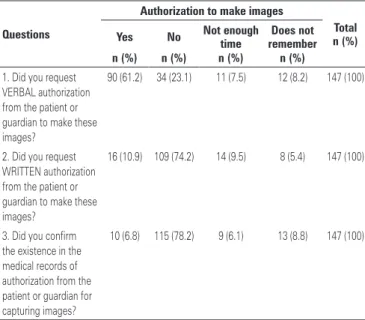
captured images (n=147), most reported having requested verbal authorization (61.2%) and the minority requested written authorization (10.9%) (Table 1).
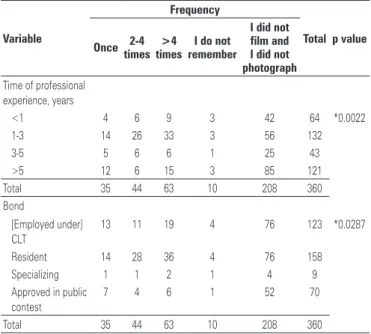
nursing, there was a significantly greater number of individuals who did not photograph/film patients relative to the other professionals (p=0.0000). Additionally, the same statistical test revealed that professionals with an experience of more than 5 years photographed/filmed significantly less relative to the employees with less time of experience (p=0.0022). As to a bond, medical residents photographed/filmed significantly more relative to those with other bonds (p=0.0287) (Table 3).
Table 1. Aspects of the authorization to make images (n=147)
Questions
Authorization to make images
Total n (%) Yes No Not enough
time
Does not remember n (%) n (%) n (%) n (%)
1. Did you request VERBAL authorization from the patient or guardian to make these images?
90 (61.2) 34 (23.1) 11 (7.5) 12 (8.2) 147 (100)
2. Did you request WRITTEN authorization from the patient or guardian to make these images?
16 (10.9) 109 (74.2) 14 (9.5) 8 (5.4) 147 (100)
3. Did you confirm the existence in the medical records of authorization from the patient or guardian for capturing images?
10 (6.8) 115 (78.2) 9 (6.1) 13 (8.8) 147 (100)
Table 2. Aspects as to the preservation of the image and legal implications (n=360)
Questions
Knowledge of professionals
Total n (%) Yes No I do not know n (%) n (%) n (%)
1. Do you think that making images of a person without prior authorization has legal implications?
351 (97.5) 3 (0.8) 6 (1.7) 360 (100)
2. Do you think that the individual’s image should be preserved?
353 (98.1) 4 (1.1) 3 (0.8) 360 (100)
3. In the Brazilian Federal Constitution, Civil Code, and Penal Code do you know about any item that provides for the capture and use of the images of persons?
126 (35.0) 168 (46.7) 66 (18.3) 360 (100)
4. In the Code of Ethics of your profession, do you know about any legislation that provides for the capture and use of images of patients?
167 (46.4) 116 (32.2) 77 (21.4) 360 (100)
Table 3. Association between sociodemographic characteristics and making patient’s images (n=360)
Variable
Frequency
Total p value Once 2-4
times >4 times
I do not remember
I did not film and I did not photograph
Sex
Male 8 8 29 3 50 98 *0.0058
Female 27 36 34 7 158 262
Total 35 44 63 10 208 360
Age, years
≤40 35 43 61 10 174 323 *0.0000
≥41 0 1 2 0 34 37
Total 35 44 63 10 208 360
Profession
Nurse 12 18 17 1 65 113 *0.0000
Nursing technician/ Licensed practical nursing
9 3 6 4 89 111
Physician 9 16 30 3 37 95
Physical therapist 5 7 10 2 17 41
Total 35 44 63 10 208 360
continue...
In questioning if they considered it important to request authorization from the patient to capture the images, 90% (n=324) responded yes, and 8.8% (n=32) responded yes, but that frequently there was not enough time to request it. When the participant was questioned as to if they thought making images of a person without their prior authorization had legal implications, 97.5% (n=351) responded yes.
Of the 147 participants that affirmed having made images, 41.5% (n=61) used them for the presentation of clinical cases and studies, 12.2% (n=18) showed friends and relatives outside of work, and 0.7% (n=1) published them on social networks. The results as to knowledge of the professionals on capturing images demonstrated that most professionals knew of the prohibition of making images (97.5%) and of the need to preserve the individual’s image (98.1%) (Table 2).
In making the association of sociodemographic
variables with taking images, the χ2 test was used, which
showed that the male professionals made more images/ films (p=0.0058), and in the age group ≥41 years, a significant number of professionals had not made images (p=0.000).
In order to obtain the list of the professional category with the number of individuals who captured images,
the χ2 test was also used, which demonstrated that in
As to knowledge of any item in the Brazilian Federal Constitution, Civil Code, and Penal Code as to the capture of images of persons, the medical residents reported the least amount of knowledge (p=0.0465).
DISCUSSION
Currently, technology has given great support to the work of healthcare professionals. Nevertheless, the fact that the majority of healthcare professionals has access to new technologies, such as cell phones with photographic cameras, has created a new ethical confrontation in healthcare organizations, since situations experienced by the patients are easily captured and reproduced, with
rare obtaining of prior consent from the patient.(5)
Patients should have a chance to give or not give their consent for making of images. This should be documented in a way that fulfills the recommendations of the code of ethics and of the patient’s data and confidentiality
protection.(9) Once the subject photographed authorizes
the use of the image, it is important to observe that the consent should be interpreted restrictively, since acceptance to be photographed may not include its publication; in the same way, the agreement for publication does not include other uses.(9)
In this study, as well as in the similar study result, we identified that the main purpose of the images
was teaching.(10) The Institute of Medical Illustrators
published, in 2006, a manualon obtaining consent for
images of patients, which emphasizes that obtaining consent is the responsibility of the professional. This term should have specified the purpose of the images, so that the patient may agree or not agree with its use. It is a common practice to offer three levels of authorization: for use only in the medical records; for use in teaching healthcare professionals and students;
for publication and public domain.(11)
Good practices indicate that the consent for publication should only be obtained for one specific use; it is not a comprehensive release. If the publication is in a journal, book, electronic media, or the internet, the patient should receive the orientation that, once published, the consent cannot be withdrawn, especially for publication on the internet, since the images are in public domain.(11)
Some experts on civil law still defend that the right to image includes cases in which the image might be violated without there being any graphic reproduction of it, not restricting it only to the physical form of the
subject.(9) The image-picture and the image-attribute
compose the identity of each individual, and its violation may cause moral damage to the person. They support that “every and any lesion that affects the individual’s being will have enough characteristics to be considered
as moral damage.”(12)
Despite moral damages and invasion of privacy, there are law researchers defending that public interest is a directive of extreme importance and therefore, if the divulging of an image is justified in this, the law of
freedom of expression prevails.(13) Others consider that
public interest should be presumed in a democratic rule-of-law state, in order to make feasible the free circulation of ideas.(14)
Although this study verified that the participating professionals used verbal authorization, the consent process should be in written form. It is important to have documented proof to support a legal defense,
when necessary.(11) Written consent is the requirement
of many journals before publication and edition of
photographs with consent forms from the patients.(15)
It is important to point out that, in the institution where the study was developed, there is no policy for image capture, with the exception of the Burn Unit, where at the time of admission the patient or guardian is requested authorization for capturing images.
The results of this study allow inferring there are gaps in knowledge of the healthcare professionals during the undergraduate course relative to the right to image, since 46.7% said they were not aware of any item in the Brazilian Federal Constitution, Civil Code,
...Continuation
Table 3. Association between sociodemographic characteristics and making patient’s images (n=360)
Variable
Frequency
Total p value Once 2-4
times >4 times
I do not remember
I did not film and I did not photograph
Time of professional experience, years
<1 4 6 9 3 42 64 *0.0022
1-3 14 26 33 3 56 132
3-5 5 6 6 1 25 43
>5 12 6 15 3 85 121
Total 35 44 63 10 208 360
Bond
[Employed under] CLT
13 11 19 4 76 123 *0.0287
Resident 14 28 36 4 76 158
Specializing 1 1 2 1 4 9
Approved in public contest
7 4 6 1 52 70
Total 35 44 63 10 208 360
and Penal Code as to this capture, as well as to the use of images of the individuals. The lack of information on the right of images by healthcare professionals can be directly related to the absence of formal orientation for the lecturers on this topic.
According to a study that evaluated the orientation given by universities of the United States and the United Kingdom to their lecturers on the topic of consent for images and publications, it was identified that of the nine participating european universities, only one issued specific orientation for the faculty as to how to show photographs of patients in their presentations. And of the three american participants, none gave orientation, although the legislation of the United States refers to confidentiality.(16)
CONCLUSION
This study revealed that the capture and reproduction of patient images within a hospital environment are carried out by a considerable part of the professionals investigated, despite most being aware of the prohibition of this practice and the need to preserve the individual’s image.
Nurse technicians and licensed pratical nursing, as well as professionals with longer time of experience perform the capture and reproduction of images with less frequency. Residents of the various fields of health made up the category that most captured and reproduced images and that showed the least amount of knowledge as to the items provided for in the Brazilian Federal Constitution, Civil Code, and Penal Code.
REFERENCES
1. Waldow VR, Borges RF. O processo de cuidar sob a perspectiva da vulnerabilidade. Rev Lat Am Enferm. 2008;16(4):765-71.
2. Bettinelli LA, Pomatti DM, Brock J. Invasão da privacidade em pacientes de uti: percepções de profissionais. Rev Bioethikos. 2010;4(1):44-50.
3. Pupulim JS, Sawada NO. O cuidado de enfermagem e a invasão da privacidade do doente: uma questão ético-moral. Rev Lat Am Enferm. 2002;10(3):433-8. Portuguese.
4. BaggioI MA, Pomatti DM, Bettinelli LA, Erdmann AL. Privacidade em unidades de terapia intensiva: direitos do paciente e implicações para a enfermagem. Rev Bras Enferm. 2011;64(1):25-30. Portuguese.
5. Batista RE, Campanharo CR, Cohrs CR. Ética e legalidade na era da imagem digital. Acta Paul Enferm. 2012;25(5):1-2.
6. Geiderman JM, Larkin GL. Commercial filming of patient care activities in hospitals. JAMA. 2002;288(3):373-9.
7. Brasil. Constituição 1998. Constituição da República Federativa do Brasil. Brasília(DF): Senado Federal: Centro Gráfico; 1998.
8. Blain C, Mackay M. Informed consent. The global picture. Br J Perioper Nurs. 2002;12(11):402-7. Review.
9. Tepedino G, Barboza HH, Moraes MC. Código civil interpretado: conforme a Constituição da República. Rio de Janeiro: Renovar; 2004.
10. McG Taylor D, Foster E, Dunkin CS, Fitzgerald AM. A study of the personal use of digital photography within plastic surgery. J Plast Reconstr Aesthet Surg. 2008;61(1):37-40.
11. Institute of Medical Illustrators. IMI National Guidelines: Consent to Clinical Photography; 2006.
12. Silva ML. Conceito constitucional de dano moral: o desrespeito pela dignidade humana [tese]. São Paulo: Universidade Católica de São Paulo; 2002. 13. Rodrigues RB. Direito à imagem e dano moral: reparação por meio de
indenização pecuniária. Rev Estud Direito UnB. 2008;7:311-36.
14. Barroso LR. Colisão entre Liberdade de Expressão e Direitos da Personalidade. Critérios de Ponderação. Interpretação Constitucionalmente adequada do Código Civil e da Lei de Imprensa. Revista Trimestral de Direito Civil. 2003; 4(16):59-102.