Heart Institute, Hospital das Clínicas - FMUSP
Mailing address: Luiz Antônio Machado César - InCor - Unidade de Coronariopatias Crônicas - Av. Dr. Enéas C. Aguiar, 44 - 05403-000 - São Paulo, SP
Objective - To study the incidence of and variation in
myocardial ischemia over 48 hours in patients with unsta-ble angina.
Methods - Thirty-nine patients with unstable angina
underwent long-term electrocardiography for 48 hours. The number of events and the period of time of ischemia (in minutes) were analyzed for the 48 hours, in two periods of 24 hours, and in periods of 4 hours.
Results - We analyzed 1755.8 hours of monitoring
ta-pes, and ischemic episodes were detected in 18 (46.2%) patients, corresponding to 173 ischemic episodes, allowing the evaluation of 1304 minutes of ischemia.only 4 of which were (2.2%) symptomatic, Considering the entire period of time of recording and the predetermined time intervals, we observed a higher number of ischemic episodes (38) and a longer duration of ischemia (315.4 minutes) between 11:00 am and 3:00 pm. However, no significant differences occur-red among the values in the different intervals.
Conclusion - Long-term electrocardiography over 48
hours showed a high incidence (97.8%) of silent ischemic episodes in patients with unstable angina. No evidence of a circadian variation of myocardial ischemia in unstable angina was observed.
Key words: myocardial ischemia, Holter monitoring, uns-table angina.
Arq Bras Cardiol, volume 75 (nº 1), 14-18, 2000
Luiz Antônio Machado César, João Fernando Monteiro Ferreira, César J. Grupi, David Pamplona, Miguel A. Moretti, Elcio Pferfmann, José A. F. Ramires
São Paulo, SP - Brazil
Does a Circadian Variation Occur in Myocardial Ischemia
over 48 hours in Patients with Unstable Angina?
Myocardial ischemia is the result of inadequate coro-nary blood flow, promoting alterations in cellular metabo-lism, myocardial relaxation, and contractility, followed by ST-Tsegment abnormalities on electrocardiogram (ST- T segment elevation or depression), culminating in clinical ma-nifestation, i.e., angina.
Ischemic events can occur without clinical manifesta-tions; in fact, most of them (60-90%) are silent 1-4. Based on
this fact, the concept of silent ischemia arose, i.e., the occur-rence of ischemic events without any clinical expression that could identify them.
Long-term electrocardiography, due, is the most used method in clinical studies for evaluating the presence of myo-cardial ischemia, particularly in individuals with documented coronary artery disease 5. Using this method, a number of
stu-dies have been conducted involving individuals with known coronary artery disease and clinical manifestations of angina. In 1982, Johnson et al 6, studying patients with unstable angina,
reported the importance of the presence of silent ischemia identifying those with more extensive coronary artery disease and those subgroups with a worse short-term clinical course. Similarly, Gotlieb et al 7 showed the importance of myocardial
ischemia as a prognostic factor during the first 30 days in patients with unstable angina and, even in those patients who received intensive pharmacological treatment, the presence of ischemia had a prognostic value higher than coronary anatomy evaluated by angiography.
Another interesting phenomenon is the variation in ischemic events throughout the 24 hours of a day. Reports exist indicating that ischemia, with or without symptoms, has a circadian variation in either stable 8,9 or unstable
angi-na 10-13. Moreover, we know neither the incidence of silent
Methods
We studied 39 patients, 21 males and 18 females, with a mean age of 58±10.71 years (38-75 years) and a diagnosis of unstable angina, who were treated at the Emergency Unit of the Heart Institute of the Hospital das Clínicas of FMUSP, from November 1993 to December 1995. At the first scre-ening, the clinical history, a physical examination, a standard 12-lead surface electrocardiogram, plasma levels of creatine kinase (CK-MB), BUN, creatinine, glucose, and blood cell count were obtained. All the patients underwent long-term electrocardiography (Holter monitoring) for 48 consecutive hours. From the beginning and during the entire study period, the patients received aspirin 100mg/day orally, diazepam 5mg each 8 hours orally and intravenous nitrate.
We required two criteria for the diagnosis of unstable angina: 1) clinical criterion - unstable angina as a manifesta-tion of chest discomfort or pain, radiating or not to one or both upper limbs, neck, dorsal region, epigastrium or jaw, ac-companied or not by concomitant factors, such as swea-ting, palpitations or sense of imminent death. It was neces-sary for the diagnosis that the patient had experienced a clear worsening of symptoms for no more than 7 days and the last episode for no more than 24 hours; 2) diographic criterion - it was necessary that the electrocar-diogram had at least one of the following alterations: tran-sient or persistent T-wave inversion in at least two conti-guous leads, or transient ST-segment depression >1mm in two or more contiguous leads.
The exclusion criteria were postinfarction angina, pre-vious cardiac surgery or coronary angioplasty, valvular heart disease, uncontrolled arterial hypertension, congesti-ve heart failure, hepatic and renal failure, uncontrolled diabe-tes mellitus, signs and symptoms of hyperthyroidism, ane-mia, pregnancy and age <18 years or >80 years, as well as al-terations on the 12 lead electrocardiogram, such as right or left bundle branch block, Mobitz type II 2nd degree
atrioven-tricular block, 3rd degree atrioventricular block, PR interval
<0.10 second, delta wave indicative of presence an acces-sory pathway, even in the absence of Wolf-Parkinson-White syndrome, atrial fibrillation, atrial flutter, and narrow or wide QRS tachycardias.
Long-term electrocardiography - technical considera-tions about the examination and recordings – a two-channel (CM5 and CM1M) portable Marquette 8000 monitor was used (Marquette, Milwaukee, WI, USA), with wave recor-ding in AM (amplitude-modulated), containing a cassette tape for continuous 24-hour recording. After this time, the tape was replaced by another allowing a total of 48 hours of study. The monitor was connected to the patients and du-ring the following 48 hours the patients were instructed to report the occurrence of chest pain or episodes of discomfort similar to those that had caused them to go to the hospital. The time of any pain episode was registered in the diary of the long-term electrocardiography examination, in order to verify whether a certain ischemic event had been sympto-matic or not. After the monitor was removed, the tapes were
analyzed on the processor Marquette Laser SXP processor (Marquette, Milwaukee, WI, USA, 1988) and assessed by at least two professionals of the Electrocardiology Unit of the Heart Institute.
Diagnostic criteria for ischemic events: ST-segment elevation >2mm or horizontal or downsloping ST-segment depression >1mm, persisting for at least 1 minute, and returning to the baseline for at least 1 minute. The possible events identified as described were defined as ischemic episodes, and each one of these events was registered on paper, with a velocity of 25mm/second, with the pattern of 1 mV, using a Marquette laser printer, and then ST-segment variation and the period of time of ischemia of each event were reevaluated manually.
Evaluation of ischemic events: 1) the total number of episodes and the sum of the period of time in minutes, of all events for each individual during the 48 hours of observa-tion; 2) the same evaluation described for each period of 24-hour recording, i.e., the first and the second periods accor-ding to each one of the recorded tapes; 3) the total number of events and the total period of time of ischemia in minutes for each period of 4 hours, in the 24 hours of each one of the two days of recording, respectively from 11:00 pm to 3:00 am, from 3:00 am to 7:00 am, from 7:00 am to 11:00 am, from 11:00 am to 3:00 pm, from 3:00 pm to 7:00 pm, and from 7:00 pm to 11:00 pm.
Statistical analysis - the analysis of data was conduc-ted by the Statistics Department of the Heart Institute. For measures that did not have a normal distribution, the varia-bles were presented in a descriptive manner in graphs and tables containing the medians, means, standard deviations and minimum and maximum values, and the groups were evaluated by the Friedman’s test 14. This procedure was
performed to evaluate the variation in the number of ische-mic episodes and the duration of ischemia in the 4-hour intervals. Non Continuous variables were analyzed by the nonparametric Wilcoxon’s rank sum test 14, which was
performed to compare the number of episodes and the duration of ischemia between the first and the second perio-ds of the long-term electrocardiographic recording, i.e., the first tape recording compared with the second one.
The calculations were processed by the SAS (statisti-cal analysis system) and a p value <0.05 was considered sta-tistically significant.
Results
We observed 1755.8 hours of monitoring in the 39 pati-ents, a mean of 45.02 (23.13 to 48) hours per case. We detec-ted ischemic episodes in the long-term electrocardiograms of 18 (46.2%) patients. In these 18 patients, the recordings allowed us to observe 820.88 hours of continuous electro-cardiographic monitoring, corresponding to a mean of 45.6±5.76 (23.13 to 48) hours per patient (table I). In five patients, we could not obtain electrocardiogram tracines that allowed ST-segment analysis.
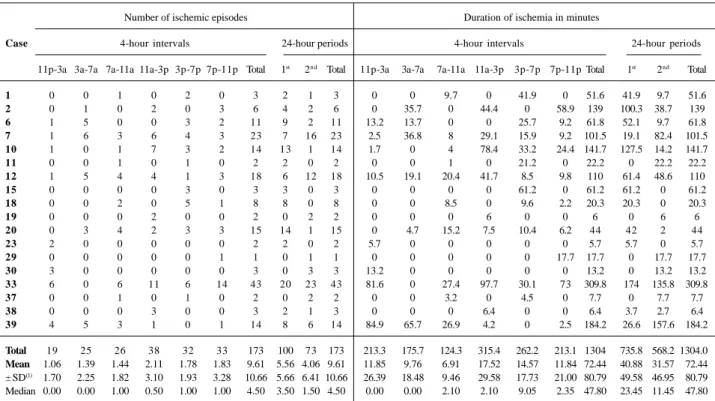
observa-tion, allowing us to analyze a total of 1304 minutes of ische-mia only 4 (2.2%) of them being symptomatic. This corres-ponds to a mean of 9.61±10.66 (1 to 43) ischemic episodes and 72.44±80.65 (5.7 to 184.2) minutes of ischemia per patient. Evaluating the occurrence of ischemic events, con-sidering the whole period of recording and the predeter-mined intervals, we observed that there was a higher inci-dence of ischemic events from 11:00 am to 3:00 pm, either in the number, 38 episodes (fig. 1), or in the duration of is-chemia, 315.4 minutes (fig. 2). However, no significant diffe-rence occurred among the values of these intervals, p=0.47 for the number of episodes and p=0.43 for the period of time of ischemia. Similarly, a higher number of episodes and a longer period of time of ischemia occurred in the first period of recording, compared with the second (table I), without statistical significance, with p=0.42 for the number of episo-des and p=0.35 for the duration of ischemia. Figures 1 and 2 more effectively show the distribution of these events among the different intervals.
Discussion
Our results apparently show a relatively low incidence of myocardial ischemia in patients with unstable angina, considering that ischemia was present in less than 50% of the patients. Otherwise, our results confirm the high inci-dence of asymptomatic ischemic events (97.8%) in a popu-lation of patients with unstable angina. Although our study population did not comprise a very large number of
patients, the use of long-term electrocardiography over 48 hours certainly diminished the importance of evaluating only 39 patients.
Fig. 1 - Number of ischemic episodes per time interval over 24 hours of a day.
Fig. 2 - Duration of ischemia per time interval over 24 hours of a day.
Table I - Characteristics of ischemic episodes throughout the time for each case.
Number of ischemic episodes Duration of ischemia in minutes
Case 4-hour intervals 24-hour periods 4-hour intervals 24-hour periods
11p-3a 3a-7a 7a-11a 11a-3p 3p-7p 7p-11p Total 1st 2nd Total 11p-3a 3a-7a 7a-11a 11a-3p 3p-7p 7p-11p Total 1st 2nd Total
1 0 0 1 0 2 0 3 2 1 3 0 0 9.7 0 41.9 0 51.6 41.9 9.7 51.6
2 0 1 0 2 0 3 6 4 2 6 0 35.7 0 44.4 0 58.9 139 100.3 38.7 139
6 1 5 0 0 3 2 11 9 2 11 13.2 13.7 0 0 25.7 9.2 61.8 52.1 9.7 61.8
7 1 6 3 6 4 3 23 7 16 23 2.5 36.8 8 29.1 15.9 9.2 101.5 19.1 82.4 101.5
10 1 0 1 7 3 2 14 13 1 14 1.7 0 4 78.4 33.2 24.4 141.7 127.5 14.2 141.7
11 0 0 1 0 1 0 2 2 0 2 0 0 1 0 21.2 0 22.2 0 22.2 22.2
12 1 5 4 4 1 3 18 6 12 18 10.5 19.1 20.4 41.7 8.5 9.8 110 61.4 48.6 110
15 0 0 0 0 3 0 3 3 0 3 0 0 0 0 61.2 0 61.2 61.2 0 61.2
18 0 0 2 0 5 1 8 8 0 8 0 0 8.5 0 9.6 2.2 20.3 20.3 0 20.3
19 0 0 0 2 0 0 2 0 2 2 0 0 0 6 0 0 6 0 6 6
20 0 3 4 2 3 3 15 14 1 15 0 4.7 15.2 7.5 10.4 6.2 44 42 2 44
23 2 0 0 0 0 0 2 2 0 2 5.7 0 0 0 0 0 5.7 5.7 0 5.7
29 0 0 0 0 0 1 1 0 1 1 0 0 0 0 0 17.7 17.7 0 17.7 17.7
30 3 0 0 0 0 0 3 0 3 3 13.2 0 0 0 0 0 13.2 0 13.2 13.2
33 6 0 6 11 6 14 43 20 23 43 81.6 0 27.4 97.7 30.1 73 309.8 174 135.8 309.8
37 0 0 1 0 1 0 2 0 2 2 0 0 3.2 0 4.5 0 7.7 0 7.7 7.7
38 0 0 0 3 0 0 3 2 1 3 0 0 0 6.4 0 0 6.4 3.7 2.7 6.4
39 4 5 3 1 0 1 14 8 6 14 84.9 65.7 26.9 4.2 0 2.5 184.2 26.6 157.6 184.2
Total 19 25 26 38 32 33 173 100 73 173 213.3 175.7 124.3 315.4 262.2 213.1 1304 735.8 568.2 1304.0 Mean 1.06 1.39 1.44 2.11 1.78 1.83 9.61 5.56 4.06 9.61 11.85 9.76 6.91 17.52 14.57 11.84 72.44 40.88 31.57 72.44 ± SD(1) 1.70 2.25 1.82 3.10 1.93 3.28 10.66 5.66 6.41 10.66 26.39 18.48 9.46 29.58 17.73 21.00 80.79 49.58 46.95 80.79
Median 0.00 0.00 1.00 0.50 1.00 1.00 4.50 3.50 1.50 4.50 0.00 0.00 2.10 2.10 9.05 2.35 47.80 23.45 11.45 47.80
Regarding the findings of the long-term electrocardio-graphy as a function of the distribution of ischemic events throughout the 24 hours of a day, we should first point out that the option of dividing the day into 4-hour intervals and for defining them from 11:00 pm to 3:00 am, from 3:00 am to 7:00 am and so on, was based on the previous experience of other authors 8,9,12,13,15-17, who reported, as a rule, a higher
frequency of ischemic events from dawn until the first hours in the morning, the so-called circadian variation of ische-mia, with or without symptoms. This evidence was based on studies that evaluated the incidence of acute myocardial infarction throughout the 24 hours of a day 18,19, which
sho-wed a higher incidence between 3:00 am and 8:00 am. We realized, therefore, that, using these intervals of time, we would be able to detect a possible higher incidence of myo-cardial ischemia during the dawn (3:00 am to 7:00 am) period and in the morning (7:00 am to 11:00 am) period. However, our data showed a higher incidence of ischemic episodes and a longer duration of ischemia from 11:00 am to 3:00 pm, based on the sum of episodes of the two recorded tapes, i.e., during the 48 hours of the examination (table I). Althou-gh the comparative analysis did not demonstrate any signi-ficant difference in the incidence of ischemic episodes amon the intervals, the graphic observation of the events (figures 1 and 2) shows a trend toward higher incidence of events in the period between 11:00 am and 11:00 pm, compared with the period between 11:00 pm and 11:00 am. This was a surpri-sing finding because it was totally opposite to the previous reports in the literature cited above. We can conjecture that our observation was made with a relatively small number of patients whereas others studied up to 193 patients 12 to
con-clude about this circadian variation in angina and myocar-dial ischemia. We can also question whether this distribu-tion had some meaning in our patients, once the statistical analysis failed to show significant differences among the in-tervals of time.
To clarify this doubt, some points of concern need to be addressed. In the report of Figueiras et al 10, in 1986 16
pa-tients with resting angina and severe coronary artery di-sease were evaluated to determine the angina threshold at different times of the day. In the evaluation of this threshold, the heart rate needed to cause an ischemic episode was used, during at least six observations and for up to 4 days. The elevation in the heart rate was obtained through a car-diac pacemaker connected to the right atrium by puncture of the right subclavian vein. The authors decided to perform the stimuli in the following periods: between 10:00 pm and 1:00 am, 4:00 pm and 7:00 pm and midnight and 3:00 am. Analyzing the results, the authors concluded that “patients with resting angina and severe coronary artery disease fre-quently exhibit a fall in the ischemic threshold during the night”. The night period referred to by the authors corres-ponds to the period between 10:00 pm and 1:00 am. In 1995, Figueiras and Lidón 13 used the same technique to evaluate
the ischemic threshold in patients with unstable angina and severe coronary artery disease. However, the authors chose other periods of time for their observations (from 7:00 am to
8:00 am and from midnight to 1:00 am) and concluded that the reduction in the ischemic threshold in the beginning of the morning, in the absence of elevation in the baseline he-art rate and blood pressure, suggests that a reduction in the coronary vasodilation capacity or an elevation in the coro-nary tonus may favor a higher incidence of ischemic events during this interval. The conclusion of this study makes it evident that different results can be obtained depending on the time the observation is made. The doubt then arises when one wants to know the exact time of day when a lower ischemic threshold exist, and consequently an increase in the incidence of ischemic events. Analyzing another study 8 in
which the authors evaluated 32 patients with stable angina continuously monitored for at least 24 hours, we verified, through the figures in the manuscript, that the time with the highest incidence of ischemia (related to physical effort) was from 6:00 am to noon. However, analyzing the same fi-gures, another period with an increase in ischemic episodes can be noted, specifically from noon to 3:00 pm. Finally, in another study, Figueiras and Lidón observed ischemic epi-sodes through the occurrence of anginal symptoms in two periods of the day, between 7:00 am and 11:00 am and 7:00 pm and 11:00 pm, in 193 patients with unstable angina, a very expressive number of patients. The analysis of sub-groups showed a higher incidence of angina between 11:00 pm and 2:00 am in patients with severe, multivessel coronary artery disease.
In summary, although considerable evidence exist suggesting that ischemic episodes occur more often in the dawn and morning hours, particularly in the presence of a clinical condition of unstable angina, we should consider the possibility that populational variations can affect the occurrence of such episodes. In our population, Solimene et al 20 did not find variations in the occurrence of ischemia
during the 24 hours of a day, analyzing patients some mon-ths after an acute myocardial infarction. In addition, two other two researchers 21,22 did not observe circadian rhythm
and morning ischemia after an acute myocardial infarction either. On the contrary, they noted an even a higher inci-dence of ischemia from 6:00 pm to midnight. Finally, it is worth noting the experience of Beamer et al 11. These
au-thors studied 3990 individuals with a history of chest pain admitted to the Emergency Department of seven different hospitals. Their findings confirmed a higher number of diagnoses of acute myocardial infarction and unstable angi-na between 6:00 am and noon, but chest pain that was caused by nonischemic cardiac causes and by noncardiac causes was also more likely to begin during the same time period. It seems, therefore, that this circadian rhythm is rela-ted to factors that can trigger chest pain, not restricrela-ted to is-chemic myocardial pain.
va-riations. In addition, we noted a trend suggesting a higher distribution of episodes and a longer duration of ischemia in
1. Stern S, Tzivoni D. Early detection of silent ischaemia heart disease by 24 hours electrocardiographic monitoring of active subjects. Br Heart J 1974; 36; 481-5. 2. Allen RD, Gettes LS, Phalan C, Avington D. Painless ST-depression in patients
with angina pectoris. Chest 1976; 69: 467-73.
3. Epstein SE, Quyyumi AA, Bonow RO. Myocardial ischaemia: silent or sympto-matic. N Engl J Med 1988; 318: 1038-43.
4. Solimene MC. Isquemia silenciosa. Rev Soc Cardiol ESP 1993; 3: 54-9. 5. Parmley WW. Prevalence and clinical significance of silent myocardial
ischaemia. Circulation 1989; 80: 68-73.
6. Johnson SM, Mauritson DR, Winniford MD, et al. Continuous electrocardiogra-phic monitoring in patients with unstable angina pectoris: identification of high-risk subgroup with severe coronary disease, variant angina and/or impaired early prognosis. Am Heart J 1982; 103: 4-12.
7. Gottleib SO, Weisfeldt ML, Ouyang P, Mellits ED, Gerstenblith G. Silent is-chaemia as a marker for unfavorable outcomes in patients with unstable angina. N Engl J Med 1986; 314: 1214-9.
8. Rocco MB, Barry J, Campbell S, et al. Circadian variation on transient myocardial ischemia in patients with coronary artery disease. Circulation 1987; 75: 395-400.
9. Nademanee K, Intarachot V, Josephson MA, Singh BN. Circadian variation in oc-curence of transient overt and silent myocardial ischemia in chronic stable angina and comparasion with Prinzmetal angina in men. Am J Cardiol 1987; 60: 494-8. 10. Figueras J, Cinca J, Balda F, Moya A, Rius J. Resting angina with fixed coronary ar-tery stenosis: nocturnal decline in ischemic threshold. Circulation 1986; 74: 1248-54.
11. Beamer AD, Lee TH, Cook EF, et al. Diagnostic implications for myocardial is-chemia of the circadian variation of the onset of chest pain. Am J Cardiol 1987; 60: 998-1002.
12. Figueras J, Lidón RM. Circadian rythm of angina in patients with unstable
angi-References
na: relationship with extent of coronary disease, coronary reserve and ECG changes during pain. Eur Heart J 1994; 15: 753-60.
13. Figueras J, Lidón RM. Early morning reduction in ischemic threshold in patients with unstable angina and significant coronary disease. Circulation 195; 92: 1737-42.
14. Hollander M, Wolfe DA. Nonparametric Statistical Methods. New York: John Wiley & Sons Inc., 1973: 68-138.
15. Yasue H, Omote S, Takizama A, Nagao M, Miwa K, Tanaka S. Circadian variation of exercise capacity in patients with Prinzmetal variant angina: role of exercise – induced coronary arterial spasm. Circulation 1979; 59: 938-48.
16. Haussmann D, Nikutta P, Trappe H, Daniel WG, Wendzlaff P, Lichtlen PR. Cir-cadian distribution of characteristics of ischemic episodes in patients with stable coronary artery disease. Am J Cardiol 1990; 66: 668-72.
17. Carpeggiani C, Michelassi M, Biagini A, et al. Findings from long-term electro-cardiographic monitoring of patients with variant angina. Am J Cardiol 1987; 60: 36-9.
18. Thompson DR, Blandford RL, Sutton TW, Merchant PR. Time of onset of chest pa-in pa-in acute myocardial pa-infarction. Int J Cardiol 1985; 7: 139-46.
19. Muller JE, Stone PH, Turi ZG, et al, and MILIS Study Group. Cicadian variation in the frequency of onset of acute myocardial infarction. N Engl J Med 1985; 313: 1315-22.
20. Solimene MC, Ramires JAF, Gruppi CJ, Oliveira SFO, da Luz PL, Pilegi F. Varia-bilidade da freqüência cardíaca e isquemia silenciosa após infarto do miocárdio. Arq Bras Cardiol 1991; 57: 363-70.
21. Currie P, Saltissi S. Transient myocardial ischemia after acute myocardial infarc-tion. Br Heart J 1991; 64: 299-303.
22. Mickley H, Pless P, Nielsen JR, Moller M. Changing circadian variation of tran-si–ent myocardial ischemia during the first year after a first myocardial infarction. Am J Cardiol 1992; 64: 1117-22.