TranslaTion and ValidaTion inTo The
Brazilian PorTuguese of The resTless legs
syndrome raTing scale of The inTernaTional
resTless legs syndrome sTudy grouP
Alice H. Masuko
1, Luciane B.C. Carvalho
2, Marco A.C. Machado
3,
José F. Morais
4, Lucila B.F. Prado
5, Gilmar F. Prado
6Abstract – Background: Restless legs syndrome (RLS) is a chronic sensory-motor disorder characterized by unpleasant limb sensations and an irresistible urge to move. The International Restless Legs Syndrome Study Group developed the Restless Legs Syndrome Rating Scale (IRLS) to assess the severity of RLS symptoms. The objective of this study was to translate and validate the IRLS into Brazilian Portuguese. Method: The IRLS was translated into Brazilian Portuguese, analyzed, back translated to English, and compared to the original version. It was applied to 10 patients for cultural verification. The language was adjusted and the final version was administered to 30 patients (13 male, mean age 58.88±14.82). Results: There was correlation among the IRLS evaluation of three experts. Many linguistic adaptations were required to achieve cultural adequacy and the Cronbach’s alpha coefficient showed reliability of 80%. Conclusion: IRLS was translated, adapted, and validated to Brazilian Portuguese language, showing good reliability and validity.
KEy woRdS: restless legs syndrome, scale, severity, validation.
Tradução e validação para a língua portuguesa da escala de graduação da síndrome das pernas inquietas do grupo internacional do estudo da síndrome das Pernas inquietas
Resumo – Introdução: A síndrome das pernas inquietas (SPI) é uma doença crônica, sensório-motora, caracterizada por sensações desagradáveis nos membros e uma urgência em movimentá-los. o Grupo Internacional de Estudos da Síndrome das Pernas Inquietas desenvolveu a Escala de Graduação da Síndrome das Pernas Inquietas (EGSPI) para avaliar a gravidade dos sintomas da SPI. Objetivo: Traduzir, adaptar culturalmente e validar a EGSPI para o português do Brasil. Método: A escala foi vertida para o português, analisada, vertida novamente para o inglês e comparada com a versão original. Foi aplicada em 10 pacientes para adequação cultural. A linguagem foi ajustada e a versão final foi aplicada em 30 pacientes (13 homens, idade média de 58,88±14,82). Resultados:
Houve correlação da aplicação da escala entre três avaliadores. Foram necessárias adaptações lingüísticas para adequação cultural e o alfa de Chronbach mostrou confiabilidade de 80%. Conclusão: A EGSPI foi traduzida, adequada e validada para o português do Brasil, com boa validade e confiabilidade.
PALAvRAS-CHAvE: síndrome das pernas inquietas, escala, gravidade, validação.
Federal University of São Paulo, São Paulo SP, Brazil (UNIFESP): 1Md, Neuro-Sono section, department of Neurology; 2Phd, Neuro-Sono section, depart-ment of Neurology; 3ddo, Phd, Neuro-Sono section, department of Neurology; 4Statistician, department of Medicine; 5Md, Phd, Neuro-Sono section, Hospital São Paulo Sleep Laboratory, discipline of Neurology; 6Md, Phd, Professor of Neurology, department of Medicine, Hospital São Paulo Sleep Laboratory, Neuro-Sono section, discipline of Neurology.
Received 17 July 2008, received in inal form 24 September 2008. Accepted 9 october 2008.
Dr. Gilmar F. Prado – Rua Claudio Rossi 394 - 01547-000 São Paulo SP - Brasil. E-mail: [email protected]
Restless legs syndrome (RLS) is very prevalent, and maybe as high as 10%, but yet many health care providers remain unaware of this syndrome1-7. Thomas willis, who
reported restlessness, tossing of arms and legs, irst de-scribed RLS in 1685, and that patients were unable to sleep well. In 1995, the International Restless Legs Syndrome Study Group (IRLSSG) published standard international
criteria for the diagnosis of RLS, in a bid to develop future collaborations in international research8,9. This Group
de-veloped a rating scale for measuring both severity and im-pact of the disorder, comprising 10 questions10.
the legs with worsening of symptoms at rest and relief upon motor activation. The symptoms also worsen in the evening or at night. other clinical features of RLS in-clude sleep disorders and their consequences, periodic limb movements during sleep and wakefulness. The dis-ease may develop into a crisis or in a progressive way. In 40% to 50% of cases there is a familial trace with autoso-mal dominant inheritance8,9.
In Brazil, no epidemiological reports on the prevalence of RLS are yet available. Some studies suggest that prev-alence does not vary signiicantly between populations of the USA and western Europe. The sleep center Neu-ro-Sono and the Brazilian association of RLS – Associa-ção Brasileira da Síndrome das Pernas Inquietas (ABRAS-PI), recently founded, have contributed to our knowledge on RLS. Thus, it is vital to have an instrument with interna-tional validation, that can be applied in the Brazilian Por-tuguese to rate RLS severity, besides the John Hopkins cri-teria11, with good correlation with the IRLS of IRLSSG.
The objective of this report is to translate, achieve cul-tural equivalence for, and validate the IRLS while assessing its internal consistency in patients diagnosed with RLS, ac-cording to gender, age, and the items of the scale.
meThod
Rating scale for RLS
The IRLSSG developed the IRLS for measuring the disease severity based on 10 questions with a similar format and po-larity. Each question has a set of ive response options, varying from score 0 (no impact) to 4 (very severe). A total score rang-es from 0 to 40.
Following the Mapi Research Institute instructions12 the scale
was translated from English into Brazilian Portuguese by two in-dependent translators luent in English and with knowledge on sleep disorders. This process resulted in two forward translations: versions 1 and 2. The translators discussed the translations and the consensus resulted in a reconciled version (version 3). Sub-sequently, an English translator translated the reconciled version into the English language, resulting in back translation (version 4). Finally, the English back translation was compared with the original English Rating Scale resulting in the version 5 adminis-tered to 10 patients with RLS to verify whether it was accept-able and understandaccept-able.
After patients had answered the questions, they were invit-ed to discuss any dificulties and suggest changes, resulting in a inal version (version 6).
Population
The inal version of the IRLS was administered between Sep-tember 2004 and February 2005 to 30 new patients. They were 17 female, aged from 18 to 81 years, diagnosed as having RLS by two neurologists. They were outpatients from the Neuro-Sono section of the department of Neurology of the Federal
Universi-ty of São Paulo (UNIFESP). The Ethics Committee of the UNIFESP approved the project and the included patients who all had a di-agnosis of RLS and assigned an informed consent. Patients who were unable to complete the questionnaire for any reason, such as dementia, aphasia or illiteracy were excluded. Reliability and validity were then determined.
Statistical analysis
A descriptive analysis was performed considering the fol-lowing parameters: age, gender, IRLS individual items, and IRLS score using mean±standard deviation (Sd) for continuous vari-ables with normal distribution, and n (%) for nominal varivari-ables13.
we calculated the 95% conidence interval (CI) for evaluating the continuous measures precision. For evaluating the reliabili-ty of IRLS we used the Cronbach’s alpha coeficient14,15. despite
the ordinal character of IRLS indicators, we used the Spearman correlation coeficient for evaluating the criterion validity. In this case we consider as criterion the opinion of three experts that evaluated the patients according to Johns Hopkins criteria for RLS severity11 and their consensus. If there was not a
consen-sus we considered the worst assessment. The SPSS for windows® v.13.0 was used for all analyses. Correlations p<.05 were consid-ered statistically signiicant.
resulTs
Translation and cultural adaptation
Instructions and questions – we modiied some wording and sentence constructions to adapt the text to the Bra-zilian cultural pattern, aiming to improve clarity and ob-jectivity (Table 1). The words in each question were adapt-ed to the habitual form and use of the Portuguese of Bra-zil, and some grammatical improprieties were necessary for a better understanding of the expressed contents, which resulted in a more informal Portuguese.
Some words took on an almost literal version and were understandable for most patients. After giving ver-sion 5 to 10 patients with RLS, we modiied some words (Table 1) to compose inal version – version 6.
consid-erar”, which corresponds to “take into account, to consid-er” for better understanding. we adopted the term “
con-siderar” in the translation of “rate” (Table 1), but in the
In-structions we used “responder” (answer).
The word “mild” was translated as “leve” according to the meaning of rating implicit in the options of questions 1 and 4. In question 2, “mild” was translated into “ peque-no” (small) and not “suave” (light) after the administration of version 2, to enable better understanding of the ques-tion. Although the term “pequeno” is not very formal, it was well understood and we therefore decided to adopt it in the inal version. The term “slight relief” was translat-ed to “pequeno alívio” (little relief) and was well under-stood. In question 3, the term “complete” could be trans-lated into “completo”, but we adopted the word “total”, which would be well understood across all cultural levels.
In question 7, we did not use the terms related to the rating of intensity associated to frequency, but maintained only the terms related to the periodicity of the symptoms so as not to compromise answers (Table 1). Continuing this approach we translated “none” (nenhum modo) as “nunca” (never) to give an idea of time raised in the sequence of options in question 7. In question 9 we substituted the ex-pression “carrying out a satisfactory” by “atividades” (ac-tivities) to provide a better understanding in relation to items of question 9. In question 10, we replaced the Eng-lish adjectives that express changes of mood by equivalent nouns in Brazilian Portuguese, because they were clearer.
Patient characteristics – There were 13 male patients (43.3%) aged 33 to 79 years, mean age 57.54±12.13, CI 45.46 to 67.92 (Table 2). The 17 female patients (56.7%) aged 18 to 81 years, mean age 58.88±14.82, IC 52.29 to 60.77. In this sample, the patients’ age varied from 18 to 81 and the mean was 58.30±13.51, IC 53.25 to 63.34. we did not ob-serve signiicant difference between mean age for all pa-tients (p>.05).
Table 1. Terms of the original English version that had to be adapted in the final Brazilian Portuguese version, and the correspondent meaning in English, again.
Item original english English
(Final version)
Instruction Rate Answer
Q1 Rate
Severe Mild
To consider To take in account
Intense Light
Q2 Rate
Severe Mild
To consider To take in account
Big Small
Q3 Slight relief
Complete
Little relief Total
Q4 How severe
Mild
How intense Light
Q5 Severe Intense
Q6 How severe How severe
Q7 None Never
Q8 How severe How long
Q9 How severe
Carrying out a satisfactory
How intense what is the intensity
Activities
Q10 Angry
depressed Sad Anxious Irritable
Anger depression
Sadness Anxiety Irritability Q, question.
Table 2. Distribution of patients by age and gender.
Age, years Male (n=13) Female (n=17) Total (n=30) Mean±Sd 57.54±12.13 58.88±14.82 58.30±13.51
95%CI 45.46 to 67.92 52.29 to 60.77 53.25 to 63.34
Range 33–79 18–81 18–81
Sd, standard deviation; CI, conidence interval.
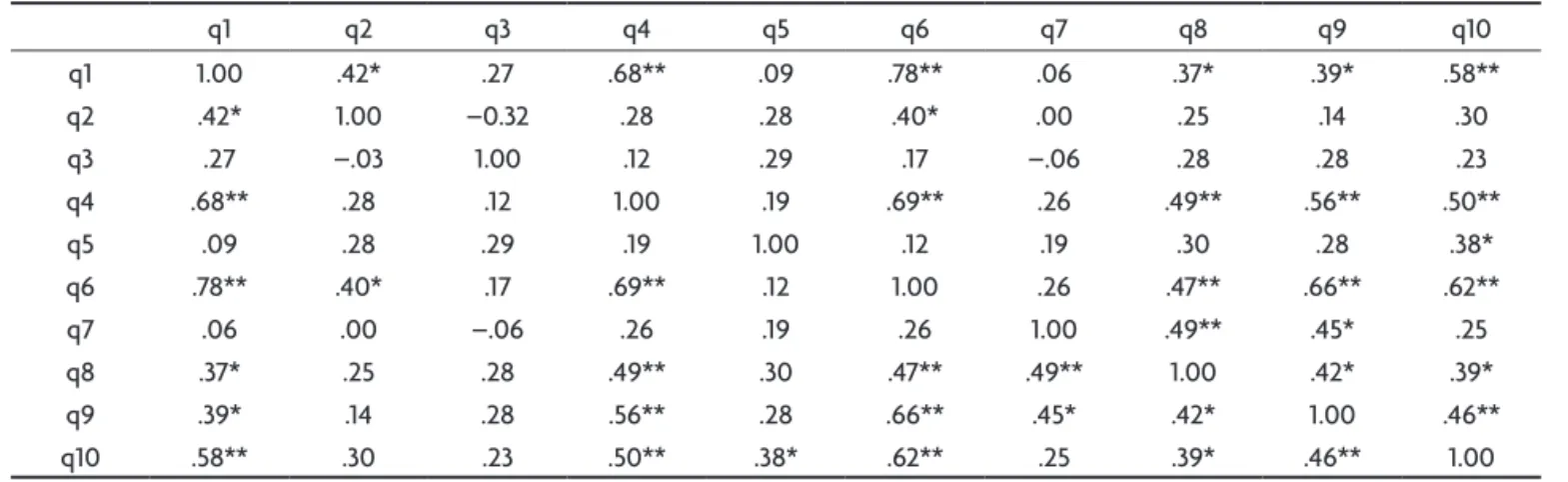
Table 3. Matrix of ordinal correlations (Spearman) among scale questions (q).
q1 q2 q3 q4 q5 q6 q7 q8 q9 q10
q1 1.00 .42* .27 .68** .09 .78** .06 .37* .39* .58**
q2 .42* 1.00 –0.32 .28 .28 .40* .00 .25 .14 .30
q3 .27 –.03 1.00 .12 .29 .17 –.06 .28 .28 .23
q4 .68** .28 .12 1.00 .19 .69** .26 .49** .56** .50**
q5 .09 .28 .29 .19 1.00 .12 .19 .30 .28 .38*
q6 .78** .40* .17 .69** .12 1.00 .26 .47** .66** .62**
q7 .06 .00 –.06 .26 .19 .26 1.00 .49** .45* .25
q8 .37* .25 .28 .49** .30 .47** .49** 1.00 .42* .39*
q9 .39* .14 .28 .56** .28 .66** .45* .42* 1.00 .46**
q10 .58** .30 .23 .50** .38* .62** .25 .39* .46** 1.00
Validation of the scale
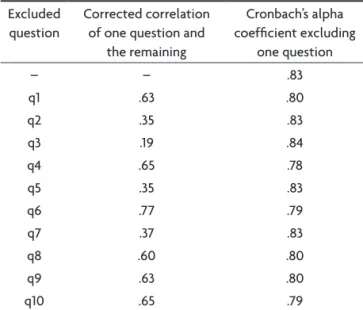
Reliability – The reliability analysis of the 10-question scale based on Bowling instructions, showed a predomi-nance of statistically positive correlations (p<.05) in each question (Table 3). In the version 6 of the scale the Cron-bach’s alpha analysis disclosed values around 80%. It is noteworthy that the exclusion of any question of scale did not introduce gain in internal consistency (Table 4).
Validity of the scale – The traditional deinition of criteri-on validity is the correlaticriteri-on of a scale with another mea-sure of the analyzed characteristic, ideally a ‘gold stan-dard’. In this study we consider the opinion of three ex-perts skilled in the use of the Johns Hopkins severity scale and their consensus as criterion. The Johns Hopkins sever-ity scale is an easy and highly reproducible tool, and was chosen as an external criterion. The results show signif-icant correlation among IRLS score and expert 1 (r=.519, p=.003), expert 2 (r=.438, p=.016), expert 3 (r=.448, p=.013), and the expert consensus (r=.44, p=.015).
discussion
The IRLS of the IRLSSG was adapted and validated to the Portuguese language of Brazil. It was necessary to modify some words and sentences. The IRLS was admin-istered to 30 patients and demonstrated internal consis-tency and proved an adequate instrument to rate RLS in Brazilian patients. Some alterations were related to ed-ucation level of the Brazilian population. The INAF, the National Indicator of Functional Literacy showed that, in 2005, Brazil illiteracy rate was 7%, whereas rudimentary literacy was 30%16. According to the classiication of the
INAF, the rudimentary literacy population can understand
a simple item of information contained in one statement, therefore calling for careful devising of the requests. The questionnaire was devised with intelligible sentences that could be understood by the majority of the population. we avoided sentence constructions that could be under-stood only by a more educated population, explaining why we committed some minor grammatical errors17.
The term “graduar” (rate), for example was not under-stood properly in the administration of version 1; hence, we replaced it by “responder” (answer) without losing the idea of graduation, which is implicit in the options of each question (Table 1). This process is inherent to adaptation of questionnaires into another language. we chose not to use the abbreviation RLS in the questionnaire SPI in Brazilian Portuguese, because it is, in general, not used informally. we did not refer to diseases with abbrevia-tions during the interview with the patients. only health professionals use such abbreviations18.
Some cultural and linguistic characteristics were adapted in the questionnaire. For example, for the term “severe”, the best translation into Brazilian Portuguese
is “grave”, but we adopted the term “qual intensidade”
or ïntenso” (how intense or intense), because in the
ad-ministration of version 1 many patients did not consider their symptoms as severe even when they were intense. It seems that the concept of disease severity in Brazil rep-resents other aspects, such that a worsening in quality of life is not understood as severe (it is not life threatening). The term “severe” in English has the meaning of “intense” but in the Brazilian Portuguese language it is not common, besides a possible meaning. For cultural and education-al reasons19-22, we keep this meaning (intense) just in the
question 6 aiming to measure the impact of the RLS as a whole, where it was cultural and linguistically appropriate.
we concluded that by following all the formal pro-cedures of version, cultural adaptation and validation in a sample of outpatients with RLS, in the Neuro-Sono section of the department of Neurology of UNIFESP, we were able to devise a questionnaire (Escala de Graduação
da Síndrome das Pernas Inquietas) with internal and
ex-ternal validity for rating the RLS according to the require-ments of IRLSSG.
A complete version of this article with the inal ver-sion of the restless legs syndrome rating scale you can ind at www.sindromedaspernasinquietas.com.br
references
1. Trenkwalder C, Walters AS, Hening W. Periodic limbs movements and restless legs syndrome. Neurol Clin 1996;14:629-650.
2. Culebras A. Restless legs syndrome and periodic limb movements of sleep. In Culebras A (ed). Clinical handbook of sleep disorders. Boston: Butterworth-Heinemann, 1996:251-256.
Table 4. Cronbach’s alpha coefficients for all questions (q) together, and by excluding each one, and the correlation of each question with as the remaining together.
Excluded question
Corrected correlation of one question and
the remaining
Cronbach’s alpha coeficient excluding
one question
– – .83
q1 .63 .80
q2 .35 .83
q3 .19 .84
q4 .65 .78
q5 .35 .83
q6 .77 .79
q7 .37 .83
q8 .60 .80
q9 .63 .80
3. Rothdach AJ, Trenkwalder C, Haberstok J, Keil U, Berger K. Preva-lence and risk factors of RLS in elderly population. Neurology 2000;54: 1064-1068.
4. Prado GF. Síndrome das pernas inquietas: há quanto tempo é ignora-da? Rev Neurocienc 2002;10:38-43.
5. Montplaisir J, Nicolas A, Godbout R, Walters AS. Restless legs syn-drome and periodic limb movement disorder. In Krigger MH, Roth T, Dement WC (eds). Principles and practice of sleep medicine. 3.Ed. Phil-adelphia: WB Saunders Company, 2000:742-752.
6. Phillips B, Young T, Finn L, Asher K, Hening WA, Purvis C. Epidemi-ology of restless legs symptoms in adults. Arch Intern Med 2000;160: 2137-2141.
7. Allen RP, Picchietti D, Hening WA, Trenkwalder C, Walters AS. Rest-less legs syndrome: diagnostic criteria, special considerations, and ep-idemiology. A report from the restless legs syndrome diagnosis and epidemiology workshop at the National Institute Health. Sleep Med 2003,4:101-119.
8. Walters AS, Group Organizer and Correspondent. Toward a better def-inition of the restless legs syndrome. Mov Disord 1995;5:634-642. 9. The International Restless Legs Syndrome Study Group. Validation of
the International Restless Legs Syndrome Study Group rating scale for restless legs syndrome. Sleep Med 2003;4:121-132.
10. Zucconi M, Ferini-Strambi L. Epidemiology and clinical indings of rest -less legs syndrome. Sleep Med 2004;5:293-299.
11. Allen PA, Earley CJ. Validation of the Johns Hopkins of restless legs se-verity scale. Sleep Med 2001:239-242.
12. Linguistic validation of a Quality of Life Questionnaire. Mapi Res Inst 2002. In: http://mapi-research-inst.org
13. Lang T. Twenty statistical errors even you can ind in biomedical re -search articles. Croat Med J 2004;:361-370.
14. Cronbach IJ. Coeficient alpha and the internal structure of test. Psy -chometrika 1951;297-334.
15. Bowling A. Measuring health-a review of quality of life measurent seals. 2.Ed. BucKmghan Open University Press, 1997:9-15.
16. INAF – Indicador de analfabetismo Funcional (Internet address). In-stituto Paulo Montenegro (12/05/2006). In: http://www.ipm.org.br/ an_ind.php
17. Correia de Campos C, Manzano G M, Bannwart de Andrade L, Castelo Filho A, Nóbrega JAM. Tradução e validação do questionário de aval-iação de gravidade dos sintomas e do estado funcional na síndrome do túnel do carpo. Arq Neuropsiquiatr 2003:61:51-55.
18. Diccionario de Siglas Médicas – y otras abreviaturas, epónimos y
tér-minos médicos relacionados com la codiicación de las altas hospita -larias. Laguna JY, Cunat VA. Madrid: Ministerio de Sanidad y Consu-mo (12/05/2006). In: http://www.msc.es/estadEstudios/estadisticas/ docs/diccionarioSiglasMedicas.pdf
19. Duarte LFD. Indivíduo e pessoa na experiência da saúde e da doença. Cienc Saude Col 2003;8:173-183.
20. Minayo MCS. Saúde-doença: uma concepção popular da etiologia. Cad Saude Pub 1988;4:363-381.
21. Herzlich, Claudine. Saúde e doença no início do século XXI: entre a ex-periência privada e a esfera pública. Physis 2004;14:383-394. 22. Duarte LFD, Leal OF. Doença, sofrimento, perturbação: perspectivas