INTRODUCTION
Since the introduction of resin composites in 1960, many efforts have been made in a way to in-crease the longevity of resin restorations. Although some progress has been made, mechanical properties in this class of materials are yet to be improved. Wear and fracture, due to chewing forces and microleakage caused by polymerization contraction stress, are the main concerns (1). These are some of the drawbacks that may compromise direct composites performance as substitutes for amalgam in posterior teeth, mainly when large restorations are necessary (2). Thus, the constant demand for esthetic restorations led to the development of new materials and techniques.
One possible way to minimize the problems
re-Effect of Experimental Heat Treatment on
Mechanical Properties of Resin Composites
Ivone L. SANTANA1 Edméa LODOVICI2 Jivaldo R. MATOS3 Igor S. MEDEIROS2 Caroline L. MIYAZAKI2 Leonardo E. RODRIGUES-FILHO2
1Department of Restorative Dentistry, Dental School, Federal University of Maranhão, São Luís, MA, Brazil 2Department of Dental Materials, Dental School, University of São Paulo, São Paulo, SP, Brazil 3Department of Fundamental Chemistry, Institute of Chemistry, University of São Paulo, São Paulo, SP, Brazil
The aim of this study was to verify the influence of an experimental heat treatment (170°C/10 min) using a casting furnace on the mechanical properties (hardness and flexural strength) of 2 commercial direct resin composites (TPH Spectrum and Filtek P60) compared to a commercial indirect resin system (BelleGlass). Heat treatment temperature was determined after thermal characteriza-tion by thermogravimetry (TG) and differential scanning calorimetry (DSC). Data was analyzed by ANOVA and Tukey’s test at 5% significance level. There was statistical significance for the main factor heat treatment (p=0.03) and composite (p=0.02), for flexural strength. For Knoop hardness, only the main factor composite was statistically significant (p=0.00). P60 presented higher hardness than TPH. No statistically significant correlation between mechanical properties tested was detected. Based on these results, it was possible to conclude that heat treatment influenced flexural strength of direct composites, while it was not observed for hardness. The association of direct composites with a simple post-cure heat treatment may be an alternative for current indirect composite systems, although more studies are needed to verify other properties of the composites for this application.
Key Words: composite resins, heat treatment, flexural strength, hardness.
lated to microleakage and polymerization stress is to use esthetic indirect composite bonded restorations instead of direct composites. In the indirect technique, the lost tooth structure is rebuilt in a cast and the material is polymer-ized under controlled conditions in the laboratory, which allows the use of higher irradiances during photoactivation and extend exposure to internal surfaces. This has been shown to improve mechanical properties, such as hard-ness and flexural strength, due to an increase in degree of conversion (3). Moreover, this procedure allows bet-ter proximal and occlusal shaping, which facilitates the subsequent cementation into the cavity (4).
Specific resin systems have been developed for indirect use. Some examples are BelleGlass (Belle de St. Claire, Orange, CA, USA), Sculpture (Jeneric/ Pentron Inc., Wallingford, CT, USA). Manufacturers
recommend an initial polymerization of the restoration followed by a special treatment that may include extra doses of light and/or heat, carried out under specific environment conditions in ovens, developed by the manufacturer for this purpose. There is a consensus in literature that, in general, the heat supplies results with an increase in mechanical properties of cured composites due to improved conversion and a consequent reduction of unreacted monomers (1,3,5,6). The heat treatment may also contribute for the relief of stresses originated during resin polymerization and finishing procedures (7). The temperature usually used in indirect systems ranges from 120 to 140°C. Ideally, the temperature ap-plied in this treatment must be above composite’s glass transition temperature (Tg) (8). This allows a significant
increase in polymer chain mobility, favoring additional cross-linking and stress relief (7,9). Nevertheless, it is noteworthy that overheating may cause degradation of the composite (10). However, there may be alternatives for these more sophisticated systems.
For instance, there is evidence that the associa-tion of direct light-cured composites with simple thermal treatments may produce results similar to the conven-tional heat treatments, with increase in the material’s properties (11). In addition, the special ovens could be replaced by other heat sources, as cast furnaces or auto-claves, commonly employed in the prosthetic laborato-ries, which are able to reach relatively high temperatures. The purposes of this study were to evaluate the
thermal characteristics, such as degradation temperature of the composites by thermogravimetry and Tg by
dif-ferential scanning calorimetry, and to verify the influ-ence of an experimental heat treatment using a casting furnace on the mechanical properties (hardness and flexural strength) of 2 commercial direct resin compos-ites compared to a commercial indirect resin system.
MATERIAL AND METHODS
Two commercial direct resin composites - TPH Spectrum and Filtek P60 - and one indirect resin sys-tem as a control - BelleGlass - were used in this study. Manufacturers’ information is presented in Table 1.
TG and DSC Analyses
Solid specimens used for thermal characterization were activated for 40 s with Optilux 501 light-curing unit (Demetron; Kerr Corp., Danbury, CT, USA; 11-mm-diameter tip, 600 mW/cm2 light intensity). TG/DTG curves
were obtained with a thermobalance (model TGA-50; Shimadzu Corporation, Kyoto, Japan) at a temperature range of 25-900°C, using platinum pans containing approximately 15 mg specimens, under dynamic air at-mosphere (50 mL min-1) and heating rate of 10°C min-1.
An isothermal TG at the experimental heat treat-ment temperature was recorded to observe the weight loss of the studied composites at a constant temperature
as a function of time. DSC curves were ob-tained in a DSC-50 cell (Shi-madzu Corporation), using standard aluminum pans, under dynamic nitrogen atmosphere (50 mL min-1) and heating rate
of 10°C min-1 at a
tempera-ture range from 25 to 550°C. The DSC cell was calibrated with indium (m.p. 156.6°C; ΔHmelt=28.54 Jg-1) and zinc
(m.p. 419.6°C) as standards.
Flexural Strength and Knoop Hardness
Specimens with rectan-gular cross-sectional area (10 Table 1. Composites descriptions (manufacturers, lot numbers and compositions).
Material Manufacturer Matrix Filler (type and vol. %)
Mean particle size (μm)
Batch number
Filtek P60 3M/ESPE, St. Paul MN, USA
Bis-GMA, UDMA, Bis-EMA
Zirconia,
silica, 61% 0.19-3.3 4MM
TPH Spectrum
Dentsply De Trey, Konstanz,
Germany
Bis-GMA, Bis-EMA, TEGDMA
Barium boro fluoroalumino
silicate glass, silica, 57%
0.8 72562
BelleGlass
Belle de St. Claire, Orange,
CA, USA
UDMA
Barium silicate glass,
65%
mm length x 2 mm width x 2 mm height) were built using a stainless steel split mould. The composite was inserted in bulk, filling the mould completely. After adjusting the composite thickness, the upper surface was irradiated for 40 s, using the same light source previously described. All specimens were dry stored in lightproof containers at 37°C for 48 h. After that, they were randomly assigned to 5 groups (n=7): direct composites (Filtek P60 or TPH Spectrum) with or without heat treatment, and indirect composite (Belleglass). The heat- treated groups of the direct composites were dry heated (170°C, previously determined) in a digitally controlled furnace (OVMAT 7, Manfredi S.p.A., Torino, Italy) for 10 min. After heat treatment, the specimens were stored again in lightproof containers at 37°C for 72 h.
After the storage period, the specimens were placed in a 3-point bending flexural device, with the aid of a guide to standardize their position, and were subjected to mechanical test in a universal testing ma-chine (Kratos Dinamômetros, São Paulo, SP, Brazil) at a crosshead speed of 0.5 mm/min, and with a span distance of 8 mm. Flexural strength was then calculated using the following equation:
where
f
is the fracture load,l
is the span distance,w
is the specimen’s width andh
the specimen’s thickness.The fractured specimens were embedded in slow-setting epoxy resin in PVC cylinders, in such a way to expose their lateral surface, parallel to the longitudinal axis. Knoop hardness was evaluated using a microhard-ness tester (model HMV-2/2 T, Shimadzu Corporation) with 100 g load and a dwell time of 15 s. Three indenta-tions were made at 1.0 mm depth of the irradiated surface. For each specimen, the mean value of Knoop hardness (KHN) was obtained by 3 readings.
The indirect composite specimens were built and irradiated similarly. The heat treatment was done according to the manufacturer’s instructions, regarding temperature, pressure and time (140°C, 80 psi nitrogen, 20 min).
Statistical Analysis
Flexural strength and KHN data were subjected to 2-way ANOVA to assess the possible effect of the heat treatment on the direct composites (P60 and TPH) properties (main factors: composite and heat treatment).
One-way ANOVA was used to compare heat-treated direct and indirect composites. Tukey’s test (a=0.05) was performed for multiple comparisons. The occur-rence of significant linear correlation between flexural strength and KHN was examined by means of Pearson's correlation test.
RESULTS
TG and DSC
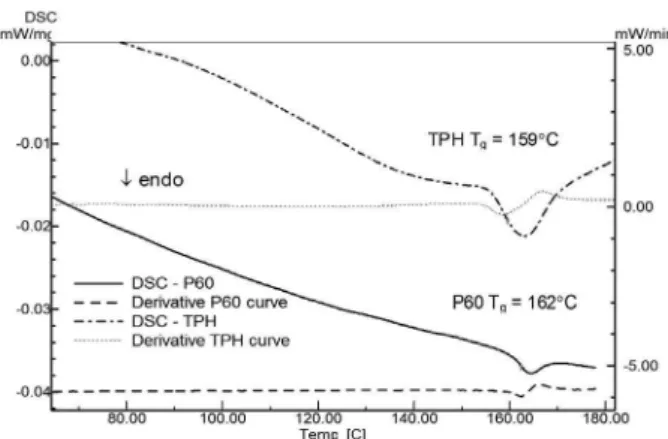
The Tg values obtained by DSC analysis were:
162°C for P60 and 159°C for TPH (Fig. 1). TG revealed that the weight loss and consequent degradation for both composite specimens occur in steps. For temperatures above 180°C, there was a significant weight loss, which may have been due to the unreacted monomer volatiliza-tion or other degradavolatiliza-tion processes.
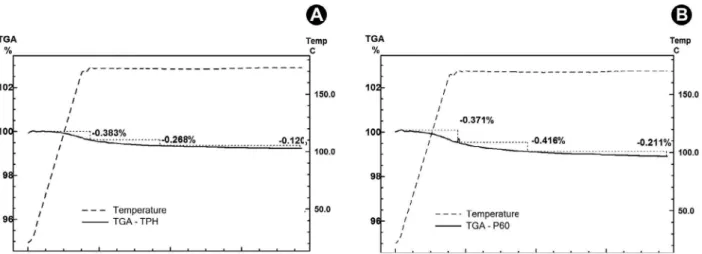
Based on this information, it was assumed that an effective and more safe temperature for the heat treatment for both composites would be 170°C. The isothermal TG showed that the weight loss at 170°C was negligible for short periods (Fig. 2), confirming this temperature to be safe in terms of composite degradation.
Flexural Strength and Hardness
Comparing the direct composites, only the main factor heat treatment was statistically significant for flexural strength (p=0.031). Mean values for flexural strength of the groups with and without heat treatment were, respectively, 180.8 ± 30 and 159.9 ± 17.6 MPa.
For Knoop hardness analysis, only the main factor
composite was statistically significant (p=0.000). P60 presented higher KHN than TPH (99.8 ± 5.3 and 73.8 ± 5.6, respectively).
Comparing only the heat-treated composites, the main factor composite was significant for flexural strength and Knoop hardness analysis (p=0.02, for both). Means and standard deviations for these parameters are presented in Figure 3.
No statistically significant correlation between hardness and flexural strength was detected in either 2-way or 1-way ANOVA (Pearson’s p-value=0.43 and
p-value=0.46, respectively).
DISCUSSION
The DSC technique assesses the energy (en-thalpy) absorbed or released by a specimen during temperature rise, reduction or even at isothermal conditions, compared to a reference specimen. With this method, it is possible to identify the critical tem-peratures for the analyzed material, which allows the observation of thermal events in ceramics, glass or polymers (e.g. crystallization, melt, Tg). In Figure 1,
derivative curves were calculated to assist the identi-fication of the thermal events.
TG provides the change in weight of a specimen as a function of temperature. It is a precise quantitative method of determining combustion, volatilization and decomposition by analyzing weight changes. In this study, this test assisted to determine the maximum secure temperature in which it is possible to submit the resin composite without the occurrence of marked
degradation of the components (10).
In-lab composite techniques were introduced as an attempt to develop materials with improved proper-ties compared to direct composites. Post-cure heating leads to an increase in the degree of conversion, which improves physical and mechanical properties (12), mainly tensile strength (4), flexural strength (4,5,13), wear (14), hardness (15), and color stability (6).
It is important to observe that, after photoactiva-tion, the polymerization reaction still proceeds in the
Figure 2. TG isothermal curves of TPH (A) and P60 (B) composites.
dark at room temperature, and this residual reaction has been related to increased degree of polymerization (5). In this study, the specimens storage (between the photoactivation and the experimental heat treatment) for a long period (48 h) may have overshadowed the possible differences in conversion rates in the early stages of polymerization and this could have washed out the real effect of the heat treatment on the mechanical properties of the materials (13). Indeed, a previous study demonstrated that even post-cure temperatures as low as 50°C were capable of greatly reducing the levels of all types of residual monomers in the tested material (16). Regarding the treatment itself, post-cure heating of resin composite materials decreases the levels of unreacted monomer after the initial light-curing stage (16). Basically, 2 mechanisms can be involved in this phenomenon. First, the residual monomer would be covalently bonded to the polymer network, as a result of the heat treatment, leading to increase in conversion itself. Second, unreacted monomers would be volatil-ized during the heating process. It is still possible that both mechanisms act simultaneously, but their relative contribution is still not totally elucidated (16).
Most conventional post-curing heat treatments employ temperatures below 130°C. However, in this study, an important concern was the determination of the specific critical temperatures (glass transition and initial loss of weight temperatures) which present a range for each material. Both parameters of the tested composites were established initially, which assured that the heat treatment was carried out using an effective and safe temperature. As observed, Tg values obtained
for both composites were around 160°C. When higher temperatures, just above composite Tg, are applied to
composites, mechanical properties have been shown to be optimized (4,8), by effectively increasing the mobil-ity of polymer networks. This leads to further monomer conversion, increasing the crosslink density (17) and also allows for some stress relief, induced during the polymerization process (9).
In this study, there was no statistical significance in the interaction composite x heat treatment since post-cure treatment affected the flexural strength of both composites in the same way.
The heat-induced improvement in flexural strength could be explained by the post-cure process and by stress relief, which is common in annealing pro-cesses (16). Polymerization shrinkage stresses, initially
concentrated mainly around the filler particles, became more homogeneously distributed by the heat treatment, reducing filler/matrix interfacial stresses (18). Hybrid composites may have benefited from these mechanisms in a more pronounced way, since their higher filler content accounts for a larger filler/matrix interface area, which explains the heat-treated composites results in flexural strength.
P60 and BelleGlass presented similar hardness results while TPH had lower hardness. This is probably due to the difference in matrix composition (19) and filler content (Table 1). P60, in addition to presenting higher filler content (61%), also includes zirconia, which is a very stiff filler, which may have accounted for the higher values of hardness compared to TPH. The microhard-ness test, however, is only capable to perform localized assessments, since it includes very diminutive areas of the specimen in a very superficial region. Therefore, the values obtained with this test are a function of type and content of inorganic filler present in the composite, rather than matrix characteristics (20).
On the other hand, flexural strength test involves the bulk of the specimen and as a result provides a better assessment of the influence of post-cure heat treatment on the resin matrix (4). Therefore, the lack of correla-tion between flexural strength and hardness is justified because each test takes in consideration different areas of the specimen. The increase in flexural strength of the heat-treated composites may be explained by both an increase in degree of conversion and stress relief, as previously mentioned, caused by temperature increase above composite’s Tg, suggesting that this can be a
relevant mechanism to improve material’s mechanical properties.
for the best treatment of each material.
Based on these results, it may be concluded that heat treatment influenced flexural strength of direct composites while it was not observed for hardness. The association of direct composites with a simple post-cure heat treatment may be an alternative for current indirect composite systems, although further studies are needed to verify other properties of composites for this application.
RESUMO
O objetivo deste estudo foi avaliar a influência de um tratamento térmico experimental (170°C/10 min), em um forno de fundição, sobre as propriedades mecânicas (dureza e resistência à flexão) de 2 resinas compostas comerciais de uso direto (TPH Spectrum e Filtek P60), em relação a uma resina comercial indireta (Belle-Glass). A temperatura de tratamento térmico foi determinada após caracterização térmica por termogravimetria (TG) e calorimetria exploratória diferencial (DSC). Os dados foram analisados por análise de variância, que mostrou, para a resistência à flexão, diferença estatística para os fatores principais tratamento térmico (p=0,03) e material (p=0,02). Para a dureza Knoop, somente o fator principal material foi estatisticamente significante (p=0,00). A P60 apresentou maiores valores de dureza em relação à TPH Spectrum. Não foi detectada nenhuma correlação estatisticamente significante entre as propriedades mecânicas avaliadas. Baseado nos resultados foi possível concluir que o tratamento térmico influenciou na resistência à flexão das resinas compostas de uso direto, enquanto, para a dureza, o mesmo não foi observado. A associação de resinas compostas a um simples tratamento térmico de pós-cura pode ser uma alternativa para os sistemas indiretos atuais. Entretanto, mais estudos são necessários para verificar outras propriedades das resinas compostas para esta aplicação.
ACKNOWLEDGEMENTS
This study was partially supported by the Brazilian funding agency CAPES.
REFERENCES
1. Mante F, Saleh N, Mante M. Softening patterns of post-cure heat-treated dental composites. Dent Mater 1993;9:325-331. 2. ADA. Statement on posterior resin-based composites. ADA
Council on Scientific Affairs; ADA Council on Dental Benefit Programs. J Am Dent Assoc 1998;129:1627-1163.
3. Lovell LG, Lu H, Elliott JE, Stansbury JW, Bowman CN. The effect of cure rate on the mechanical properties of dental resins. Dent Mater 2001;17:504-511.
4. Asmussen E, Peutzfeldt A. Mechanical properties of heat treated restorative resins for use in the inlay/onlay technique. Scand J Dent Res 1990;98:564-567.
5. Loza-Herrero MA, Rueggeberg FA, Caughman WF, Schuster GS, Lefebvre CA, Gardner FM. Effect of heating delay on conver-sion and strength of a post-cured resin composite. J Dent Res 1998;77:426-431.
6. Wendt SL Jr. The effect of heat used as secondary cure upon the physical properties of three composite resins. II. Wear, hardness, and color stability. Quintessence Int 1987;18:351-356.
7. Sideridou I, Achilias DS, Kyrikou E. Thermal expansion character-istics of light-cured dental resins and resin composites. Biomateri-als 2004;25:3087-3097.
8. Eldiwany M, Powers JM, George LA. Mechanical properties of direct and post-cured composites. Am J Dent 1993;6:222-224. 9. Viljanen EK, Skrifvars M, Vallittu PK. Dendritic copolymers and
particulate filler composites for dental applications: degree of con-version and thermal properties. Dent Mater 2007;23:1420-1427. 10. Turi E. Thermal characterization of polymeric materials. San
Diego: Academic Press; 1997.
11. Touati B. The evolution of esthetic restorative materials for inlays and onlays: a review. Int Aesth Chron 1996;8:657-666.
12. Silva GR, Simamoto-Júnior PC, da Mota AS, Soares CJ. Mechani-cal properties of light-curing composites polymerized with differ-ent laboratory photo-curing units. Ddiffer-ent Mater J 2007;26:217-223. 13. Loza-Herrero MA, Rueggeberg FA. Time-temperature profiles of
post-cure composite ovens. Gen Dent 1998;46:79-83.
14. Ferracane JL, Mitchem JC, Condon JR, Todd R. Wear and mar-ginal breakdown of composites with various degrees of cure. J Dent Res 1997;76:1508-1516.
15. Ferracane JL, Condon JR. Post-cure heat treatments for compos-ites: properties and fractography. Dent Mater 1992;8:290-295. 16. Bagis YH, Rueggeberg FA. The effect of post-cure heating on
residual, unreacted monomer in a commercial resin composite. Dent Mater 2000;16:244-247.
17. Soh MS, Yap AU. Influence of curing modes on crosslink density in polymer structures. J Dent 2004;32:321-326.
18. de Gee AJ, Pallav P, Werner A, Davidson CL. Annealing as a mechanism of increasing wear resistance of composites. Dent Mater 1990;6:266-270.
19. Floyd CJE, Dickens SH. Network structure of Bis-GMA- and UDMA-based resin systems. Dent Mater 2006;22:1143-1149. 20. Ferracane JL. Correlation between hardness and degree of
conver-sion during the setting reaction of unfilled dental restorative resins. Dent Mater 1985;1:11-14.