15ª Conferência da Associação Portuguesa de Sistemas de Informação (CAPSI 2015) 02 e 03 de Outubro de 2015, Lisboa, Portugal
ISSN 2183-489X
DOI http://dx.doi.org/10.18803/capsi.v15.116-124
116 Dario Messina, Faculty of Engineering, University of Porto - INESC, Portugal, [email protected]
Ana Cristina Barros, INESC TEC, Portugal, [email protected]
António Lucas Soares, Faculty of Engineering, University of Porto - INESC, Portugal, [email protected]
Abstract
This thesis aims at contributing with new research at the intersection of the research fields of information management and supply chain risk management. Information is a fundamental element for an effective risk management in supply networks. In spite of this, research on how to use internal and external information for risk management decisions in supply networks is scarce. Therefore, this thesis main goal is to characterize information models used in supply networks and the supply chain risk management process in order to propose an aggregated model of internal and external information for risk management decision support in supply networks. This work is based on the Design Science paradigm, which will be applied through several research methods: systematic literature review to analyse the current state of the art on information management in supply networks; field research to analyse the influence of different information organisation models in the process of supply chain risk management and to develop an information model based (artifact); and action research to implement the artifact for the definition of risk mitigation strategies in aeronautic supply networks.
Keywords: Information Management, Supply Chain Risk Management, Information Model, Supply
Network, Design Science.
1.
R
ESEARCHS
ITUATIONThis thesis is an interdisciplinary work at the intersection between information management and supply chain risk management. I started my Ph.D. in September 2014 in the “Engineering and Industrial Management” Doctoral Program, and taking into account the two areas of this work I think they perfectly fit in a modern and competitive industrial context. Regarding the benefits of my participation at CAPSI Doctoral Consortium please refer to the CV.
2.
C
ONTEXT ANDM
OTIVATIONSDuring the past decades Original Equipment Manufacturers (OEM’s) have been increasingly focusing on their core competences (overall design, architecture, integration, and final assembly and delivery to end customers), though becoming large scale integrators by the coordination of a supply network [Ro et al., 2008]. Consequently, OEM’s have today a higher integration with first-tier suppliers, but a looser control over second-tier suppliers, mainly due to lack of contractual relationship and the difficulty of strategic
15ª Conferência da Associação Portuguesa de Sistemas de Informação (CAPSI 2015) 117 alignment between OEM and second-tier suppliers [Fawcett and Magnan, 2002]. Therefore, first-tier suppliers have assumed a critical role in the supply chain, since they have to coordinate second-tier suppliers and help OEM’s managing supply chain risk. This leads to the development of new supply chain capabilities in terms of supply chain risk management. These changes in the role of supply chain players calls for more research on how supply chains risk are being managed, and how information should be managed among supply chain partners to support risk management related decision-making. Consequently, this thesis aims at addressing this research gap and its research design is outlined in the following sections. Section 3 reviews the literature on information management in supply networks, supply chain integration, and risk management. Section 4 defines the problem underlying this thesis while in section 5 research questions, objectives and research methodologies are presented. Section 6 shows the actual status of this thesis work. The last section provides the main conclusions and points future research work.
3.
F
UNDAMENTALS ANDR
ELATEDW
ORKThe literature review of this thesis is structured in accordance with the main topics representing the pillars of this work. We start analysing how information is managed in supply networks, then we describe supply chain integration with a focus particularly on the risk management process, in order to identify the best strategies for supply networks risk mitigation.
Information Management in Supply Networks
A supply network is defined as a collection of interconnected organisations with the primary purpose of procure, use and transform resources in order to provide goods and services [Harland et al., 2004]. An important aspect for the management of supply networks is to establish how the information is acquired, organised and used among members, towards a proper risk management of the supply network [Hung et al., 2011]. Also, a correct management of the information flow is critical for increasing visibility over the network [Barratt and Oke, 2007] in order to support decision-making process and mitigate the risk [Yu and Goh, 2014]. Even though previous research has confirmed the strategic importance of information and several authors were interested in developing information models to proper manage this information flow [Chi, 2010], there is still a need to explore in depth this field in order to analyse how different information models influence the risk management decision process of supply networks.
Supply Chain Integration, and Risk Management
Due to the global and turbulent environment in which firms compete, several researchers have highlighted the need for a closer relationship between manufacturers and their partners as a way to improve supply chain performance [Childerhouse and Towill, 2011]. Even if across industries the level of implementation results differ, supply chain integration seems a good alternative to the verticalisation of operations [Figueiredo et al., 2008]. In order to ensure supply chain integration is necessary that supply chain partners
15ª Conferência da Associação Portuguesa de Sistemas de Informação (CAPSI 2015) 118 share and collaboratively manage processes [Flynn et al., 2010]. According to the literature, in an integrated supply chain, the information is the key element that firms have to share with their partners [Ragatz et al., 2002]. Within the supply chain, the typical information shared is related with material requirements, demand forecasts and inventory levels (Chandra et al., 2007, Omar et al., 2010, Datta and Christopher, 2011, Hung et al.,2011). To ensure the effectiveness of long-term collaborations and to generate trust among partners, these information exchanges should be held within processes with high level of visibility, which should desirably enable effective communications and exchange of real-time data [Chengalur-Smith et al., 2012]. Companies also value the importance of establishing a risk management process to identify, measure, mitigate, and control risks in their supply network (Elsalmi and Hachicha, 2014). In order to be able to identify these risks, companies are starting to work with their network partners towards creating supply networks visibility (Nooraie and Parast, 2015). By sharing what sometimes is sensitive and proprietary information with their network partners, companies aim at aligning their common objectives though ensuring the efficient management of the whole chain. Still, there is a need to create visibility over the specific information that will enable companies to identify and act upon the risks and opportunities of their supply network. In fact, in the global and digital context in which firms operate, information assumes a distinctive role, as it supports effective decision-making process. In this thesis we propose a framework for the organization of information among a supply network that enables the identification of strategies for supply network risk mitigation.
4.
R
ESEARCHP
ROBLEM DEFINITIONThe aeronautic sector has shown a trend in the past decade in providing new solutions related to the management of new product development (Strategy&, 2015 (a), (b)). This sector is characterized by increasing costs in developing new products, and consequently there is the need to transfer the risk downstream the value chain. In this context, supply chain is characterized by a geographical dispersion of partners, and an increasing need of communication and coordination that is possible to achieve sharing vital information [Pereira, 2009] and through the adoption of ICT solutions.
Considering the scarcely research on how to use internal and external information for risk management decisions in supply networks, and the relevance that supply chain risk management and mitigation plays for practitioner (Global supply chain institute report, 2014), this research thesis will characterize the information models in supply network in order to develop and implement an information model, our artifact, that support strategic decision making in supply network in order to assess the risk along the whole chain, and provide a practical solution for decisions related to the configuration of the network. In particular, this work will be based on the specific needs of the aeronautic sector.
15ª Conferência da Associação Portuguesa de Sistemas de Informação (CAPSI 2015) 119 5.
O
BJECTIVES,
M
ETHODOLOGY ANDR
ESEARCHM
ETHODSThis thesis presents three research questions:
RQ1: What models exist for managing strategic information in supply networks?
RQ2: How information organization models influence the process of supply chain risk management?
RQ3: What are the specifics that characterise an information organisation model for supply chain risk management and mitigation?
RQ4: How the developed model support strategic decision-making related to aeronautic network configuration?
The research questions led to formulate the following goals:
To characterize information management models used in supply networks;
To describe the risk management process of supply networks and the role that first-tier and second-tier suppliers have in this process;
To propose a multi-view and aggregated model of internal and external information that allow to bring to the surface the main causes of risk, and to identify the strategies to mitigate it.
5.1.
Design Science Research Paradigm
The centrality of design activity has been recognised in several disciplines, and particularly it results even more crucial in the areas of Information Systems. Information systems for its own nature represent the meeting point between Information Technology (IT) and human interface, and for this reason it is characterised by challenging problems related to design activity in order to provide unique and creative solutions [Hevner and Chatterjee, 2010]. Based on the seminal book of Herbert Simon “Sciences of the Artificial”, a pool of scholars in information systems sets the basis of a new paradigm, called Design Science Research Paradigm.
This thesis work is based on Design Science Research Paradigm, and the schema in fig. 1 represent the structure underlying it. The ultimate goal of design science is to address research in order to develop artifacts that, once tested, are able to provide innovative solutions for specific business needs [Holmstrom et al., 2009].
15ª Conferência da Associação Portuguesa de Sistemas de Informação (CAPSI 2015) 120 Figure 1 - Design Science Research Framework. Based on Havner et al.[2004]
Starting from the “environment” block we want to identify the needs on the aeronautic sector, then we adopt systematic literature review to built the foundation of the “knowledge base” block, and finally through the adoption of field research and action research, belonging to the “information systems research” block, we want to develop, implement and test an information model to support strategic decision in supply network. The purpose of design science is to develop new knowledge to provide to practitioner in order to design solutions for specific field problems [van Aken, 2005].
Due to the exploratory nature of this research a portfolio of qualitative research methods are used: systematic literature review to analyse the current state of the art on information management in supply networks; field research to analyse the supply chain risk management process of a first-tier and three of its second-tiers in supply networks; and action research to implement and test an information model for the evaluation of the impact of the use of the information model in the risk mitigation strategies in aeronautic supply networks. The different methodologies here are applied in order to fulfil the three different section of the design research framework presented in fig.1. The following explains briefly the application of each of these methods.
15ª Conferência da Associação Portuguesa de Sistemas de Informação (CAPSI 2015) 121 The systematic literature review is the methodology that allows to build the theoretical foundation, and to ensure rigor in this thesis project. Considering the strategic relevance of information for supply chain management a systematic literature review will be carried out in order to discuss and synthesize the literature on information management in the context of supply networks. This research method is considered appropriate because it allows to identify the most relevant scientific contribution to a field or question [Becheikh et al., 2006], by adopting a replicable, scientific and transparent research process [Tranfield et al., 2003], In order to assure the quality of the review process, search terms will be selected from the literature, a detailed review protocol will be developed, and a team of four researchers will be involved in the paper selection and analysis phases.
Field Research
After describing how information is managed in supply networks, it is important to investigate how supply chain risk management is influenced by the information organisation models adopted, in order to identify the specifics necessary to develop our own information organisation model for supply chain risk management and mitigation. Considering the exploratory nature of this work, field research was adopted. A highly complex supply chains will be selected for this study, namely aircraft maker industry. Data collection will be carried out by means of semi-structured interviews at first-tier and three of its second-tier suppliers belonging to the network. All the interviews will be recorded, transcribed and then coded with the support of specific software (MAXQDA).
Action Research
The results from the two research works above will contribute for the design of an action research study. In particular the action research will act as trait d’union between the business needs provided in the field research and the applicable knowledge resulting from the systematic literature review, in order to implement and test the relevance of the developed artifact and the rigor underlying it.
Action research is appropriate to investigate the development of solutions for actual problems [Eriksson and Kovalainen, 2008] where researchers and operations managers collaboratively contributed to the development of solutions [Gummesson, 2010]. In this thesis, action research allows to implement our information model for risk management of supply networks, and to observe how the artifact is used in a manufacturing environment.
6.
T
HESISS
TATUSA comprehensive analysis of the literature was made both in the field of Information Management and Supply Networks to identify the information management models adopted.
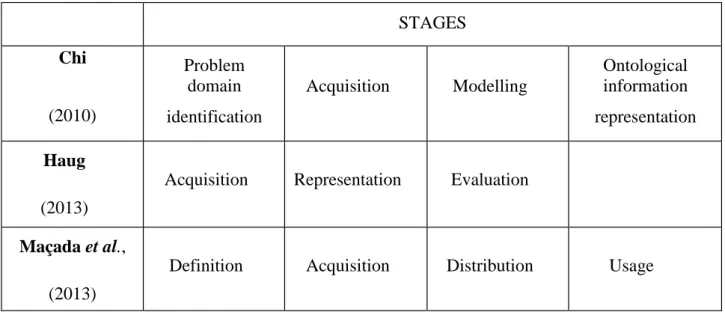
15ª Conferência da Associação Portuguesa de Sistemas de Informação (CAPSI 2015) 122 At the moment, preliminary results exist only from the Systematic Literature Review. In particular the results of this methodology can be resumed in Table 1:
Table 1: Information Model in Supply Network
After the analysis of models obtained, the one proposed by Maçada et al., (2013) was considered the most complete in the sample, for its characteristics. Even so, this model doesn’t seem exhaustive, we found it lacking of some additional stage between the acquisition and the distribution stages. Analysing other generic information model in the literature, two of them presents some additional stages, namely in Choo (2002) and Detlor (2010). Choo’s model is characterised by the following six stages: identification of information needs, acquisition, organisation and storage, development of product and services information, distribution, and usage; also Detlor’s model uses six stages, that are: creation, acquisition, organisation, storage, distribution, and usage.
Merging the information from the three models we develop our own characterised by the following six stages: identification of information needs, acquisition, organisation, storage, distribution, and usage. Regarding the other methodologies, we plan to conduct interviews in Spain and Portugal in order to create the base for field research, and so provide all the elements needed to move to the third and last methodology, the action research.
7.
C
ONCLUSIONS ANDE
XPECTED CONTRIBUTIONSThe topic of information management in supply chains has been extensively studied in the past, though most researchers focus on the dyad OEM - first-tier or the dyad first-tier - second-tier.
STAGES
Chi
(2010)
Problem
domain
identification
Acquisition
Modelling
Ontological
information
representation
Haug
(2013)
Acquisition
Representation
Evaluation
Maçada et al.,
(2013)
15ª Conferência da Associação Portuguesa de Sistemas de Informação (CAPSI 2015) 123 This paper sheds lights on how the risk management process is currently carried out in a complex multi-tier supply network and the role supply chain partners have in this process. Furthermore, this thesis contributes to the supply chain management field with a multi- view and aggregated model of internal and external information for decision support in supply networks in aeronautic sector. The implementation and pilot use of this model in a real setting will confirm the relevance of this work for practitioners and develop further managerial insights on the implementation of such models in practice.
8.
A
CKNOWLEDGEMENTSThis work is financed by the FCT – Fundação para a Ciência e a Tecnologia (Portuguese Foundation for Science and Technology) within project CMUP-ERI/TPE/0011/2013 of the CMU Portugal Program.
R
EFERENCESBarratt, M., Oke, A. “Antecedents of supply chain visibility in retail supply chains: a resource- based theory perspective.” Journal of operations management, 25(6), (2007): 1217-1233.
Becheikh, N., Landry, R., Amara, N. “Lessons from innovation empirical studies in the manufacturing sector: A systematic review of the literature from 1993–2003.” Technovation, 26(5), (2006): 644–664. Chandra, C., Grabis, J., & Tumanyan, A. “Problem taxonomy: a step towards effective information sharing in
supply chain management.” International Journal of Production Research, 45(11), (2007), 2507-2544. Chengalur-Smith, I., Duchessi, P., Gil-Garcia, J. R. “Information sharing and business systems leveraging in
supply chains: An empirical investigation of one web-based application.” Information & Management, 49(1), (2012): 58-67.
Chi, Y. L. “Rule-based ontological knowledge base for monitoring partners across supply networks.” Expert Systems with Applications, 37(2), (2010): 1400-1407.
Childerhouse, P., Towill, D. R. “Arcs of supply chain integration.” International journal of production research, 49(24), (2011): 7441-7468.
Choo, C.W. Information management for the intelligent organization: the art of scanning the environment. Information Today, Inc., 2002.
Datta, P.P. and Christopher, M.G. “Information sharing and coordination mechanisms for managing uncertainty in supply chains: A simulation study”, International Journal of Production Research, Vol. 49 No. 3, (2011), pp. 765–803.
Detlor, B. Information management. International Journal of Information Management, 30, (2010) 103-108. Elmsalmi, M., & Hachicha, W. (2014, May). Risk mitigation strategies according to the supply actors'
objectives through MACTOR method. In Advanced Logistics and Transport (ICALT), 2014 International Conference on (pp. 362-367). IEEE.
Eriksson, P., & Kovalainen, A. Qualitative methods in business research. Sage. 2008
Fawcett, S. E., Magnan, G.M. "The rhetoric and reality of supply chain integration." International Journal of Physical Distribution & Logistics Management 32.5 (2002): 339-361.
Figueiredo, P., Silveira, G., Sbragia, R. “Risk sharing partnerships with suppliers: the case of Embraer.”Journal of Technology Management & Innovation, 3(1), (2008): 27-37.
Flynn, B. B., Huo, B., Zhao, X. “The impact of supply chain integration on performance: A contingency and configuration approach.” Journal of Operations Management, 28(1), (2010): 58–71.
Global supply chain institute report, 2014:
http://globalsupplychaininstitute.utk.edu/publications/documents/Risk.pdf Gummesson, E., “Qualitative Methods in Management Research”, Sage, 2000.
Harland, C., Zheng, J., Johnsen, T., Lamming, R. “A Conceptual Model for Researching the Creation and Operation of Supply Networks”. British Journal of Management, 15(1), (2004): 1–21.
15ª Conferência da Associação Portuguesa de Sistemas de Informação (CAPSI 2015) 124 Hevner, A., Chatterjee, S. Design Science Research in Information Systems Good. In Design Research in
Information Systems (pp. 9–22). Springer Science+Business Media. 2010
Hevner, A., March, S. T., Park, J., & Ram, S. Design science in information systems research. MIS quarterly, 28(1), (2004): 75-105.
Holmström, Jan, Mikko Ketokivi, and Ari--‐‐Pekka Hameri. "Bridging practice and theory: a design science approach." Decision Sciences 40.1 (2009): 65-87.
Hung, Wei-Hsi, Chin-Fu Ho, Jau-Jeng Jou, Yi-Ming Tai. "Sharing information strategically in a supply chain: antecedents, content and impact." International Journal of Logistics: Research and Applications 14, no. 2 (2011): 111-133.
Maçada, A. C. G., Costa, J. C., Oliveira, M., Curado, C. “Information management and knowledge sharing in supply chains operating in Brazil.” International Journal of Automotive Technology and Management, 13(1), (2013): 18–35.
Nooraie, S. V., & Parast, M. M. (2015). A multi-objective approach to supply chain risk management: Integrating visibility with supply and demand risk. International Journal of Production Economics,161, 192-200.
Omar, R., Ramayah, T., Lo, M.-C., Sang, T.Y. and Siron, R. “Information sharing, information quality and usage of information technology (IT) tools in Malaysian organizations”, African Journal of Business Management, Vol. 4 No. 12, (2010), pp. 2486–2499.
Pereira, J.V. "The new supply chain's frontier: Information management." International Journal of Information Management 29.5 (2009): 372-379.
Ragatz, G. L., Handfield, R. B., Petersen, K. J. “Benefits associated with supplier integration into new product development under conditions of technology uncertainty.” Journal of Business Research, 55(5), (2002): 389-400.
Ro, Y. K., Liker, J.K., Fixson, S.K. "Evolving models of supplier involvement in design: the deterioration of the Japanese model in US auto." Engineering Management, IEEE Transactions on 55.2 (2008): 359- 377.
Strategy&, 2015 (a): http://www.strategyand.pwc.com/perspectives/2015-aerospace-defense-trends Strategy&, 2015 (b): http://www.strategyand.pwc.com/perspectives/2015-aviation-trends
Tranfield, D., Denyer, D., Smart, P. "Towards a methodology for developing evidence in formed management knowledge by means of systematic review." British journal of management 14.3 (2003): 207-222. Van Aken, J. E. “Management research as a design science: Articulating the research products of mode 2
knowledge production in management.” British Journal of Management, 16, (2005): 19–36.
Yu, M. C., Goh, M. "A multi-objective approach to supply chain visibility and risk." European Journal of Operational Research 233, no. 1 (2014): 125-130.