Vol.49, Special : pp. 53-58, January 2006
ISSN 1516-8913 Printed in Brazil BRAZILIAN ARCHIVES OF
BIOLOGY AND TECHNOLOGY
A N I N T E R N A T I O N A L J O U R N A L
Evaluation of Reproductibility and Detection Limit of
CaSO
4:Dy Radiation Detectors
José Eduardo Manzoli1,2∗,Vicente de Paulo de Campos1 and Mirian Saori Doi1
1
Instituto de Pesquisas Energéticas e Nucleares - IPEN; Av Lineu Prestes, 2242; Cidade Universitária; 05508-000; São Paulo - SP - Brasil. 2Universidade São Judas Tadeu - USJT; R. Taquari, 546; Mooca; [email protected]; São Paulo - SP - Brasil
ABSTRACT
Measurement response of thermoluminescent dosimeter, TLD, used by workers or placed at positions where gamma radiation field could be in action affecting biological tissues, should be completely characterized, in order to achieve the radiation quantity with precision and confidence. Among the evaluations concerned to its characterization, the detector reproductibility is of fundamental importance, because detectors present inside the TLD will be used many times in routine. Reproductibility is studied by repeated exposure to the same radiation field. The minimum detection limit is another important characteristics of a TLD. In this work evaluations of reproductibility and minimum detection are presented, for dosimeters produced at IPEN.
Key words: Detector selection, personal dosimetry, environmental dosimetry
∗
Author for correspondence INTRODUCTION
Brazilian Laboratório de Dosimetria
Termoluminescente, LDT at IPEN, uses, for its
personal dosimetry (Manzoli and Carvalho, 2002) and environmental dosimetry (Manzoli and Manzoli, 2003), thermoluminescent dosimeters, TLDs, composed by three phosphor detectors. A view of the trunk dosimeter is presented in (Fig. 1). A detector will be used many times in its routine lifetime and its TL response should be precisely known at every utilization, mainly at non predictable radiological emergencies.
Detectors are not selected by the manufacturer, stockist of LDT, then detectors must be selected in batches of sensibility before utilization. For selection and characterization, it was evaluated, in this work, the measurement uncertainty sources
reproductibility and detection limit (minimum).
These are the most strength sources of
measurement uncertainties, for the CaSO4:Dy
detector.
MATERIALS AND METHODS
Detector is a composite whose shape is a disc of 6.0 mm diameter and 1.0 mm thick, composed by
Calcium Sulphate and Disprosium doping
(CaSO4:Dy) pressed in a matrix of
polytetrafluorethilene (PTFE) (Manzoli and
Carvalho, 2002). These detectors are re-utilized many times.
Thermoluminescent response of detectors, called "readings", were made in TL reader Harshaw model 5500 and in model 2000.
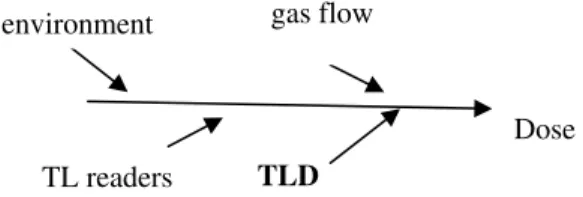
sources. Some of them are illustrated in Ishikawa diagram of (Fig. 2).
Figure 1 - Trunk dosimeter (6x4 cm) of LDT-IPEN. In the indicated positions of the drawing, three detectors of CaSO4:Dy/PTFE are placed.
Figure 2 - Ishikawa diagram of some uncertainty sources of the dose measurement using TLD. Each of the sources could be subdivided in many others.
The "branch" TLD, as source of uncertainty in
(Fig. 2), presents subdivisions like
reproductibility, thermal treatment, homogeneity and detection limit, as represented in diagram of (Fig. 3).
The value of each uncertainty source should be methodically evaluated using whenever possible, the procedure to vary one and leave the other sources unchanged. This is called robustness analysis, in analytical essays. The weight, or importance of each source can be estimated. It is worth remembering that there is no repeatability in destructive (information) essays, like thermoluminescence ones. It is considered a
destructive essay, because the information is lost after TL reading and it is not possible to repeat the
measurement at the same conditions.
Reproductibility is defined here as the detector
ability to reproduce its measurement, maintaining the other conditions as unchanged as possible,
trying to be closer to the repeatability concept.
Actually, the technical definition of
reproductibility demands to change the essays conditions as much as possible, which will not be the case in this work.
Figure 3 - Ishikawa diagram of subdivisions in TLD itself as source of measurement of radiation dose uncertainty.
RESULTS AND DISCUSSION
Reproductibility
It is extremely difficult to maintain all uncertainty sources as low as desired, like irradiation details,
thermal treatment, machine parameters,
environmental conditions etc.. Thus, the
reproductibility alone, as defined, contains or summarizes important information about the TL response variation that a detector batch could have under the same radiation dose imparted on it. Determination of the interval of this variation, or the dispersion of TL responses (reproductibility), leads us to state that the same detector, being read at the same conditions, will not have a TL response out of this interval, at a determined confidence level.
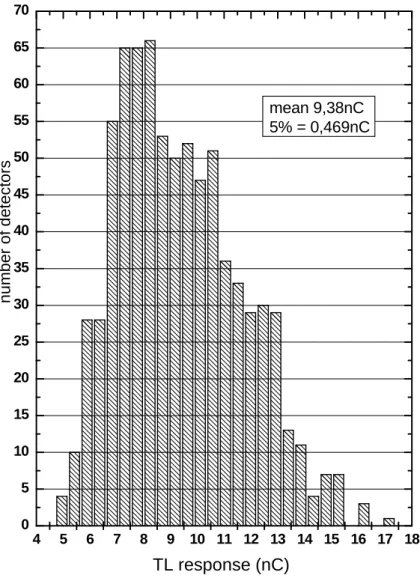
The first step after receiving the detectors is to make the selection in batches by theirs sensibility (Manzoli and Campos, 2003). An example of TL response distribution used in such a selection is shown in (Fig. 4). It can be seen that for the hole received set there is a TL response variation higher
than 100%, a great non-homogeneity
characteristics of the received detectors..
To evaluate the reproductibility is to define the width of each box in that mathematical distribution
reproductibility
TLD
thermal treatment
detection limit homogeneity
TLD
environment gas flow
histogram, in such a way that these boxes fit precisely the sensibility batches.
A sample set with 189 detectors was chosen. They were irradiated with 5.0 mGy, read after 24 h, thermally treated and irradiated again. This cycle was repeated four times.
These TL responses were analysed by the criteria 10, 15, 20, 25 and 30% as follows: if a detector had its TL response in the next cycle different from the previous, and the modulus of this difference per cent is smaller than the criterion, it is counted in; if not, it is counted out of this criterion.
The difference in successive TL readings is
measured by the per cent deviation, D% :
.100
A A A
D
min min max %
−
= (1)
Where Amax,min are the higher and the lower values
in successive TL readings, respectively.
After four TL readings (three repetitions), and putting each detector response in one or more criteria in successive readings, the per cent number of detectors which are excluded from the previous oddment is counted.
4 5 6 7 8 9 10 11 12 13 14 15 16 17 18
0 5 10 15 20 25 30 35 40 45 50 55 60 65 70
mean 9,38nC 5% = 0,469nC
n
u
m
b
e
r
o
f
d
e
te
c
to
rs
TL response (nC)
Figure 4 - TL response distribution of 777 detector irradiated by 2.0 mGy of 60Co.
These counting results for each criterion are in (Fig. 5). This procedure permits to establish a reproductibility limit, below which it will not have an acceptable number of detectors. The boundary
Then, reproductibility as an uncertainty source,
was evaluated as (15%)95% for CaSO4:Dy/PTFE
detectors used at LDT/IPEN.
Minimum Detection Limit
Minimum detection limit, DL, is the quantity value below which it is not possible to use it for measurements.
The DL calculus for a batch of CaSO4:Dy/PTFE
detectors used results of 90 TL readings. Detectors are thermally treated but not irradiated, and read next. Thermal treatment consists of heating
detectors at 300oC for 1 h.
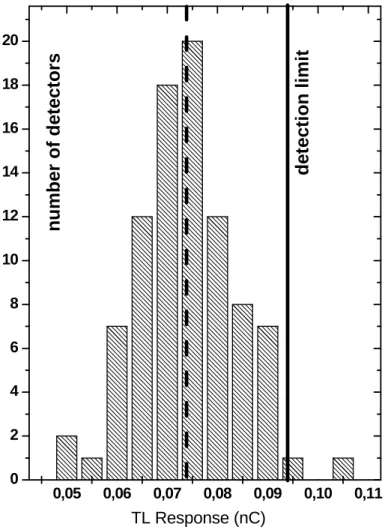
Mathematical distribution of TL responses is in (Fig. 6). One detector was excluded by Chauvenet criterion.
DL is:
DL = measurement median +
+ 2 x (standard deviation) (2)
The factor 2 comes from spectroscopy resolution of peaks. The median, instead of mean, is more interesting for these evaluation because it is less liable to individual results and ideal for distributions of small symmetry. For TL response, in the limit, the median is the mean and distribution becomes gaussian.
For the studied batch, DL is 0.094 nC. In the
quantity Photon Individual Dose, DL is 4.5 µSv,
and in Photon Exposure, DL is 0.12µC/kg.
1 2 3
0 1 2 3 4 5 6 7 8
25%
criterion
30% 20%
15% 10%
e
x
c
lu
d
ed
d
e
te
c
to
rs
(%
)
repetition
0,05 0,06 0,07 0,08 0,09 0,10 0,11 0
2 4 6 8 10 12 14 16 18 20
n
u
m
b
e
r
o
f
d
e
te
c
to
rs
d
e
te
c
ti
o
n
l
im
it
TL Response (nC)
Figure 6 - TL response distribution for non irradiated detectors. Dotted line is the median. Straight line is the DL, not yet converted by the calibration factor.
These values of reproductibility and detection limit permit the utilization of these detectors for Personal and Environmental Dosimetry because they are in accordance with the regulations (C.A.S.M.I.E., 1995; Townsend et al., 1995).
ACKNOWLEDGMENTS
The authors are grateful to the LDT staff: Fátima, Osvaldo, Salomão and Eliomar.
RESUMO
A resposta de um dosímetro termoluminescente, TLD, utilizado por um trabalhador ou colocado em um local que possa estar sujeito a um campo de radiação gama afetando tecidos biológicos, deve
ser muito bem caracterizada afim de se obter o valor da grandeza de medição da radiação desejada, com precisão e confiança. Entre as
avaliações envolvidas nesta caracterização
encontra-se sua reprodutividade, de fundamental importância pois o detector é re-utilizado várias vezes na rotina de serviços. A reprodutividade é estudada pela exposição do detector a um mesmo campo de radiação repetidas vezes. O seu
limite de detecção é outra importante
REFERENCES
Brasil. Comitê de Avaliação de Serviço de Monitoração Individual Externa (1995), Regulamentos técnicos referentes ao processo de certificação de sistemas de monitoração individual externa - IRD-RT n. 001 ao 004.01/95. [S. l.]: CASMIE.
Manzoli, J. E. and Campos, V. P. (2003), Selecionamento de Detectores de Radiação Segundo sua Sensibilidade e Viabilidade para Dosimetria Termoluminescente. In: Metrologia - 2003: Metrologia para a Vida, Sociedade Brasileira de Metrologia (SBM), Recife. Anais… Recife, Pernambuco, Brasil.
Manzoli, J. E. and Carvalho, R. N. (2002), The Thermoluminescent Dosimeter of IPEN - a Descriptive Work of Basic Operation and Production. In: International Conference on Occupational Radiation Protection: Protecting Workers against Exposure to Ionizing Radiation, Genebra. Proccedings... Genebra, Switzerland.
Manzoli, J. E. and Manzoli, O. (2003), Algoritmo para Monitoramento Ambiental com Detector Passivo na Impossibilidade de Blindagem. In: Metrologia - 2003: Metrologia para a Vida, Sociedade Brasileira de Metrologia (SBM), Recife. Anais… Recife, Pernambuco, Brasil.
Townsend, P. D.; Moscovitch, M. and McKeever, S. W. (1995), Thermoluminescence Dosimetry Materials: Properties and Uses. Ashford: Nuclear Technology Publishing. pp. 29-30.