Resource partitioning and ecomorphological
variation in two syntopic species of Lebiasinidae
(Characiformes) in an Amazonian stream
Nathália Carina dos Santos SILVA*¹; Aluízio José Lopes da COSTA¹,²; José LOUVISE³; Bruno Eleres
SOARES¹; Vanessa Cristine e Souza REIS¹,4; Míriam Pilz ALBRECHT¹,5; Érica Pellegrini CARAMASCHI¹ ¹ Universidade Federal do Rio de Janeiro, Instituto de Biologia. Av. Carlos Chagas Filho 373, Ilha do Fundão, Rio de Janeiro, RJ, Brasil. CEP 21941-902. CP 68020. ² Universidade Federal do Estado do Rio de Janeiro, Instituto de Biociências. Av. Pasteur, 296 – Urca, Rio de Janeiro, RJ, Brasil. CEP 22290-240.
³ Universidade Federal do Ceará, Centro de Ciências, Departamento de Biologia – Campus do Pici - Bloco 906, Pici, Fortaleza, CE, Brasil. CEP 60455-760. 4 Griffith University, Australian Rivers Institute. Nathan, Queensland 4111, Australia.
5 Universidade Federal de Juiz de Fora, Programa de Pós-Graduação em Ecologia, Instituto de Ciências Biológicas, Bairro São Pedro, Juiz de Fora, MG, Brasil. CEP 36036-900. * Corresponding author e-mail: [email protected]
ABSTRACT
Resource partitioning is important for species coexistence. Species with similar ecomorphology are potential competitors, especially when phylogenetically close, due to niche conservatism. The aim of this study was to investigate the resource partitioning among populations of two species of lebiasinids (Copella nigrofasciata and Pyrrhulina aff. brevis) that co-occur in a first-order Amazonian stream, analyzing the trophic ecology, feeding strategies and ecomorphological attributes related to the use of food and space by these species. Fish were captured in May and September 2010. The stomach contents of 60 individuals were analyzed and quantified volumetrically to characterize the feeding ecology of both species. Eleven morphological attributes were measured in 20 specimens and combined in nine ecomorphological indices. Both species had an omnivorous-invertivorous diet and consumed predominantly allochthonous items. Both showed a tendency to a generalist diet, but intrapopulational variation in resource use was also detected. Overall feeding niche overlap was high, but differed between seasons: low during the rainy season and high in the dry season. In the latter, the food niche overlap was asymmetric because C. nigrofasciata consumed several prey of P. aff. brevis, which reduced its food spectrum. The ecomorphological analysis suggests that C. nigrofasciata has greater swimming capacity (greater relative length of caudal peduncle) than P. aff. brevis, which has greater maneuverability and tendency to inhabit lentic environments (greater relative depth of the body). Our results demonstrate that these species have similar trophic ecology and suggest a spatial segregation, given by morphological differences related to locomotion and occupation of habitat, favoring their coexistence.
KEYWORDS:Feeding, coexistence, spatial segregation, Copella nigrofasciata, Pyrrhulina aff. brevis.
Partilha de recursos e variação ecomorfológica em duas espécies
sintópicas de Lebiasinidae (Characiformes) em um igarapé amazônico
RESUMO
A partilha de recursos é importante para a coexistência das espécies. Aquelas com ecomorfologia similar tem alto potencial competitivo, especialmente quando próximas filogeneticamente, devido ao conservantismo do nicho. O objetivo deste estudo foi investigar a partilha de recursos entre populações de duas espécies de lebiasinídeos (Copella nigrofasciata e Pyrrhulina aff.
brevis) que coocorrem em um igarapé amazônico de primeira ordem, analisando a ecologia trófica, estratégias alimentares e atributos ecomorfológicos relacionados ao uso de recursos alimentares e espaciais. Os peixes foram capturados em maio e setembro/2010. O conteúdo estomacal de 60 indivíduos foi analisado e os itens quantificados volumetricamente para caracterizar a ecologia trófica das espécies. Foram medidos 11 atributos morfológicos, combinados em nove índices ecomorfológicos. As espécies apresentaram dieta onívora-invertívora com predomínio de itens alóctones, tendência ao generalismo e variação intrapopulacional no uso de recursos alimentares. A sobreposição de nicho trófico foi alta, mas diferiu entre os períodos, sendo baixa na chuva e alta na estiagem. Na última foi assimétrica, pois a dieta de C. nigrofasciata se sobrepôs à de P. aff. brevis, que reduziu seu espectro alimentar. A análise ecomorfológica diferenciou as espécies, indicando que C. nigrofasciata apresenta maior capacidade natatória (maior Comprimento Relativo do Pedúnculo Caudal) do que P. aff. brevis, que apresenta maior manobrabilidade e tendência a habitar ambientes lênticos (maior Altura Relativa do Corpo). Estes resultados demonstram que as espécies têm ecologia trófica semelhante e sugerem uma segregação espacial, dada por diferenças morfológicas relacionadas à locomoção e ocupação de hábitat, favorecendo sua coexistência.
MATERIALS AND METHODS
Specimens of Copella nigrofasciata and Pyrrhulina aff. brevis
were collected in a first order stream (UTM 554624/9802314) where these two species co-occur and are abundant. This stream belongs to the Araticum micro-basin, located within the Saracá-Taquera National Forest (FLONA) – PA, Northern Brazil (1º 20’and 1º 55’ S, 56º 00’ and 57º 15’). Samplings were carried out in the rainy season (May/2010) and in the dry season (September/10) during the daytime, using manual trawl (3mm mesh) and screens (55 cm diameter, 0.36 mm mesh) over a stretch of 50 m, which was blocked both upstream and downstream with nets (5 mm mesh). The collected specimens were anesthetized with menthol and fixed in 10% formaldehyde, and taken to the Laboratory of Fish Ecology (UFRJ), where they were transferred to 70° ethanol and identified. Voucher specimens of both species were deposited in the collection of the National Museum of Rio de Janeiro (P. aff. brevis MNRJ 42035; C. nigrofasciata
MNRJ 42002).
Trophic ecology
Stomach contents of 30 individuals of each species were analyzed using a stereoscopic microscope. Food items were identified to the lowest taxonomic level with the aid of specialized literature, and were quantified by volumetric method as described in Albrecht and Caramaschi (2003).
For the qualitative characterization of the diet, the identified items were grouped into seven categories: 1) Algae - filamentous algae; 2) Sediment and debris - debris mixed with sediments; 3) Aquatic Invertebrates - adult and immature forms of aquatic insects and other arthropods; 4) Terrestrial Invertebrates - adult and immature insects and other terrestrial arthropods; 5) Organic Matter Unidentified - materials of organic origin not identified as animal or vegetal source; 6) Plant Material - parts of leaves, fruits and stems; and 7) Insects Remains - many digested parts difficult to attribute to a taxonomic group or origin (aquatic or terrestrial). The importance of these categories for species’ diets was estimated through an Index that combines percentual volume and frequency of occurrence of consumed items (IAi - Kawakami and Vazzoler 1980).
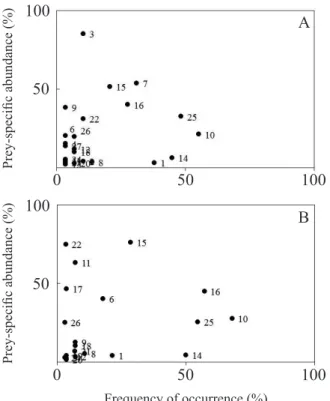
Feeding strategies were characterized using the graphical method proposed by Amundsen et al. (1996), which relates prey-specific abundance and frequency of occurrence. The distribution of points (food items) along the graph axes indicates the importance of prey for the population (rare or dominant), the feeding strategy of the predator (generalist or specialist), and the contribution of the between-phenotype (variation in resource use among individuals of the population) and within-phenotype components (when individuals tend to use similar resources) to the niche breadth.
INTRODUCTION
Resource partitioning is one of the main processes underlying species coexistence and community structure on local scale. Several factors may influence the ecological segregation among species, and dietary and spatial resources are considered the predominant factors in structuring populations and communities of vertebrates (Schoener 1974). For fish communities, trophic segregation is considered more important than habitat segregation (Ross 1986).
Resource partitioning in neotropical fish communities has been well documented (Corrêa et al. 2009; Silva et al. 2012) and often related to ecomorphological and/ or behavioral differences that influence the use of space (micro-habitat) and food resources (Piorski et al. 2005; Lima et al. 2008; Brazil-Sousa et al. 2009). Morphological features might be indicators of species life habits, types of resource use or adaptations to occupy the environment (Gatz 1979). Thus, ecomorphology aims to access the relationship between shape and function that exists between morphological and ecological characters and to relate it with ecological concepts (Cunico and Agostinho 2006).
Species with similar ecomorphological characters have high competitive potential (Gatz 1979), especially when phylogenetically close, due to niche conservatism (Wiens
et al. 2010). Thus, it can be expected that these species, especially when syntopic, exhibit differences in resource use that might minimize competition (Herder and Freyhof 2006). For example, in the size of consumed prey, use of microhabitats and feeding strategy (Esteves and Aranha 1999; Piorski et al. 2005; Brazil-Sousa et al. 2009).
Copella nigrofasciata (Meinken, 1952) and Pyrrhulina
sp. aff. P. brevis Steindachner, 1876 (called P. aff. brevis
thereafter) belong to the Lebiasinidae family, highly representative in Amazonian streams (Montag et al.
2008). Lebiasinids usually have an omnivorous diet based on allochthonous arthropods (Silva 1993; Arias and Rossi 2005; Oliveira 2013) and inhabit predominantly the surface of the water column in marginal areas with low flow (Sabino and Zuanon 1998). Similarities in the use of habitat and food resources demand mechanisms that minimize interspecific competition to promote the coexistence of these species. The aim of this study was to investigate the resource partitioning among populations of two species of lebiasinids (Copella nigrofasciata and
capacity; and 9) relative depth of caudal peduncle (RDCP = CPD/MBD) - Higher values indicate good swimming potential.
The ecomorphological indices were applied to a Principal Component Analysis (PCA) using broken-stick as a stopping rule, and only the extreme variables with the highest correlations with the selected axes were interpreted. A one-way ANOVA was used to test for ecomorphological differences among species, using the principal axes values as ecomorphological predictors. PCA was performed on PC-Ord (McCune and Mefford 2011) whereas ANOVAs were performed on R (R Development Core Team 2014).
RESULTS
Trophic ecology
Of the 60 individuals whose stomachs were examined, only three had empty stomachs (one C. nigrofasciata and two P. aff. brevis). The results of IAi showed that both species are omnivores with a tendency towards an invertivorous habit, consuming predominantly allochthonous items. The diet of C. nigrofasciata was primarily composed of Terrestrial Invertebrates (IAi = 27.10%), Insects Remains (24.53%), Debris and Sediment (14.59%) and Plant Material (13.17%), while the population of P. aff. brevis consumed mainly
Terrestrial Invertebrates (IAi = 34.37%), Plant Material (36.55%) and Insects Remains (21.82%) (Figure 1). A complete list of food items consumed by the two species is shown in Appendix 1.
Both species had an overall generalist diet, as no item was found to be dominant in their diets (consumed in high abundance by most individuals). The prevalence of rare items in the diet of both populations and the presence of groups of individuals who behaved as specialists The degree of diet overlap between species was calculated
using the Pianka pair-wise niche overlap index (Pianka 1973), which ranges from 0 (no overlap) to 1 (complete overlap). We considered two situations: (1) “overall overlap” between species without distinction between seasons, which can be interpreted as a ‘potential’ overlap, independent of temporal and/or spatial coexistence; and (2) the “temporal overlap” calculated for each season sample separately. The results of interspecific overlap were interpreted according to Grossman (1986): high (> 0.6), intermediate (0.4 to 0.6) or low (< 0.4).
We used an Analysis of Similarities (ANOSIM) to evaluate possible differences in diet composition among species. Data were log-transformed and matrices of dissimilarity between individuals were constructed based on the coefficient of Bray-Curtis distance. A Similarity Percentage Analysis (SIMPER) was used to identify which food items contributed to the dissimilarity. These analyses were also performed in two situations: (1) considering the overall spectrum of food consumed by the population, and (2) considering the food resources consumed by populations in each season separately. Both analyses were performed on PRIMER ®6 (Clarke and Gorley 2006).
Ecomorphology
To investigate the morphological differences associated with habitat use and feeding habits, 11 morphological measurements were taken on 20 specimens of each species using a digital caliper with 0.01 mm accuracy. The following morphological measurements were quantified following Piorski et al. (2005) and Mazzoni et al. (2010): 1) Standard length (SL); 2) Digestive tract length (DTL); 3) Mouth width (MW); 4) Maximum body width (MBW); 5) Eye height (EH); 6) Head depth (HD); 7) Head length (HL); 8) Caudal peduncle length (CPL); 9) Caudal peduncle depth (CPD); 10) Maximum body depth (MBD); 11) Mouth depth (MD).
The ecomorphological indices used were: 1) relative length of the digestive tract (RLDT = DTL/SL) - High values occurs in detritivorous or herbivorous species, while low values are related to carnivorous habits; 2) relative width of the mouth (RWM = MW/MBW) - Higher values indicate ability to ingest larger prey; 3) relative depth of the mouth (RDM = MD/ HD) - Higher values indicate ability to ingest larger prey; 4) eye position (EP = EH/HD) - Higher values occur in benthic species, while lower values occur in nektonic species; 5) relative length of the head (RLH = HL/SL) - Higher values indicate ability to ingest larger prey; 6) compression index (CI = MBD/ MBW) - Higher values indicate a laterally compressed body adapted to inhabit lentic environments; 7) relative depth of the body (RDB = MBD/SL) - Higher values are related to high maneuverability and with low hydrodynamic environments; 8) relative length of the caudal peduncle (RLCP = CPL/ SL) - Higher values occur in predators with good swimming
50
40
30
20
10
0
C. nigrofasciatta
P. aff. brevis
Al SD AI TI OM PM IR
Feeding index (%)
Categories of food items
Figure 1. Alimentary index (IAi) for the categories of diet items consumed by
(consuming few items in large quantities), indicate a high influence of the between-phenotype component in the niche width of both species (Figure 2). Hymenoptera (especially Formicidae) was the only item consumed by a little more than 50% of the population of C. nigrofasciata, but in low abundance (Figure 2a). Pyrrhulina. aff. brevis
consumed other items in high frequencies and relative abundances besides hymenopterans (Plant Material, Insects Remains and Diptera Larvae), indicating that the feeding strategy of this species is also under influence of the within-phenotype component (Figure 2b).
The calculated degree of niche overlap between species was high (0.83), and feeding dissimilarity was low, albeit significant (ANOSIM; R = 0.07; p = 0.001). Copella nigrofasciata consumed Debris and Algae, contrary to P. aff.
brevis. The latter, in turn, consumed, in larger quantities,
items present in the diets of both species (Table 1), such as Plant Matter, Insect Remains and Hymenoptera.
Niche overlap between the two species was high in the dry season (0.75), and no significant differences were found in the proportion of items consumed (ANOSIM; R = 0.008, p = 0.527). During the dry season, the number of items consumed by P. aff. brevis was lower (13) than that consumed by C. nigrofasciata (17), and, with the exception of Opiliones and allochthonous Coleoptera, all items consumed by P. aff. brevis were also present in the
diet of C. nigrofasciata (Table 2).
In the rainy season niche overlap had an intermediate value (0.52), and the proportion of consumed items was significantly different between species (ANOSIM; R = 0.13; p = 0.014). Copella nigrofasciata and P. aff. brevis consumed similar number of items (18 and 19, respectively), but types and relative proportions were different (Table 2). The major items that contributed to the dissimilarity between the diets of the species during rainy season were Plant Material, Hymenoptera and Insect Remains which were consumed by both species, but in higher quantities by P. aff. brevis, and Algae and Debris, which were consumed exclusively by C. nigrofasciata (SIMPER - Table 3).
Ecomorphology
The standard length (SL) of C. nigrofasciata ranged from 19.26 to 33.7 mm (26.27 ± 4.30 standard deviation), and SL of P. aff. brevis from 17.55 to 55.06 mm (30.64 ±
11.69 standard deviation). The first three PCA axes were selected by the broken-stick criteria and accounted for 76.01% of the total variation in the ecomorphological space. However, we interpret only PC1 and PC2 (58.6% of variation, Table 4). PC3 was not interpreted because it showed intrapopulational variations rather than diferences between species. Furthermore, indices with high scores on both PC2 and PC3 (RDM and RWM, respectively) indicate similar ecological features (ability to ingest larger prey). The first principal component explained most of the variation (35.03%) and showed interspecific differences related to the relative depth of the body (RDB) and to the relative length of the caudal peduncle (RLCP). The second axis showed mainly intraspecific variations related to relative length of the head (RLH) and to the relative depth of the mouth (RDM) (Table 4; Figure 3). The species ordination on the first axis formed two groups (T = 6.51; d. f. = 38; p < 0.001), but some overlap could be observed in the ecomorphological space (Figure 3). Copella nigrofasciata
had usually higher scores on the first axis, showing higher values of RLCP, whereas P. aff. brevis had lower values in the axis, showing higher values of RDB.
0 50 100
50 100
0 50 100
50 100
A
B
Frequency of occurrence (%)
Prey-specific abundance (%)
Prey-specific abundance (%)
Table 1. Similarity Percentage Analysis (SIMPER) showing the contribution of the principal items that are responsible for the dissimilarity between the diets of
Copella nigrofasciata(C_nig) and Pyrrhulina aff. brevis(P_brev) in a first order stream located inside the Saracá-Taquera National Forest – PA. Codes: Av. Diss - Average Dissimilarity; Diss/SD - Standard Deviation of Dissimilarity; Cont. (%) - Percentage contribution for each diet item; Cum. (%) - Cumulative contribution.
Average volume
Diet items C_nig P_bre Av.Diss Diss/SD Cont.% Cum.%
Plant Matter 0.45 1.09 12.70 1.01 16.48 16.48
Insects Remains 0.61 1.00 11.71 1.12 15.20 31.68
Hymenoptera 0.63 1.05 11.67 1.11 15.15 46.83
Organic Matter 0.37 0.43 7.66 0.75 9.95 56.78
Debris 0.50 0.00 6.70 0.59 8.70 65.48
Diptera Larvae 0.24 0.27 4.23 0.83 5.49 70.97
Adult Coleoptera 0.05 0.33 3.73 0.46 4.84 75.81
Filamentous Algae 0.27 0.00 3.15 0.32 4.08 79.89
Invertebrate Eggs 0.11 0.08 2.33 0.31 3.03 82.92
Isoptera 0.02 0.17 2.02 0.29 2.63 85.55
Acarina (Hydracarina) 0.10 0.08 1.87 0.67 2.42 87.97
Seeds 0.05 0.07 1.28 0.28 1.66 89.63
Hemiptera 0.06 0.08 1.23 0.28 1.60 91.23
Table 2. Alimentary indices (IAi) for the diet items consumed byCopella nigrofasciata(C_nig)and Pyrrhulinaaff.brevis(P_bre) in a first order streamlocated inside the Saracá-Taquera National Forest – PA, for both rainy and dry season. Codes: A – Aquatic; T – Terrestrial;
Rainy season Dry season
Items/Species C_nig P_bre C_nig P_bre
Plant Matter 10.80 41.74 11.67 13.60
Debris and Sediment - 0.46 -
-Ephemeroptera Nymph 0.19 0.02 0.10 0.09
Odonata Nymph - 0.03 -
-Plecoptera Nymph 0.09 0.01 -
-Opiliones - 0.01 - 1.18
Invertebrate Eggs 0.09 0.24 1.75
-Psocoptera 0.09 - -
-Diptera Pupae 0.09 0.01 -
-Insects Remains 5.12 13.78 40.39 46.97
Seeds 0.04 0.16 0.25
-Tysanoptera - - 0.10
-Number of items 18 19 17 13
Niche overlap 0.516 0.757
Rainy season Dry season
Items/Species C_nig P_bre C_nig P_bre
Acarina (A) 1.71 0.02 1.02 1.63
Acarina (T) 0.05 0.01 0.14 0.05
Algae 26.15 - -
-Araneae - - 0.35
-Blattodea - 0.03 -
-Adult Coleoptera (T) 0.57 3.80 - 0.27
Debris 9.95 - 14.90
-Adult Diptera (T) 0.09 0.07 0.26 0.04
Hemiptera - 0.16 0.50 0.04
Hymenoptera 31.84 35.25 17.73 15.42
Isoptera - - 0.10 9.07
Coleoptera Larvae (A) 0.95 - -
-Coleoptera Larvae (T) - - 0.05
-Diptera Larvae 1.93 1.19 6.53 5.84
DISCUSSION
Copella nigrofasciata and Pyrrhulina aff. brevis showed an overall similar trophic ecology. Both could be classified as omnivores with a tendency for an invertivorous habit, and consumed predominantly allochthonous prey. Their feeding strategy is generalist with high influence of the between-phenotype component on niche breadth; however, the influence of the within-phenotype component cannot be neglected, particularly for P. aff. brevis. The diet niche
Table 3. Similarity Percentage Analysis (SIMPER) showing the contribution of the principal items responsible for the dissimilarity between the diets of Copella nigrofasciata (C_nig) and Pyrrhulina aff. brevis (P_bre) in a first order stream located inside the Saracá-Taquera National Forest – PA in the rainy season. Codes: Av. Diss - Average Dissimilarity; Diss/SD - Standard Deviation of Dissimilarity; Cont. (%) - Percentage contribution for each diet item; Cum. (%) - Cumulative contribution.;(T) – Terrestrial;
Average volume
C_ nig P_ bre Av.Diss Diss/SD Cont. (%) Cum.%
Plant Matter 0.55 1.99 14.77 1.03 18.9 18.9
Hymenoptera 0.93 1.85 11.64 1.2 14.89 33.79
Insects Remains 0.37 1.23 9.26 1.19 11.84 45.63
Organic Matter 0.56 0.6 7.48 0.72 9.57 55.21
Filamentous Algae 0.87 0 6.58 0.51 8.41 63.62
Adult Coleoptera (T) 0.13 0.65 5.35 0.56 6.85 70.47
Debris 0.54 0 4.83 0.49 6.18 76.65
Diptera Larvae 0.23 0.37 3.92 0.71 5.01 81.66
Table 4. Pearsoncorrelation coefficients (r) obtained for the first two axes of the Principal Component Analysis (PCA) for the nine ecomorphological indices of Copella nigrofasciata and Pyrrhulina aff. brevis in a first order stream located inside the Saracá-Taquera National Forest – PA. The indices with the highest correlation with the axes are shown in bold type. Codes: RLDT – relative length of the digestive tract; RWM – relative width of the mouth; RDM – relative depth of the mouth; EP – eye position; RLH – relative length of the head; CI – compression index; RDB – relative depth of the body; RLCP – relative length of the caudal peduncle; RDCP – relative depth of caudal peduncle.
Ecomorphological indices Axis 1 Axis 2
RLDT -0.399 -0.212
RWM 0.585 0.496
RDM 0.197 0.801
EP 0.181 0.099
RLH -0.258 -0.410
CI -0.207 -0.066
RDB -0.446 -0.171
RLCP 0.893 -0.384
RDCP -0.233 0.361
% of Explanation 35.034 23.543
overlap between species is potentially high, but showed significant temporal variations: it was intermediate in the rainy season and high but asymmetric in the dry season, when
C. nigrofasciata consumed several prey types also consumed by P. aff. brevis, which in turn, showed a decrease in the diet spectrum. In contrast to the similarity in trophic ecology, species showed ecomorphological differences that suggest a distinct use of space. Individuals of Copella nigrofasciata
showed greater swimming endurance, while individuals of
P. aff. brevis showed greater maneuverability and tendency to inhabit slow water pools.
Despite the high diversity of prey consumed, most of the diet of C. nigrofasciata and P. aff. brevis were composed by arthropods, mainly terrestrial, fact that is favored by the terminal upward position of the mouth and occupation of the superficial layer of the water column. The predominance of terrestrial arthropods confirms other studies on these species (Anjos 2005; Carvalho 2008) and on other species of lebiasinids (Lebiasina panamensis (Gill, 1877) in a stream of Colombian Amazonia - Román-Valencia 2004; and Copella arnoldi (Regan, 1912) in streams of eastern Amazonia - Oliveira 2013), but contrasts to the findings of Arias and Rossi (2005), which showed a significant contribution of aquatic arthropods in the diet of Pyrrhulina australis Eigenmann and Kennedy 1903in lagoons of the middle Paraná River.
The massive consumption of ants by the majority of individuals in the populations of C. nigrofasciata and P.
was reported (Mendonça et al. 2012; Gonçalves et al. 2013). Terrestrial arthropods that fall into the streams are an important high quality food resource (low C: N ratio) that is directly available to fish (Baxter et al. 2005; Small et al. 2013). This fact highlights the importance of riparian vegetation and associated animal resources for the maintenance of aquatic communities. The consumption of these organisms reveals the participation of the studied species in the pathways of matter and energy between terrestrial and aquatic ecosystems (Baxter et al. 2005).
The calculated feeding overlap was high, which could indicate competition for resources between these two phylogenetically and morphologically similar syntopic species. We however interpret it as potential diet overlap value, since other analyses carried out in the present study suggest rather a low overlap due to: (i) different feeding strategies within populations (individuals or groups of individuals); (ii) seasonal variation in the diet; and (iii) minor morphological differences that suggest distinct spatial niche (utilization of microhabitats).
Niche partitioning is considered a common feature of fish communities (Ross 1986), but variable according to environmental conditions, such as seasonality (Bouton et al. 1997), like it was observed for both species in our study. The differences in feeding overlap between seasons indicate variation in food availability (Deus and Petrere-Junior 2003), despite the fact that seasonal fluctuations are supposed to be milder upstream in Amazonian streams (Sioli 1984). During the rainy season, the flooding of marginal areas carries allochthonous resources into the stream and increases foraging
areas, what we believe has led to a higher trophic segregation among P. aff. brevis and C. nigrofasciata, whereas in dry season the opposite was observed, i.e., more resource sharing. The
relationship between the availability of resources and niche overlap between populations has shown controversial results. In a review paper, Esteves and Aranha (1999) reported studies that demonstrated higher overlap among fishes in dry seasons, whereas other studies show the opposite pattern.
The high niche overlap observed in the dry season does not necessarily mean a scenario of competition. Since the niche is multidimensional, resource partitioning may be not experienced in the type of consumed preys, but in other dimensions like prey size, different use of space and/ or phenotypic characteristics that allow subtle differences in the use of available resources (Esteves and Aranha 1999; Piorski et al. 2005; Brazil-Sousa et al. 2009). Furthermore, when considering average values of resource use within a population we ignore the fact that the individuals composing the same population may use different resources, minimizing an apparent competition between species.
The generalist feeding strategy observed for both P. aff.
brevis and C. nigrofasciata was also observed by Arias and Rossi (2005) for Pyrrhulina australis. This type of feeding strategy is favored by the naturally unstable characteristic of lotic systems, especially in tropical environments (Lowe-McConnell 1999). A generalist population may be formed: (1) by groups of specialist individuals (high between-phenotype component); or (2) all or most part of generalist individuals (high within-phenotype component) (Bolnick et al. 2003), both resulting in a high niche breadth. Copella nigrofasciata and P. aff.
brevis appear to have an intermediate strategy between these two extremes, similarly to two species of Heptapteridade in Atlantic Forest streams (Brazil-Sousa et al. 2009).
However, some subtle differences can be found in the feeding strategies of these lebiasinids. Most individuals of C. nigrofasciata behaved as generalists, i.e., each individual or groups of individuals fed on several items. Exceptions to this pattern were a few individuals that consumed filamentous algae in large quantities. On the other hand, P. aff. brevis
showed both extremes, being influenced both by between-phenotype and within-between-phenotype components. Groups of individuals were specialists, consuming invertebrate eggs, termites and organic matter in high amounts (volume), whereas the majority of the population consumed insect remains, plant material, and hymenopterans. The influence of the within-phenotype component was also observed for P. australis in the middle Paraná River (Arias and Rossi 2005). The importance of the between-phenotype component indicates an intraspecific variation in resource use, suggesting the occurrence of individual specialization (Bolnick et al. 2003). This variation is possibly a reflection of
0.4 0.2 0.0 -0.2 -0.4 -0.4 -0.2 0.0 0.2 0.4 Axis2 (2354%) Axis1 (35.03%) Capacity to use
large preys
High swimming ability and low maneuverability
intraspecific morphological variation on prey size, revealed by ecomorphological analyzes in our study.
The ecomorphological analysis of C. nigrofasciata and
P. aff. brevis indicated that these species differ in swimming endurance and maneuverability, and consequently in their ability to explore different habitats and resources available in streams. Upstream rivers are usually shallow (mainly first-order streams), but can present high diversity of habitats, such as dens, marginal mudflats, sandy and litter banks, and the channel of the stream itself (Pazin et al. 2006). The largest swimming endurance of C. nigrofasciata enables it
to explore different environments available along the water column more easily, allowing it to maintain a diversified diet even during the dry season. Pyrrhulina aff. brevis, in turn, shows a tendency to inhabit lentic environments, and greater maneuverability than C. nigrofasciata, which could facilitate
vertical movement, but hampers occupation and horizontal mobility among microhabitats. These results are consistent with the habitats where these species were captured: more than 60% of individuals of P. aff. brevis were captured in flooded marginal areas, while individuals of C. nigrofasciata
were captured more evenly across all available microhabitats (~ 30 %).
A significant amount of debris was found in the diet of
C. nigrofasciata. Although water velocity is usually high in headwaters (Vannote et al. 1980), in Amazonian igarapés the low declivity permits the deposition of debris on the bottom substrate. Furthermore, individuals of Copella nigrofasciata
were captured on flooded marginal areas, which are small temporary pools that form in valleys during rainy season by the overflowing stream water (Pazin et al. 2006). These pools can be the environment where this species can easily consume detritus. Although P. aff. brevis also occurs in high abundance in these microhabitats, the low amounts of detritus in its diet may indicate that it has a different foraging behavior when compared to C. nigrofasciata.
The consumption of debris has been associated with the behavior of substrate exploration (Mendonça et al. 2012), which can be the case for C. nigrofasciata. Individuals of P.
aff. brevis, on the other hand, could capture prey mainly in water column or surface (Arias and Rossi 2005); a sit-and-wait strategy may be related to the increased maneuverability observed in P. aff. brevis. In a behavioral study in captivity,
Arias and Rossi (2005) found that the sit-and-wait is the main strategy adopted by P. australis : during the “waiting period”, individuals spent most of the time amidst the vegetation or near the substrate and when moving towards prey demonstrated skill in maneuvering and braking abruptly. Data available for the present study do not allow inferring which type of behavior is predominant for the studied species.
However, morphological and diet analyses provide clues about behavioral patterns.
CONCLUSIONS
Albeit the phylogenetically close species P. aff. brevis
and C. nigrofasciata belong to the same trophic guild and have a high potential niche overlap, their coexistence in this first order stream seems to be facilitated by a variety of non-mutually exclusive factors, such as seasonal variation in diet, intraspecific variation in resource use, and morphological differences that allow a differentiated exploitation of available habitats. Whether these patterns are consistent across Amazonian streams will only be known by the accumulation of studies or through studies with replicates in larger scales. Our findings in this study, however, provide information on the ecology of these particular species with potential use as ornamental fish and that dwell Amazon streams, which are still poorly understood systems, despite being subject of anthropogenic modifications that may result in species losses even before they are known. Studies on the natural history and ecological relations of fish species are fundamental to provide knowledge on the ecological processes of the Amazon region for monitoring and management actions.
ACKNOWLEDGEMENTS
This research was supported by Mineração Rio do Norte. Authorization (No. 513/2014) for fish capture and transportation was given by IBAMA (DILIC) to Mineração Rio do Norte. The authors are grateful to other participants of the project for obtaining fish and field data, to members of the Laboratório de Ecologia de Peixes/ UFRJ for early discussions about the study design and analyses. NCSS was recipient of a Conselho Nacional de Desenvolvimento Científico e Tecnológico (CNPq) MSc fellowship.
REFERENCES
Albrecht, M.P.; Caramaschi, E.P. 2003. Feeding ecology of
Leporinus friderici (Teleostei; Anostomidae) in the upper Tocantins river, Central Brazil, before and after installation
of a hydroelectric plant. Studies on Neotropical Fauna and
Environment, 38: 33-40.
Amundsen, P.A.; Gabler, H.M.; Staldvik, F.J. 1996. A new approach to graphical analysis of feeding strategy from stomach contents
data – modification of the Costello (1990) method. Journal of
Fish Biology, 48: 607-614.
Anjos, M.B. 2005. Estrutura de comunidades de peixes de igarapés
de terra firme na Amazônia Central: composição, distribuição e características tróficas. Dissertação de Mestrado, Instituto Nacional de Pesquisas da Amazônia/Universidade Federal do Amazonas, Manaus, Amazonas. 68p.
Arias, J.; Rossi, L. 2005. Dieta y estrategia alimentaria de Pyrrhulina
Baxter C.V.; Fausch, K.D.; Saunders, W.C. 2005. Tangled webs: reciprocal flows of invertebrate prey link streams and riparian
zones. Freshwater Biology, 50: 201-220.
Bolnick, D.I.; Svanbäck, R.; Fordyce, J.A.; Yang, L.H.; Davis, J.M.; Hulsey, C.D.; Forister, M.L. 2003. The ecology of individuals:
incidence and implications of individual specialization. The
American Naturalist, 161: 1-28.
Bouton, N.; Seehausen, O.; van Alphen, J.J.M. 1997. Resource partitioning among rock-dwelling haplochromines (Pisces:
Cichlidae) from Lake Victoria. Ecology of Freshwater Fish, 6:
224-240.
Brazil-Sousa, C.; Marques, R.M.; Albrecht, M.P. 2009. Segregação alimentar entre duas espécies de Heptapteridae no Rio Macaé
(RJ). Biota Neotropica, 9: 1-7.
Carvalho, L.N. 2008. História natural de peixes amazônicos: utilizando
a abordagem do Conceito do Rio Contínuo. Tese de Doutorado, Instituto Nacional de Pesquisas da Amazônia/Universidade do Amazonas. Manaus. 142p.
Clarke, K.R.; Gorley, R.N. 2006. PRIMER v6: User Manual/ Tutorial. PRIMER-E, Plymouth, 192pp.
Corrêa, C.E.; Hahn, N.S.; Delariva, R.L. 2009. Extreme trophic segregation between sympatric fish species: the case of small
sized body Aphyocharax in the Brazilian Pantanal. Hydrobiologia,
635: 57-65.
Cunico, A.M.; Agostinho, A.A. 2006. Morphological patterns of fish
and their relationships with reservoirs hydrodynamics. Brazilian
Archives of Biology and Technology, 49:125-134.
Deus, C.P.; Petrere-Junior, M. 2003. Seasonal diet shifts on seven fish species in an Atlantic Rainforest stream in southeastern
Brazil. Brazilian Journal of Biology, 63: 579-588.
ESTEVES, K.E. and ARANHA, J.M.R. 1999. Ecologia trófica de peixes de riachos, p. 157182. In: E.P. CARAMASCHI R. MAZZONI & P.R. PERES NETO (Eds). Ecologia de Peixes de Riachos. Rio de Janeiro, Série Oecologia Brasiliensis, PPGEUFRJ.
Fittkau, E.J.; Klinge, H. 1973. On biomass and trophic structure
of the Central Amazonian Rain Forest Ecosystem. Biotropica,
5: 2-14.
Gatz Jr., A.J. 1979. Community organization in fishes as indicated
by morphological features. Ecology, 60: 711-718.
Gonçalves, A.F.G.; Prudente, B.S.; Carvalho-Filho, F.S.; Montag,
L.F.A. 2013. Feeding ecology of dash-dot tetra Hemigrammus
belotti (Steindachner, 1882) (Characiformes: Characidae) in the
streams of the Urucu River basin, central Amazonia, Brazil. Biota
Neotropica, 13: 141-147.
Grossman, G.D. 1986. Food partitioning in a rocky intertidal fish
assemblage. Journal of Zoology , 1: 317-355.
Herder, F.; Freyhof, J. 2006. Resource partitioning in a tropical
stream fish assemblage. Journal of Fish Biology, 69: 571-589.
Kawakami, E.; Vazzoler, G. 1980. Método gráfico e estimativa de índice alimentar aplicado no estudo de alimentação de peixes.
Boletim do Instituto Oceanográfico de São Paulo, 29: 205-207.
Lima, S.M.Q.; Cunha, A.A.; Sánchez-Botero, J.I.; Caramaschi,
E.P. 2008. Vertical segregation of two species of Hyphessobrycon
(Characiformes: Characidae) in the Cabiúnas coastal lagoon,
southeastern Brazil. Neotropical Ichthyology, 6: 683-688.
Lowe-McConnell, R.H. 1999. Estudos ecológicos de comunidades de
peixes tropicais. EDUSP, São Paulo, 584p.
Mazzoni, R.; Moraes, M.; Rezende, C.F.; Miranda, J.C. 2010. Alimentação e padrões ecomorfológicos das espécies de peixes
de riacho do alto rio Tocantins, Goiás, Brasil. Iheringia, Série
Zoologia, 100: 162-168.
McCune, B.; Mefford, M.J. 2011. PC-ORD. Multivariate analysis of Ecological Data, Version 6.0 for Windows.
Mendonça, M.B.; Montag, L.F.A.; Oliveira-Raiol, R.D.; Wosiacki, W.B. 2012. Feeding ecology of two sympatric species of the
genus Jupiaba (Characiformes: Characidae) in streams in the
Urucu river basin, AM, Brazil. Uakari, 8: 59-67.
Montag, L.F.A.; Freitas, T.M.S.; Wosiacki, W.B.; Barthem, R.B. 2008. Os peixes da Floresta Nacional de Caxiuanã (Município
de Melgaço e Portel, Pará – Brasil). Boletim do Museu Paraense
Emílio Goeldi (Série Ciências Naturais), 3: 11-34.
Oliveira, E.S. 2013. Variáveis ambientais influenciam na dieta de um
lebiasinídeo na Amazônia Oriental? Trabalho de Conclusão de Curso, Universidade Federal do Pará, Belém, Pará. 21p. Pazin, V.F.V.; Magnusson, W.E.; Zuanon, J.; Mendonça, F.P. 2006.
Fish assemblages in temporary ponds adjacent to “terra-firme”
streams in Central Amazonia. Freshwater Biology, 51: 1025-1037.
Pianka, E.R. 1973. The structure of lizard communities. Annual
Review of Ecology and Systematics, 4: 53-74.
Piorski, N.M.; Alves, J.R.L.; Machado, M.R.B.; Correia, M.M.F. 2005. Alimentação e ecomorfologia de duas espécies de piranhas (Characiformes: Characidae) do lago de Viana, Estado do
Maranhão, Brasil. Acta Amazonica, 35: 63-70.
R Core Team. 2014. R: A language and environment for statistical computing. R Foundation for Statistical Computing, Vienna, Austria. URL http://www.R-project.org/.
Román-Valencia, C. 2004. Sobre la bioecología de Lebiasina
panamensis (Pisces: Lebiasinidae) en la cuenca del Río León,
Caribe Colombiano. Asociación Colombiana de Ictiólogos -
DAHLIA, 7: 33-35.
Ross, S.T. 1986. Resource partitioning in fish assemblages: a review
of field studies. Copeia: 352-388.
Sabino, J.; Zuanon, J. 1998. A stream fish assemblage in Central Amazonia: distribution, activity patterns and feeding
behavior. Ichthyological Exploration of Freshwaters, 8: 201-210.
Schoener, T.W. 1974. Resource partitioning in ecological
communities. Science, 185: 27-39.
Silva, C. 1993. Alimentação e distribuição espacial de algumas
espécies de peixe do igarapé do Candiru, Amazonas, Brasil. Acta
Amazônica, 23: 271-185.
Silva, J.C.; Delariva, R.L.; Bonato, K.O. 2012. Food-resource partitioning among fish species from a first-order stream in
northwestern Paraná, Brazil. Neotropical Ichthyology, 10:
Sioli, H. 1984. Hydrochemistry and geology in the Brazilian Amazon
region. Amazoniana, 1: 74-83.
Small, G.E.; Torres, P.J.; Schweizer, L.M.; Duff, J.H.; Pringle, C.M. 2013. Importance of terrestrial arthropods as subsidies in lowland
Neotropical rain forest stream ecosystems. Biotropica, 45: 80-87.
Vannote, R.L.; Minshall, G.W.; Cummins, K.W.; Cushing, C.E.
1980. The river continuum concept. Canadian Journal of Fisheries
and Aquatic Sciences, 37: 130-137.
Wiens, J.J.; Ackerly, D.D.; Allen, A.P.; Anacker, B.L.; Buckley, L.B;
Cornell, H.V.; et al. 2010. Niche conservatism as an emerging
principle in ecology and conservation biology. Ecology Letters,
13: 1310-1324.
Annex 1. Diet items consumed byCopella nigrofasciataandPyrrhulina aff. brevisin a first order stream located inside the Saracá-Taquera National Forest – PA, for both rainy and dry seasons of 2010. Codes: A – Aquatic; T – Terrestrial.
Category C. nigrofasciata P. aff. brevis
Item IAi (%)
Algae 5.26
-Filamentous algae 5.26
-Debris and sedimento 14.59 0.25
Debris and sediment 14.59 0.25
Aquatic invertebrates 8.03 2.82
Hemiptera 0.19 0.18
Acari (A) 1.49 0.23
Coleoptera larvae (A) 0.19
-Diptera larvae 4.88 2.22
Ephemeroptera ninfae 0.15 0.03
Odonata ninfae - 0.01
Plecoptera ninfae 0.04 0.01
Invertebrate eggs 1.06 0.13
Diptera pupae 0.02 0.01
Terrestrial invertebrates 27.10 34.37
Acari (T) 0.11 0.02
Araneae 0.13
-Blattodea - 0.01
Adult Coleoptera (T) 0.11 2.69
Adult Diptera (T) 0.21 0.06
Hymenoptera 26.42 30.66
Isoptera 0.04 0.72
Coleoptera larvae (T) 0.02
-Opiliones - 0.20
Psocoptera 0.02
-Tysanoptera 0.04
-Organic matter 7.32 4.19
Organic matter 7.32 4.19
Plant material 13.17 36.55
Plant material 12.97 36.46
Seeds 0.21 0.09
Insects remains 24.53 21.82