Plant Breeding |
Article
based on phenotypic and molecular markers
Francisco Ermelindo Rodrigues (1); Samira Santiago Librelon (2); Silvia Nietsche (1*); Márcia Regina Costa (1); Marlon Cristian Toledo Pereira (1)(1)Universidade Estadual de Montes Claros, Departamento de Ciências Agrárias, Programa de Pós-Graduação em Produção Vegetal
no Semiárido, Caixa Postal 91, 39440-000 Janaúba (MG), Brasil.
(2) Universidade Federal de Lavras, Departamento de Biologia, Programa de Pós-Graduação em Genética e Melhoramento de
Plantas, Caixa Postal 3037, 37200-000 Lavras (MG), Brasil. (*) Corresponding author: [email protected]
Received: Dec. 13, 2011; Accepted: May 23, 2012
Abstract
The objective of this study was to examine the molecular and phenotypic variability of ‘Prata Anã’ banana clones cultivated in
northern Minas Gerais State. For the phenotypic and molecular characterization, the clones were collected from five proper -ties. The morphological characterization of 20 clones was accomplished through a qualitative evaluation of 74 descriptors.
For the molecular evaluations, 45 clones were collected, and 14 Random Amplified Polymorphic DNA primers were used.
Among the 74 morphological descriptors evaluated in the 20 ‘Prata Anã’ banana tree clones, 53 descriptors presented in the
same homogeneous class for all clones. The presence of anthocyanin in the pseudostem (ANT) and the shape (BUS) and flex
-ion (FLX) of the bunch clearly differentiated the ‘Prata Anã’ banana clones from the commercial cultivar. A total of 176 bands were produced from the molecular analysis using the 14 RAPD primers; there were 116 monomorphic and 60 polymorphic bands, with an average polymorphism percentage of 52.2%. The amplification using the OPP 14 primer resulted in the great -est percentage of polymorphic bands at 88%. The dendrogram indicated that each of the 45 ‘Prata Anã’ clones that were
evaluated using RAPD markers clustered with the commercial ‘Prata Anã’ cultivar. Key words:Musa spp., morphological variation, diversity, clonal population, RAPD.
Variabilidade genética em clones de bananeira ‘Prata Anã’ por meio de marcadores
fenotípico e molecular
Resumo
O objetivo do presente estudo foi avaliar a variabilidade fenotípica e molecular de clones de bananeira ‘Prata Anã’ cultivados no Norte de Minas Gerais. Os clones foram coletados em cinco propriedades. A caracterização morfológica de 20 clones foi realizada por meio da avaliação qualitativa de 74 descritores. Para a avaliação molecular, 45 clones foram coletados e 14 primers RAPD foram utilizados. Dentre os 74 descritores morfológicos avaliados nos 20 clones de bananeira ‘Prata Anã’, 53 descritores tinham a mesma classe, sendo homogêneos para todos os clones. Dentre os descritores avaliados, a presença de antocianina no pseudocaule (ANT), a forma do cacho (FCA) e a flexão das pencas (FLX) diferenciaram de maneira clara os clones de ‘Prata Anã’ da cultivar comercial. Por meio da amplificação de 14 iniciadores RAPD foram produzidos o total de 176 bandas, sendo116 monomórficas e 60 polimórficas, média de 52,2% de polimorfismo. O primer OPP14 produziu a maior porcentagem de bandas polimórficas, 88%. Pelo dendrograma observou-se que todos os 45 clones avaliados por meio do uso dos marcadores RAPD agruparam com a cultivar ‘Prata Anã’. Palavras-chave:Musa spp., variação morfológica, diversidade, população clonal, RAPD.
1. INTRODUCTION
Among the most common banana cultivars in the Brazilian market are the ‘Prata,’ ‘Nanica,’ ‘Maçã,’ ‘Terra,’ ‘Ouro’ and ‘Marmelo’ varieties. The narrow ge-netic variability of the Brazilian cultivars makes these bananas vulnerable to disease (Silva et al., 2008).
According to Lichtemberg and Lichtemberg (2011) the ‘Branca’ banana (AAB) originated in Santa Catarina State, and a natural mutation gave rise to the ‘Enxerto’. The Enxerto cultivar was registered at the germplasm bank of the Centro Nacional de Pesquisa Mandioca e Fruticultura (CNPMF) in the 1970s. It
later received the name ‘Prata Anã’ and was distributed worldwide and throughout various regions of Brazil.
Notable morphological characteristics of the ‘Prata Anã’ banana tree include the bright green coloration of its pseudostem sheaths. Under favorable cultivation conditions, the pseudostem girth normally exceeds one meter with a height from the ground to the foliar rosette between 2.20 and 4.50 meters (Marques et al., 2011).
Table 1. The collection county, geographic location and code among the ‘Prata Anã’ banana clones collected in northern Minas Gerais
County-State Farm Clones
Code Altitude (m) Latitude Longitude
Nova Porteirinha (MG) Uvale PGFU 563,5 15º45’51,2” S 43º15’46,2” W
Janaúba (MG) Belém PGFB 544,2 15º44’42,7” S 43º18’39,7” W
Janaúba (MG) Piranhas PGFC 530,2 15º44’50,7” S 43º19’27,4” W
Jaíba (MG) Thelo PGZT 479,5 15º15’04,9” S 43º55’19,1” W
Jaíba (MG) Odilia PGFS 479,1 15º15’32,3” S 43º48’01,5” W
Table 2. Plant identification, clone codes and types of analysis, phenotypic (P) and molecular (M) performed of 48 ‘’Prata Anã” clones
and the Prata Anã cultivar
Plant Identification Clones Code Type of
Analysis Plant Identification Clones Code Type of Analysis
Prata Anã Gorutuba 1 PGFU 1 M and P Prata Anã Gorutuba 26 PGZT6 M
Prata Anã Gorutuba 2 PGFU 2 M and P Prata Anã Gorutuba 27 PGZT7 M
Prata Anã Gorutuba 3 PGFU 3 M Prata Anã Gorutuba 28 PGZT8 M and P
Prata Anã Gorutuba 4 PGFU 4 M Prata Anã Rio 29 PGZT9 M
Prata Anã Gorutuba 5 PGFU 5 M and P Prata Anã Rio 30 PGZT 10 M
Prata Anã Gorutuba 6 PGFU 7 M and P Prata Anã Rio 31 PGZT11 M
Prata Anã Gorutuba 7 PGFU 8 M Prata Anã Rio 32 PGZT12 M
Prata Anã Gorutuba 8 PGFB 1 M and P Prata Anã Rio 33 PGZT13 M
Prata Anã Gorutuba 9 PGFB 2 P Prata Anã Rio 34 PGZT14 M
Prata Anã Gorutuba 10 PGFB 3 M Prata Anã Rio 35 PGZT15 M
Prata Anã Gorutuba 11 PGFB 4 P Prata Anã Gorutuba 36 PGFS 1 M
Prata Anã Gorutuba 12 PGFB 5 M and P Prata Anã Gorutuba 37 PGFS 3 M and P
Prata Anã Gorutuba 13 PGFB 6 M Prata Anã Gorutuba 38 PGFS 4 M and P
Prata Anã Gorutuba 14 PGFB 7 M Prata Anã Gorutuba 39 PGFS 5 M
Prata Anã Gorutuba 15 PGFC 1 M and P Prata Anã Gorutuba 40 PGFS 6 M
Prata Anã Gorutuba 16 PGFC 2 M Prata Anã Gorutuba 41 PGFS 7 M and P
Prata Anã Gorutuba 17 PGFC 3 M and P Prata Anã Catarina 42 PGFS 8 M
Prata Anã Gorutuba 18 PGFC 4 M Prata Anã Catarina 43 PGFS 9 M and P
Prata Anã Gorutuba 19 PGFC 5 M and P Prata Anã Catarina 44 PGFS 10 M
Prata Anã Gorutuba 20 PGFC 6 P Prata Anã Catarina 45 PGFS 11 M
Prata Anã Gorutuba 21 PGFC 7 M Prata Anã Catarina 46 PGFS 12 M
Prata Anã Gorutuba 22 PGZT1 M and P Prata Anã Catarina 47 PGFS 13 M
Prata Anã Gorutuba 23 PGZT2 M Prata Anã Catarina 48 PGFS 14 M
Prata Anã Gorutuba 24 PGZT4 M and P Prata Anã cultivar PC M and P
Prata Anã Gorutuba 25 PGZT5 M and P - -
-Several methods have been used to investigate the genetic variability present in the Musa germplasm. Morphotaxonomic descriptors were the first to be developed and perfected for banana trees, and 119 descriptors were re-cently defined as normal for the Musa germplasm (IPGRI, 1996). More recently, molecular markers have been applied to studies concerning the genotypic relationships (Shinwari, 1995), identification of mutants (Damasco et al., 1996), and classification of clones (Bhat et al., 1995) of the Musa spp.
The analysis of genetic diversity based on RAPD mole-cular markers is a technique used for studies of inter – and intra-varietal genetic variability among different species (Solouki et al., 2008, Martins-Lopes et al., 2009). One of the advantages of molecular markers is phenotypic neu-trality, which is generally co-dominantly inherited and rarely exhibits epistatic or pleiotropic interactions, allowing it to be detected in both young and adult tissues (Brammer, 2000).
The objective of the present study was to analyze the phenotypic and molecular variability of ‘Prata Anã’ bana-na clones cultivated in northern Mibana-nas Gerais.
2. MATERIAL AND METHODS
Morphological Characterization
The morphological characterization of the clones was con-ducted at five properties located in the northern region of Minas Gerais with orchards of ‘Prata Anã’ banana trees. Sucker plants were obtained using an in vitro micropropa-gation process. All plants selected had completed at least two productive cycles (possessing a third cluster). Four plants from each property were characterized, for a total of 20 plants. The geographic location of the properties used in the morphological characterization was defined using a GPSMAP 76S Garmin device with the South American Datum 1969 (SAD 69) standard (Tables 1 and 2).
The qualitative characteristics were determined by the consensus of the evaluations of three different resear-chers. The adult leaves from mature plants and suckers were evaluated at each clump or production unit (mother, daughter and granddaughter).
The morphological characterization was conducted through the qualitative evaluation of 74 descriptors, in-cluding 24 plant, 25 cluster and 25 inflorescence charac-teristics (heart and male flowers). The descriptors used are detailed and illustrated according to the International Plant Genetic Resources Institute (IPGRI, 1996). The data were subjected to a hierarchical agglomerative cluster analysis (HAC). Similarity dendrograms were established using Pearson’s correlation coefficient, and the dendrogram was produced using the XLSTAT®
software for Excel.
Molecular Characterization
For the molecular characterization, 45 ‘Prata Anã’ banana tree clones from five properties located in the northern re-gion of the state of Minas Gerais and the ‘Prata Anã’ cul-tivar from the EMBRAPA CNPMF Germplasm Active Bank were evaluated (Table 2).
Leaf samples from 31 ‘Prata Anã Gorutuba’ clones, 7 ‘Prata Rio’ clones, 7 ‘Prata Catarina’ (EX-033) clones, and the common ‘Prata Anã’ cultivar were collected, identi-fied, and sent to the laboratory for DNA extraction.
DNA was extracted from young leaves in accordance with the methods of Doyle and Doyle (1990). The DNA was quantified spectrophotometrically (FEMTO 700 Plus), and the quality of the DNA was assessed on a 0.8% agarose gel. After estimating the quantity of the DNA, the samples were adjusted to a concentration of 10 ng/µL. A total of 14 primers (decamers) were selected and used for amplification (Table 3). The RAPD reactions were performed according to Williams et al. (1990) with the following concentrations:
genomic DNA (30 ng), Tris HCl-KCl (10mM/50mM), MgCl2 (3mM), dNTPs (0.1mM), primer (0.4 µM), Taq DNA polymerase (1 unit), and distilled water in a final vo-lume of 25 µl. Amplification was performed in a Techne®
TC-412 thermal cycler with the following program: one cycle of 94 ºC for 3 minutes, forty cycles of 94 ºC for 10 seconds, 35 ºC for 30 seconds and 72 ºC for 1 minute, followed by a final cycle of 7 minutes at 72 ºC. The amplifi-cation products were subjected to electrophoresis on a 1.2% agarose gel at 5V/cm in 1X TBE buffer for three hours. The gel was stained with a 5mg/ml ethidium bromide so-lution. The amplified fragments were visualized under UV light and photographed using a UVP®Life Science software
digital photo documentation system. Only the distinct and reproducible fragments were considered. The presence of an amplification product was classified as 1, and the absence of product was classified as 0. A matrix of binary data was pre-pared, and the Jaccard coefficient of similarity was applied. Estimates of dissimilarity were used to construct a dendro-gram according to the Unweighted Pair Groups Method with Arithmetic Mean (UPGMA). A bootstrap analysis was per-formed with 1000 repetitive samplings of the RAPD data to compute p values. The data were analyzed using the statisti-cal program Genes (Cruz, 2006).
3. RESULTS AND DISCUSSION
Morphological Characterization
Among the 74 morphological descriptors evaluated in the 20 ‘Prata Anã’ banana tree clones, 53 presented in the same homogeneous class for all of the clones. The 21 des-criptors that presented in different classes were submitted to a hierarchical agglomerative cluster analysis (HAC), establishing similarity dendrograms using Pearson’s corre-lation coefficient (Figures 1 to 3).
Table 3. The RAPD markers produced with the 14 primers among 45 different ‘Prata Anã’ banana clones and the Prata Anã cultivar
Primer Sequence 5’–3’ Total bands Polymorphic Bands
Polymorphism
percentage (%)
OPC 07 GTCCCGACG A 5 2 40
OPN 11 TCGCCGCAA A 9 4 44
OPD 04 TCTGGT GAG G 10 2 20
OPQ 11 TCTCCGCAA C 9 3 33
OPH 14 ACCAGGTTG G 9 4 44
OPE 12 TTATCG CCC C 7 6 86
OPB 10 CTGCTGGGA C 11 6 55
OPG 17 ACGACCGAC A 11 6 55
OPA 10 GTGATCGCA G 10 5 50
OPP 14 CCAGCCGAA C 8 7 88
OPU 10 ACCTCGGCA C 10 6 60
OPO 10 TCA CAG CGC C 5 2 40
OPV 14 AGA TCCCGC C 6 4 66
OPY 20 AGCCGTGGA A 6 3 50
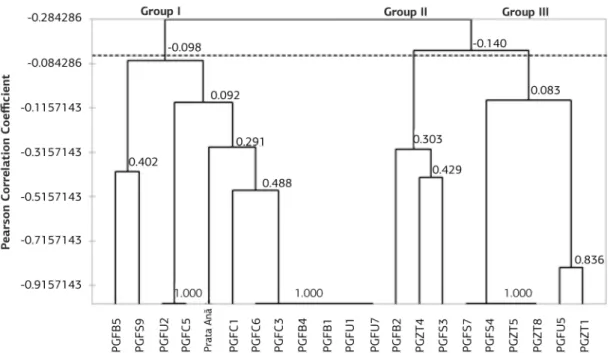
Figure 1. Distribution of Pearson’s correlation coefficients observed among the morphological characteristics (GCH, WAX, DSC, ANT, DSD, PMS, PCB, PCB, DSW) of 20 ‘Prata Anã’ banana tree clones and the ‘Prata Anã’ cultivated in northern Minas Gerais.
Figure 2. Distribution of the Pearson’s correlation coefficients observed in the cluster characteristics (BUS, FLX, PSF, MPR and BRP) of
20 ‘Prata Anã’ banana tree clones and the ‘Prata Ana’ cultivated in northern Minas Gerais.
Differences in nine plant descriptors, including green color hue (GCH), waxiness (WAX), dark spot co-lor (DSC), presence and quantity of anthocyanin in the pseudostem (ANT), dark spot density (DSD), petiole edge color (PMS), petiole colored band form and size (PCB), and dorsal surface limb waxiness (DSW), resulted in the classification of three groups. Pearson’s correlation coefficient analysis showed that the six clones of group I
presented 100% similarity and a significant correlation (0.488) with ‘Prata Anã’. However, a negative Pearson’s correlation coefficient (-0.284) was recorded between the three groups (Figure 1).
descriptor. Pillay and Tenkouano (2011) suggested that the variability within a clonal population is more phe-notypic than gephe-notypic and is often influenced by slight environmental differences within the habitat.
The amount of anthocyanin in the pseudostem (ANT) was another clearly differentiated descriptor among the eva-luated clones. While the ‘Prata Anã’ and ‘Prata Anã Catarina’ cultivars and clone PGFS 9 had pseudostems with a large distribution of anthocyanin, the other evaluated clones pre-sented little anthocyanin in the external sheath. Genotypes with little pseudostem pigmentation tend to be more similar to the Musa balbisiana Colla species. Those with anthocya-nin deposition and the presence of spots in the pseudostem tend to be similar to Musa acuminata Colla (Stover and Simmonds, 1987). The color of the pseudostem, petioles and midribs are considered minor changes and normally do not alter the nomenclature of the cultivar (Pillay and Tenkouano, 2011).
Clusters based on the BUS, FLX, PSF, MPR and BRP descriptors were classified into three distinct groups: group I was defined to include the ‘Prata Anã’ cultivar and clones PGFU 1, PGFS 4 and PGFS 9, showing a positive correlation of 0.297 with Group II and a negative corre-lation (-0.314) with Group III. Group III comprised 10 clones with 100% similarity (Figure 2).
The evaluated clones showed variability in the persis-tence of the remaining bract portions (BRP) in the rachis and the persistence of floral remains (MPR) on the male rachis. The MPR was only observed in the ‘Prata Anã’ banana cultivar, while in the other evaluated clones 62% of the plants presented floral remains along the entire
rachis. The BRP in the ‘Prata Anã Gorutuba’ clones was 76% differentiated from the ‘Prata Anã’ cultivar, predo-minantly in plants that are commonly referred to as “dirty tail” plants, as described by (Moreira, 1999).
In all 20 ‘Prata Anã Gorutuba ‘ clones, it was ob-served that the older bunch on the inside of the stalk had crooked and curved fruit. The characteristics that differentiated the ‘Prata Anã Gorutuba ‘ clones from the ‘Prata Anã’ cultivar included the shape (BUS) and flexion (FLX) of the bunch. In all evaluated clones, the clusters were compact, and the bunches were plain and slightly curved with extremely close insertions, clearly demonstrating cluster compaction, which was not ob-served in the ‘Prata Anã. According to Nantale et al. (2008) a number of morphological characteristics are prone to mutations, including plant stature, bunch and fruit shapes and fruit pulp stringency. Despite the great importance of genetic variation, it is not known how these traits are selected and subsequently conserved within a given farming community.
A high level of homogeneity was observed among inflorescence characteristics (heart and male flowers), as only seven descriptors among the 25 evaluated presented more than one category class.
The ‘Prata Anã’ was clustered in Group I and recor-ded a high correlation (1.000) with the PGFS7, PGFC6 and PGFS4 clones. The other two groups (II and III) were clustered with 23.8% and 28.6% of the evaluated clones, respectively (Figure 3).
Although the presence of anthocyanin occurred in the ‘Prata Anã’ banana tree cultivar, 57% of the ‘Prata Anã
Figure 3. Distribution of the Pearson’s correlation coefficients observed in the inflorescence characteristics (WAX, MAI, PAP, PLC, CAT,
Gorutuba’ clones presented anthocyanin throughout the perianth, with the same characteristic detected in ‘Prata Anã Catarina’ (PGFS 9).
This characteristic presents great variation among the evaluated clones and requires careful observation because the flowers must be evaluated in the first week after the bract opens; after the first week, it is common for flowers to acquire a rosy hue, even those from clones with white or cream colored bases and perianths. Floral structure senescence also causes the darkening of some tissues and can lead to incorrect evaluations of these descriptors.
Jesus et al. (2009) reported similar observations of the varying states of some descriptors and the subjectivity of evaluation. According to the author, the pseudostem spot color descriptor, for example, could be considered a single color due to the difficulty in differentiating shades of brown. Similar suggestions have been made for mature fruit pulp color (white and white matte) and anther color (pale brown and cream).
Despite the difficulty of differentiating some quali-tative characteristics, anthocyanin pigments are called melanins and are present in various parts of the plant. Various shades of red, brown, bronze and black can be observed along the pseudostem, petioles, upper sheaths and midribs. These variations are considered mutations and are useful for identifying clones (Simmonds, 1966).
Among the 74 evaluated characteristics, 37.5% of the plant characteristics, 12% of the cluster characteris-tics and 28% of the inflorescence characterischaracteris-tics presented more than one categorical class, which is equivalent to 12%, 4% and 9% of the total number of evaluated cha-racteristics, respectively.
In general, a high rate of similarity was observed among the evaluated clones. Therefore, a study conduc-ted with ‘Mysore’ banana clones revealed that the pseu-dostem girth, fruit maturity period, bunch, total, and average fruit weight and fruit circumference in the se-cond comb had high genotypic variation (Sirisena and Senanayake, 2000). Tezenas du Montcel et al. (1983) observed marked variability among plantains from Cameroon, although the sub-group was homogeneous from a botanical point of view. This author suggested that the morphological variability was due to some pa-rental influences during the natural hybridization pro-cess and to certain mutations. In addition, an additional source of morphological variation is associated with the process of selection. Bunch and fruit characters expe-rience tremendous selection pressure, particularly the compactness and shape of the bunch and fingers (Pillay and Tenkouano, 2011).
Morphological descriptors for the characterization of germplasm are not biased by the environment, should be scored easily and must have constant phenotypic ex-pression. Meanwhile, descriptors that are affected by the
environment are more important for agronomic evalua-tion or selecevalua-tion and for classificaevalua-tion (Ortiz, 1997).
Molecular Characterization
The fourteen RAPD primers produced a total of 176 bands, 116 monomorphic and 60 polymorphic. The average percentage of polymorphism was 52.2%, with a low of 20% and a high of 88%. The average number of polymorphic bands per primer was 4.28, and the OPP 14, OPB 10, OPG 17, OPE 12, and OPU 10 primers generated the greatest number of polymorphic bands: 7, 6, 6, 6 and 6, respectively (Table 3). Uma et al. (2006) conducted a study to estimate the diver-sity between and within the M. balbisiana species. The authors demonstrated that, of the 80 random primers used, 34 produced reproducible bands and only four primers produced more than five polymorphic bands. The average polymorphism obtained was 74.6%, indi-cating a considerable variation at the DNA level within M. balbisiana accessions.
The results of this and other studies demonstrate that a percentage of polymorphisms above 50% were observed for the intra – and inter cultivar genetic va-riability in species of the genus Musa. Studies con-ducted in different regions of Turkey using RAPD markers indicated a 61.3% polymorphism within the somaclonal variants of the Dwarf Cavendish cul-tivar (Gubbuk et al., 2004). In southern India, re-searchers evaluated the genetic variability of 21 com-mercial cultivars of banana by amplification using 50 RAPD primers and observed a 60.2% polymorphism (Venkatachalan et al., 2008).
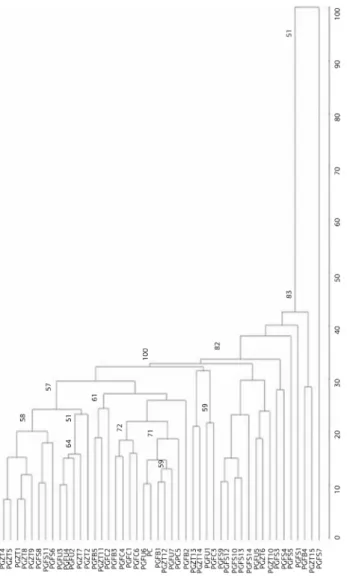
The ‘Prata Anã Gorutuba’ clone PGFS 7, collected at the Jaíba city, Santa Odília farm, had the highest percen-tage of polymorphic bands, with an average dissimilari-ty of 13.2% when compared with the ‘Prata Anã’ culti-var. However, clone PGZT 12, named ‘Prata Anã Rio’, showed a similarity of 98.7% with the ‘Prata Anã’ banana cultivar. Morphologically, the PGZT 12 clone had phe-notypic characteristics that were similar to those of the ‘Prata Anã’ cultivar in the field.
It was not possible to group the clones according to collection location or clone origin. When comparing the dissimilarity of the clones using collection location, the data indicated that the clones cultivated in Nova Porteirinha and Janaúba cities had a lower average dissi-milarity percentage of 3.56, whereas the clones that were cultivated at Janaúba e Jaíba cities had a higher average dissimilarity percentage of 5.23.
Figure 4. Dendrogram of similarity (%) among 45 Prata Anã banana clones and the ‘Prata Anã’ cultivar derived from Jaccard’s coefficient of similarity. Bootstrap values higher than 50%. genomic groups but presented the lowest dissimilarity with RAPD markers, with most classes showing a dissi-milarity value below 30%.
According to the dendrogram, the clone PGFS 7 had the greatest dissimilarity when compared with the ‘Prata Anã’ cultivar (Figure 4).
Studies indicate that the use of RAPD markers is effi-cient in separating cultivars that are derived from different genomic groups, but not for the characterization among clones (Bhat et al., 1995; Visser, 2000).According to Guimarães et al. (2009), the 103 RAPD primers and 33 pairs of SSR primers used did not produce polymorphic bands and were not efficient in distinguishing ‘Prata Anã’ (normal plants) from somaclonal variants. Conversely, Jesus et al. (2009) and Uma et al. (2009) recommend the use of SSR and AFLP markers for more refined and specific results.
The use of two molecular techniques combines the information generated from the broad coverage of the ge-nome generated through the use of RAPD and the high
reproducibility of the SSR bands, which generate impor-tant, reliable and informative bands for the genotypes (Rocha et al., 2002).
Although all of the clones evaluated clustered with the ‘Prata Anã’ cultivar, the identification and selection of superior clones is considered an important strategy in banana breeding programs.
4. CONCLUSION
Morphological descriptors, such as pseudostem color, presence of anthocyanin in the pseudostem, shape of the clusters and bunches, and the persistence of remaining flowers and bracts on the rachis were used to differentia-te ‘Prata Anã’ clones from the cultivar Prata Anã. All 45 ‘Prata’ clones evaluated were grouped with the ‘Prata Anã’ cultivar using RAPD markers.
ACKNOWLEDGMENTS
The authors would like to thank FAPEMIG and CNPq for supporting this work.
REFERENCES
BHAT, K.V.; JARRET, R.L.; RANA, R.S. DNA profiling of banana and plantain cultivars using random amplified polymorphic DNA (RAPD) and restriction fragment length polymorphism (RFLP) markers. Electrophoresis, v.16, p.1736-1745, 1995.
BRAMMER, S.P. Marcadores moleculares: princípios básicos e uso em programas de melhoramento genético vegetal. Passo Fundo: Embrapa Trigo, 2000. 7p. (Embrapa Trigo. Documentos online, 3). Disponível em: <http://www.cnpt.embrapa.br/biblio/p_do03. htm>. Acesso em: 16/10/2010.
CRUZ, C.D. Programa Genes – Estatística Experimental e Matrizes. Viçosa: Editora UFV, 2006. 285p.
DAMASCO, O.P.; GRAHAM, G.C.; HENRY, R.J; ADKINS, S.W.; SMITH, M.K. Random amplified polymorphic DNA (RAPD) detection of dwarf off-types in micropropagated Cavendish (Musa spp. AAA) bananas. Plant Cell Reports, v.16, p.118-123, 1996.
DOYLE, J.J.; DOYLE, J.L. Isolation of plant DNA from fresh tissue. Focus, v.12, p.13-15, 1990.
GUBBUK, H.; PEKMEZCI, M.; NACI ONUS, A.; ERKAN, M. Identification and selection of superior banana phenotypes in the cultivar Dwarf Cavendish using agronomic characteristics and RAPD markers. Pakistan Journal of Botany, v.36, p.331-342, 2004.
técnicas moleculares e citogenéticas. Ciência e Agrotecnologia, v.33, p.448-454, 2009.
JESUS, O.N; FERREIRA, C.F; SILVA, S.O; CAMARA, T.R; SOARES, T.L; PESTANA, K.N. Characterization of recommended banana cultivars using morphological and molecular descriptors. Crop Breeding and Applied Biotechnology, v.9, p.164-173, 2009.
IPGRI – International Plant Genetic Resources Institute. Descriptors for banana (Musa spp.). Rome: FAOP-IPGRI-INIBAP, 1996. 55p.
LICHTEMBERG, L.A; LICHTEMBERG, P.S.F. Avanços na bananicultura brasileira. Revista Brasileira de Fruticultura, v.33, p.29-36, 2011.
MARQUES, P.R.R.; DONATO, S.L.R.; PEREIRA, M.C.T.; COELHO, E.F.; ARANTES, A.M. Características agronômicas de bananeiras tipo ‘Prata’ sob diferentes sistemas de irrigação. Pesquisa Agropecuária Brasileira, v.46, p.852-859, 2011.
MARTINS-LOPES, P.; GOMES, S.; LIMA-BRITO, J.; LOPES, J. Assessment of clonal genetic variability in Oleaeuropaea L. ‘Cobrançosa’ by molecular markers. Scientia Horticulturae, v.123, p.82-89, 2009.
MOREIRA, R.S. Banana: teoria e prática de cultivo. 2. ed. São Paulo: Fundação Cargill, 1999. CD-ROM.
NANTALE, G.; KAKUDIDI, E.K.; KARAMURA, D.A.; KARAMURA, E.; SOKA, G. Scientific basis for banana cultivar proportions on-farm in East Africa. African Crop Science Journal, v.16, p.41-49, 2008.
ORTIZ, R. Morphological variation in Musa germplasm. Genetic Resources and Crop Evolution, v.44, p.393-404, 1997.
PILLAY, M.; NWAKANMA, D.C.; TENKOUANO, A. Identification de RAPD markers linked to A and B genome sequences in Musa L. Genome, v.43, p.763-767, 2000.
PILLAY, M.; TENKOUANO, A. Banana Breeding: Progress and Challenges. Boca Raton, Florida: CRC Press, 2011. 383p.
ROCHA, R.B.; MURO ABAD, J.I.; PIRES, I.E.; ARAÚJO, E.F. Fingerprinting and genetic diversity analysis of Eucalyptus spp. genotypes using RAPD and SSR makers. Scientia Forestalis, v.62, p.24-31, 2002.
RODRIGUES, F.E. Prata Gorutuba (Musa AAB Prata Ana Clone Gorutuba). Ficha Técnica. Disponível em: http://www.sbwbrasil.
com.br/Ficha%20t%C3%A9cnica%20Prata%20Gorutba.pdf. Acesso em: 20/6/2009.
SILVA, S.O.; SHEPHERD, K.; ALVES, E.J. Cultivares de banana. In: ALVES, E.J. (Ed.). A Cultura da Banana: aspectos técnicos, socioeconômicos e agroindustriais. Brasília: Embrapa, 1997. p.85-105.
SIMMONDS, N.W. Bananas. 2. ed. London: Longmans, 1966. 512p.
SHINWARI, Z.K. Introduction of new techniques in biological sciences in Paquistan. I. Future Directions for Plant Systematics using RFLP. Science Technology Development, v.14, p.22-30, 1995.
SIRISENA, J.A.; SENANAYAKE, S.G.J.N. Estimation of variability parameters within ‘Mysore’ banana clones and their implication for crop improvement. Scientia Horticulturae, v.84, p.49-66, 2000.
SOLOUKI, M.; MEHDIKHANI, H.; ZEINALI,H.;EMAMJOMEH, A.A. Study of genetic diversity in chamomile (Matricaria chamomilla) based on morphological traits and molecular markers. Scientia Horticulture, v.117, p.281-287. 2008.
STOVER, R.H.; SIMONDS, N.W. Bananas. 3. ed. New York: Longmann, 1987. 468p.
TEZENAS DU MONTCEL, H.; DE LANGHE, E.; SWENNEN, R. Essai de classification des bananiers platain (AAB). Fruits, v.38, p.461-474, 1983.
UMA, S.; SIVA, S.A.; SARASWATHI, M.S.; MANICKAVASAGAM, M.; DURAI, P.; SELVARAJAN, R.; SATHIAMOORTHY, S.Variation and intraespecific relationships in India wild Musa balbisiana (BB) population as evidenced by random amplified polymorphic DNA. Genetic Resources and Crop Evolution, v.53, p.349-355, 2006.
VENKATACHALAM, L.; SREEDHAR, R.V.; BHAGYALAKSHMI, N. The use of genetic markers for detecting DNA polymorphism, genotype identification and phylogenetic relationship among banana cultivars. Molecular Phylogenetics and Evolution, v.47, p.974-985, 2008.
VISSER, A.A. Characterization of banana and plantain using random amplified polymorphic DNA markers. Acta Horticulturae, n.540, p.113-123, 2000.