TOURISTIC DESTINAION AND DESINATION IMAGE:
CASE SUDY OF SLOVAKIA
Ivana Bukaiová
Project submitted as partial requirement for the conferral of Master in Business Administration
Supervisor:
Professor Renato Pereira, Professor at ISCTE Business School,
2
ABSTRACT
The master's thesis aims are to deeply analyze factors of the destination image which contribute to the formation of the secondary and subsequently to the shaping of the primary image. After the analysis of the factor of the secondary image, the same factors are analyzed with same methods also in the primary image part of this project. In the end, this two analyzes are compared, and the results are presented.
The results of this work point out that after the real visit of Slovakia, tourists tend to have much more positive image than before. This means that their secondary image, which is formed before the visited it positively affected by the real visit to Slovakia and the primary
One of the tools to increase the competitiveness of the country and to support its development is tourism, which, as a sector, occupies an increasingly important place in the national economy because the interest in traveling is constantly increasing. Moreover, to have a positive and steadily growing tourism sector, it is important to have a good marketing strategy with a strong country brand and excellent destination image.
Keywords: Tourism, Destination image, Travel, Slovakia
3
RESUMO
Os objectivos desta tese são analisar profundamente factores da imagem do destino que contribuem para a formação da imagem secundária e consequentemente para a formação da imagem primária. Após a análise dos factores da imagem secundária, os mesmos factores são utilizados com os mesmos métodos também na parte deste projecto relacionada com a imagem primária.
No final, estas duas análises são comparadas e os resultados são apresentados. Os resultados deste projecto demonstram que após uma visita à Eslováquia, os turistas tendem a ter uma imagem muito mais positiva do país do que tinham anteriormente. Isto significa que a sua imagem secundária, que é formada antes da visita, é positivamente influenciada pela real visita à Eslováquia e pela imagem primária.
Uma das formas de aumentar a competitividade do país e de apoiar o seu desenvolvimento é apostar no turismo que, como sector, ocupa um lugar cada vez mais importante na economia nacional porque o interesse em viajar tem crescido constantemente. Assim, para ter um crescimento positivo e estável no sector do turismo, é importante ter uma boa estratégia de marketing com uma marca de país forte e uma excelente imagem de destino.
Palavras-chave: Turismo, Imagem de Destino, Viagens, Eslováquia,
4
ACKNOWLEDGEMENTS
This is the way I speak to prof. Renata Pereira for help, expert guidance, valuable advice, and comments on my master's thesis work.
5 INDEX ABSTRACT ... 2 RESUMO ... 3 ACKNOWLEDGEMENTS ... 4 INDEX ... 5 LIST OF FIGURES ... 7 LIST OF GRAPHICS ... 8 LIST OF TABLES ... 9 LIST OF APPENDIXES ... 10 EXECUTIVE SUMMARY ... 11 1.INTRODUCTION ... 13
1.1. Problem statement & Research question ... 13
1.2.Study Motivation ... 13
2.LITERATURE REVIEW ... 16
2.1 Tourism definition ... 16
2.2.Definition of destination ... 23
2.3 The essence of place branding in tourism ... 24
2.4.Definition of destination image (brand image) ... 29
3.1. Quantitative Research ... 38
4.RESULTS ... 40
4.1 Quantitative research 4.1.1.Sample's social and demographic characterization ... 40
4.2 Branding ... 45
4.3 Secondary image ... 49
4.4 Primary image ... 54
4.5. Comparative analyses of the primary and secondary image ... 58
6
4.7. Conative Image Descriptive and Frequencies' Analysis ... 63
5. CONCLUSIONS ... 68
5.1. Branding Slovakia ... 68
5.2. Comparative analysis of the secondary and primary image. ... 68
5.3.Comparison with the previous studies ... 69
5.4. Study Limitations ... 70
5.5. Further Research Recommendations ... 70
7.ANNEX ... 75
Section A. Survey ... 76
Slovakia´s Destination Image ... 76
Section B- Sample's social and demographic Analysis ... 86
Section C - Traveler's Profile Analysis... 90
Section D- The purpouse for visiting Slovakia analysis ... 91
Section E- Factors shaping destination image ... 92
7
LIST OF FIGURES
Figure 1. Slovakia Little Big Country ... 27 Figure 2. Good Idea Slovakia ... 29 Figure 3 - Factor influencing Destination Image (Baloglu and McCleary,1999) ... 34 Figure 4. Image types according to type of the knowledge (Adapted from Phelps, 1986, Gunn, 1988 and Mansfeld, 1992) ... 35
8
LIST OF GRAPHICS
Graphic 1 – Age groups of the Survey's Respondents... 41
Graphic 2 - Education Level of the Survey's Respondents ... 41
Graphic 3 - Sample's distribution by Nationality (Continent) ... 42
Graphic 4 - Sample's main reason for travelling ... 44
Graphic 5 - Sample's main reason for travelling ... 45
Graphic 6 - Sample's logo recognition ... 46
Graphic 7 - Sample's association of logo with various attributes Little Big City... 47
Graphic 8 - Sample's logo recognition ... 47
Graphic 9 - Sample's association of logo with various attributes ... 48
Graphic 10 - Factor shaping destination image ... 53
Graphic 11 - Sample's way of the changing the view... 60
Graphic 12 - Sample's way of the changing the view... 61
Graphic 13 – The number of the sample's visits of Slovakia ... 62
Graphic 14 –Sample's duration of the last stay ... 63
Graphic 15- Frequencies of the variable Likeliness to Recommend Slovakia to others ... 64
Graphic 16 - Frequencies of the variable "Revisiting Slovakia" ... 65
Graphic 17 – Samples Likeliness to Revisit ... 66
Graphic 18- Sample's Distribution by Gender ... 86
Graphic 19 - Sample's Distribution by Gross Income Level ... 87
Graphic 20 - Sample's Distribution by Country of Origin... 88
Graphic 21 - Sample's Distribution by Professional Status ... 89
9
LIST OF TABLES
Table 1:Selected definitions of the destination image ... 31
Table 2 – Factors Affecting Image Formation ... 37
Table 3 - Descriptive Analysis for the Image attributes ... 49
Table 4 - Cronbach's Alpha for Affective Image Bipolar Attributes ... 50
Table 5 - Descriptive Analysis to Affective Image Bipolar Scale ... 51
Table 6 - Evaluation of primary image ... 54
Table 7 - Descriptive Analysis for the Image attributes ... 55
Table 8 - Cronbach's Alpha for Affective Image Bipolar Attributes ... 56
Table 9 - Descriptive Analysis to Affective Image Bipolar Scale ... 57
Table 10 – Table Comparative Analysis of means of the Image attributes ... 58
Table 11 – Comparative analyses of means of means of primary and secondary image of Affective part of the destination Image ... 59
Table 12- Descriptive Statistics to Likeliness to Recommend Slovakia to others... 64
Table 13 - Descriptive Statistics of Likeliness to Revisit Slovakia ... 66
Table 14 Age classes frequencies ... 86
Table 15 - Gross Monthly Income Frequencies ... 87
Table 16 - Sample's Distribution by Professional Status ... 89
Table 17- Frequencies of Number of travels per year ... 90
Table 18- Frequencies of travel motivation ... 91
10
LIST OF APPENDIXES
Section A. Survey ... 76
Section B- Sample's social and demographic Analysis ... 86
Section C - Traveler's Profile Analysis ... 90
Section D- The purpouse for visiting Slovakia analysis ... 91
Section E- Factors shaping destination image ... 92
11
EXECUTIVE SUMMARY
The following thesis has the role to define in the theoretical part what tourism is and the formation and the development of tourism in Slovakia. Its main task, however, is not just to define tourism but also to find out what a destination image is and its primary attributes. Defining what the destination image is, to know how it is formed and shaped is essential for the positive growth of tourism in the state’s economy.
As we will see, there are more divisions of the destination image. The division on which we will focus on in this thesis, in a practical part, is the division of the destination image by the type of knowledge. The two types of this destination are the primary and secondary images.
The first one to be formed is the secondary image. This image is formed before the actual visit of the destination, and it is shaped by different information sources. The main three on which we focus are Family & friends, school, and social media. This image gives us some idea of the destination that is affected only by the external factors mentioned above and not the personal feelings.
The primary image is formed during and after the real experiencing the destination. This image is much more complex and real than the primary one because it is based on an experience. This image has an important role when tourist are deciding to recommend the destination to others and it has a huge impact on their likeliness to revisit the destination.
The practical part of this thesis is devoted to the analysis of the questionnaire, which can be found in the Annex. The questionnaire was filled in by 260 respondents, of whom 35 were disqualified for the reasons given below. This means that the practical part was an analysis of 225 questionnaires completed by foreigners who visited Slovakia at least once in their lives. This practical part is, in its first part, devoted to analyzing the sample´s social and demographic characterization, traveler´s profile and the reason why they have decided to visit Slovakia.
The second part of the practical part of the thesis is dedicated to the branding, and two logo´s that Slovakia uses to promote itself since it was established.
Subsequently, there is an analysis of the secondary image and its attributes. Firstly we analyze the characteristics that shape and form the voyager's view, and secondly, we examine
12 the attributes that are part of the affective image. We meet the expectations that the travelers had before the travel, and we analyze what did shape the voyagers view about Slovakia.
The next section is about the analysis of the primary image attributes. The study follows the same order as in the secondary image and the same attributes are analyzed. In the pool the interviewed were asked to rate the same attributes twice according to the view they had before the travel and after the travel in order to be able to perform the comparative analysis.
Section five is dedicated to the comparative analysis of the primary and secondary image. First, there is a comparative analysis of the factors that affect the formation of the destination image, and then we will meet the comparative study of the affective image. Afterward, we will analyze if the image that the travelers had had before the travel changed and if so how.
The penultimate part of the practical part of this thesis is dedicated to the analysis of travel in Slovakia. We will find out how many times have the tourist visited Slovakia and what the duration of their last stay was.
The last part is dedicated to the conative image and its analysis. Here we analyze the likeliness of tourist to recommend Slovakia to others and their likeliness to revisit Slovakia in next three years.
13
1.INTRODUCTION
1.1. Problem statement & Research questionDuring socialism, Slovakia, in a common state with the Czech Republic, was one of the most visited regions in the East Bloc. The temptation for tourists were mainly ski centers in winter, water reservoirs, and dams in summer, but also hiking trails in the mountains.
After the fall of the regime, Slovakia was visited by mostly western tourists who wanted to know how the country that was dominated for such a long time by communist looks likes. (Johnson, Maxwell; 1995) Tourists were positively astonished, and they were open to an idea to come back in upcoming years.
For many years the services did not improve much, and Slovakia experienced the fall of the tourism. This was just one of many causes of the fall of tourism.
The more severe problems hampering the development of tourism in Slovakia is a negative image of Slovakia abroad, weak and ineffective state advertising. Slovakia is perceived as a country with the continuing problems in the functioning of law and the undemocratic practices of the current ruling coalition. Moreover, movies in which Slovakia was mentioned helped to the development of Slovakia's image as a country of the third world which is very cheap and not safe. This image gives potential visitors a sense of uncertainty and concern.
Are natural beauties and other features of Slovakia capable, even with the aforementioned problems, change the secondary image created in the minds of tourists after they visit it?
Did the secondary image of the visitors change after the visit? Is it the states advertising more effective nowadays?
1.2.Study Motivation
The emergence and development of tourism to the nowadays form passed a long way. At first, there were movements in the countryside for food and gradually for better living conditions for housing and work, then for fun, learning and in the end for recreation. History saw the first organized tours, and maintain the first itineraries, and today we already have generalized knowledge about forms of tourism, and they form an essential basis for the
14 development of society at different levels. From individual, through the community, national to international benefits.
Travelling has become an integral part of modern life, work, and leisure activities. The desire of man for learning about the natural, historical and cultural heritage become a driving force for the tourism sector. Existing tourists are educated, purposeful and they determine the further developments in this area.
Satisfying human needs through tourism has become an integral part of the standard of living and traveling has become an integral part of modern life, work, and leisure activities. Human movement, except for daily commuting to work from a location of permanent residence, is basically tourism. Whether traveling for shopping, recreation, sightseeing or service, or for family, sports, education, trade, you always notes surrounding nature,
buildings, monuments, culture, customs, history and culture of a region, country or continent visited. If the movement is directed, as a form of spending holidays and free time it has its special characteristics.
Tourism is one of the fastest growing sectors of the economy. The tourist movement has millions of people every year moving from the place of habitual residence to tourist destinations around the world. The importance of tourism nowadays is increasing, and it is demonstrated by the fact that the share of tourism in the world gross domestic product is around 10%. The action of the multiplier doesn´t affect only the GDP but the whole range of macroeconomic indicators (employment, investment activities, etc.) Tourism also brings another benefit: it stimulates exports of local products. In addition, tourism has the potential to contribute to the development of rural, peripheral and less developed areas. The sum of these and other factors contributes to the welfare of a state and leads to a rise in living standards and overall prosperity of the destination. This leads to increased interest in tourism and rising of efforts of the coordinated development, which leads to the development and the formation of a strategic concept for tourism development.
Likewise, it is important to add that tourism is stopping to be understood only in the context of the economy, and the vast majority of countries in the world also recognize its social and political importance. Nowadays, are taken a lot of political, economic and legislative changes which significantly affect the business environment in the world. The tourism is also marked by this transformation process.
Due to the constant development of political, economic and social spheres, increased education, advancing the process of globalization and the new opportunities offered by information and communication technologies the form of tourism is constantly reshaping. With
15 needs and requirements of tourists that are changing rapidly, the destination can withstand the ever increasing competitive environment, adapting its offer to new trends and develop cooperation among tourism operators.
The fact that the destination has natural, historical or cultural attractiveness, in itself does not mean anything, the destination needs to sell these advantages, and therefore the marketing practices are penetrating into the tourism which implies a development of strategic and program documents not only at national but also at local level. Emerging tourist regions development programs aim to map the region's tourism potential and to define projects that will develop and activate tourism in the locality.
16
2.LITERATURE REVIEW
2.1 Tourism definition
According to the UNWTO (World Tourism Organization) definition, which at the international conference held in Ottawa in 1991 identified and defined the basic concepts in order to uniform terminology for the purpose of collecting statistical data, defined tourism as an activity of the person traveling on a temporary basis to a place outside its normal
environment, and doing so for the shorter period than stipulated. In the case of international travel, this period is set for one year and in a case of domestic tourism for 6 months. Another condition is that the main purpose of travel is other than the pursuit of economic activities in the place visited.
Find in terms of practice and theory precise and uniform definition of tourism is not at all a simple matter. This stems from the complexity of the concept of tourism which is
associated with many meanings. Obviously, it is closely related to travel and leisure. The authors in their definition emphasize different aspects of this complex phenomenon, sometimes depending on the terms of scientific discipline where tourism is studied and defined.
There are several definitions of tourism. One of the first to express the definition of tourism was in 1910 the Austrian economist Hermann v. Schullard, pursuant to which tourism is the totality of transactions, particularly of an economic nature, which is directly related to the entry, stay and movement of foreigners inside or outside of a country, city or region.
Renowned Swiss professors W. Kunziker and K. Krapf released "Outline of the General Teaching of Tourism" (Grundriss der Allgemeine Frendenverkehrlehre), in which they presented the foundations of modern so-called Swiss school of tourism. Tourism is here defined as a set of relationships and phenomena, resulting from a stay in a foreign place, if the aim of the stay is not permanent or gainful occupation. This definition was also acknowledged by the International Association of Scientific Experts in Tourism (AIEST).
On this definition bind another Swiss professor C. Kaspar. He explains the concept of tourism as the sum of relationships and phenomena, resulting from travel or stay of people, taking into consideration that the place of the stay is not the main or permanent place of workplace or residence. In the 80s of the 20th century, this definition became an official definition of the International Association of Researchers of tourism.1
17 American authors Horner - Swarbrooke (2003) defines tourism as a short-term
movement of people to other places as places of their habitual residence, in order for them to carry out pleasurable activities.
According to the other American authors McIntosh - Goeldner (1990), tourism is a "sum of the phenomena and relationships arising from the interaction" of participants in tourism, service providers, representatives of state and local governments and local
communities in the process of attracting and satisfying the needs of vacationers. It consists of activities and services that contribute to creating the impression on tourists. Such services incorporate in particular transport, accommodation, catering, entertainment, business, health and other services available for individuals or groups traveling outside their place of
residence.
Medlik´s (2003) definition of tourism is correlated with travel for pleasure. For him, the word tourism means traveling for recreation and is a synonym of the holiday.
Authors Mathieson and Wall (1982) defined tourism as the relocation of people outside their usual environment for a temporary time to places that can satisfy all their needs and requirements.
Fossati a Panella (2000) identified three elements contained in almost all definitions of tourism, namely:
1. the intention to move (hike, change of habits or habitual place of residence); 2. the intention of a person to behave like a tourist,
3. environment or tourist area.
Although the definitions of tourism reported by different authors are formally
different, in content they emphasized the spirit of tourism, which is the temporary change of a habitual place of residence to a particular environment, often in their free time in order to rest, develop knowledge or become familiar with the history of the place, habits and traditions.
2.1.1 Importance of tourism in the Europe
Tourism plays a major role in the EU because of its economic potential and the potential for employment as well as for its social and environmental impact.2 European tourism faces significant challenges, which constitute as well its possibilities. On the one hand, the industry must adapt to changes that are happening in society, which affects tourism demand, on the other hand, it has to face the pressure resulting from the current structure of
2 Europe as the world's leading travel destination - a new political framework for European tourism.
18 the industry, its characteristics and its economic and social context. 3 Moreover, tourism, as well as in the world also in the European countries must tackle new challenges and pitfalls that have become terrorism, unforeseen natural disasters, and epidemics.4
Similarly to other sectors of the economy, also the tourism industry is facing increasing global competition since the developing countries are attracting still more and more tourists. Due to this still increasing competition, Europe must offer sustainable and quality tourism. Moreover, the European countries shall exploit comparative advantages, in particular, the variety of landscapes and extraordinary cultural wealth that is hidden in Europe. Europe ought to intensificate the cooperation with those countries whose population can be seen as a major source of visitors to European destinations after their standard of living will increase.5 At this point, it is important to emphasize that Europe remains the largest generating and at the same time receiving tourism market with more than 50% of total world tourist arrivals and revenues from inbound tourism.
The another challenges that the world is facing nowadays and which include particularly globalization, demographic change of population and pressure on resources, require a new approach and urgent action also by the European Union. Given these facts, the European Commission, in March 2010, presented the strategy Europe 2020 for smart,
sustainable and inclusive growth, which is the vision of the European social market economy in the 21st century.
Tourism is an economic activity that is, in the European Union, able to generate growth and employment while contributing to the economic and social development and integration, particularly in terms of rural and mountain areas, coastal regions and islands, peripheral and outermost regions. European tourism industry, which accounts for approximately 1.8 million mainly small and medium enterprises employing around 5.2% of the total workforce (which is about 9.7 million jobs, with a significant proportion of young people), produces in EU more than 5% GDP and this rate is steadily increasing. Tourism, therefore, represents the third most extensive socio-economic activity in the EU, after the trade, distribution and construction industries. Taking into account the side contributing sectors and
3 Europe as the world's leading travel destination - a new political framework for European tourism.
Announcement of the European Commision COM(2010) 352 final. 2010
4 Mišúnová, E. & Mišún, Ľ. Preconditions to increase the competitiveness of Slovak tourism industry. Paper,
Ekonomická fakulta TU v Košiciach, Košice.f
5 Europe as the world's leading travel destination - a new political framework for European tourism.
19 industries the contribution of tourism to GDP is even higher- more than 10% of EU GDP and around 12% of employment. If in this regard, we compare the evolution over the last decade, employment growth in the tourism sector has always been stronger than in other sectors of the economy.
Solving problems in European tourism requires a coordinated approach at all levels of the EU. On 30 June 2010 the following statement was published by the European Commission: "Europe, the world's No 1 tourist destination – a new political framework for tourism in Europe". This announcement also addresses the ambitious proposals for European tourism policy, one of the key sectors of the European economy. Its primary objective is to increase the competitiveness of sustainable, responsible and ethical tourism in Europe, taking into account social policy, territorial cohesion and the contribution of the tourism sector to the protection and promotion of Europe's natural and cultural heritage.6
In 2014, the international tourism reached in the world 1,133,000,000 visitors (+ 4.3%) and in Europe amounted to 582 million of visitors, i.e., 51% of the market (+ 3%). Europe (on the 1st place with France) confirms its position as the most visited tourist destination in the world. In addition, a long-term prospective study of the World Tourism Organization expects moderate growth of tourism in Europe in 2030, with an estimated 744 million tourists (+ 1.8%), representing a 41.1% market share.
From a European perspective, the policy in the field of tourism is also a tool in support of overall policy objectives in terms of employment and growth. Increasing importance acquires a sustainable environmental dimension of tourism, which is already on the agenda of sustainable, responsible and ethical tourism.7
2.1.2 Origin and development of tourism in Slovakia
The origins of tourism in Slovakia are dated into the period when the Romans started to create first spas. The first spa about which the written record is preserved is Turčianske Teplice. The mountainous regions started to play a major role in the development of tourism and helped to enlarge the traffic in the Tatras as soon as the railway line Bohumín - Košice in the 1870 -1871 was built.
6 Europe as the world's leading travel destination - a new political framework for European tourism.
Announcement of the European Commision COM(2010) 352 final. 2010
7 Ratcliff, C. 2017. Tourism. Fact Sheet of the European Union. Retriewed at
20 Under the influence of the initial interest had originated in 1873 in the Tatras the first tourist associations (Carpathian tourism association and others) which have set itself the objective of expanding and improving services related to the tourism.
In the second half of the 19th century there were established therapeutic and recreational facilities in Stary Smokovec, and in less than 20 years were added other visiting centers as Štrbské Pleso, Nový Smokovec, Dolny Smokovec, Tatranská Polianka, Vyšné Hagy Tatranska Lomnica, and others.
The development of tourism traffic in Tatras caused the increase of interest of the surrounding mountains, especially the Low Tatras, Little and Big Fatra, in which in the late 19th century also occurs the construction of various facilities, modifying paths, and walkways and etc. In the last decade of the last century greatly increased the importance of Slovak spa resorts with rich medical traditions.
After World War I the development of tourism in Slovakia suffered a fall because of the interruption of contacts with Hungary. With the change of state borders after 1918 Slovakia’s visit centers had lost a lot of its territory. It took several years until the guests from Hungary began again visit Slovakia more massively.8 The period before the Second World War can be defined as the period of uneven development of the tourism in Czechoslovakia because there was better condition for the development of tourism in Czech regions.9
Other changes in the structure and volume of Slovakia’s tourism were brought by political changes after 1939 and World War II.
After 1948, under the influence of a new understanding of tourism, came to the foreground the bound tourism, represented by trade-unionist workers. A large number of recreation facilities were entrusted to social organizations, great plants, and undertakings.10 These changes in organizational structure of enterprises declined the accommodation capacity.
The change occurred in years 1958 – 1967. In these years was recorded the extensive development of tourism. Interestingly, the tourism in these years grew 6 times compare to 1957. Moreover, in 1958, the first government resolution no. 520/1958 Coll. concerning the tourism was published. The Government Resolution no. 303/1963 Coll . from 1963 simplified travel formalities for bound tourism. Intergovernmental agreements on a visa waiver and the payment system were established. We date back to these years the first promotion of our country abroad.
8 Šenková, A. 2013. The analysis of tourism and the hotel industry development in Slovakia since 1989th.
Medzinárodný vedecký časopis mladá veda/young science, 1 (2): 29-38.
9 Gúčik, M.2011. Marketing Cestovného ruchu, Značka v cestovnom. 197-211, Banská Bystrica: Dali-BB 10 Šenková, A. 2013. The analysis of tourism and the hotel industry development in Slovakia since 1989th.
21 Years 1958-1967 also recorded a sharp increase in short-term traveling, reducing the average time of stay and changes in the organizational structure of the tourism.
The period between 1968 – 1988 in Czechoslovakia experienced a further development of short-term tourism, an "active" State policy concerning tourism and another change in the organizational structure of the tourism. It began to develop mass-organized hiking and touring activities through travel agencies which were mainly established in these years (especially in Slovakia). In the seventies, the construction of individual cottages began to widely spread along with business facilities located in the most attractive areas.11
Changes that the year 1989 brought in the social and political life of the former Czechoslovakia greatly influenced also tourism. Open borders and abolishment of visa requirement increased the number of foreigners who wanted to visit Slovakia. In this period, was recorded the collapse of the socialist system of the state as well as of political barriers for traveling. This milestone can be regarded as an important point in the development of modern tourism. 12
2.1.3 Development of tourism after the split of Czechoslovakia in 1993
Another milestone that had a massive impact on tourism in Slovakia was the 1st January 1993. On 1st January 1993, the common state of Czechoslovakia was split into two independent states. Although this division brought the change of geographical boundaries and Slovakia lost the city of Prague which is known for its cultural wealth, it gained the natural beauties in the form of caves, lots of natural parks and inland water resources.
While in the first years after the division the Czech Republic experienced a mass growth in international tourist arrivals, Slovakia recorded the loss in the number of the international arrivals. Few explanative factors could be helpful to understand this issue.
First of all, it is important to highlight, that the division didn´t bring only the division of boundaries, but it also brought political changes. The first prime minister of Slovakia became Vladimir Meciar who was known for his repressive form regarding the politics of tourism. His politics brought a tension in between the public and private sector which needs to perfectly collaborate to succeed.
Secondly, the common state of Czechoslovakia was famous for the city of Prague, and most of the tourist visited Czechoslovakia for its magnificence. But the decline in tourism in
11 Gúčik, M.2011. Marketing Cestovného ruchu, Značka v cestovnom. 197-211, Banská Bystrica: Dali-BB 12 Šenková, A. 2013. The analysis of tourism and the hotel industry development in Slovakia since 1989th.
22 Slovakia cannot be written to this simple factor. Another factor that influenced the fall of tourism was the low awareness about Slovakia outside the Central and Eastern Europe.
Moreover, bad infrastructure and low presentation of Slovakia abroad contributed to the fall of the international arrivals.13
Slovakia before joining the European Union was incorporated into several international organizations in order to ensure higher international cooperation with neighboring countries. The Slovak Republic is a member of several international tourism organizations, from which the most important are the membership with the World Tourism Organisation (WTO), membership in OECD Committee for Tourism, and membership in the community of countries Die Donau and Arge Donau.
Promotional activities of Slovakia in tourism are coordinated jointly by the countries' cooperation of the Visegrad group. Within the international cooperation in tourism, Slovakia wants to continue to focus on fulfilling the duties and the obligations of membership in those international organizations and participate in various projects and initiatives focused on the enhancement of the international contacts, especially within the European continent.
The accession of Slovakia into the European Union undoubtedly influenced the development of Slovak tourism. Regardless of whether or not, this is an active or passive tourism, Slovakia should count with the higher competitiveness and following specialization. Consequently, it is necessary to change the marketing approach and create a positive image of Slovakia in the world. From the national point of view, it is important to invest not only into the material-technical base of Bratislava western regions but in whole Slovakia.
The Accession to the EU is considered an important step towards a global presentation of Slovakia abroad. According to statistics, the inflow of foreign tourists is increasing, rising investment in tourism. It is also foreseen a broader market and the growing number of clients, which is, on the one hand, positive, on the other hand, it is necessary to improve the quality of services which are currently lagging behind. Compared with neighboring countries we lag far behind in the promotion, which is a state-level minimum.
Summing up, by Slovakia's accession to the EU, there are a free movement goods and services, which opened tourist offer services throughout the EU territory, allowing expansion into new markets. From the point of view of the businesses, it also means an increase in competition.
13 Šenková, A. 2013. The analysis of tourism and the hotel industry development in Slovakia since 1989th.
23 In order to develop tourism in Slovakia, we must take into account that neighboring competitive landscape gets massive financial support from the state for promotion, produces intensively their products and reach new target groups. Also, marketing agencies of
neighboring countries have much more numerous representations abroad than the Slovakia and their marketing dynamic are more efficient. Therefore, the state has to contribute higher amounts to promote Slovakia as a country of the tourism destination.14
2.2.Definition of destination
Changes in the tourism market in recent years have brought the fact that the drive of competitiveness is not the hotel itself, B&B or water park, but a larger whole - i.e.,. a tourist destination. The destination is what the vacationer picks as a target of their journey / stay. The destination is characterized by the fact that it has the fundamental accommodation or
gastronomic facilities, entertainment options, and recreation possibilities.
The most basic definition of destination is offered by Bieger (2002) who defines the destination as a geographic area that is chosen by the visitor as a goal for his stay.
Dredge and Jenkins (2007) describe the destination as a place in which a person travels, and which is different from the place where that person usually resides.
Boo, Brusser, & Baloglu (2009) defined that tourist destination can be considered as a product which must be strategically managed. This implies that it is a role of destination marketing associations which need to build a reliable brand and a decent strategy in promoting the destination to gain the competitive advantage (Pike, 2009)
The World Tourism Organization (UNWTO) defines a destination as a geographical area (country, city, region) that a visitor chooses as their destination, and he spends there at least one overnight. This definition incorporates other bolster services and attractions and other items needed for a one day journey.
A definition that was made by Hunziker and Krapf (1942, p. 21) is well known and states: "tourism is the relationships and phenomena that stem from the sojourn of strangers to
a place if through the sojourn no establishment for paid work is founded."
According to Buhalis (2000), every touristic destination is characterized by six particular components which play a major role in the tourist decision-making process when
14 Mišúnová, E. & Mišún, Ľ. Preconditions to increase the competitiveness of Slovak tourism industry. Paper,
24 choosing the destination. The quality of each characteristic is crucial. These six elements are likewise called "six A":
• Attractions - primary tourism offer, which with its quantity, quality, and attractiveness helps to increase the number of visitors. These attractions can have natural, cultural or historical potential. Examples of natural potential are beaches, mountains, parks, etc. By cultural attractions, he means museums, theaters, art galleries and other cultural events. Attractions with historical potential are unique structures such as religious buildings, Colosseum, etc.;
• Accessibility - general infrastructure that permits easy access to the destination via road, air, rail or ship. All visitors should travel and should be able to move from one point to another with.
• Ancillary services - by ancillary services he means telecommunications, health care, banks, etc. ;
• Amenities – services that support the stay in the destination and use of its attractions (accommodation, hostelry, sports and recreation, cultural and social and other facilities) such as infrastructure, public transport, roads;
• Available packages - ready product packages; • Activities – various activities.
From a marketing point of view, the destination is seen as a product of the tourism industry, i.e., set of the offers of individual tourism service providers. In geographical terms, we can very simply say that the destination is an area that has its own specifics characteristic points. Merging this two definition the destination can be understood as a system consisting of various service providers who are influenced by the surroundings, in which they operate. (Vystoupil, 2007)
2.3 The essence of place branding in tourism
Although for many years, branding wasn´t included in hospitality literature, nowadays it is becoming one of the most important success factors of the destination. One of the first times when many researchers opened and proposed the topic of destination branding was in 1997 in the American Marketing Science conference held in the USA.15
15 Tasci, A., & Kozak, M. 2006. Destination brands vs destination images: Do we know what we mean? Journal of Vacation Marketing, 12(4): 299 - 317
25 The basis for the concept of place branding is a comprehension of the place as a product, which is the essence of so-called marketing approach. Product - the place is perceived not only through its unique material peculiarities, but also through intangible attributes (sensations, smell, feelings or atmosphere).
Most authors would agree that destinations can form its brand in a similar way as consumer goods and services. However, the formation of the brand of the destination is a relatively new concept.
Anholt (2004) seeing the destination as a product defined that for place branding or destination branding we use the same marketing and branding processes and strategies that would be used for other product with the only distinction that here we apply these strategies to towns, urban communities, regions, and nations we want to promote. In response, Lodge (2006) proposes that place branding ‘encompasses everything a place wishes to sell“.
The importance of brand of destination is pointed out by Morgan and Pritchard (2004), which stated that the fight for the visitors in tourism wouldn't take place through price but through the hearts of visitors. These authors also reported that the place branding is "the most
powerful marketing weapon available to contemporary destination marketers' due to ‘increasing product parity, substitutability, and competition." Moreover, these authors stated
that the brand is a demonstration of a distinctive mix of the product attributes, qualities, and added values.
The origins of place branding can be found in the literature dealing with the promotion of places, attracting researchers from different academic fields by geographers, sociologists to a regional economist (in Hankinson and Kavaratzis Ashworth, 2010).
A very simple definition of place branding related to the increasing attractiveness of places mentioned in his work Rainisto (Rainisto in 2001, 2003, p. 44) when he says that the place branding brings an added attraction to the place and the central theme is to build brand identity of the place.
Diverse comprehension of place marking, concentrating on the multifaceted nature we find in Simon Anholt (in Moilanen and Rainisto 2009, p. 7) who defines place branding as the management of the image of the place through strategic innovation and coordinated economic, commercial, social, cultural and government policy.
Perhaps the most widely recognized application of branding of places is focused on visual branding elements as the creation of a new logo, new slogan, and advertising campaign. Branding, however, involves a much wider range of activities that clearly influence and shape
26 the places brand. Despite the fact that the places, too often, only acquire branding as part of the branding process and most efforts of place branding begin and end with a simple creation of slogan or logo. Place branding is much more complex than the branding of a product or service (Middleton in Dinnie, 2011). People, in their minds gradually create the image of the place through perceptions, impressions, and pictures of the cities. (Ashworth a Kavaratzis, 2010).
Place branding is an instrument used by destination marketers through which they can mediate the unicity of the destination to vacationers and distinguish it from different destinations. (Cai, 2002) Iversen and Hem (2008) stated that the gist of a great place branding is to communicate to vacationers positive and constructive values and perceptions of the destination.
Although many authors and researchers see the place branding as a product, the tourism industry has to face its own particular kind of challenges and difficulties. In Morgan´s (2002) point of view, the difficulties that affect the place branding are the vague nature of destination product; the governmental issues included in place marketing and restricted assets designated for place marketing.
2.3.1 Branding Slovakia
The Slovak Republic is for sure not the only state which after the great geopolitical dumping started after the fall of Communism Alliances, has to necessarily deal with not only with its real foreign-political position, but also with its image in the foreign media, in the eyes of the political media, attractiveness for business partners and investors. In achieving the objectives of the newly established state, it is necessary to take into account what brand name Slovakia denotes that its inhabitants and the atmosphere in the country emit.16
National branding is perceived by the Ministry of Foreign and European Affairs of the Slovak Republic as the process of the creation of the brand of the country, by identifying all the specific attributes of the country and their attractive and reliable communication to target groups.
Excellent presentation identity of the country helps to create better conditions for attracting foreign investments, increase the attractiveness of Slovakia to tourists and promote the export of Slovak products to world markets.
16 Gyárfášová , O., Bútora, M., & Bútorová, Z. 2012. The image of Slovakia from the perspective of foreigners.
27 The aim is to develop and put into practice a set of attractive and reliable messages and their graphic designs with which the domestic population can identify with and which will assist in creating a positive image of Slovakia abroad.17
The brand strategy of Slovakia as a tourist place focuses on the emotional and symbolic differentiation of Slovakia, distinction from a comparable range of target countries on the international tourism market. Since 2005, the name of a brand of Slovakia is associated with the name, size, and potential of the country. Brand "Slovakia - Little Big Country" is broken down into the logo stylized into butterfly wings. It symbolizes transformation and rebirth, joy and positivity, fragility and impressiveness. The stylization of wings reminds traditional Slovak patterns, its history, and culture. In addition to two colors of Slovakian tricolor (blue, red) has a yellow color, symbolizing the energy of the young country.
Figure 1. Slovakia Little Big Country
The Tatras, the Danube, the Spiš Castle and the gleaming fountains on the sunny squares of the towns. Roughly in this spirit, the attempts have been made to bring Slovakia into foreign consciousness. But no matter how pompous the raids on the endings of tower and churches, it has always been clear that despite the indescribable beauty of the country, we do not have the jokers of the first league, for which foreigners would massively break their legs to come to visit Slovakia.
For this reason in October 2015 Ministry of Foreign Affairs announced a tender for the branding of Slovakia. By introducing a new brand in April 2016, Slovakia completes a process that began in 2009. At that time the State Department launched efforts to analyze the perception
17 Gyárfášová , O., Bútora, M., & Bútorová, Z. 2012. The image of Slovakia from the perspective of foreigners.
28 of Slovakia abroad and define the essence of the country in the 21st century for future policy-branding.
Create not only good but also the effective presentation of Slovakia is really tough. An essential condition for its success is that this presentation is shared by compatriots and patriots and is widely accepted abroad. Thus, these two opposites deliver the same.
Another important factor is that when we talk about outland, the country wants to address its message both to tourists as well as to investors.18
Slovakia is a beautiful and diverse country in the heart of Europe with beautiful nature, multifaceted culture, and unique folklore. But marketers who focused on new branding wanted to show an unusual image of Slovakia. Through the various studies and opinion polls were defined the attributes of modern Slovakia that can be summed up as - authenticity, diversity, vitality and ingenuity. The whole preparatory process resulted in defining of Slovakia as a "country with potential." Slovakia is a small country which does not abound with much mineral wealth, so we have to sell the ideas. Something that Slovak´s should be proud of is the force of ideas. Slogan “Good Idea Slovakia” presents Slovakia as a place where good ideas are not only born but also turned into reality. Hatchery of ideas is represented, for example, by success stories of companies as Eset, Sygic, project Aeromobil or the festival Pohoda. For foreign people, Slovakia may be a "good idea" as a tourist destination, as well as an investment destination, as a source of interesting export, and as a breeding ground for interesting cultural and innovative thinking.
The concept of the new brand do not separate the slogan from the logo; the two components form a unity. The solution is based on using bold letters of the successful Slovak typographer Peter Bilak.19
18 Gúčik, M.2011. Marketing Cestovného ruchu, Značka v cestovnom. 197-211, Banská Bystrica: Dali-BB 19 Gúčik, M.2011. Marketing Cestovného ruchu, Značka v cestovnom. 197-211, Banská Bystrica: Dali-BB
29
Figure 2. Good Idea Slovakia
2.4.Definition of destination image (brand image)
The most recent 50 years of the mankind's history have contributed to the growing and development of a global market, the accessibility to the internet, higher income and more developed infrastructures what have brought greater freedom to customer decisions. More educated customers have conveyed new challenges to the development of new tourism marketing strategies. One of the key components of the tourism marketing strategies is a creation of an attractive and feasible destination image (Calantone, Di Benetto, Hakam & Bojanic, 1989) which is likewise called brand image or the touristic destination image (TDI). Naturally, with still increasing the importance of the destination image, many researchers have focused their sight to this new and critical subject.
It is clear that as for any brand the brand image is a central point on which the company builds its rudiments also for a destination a strong and feasible brand image becomes a focal point of its success. (Aaker, 1991).
Researchers agreed that for vague nature of image it is hard to define destination image and that is the main reason why there are so many different definitions of the destination image. (table)
Crompton (1979) and Reilly (1990) suggest that we should see the TDI as a picture in people's mind. For these authors, a TDI is just a simple aggregate of every one's convictions, thoughts, memories and impressions that they have about a destination. Specifically, destination image is defined as "the expression of all objective knowledge, impressions, prejudice,
30 imaginations, and emotional thoughts an individual or group might have a particular place" (Lawson & Baud-Bovey, 1977).
Hose and Wickens (2004) characterize a destination image „as any visual, oral or
written representation of a tourism location that is recorded and can also be transmitted to others." To better understand their definition they say that destination image can be any
representation of a destination such a postcard that you sent back home during your travel or telling stories about the place to your loved ones after your journey. In this way, they suggested that additionally image can also be viewed as a product that can be positioned in the market like any other product and which affect consumers behavior.
According to Milman and Pizam (1995), the destination image is made of three parts: the product (underneath which they see the quality and the nature of the attraction); the behavior and attitude (of the destinations guests and visitors); and the environment (climate, landscape,...).
The concept of the image is defined by the World Tourism Organization as: • The artificial imitation of the apparent form of an object.
• Similarity or identity with the form (e.g.: art or design). • Individual or collective ideas about the destination.
31
32 Reynolds (1965) described a formation of the image as “the development of a mental
construct based on a few impressions chosen from a flood of information” which will be
changed upon the first visit to the destination.
Valls (1992) in his definition of the brand image of the country is taking into account the view of consumer, and he came up with a definition according to which a destination image is just a collection of consumer perceptions.
Hunt (1975) characterized destination image as impressions of individuals about nations that they don't live in.
One of the most acknowledged definitions of destination image was declared by Crompton (1979). He defines the destination image as ‘the sum of beliefs, ideas, and
impressions that a person has a destination.'
Capriotti (1992) summed up all the definitions and came up with 3 main definitions used to describe the destination image:
• The image as fiction: the destination image varies from the genuine image of the destination because it is just a construct created in people´s mind.
• The image as an icon: the image as “an iconic representation of an object, or rather, the
mental representation of a brand as an icon.”
• The image as an attitude: the relationship between the two notions of the image and the attitude depends on an intellectual measurement (how buyers see a brand), an affective measurement (feelings produced by the brand) and a behavioral measurement (which impacts the behavior after the purchase of the product).
At this point it is essential to mention that the studies of destination image have shown that the image of a destination that is presented to vacationers influences their decisions in the selection of the destination in spite of the fact that this picture is frequently only a subjective construction. (Hunt, 1975; Pearce, 1982)
Gunn (1972) expressed that although an individual has never visited the destination, he will have some king of the image about that destination. This image is called by Gunn secondary organic image and is formed by impressions that originate from daily paper reports, magazine articles, news, history books, media, etc.
Many authors and researchers agree with Gunn, and they state that this is the main reason why the destination image differs from individual to individual depending on the type of the information he was exposed to.
33
2.4.1 Destination Image Formation Process
It is well known that tourists behavior and their decision making is affected by a destination image. Consequently, it is in countries best interest to be aware of how it is perceived among the tourist and to create the connection between motivations and destination selection. (O’Leary, & Deegan, 2003).
The destination image is "made" in people's minds. This image is created thanks to all the general knowledge and feelings that anyone have. Moreover, external stimuli as friends and family, advertisement or each one's past experience contribute to the creation of the destination image. For this reason, the anticipation of the destination image has become a crucial subject for all the travel agencies and marketing companies which are interested in the promotion of the destination. They know that there is a correlation between the anticipated image and the apparent image and that this correlation represents one of the most crucial links to create a feasible image of the destination. (Andreu, et al., 2000).
Baloglu and Mangaloglu, 2001 stated that especially for international destinations the travel agencies and travel agents had become a noteworthy information source. The information is spread throughout the different marketing channels impacting on the final destination´s image. They are talking especially about international destinations because travelers tend to visit travel agent more often if the destination is more faraway and they don't have as much information about it. In this regard, also other authors stated that travel agencies and travel agents play a major role in the process of formation of induced images (Gartner, 1993; Gartner and Bachri, 1994).
Stern and Krakover (1993) proposed a model which uncovers the process of image formation and they state that this process is impacted by data acquired from an assortment of different sources. Pursuant to these authors these components affect the arrangement of interrelationships which is overseeing the perceived stimuli of the environment which surround us, delivering a combined picture.
The process of formation of a destination image is tough and compound process in which tourist, as already resumed in the definition of destination image by Reynolds, need to
„develop a mental construct based on a few impressions chosen from a flood of information."
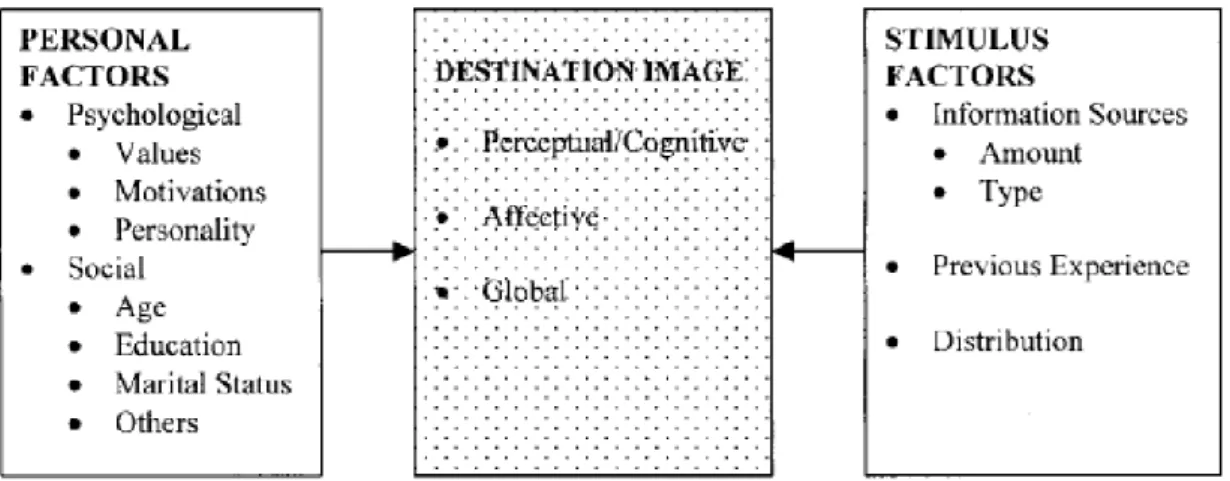
Baloglu and McClearly (1999) in order to better explain the process of the formation of the destination image emphasize that the destination image formation is based on two factors: stimulus and personal factors. Stimulus and personal factors are the main forces that act as formers of a destination image. The personal factors are so-divided into two secondary groups:
34 psychological factors and social factors. The stimulus factors include information sources, the previous experience, and the distribution channels. Both of these factors affect the the destination image, and they create distinctive assessments of the picture. Besides, they quarrel that the destination image that people already have about a destination can by easily changed after the real experience. Thusly, this means that the final image that they will have to the destination is shaped during the stay and it depends on the quality of the product.
Figure 3 - Factor influencing Destination Image (Baloglu and McCleary,1999)
A model which was built up by Beerli and Martín (2004) incorporates both of the essential parts included in the process of image formation namely primary and secondary data sources and stimuli factors which shape the pre-visit recognitions and post-visit assessments of destination. Additionally, other authors added that the behavioral perspective is another form of the information source to which the people are an exhibit to and which is accountable in the decision-making process if to choose an alternative destination or not. (Fakeye & Crompton, 1991; Gartner, 1993; Mansfeld, 1992; Um & Crompton, 1990; Woodside & Lysonsky, 1989
It was consented by the most recent Tourism Marketing guidelines that the development of the destination image lays in the foundations of the consumer´s rationality and emotionality. Moreover, the final destination image is not just the immaculate construct of rationality and emotionality, but it is likewise the right combination of 2 important elements: Perceptual and cognitive and Affective (Moutinho, 1987, Gartner, 1993; Baloglu and Brinberg, 1997; Walmsley and Young, 1998; Baloglu and McCleary, 1999a, 1999b; Dobni and Zinkhan, 1990; Lin, Duarte, Kerstetter and Hou, 2007).
Perceptual and cognitive: in order to rouse the tourist demand to visit the touristic destination (Alhemoud and Armstrong, 1996, Schneider and Sönmez, 1999; Gallarza, Saura
35 and Garcia, 2002; Beerli and Martín, 2004; Govers and Go, 2005) the supremacy importance is given to the quality of assets and attractions (Stabler, 1995).
Affective: Is the emotional component of this mix and is influenced by travelers inspirations (Beerli and Martín, 2004).
In this regard, the image formation of the destination image is a process which includes a multiplicity of information sources to which the vacationers are an exhibit. The general image of the destination is not directly affected by a number of information sources.
It is essential to focus on the fact that tourist can create an image of a destination they have never ever visited before. This implies that a wide range of non-commercial information as historical, political, economic and social elements forms the shape of the destination image. (Etcher&Richie, 2003). Bonn, Joseph & Dai (2005) included that the nation from which we originate from forms, greatly, the images that we have about the destination.
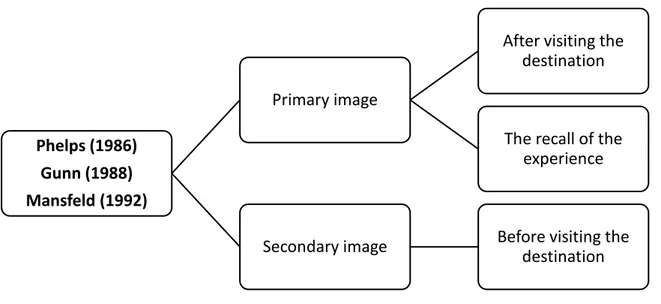
Many other authors proposed a different interpretation of the formation of the destination image. As already noted the image is just a mental construct consisting of the information collected from various sources. Whereupon these authors perceive not just one destination image but two destination images: Secondary image and primary image. According to Phelps (1986), the primary image of the destination is built upon the visit of the destination and the secondary image is constructed before the visit of the goal and the auxiliary picture.
Figure 4. Image types according to type of the knowledge (Adapted from Phelps, 1986, Gunn, 1988 and Mansfeld, 1992)
Phelps (1986) Gunn (1988) Mansfeld (1992)
Primary image
After visiting the destination
The recall of the experience
Secondary image Before visiting the destination
36 Gunn (1988) and Mansfeld (1992) agee with this division but according to these authors the secondary image is made od two types of images.
Gunn (1988) defined two main groups of secondary destination image- organic and induced image. The main distinction among the two is the source of information that contributes to their foundation. The organic image is an image that is produced by impressions derivating from non-tourist, non-commercial information sources. In other words, impressions that originate from daily paper reports, magazine articles, news scope, school courses, recordings, geology or history books, media, and from the opinion of family and friends and which are not overwhelmed by tourism experts.
The final product of the information collected deriving from travel agents which main aim is to advertise the destination through the images is called induced image. This means that the induced image is information overwhelmed by tourist agents which use marketing and promotion strategies to shape the destination image. (Gunn, 1988).
For Mansfeld (1992) the division of the secondary image is the same as made by Gunn (1988) but he calls the the organic image informal image and the induced image formal image.
Figure 5. Types of secondary image (Adapted from Gunn, 1998 and Mansfeld, 1992)
Similarly to previous authors, Fakeye and Crompton (1991) recognize 3 types of images which show a piece of information that is underneath the establishment of the destination image. These 3 destination images are an organic image, induced image and complex image (primary image) and they are directly accountable to the types already described.
Gunn (1988)
Mansfeld (1992) Secondary image
Organic/Informal Image
-Based on informational messages
-Independenr of the organization of the destination
Induced/Formal Image
-Persuasice messages -Promotions by the
37 To summarize the analysis above is presented the table which summarizes all external and internal factors which are shaping and influencing the process of image formation:20
Table 2 – Factors Affecting Image Formation
Before moving on the next chapter, to conclude, authors Tasci and Gartner (2007) assume that if a person actually visits a destination, the image they create after a visit is much more realistic than the image that they had created before the visit and which was created with secondary information. And so the two images are divided into static and dynamic. The static image is a secondary image, therefore, it is not based on the actual visit to the destination, but only on the information obtained from the second person. Dynamic image is a primary image because it includes a separate experience of a destination visit and is therefore much more accurate and personal.
20 Marino, E. The strategic dimesion of destination image. An analysis of the French riviera
image from the italian tourists´ perception. Paper, University of Naples “Federico II” Faculty of Economics, Naples.
38
3.METHODOLOGY
3.1. Quantitative Research
The quantitative research was directed through an online survey. The primary
prerequisites of individuals filling out the survey were being a non-Slovak tourist, with at the time of collecting the survey answers was visiting Slovakia or had already visited it before at least once. The survey was online from 1.4.2017 to 1.8.2017 on different online platforms (e.g., online social networks), in hotels and tourist information centers. In hotels and tourist information centers a tablet was handled to tourists to facilitate the collection a further analysis of the data. The primary objective of the survey was to get a statistic profile of the respondents and to get their view on the secondary and the primary image of the given destination, seeing the three components of the destination image affective, cognitive and overall and to compare them. To better understand and see how the primary image varies from the secondary image and which are the factors that mainly influence and impact this change.
The survey was conducted through mainly closed question and some open questions. The open question was chosen only for those question that was concerning the personal feelings or personal experience of the interview. Through the open question we were trying to find out the expectations that they had before the actual travel, the most unexpected
experience they experienced during the stay in Slovakia, interviewed were asked to name the places and cities they visited during their stay, to write an example of what did change their view about Slovakia.
The only form of the survey was an online questionnaire. On online version was organized as follows: the first section, Section 1, was dedicated to the branding and marketing strategies of Slovakia. The second section, Section 2 of the survey, was about the secondary image of the visitors. The section 3 of the survey, is dedicated to the primary image of the destination, and to the overall image after the visit and how it changed compared to the secondary image, and the likeliness to recommend Slovakia to others. Section 4 is about the travel characterization of the interviewed in Slovakia, followed by section 5 with aims to build a travelers profile. Section 4 includes questions about the duration of the last stay in Slovakia and the number of visits of Slovakia, and the section 5 about the average number of travels per year, the motivation for traveling and the place of travel (of they tend to travel inside or outside their country). Last section, section 6, is dedicated to the building of the
39 demographic profile of the interviewed. This section contains questions about the gender, age, education level, professional status, the nationality of the interviewed and their gross monthly income.
Issues related to the comparison of various attributes of the cognitive part of the destination image, which means the comparison of the same characteristics of the primary and secondary images took the form of closed-end questions. These closed-end questions were scaled on a Five-level Likert rating scale and to each number was assigned a particular verbal value with the number one assigned to the lowest value and the number 5 to the highest. Specifically, 5= “Strongly agree,” 4= “Agree,” 3= “neither agree nor disagree,” 2=
“Disagree,” 1= “Strongly disagree.” Based on the following scale interviewed were asked to rate the following ten attributes: good nightlife, variety of fauna and flora, natural attractions, good climate, beautiful monuments and cultural attractions, great gastronomy, good
infrastructure, clean public spaces, safety and good value for money
The use of bipolar scales was used in one of the questions from a section 2 and one from section 3 which is an identical question comparing the primary and secondary image if the interviewed on Slovakia. The standard 7 point bipolar scales were used to rate nine variables of the affective part of the destination image. The following 9 bipolar scales were used: Unpleasant (1) – Pleasant (7), Boring (1) – Arousing (7), Gloomy (1) – Exciting (7), Distressing (1) – Relaxing (7), Untrusted (1) – Trustworthy (7), Uninteresting place (1) – Interesting place (7), Bad travel destination (1) – Good travel destination (7), Expensive (1) – Cheap (7), Unsafe (1) – Safe (7).
The likeliness to revisit Slovakia in the future is measured with a 7-level Likert scale, being 1 extremely unlikely and 7 extremely likely. The likeliness to recommend Slovakia to friend or family was measured through a 10-level Likert scale, being 1-not at all likely and 10 extremely likely.