Running head: TRUST IN ORGANIZATIONS
Clarifying the Importance of Trust in Organizations as a Component of Effective Work Relationships
Maria Sousa-Lima** Deloitte Consulting
John W. Michel** Towson University
António Caetano ISCTE Business School
Forthcoming at Journal of Applied Social Psychology
** First authorship was determined arbitrarily as the first two authors contributed equally to the delivery of the manuscript.
† The authors thank Dr. Andrew Baum and two anonymous reviewers for their helpful comments in the development of this article.
Correspondence concerning this manuscript should be addressed to António Caetano and Maria Sousa Lima, ISCTE Business School, Av. das Forças Armadas, Edifício ISCTE, 1649-026 Lisbon, Portugal. Phone: (00351) 21793001, Fax: Fax: (00351) 217903002, E-mail: [email protected] or [email protected].
Abstract
Organizational trust is an important element of an organization’s long-term success, as it is a central component of effective work relationships. This study examines the extent to which one’s trust in the organization mediates the relationship between three drivers of social exchange relationships and three attitudinal outcomes. The results from a sample of 1,300 manufacturing employees revealed that trust in the organization partially mediated the relationship between perceived supervisor support and turnover intentions, affective
organizational commitment and job satisfaction, and fully mediated the relationship between distributive justice and information receiving and these outcomes. This paper extends the empirical literature about the antecedents and consequences of trust in organization, giving special attention to the mediating role of trust in organizations.
Clarifying the Importance of Trust in Organizations as a Component of Effective Work Relationships
Over the past 20 years, organizational researchers have become increasingly
interested in high quality relationships between employees and the organization (Rousseau & Parks, 1993). Much of this research has employed social exchange theory as the underlying framework for understanding how these relationships develop and their importance (Blau, 1964). Unlike economic exchange relationships which are based on the exchange of tangible resources, the development of socio-emotional resources such as trust, support and fairness is the basis for social exchange relationships because they involve unspecified obligations for which no binding contract can be written between the exchange partners (Rupp &
Cropanzano, 2002). As relationships develop, feelings of mutual obligation, support and trust may develop (Cropanzano & Mitchell, 2005). This reinforces and stabilizes trust among the exchange partners as they discharge obligations with each other; thereby, aiding in the maintenance of the relationship over time.
Building trust within organizations is a key component for developing social
exchange relationships because of the discretionary nature of the reciprocation process. For example, employees are more likely to reciprocate greater effort and have more positive work attitudes when they have trust in the organization (Aryee, Budhwar, & Chen, 2002). To understand how to develop trust in organizations, researchers have investigated numerous antecedents of trust such as organizational justice (Aryee et al., 2002), perceived
organizational support (Chen, Aryee, & Lee, 2005), human resource practices (Whitener, 1997), leader-member exchange (LMX; Loi & Ngo, 2009), and communication (Gilbert & Tang, 1998). Furthermore, trust in organization is related to various job attitudes such as organizational commitment, job satisfaction, and intentions to stay (Aryee et al., 2002) and to various employee behaviors such as task performance and organizational citizenship
behaviors (Chen et al., 2005). While this research underscores some of the ways in which trust in the organization is developed, we believe there is room to expand the nomological network of the trust in organization literature. To accomplish this, the purpose of this study is to examine three antecedents of trust in the organization that have been either
under-emphasized in the extant trust in the organization literature (i.e., distributive justice), or shown to relate to trust in supervisor (i.e., information receiving and perceived supervisory support). Moreover, we demonstrate how trust in the organization mediates the relationship between these antecedents and various outcomes such as job satisfaction, affective
organizational commitment and turnover intentions. Trust in the organization
Mishra (1996) proposed that trust is a central factor in enhancing an organization’s long-term success and survival. This is especially true because of the uncertainty and competitiveness inherent within the current global business environment. Trust is important because it facilitates the adaptation to new processes and forms of work and as noted by Crawford (1998, p.24) “all great organizations have one basic similarity - they are built on trust.” Employees differentiate between two referents of trust - trust in others (i.e., supervisor and coworkers) and trust in the organization. While both foci of trust are important, the focus of this paper is trust in the organization. Regardless of the foci, trust has an important
influence on employee attitudes and behavior. In fact, research suggests that when employees have trust in the organization they are more likely to reciprocate effort back toward the organization with higher satisfaction and commitment (Chen et al., 2005; Whitener, 2001) and better performance and lower quit intentions (Aryee et al., 2002).
McAllister (1995) differentiated between two forms of trust, cognitive-based trust and affect-based trust. Cognitive-based trust reflects a rational belief that the trustee is reliable, dependable, and competent. While much of the literature on trust in the organization has
been driven by the cognitive-based model, some have argued that this model is overly calculative and overlooks the social and relational nature of trust (Mayer, Davis, & Schoorman, 1995). The affect-based of trust on the other hand refers to the emotional attachment garnered from the mutual care and concern developed by individuals engaged in social exchange relationships. Such relationships motivate employees to reciprocate back to the organization by being more committed to the organization; engaging in more
organizational citizenship behaviors and staying with the organization (Williams, 2001). As previously noted, researchers commonly utilize the social exchange perspective when investigating trust in the organization (e.g., Aryee et al., 2002; Whitener, 2001). Social exchange theory postulates that employees acquire economic (e.g., pay) and socioemotional (e.g., support) resources through the relationships with supervisors (Rhoades Shanock & Eisenberger, 2006), coworkers (Chiaburu & Harrison, 2008) and the organization
(Eisenberger, Huntington, Hutchison, & Sowa, 1986). Social exchange relationships entail unspecified obligations in which the parties involved reciprocate effort toward one another overtime; whereas, economic exchanges emphasize the financial and tangible aspects of exchange relationships. As such, feelings of trust and mutual obligation are a key for developing social exchange, but not economic exchange relationships.
The extant literature has primarily focused on the use of fair and supportive practices as drivers of trust in the organization. Specifically, research has demonstrated a relationship between organizational justice and trust because fair treatment induces the mutual obligation necessary for establishing social exchange relationships (Aryee et al., 2002; Pillai,
Schriesheim, & Williams, 1999; Stinglhamber, De Cremer, & Mercken, 2006). Similarly, a relationship between perceived organizational support and trust has been demonstrated based on the argument that trust is developed when employees perceive that the organization values their contributions and cares about their well-being (Chen et al., 2005; Konovsky & Pugh,
1994). While this literature has been promising, we propose that some social exchange processes that have been under-emphasized in the trust in the organization literature.
This study investigates the relationship between trust and three different predictors distributive justice, information receiving and perceived supervisor support. While
distributive justice has been shown to relate to trust in the organization (Aryee et al., 2002), its impact is equivocal in comparison to procedural justice. Information receiving and perceived supervisor support on the other hand have been shown to relate to trust in
supervisor (Ellis & Shockley-Zalabak, 2001; Neves & Caetano, 2006), but not to trust in the organization. As such, we hope this study contributes to the trust in the organization
literature by demonstrating the extent to which trust in the organization mediates the relationship between distributive justice, information receiving and perceived supervisor support and three attitudinal outcomes; thereby, extending our understanding of trust in the organization as an important social exchange process. The following sections provide a more detailed rationale for the inclusion of these three antecedents of trust in the organization.
Distributive justice. Organizational justice refers to an individual’s perception of the fairness of treatment received from the organization (Aryee et al., 2002). Three components of justice include distributive justice (the fairness of outcomes received by employees); procedural justice (the fairness of procedures used to determine the outcomes received by employees); and interactional justice (the fairness of treatment provided by the organization or its decision makers) (Colquitt, Conlon, Wesson, Porter, & Ng, 2001). Perceptions of organizational justice exhibit relationships with important workplace attitudes and behaviors such as organizational citizenship behaviors, job satisfaction, organizational commitment and trust (Cohen-Charash & Spector, 2001; Colquitt et al., 2001). Moreover, research has
demonstrated a positive relationship between trust and justice (Aryee et al., 2002; Konovsky & Pugh, 1994; Piliai, Schriesheim & Williams, 1999). While procedural and interactional
justice are more strongly related to trust than is distributive justice, Aryee et al. (2002) found that distributive justice is more strongly related with trust in organization (r = .44) than to trust in supervisor (r = .29). One possible reason for this finding is that employees may attribute that the distribution of outcomes is directed by policies of the organization rather than the discretion of supervisors.
Based on this rationale, we propose that distributive justice should receive greater attention in the development of a person’s trust in the organization since the organization controls the rewards valued by employees’.1 Accordingly, when employees perceive that the organization rewards them in a manner consistent with their inputs, they will have more favorable perceptions that the organization values their contributions and will trust that the organization will come through for them in the future. In turn, employees will respond by feeling more satisfied and committed and less desire to want to leave the organization (cf. Aryee et al., 2002). It is important to note that Chen, Brockner, and Greenberg (2002) demonstrated that high procedural justice can diminish positive reactions to favorable outcomes. As such, we focus solely on distributive justice in order to gain a better understanding of its relationship with trust in the organization independent of other dimensions of justice. Based on this rationale we assert the following hypothesis.
Hypothesis 1. Trust in the organization will mediate the relationship between
distributive justice and organizational commitment, job satisfaction and turnover intentions.
Information receiving. Information is another aspect of social exchange
relationships important for developing trust within organizations (O’Reilly & Roberts, 1974). When important information is communicated with employees, feelings of trust develop as
1 Because the relationship between procedural justice and trust has been consistently demonstrated in the extant
literature and the primary focus of interactional justice would be trust in supervisor, we focus only on distributive justice as an antecedent of trust in organization in this study.
employees perceive that the organization is open and honest. Gilbert and Tang (1998) demonstrated that communication of important information aids in the development of trust. In particular, providing timely information and adequate explanations about important events and issues sends a message that the organization values employees as meaningful
organizational members (Mishra & Morrissey, 1990). An important aspect of the communication process in relation to trust is information receiving, which refers to the information that employees receive about the organizational procedures, processes and decisions that flow within the organization (Ellis & Shockley-Zalabak, 2001). These
researchers found that the amount of information received about job and organizational issues explained 26% of the variance in trust in top management and 13% of the variance in trust in immediate supervisor.
Although the relationship between supervisor-subordinate information exchanges and trust has been demonstrated, less is known about the relationship between information exchanges and trust in organization. However, research conducted in governmental agencies provides some evidence that communication is an important antecedent to trust in the
organization (Gilbert & Tang, 1998; Mishra & Morrissey, 1990). Based on this literature, we propose that when employees receive timely, accurate, and forthcoming information from their organization they are more likely to see their organization as trustworthy. As with distributive justice, trust in the organization should mediate the relationship between
information receiving and satisfaction, commitment and turnover intentions. Therefore, we assert the following hypothesis with respect to information receiving:
Hypothesis 2. Trust in the organization will mediate the relationship between
information receiving and organizational commitment, job satisfaction and turnover intentions.
Perceived supervisor support. Perceived organizational support (POS) is an employee’s global belief concerning the extent to which the organization values his/her contribution and cares about his/her well-being (Eisenberger et al., 1986). POS is related to trust because support suggests to employees that they can rely on their supervisor or the organization (Ambrose & Schminke, 2003). While support from the organization is
important, support garnered from one’s supervisor is also important because supervisors act as agents of the organization; thereby, indicating to employees that the organization values their contributions and cares about their well-being (Rhaodes Shanock & Eisenberger, 2006). This is important since employees rely on their supervisor for goals, direction and resources. Furthermore, according to Levinson (1965), employees tend to attribute human qualities to their organizations and “generalize from their feelings about people in the organization who are important to them, to the organization as a whole” (p.377).
Two studies have empirically demonstrated a positive relationship between perceived support and trust in management (Neves & Caetano, 2006; Whitener, 2001). While,
Whitener (2001) focused on the role of POS, Neves and Caetano (2006) focused on perceived supervisor support (PSS). When employees perceive that the organization or supervisors values their contribution and cares for their well-being, they will have greater trust that the organization or supervisors will fulfill its obligations toward them. Just as POS is related to trust in management, we propose that PSS will be similarly related to an employee’s trust in their organization, based on the aforementioned importance of supervisors. Moreover, when employees perceive that their supervisor supports them they are more likely to engage in a social exchange with the organization and reciprocate through higher levels of job
performance, greater feelings organizational commitment and trust, and a lower likelihood of leaving the organization (Rhoades & Eisenberger, 2002). Therefore, we assert the following hypothesis with respect to perceived supervisor support:
Hypothesis 3. Trust in the organization will mediate the relationship between
perceived supervisor support and organizational commitment, job satisfaction and turnover intentions.
Method Sample and procedure
Data were obtained from employees of a large manufacturing organization that occupies a leading position in both Portugal and the international marketplace. After
management approval to conduct this study, 2,160 employees of the organization were asked to participate. Questionnaires were distributed at the workplace during working hours. Prior to survey administration, all items were translated/back-translated using the approach
proposed by Behling and Law (2002). The first author translated each item from English to Portuguese. Next, the third author translated each item from Portuguese back to English. Finally, the first author checked the back-translated items for accuracy.
Data collection sessions were held in groups of 10 to 20 people, where each session began with a researcher explaining that the purpose of the study was to gain a better
understanding of workplace perceptions. Participation in the study was voluntary, and confidentiality was assured. A total of 1,300 questionnaires were collected, corresponding to an 85% response rate. The majority of the participants were male (89%), and had at least a high school education (96%). The average age of the participants was 42 years, and the average tenure was 13 years.
Measures
All responses were made on a 7-point Likert-type scale ranging from 1 = strongly
disagree to 7 = strongly agree. Because the organization wanted us to limit the survey to 30
items, we used short versions of the trust in the organization, distributive justice and affective commitment scales.
Trust in organization. Three items from the 7-item scale developed by Gabarro and Athos (1976) were used to measure trust in organization. We chose the first three items from the scale. An example item was “My organization is not always honest and truthful.” The scale’s coefficient alpha was .75.
Distributive justice. Four items from the 5-item scale developed by Price and Mueller (1986) were used to measure distributive justice. We chose the four items with the highest factor loadings for inclusion in this scale. An example item was: “I am fairly paid or rewarded considering my job responsibilities.” The scale’s coefficient alpha was .89.
Information receiving. Information receiving was assessed with a 3-item measure from Kinnie and colleagues (Kinnie, Hutchinson, Purcell, Rayton, & Swart, 2005). An example item was: “I am very satisfied with the amount of information I receive about how my organization is performing.” The scale’s coefficient alpha was .70.
Perceived supervisor support. An 8-item scale adapted from the Survey of Perceived Organizational Support was used to measure perceived supervisor support. Following the procedure used in other studies (e.g. Rhoades, Eisenberger, & Armeli, 2001), we adapted these items by replacing the term “organization” with the term “supervisor.” An example item was “My supervisor really cares about my well-being.” The scale’s coefficient alpha was .86.
Turnover intentions. A 3-item scale developed by Landau and Hammer (1986) was used to assess the employees’ turnover intentions. An example item is “I am actively looking for a job outside.” The scale’s coefficient alpha was .74.
Affective organizational commitment. Five items from the 6-item scale developed by Meyer and Allen (1997) was used to measure affective organizational commitment. We dropped the first item from this scale because it reflects turnover intentions rather than an
attitude to an affective commitment toward the organization. An example item was: “I do not feel emotionally attached to this organization.” The scale’s coefficient alpha was .77.
Job satisfaction. A 4-item scale adapted from Spector (1997) was used to assess the job satisfaction of employees. An example item was: “To what extent are you satisfied with the job you do.” The scale’s coefficient alpha was .72.
Analyses
We assessed the hypothesized model using the two step approach proposed by Anderson and Gerbing (1988). These two steps include (1) a test of the model’s
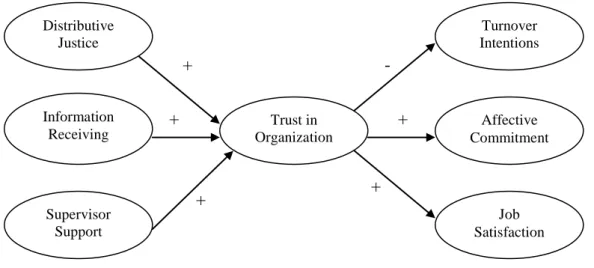
measurement properties utilizing confirmatory factor analysis (CFA) and (2) a test of the structural model to assess the hypothesized relationships. LISREL 8 (Jöreskog & Sörborn, 1993) was use to perform these analyses. In the first step we conducted a CFA to assess the discriminant validity of the variables used in this study. The second step was an assessment of the structural model depicted in Figure 1.
--- Insert Figure 1 about Here ---
The measurement model was assessed using CFA with the sample covariance matrix as input and a maximum likelihood solution. To demonstrate the discriminant validity of the variables, we compared the fit of the hypothesized 7-factor Model with two 6-factor Models, a 5-factor Model and a 1-factor Model. In the first 6-factor Model, perceived supervisor support and trust in organization were loaded onto one factor. In the second 6-factor Model, job satisfaction and organizational commitment were loaded onto one factor. In the 5-factor Model distributive justice, information receiving, and perceived supervisor support were loaded onto one factor. In the 1-factor Model, all variables in the study were loaded onto a single-factor.
We assessed the hypothesized mediated model using a structural equation modeling approach since the baseline model was predicted to be completely mediated (James, Mulaik, & Brett, 2006). To ensure that our hypothesized model was the best fitting model, we
compared its fit with three partially mediated models and a direct effects model. We assessed the fit of each model using the chi-square measure, the root mean square error of
approximation (RMSEA; Browne & Cudeck, 1993), the comparative fit index (CFI; Bentler, 1990), the Tucker-Lewis Index (TLI; Tucker & Lewis, 1973), and the Standardized Root Mean Square Residual (SRMR; Kline, 2005).
Results
Table 1 presents the correlations and descriptive statistics among the study variables. Moreover, as depicted in Table 2 the CFA results for the hypothesized 7-factor model ( ²= 1244.58, df = 329; TLI = 0.97; CFI = 0.97; RMSEA= 0.05; SRMR= 0.04) indicated that the measurement model provided a good fit to the data. The 7-factor model fit the data better than any of the comparison models, providing support for the discriminant validity of the constructs in this study. This also provides some support that common method bias is not a serious issue which is especially important since all variables were rated by participants at the same time.
--- Insert Tables 1 and 2 about Here ---
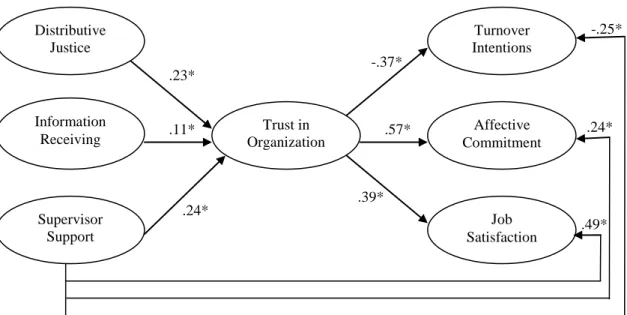
Next, we estimated the fit of the hypothesized structural model using LISREL 8.0 with the sample covariance matrix as input and a maximum likelihood solution. Since the hypothesized model proposes a mediation framework, it was expected that the three independent variables would correlate significantly with trust in organization, as well as affective commitment, job satisfaction, and turnover intentions (Baron & Kenny, 1986). As depicted in Figure 2, distributive justice (β = .23, p < .05), information receiving (β = .11, p <
.05) and perceived supervisor support (β = .24, p < .05) were positively and significantly related to trust in organization. Results also demonstrated that trust in the organization was negatively related to turnover intentions (β = -.37, p < .05) and positively related to affective organizational commitment (β = .57, p < .05) and job satisfaction (β = .39, p < .05), providing initial support for the hypothesized relationships.
--- Insert Figure 2 about Here ---
As noted previously, to ensure that the fully mediated model fit the data best, we compared its fit with three partially mediated models and a direct effects (fully saturated) model (see Table 3). Overall, these findings provide evidence that the proposed model fit the data well ( ²= 2014.17, df = 368; TLI = 0.95; CFI = 0.96; RMSEA= 0.06; SRMR= 0.06). However on the basis of the fit indices and parsimony, Model 4 provided a better fit relative to the hypothesized fully mediated model. Moreover, the Akaike information criterion (AIC, Akaike, 1987) values showed that Model 4 had a smaller value (AIC= 1858.52), than the hypothesized model (AIC= 2148.17) providing additional support for the fit of Model 4. As depicted in figure 2, distributive justice and information receiving demonstrated indirect effects on turnover intentions, affective organizational commitment and job satisfaction through trust in organization. However, the relationship between PSS and each of the three outcomes was only partially mediated by trust in organization. The fit indices for Model 4 were: ²= 1718.52, df = 365; TLI = 0.96; CFI = 0.96; RMSEA= 0.05; SRMR= 0.06. These results provide full support for hypotheses 1 and 2 and partial support for hypothesis 3. In all, this suggests that fair outcomes, clear information, and support from supervisors’ leads to greater trust in the organization, which will lead to greater employee satisfaction,
--- Insert Table 3 about Here ---
Discussion
The purpose of this study was to expand our understanding of trust in the organization as an important social exchange process. Specifically, the study investigated the mediating influence of trust in the organization on the relationship between distributive justice, information receiving, and perceived supervisor support and three important outcomes. In general, we found support for the hypothesized relationships. These findings suggest that feelings of trust in the organization can be developed by distributing outcomes in a fair manner, sharing important information with employees, and having supportive supervisors. Moreover, these increased feelings of trust will increase employee satisfaction and
commitment and decrease their intentions to leave the organization.
Consistent with previous research, trust in the organization mediated the relationship between distributive justice and job satisfaction, organizational commitment and turnover intentions (Aryee et al., 2002; Colquitt et al., 2001). These findings lend further support to the notion that when employees perceive the organization provides valued rewards in a fair and consistent manner, they will be more likely to trust that the organization has their best interests in mind. Distributive justice may be particularly important for developing feelings of trust in the organization, because employees likely perceive that final decisions about the distribution of rewards are determined by organizational policies rather than by decisions made by individual supervisors. This suggests that both distributive and procedural justice may be simultaneously important in predicting trust in the organization. As such, future research should investigate the extent to which procedural justice moderates the relationship between distributive justice and trust in the organization (Brockner & Wiesenfeld, 1996). Specifically, we believe that procedural justice is less important in developing feelings of
trust in the organization when the distribution of outcomes are fair, but procedural justice is of greater importance when distributive justice is low.
Information receiving was also significantly related to trust in the organization, which provides additional support for the importance of communication in the development of feelings of trust (Gilbert & Tang, 1998). Our findings suggest that sharing important
information with employees’ increases feelings of satisfaction and commitment and decreases intentions to quit. Interestingly, information receiving had a weaker relationship with trust in the organization compared to either distributive justice or perceived supervisor support. This result was a bit surprising since a large body of earlier literature (Folger & Konovsky, 1989; Konovsky & Cropanzano, 1991)has suggested that an accurate and forthcoming
communication process between supervisors and employees assumes a central role in the development of feelings of trust. One explanation for this finding may be related to the use of information receiving to understand the importance of communication in the building of trust in the organization. While open and accurate communication is undoubtedly important for building relationships between the organization and its employees, it may be equally important for that information to be presented in a timely, thorough and fair manner (i.e., informational justice) for developing trust in the organization. As a result, future research should be conducted to determine the extent to which both information receiving and informational justice impact a person’s trust in the organization.
As expected, perceived supervisor support was significantly related to employees’ trust in their organization. These findings provide support for the notion that employees often perceive their supervisor as an agent of the organization (Rhoades & Eisenberger, 2002). As such, when employees perceive that their supervisor values their contribution and cares about their well-being they will sense that the organization has their best interests in mind and feel like they are a valued member of the organization. Unexpectedly, our findings
demonstrate that trust in the organization only partially mediates the effect between perceived supervisor support and job satisfaction, affective commitment and turnover intentions. One explanation for this finding is that because employees rely on their supervisor for attaining resources, dealing with unruly coworkers and customers, and completing work on-time, it may be important for employees to develop feelings of trust in their supervisor. Future research should examine the extent to which both trust in the organization and trust in one’s
supervisor mediate the relationship between perceived supervisor support and the outcomes. Theoretical and Practical Implications
This study provides support for some antecedents of trust in the organization that have been under-emphasized. In doing so, our findings extend our understanding of the
nomological network of the trust in the organization construct. Future research on trust in the organization should incorporate a more inclusive list of antecedents such as organizational justice, perceived support and communication issues. Moreover, future research should determine the impact of these variables on other important behavioral variables such as task performance, organizational citizenship behaviors, and counterproductive behaviors. This will provide a better understanding for how trust in the organization is developed and the impact it has on various attitudinal and behavioral outcomes; thereby, giving continuity to the important stream of research within the organizational trust literature.
This study also presents a number of practical implications. First, these results reinforce the importance of considering trust building capacity when formulating human resource practices. Indeed, supervisor-employee relationships could benefit from building such content into team-building programs. In this sense, supervisors might benefit more from focusing on their interactions with employees, ensuring that they understand how to distribute rewards in a fair manner, as well as supporting their employees and valuing their
organizational processes, procedures and decisions is disseminated to employees appears to be crucial in promoting higher levels of employees’ trust in their organization.
In a general sense, our findings suggest that fostering social exchange relationships will increase the extent to which employees will reciprocate effort back to the organization. Employees who develop a trusting relationship with their organization will reciprocate effort back in the form of higher levels of affective organizational commitment, job satisfaction, and intention to stay with the organization. Taken together, these results reinforce the view of trust as a vital component of effective and productive work relationships and an important concern for managers (Fells, 1993).
Limitations
The results of this study should be interpreted within the context of three limitations. First, the fact that the sample is composed of employees from a single organization limits the generalizability of our results and consequently their external validity. While external validity is certainly important, we do not believe this is a major limitation since the correlations and factor loadings depicted in this study are similar to those found in similar studies (see Aryee et al., 2002; Chen et al., 2005). However, future research should be conducted to assess the validity of our model in other contexts.
Second, it is possible that trust in the organization is perceived differently by Portuguese employees due to the collectivist nature of their culture (Hofstede, 2001).2 Similar to Aryee et al. (2002) our findings provide support for the importance of trust in the organization in collectivist cultures. However, it is likely that we would attain similar
findings in individualistic cultures since much of the social exchange and organizational trust literatures has been conducted in the United States and other individualistic cultures
(Cropanzano & Mitchell, 2005; Schoorman, Mayer, & Davis, 2007). Future research should
be conducted in more individualistic cultures such as the United States to substantiate our results and those provided by Aryee et al. (2002).
Third, all data were collected using a cross-sectional design, which means some relationships could be inflated because of common method bias (CMB). Although the conclusions drawn from this study could be strengthened by collecting data from different sources, we feel that the respondents were the best sources of their own perceptions and attitudes. However, to assuage concerns regarding CMB we utilized two approaches
proffered by Podsakoff and colleagues (Podsakoff, MacKenzie, Lee, & Podsakoff, 2003). As a procedural remedy, throughout the survey we repeatedly reassured participants that their responses were confidential and that no one except the researchers would see their responses. As a statistical procedure we compared the fit of the hypothesized seven-factor measurement model to a Harman’s single-factor model. Inspection of Table 2, demonstrated that the seven-factor model fit the data better than the single-factor model which did not fit the data well [χ2(377, n = 1300) = 7723.52, p < .001, CFI = .79, TLI = .86, RMSEA = .14, and SRMR = .11] and was a significantly worse fit (Δχ2(21) = 6340.27, p < .001) to the data than the seven-factor model. Finally, we showed differential relationships between the predictors, mediator and outcomes; thereby, providing addtional evidence against CMB (Spector, 2006).
In all, the results presented here contribute to the extant literature by extending the nomological network of antecedents to trust in organization and point toward the importance of considering additional affect-based predictors in order to extend our understanding of how trust in the organization is developed and the impact it has on important organizational outcomes.
References
Akaike, H. (1987). Factor analysis and AIC. Psychometrika, 52, 317-332. doi: 10.1007/BF02294359
Anderson, J.C., & Gerbing, D.W. (1988). Structural equation modeling in practice: A review and recommended two-step approach. Psychological Bulletin, 103, 411-423. doi: 10.1037/0033-2909.103.3.411
Aryee, S., Budhwar, P., & Chen, Z. (2002). Trust as a mediator of the relationship between organizational justice and work outcomes: Test of a social exchange model. Journal of
Organizational Behavior, 23, 267-285. doi: 10.1002/job.138
Baron, R.M., & Kenny, D.A. (1986). The moderator-mediator variable distinction in social psychological research: Conceptual, strategic, and statistical considerations. Journal of
Personality and Social Psychology, 51, 1173-1182. doi: 10.1037/0022-3514.51.6.1173
Behling, O., & Law, K.S. (2002). Translating questionnaires and other research instruments:
Problems and solutions. Thousand Oaks, CA: Sage.
Bentler, P.M. (1990). Comparative fit indexes in structural models. Psychological Bulletin,
107, 238-249. doi: 10.1037/0033-2909.107.2.238
Blau, P.M. (1964). Exchange and power in social life. New York, NY: John Wiley.
Brockner, J., & Wiesenfeld, B.M. (1996). An integrative framework for explaining reactions to decisions: Interactive effects of outcomes and procedures. Psychological Bulletin,
120, 189-208. doi: 10.1037/0033-2909.120.2.189
Browne, M.W., & Cudeck, R. (1993). Alternative ways of assessing model fit. In K.A. Bollen & J.S. Long (Eds.), Testing structural equation models (pp. 136-162). Newbury Park, CA: Sage.
Chen, Y., Brockner, J., & Greenberg, J. (2002). When is it “A pleasure to do business with You”? The effect of status, outcome favorability, and procedural fairness. Academy of
Management Proceedings.
Chen, Z., Aryee, S., Lee, C. (2005). Test of a mediation model of perceived organizational support. Journal of Vocational Behavior, 66, 457-470. doi: 10.1016/j.jvb.2004.01.001 Chiaburu, D.S., & Harrison, D.A. (2008). Do peers make the place? Conceptual synthesis and
meta-analysis of coworker effects on perceptions, attitudes, OCBs, and performance.
Journal of Applied Psychology, 93, 1082-1103. doi: 10.1037/0021-9010.93.5.1082
Cohen-Charash, Y., & Spector, P.E. (2001). The role of justice in organizations: A meta-analysis. Organizational Behavior and Human Decision Processes, 86, 278-321. doi: 10.1006/obhd.2001.2958
Colquitt, J.A., Conlon, D.E., Wesson, M.J., Porter, C.O., & Ng, K.Y. (2001). Justice at the millennium: A meta-analytic review of 25 years of organizational justice research.
Journal of Applied Psychology, 86, 425-445. doi: 10.1037/0021-9010.86.3.425
Crawford, D. (1998). A matter of trust. The British Journal of Administrative Management,
Nov-Dec, 24.
Cropanzano, R., & Mitchell, M.S. (2005). Social exchange theory: an interdisciplinary review. Journal of Management, 31, 874-900. doi: 10.1177/0149206305279602 Dirks, K.T., & Ferrin, D.L. (2002). Trust in leadership: Meta-analytic findings and
implications for research and practice. Journal of Applied Psychology, 87, 611-628. doi: 10.1037/0021-9010.87.4.611
Eisenberger, R., Huntington, R., Hutchison, S., & Sowa, D. (1986). Perceived organizational support. Journal of Applied Psychology, 71, 500-507. doi: 10.1037/0021-9010.71.3.500
Ellis, K., & Shockley-Zalabak, P. (2001). Trust in organization and immediate supervisor: The relationship to satisfaction, perceived organizational effectiveness, and information receiving. Communication Quarterly, 49, 382-398. Retrieved from Business Source Complete database.
Fells, R.E. (1993). Developing trust in negotiation. Employee Relations, 15, 33-45. Retrieved from Business Source Complete database.
Folger, R., & Konovsky, M.A. (1989). Effects of procedural and distributive justice on reactions to pay raise decisions. Academy of Management Journal, 32, 115-130. doi: 10.2307/256422
Gabarro, A., & Athos, P. (1978). Interpersonal Relations and Communications. New York, NY: Prentice-Hall.
Gilbert, J.A., & Tang, L. (1998). An examination of organizational trust antecedents. Public
Personnel Management, 27, 321-338. Retrieved from Business Source Complete
database.
Hofstede, G. (2001). Culture’s consequences: Comparing values, behaviors, institutions, and
organizations across nations (2nd ed.). Thousand Oaks, CA: Sage.
James, L.R., Mulaik, S.A., & Brett, J.M. (2006). A tale of two methods. Organizational
Research Methods, 9, 233-244. doi: 10.1177/1094428105285144
Joreskog, K., & Sorbom, D. (1993). LISREL 8 – User’s reference guide. Scientific Software International, Chicago.
Kinnie, N., Hutchinson, S., Purcell, J., Rayton, B. & Swart, J. (2005). Satisfaction with HR practices and commitment to the organization: Why one size does not fit all. Human
Resource Management Journal, 15, 9-29. Retrieved from Business Source Complete
Kline, R.B. (2005). Principles and practice of structural equation modeling (2nd ed.). New York, NY: Guilford Press.
Konovsky, M.A., & Cropanzano, R. (1991). Perceived fairness of employee drug testing as a predictor of employee attitudes and job performance. Journal of Applied Psychology,
76, 698-707. doi: 10.1037/0021-9010.76.5.698
Konovsky, M.A., & Pugh, S.D. (1994). Citizenship behaviour and social exchange. Academy
of Management Journal, 37, 656-669. doi: 10.2307/256704
Landau, J., & Hammer, T.H. (1986). Clerical employees: Perceptions of career opportunities.
Academy of Management Journal, 29, 385-404. doi: 10.2307/256194
Levinson, H. (1965). Reciprocation: the relationship between man and organization.
Administrative Science Quarterly, 9, 370-390. doi: 10.2307/2391032
Mayer, R.C., Davis, J.H., & Schoorman, F.D. (1995). An integrative model of organizational trust. Academy of Management Review, 20, 709-734. doi: 10.2307/258792
McAllister, D.J. (1995). Affect- and cognitive-based trust as foundations for interpersonal cooperation in organizations. Academy of Management Journal, 38, 24-59. doi: 10.2307/256727
Meyer, J.P., & Allen, N.J. (1997). Commitment in the workplace: Theory, research, and
application. Thousand Oaks, CA: Sage.
Mishra, A.K. (1996). Organizational responses to crisis: the centrality of trust. In R.M. Kramer & T.R. Tyler (Eds.), Trust in organizations: frontiers of theory and research (pp. 261-287). Thousand Oaks, CA: Sage.
Mishra, J., & Morrissey, M.A. (1990). Trust in employee/employer relationships: A survey of West Michigan managers. Public Personnel Management, 19, 443-463. Retrieved from Business Source Complete database.
Neves, P., & Caetano, A. (2006). Social exchange processes in organizational change: The roles of trust and control. Journal of Change Management, 6, 351-364. doi:
10.1080/14697010601054008
O’Reilly, C.A., & Roberts, K.H. (1974). Information filtration in organizations: Three experiments. Organizational Behavior and Human Performance, 11, 253-265. doi: 10.1016/0030-5073(74)90018-X
Piliai, R., Schriesheim, C.A., & Williams, E. (1999). Fairness perceptions and trust as mediators for transformational and transactional leadership: A two-sample study.
Journal of Management, 25, 897-933. doi: 10.1177/014920639902500606
Podsakoff, P.M., MacKenzie, S.B., Lee, J.Y., & Podsakoff, N.P. (2003). Common method bias in behavioral research: A critical review of the literature and recommended remedies. Journal of Applied Psychology, 88, 879-903. doi: 10.1037/0021-9010.88.5.879
Price, J.L., & Mueller, C.W. (1986). Distributive justice. In J.L. Price, & C.W. Mueller (Eds.), Handbook of Organizational Measurement (pp. 122-127). Marshfield, MA, Pitman.
Rhoades, L., & Eisenberger, R. (2002). Perceived organizational support: A review of the literature. Journal of Applied Psychology, 87, 698-714. doi:
10.1037/0021-9010.87.4.698
Rhoades, L., Eisenberger, R., & Armeli, S. (2001). Affective commitment to the
organization: The contribution of perceived organizational support. Journal of Applied
Rhoades Shanock, L., & Eisenberger, R. (2006). When supervisors feel supported:
Relationships with subordinates’ perceived supervisor support, perceived organizational support, and performance. Journal of Applied Psychology, 91, 689-695. doi:
10.1037/0021-9010.91.3.689
Rousseau, D.M., & Parks, J.M. (1992). The contracts of individuals and organizations.
Research in Organizational Behavior, 15, 1-45. Retrieved from Business Source
Complete database.
Rupp, D.E., & Cropanzano, R. (2002). The mediating effects of social exchange relationships in predicting workplace outcomes from multifoci organizational justice. Organizational
Behavior and Human Decision Processes, 89, 925-946. doi:
10.1016/S0749-5978(02)00036-5
Schoorman, F.D., Mayer, R.C., & Davis, J.H. (2007). An integrative model of organizational trust: Past, present, and future. Academy of Management Review, 32, 344-354. doi: 10.2307/20159304
Spector, P.E. (1997). Job satisfaction: Application, assessment, causes, and consequences. Newbury Park, CA: Sage.
Spector, P. E. (2006). Method variance in organizational research: Truth or urban legend?
Organizational Research Methods, 9, 221-232. doi: 10.1177/1094428105284955
Tucker,L.R., & Lewis, C. (1973). The reliability coefficient for maximum likelihood factor analysis. Psychometrika, 38,1-10. doi: 10.1007/BF02291170
Whitener, E.M. (2001). Do “high commitment” human resource practices affect employee commitment? A cross-level analysis using hierarchical linear modelling. Journal of
Williams, M. (2001). In whom we trust: Group membership as an affective context for trust development. Academy of Management Review, 26, 377-396. Retrieved from Business Source Complete database.
Table 1
Means, Standard Deviations, and Correlations
Variable M SD 1 2 3 4 5 6 7 1. Distributive Justice 2.82 1.33 (.89) 2. Information Receiving 5.13 1.08 .16** (.70) 3. Supervisor Support 4.37 1.20 .28** .39** (.86) 4. Turnover Intentions 2.44 1.19 -.12** -.21** -.33** (.74) 5. Affective Commitment 5.49 0.96 .16** .29** .34** -.44** (.77) 6. Job Satisfaction 4.68 0.78 .25** .40** .49** -.40** .46** (.72) 7. Trust in Organization 4.57 1.19 .27** .19** .31** -.30** .43** .38** (.75)
Note. n = 1300; Cronbach’s alpha values are displayed on the diagonal
* p < .05 **p < .01
Table 2
The Results of the CFA
Models χ2 df GFI TLI CFI RMESA SRMR
1-Factor Modela 7723.52 377 0.64 0.86 0.79 0.14 0.11 5-Factor Modelb 5520.70 368 0.77 0.80 0.87 0.10 0.10 6-Factor Model 1c 2708.08 362 0.87 0.94 0.94 0.07 0.07 6-Factor Model 2d 2021.75 362 0.90 0.95 0.96 0.06 0.05 7-Factor Modele 1383.25 356 0.93 0.97 0.97 0.05 0.04 n = 1300; *p < .01; **p < .01 a
Model 1: 1-Factor Measurement Model (All dimensions loaded onto a single latent factor).
b
Model 2: 5-Factor Measurement Model (distributive justice, information receiving, and perceived supervisor support loaded onto one factor).
c
Model 3: 6-Factor Measurement Model (perceived supervisor support and organizational trust loaded onto one factor).
d
Model 4: 6-Factor Measurement Model (job satisfaction and organizational commitment loaded onto one factor).
e
Model 5: 7-Factor Measurement Model (all seven constructs were treated as seven independent factors).
Table 3
The Results of the Structural Equation Model
Models χ2 Df GFI TLI CFI RMESA SRMR
1. Model 1a 2014.17 368 0.90 0.95 0.96 0.06 0.06 2. Model 2b 1983.22 365 0.90 0.95 0.96 0.06 0.06 3. Model 3c 1795.58 365 0.91 0.96 0.96 0.06 0.06 4. Model 4d 1718.52 365 0.92 0.96 0.96 0.05 0.06 n = 1300; *p < .01; **p < .01 a
Model 1: Hypothesized fully mediated model.
b
Model 2: Partially mediated model – adds paths directly from distributive justice to turnover intentions, affective commitment, and job satisfaction.
c
Model 3: Partially mediated model – adds paths directly from information receiving to turnover intentions, affective commitment, and job satisfaction.
d
Model 4: Partially mediated model – adds paths directly from perceived
Figure 1. Path-analytic model for the hypothesized model. Distributive Justice Information Receiving Supervisor Support Trust in Organization Turnover Intentions Affective Commitment Job Satisfaction + + + - + +
.49* .24*
-.25*
Figure 2. Path-analytic model for Model 4.
*p < .05 Distributive Justice Information Receiving Supervisor Support Trust in Organization Turnover Intentions Affective Commitment Job Satisfaction .23* .11* .39* -.37* .57* .24*