BJRS
RADIATION SCIENCES
07-02A (2019) 01-13ISSN: 2319-0612
A THIRD GENERATION TOMOGRAPHY SYSTEM
WITH FIFTEEN DETECTORS SIMULATED BY
MONTE CARLO METHOD
A.F. Velo
a; A.G. Alvarez
a; D.V.S. Carvalho
a,V. Fernandez
a; S. Somessari
a, F.F.
Sprenger
a, M.M Hamada
a, C.H. Mesquita
aaInstituto de Pesquisas Energéticas e Nucleares/ Centro de Tecnologia das Radiações. 05508-000, São Paulo, São
Paulo, Brasil [email protected]
ABSTRACT
This paper describes the Monte Carlo simulation, using MCNP4C, of a multichannel third generation tomography system containing a two radioactive sources 192I (316.5 – 468 KeV) and 137Cs (662 KeV), and a set of fifteen NaI(Tl)
detectors, with dimensions of 1 inch diameter and 2 inches thick, in fan beam geometry, positioned diametrically opposite. Each detector moves 10 steps of 0,24o, totalizing 150 virtual detectors per projection, and then the system
rotate 2 degrees. The Monte Carlo simulation was performed to evaluate the viability of this configuration. For this, a multiphase phantom containing polymethyl methacralate (PMMA (( 1.19 g/cm3)), iron ( 7.874 g/cm3), aluminum
( 2.6989 g/cm3) and air ( 1.20479E-03 g/cm3) was simulated. The simulated number of histories was 1.1E+09
per projection and the tally used were the F8, which gives the pulse height of each detector. The data obtained by the simulation was used to reconstruct the simulated phantom using the statistical iterative Maximum Likelihood Estimation Method Technique (ML-EM) algorithm. Each detector provides a gamma spectrum of the sources, and a pulse height analyzer (PHA) of 10% on the 316.5 KeV and 662 KeV photopeaks was performed. This technique provides two reconstructed images of the simulated phantom. The reconstructed images provided high spatial resolution, and it is supposed that the temporal resolution (spending time for one complete revolution) is about 2.5 hours.
Keywords: Monte Carlo simulation, third generation industrial tomography, image reconstruction.
1. INTRODUCTION
Multiphase systems are structures that contain a mixture of solids, liquids and gases inside a chemical reactor or pipes in a dynamic process. These systems are widely used by the chemical, food, pharmaceutical and petrochemical industries. The gamma ray CT system has been applied to visualize the distribution of multiphase systems, providing analysts and engineers the means to obtain measurements in real time without actually interrupting production. CT systems have been used to improve design, operation and troubleshooting of industrial processes. Computer tomography for multiphase processes is now a promising technique being developed at several advanced research laboratories [1, 2].
Scanners for transmission tomography employ radioisotope sources positioned on one side of the object to be scanned and one, or a set of, collimated detectors arranged on the opposite side [3]. Currently, scanners typified as third and fourth generations are commonly used in industrial applications. Usually, the third generation CT systems have better spatial resolution, while fourth-generation CT systems have enhanced temporal resolution (time needed to obtain an image). Also it is capable of generating images at a faster rate but generally with lower spatial resolution. On the other hand, if spatial resolution is important and knowledge of dynamic phenomena can be limited to their trends, then third generation CT systems should be a suitable choice [4, 5].
Usually, the analyzed objects in the industrial tomography field, such as distillation columns and engines, contain materials with a large range of densities, for example iron (7.8 g/cm3), aluminum (2.7 g/cm3), water (1.0 g/cm3), gases (0.000125 g/cm3) [6]. Thus, ideally, radioactive sources containing different gamma energies should be used [7]. The combination of 137Cs with 192Ir or
137Cs with 75Se could be used as their energy spectra present energy peaks of 662, 468, and 317 keV
for a 137Cs + 192Ir combination or 662, ≅132, ≅ 269 and 401 keV for a 137Cs + 75Se combination [8].
Moreover, in case the object to be analyzed contains high-density material, the 60Co (1173 and 1332 keV [8]) can be included in the source combination to allow the beam to cross the materials. However, depending on the density and dimension of the object the 241Am (59 keV [8]) can be added to the source combination in order to improve the image quality in the regions where low density material is present. Moreover, if the image details of the object edge are important for the
analysis, thus photons with low energy are preferable because the path of radiation absorption in the object edge is relatively small.
CT systems measure linear attenuation coefficients, µ(cm-1) which depends on material density. Generically, high-density material implies a reduction of the transmitted beam. According to the attenuation exponential law (Beer-Lambert's law), the fraction of a beam from high-energy radiation that crosses an object of high density is higher when compared to that low-energy radiation. This effect is caused by the decrease of the mass coefficient µ (cm-1) as the energy of the radiation increases. Thus, for objects containing different density materials, ideally, the tomographic measurement should be carried out, using different energies from gamma rays. In this case, the CT data acquisition system should have the ability to discriminate between different gamma ray energies. An arrangement with 192Ir (≅317 and ≅468 keV), 137Cs (662 keV) and 60Co
(1173 and 1332 keV) sources meets this need. Alternatively, depending on the density profile of the multiphase components, a single radioisotope source, such as 75Se (≅132, ≅269 and 401 keV), could be used [7].
Some laboratories use two radioactive sources with two sets of detectors and single channel counters, spaced at 90 degrees [7, 9]. However, this option has the inconvenience of needing a double set of detectors and counters. Instead, fast multichannel counters with a single set of detectors can be used. This alternative meets the requirements of the CT system for multiphase system analysis more efficiently since the number of shielded sources, detectors and counters are reduced.
In this study, a third generation multi-source transmission computed tomography system with a multichannel data acquisition electronic system was simulated. Two different radioactive sources,
192Ir and 137Cs placed in a single lead collimation system and fifteen NaI(Tl) detectors of 1 inch
diameter and 2 inches thick comprise this tomography. The capacity of this CT system to determine and differentiate the attenuation coefficients of materials with different phases (gas, liquid, solid) was studied using different radioisotope energies and a phantom comprised a polymethylmethacrylate (PMMA) solid cylinder containing three holes: one filled with a steel plug, another with an aluminum plug and the third one empty (filled with air) and surrounded with glass.
2.
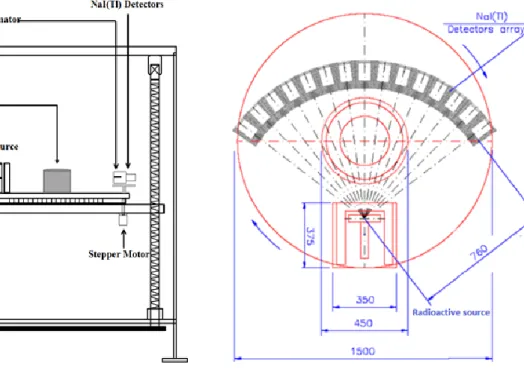
MATERIALS AND METHODSA third multichannel industrial generation computed tomography system, comprising fifteen NaI(Tl) detectors of ø1 x 2 inches (diameter, thickness) was simulated. The detectors were placed on a gantry in fan-beam geometry opposite to the gamma ray source, as shown in Fig.1. The fifteen NaI(Tl) detectors were individually collimated with lead containing a septa of ø 0.196 x 1.96 inches (diameter, depth). The detectors move 10 times in a step angle of 0.23 degree, emulating 150 detectors per projection. Thereafter, the support table containing the gantry and the 137Cs gamma source (Fig. 1) rotates 2 degrees forward, and this process goes on up to completing 360 degrees, totalizing 180 projections. For a total of 2700 samples (150 'virtual detectors' x 180 projections) the system is supposed to spend 9000 seconds or 2.5 hours to obtain each tomography image. The 192I and 137Cs radioactive sources, of 317, 468 KeV and 662 KeV of energy respectively, were
placed into a radioactive shield-case with an aperture angle of 36 degrees. This system was previously described by Mesquita et al [12, 13].
When performing the simulation of NaI(Tl) detectors, some corrections should be made to improve the simulation approaching to the real case. Two of the main corrections are essential: (i) the determination of the photon detection efficiency; and (ii) the energy resolution, which is related to distinguish different peaks very close to each other in the energy spectrum [10-12].
The energy resolution of the detector is given by the full width at half maximum (FWHM), which is approximated to a Gaussian peak for a given energy [10-13]. Some of the effects related to the photopeak are inherent to the electronic circuit of the spectrometric system which is not simulated by the MCNP. In this way, to optimize the detector response and consider these physical effects in the simulation, it is necessary to obtain experimentally adjustment parameters of the detector energy resolution and apply a MCNP code function to fits the Gaussian to the spectrum obtaining the proper corrections [10].
The MCNP fitting technique to take into account the resolution of the real detector, measured experimentally, consists of using a “FT8 GEB” card into the input file of the code [3, 9]. GEB (Gaussian energy broadening) is a special treatment for tallies to better simulate a physical radiation detector [10, 12].
A non-linear function adjusted by least-squares procedure was used as an input to the MCNP code, using a fitting function [14]. These parameters should be used with the (GEB) command in order to consider the energy resolution of the detector in the simulation [10, 12]. These parameters were calculated in previous work [12].
For the estimation of the pulse height, a F8 tally was applied on MCNP code to obtain the deposited energy distribution per incident photon on the NaI(Tl) detector, where for each individual history, the tally accumulates the deposited energy. In order to obtain a good statistic counts, the histories number used was 11E+09.
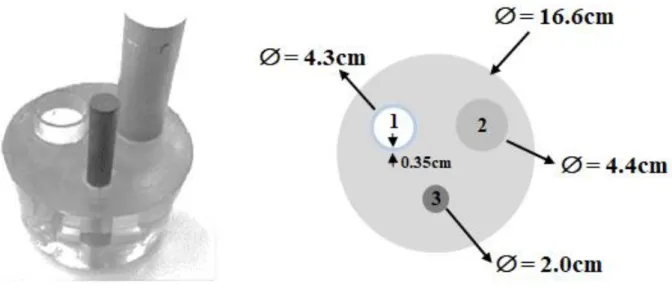
A multiphase phantom was simulated to evaluate the performance of the multichannel third generation industrial tomography system device. The phantom consists of a PMMA (ρ ≈ 1.19 g/cm3 [6]) solid cylinder containing three holes: one filled with steel (ρ ≈ 7.874 g/cm3[6]), another with aluminum (ρ ≈ 2.698 g/cm3[6]) and the third one empty (filled with air) and surrounded with glass, as illustrated in Fig. 3.
Figure 2: Picture (A) and Illustration of the multiphase phantom scheme. 1- Air surrounded with
glass wall, 2-aluminum bar and 3-steel bars. The phantom is made of acrylic (B)
The image reconstruction is based on the exponential decay law defined by the equation (1), which is known as Lambert-Beer’s law [15]:
I=I0∙e∑ μi∙wi,j⃗
N
i=1 (1)
Where I0 is the initial intensity of the beam radiation that focuses on the object on 𝑗⃗ direction, I is
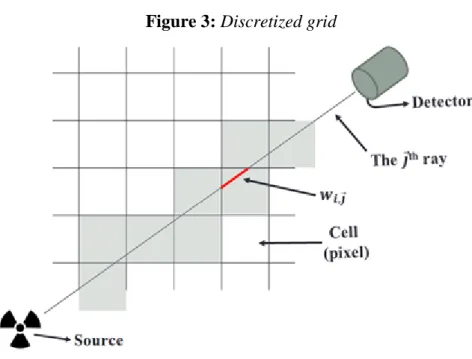
the intensity of the beam radiation through the object, N is the number of pixels on matrix, I is the mass attenuation coefficient of the matter on pixel I and 𝑤𝑖,𝑗⃗ is the length of the beam radiation
Figure 3: Discretized grid
The discretized ray sum for each ray j (j = 1, 2, …, J) can be expressed as the equation (2) [15]. 𝑝𝑗𝑛𝑜𝑟𝑚𝑎𝑙𝑖𝑧𝑒𝑑 = 𝑙𝑛 (𝐼𝑜𝑗 𝐼𝑗 ) = ∑ 𝑤𝑖𝑗𝜇𝑖 𝑁 𝑖=1 (2)
Where, N is the number of pixels. The term wji represents an element of the weight matrix (W), and
is defined as the intersectional area between the jth ray and the ith pixel divided by the intersectional
area between the jth ray and the sample. The size of W is defined by the number of pixels in the reconstruction grid. Due to Poisson noise corruption of the measured data, a term 𝜂𝑗describing the noise is added to the equation (3) [15]:
𝑝𝑗𝑛𝑜𝑟𝑚𝑎𝑙𝑖𝑧𝑒𝑑 = 𝑙𝑛 (𝐼𝑜𝑗
𝐼𝑗 ) = ∑ 𝑤𝑖𝑗𝑥𝑖 + 𝜂𝑗
𝑁
𝑖=1
Solving a high number of linear equations based on measurements corrupted by random variables and noise, requires the use of iterative algorithms. The iterative methods are divided in two categories, the algebraic and the statistical [15]. Algebraic reconstruction methods solve a set of linear equations by comparing the measured data set to an estimate and reduce the difference between these. Statistical methods reconstruct the image by implementing the maximization of the likelihood function, recognizing the Poisson distribution function of the projections with the measured [15]. In the present work, the Simultaneous Iterative Reconstruction Technique (SIRT), Maximum Likelihood Expectation Maximization (MLEM) was used to reconstruct the images. The statistical method MLEM is expressed by equation (4) respectively [3, 15].
𝑓𝑗(𝑛+1) = ∑ [𝐼0𝑒(− ∑ ℎ𝑖𝑘𝑓𝑘 (𝑛) 𝑁 𝑘=1 )(1 − 𝑒−ℎ𝑖𝑗𝑓𝑗 (𝑛) )] 𝑀 𝑖=1 ∑ [𝐼𝑖 − 𝐼̅ + 0.5(1 + 𝑒𝑖 −ℎ𝑖𝑗𝑓𝑗 (𝑛) )𝐼0𝑒(− ∑ ℎ𝑖𝑘𝑓𝑘 (𝑛) 𝑁 𝑘=1 )] 𝑀 𝑖=1 (4)
All reconstruction was performed in a matrix of 128 x128 pixels and 100 iterations and performed by the Matlab 2013b®.
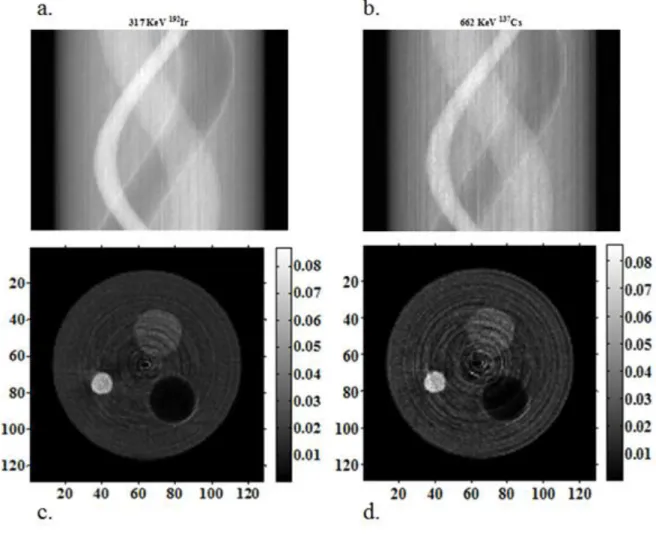
For the reconstruction it was considered only the energy peaks of 317 KeV of the 192Ir and 662 KeV of the 137Cs. For this, for each revolution, it is possible to obtain two images.
3. RESULTS AND DISCUSSION
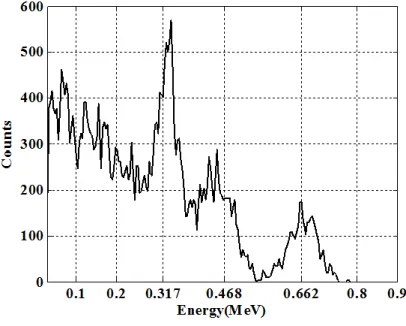
The multichannel spectrum of 192Ir and 137Cs obtained by the simulated NaI(Tl) detectors is shown in Fig. 4. From this figure, it may be observed the different peaks corresponding to the energies from respective sources. The reconstructed images of the simulated phantom were performed by these peaks.
Figure 4: Simulated multichannel spectrum
The reconstructed images of the simulated phantom (Fig. 3) obtained by the simulation of the third generation tomography system, are presented in Fig. 5, where Fig. 5(a) and 5(b) presents the sinogram of the simulated phantom using the 317 KeV 192Ir and 662 KeV 137Cs respectively. Fig. 5(c) and 5(d) presents the reconstructed images using the 317 KeV 192Ir and 137Cs 662 KeV respectively.
Figure 5: Sinogram of the simulated phantom with 317 KeV (a) and 662 KeV (b), and
reconstructed images using 317 KeV (c) and 662 KeV (d).
From the reconstructed images presented in Fig. 5, it is possible to infer that the proposed configuration of the third generation tomography system is feasible, since these images presented good spatial resolution with a reasonable temporal resolution, besides the advantage of the multichannel, which is possible to obtain more than one image per revolution.
4. CONCLUSION
The simulation of the proposed tomography showed that the system has suitable capacity to distinguish several structures in the multiphase systems. Simulated results demonstrated the feasibility of the development of the third generation tomography containing fifteen NaI(Tl) detectors and boards of multichannel acquisition system. A high spatial resolution was observed in the reconstructed images and a temporal resolution about 2.5 hours is estimated.
5. ACKNOWLEDGMENT
The authors express their acknowledgment to CNEN, FAPESP and IAEA for the financial support. The authors, Carlos Henrique de Mesquita and Margarida Mizue Hamada thank to CNPq and Alexandre França Velo to CNEN for their fellowship.
REFERENCES
1. JOHANSEN G.A, HAMPEL U., HJERTAKER B. T, Flow imaging by high speed transmission tomography. Applied Radiation and Isotopes, v. 68, p. 518–524, 2010 2. FALAHI F. Al., Al-DAHHAN M., Experimental investigation of the pebble bed
structure by using gamma ray tomography, Nuclear Engineering and Design, v. 310, p.- 231-246, 2016.
3. IAEA-TECDOC-1589, Industrial Process Gamma Tomography, International Atomic Energy Agency, Vienna, 2008.
4. MESQUITA C.H., VASQUEZ P.A.S., CALVO W.A.P., CARVALHO D.V.S., MARCATO L.A., MARTINS J.F.T., HAMADA M.M. Multi-source third generation computed tomography for industrial multiphase flows applications. In: IEEE Nuclear
Science Symposium, New York, 2011, p. 1294-1302.
5. MESQUITA C.H., DANTAS C.C., COSTA F.E., CARVALHO D.V.S., MADI FILHO T., VASQUEZ P.A.S., HAMADA M.M. Development of a Fourth Generation
Industrial Tomography for Multiphase Systems Analysis. In: IEEE Nuclear Science
Symposium, New York, 2011, p. 19-23.
6. Disponível em <https://physics.nist.gov/cgi-bin/Star/compos.pl?matno=104>, acesso em 10 dez 2018.
7. MESQUITA, C.H., VELO, A.F., CARVALHO, D.V.S., MARTINS, J.F.T., HAMADA, M.M. Industrial tomography using three different gamma rays. Flow Measurement and Instrumentation, v. 47, p. 1-9, 2016.
8. Disponível em <https://www.inl.gov/>. Acesso em 10 dez 2018.
9. BENAC J. Alternating minimization algorithms for X-ray computed tomography:
multigrid acceleration and dual energy application, Tese (Ph.D), Washington
University, St. Louis, 2005.
10. SALGADO, C.M., BRANDÃO L.E.B., SCHIRRU, R., PEREIRA, C.M.N.A. CONTI C.C. Validation of a NaI(Tl) detector's model developed with MCNP-X code. Progress
in Nuclear Energy, v. 59, p. 19-25, 2012.
11. JEHOUANI, A., ICHAOUI, R., BOULKNEIR, M. Study of the NaI(Tl) efficiency by Monte-Carlo method. Applied Radiation and Isotopes, v. 53, p. 887-891, 2000.
12. VELO A.F, HAMADA M.M., CARVALHO D.V.S., MARTINS J.F.T, MESQUITA C.H., A portable tomography system with seventy detectors and five gamma-ray sources in fan beam geometry simulated by Monte Carlo method. Flow Measurement
and Instrumentation, v. 53, p. 89-94, 2017.
13. HADIZADEH YAZDI M.H., MOWLAVI A.A., THOMPSON M.N., MIRI HAKIMABAD H. Proper shielding for Na(Tl) detectors in combined neutron-gamma fields using MCNP. Nuclear Instruments and Methods in Physics, v. 522, p. 447-454, 2004.
14. PELOWITZ, D.B. MCNP-X TM, User’s Manual, Version 2.5.0, LA-CP-05-0369. Los Alamos National Laboratory (2005).
characterization of a high speed gamma-ray tomography. Flow Measurement and