How over-regulation could destroy an economic revolution
The sharing economy
Institute o
f
Public Affairs
T H E V O I C E F O R F R E E D O M E S T A B L I S H E D − 1 9 4 3Darcy Allen
Research Fellow
Chris Berg
Senior Fellow
December, 2014
1
About the Institute of Public Affairs
The Institute of Public Affairs is an independent, non-profit public policy think tank, dedicated to preserving and strengthening the foundations of economic and political freedom.
Since 1943, the IPA has been at the forefront of the political and policy debate, defining the contemporary political landscape.
The IPA is funded by individual memberships and subscriptions, as well as philanthropic and corporate donors.
The IPA supports the free market of ideas, the free flow of capital, a limited and efficient government, evidence-based public policy, the rule of law, and representative democracy.
Throughout human history, these ideas have proven themselves to be the most dynamic, liberating and exciting. Our researchers apply these ideas to the public policy questions which matter today.
About the authors
Darcy Allen is a Research Fellow with the Institute of Public Affairs. He is also a PhD Candidate (Economics) at RMIT University.
At the IPA, his current work focuses on innovation and emerging industries, as well as the regulation of Australian schools. His doctorate focuses on innovation, institutional and evolutionary economics. He previously received First Class Honours in Bachelor of Business (Economics and Finance).
Chris Berg is a Senior Fellow with the Institute of Public Affairs. He is a regular columnist with ABC's The Drum, and an award-winning former editor of the IPA Review.
His latest book is In Defence of Freedom of Speech: from Ancient Greece to Andrew Bolt. A
monograph, The Growth of Australia's Regulatory State, was published in 2008. He is also the editor of 100 Great Books of Liberty (with John Roskam) published by Connor Court Publishing in 2010, and
2
Executive summary
The sharing economy describes a rise of new business models (‘platforms’) that uproot traditional markets, break down industry categories, and maximise the use of scarce resources. The best known services are the ridesharing system Uber and the accommodation service Airbnb. However, the sharing economy extends much further into finance, home tools, investment, and everyday tasks.
The ‘sharing economy’ emerged from dramatically falling transaction costs that had prevented
certain markets from developing. The sharing economy coordinates exchanges between individuals in much the same way as a traditional market, but does so in a flexible, self-governing, and
potentially revolutionary way.
These burgeoning benefits are profound: more sustainable use of idle and underutilised resources; flexible employment options for contractors; bottom-up self-regulating mechanisms; lower
overheads leading to lower prices for consumers; and more closely tailored and customised products for users.
These sharing economy platforms are only in their embryonic stage of development. The benefits to the Australian economy as the market becomes more efficient are likely to expand. This expansion
will only occur if Australia’s entrepreneurs are left to experiment and innovate.
The real threat to the sharing economy is government regulation driven by the incumbent industries that are challenged. The danger of excessive legislation and regulation will absorb the gains yielded by technology improvements, preventing mutually beneficial trade and stifling economic growth.
This paper recommends new approaches to regulatory design that would encourage the growth of the sharing economy:
regulators should encourage bottom-up, organic, self-regulating institutions prior to introducing top-down government control;
occupational licensing needs to be reduced to allow private certification schemes and reputation mechanisms to evolve;
industry specific regulatory frameworks need to be avoided;
regulations making it harder for start-ups to compete for labour need to be reduced; and
3
Table of contents
Introduction ... 4
1. The sharing economy landscape ... 6
Uber ... 6
Airbnb... 8
Open Shed ... 9
Zopa ... 9
Kickstarter ... 11
Airtasker ... 12
2. The economics of the sharing economy ... 13
3. What is unique about the sharing economy? ... 17
More sustainable use of idle and underutilised resources ... 17
Better satisfying the needs and wants of consumers ... 19
Cost reductions through decentralisation ... 20
Better matching through dynamic pricing ... 20
How the sharing economy self-regulates ... 22
What type of revolution may the sharing economy bring? ... 25
4. Excessive regulation holds back the sharing economy ... 26
5. Recommendations ... 28
Bottom up self-regulation rather than top-down government control ... 28
Reduce occupational licensing ... 30
Reduce industry specific controls ... 32
Provide an environment for platforms to develop private solutions ... 32
Regulatory reductions to encourage entrepreneurship and flexible work practices ... 33
Conclusion ... 35
Appendices ... 36
4
Introduction
It has many names: sharing economy, collaborative production, collaborative consumption, peer-to-peer, mesh, commons-based peer production and access economy. An all-encompassing definition
of these ‘economies’ is likely to remain elusive.1 For the remainder of this report, these innovative
models, platforms and technologies are all referred to more generally as the sharing economy.
The sharing economy is a broad term for an emerging set of business models, platforms and exchanges. The sharing economy is about sharing the knowledge of goods and services to better exchange them. These exchanges are leveraged by ubiquitous and cheap knowledge made available through disruptive technology. The distinguishing characteristics include decentralised exchange, a focus on access over ownership of resources, firms becoming the facilitator of exchange (rather than acting as a producer), and mechanisms of self-governance.
The sharing economy is growing. The consumer peer-to-peer rental market has been estimated at a worth of $26 billion.2 The growth of the ‘share economy’ was estimated at 25% in 2013, with over $3.5 billion in revenue.3 In the last year, 25% of people in the UK have undertaken internet-based collaborative activities.4
Despite the widespread consumer benefits and potential for improvements in living standards, there remains much furore about the sharing economy. Constant and continuing battles occur between incumbents, lobbyists and governments. The huge potential benefits will only come to fruition if entrepreneurs are able to experiment, expand, and evolve in a flexible environment without the overly-constraining shackles of government regulation.
Direct government intervention will hinder, rather than help, the growth of these services, and at the most critical time in industry emergence. There is a proper and important role for government as the sharing economy develops. Governments must provide a reliable and predictable legal system in which contracts are enforced and property rights defined. Under a neutral and uniformly enforced legal system, the sharing economy will thrive.
The debate over the sharing economy has focused a little too much on ‘sharing’, and too little on
‘economy’. This report applies the underlying economics of the sharing economy to inform policy
responses. The dynamics are explored through a number of pressing questions: Why have these platforms emerged only now? What are the underlying economic institutions? What potentially stands in the way of these benefits? How do these mechanisms differ from traditional markets? What regulatory role does the government have, if any? These questions are all addressed in turn.
This report is structured as follows. Section 1 lays the landscape of the sharing economy through six case studies – Uber, Airbnb, Open Shed, Zopa, Kickstarter and Airtasker. While this section focuses
1
See Appendix A. 2
Botsman, Rachel, What’s Mine is Yours: How Collaborative Consumption is Changing the Way We Live, (HarperCollins: London, 2011).
5 on all six case studies, the remainder of the paper focuses more heavily on the first two, due to the availability of data and the degree of media attention around Uber and Airbnb.
Section 2 explores the economics of the sharing economy. The sharing economy is framed as a market in the context of transaction cost economics. That is, the sharing economy platforms are emerging from the use of widespread communications technologies and the decreasing cost of knowledge.
Section 3 asks what is unique about the sharing economy. Features of ‘traditional’ markets are compared to those of ‘sharing’ markets, with a focus on four main benefits brought by the latter: sustainable resource utilisation, the potential for self-governance through civil-society institutions, cost reductions through decentralisation, and preference matching.
Section 4 explores the potential impact of Australia’s expanding regulatory state on the sharing economy.
6
1. The sharing economy landscape
This section sets out the landscape through six sharing economy platform case studies – Uber, Airbnb, Open Shed, Zopa, Kickstarter and Airtasker. These have been selected to represent the broad nature of the sharing economy, and the diversity of platforms, services and goods which it impacts. These are by no means a wide depiction of the influence; rather illustrating interesting fundamental characteristics. A discussion of the deeper theoretical characteristics and emergence of the sharing economy can be found in Section 2.
Uber
Uber is a platform for connecting passengers and drivers.
Launched in 2010, Uber has now extended services to over 45 countries, has raised $US1.2 billion from mutual funds and other investors,5 and has confirmed pre-money valuation at US$17 billion.6
Uber does not own any of the cars. It is a smartphone application that facilitates the coordination of independent drivers and riders. For the riders, the app displays the location of available drivers, the waiting time, and the price of the fare. Riders may then set a pickup location and request a driver (an
independent operator who ‘partners’ with the platform).
Uber provides access to multiple levels of transportation services, each with different prices and needs.7 These are all alternative modes of transport, extending to many domains of the market. Uber should be conceived as more broad than an alternative to taxicabs – it is a platform for
transportation services more generally.
Uber has launched a courier delivery service, UberRUSH, which makes use of messengers on bikes or on foot.8 Senders chose RUSH in the Uber application, request a messenger, provide delivery details to the messenger, and track the progress of the item in the application. Uber also launched
UberBOAT in Boston – a service to request a water taxi around the Harbor – which was also available in Sydney earlier this year. 9
Uber has also launched a carpooling service. UberPOOL coordinates individual riders who are travelling to similar locations along a similar route. If there is a match found along the route, the rider will be notified of the co-riders’ first name. UberPOOL has received attention from regulators;
the Public Utilities Commission in California decided that Uber’s new carpooling service is illegal
because two distinct riders pay separate fares to share one car.10
5
‘Uber valued at $US18.2b after latest billion-dollar investment round’, Sydney Morning Herald, 7 June 2014, www.smh.com.au/business/world-business/uber-valued-at-us182b-after-latest-billiondollar-investment-round-20140607-39peh.html.
6
Travis, ‘4 Years In’, Uber Blog, 6 June 2014, www.blog.uber.com/4years. 7
Some of these include uberX , UberTAXI, UberBLACK, UberSUV and UberLUX. 8 Kimiko, ‘A Reliable Ride for Your Deliveries,’
Uber Blog, 7 April 2014, www.blog.uber.com/RUSH. 9
Lauren, ‘Set Sail With UberBOAT’ Uber Blog, 3 June 2014, www.blog.uber.com/uberboatboston. 10Rogowsky, Mark. ‘California Threatens to Shut Down Uber’s New Carpooling Service [UPDATED]’
7 The average typical uberX partner in Sydney drives around 20 hours a week and takes home $2,500 a month.11 In Chicago alone, Uber has estimated the creation of 25,000 additional rides in 2013
(incremental to the transportation market).12
At the same time, the uberX service is approximately 20-50% cheaper than a taxicab alternative. A study by Uber has calculated that a typical company using uberX can expect to save over $1,000 per year per travelling employee compared to the yearly cost of hiring traditional taxis.13
Media attention around Uber has focused heavily on safety concerns. In reality, there is little evidence that Uber is any less safe as a transportation platform than alternative transport services. The rate of taxicab-located crimes in Chicago decreased by 20% in the 300 days after Uber entered, compared to the 300 days before Uber was introduced.14 This is potentially due to the many safety-related mechanisms incorporated into Uber:
Uber drivers are pre-screened under four separate checks on drivers: driving history; criminal background checks; vehicle inspections; and medical checks;15
the vehicles of Uber partners face standards tests: no Uber vehicle is pre-2004, and the average model year for vehicles is typically 2008;16
every passenger is covered by Uber’s contingent liability policy that provides US $5 million in coverage for each trip. Further, on UberBLACK riders are also covered by commercial
insurance covered by Uber’s licensed and registered hire car partners;
a record of every transaction is held by Uber (transactions are not anonymous);
there is no handling of cash as payment occurs through the registered payment type within the Uber application; and
the system is self-governing as riders and drivers who fall below a certain peer-determined rating are reviewed and potentially suspended.
This last point is important, and is elaborated in Section 3. Following the ride, both the rider and the driver provide feedback on their experience with the other party through a ratings system. This keeps both parties accountable for their actions; aligning incentives of both drivers and riders to maintain high ratings. These ratings are reviewed on a regular basis by the local teams.17 When a rating below a certain level is selected by either a driver or a rider, they are required to provide a reason for their low rating. This may trigger a consultation process between the relevant party and
11
Katie, ‘Uber’s Letter to the Transport Ministers of Australia’ Uber Blog, 6 November 2014, www.blog.uber.com/Transport-Minister-Letter.
12 MacDonald, Andrew, ‘UberData: Uber’s Economic Impact on the City of Chicago’
Uber Blog, 12 March 2014, http://blog.uber.com/ChiEconStudy.
13Myhrvold, Connor, ‘U4B Saves Companies $1000+ Per Employee Every Year,’
Uber Blog, 21 October 2014, www.blog.uber.com/save-with-u4b.
14
Lauren, ‘Uber’s Impact on Taxi Crime In Chicago,’ Uber Blog, 28 April 2014, www.blog.uber.com/chicagotaxicrime.
15 Snowdon, T. ‘Taxi companies want the ridesharing Uber app banned in Queensland,’
The Courier Mail, May 12, 2014 ; Parker, Gareth ‘Taxis face Uber-assault’, Courier Mail, October 9 2014,
www.au.news.yahoo.com/thewest/a/25215714/taxis-face-uber-assault/. 16Uber, ‘Safer Streets,’
Uber Website, accessed November 15 2014, www.uber.com/safety. 17
8 Uber. This reputation mechanism works both ways – protecting drivers from passengers as well as passengers from drivers, who have a bad rating from previous trips.18
Airbnb
Airbnb is a platform for connecting and coordinating the short or long term renting of property.
Founded in 2008, Airbnb has now extended to over 34,000 cities in 190 countries.19 After receiving $450 million investment earlier this year, the home-rental site has been valued at approximately $10 billion.20
Airbnb has received much media attention as an alternative to hotels. This is not surprising given their recent economic impact estimates – from April 2013 to March 2014 their total economic impact in Montreal, Canada was $54.6 million.21
The two parties to an Airbnb exchange – hosts and travellers – must register on the Airbnb website. Hosts list their available space – whether it is an entire apartment, a room in a house, a castle, or even an igloo. Travellers can then browse and book these listings. Airbnb takes a 6-12% guest service fee every time the reservation is booked.22
As with the majority of sharing economy platforms, Airbnb does not own any of the ‘spaces’, they act as a facilitator of matching hosts with travellers. The focus, much like that of Uber, is on the idle space or excess capacity of resources. The Airbnb platform has a number of safety-related advantages built in, including:
no handling of cash – payment is transferred through Airbnb itself;23
profiles are attached to a reputational mechanism;
guests and hosts both verify their identity by:
o connecting to social networks;
o scanning their official ID; or
o confirming personal details.24 Hosts may require guests to have this verified ID before requesting the space.25
hosts also have the option of requiring a security deposit;26 and
hosts are covered by up to $900,000 AUD in damages to their property through the Airbnb Host Guarantee.27
18Nairi, ‘Feedback is a Two
-Way Street,’ Uber Blog, April 23 2014, www.blog.uber.com/feedback. 19 Airbnb, ‘How To Travel,’
Airbnb Website, www.airbnb.com.au/help/getting-started/how-to-travel. 20
Spector, Mike, MacMillan, Douglas, and Rusli, Evelyn M. ‘TPG-led Group Closes $450 Million Investment in Airbnb,’ The Wall Street Journal, 18 April 2014.
21 Airbnb, ‘Economic Impacts in Montreal,’
Airbnb Blog, http://blog.airbnb.com/economic-impacts-montreal/. 22
Airbnb, ‘What are guest services fees?’Airbnb Website, www.airbnb.com/help/article/104. 23
Airbnb, ‘How it Works: Payment System,’ Airbnb Website, www.airbnb.com.au/help/getting-started/how-it-works. 24
Airbnb, ‘Trust,’ Airbnb Website, www.airbnb.com.au/trust. 25Airbnb, ‘How Do IView and Send Messages?’
Airbnb Website, www.airbnb.com.au/help/article/145. 26Airbnb, ‘How Does Airbnb Handle Security Deposits,’
Airbnb Website, www.airbnb.com.au/help/article/140. 27 Airbnb, ‘Airbnb’s $900,000 AUD Host Guarantee,’
9
Open Shed
Open Shed facilitates used item rental between individuals.
The most popular items include projectors, post hole diggers, moving trolleys, mowers and jet washers.28 Open Shed has over 5,000 members Australia wide, and is growing at approximately 50 members per week.29 This is a collaborative consumption model with a clear and specific focus on sustainability.
The two parties to the exchange are ‘owners’ and ‘renters’. Owners list their items, while potential
renters browse these listings and can send rental requests. Owners can then accept the request and provide details of where to meet. These requests come with pre-approved rental funds by PayPal. Once the parties have met, the renter provides their ‘secret code’, which the owner enters into the site and if the code is correct, the relevant funds are transferred automatically to the owners account.
Open Shed also has a number of safety features for both owners and renters:
a bond may be incorporated into the price for security purposes. The bond is returned from the renter to the borrower on successful return. This amount will be deducted from the rental fee before it is transferred into the owners account;
an Item Damage Guarantee up to $1,000 for repair or replacement of an item ‘if something unfortunate happens to your item during an Open Shed rental’;30
a private messaging system allows individuals to interact with other members before exchange;31 and
following the exchange, parties rate each other, on a rating system which is visible for all potential borrowers and renters.32
Zopa
Zopa is a peer-to-peer lending application that facilitates transaction of funds between individuals.
Developed in the United Kingdom in 2005, Zopa has a fast growing community of over 57,000 lenders who have transacted over 629 million GBP.33 Zopa is a decentralised system that avoids the expensive traditional banking system –‘Zopa allows you to cut out the middle man and lend directly
to sensible people.’34
The two parties to the exchange are lenders and borrowers. Lenders decide on the amount they want to lend (a minimum of 10GBP and no maximum). These funds are lent in small chunks to different borrowers (split into longer and shorter loan terms). Repayments are monthly and are composed of both interest and principal. Funds can be re-lent automatically.
28
Personal communication from Open Shed CEO on Tuesday October 14 2014. 29
Ibid. 30
Open Shed, ‘Terms and Conditions,’ Open Shed Website, www.openshed.com.au/info/terms_and_conditions. 31
Open Shed, ‘Frequently Asked Questions,’ Open Shed Website, www.openshed.com.au/info/faq. 32Open Shed, ‘How It Works,’
Open Shed Website, www.openshed.com.au/info/how_it_works. 33
Also known as social lending, or lend-to-save. 34 Zopa, ‘What is Zopa?’
10
Zopa’s ‘data scientists’ calculate ‘Tracker Rates’ taking into account the best rates traditional banks
are offering. Out of these rates, Zopa takes a 1% fee. This is significantly smaller than the traditional bank spread, and therefore provides higher rates for lenders and lower rates for borrowers. Further,
this is guaranteed through a threshold ‘to ensure your projected return is always at least 1% above
the average savings rate the banks are offering’.35 A number of safety and security related features
are embedded in the platform:
borrowers must be:
o over 20 years of age;
o UK residents for over 3 years; and
o earning at least 12,000GBP per year with a solid credit history.36
a missed payment will result in the Collections Team at Zopa to ‘chase on your behalf’;37 and
if repayments have been missing for 4 months, then the Safeguard Fund is to ‘step in and
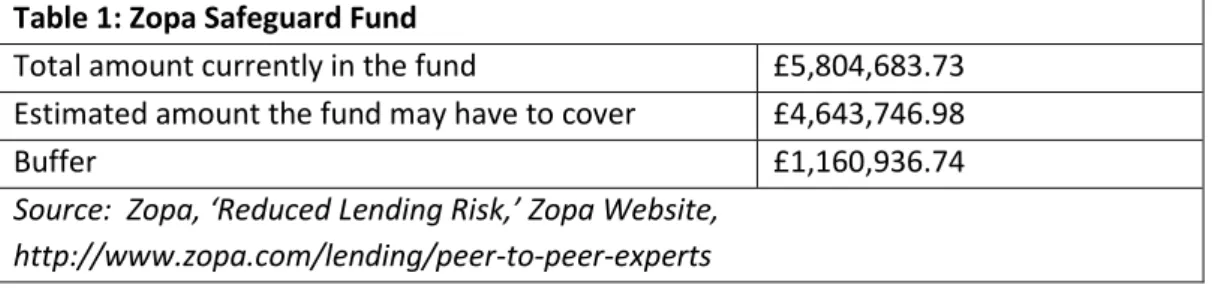
give you your money back, including interest owed’. The most current levels of the fund are
shown in the table below:
There is a substantial ‘buffer’ between the estimated amount the fund may have to cover, and the level the fund currently has. The fund has covered 100% of all bad loans since it was launched. That
is, the platform has privately incorporated an ‘insurance’ fund.
Since April 2014, Zopa is now regulated in the UK by the Financial Conduct Authority (FCA).38 Zopa
holds that ‘Most of the FCA regulation consists of policies and procedures that Zopa already adheres
to.’39
35 Zopa, ‘Reducing Lending Risk: Tracker Rates Explained,’
Zopa Website, www.zopa.com/lending/peer-to-peer-experts#rates-explained.
36
Zopa, ‘How Lending Money Works,’ Zopa Website, www.zopa.com/lending/how-lending-money-works. 37 Zopa, ‘Reducing Lending Risk: Tracker Rates Explained,’
Zopa Website, www.zopa.com/lending/peer-to-peer-experts#rates-explained.
38Mat, ‘What regulation of peer to peer lending means to you,’
Zopa Blog, April 11 2014, www.zopa.com/blog/2014/04/11/what-regulation-of-peer-to-peer-lending-means-to-you/. 39
Ibid.
Table 1: Zopa Safeguard Fund
Total amount currently in the fund £5,804,683.73 Estimated amount the fund may have to cover £4,643,746.98
Buffer £1,160,936.74
11
Kickstarter
Kickstarter is a website matching investors with potential projects through crowdfunding.
Since 2009, 7.2 million people have pledged $1.3 billion, funding 72,000 projects.40 Kickstarter does not back any of the projects – all projects are funded by individual creators. The two parties to the
exchange are ‘creators’ and ‘backers’. Creators list projects (which must be a ‘finite work’ with a
‘clear goal’) for potential funding towards a funding goal from backers. If the funding goal is reached
within the set time, the pledged money is debited from the individual accounts.
Backers will then receive (if applicable) the ‘rewards’. These are often one-of-a-kind experiences,
copies of the work, or limited editions. For example, in the case of a published book, the rewards
may include the backer’s name listed at the front, or a copy of the book. These rewards tend to vary
based on the amount invested. That is, a larger backer will receive a greater reward.
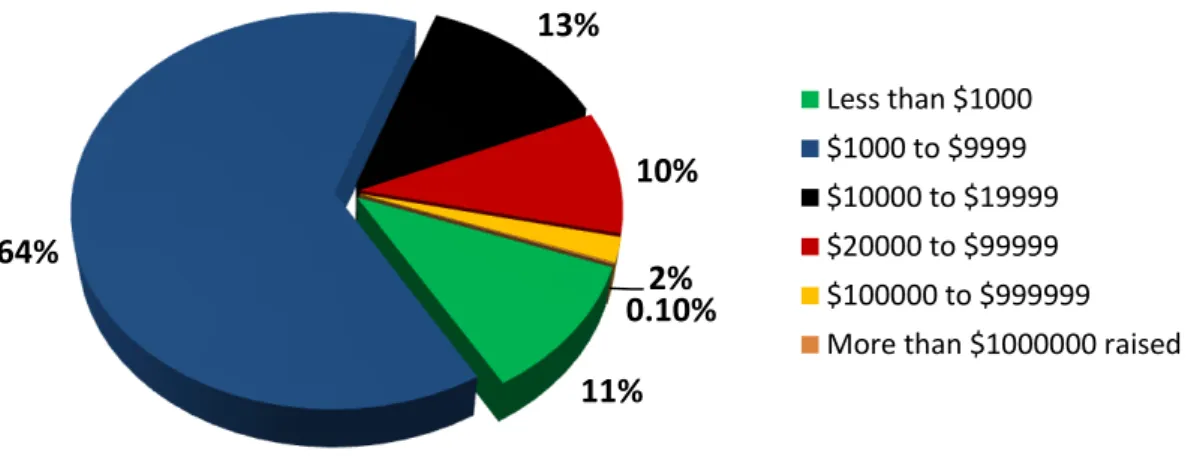
The funding goal can also vary widely, and so can the amount raised. Figure 1 below depicts the amount raised on over 50,000 Kickstarter projects until October 30, 2013.
Figure 1: Amount Raised on Over 50,000 Kickstarter Projects
Source: McGregor, Michael and Benenson, Fred. ‘Five million backers,’ Kickstarter Blog, 29 October 2013, www.kickstarter.com/blog/five-million-backers.
The outcome of a Kickstarter campaign is all-or-nothing. If the funding goal is not reached, no bank accounts are debited and the project does not go forward. On the other hand, if the project raises equal to or more than the funding goal 41 all accounts are automatically debited and the project commences production.42 Kickstarter suggests that this has two main benefits. First, it lowers the risk for everyone. That is, backers do not pay if funding goal is not reached. Second, the model presents greater motivation for spreading the word for the project. That is, presumably once you fund a project, you will have the incentive to spread the word of the project to reach its goal.
40
Kickstarter, ‘Stats,’ Kickstarter Website, www.kickstarter.com/help/stats?ref=footer. 41
Within the allotted time
42Kickstarter, ‘Kickstarter Basics: Kickstarter 101,’
Kickstarter Website, accessed November 15 2014, kickstarter.com/help/faq/kickstarter%20basics.
11%
64%
13%
10%
2%
0.10%
12 Kickstarter applies a 5% fee to all funds collected if the project is successful. Note that Kickstarter provides no guarantee for the completion of projects. That is, they stay entirely independent from the actual projects and merely act as a facilitator and coordinator. In defending this, Kickstarter cites
that ‘Launching a Kickstarter is a very public act, and creators put their reputations at risk when they do’.
Airtasker
Airtasker facilitates the exchange of everyday service tasks between both individuals and businesses.
Airtasker was founded in 2012 in Sydney. Airtasker boasts over 160,000 members, has created over $5.85 million worth of jobs,43 and has raised over $3.5 million in funding.44 It acquired Sydney-based rival TaskBox in February 2013,45 and Melbourne-based Occasional Butler in mid-2014.46
The site allows individuals or businesses to post a task they need completed, when they need it completed, and the price they are willing to pay. The suggested tasks include ‘home and garden’,
‘deliveryand removals’, and ‘handymen & tradies’.47Those who can complete the task (‘the
workers’) can apply. There is no obligation to hire.
When the request to complete the task is received, the task-commissioner can view a profile of the respondent, which includes feedback and references from jobs they previously completed. Airtasker then connects the two within an internal safe messaging service, and facilitates the payment
process. The site takes a 15% commission on completed tasks.48
A number of safety mechanisms are incorporated into the Airtasker platform. These include: verified IDs, secure payment system, and the option to undertake the AirtaskerPRO verification process. This
additional verification process includes ‘an application approval, ID check and video or in-person
interview with an Airtasker community manager.’49
There is also a reputation mechanism for all users – a requirement to have a detailed profile with qualified peer reviews.50 Airtasker also boasts $20 million in public liability insurance for service providers, which is covered by Lloyds of London and includes cover for personal injury and property.51
43Airtasker, ‘What is Airtasker?’
Airtasker Website, www.airtasker.com/categories/. 44 Bender, Adam. ‘Airtasker snags $2 million in funding round,’
Techworld Australia, 26 November 2013, www.techworld.com.au/article/532824/airtasker_snags_2_million_funding_round/.
45Smith, Paul. ‘Outsourcing odd jobs pays off as Airtasker expands,’
Australian Financial Review, 11 June 2014. 46 Kitney, Damon. ‘Butler just the job for Airtasker’
The Australian, 11 July 2014. 47
Ibid. 48
Lim, Jason. ‘Australia’s Airtasker Looks to Adopt Disgruntled Rabbits from TaskRabbit,’ Forbes, 12 August 2014.
49
Airtasker, ‘AirtaskerPRO,’ Airtasker Website, accessed November 15 2014, www.airtasker.com/pro/. 50
Airtasker, ‘Trust and Quality,’ Airtasker Website, accessed November 15 2014, www.airtasker.com/trust/. 51Airtasker, ‘Airtasker Insurance,’
13
2. The economics of the sharing economy
This section explores the economics of the sharing economy. Recently, disruptive technologies have significantly reduced the transaction costs of exchange. They have done this by making dispersed knowledge cheap and ubiquitous. Combining this with innovative software platforms, we have vastly extended the ability to coordinate economic exchanges. This is a contemporary and visible example
of Friedrich Hayek’s extended order of the market. The theory of the firm and the market process
are also useful to understand our decreasing reliance on exchange with large, monolithic corporations and our increasing decentralisation of trade.
Transaction costs
The decreasing transaction costs arising from disruptive communications technologies have had a deep impact on the way individuals undertake economic exchange. The idea of ‘transaction costs’ is largely credited to Ronald Coase, referring to the costs associated with market exchange:
In order to carry out a market transaction it is necessary to discover who it is that one wishes to deal with, to inform people that one wishes to deal and on what terms, to conduct negotiations leading up to a bargain, to draw up a contract, to undertake the inspection needed to make sure that the terms of the contract are being observed, and so on.52
Transaction cost economics focuses on ‘making the transaction – rather than commodities – the basic unit of analysis and by assessing governance structures, of which firms and markets are the
leading alternative, in terms of their capacities to economize on transaction costs.’53 A workable
concept of transaction costs can be split into three main parts:
search and information costs;
bargaining and decision costs; and
policing and enforcement costs.54
While this is often the focus of the literature, a taxonomy of transaction costs can be seen as
‘unnecessarily elaborate’, where the general problem is more broadly captured as ‘resource losses
due to a lack of information.’55 Dahlman argues that the resource losses experienced due to a lack of
information (or knowledge), have presented a continual struggle throughout economic history – an argument that is particularly useful for understanding the emergence of the sharing economy.
The importance of transaction costs is best illustrated through example. You may be willing to pay someone $10 to walk down the street and purchase a coffee. There may also be another individual who is willing to undertake the task for $5. There’s clearly potential for a mutually beneficial trade here. The reason why this may not occur is transaction costs – it would take time, and potentially money, to discover who the other individual is, bargain a price with them (somewhere between $5
52 Coase, Ronald, ‘The Problem of Social Cost’
Journal of Law and Economics 3 (1960): 15. 53
Williamson, Oliver, ‘The Economics of Organization: The Transaction Cost Approach’ The American Journal of Sociology 87(3) (1981): 549.
54Dahlman, Carl J, ‘The problem of externality’
Journal of Law and Economics (1979): 148. 55
14 and $10), and enforce the agreement. In this scenario, transaction costs ‘eat up’ the profitability of exchange, preventing mutually beneficial trade from taking place.
As economies grow larger, so do the number of potentially mutually beneficial trades. The problem is that we cannot access all of them. When transaction costs are too high, many of these exchanges are rendered ‘unprofitable’ and will not take place. In 1937, Coase pointed out that high transaction costs present an obstacle to many trades:
… operations are often extremely costly, sufficiently costly at any rate to prevent many
transactions that would be carried out in a world in which the pricing system worked without cost.56
Knowledge coordination
It should be made clear that the problem here is not the cost of the resource itself per se. The problem is the cost of coordinating the knowledge individuals require to transact that resource. For much of human history, many beneficial trades did not take place because the costs in undertaking the trade were simply too high. Fortunately, over the previous few decades, we have seen
unprecedented advances in widespread communications technologies while have led to the broad dispersal of cheap knowledge.
Nobel Laureate Friedrich Hayek suggested that the economic problem we face is not the allocation
of resources, but the ‘problem of the utilization of knowledge not given to anyone in its totality.’57
We are now have fast, cheap access to knowledge in all of the three areas listed earlier – search and information, bargaining and decision, and policing and enforcement.
These interesting new exchanges we are seeing in the sharing economy are not new. Many have been in existence for a long time; it was simply too expensive to undertake the trade. Decreasing transaction costs are rapidly extending the market, allowing access of the excess capacity of existing resources.
The extended order
The concept of the ‘extended order of the market’ (introduced by Friedrich Hayek) referred to the
extension of trade from local, to national, to international levels throughout history as being the result of decreasing transaction costs. Transaction costs have declined through the development of:
… a framework of institutions – economic, legal, and moral – into which we fit ourselves
by obeying certain rules of conduct that we never made, and which we have never understood in the sense of which we understand how the things that we manufacture function.
The impact of these institutions ‘constitutes an information gathering process, able to call up, and
put to use, widely dispersed information that no central planning agency, let alone any individual,
56Coase, Ronald, ‘The Nature of the Firm’
Economica 4(16), (1937): 15. 57 Hayek, Friedrich, ‘The Use of Knowledge in Society’
15
could know as a whole, possess or control.’58 That is, the development of these institutions
throughout human history has, although not explicitly nor intentionally, created a framework in which dispersed knowledge can be put to work:
civilisation depends, not only for its origin but also for its preservation, on what can be precisely described only as the extended order of human cooperation, an order more commonly, if somewhat misleadingly, known as capitalism.59
That is, over thousands of years, the spontaneous development of a framework of institutions that foster knowledge coordination and trust is the cause of our leaps and bounds in terms of economic development. Hayek explained that one of the most marvellous examples of these institutions is the price mechanism:
I am convinced that if it were the result of deliberate human design … this mechanism
would have been acclaimed as one of the greatest triumphs of the human mind.60
Hayek argued that the price mechanism enabled the coordination of local knowledge that could never be aggregated into a government plan. This mechanism is highly misunderstood, and was not the result of human design:
The price system is just one of those formations which man has learned to use (though he is still very far from having learned to make the best use of it) after he had stumbled upon it without understanding it.61
The sharing economy – much like the price mechanism – has spontaneously emerged as a set of institutions for the coordination of knowledge not known to anyone in its totality.These new institutions – manifest in platforms such as Uber – are extending the market order in unprecedented ways.
It is in this way that the sharing economy is a market; an emergent ‘new, super-individual, spontaneous pattern’ facilitating the exchange of resources.
Markets and firms
The sharing economy has emerged as the market institution and the price mechanism have done before – as a way to coordinate knowledge. This is a natural evolution. Only once we understand that these sharing economy platforms are markets for the coordination of dispersed and valuable knowledge, can we explain these platforms in terms of markets and firms.
The relationship between markets and firms has created a significant body of literature under the broad title: ‘the theory of the firm’. Ronald Coase raised the question: why aren’t all transactions undertaken between individuals in the market? That is, why do firms exist? This is the transaction cost theory of the firm, and can be summarised:
58
Hayek, Friedrich, The Fatal Conceit: The Errors of Socialism. (University of Chicago Press, 1988): 14. 59
Ibid., 6.
60Hayek, Friedrich, ‘The Use of Knowledge in Society’
The American Economic Review 35(4), (1945): 527. 61
16 the operation of a market costs something and by forming an organisation and allowing some authority (an ‘entrepreneur’) to direct the resources certain … costs are saved.62
It costs money to find, enforce and change contracts in a market. If this is the case, firms emerge when entrepreneurs can coordinate production in firms at a lower cost than through market exchange. Exchanging various resources within a firm is often much cheaper than on a market. For example, an ongoing employment contract may be much more convenient than having to find and negotiate an additional contract each time a different task is required.
Following in this transaction cost theory of the firm, the boundaries of firms and markets are directly related to the transaction costs in a market. This point was later noted by Benkler:
The combined effect of the motivational effects and the transaction costs of each system will determine, for any given good or use, whether it will most effectively be provisioned through the price system, a firm, a bureaucracy, or a social sharing and exchange system.63
In terms of the sharing economy, this could imply that the cost of exchange in a market has become relatively cheaper than the cost of coordinating production and exchange with a firm. This signifies an increase in market transactions. The role of the sharing economy platforms is to facilitate and coordinate, rather than produce. The relationship between individuals and firms are evolving.
In all of the case studies explored in section 1, the platform does not own any of the resources. The value platforms are adding is in connecting and coordinating knowledge in the market. We are seeing the extension of markets, and different role for firms. The following section compares the
unique benefits of the ‘sharing economy markets’ and the ‘traditional markets’ –explaining why this
increase in efficient knowledge coordination makes better for markets.
62
Coase, Ronald, ‘The Nature of the Firm’Economica 4(16), (1937): 22.
17
3. What is unique about the sharing economy?
The previous section made it clear that the ‘sharing economy’ follows the same fundamental tenets as a market economy: networks of individuals coordinating their exchanges in a socio-economic system. The sharing economy leverages on market institutions by taking advantage of ubiquitous and cheap knowledge.
The next step is to compare ‘traditional’ markets and ‘sharing economy’ markets: what is unique about the sharing economy? This section focuses on the benefits of the sharing economy, which include:
more sustainable use of idle and underutilised resources;
self-governance through civil society institutions;
decentralised exchange leading to cost reductions;
alternative pricing models such as dynamic pricing; and
the ability to leverage market knowledge as a trial-and-error innovation process.
More sustainable use of idle and underutilised resources
The sharing economy presents gains in resource sustainability due to increased access to idle and underutilised resources.
There is a growing focus on access over ownership as a way to exchange the value of resources. When the economy maximises units of usage, rather than the number of units sold, ‘we begin to see eco-efficiency and business efficiency align.’64
What the sharing economy uniquely does is slice up the provision of goods and services into smaller parts, both in time and in space.
Take two examples: a car and a house. Cars are one of the most expensive and dormant resources to own. They are usually either empty, or transport 1 or 2 people at a time. Transportation-sharing applications such as Uber are opening up the capacity of these existing resources. Both the time a car is not in use, and the spare seats when a car is in use, can now be exploited.
Further, a house exists both as a single entity, and as separate rooms. It is also unoccupied at certain times. Accommodation-sharing applications such as Airbnb are opening up the capacity of the existing accommodation resources.
While the car and the home are both prominent examples of these characteristics, the remainder of the platforms operate on the same principles, whether they help users access tools in their
neighbourhood (eg. Open Shed ), or the spare time of other individuals (eg. Airtasker).
The increased efficiency in the use of resources, as provided by the sharing economy, will have a profound impact on sustainability outcomes. For example, it has been estimated that every
64
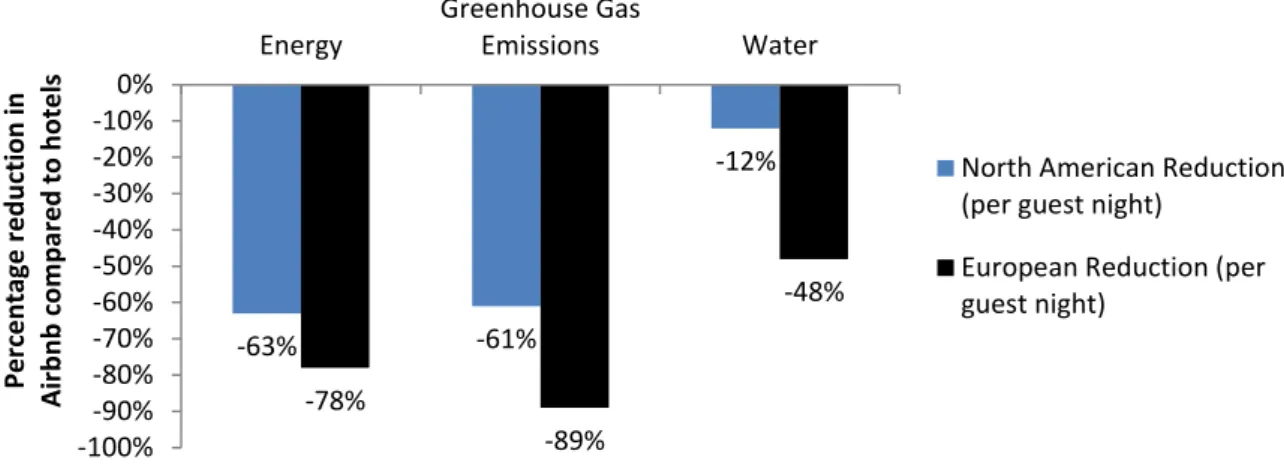
18 sharing vehicle reduces car ownership by 9-13 vehicles.65 Further, Airbnb has produced a number of
statistics in relation to ‘home sharing’, illustrated in in Figure 2 below. Airbnb suggests that in
Europe, greenhouse gas emissions are 89% lower per guest night in Airbnb, compared to hotels. This data comes from 8,000 survey responses from guests and hosts worldwide when compared to some of the most sustainable and energy-efficient hotels.
Figure 2: Airbnb’s Estimates on Sustainability Measures
Source: Airbnb, ‘A greener way to travel: the environmental impacts of home sharing,’ Airbnb Blog, July 31 2014, www.blog.airbnb.com/environmental-impacts-of-home-sharing/.
Airbnb recently completed a further study into their sustainability impacts in Montreal, Canada. This study found that in April 2013 to March 2014, Airbnb had:
energy savings equivalent of 620 homes;
greenhouse gas emissions reduction equivalent of 1,070 cars;
waste reduction equivalent of 9 Olympic-sized swimming pools; and
waste reduction of 195 metric tons.66
The economics of excess capacity
One of the ways Yoachai Benkler characterised goods was in terms of ‘granularity’. Granularity refers to the degree to which objects may be broken down into smaller packages. A fine-grained good is one where the consumer can purchase an amount very close to that which they desire (eg. a coffee). A large-grained good is one where the resource is so large that demand must be aggregated for it to exist (eg. large industrial equipment).
In the middle of these two extremes are mid-grained goods (eg. a computer, house, or car). These
are ‘small enough for an individual to justify buying for her own use, given their price and her
willingness and ability to pay…’ 67 That is, a consumer will buy a computer, or a car, or a house, if the
65
Owyang, Jeremiah, Tran, Christine, and Silva, Chris. ‘A Market Definition Report: The Collaborative Economy,’ (Altimeter Research, 2013).
66
Airbnb, ‘Environmental Impacts in Montreal,’ Airbnb Website, November 13 2014, http://blog.airbnb.com/environmental-impacts-montreal/.
67Benkler, Yochai, ‘Sharing Nicely: On Shareable Goods and the Emergence of Sharing as a Modality of Economic Production’ Yale Law Journal 114, (2004): 297.
-63% -61%
-12% -78% -89% -48% -100% -90% -80% -70% -60% -50% -40% -30% -20% -10% 0% Energy Greenhouse Gas Emissions Water Per ce n tage re d u ction i n A ir b n b c o m p ar e d to h o te ls
North American Reduction (per guest night)
19 utility they gain from buying and using that good exceeds the price of the unit in its lifetime (given alternative uses of the money). The purchase of a good does not necessarily mean there is no excess capacity within that good. It is also in the interest of both the owner, and potential users of that excess capacity, to exchange that value.
Benkler, writing one decade ago, suggested that secondary markets may be an efficient alternative to the firm in accessing this vast excess capacity. Since the time Benkler was writing, we have seen a decade of decreasing transaction costs. As a result the technological constraints on the excess capacity of these resources has declined, and secondary ‘sharing’ markets are continually emerging.
At a time when many are concerned over continual production and consumption, the sharing economy is an emergent set of institutions that provide a pure free-market form of sustainability by utilising excess capacity.
Better satisfying the needs and wants of consumers
The level of flexibility in the provision of goods and services is a particular strength of decentralised institutions in the sharing economy.
Consumers have a set of preferences for the goods they want to buy. Consumers derive some level of utility (or value) from buying and consuming those goods. More utility will be derived from goods that more closely match their preferences.
For example, you may want a blue pair of pants, yet there is only black available. The pants company only produces black pants because it is expensive to produce many different colours. Although you are likely to buy black pants anyway, it is clear that you would derive more utility from blue pants.
An efficient economy best satisfies the wants and needs of consumers. That is, providing blue pants to those who want blue pants. A large and diverse body of scholarship has developed to find ways of satisfying consumer wants and needs – a subject that is largely covered in consumer choice theory, welfare economics and social choice theory.68 This can be more generally be referred to as
‘preference-matching’.
The sharing economy presents great potential for preference-matching through the decentralisation of production and distribution of goods and services. The more decentralised transactions become, the more the conditions and characteristics of the exchange can be personalized to more closely match the needs of the individual.
For example, on Airbnb travellers are not restrained by hotel rooms in physically large hotels in a set range of locations, with a set range of room types. Rather, travellers are exposed to thousands of rental options from small city apartments to igloos and castles. It would be prohibitively expensive for a single firm to have a continually changing set of room types and locations. Further, on
Kickstarter, ‘creators’ set terms and conditions based on their particular project, and reward
different levels of funding with different rewards.
68
20
Cost reductions through decentralisation
Decentralisation allows some goods to be exchanged at a lower cost.
The sharing economy often makes it cheaper to exchange through decentralised markets, compared to production and consumption through large corporations. It is expensive to run large hotel chains, taxi companies, production lines, and banks. uberX, for example, provides a ridesharing service that is up to 50 per cent cheaper than a taxi.69
Zopa is another fantastic example of the cost reduction benefits of decentralised exchange. Zopa provides rates that are more attractive than the traditional bank alternative because they do not require a physical presence. This cost reduction for Zopa is passed onto the consumer through a smaller interest rate spread of only 1% (that Zopa takes out of the middle of the transactions). For the lender this means higher interest rates, and for the borrower this means lower interest rates.
It is likely that we are only seeing the beginning of these cost reductions. As further disruptive technologies are coupled with innovative software we will more efficiently be able to coordinate individuals. Further, as we traverse through the trial-and-error process of matching and searching algorithms, more efficient platforms for exchange will emerge – which brings us to the next benefit of the sharing economy.
Better matching through dynamic pricing
With cheaper and deeper information, we can more accurately leverage market mechanisms and match dynamic supply and demand.
Markets coordinate knowledge to match supply and demand. The sharing economy is able to implement a number of novel market institutions for this purpose. This section touches on a prominent example –Uber’s ‘dynamic’ or ‘surge’ pricing model. This is only one of many examples emerging in sharing economy platforms, and is only illustrative.
In times of high demand within a certain geographical area, Uber automatically triggers higher prices, as multiples of the normal fare (eg. 1.5X the normal fare). 70 The response has an important impact on market efficiency. As fares rise, more drivers are attracted to the road with the potential of earning higher incomes. This is described on the UberDATA blog as: ‘The supply of Uber rides can quickly respond to changes in demand, ensuring that people have a safe ride when they most need
them’.
By adding incentives for drivers to supply more rides in a market with high demand, Uber is equilibrating the forces of supply and demand more efficiently.
It is important to note that dynamic pricing is automatically triggered, and is not optimised for revenue.71 It optimises coordination by optimising driver efficiency – because driver efficiency decreases as rider requests increase.
69
Katie, ‘Uber’s Impact in Australia’, Uber Blog, October 28 2014, http://blog.uber.com/Australia-Impact 70
Note that riders are informed of this before they ride. 71Hill, Dan. ‘Open Air: Algorithmic Pricing’
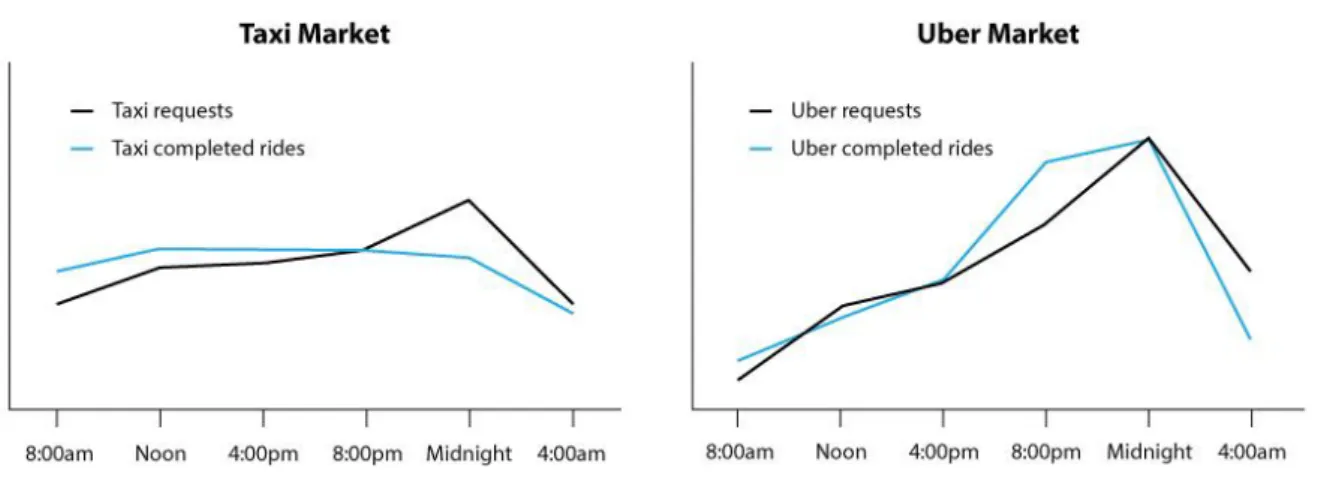
21 Figure 3 below contains two graphs extracted from the UberData blog. These show the impact of dynamic pricing on Uber rides (compared to traditional Taxicabs in Austin). The black curve on both graphs describes the taxi requests over a period of time, and the blue curve shows the completed rides. It is clear that in the Uber graph, as dynamic pricing is implemented, the number of completed rides increases at the time of highest demand.
Figure 3: Uber versus Taxi Supply and Demand in Austin
Source: Ryan, ‘Providing rides when they are most needed,’ Uber Blog, September 13 2014, http://blog.uber.com/atxsaferides
Dynamic pricing models are not limited to the type developed in Uber. Early in their development,
Airbnb discovered that listing a ‘space’ was a relatively easy process until the potential hosts had to
pick a price. Airbnb set out to fix this problem through a series of algorithms. Airbnb now provides price recommendations to hosts on a model based on Location, Likeness and what Airbnb describe
as ‘Recency’. These price recommendations also include temperature as a proxy for seasonal
patterns of booking behaviour.
22
How the sharing economy self-regulates
Much of the furore about the sharing economy revolves around safety concerns. This section focuses on the effectiveness of civil-society self-governance mechanisms in the sharing economy. It should be clear from Section 1 that all of the case studies covered (and this is not due to selection) have a number safety related governance mechanisms built in. This is a fundamental characteristic of the sharing economy.
Many media reports concerned about the safety of platforms have urged top-down government regulation, but government control is only one solution. It may be a sub-optimal way to regulate the behaviour of individuals.
Over hundreds and thousands of years we have come to rely on a system of institutions such as policing, laws and courts. These institutions provide a level of assurance that market transactions are safe. That is, institutions have evolved to reduce transaction uncertainty. These are government solutions to the safety concerns.
It is not controversial to suggest that government solutions are often a slow, expensive, and inflexible alternative.
The second alternative is governance. Compared to top-down government control, self-regulation presents a cheap and flexible alternative. This is not to suggest that self-self-regulation through reputation is a universal panacea; it is not. Yet, it is reasonable to suggest that these bottom-up institutions become more efficient as the ability to coordinate knowledge becomes cheaper and quicker.
This section has three parts. First, a discussion of reputational rating mechanisms aligning incentives on both sides of the transaction. A focus is placed on why the increasing reach of social networks leverages social capital to produce desirable outcomes. It is important to remember that reputation affects not only individuals, but also businesses. It is in the best interest of a business to provide a safe and reliable platform; each individual platform benefits from a cooperative transaction.
Second, a discussion of how the sharing economy presents more flexible platforms for each of the parties to the exchange to tailor the conditions of the trade to best meet their safety concerns. These measures focus on the adoption of bonds and guarantees that have been incorporated into sharing economy platforms.
23
Reputational Rating Mechanisms
There is one particular mechanism that the ‘sharing economy’ has almost universally incorporated:
reputational mechanisms.
While knowledge relating to ‘search and discovery’ has been crucial to the emergence of the sharing
economy, it is the decrease in costs of ‘social reputation knowledge’ that has acted as a self
-governance enforcement mechanism. Decreasing transaction costs of knowledge foster reputational networks as a method of civil-society governance.
The decrease in transaction costs of ‘social reputation knowledge’ has occurred in a particularly
interesting way. There has been a parallel increase in reach and depth of social networks. The networking of social capital has created a set of incentives much more conducive to cooperative behaviour. The links to various social networks leverage on the already existing, networked social capital. By leveraging this social networked capital, it is more expensive for individuals to undertake undesirable activity in an economic exchange. This is because the cheaters in the system have never been more visible, and can be ostracised from other potential exchanges.
What is important for cooperative behaviour is not necessarily raising or lowering the stakes, but the relative cost of cooperation. That is, the relationship between the costs and the benefits of cheating or cooperating on a trade. In the context of social networks and leveraging social capital, sharing economy platforms are fast altering the relative cost of cooperation; an important self-regulation mechanism.
While in recent years we have come to value online business reputation (reflected in review-heavy services like Urbanspoon and eBay), we are quickly moving towards valuing individual reputation as well as business or organizational reputation.
Guarantees, Bonds and Insurance
On many of the sharing economy platforms, bonds and damage guarantees may be automatically handled by the application. These are often messy processes to undertake in a regular transaction. Sharing economy platforms reduce this burdensome process of managing bonds and guarantees.
On Open Shed, owners must take out an Item Damage Guarantee for additional security (at 0.5% per day or 1.6% per week of the coverage amount). Further, Zopa has a Safeguard fund with
approximately £1,160,936.74 buffer. Each uberX trip is covered by $5m US contingent liability cover,
in addition to each partner driver’s own full insurance policies. Airbnb has Host Guarantee protection
for up to $900,000 AUD in damages, and the option for hosts to request a Security Deposit through the system.
24
Personalised Transactions and Zopa Default Rates
Laboratory experiments in economic game theory have come across an interesting phenomenon: people tend to cooperate and trust others more when the exchange becomes more personalized. This could be through a photograph, a name, face-to-face communication or through knowing certain demographic cues.72
The individual, peer-to-peer nature of the transaction has an important impact on the way we
‘frame’ a particular exchange. It is not surprising that humans act differently when trading with a
large, relatively anonymous corporation, compared to with an individual person. Successful cooperative systems are based on the fundamental pillars of empathy, social norms, fairness, and trust –all of which are closer to the forefront of an individual’s mind when interacting with another individual.
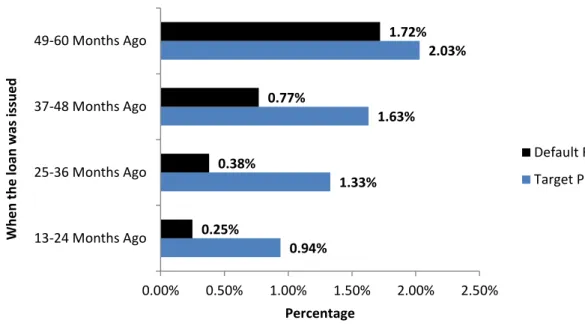
This could be an explanation for the often unexpectedly low default rates on Zopa. Appendix B contains Zopa arrears and default rates, while Figure 4below describes the ‘default rates’ against the
‘target performance’ for Zopa. Each of the categories on the Y-axis show when the loan was issued.
The data for the Figure were extracted from the Zopa website.
Figure 4: Zopa Default Rates and Targets
Source: Zopa, ‘Solid Lending Performance,’ accessed November 17 2014, www.zopa.com/lending/peer -to-peer-experts
72
Axelrod, Robert. M. The evolution of cooperation, (Basic Books, 2013). 0.94%
1.33% 1.63%
2.03%
0.25% 0.38%
0.77%
1.72%
0.00% 0.50% 1.00% 1.50% 2.00% 2.50%
13-24 Months Ago 25-36 Months Ago 37-48 Months Ago 49-60 Months Ago
Percentage
Whe
n
t
h
e
l
o
an
w
as i
ssue
d
Default Rate
25
What type of revolution may the sharing economy bring?
The above analysis suggests some potentially revolutionary consequences from the development of the sharing economy. The modern economy is full of vast excess capacity. There is a large amount of idle resources in the modern world – goods which are not being used, and labour which is not being purchased. In large part this excess capacity is due to the substantial transaction costs involved in utilising those resources.
Services like uberX take advantage of two underutilised resources – idle cars and people in need of work – in order to match them to the demand of people who need a ride. It reduces matching costs to near zero and removes the overhead involved on both sides of the exchange, creating a full car sharing service. Likewise, Open Shed employs idle resources around the home to where they are most economically valuable. Airbnb utilises idle living space for people looking for room to stay.
The sharing economy has been enabled by technological change including constantly accessible internet access, consumer satellite technology, and computing power. But it uses relatively traditional technologies – cars, houses, tools. The possibilities of combining sharing economy principles with other disruptive new technologies are very significant. For instance, how would a sharing economy business model utilise nascent technologies such as consumer-level drones and 3D
printers? We don’t propose to have the answers here, of course, but we expect there will be
entrepreneurs who face those questions in the near future.
The sharing economy has similar significance for industrial organisation. Ronald Coase’s theory of the
firm posits that firms are built in order to reduce transactions costs. The twentieth century was in many ways the century of the firm – where large corporate entities were able to harness economies of scale to push down less efficient service provision outside the firm. If the sharing economy pushes transactions costs down, how will efficient firms restructure?
The sharing economy is it is likely to become more efficient the larger it gets. There are economies of scale in other industries, but these traditional economies of scale continually increase the excess capacity by increasing the resource set of an economy. More goods are produced, at a lower cost, but the excess capacity continues to rise. The economies of scale within the sharing economy, in contrast, decrease the excess capacity in the economy.
26
4. Excessive regulation holds back the sharing economy
This report has explored the emergence of the sharing economy as a market, and the widespread benefits these platforms potentially yield over traditional markets. Unfortunately, the sharing economy faces numerous regulatory burdens, particularly in the areas of consumer protection, taxation, safety, employment practices, contracting legitimacy, liability, insurance, not to mention the already existing industry specific law and regulation.
The Australian economy is heavily burdened by regulatory controls. Regulation places constraints on what exchanges can occur and the circumstances under which they can occur. The Australian government has a long and poor history of stifling innovation through regulation. For instance, while FM radio was developed throughout the 1930s in the US, the technology remained effectively banned in Australia until 1974. Further, the introduction of pay television took over a decade from the recommendation of its introduction by the Australian Broadcasting Tribunal in 1982.73
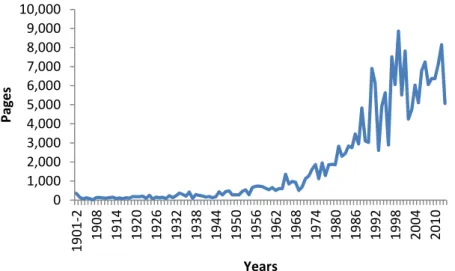
Adding to a large variety of documented case studies, another indicator of regulatory burden is the number of pages of legislation passed every year by Australian legislatures. While not a perfect reflection of the growing regulatory burden – some bills amend other bills, others do not impose regulatory requirements on the economy, and the count is highly sensitive to changes in drafting and formatting – the pages of legislation measure provides an indicative measure of growing regulatory burden.74 Figure 5 depicts the growth in new pages of legislation introduced to federal parliament since federation.
Figure 5: Pages of Commonwealth Acts of Parliament passed per year
Source: Chris Berg, IPA
73Allsop, Richard, ‘How Government Holds Back Technological Change,’
IPA Review, Vol. 66 No. 2 (2014), 14. 74
For further discussion on this measure see Berg, Chris. The Growth of Australia’s Regulatory State: Ideology, accountability and the mega-regulators. (Melbourne: Institute of Public Affairs, 2008).
27 The argument for regulation is well known. Using regulatory tools, governments seek to impose regulations to maximise social welfare where it is assumed that leaving transactions up to the market would fail to do so. This is the idea that the market left to its own devices would produce some sort of suboptimal outcome.
However, regulation does not always act to maximise social welfare. The public choice school of economics has taught us that regulation is highly susceptible to being introduced and implemented in a manner that furthers the private interest rather than the public interest. The economist George
Stigler has described regulation as being ‘acquired’ by firms for their own benefit.75 For instance,
incumbent firms in a market often welcome new regulations – even costly new regulations – because they present barriers to entry for new competitors.
Another common regulation, price controls, are often presented to voters as if the controls are designed to help consumers but instead tend to protect inefficient business models. Private firms leverage their political power to lobby and influence regulations for their own private interest. It has been suggested that the influence of these private actors is directly related to the size and scope of government.76
The expansion of the ‘regulatory state’ has great impact on the sharing economy. By definition,
sharing economy models are disruptive – emerging, innovative industries and platforms. By
disruptive, it is meant that they are likely to force some more inefficient, incumbent industries out of
business. This is Joseph Schumpeter’s gale of creative destruction – the economy is under a continual
‘process of industrial mutation that incessantly revolutionizes the economic structure from within,
incessantly destroying the old one, incessantly creating a new one.’77 Creative destruction is the basis of a capitalist, free market economy, yet it presents some regulatory challenges.
With this continual disruption of existing powerful industries, there is a significant threat that regulations will be used to protect private, rather than the public, interest. On one hand, there may be calls for some light level of regulation in the genuine public interest. On the other, there are calls for government entry barriers from incumbent industries. The following section provides a series of recommendations that focus direct our regulations towards the public, rather than the private, interest.
75 Stigler, George J. ‘The theory of economic regulation,’
The Bell Journal of Economics and Management Science, (1971): 3-21.
76Buchanan, James M. ‘Rent Seeking and Profit Seeking’,
The Logical Foundations of Constitutional Democracy (Liberty Fund, Indianapolis, 1999).
77
28
5. Recommendations
When facing these regulatory battles it must be remembered that top-down, government-imposed regulations are only one choice in a suite of alternatives. By approaching the problems that are often cited (namely safety and privacy) in the same way we approach many of our other problems (top-down government direction), we will destroy a huge number of potentially mutually beneficial exchanges.
New technologies and software platforms have made previously unrealisable exchange possible. The main threat to the further emergence of these new technologies is crowding out of beneficial exchanges with costly government regulation. Every government regulation placed onto these new technologies and platforms threatens a backwards step – directly reducing the gains we have made.
This section provides several recommendations:
Encourage bottom up self-regulation rather than top-down government control;
Reduce occupational licensing;
Reduce industry specific controls that entrench business structure;
Provide an environment for platforms to develop private solutions; and
Reduce regulations to encourage entrepreneurship and flexible work practices.
Bottom up self-regulation rather than top-down government control
The default position for regulators should be to enable bottom-up, organic, self-regulating institutions before top-down, rigid, government control.
Having a general framework for the future of regulating disruptive technologies is important. The current worldwide battles over disruptive technologies are not a single wave of passing concerns. The relationship between innovation and regulation is an expensive and continuing one. If Australia once again approaches these issues without their context, the regulatory process will be more painful than needed.
In his book Permissionless Innovation, Adam Thiererfocuses on the continuing battles of emerging technologies and industries with governments and incumbents. This idea of permissionless
innovation is important – not only for the sharing economy, but for the future challenges we face through the gale of creative destruction.
Permissionless innovation is the notion that ‘experimentation with new technologies and business models should generally be permitted by default’. Societies tend to follow a precautionary principle
when regulating new technology ‘because a new idea or technology could pose some theoretical
danger or risk in the future’. The reaction is then to control or limit the innovations to protect from
some hypothetical harm. Thierer argues that the position of public policy should be to permit technologies by default, rather than to constrain, regulate and control by default.