ORIGIN
AL RESEAR
CH
Study carried out in the Faculty of Physical Education of the University of Brasília (UnB) – Brasília (DF), Brazil.
1Master of Physical Education from the University of Brasília (UnB) – Brasília (DF), Brazil. 2PhD of Physical Education from the University of Brasília (UnB) – Brasília (DF), Brazil. 303
Corresponding address: Guilherme Henrique Ramos Lopes – University of Brasília (UnB), Faculty of Physical Education – UnB Área 1, Asa Norte, QMSW 06 G, ap. 267 – Brasília (DF), Brazil – Zip Code: 70606-680 – Phone: (61) 98169-1335 – E-mail: [email protected] – Financing source:Nothing to declare – Conflict of interests: Nothing to declare – Presentation: Mar. 7th, 2017 – Accepted for publication: Apr. 20th, 2018 – Assessment methods and intervention protocol approved by the Ethics Committee of the
School of Health Sciences, Universidade de Brasilia, under opinion number 109/12.
ABSTRACT | To compare postural control between Football 7-a-side players with cerebral palsy (CP) and active non-athletes without neurologic impairments, 28 individuals (15 to 35 years old) were selected and divided into the Non-Athletes Group (NAG), consisting of 14 individuals without neurologic or musculoskeletal injury; and the CP Group (CPG), composed of 14 athletes from the regional football team. A force platform was used to measure anteroposterior displacement of center of pressure (COPap), velocity (COPvel), mediolateral displacement (COPml), and 95% confidence ellipse area (AREA95) on bipedal and unipedal stance. On bipedal stance, there was no difference between groups in anteroposterior displacement of center of pressure (COPap) and velocity (COPvel). On unipedal stance with the dominant leg, the NAG presented better postural control, statistically significant in mediolateral displacement (COPml), 95% confidence ellipse area (AREA95) and COPap (p = 0.003; p = 0.001; p = 0.018, respectively). Our results showed that both groups have similar postural control on bipedal stance, but NAG demonstrated better postural control with unipedal stance than Football 7-a-side players with CP.
Keywords | Cerebral Palsy; Postural Balance; Soccer.
RESUMO | Para comparar o controle postural entre jogadores de futebol de sete com paralisia cerebral (PC) e não-atletas ativos sem deficiências neurológicas, 28 indivíduos (15 a 35 anos de idade) foram selecionados e divididos entre o grupo de Não atletas (GNA), constituído por 14 indivíduos sem lesão neurológica ou músculo-esquelética; e o grupo com PC (GPC), composto por 14 atletas da equipe de futebol regional. Uma plataforma de força foi usada para
medir o deslocamento ântero-posterior do centro de pressão (COPap), velocidade (COPvel), o deslocamento médio-lateral (COPml) e a área de elipse com 95% de confiança (ÁREA95) em posição bipodal e unipodal. Na postura bipodal, não houve diferença entre grupos em relação ao deslocamento ântero-posterior do centro de pressão (Ta455843) e à velocidade (COPvel). Na posição unipodal com a perna dominante, o GNA apresentou melhor controle postural, estatisticamente significativo em relação ao deslocamento médio-lateral (COPml), à área de elipse com 95% de confiança (ÁREA95) e ao COPap (p = 0,003; p = 0,001; p = 0,018, respectivamente). Nossos resultados mostraram que ambos os grupos têm controle postural semelhante na postura bipodal, mas o GNA demonstrou melhor controle postural na posição unipodal do que jogadores de futebol de sete com PC.
Descritores | Paralisia Cerebral; Equilíbrio Postural; Futebol.
RESUMEN | Para comparar el control postural entre jugadores de fútbol 7 con parálisis cerebral (PC) y atletas activos y no activos sin deterioro neurológico se seleccionaron 28 individuos (de 15 a 35 años), divididos en Grupo de No Atletas (NAG), que consta de 14 personas sin lesiones neurológicas o musculoesqueléticas; y el Grupo PC (CPG), compuesto por 14 atletas del equipo regional de fútbol. Se utilizó una plataforma de fuerza para medir el desplazamiento anteroposterior del centro de presión (COPap), la velocidad (COPvel), el desplazamiento medial-lateral (COPml) y el área de elipse de confianza del 95% (AREA95) en la postura bípeda y unipodal. En la postura bípeda, no hubo diferencias entre los grupos en el desplazamiento anteroposterior del
Bipedal and unipedal stance in Brazilian football
7-a-side athletes with cerebral palsy
Posição bipodal e unipodal em atletas do futebol de sete brasileiro com paralisia cerebral
Postura bípeda y unipodal en atletas brasileños de fútbol 7 con parálisis cerebral
INTRODUCTION
Football 7-a-side is one of the most widely played sports among participants with cerebral palsy (CP). It has some rules that differ from soccer, such as the smaller amount of athletes on the playing field, reduced field size and the possibility of throw-ins being executed with only one hand. These adjustments are necessary because of the neurological conditions and motor limitations of its participants1,2.
CP refers to a posture and movement disorder, resulting from a non-progressive, permanent brain injury that occurs during the development of the immature brain3-5. Such changes cause individuals with CP to have
impaired motor and postural control, which interferes with the ability to perform daily living activities, physical activities, and sports. Children, young people, and adults with CP have worse postural control than those without CP, and these differences can be related to structural and mechanical body alignment issues or neurologic deficits, such as muscle control deficit in the lower limbs, especially in the ankles and legs6-11.
Despite the difficulties related to postural control that arise from CP-related neuromotor effects, some research has shown that therapy and varied motor experiences improve postural control in these individuals5,9,11-15. In
addition to speed, agility, and strength, soccer requires coordinative skills with a high demand for postural control. Postural control during unipedal stance is especially important because athletes drive and handle the ball with their feet by consistently using a single leg stance. Such skill has been described as one of the reasons that soccer players, in general, have better postural control compared to non-athletes and also compared to athletes who play other sports16-19.
CP soccer players are faced with the challenge of a high-performance requirement in this sport, given their motor impairment possibly hindering their movement control. Maintenance of postural control in such cases is more complex, as soccer movements are typically performed
in unpredictable conditions with precision and high speed16,20. Even though there are studies that have focused
on soccer players’ muscle strength and cardiorespiratory fitness, no studies have been performed that focus on postural control in soccer players with CP. Some studies have shown differences in strength and muscle activation between the two legs of soccer players21,22. However,
the postural control difference between dominant and non-dominant legs in these athletes does not seem to be fully understood.
Owing to the importance of postural control in 7-a-side football players, this study analyzes postural control in CP football athletes, compared to young adults without neurological impairments, to increase practical aspects of physical therapy intervention and sports training. Thus, the aim of the study was to evaluate and compare postural control in bipedal and unipedal stance between soccer players with CP and active, non-athletes without neurologic impairments. Our hypothesis is based on the assumption that soccer skills and training would improve postural control in athletes with CP, leading to similar postural control of non-athletes without neurological impairments.
METHODOLOGY
Participant recruitment
Twenty-eight adolescents and adults, ages between 15 to 35 years, were selected and divided into two groups: the Non-Athletes Group (NAG), consisting of 14 individuals (mean age 23.4 ± 5.1 years; mean weight 82.6 ± 11.4 kg; mean height 176.0 ± 5.0 cm) without neurologic or musculoskeletal injury; and the CP Group (CPG), composed of 14 athletes (mean age 21.6 ± 5.5 years; mean weight 64.9 ± 6.6 kg; mean height 175.0 ± 5.0 cm) from the regional football 7-a-side team of Brasília – Training Center of Special Physical Education (CETEFE). All CPG participants were independently ambulating without centro de presión (COPap) y en la velocidad (COPvel). En la postura
unipodal con la pierna dominante, el NAG presentó un mejor control postural, estadísticamente significativo en desplazamiento medial-lateral (COPml), área de elipse de confianza 95% (AREA95) y COPap (p = 0,003, p = 0,001; p = 0,018, respectivamente).
Nuestros resultados mostraron que ambos grupos tienen un control postural similar en la postura bípeda, pero NAG demostró un mejor control postural con postura unipodal que los jugadores de fútbol 7 con PC.
use of aid-locomotion, ranked according to the GMFCS Scale23 (Gross Motor Function Classification System
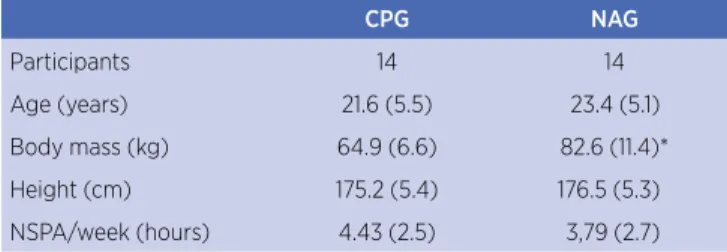
for Cerebral Palsy) at level I by an experienced physical therapist. It should be noted that all CPG participants maintained a minimum routine of especially designed soccer training of two hours per day, three times a week, complementing it with other exercises such as running, swimming, and strength training. Characteristics of the participants are presented in Table 1.
Table 1. Participant descriptive characteristics. All variables are shown as Mean (standard deviation).
CPG NAG
Participants 14 14
Age (years) 21.6 (5.5) 23.4 (5.1) Body mass (kg) 64.9 (6.6) 82.6 (11.4)* Height (cm) 175.2 (5.4) 176.5 (5.3) NSPA/week (hours) 4.43 (2.5) 3,79 (2.7)
NAG: non-athletes group; CPG: cerebral palsy group; NSPA: non-soccer physical activity; * p < 0.001
Subjects with CP were selected based on the following inclusion criteria: (A) diagnosis of CP, as evident through the medical record provided by the athletes and requested as official document by the team and 7-a-side federation for participating in the sport; (B) soccer athlete for at least one year; (2) ability to remain for a minimum of ten seconds in a standing position with one-leg support (in at least one of the lower limbs) without the aid of external support and without wearing shoes or orthotics.
Participants in the NAG could not be diagnosed with neurologic diseases or injuries and could not participate in sports training programs. The exclusion criteria for both groups were: having previous injuries in lower limbs (knees and ankles) over the past 6 months, undergone orthopedic surgery of the lower limbs or trunk within the previous 12 months, suffered from neuromuscular blockade within the last 6 months, or uncorrected visual deficits.
The Ethics Committee of the School of Health Sciences, University of Brasilia, approved the assessment methods and intervention protocol under opinion number 109/12. Participation in this study was voluntary, and legal guardians signed a consent form.
Measurement instrument
Data acquisition of postural control was conducted in the Human Movement Analysis Laboratory and Training Center of Special Physical Education, Brasilia, Brazil, using an AMTI AccuSway Plus force platform
(Advanced Mechanical Technologies, Inc.). The center of pressure (COP) variables that were analyzed included anteroposterior displacement (COPap), mediolateral displacement (COPml), velocity of displacement (COPvel), and 95% confidence ellipse area (AREA95). The platform was positioned on the ground at a distance of 2 meters from a wall.
Postural control measurement was performed individually, barefoot, in a quiet standing position and arms alongside the body. Three attempts were made in two positions, bipedal and unipedal stance with the dominant leg, defined as the preferred leg to kick a ball. For bipedal stance assessment, participants were required to self-select feet positions no more than the width of the shoulders. Markers on the platform were done to guarantee the same position for the three attempts. For the evaluation of unipedal stance, each participant positioned the dominant foot in the center of the force platform with the knee extended and the contralateral leg positioned with a knee flexion of 90º, according to the condition of each participant.
The time of acquisition for each trial was of 10 seconds at a sampling frequency of 100 Hz, with 1-minute seated rest intervals between trials. An average of three attempts was used in the analysis for each participant.
Statistical methods
Data distribution was evaluated by the Shapiro-Wilk test and for homogeneity of variance by the Levene test. After verifying the normality of the groups, the Multivariate Analysis of Variance (MANOVA) was selected to verify the presence of significant intergroup differences in postural control variables (COPml, COPap, COPvel and AREA95) in bipedal and unipedal stance. The paired t-test was performed to verify the differences between the evaluated positions (bipedal x dominant single leg) intragroup. An alpha level of 5% was considered for significant statistical difference. Effect size (ES) for all dependent variables were calculated between groups. Statistical analysis was performed using SPSS (Statistical Package for Social Science, version 20.0 for Macintosh).
RESULTS
and NAG (82.6 ± 11.4 kg). Regarding CP classification based on topography, the group consisted of monoplegia (n = 1), diplegia (n = 2) and hemiplegia (n = 11). Hemiplegic athletes had a dominant leg that was contralateral to that which was impaired. The leg with motor involvement was preferably used for support during execution of soccer abilities. The dominance ratio (right: left) for the dominant leg in the groups was 8:6 in the CPG and 11:3 in the NAG.
There was non-significant difference between the groups at bipedal position, regarding the variable COPvel {F (1, 26) = 0.042; p > 0.05}, and at the unipedal position NAG had a tendency towards better performance, despite its non-significant difference (Table 2). The effect size was 0.56 {F (1, 26) = 3.756; p = 0.064}.
Table 2. Comparison of center of pressure variables between groups with regard to dominant bipedal and single-leg stance. All variables are shown as Mean (standard deviation).
CPG NAG Effect Size p-value
COPml (cm)
Bipedal 1.1 (0.4) 0.8 (0.2) 0.84 0.012 Single-leg 3.4 (0.4) 2.7 (0.6) 1.57 0.003 COPap (cm)
Bipedal 1.7 (0.4) 1.5 (0.4) 0.47 0.219 Single-leg 4.1 (1.1) 3.2 (0.7) 0.81 0.018 COPvel (cm/s)
Bipedal 1.1 (0.2) 1.1 (0.3) 0.09 0.839 Single-leg 5.5 (2.0) 4.4 (0.8) 0.56 0.064 AREA95 (cm2)
Bipedal 1.8 (1.1) 1.0 (0.5) 0.71 0.022 Single-leg 13.1 (4.6) 7.6 (2.7) 1.19 0.001
AREA95: 95% confidence elipse area; NAG: control group; COP: center of pressure; COPap: anteroposterior displacement; COPml: mediolateral displacement; COPvel: velocity of displacement; CPG: cerebral palsy group. Significant statistical difference p < 0.05
For the variable COPap, no significant difference was observed at bipedal stance {F (1, 26) = 1,597; p = 0.218}, while lower anteroposterior displacement of COP for NAG participants at unipedal position was observed {F (1, 26) = 6.411; p ≤ 0.05}.
When comparing the variable COPml between groups, a significant difference was observed in the bipedal stance {F (1, 26) = 7.294; p ≤ 0.05} and unipedal stance (F (1, 26) = 10.975; p ≤ 0.05}, with significantly lower values of mediolateral displacement of COP in the NAG, in both positions (Table 2).
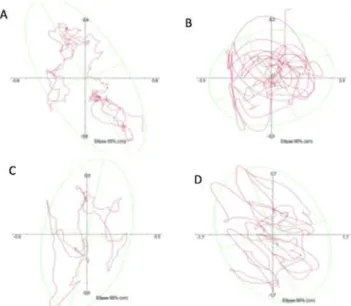
Significant difference was observed for the variable AREA95 between groups in the bipedal position {F (1, 26) = 5.958; p < 0.05} and unipedal {F (1, 26) = 14.758;
p ≤ 0.05}, with significantly higher values in the CPG compared to NAG, in both positions.
Figure 1. Posturography results image. A) AREA95 bipedal GPC; B) AREA95 single-leg GPC; C) AREA95 bipedal GC; and D) AREA95 single-leg GC.
DISCUSSION
better postural control in soccer practitioners compared to non-athletes17,18.
Nevertheless, in bipedal stance, the COPml showed significant difference, which can be explained by asymmetric lower limb impairment in the CPG. This may be due to the fact that control of COPml occurs based on a load-unloading system (hip strategy), in which the maintenance of postural control in the lateral axis is regulated by a mechanism of weight transfer from one foot to the other24. Although an evaluation of strength
imbalance between legs in CPG was not conducted, it has already been demonstrated a difference in muscle strength of lower limbs between affected and non-affected legs of young CP soccer athletes22.
In unipedal stance, differences were found in all COP variables. Regarding the differences between groups in unipedal stance in the dominant leg, the CPG presented higher values of COPml, COPap, and COPvel. These results reveal a better postural control of NAG in a smaller and unstable base. Although it is known that differences in postural control exist in individuals with CP when compared with their peers without neurologic lesions10,
there are no comparative studies focused on postural control in unipedal stance8.
Although studies with soccer athletes indicate that there is no dominant support-leg when considering postural control18,21, Barone et al.17 stated that the constant
use of the leg that creates the support (non-dominant leg) throughout the performance of soccer skills promotes postural control improvement in this leg. In this way, better postural control of the non-dominant lower limb could have been observed in the CPG. However, it was verified that athletes with CP prefer to support the involved leg during soccer tasks (kick and pass, for example), but were not able to keep postural control with unipedal support in this limb.
Study limitations
Limitations of this study include small sample size due to the difficulty of recruiting a large number of CP athletes and the fact that CP athletes were playing at the regional level and probably had less motor skill and postural control than international level athletes. However, this work presents the results of postural control in athletes with cerebral palsy in a sport with high postural control requirement and, therefore, allows for the better understanding, training, and practice of soccer in this population.
CONCLUSIONS
The CPG was concluded to have similar postural control in bipedal stance when compared to a NAG without CP. Despite regular soccer training, with high demand for one-foot support, a similar postural control in this support comparing CPG with NAG was not found. However, the main difference between groups was found in the single leg position. Further studies are warranted in this area, such as an intervention in soccer athletes with CP aiming to evaluate the possibility of an increase in single-leg balance in both legs. Likewise, actions among teachers of this modality should be encouraged to consider the results obtained in the planning of introductory and training programs, insofar as improvement of postural control can bring positive results to participants’ athletic performance.
CONFLICT OF INTEREST
The authors declare no conflicts of interest.
ACKNOWLEDGMENTS
The authors thank the research group of the Human Movement Analysis Laboratory, School of Physical Education, University of Brasília and the Training Center of Special Physical Education (CETEFE-DF, Brazil). And, especially, we strongly appreciate the support of the Brazilian Paralympic Academy.
REFERENCES
1. Reina R. Evidence-based classification in paralympic sport application to football-7-a-side. Eur J Hum Mov. 2014;32:161-85. 2. Yanci J, Castagna C, Los Arcos A, Santalla A, Grande I, Figueroa
J, et al. Muscle strength and anaerobic performance in football players with cerebral palsy. Disabil Health J. 2016;9(2):313-9. 3. Bax M, Goldstein M, Rosenbaum P, Leviton A, Paneth N, Dan B,
et al. Proposed definition and classification of cerebral palsy. Dev Med Child Neurol. 2005;47(8):571-6.
4. Bleck EE. Locomotor prognosis in cerebral palsy. Dev Med Child Neurol. 1975;17(1):18-25.
6. Burtner PA, Woollacott MH, Craft GL, Roncesvalles MN. The capacity to adapt to changing balance threats: a comparison of children with cerebral palsy and typically developing children. Dev Neurorehabil. 2007;10(3):249-60.
7. Rha DW, Kim DJ, Park ES. Effect of hinged ankle-foot orthoses on standing balance control in children with bilateral spastic cerebral palsy. Yonsei Med J. 2010;51(5):746-52.
8. Lopes GHR, David AC. Posturography in the analysis of postural control in children with cerebral palsy: a literature review. Fisioter Pesqui. 2013;20(1):97-102.
9. Lemos LFC, Oliveira RS, Pranke GI, Teixeira CS, Mota CB, Zenkner JEA. Sistema estomatognático, postura e equilíbrio corporal. Salusvita. 2010;29(2):57-67.
10. Tomita H, Fukaya Y, Ueda T, Honma S, Yamashita E, Yamamoto Y, et al. Deficits in task-specific modulation of anticipatory postural adjustments in individuals with spastic diplegic cerebral palsy. J Neurophysiol. 2011;105(5):2157-68.
11. Verschuren O, Ketelaar M, Gorter JW, Helders PJ, Uiterwaal CS, Takken T. Exercise training program in children and adolescents with cerebral palsy: a randomized controlled trial. Arch Pediatr Adolesc Med. 2007;161(11):1075-81.
12. Drużbicki M, Rusek W, Szczepanik M, Dudek J, Snela S. Assessment of the impact of orthotic gait training on balance in children with cerebral palsy. Acta Bioeng Biomech. 2010;12(3):53-8.
13. Harbourne RT, Willett S, Kyvelidou A, Deffeyes J, Stergiou N. A comparison of interventions for children with cerebral palsy to improve sitting postural control: a clinical trial. Phys Ther. 2010;90(12):1881-98.
14. Shumway-Cook A, Hutchinson S, Kartin D, Price R, Woollacott M. Effect of balance training on recovery of stability in children with cerebral palsy. Dev Med Child Neurol. 2003;45(9):591-602.
15. Kuczyński M, Słonka K. Influence of artificial saddle riding on postural stability in children with cerebral palsy. Gait Posture. 1999;10(2):154-60.
16. Davlin CD. Dynamic balance in high level athletes. Percept Mot Skills. 2004;98(3 Pt 2):1171-6.
17. Barone R, Macaluso F, Traina M, Leonardi V, Farina F, di Felice V. Soccer players have a better standing balance in nondominant one-legged stance. Open Access J Sports Med. 2011;2:1-6. 18. Teixeira LA, Oliveira DL, Romano RG, Correa SC. Leg preference
and interlateral asymmetry of balance stability in soccer players. Res Q Exerc Sport. 2011;82(1):21-7.
19. Matsuda S, Demura S, Uchiyama M. Centre of pressure sway characteristics during static one-legged stance of athletes from different sports. J Sports Sci. 2008;26(7):775-9. 20. Hrysomallis C. Balance ability and athletic performance. Sports
Med. 2011;41(3):221-32.
21. Gstöttner M, Neher A, Scholtz A, Millonig M, Lembert S, Raschner C. Balance ability and muscle response of the preferred and nonpreferred leg in soccer players. Motor Control. 2009;13(2):218-31.
22. Andrade MS, Fleury AM, Silva AC. Força muscular isocinética de jogadores de futebol da seleção paraolímpica brasileira de portadores de paralisia cerebral. Rev Bras Med Esporte. 2005;11(5):281-5.
23. Palisano R, Rosenbaum P, Walter S, Russell D, Wood E, Galuppi B. Development and reliability of a system to classify gross motor function in children with cerebral palsy. Dev Med Child Neurol. 1997;39(4):214-23.