RESUMO.- [Caracterização do ciclo estral de Galea spixii
(Wagler, 1831).]Os Galea spixii habitam a vegetação semiá-rida da Caatinga, no Nordeste brasileiro. Eles são criados em cativeiro para realização de pesquisas relacionadas a
biolo-gia da reprodução. Sendo assim, o objetivo deste trabalho foi caracterizar o ciclo estral de G. spixii para obtenção de in-formações que melhorem o conhecimento do manejo repro-dutivo da espécie em cativeiro. O ciclo estral foi monitorado por citologia esfoliativa vaginal em doze fêmeas adultas. Após a detecção de dois ciclos completos em cada animal, os mesmos foram eutanasiados. Em seguida foi realizado estu-do histológico estu-do epitélio vaginal com três fêmeas em cada fase do ciclo estral; cinco foram pareadas com machos para realização do grupo controle e outras três fêmeas foram uti-lizadas para monitorar a formação e ruptura da membrana de oclusão vaginal. Através de citologia esfoliativa vaginal, constatou-se predomínio de células superficiais em estro, células intermediárias grandes em proestro, células inter-mediárias pequenas e células parabasais com presença de neutrófilos em diestro e metaestro, respectivamente. O es
-Characterization of the estrous cycle in
Galea spixii
(Wagler, 1831)
1Amilton C. Santos2, Diego C. Viana2, Bruno M. Bertassoli3, Gleidson B. Oliveira4,
Daniela M. Oliveira2, Ferdinando V.F. Bezerra4, Moacir F. Oliveira4
and Antônio C. Assis-Neto2*
ABSTRACT.- Santos A.C., Viana D.C., Bertassoli B.M., Oliveira G.B., Oliveira D.M., Bezerra F.V.F., Oliveira M.F. & Assis-Neto A.C. 2015. Characterization of the estrous cycle in Galea spixii (Wagler, 1831). Pesquisa Veterinária Brasileira 35(1):89-94. Setor de Anatomia dos Animais Domésticos e Silvestres, Faculdade de Medicina Veterinária e Zootecnia, Univer-sidade de São Paulo, Av. Prof. Dr. Orlando Marques de Paiva 87, São Paulo, SP 05508-030, Brazil. E-mail:[email protected]
The Galea spixii inhabits semiarid vegetation of Caatinga in the Brazilian Northeast. They are bred in captivity for the development of researches on the biology of reproduction. The-refore, the aim of this study is characterize the estrous cycle of G. spixii, in order to provide information to a better knowledge of captive breeding of the species. The estrous cycle was monitored by vaginal exfoliative cytology in 12 adult females. After the detection of two complete cycles in each animal, the same were euthanized. Then, histological study of the vaginal epithelium, with three females in each phase of the estrous cycle was performed; five were paired with males for performing the control group for estrous cycle phases, and three other were used to monitor the formation and rupture of vaginal closure membrane. By vaginal exfoliative cytology, predominance of superficial cells in estrus, large intermedia -te cells in proestrus, in-termedia-te and parabasal cells, with neutrophils, in diestrus and me-testrus respectively was found. Estrus was detected by the presence of spermatozoa in the control group. By histology, greater proliferation of the vaginal epithelium in proestrus was observed. We conclude that the estrous cycle of G. spixii lasts 15.8 ± 1.4 days and that the va-ginal closure membrane develops until complete occlusion of the vava-ginal ostium, breaking after few days. Future studies may reveal the importance of this fact for the reproductive success of this animal.
INDEX TERMS: Galea spixii, cavies, female, preservation, reproduction, rodents.
1 Received on April 1, 2014.
Accepted for publication on December 21, 2014.
2 Faculdade de Medicina Veterinária e Zootecnia, Universidade de São Paulo (USP), Av. Prof. Dr. Orlando Marques de Paiva 87, Cidade Univer-sitária, São Paulo, SP 05508-270, Brazil. E-mails: amiltonsantoss@bol. com.br, [email protected], [email protected]; *Corresponding author: [email protected]
3 Universidade Federal de Minas Gerais (UFMG), Av. Presidente Antônio Carlos 6627, Belo Horizonte, MG 31270-901, Brasil. E-mail: brunobertassoli@ gmail.com
tro foi detectado pela presença de espermatozoides no gru-po controle. Através de histologia, observou-se uma maior proliferação no epitélio vaginal no proestro. Concluiu-se que o ciclo estral de G. spixii dura em média 15.8 ± 1.4 dias e a membrana de oclusão vaginal se desenvolve até completa oclusão do óstio vaginal externo, rompendo-se em poucos dias. Futuros estudos podem revelar a importância deste úl-timo fato para o sucesso reprodutivo deste animal.
TERMOS DE INDEXAÇÃO: Galea spixii, fêmeas, preás,preservação, reprodução, roedores.
INTRODUCTION
The Spix’ yellow-toothed cavies (Galea spixii) are rodents that belong to the Caviinae subfamily and Caviidae family. They live in semiarid vegetation of Caatinga at Brazilian Northeast (Oliveira et al. 2008), where they are constantly used as alternative source of protein for inhabitants of this region (Santos et al. 2014a).
In Brazil, they are bred in captivity for conservation of the species, which is found as vulnerable in the “red list of threate-ned species” (IUCN 2014). Moreover, they are used for develo-pment of a new experimental model for research about repro-ductive biology (Rodrigues et al. 2013, Santos et al. 2014b).
Researches related with reproductive biology have sho-wn that G. spixii has continuous poliestral cycle, developing a type of inverted choriovitellinic placenta during pregnancy (Oliveira et al. 2008, 2012); gestation period lasts about 48 days (Oliveira et al. 2008); the onset of puberty in males oc-curs after 45th postnatal day (Santos et al. 2012); and females have masculinized external genitalia (Santos et al. 2014b).
It is known that the majority of female rodents can breed throughout the year and the reproductive cycle is systematically repeated, alternating periods of sexual acti-vity and preparation of the reproductive tract for possible pregnancy (Selle 1922, Lilley et al. 1997, Touma et al. 2001, Mahoney et al. 2011). In this sense, tools to detect features related to receptivity of the female for copulation in order to assist captive breeding of threatened species is very im-portant (Binelli et al. 2014).
Regarding Caviidae as Cavia porcellus (Stockard & Papa-nicolaou 1917; Kelly & PapaPapa-nicolaou 1927), C. aperea and G. musteloides (Touma et al. 2001), the authors report that females show development of a vaginal closure membrane during the estrous cycle. This fact may be related to intras-pecific sexual selection and formation of various mating systems among Caviidae (Adrian & Sachser 2011).
Due to the lack of studies on the reproductive cycle of G. spixii females, characterize the estrous cycle by vaginal exfoliative cytology and corresponding vaginal epithelium variations and check the presence of vaginal closure mem-brane, providing more data for captive breeding of this spe-cies were the aim of this study.
MATERIALS AND METHODS
Animals. Twenty adults, non-pregnant, primiparous females and two adult males, prevenient of the Center for Wild Animals Multiplication of Federal Rural University of the Semi-Arid, Mos-soró, RN, Brazil were used. This research was approved by Brazi-lian Institute of Environment and Renewable Resources (IBAMA,
2028236/2008) and Bioethics Committee of the School of Veteri-nary Medicine and Animal Science of the University of São Paulo, Brazil (protocol 2400/2011).
Detection of estrous cycle phases by vaginal cytology. Twelve adults, non-pregnant females in three separate boxes,
each of which contained four properly identified females were
used. During the experiment the females were fed with fruits, grasses, corn, rabbit feed and water.
In another box, five females were paired with adult males for
comparison of cell types along the estrous cycle, especially in the estrous phase, with possible detection of spermatozoa in vaginal exfoliative cytology.
The vaginal exfoliative cytology was performed daily by the same collector. The collection of vaginal smears was performed using swabs of sterile cotton and subsequent deposit of biological material in histological slides, which were stained with fast Pa-noptic, according to the manufacturer (Laborclin®, Vargem
Gran-de/Pinhais, PR, Brazil). The females were independently monito-red and there was no synchronization.
Subsequently, the samples were analyzed and photo
docu-mented by light microscopy. Different cell types: superficial cells;
large and small intermediate cells; parabasal cells and
neutro-phils were identified (Stockard & Papanicolaou 1917, Selle 1922,
Lilley et al. 1997, Touma et al. 2001, Allison et al. 2008).
For a better monitoring of the estrous cycle phases, cells were
counted in each sample of vaginal exfoliative cytology into fields
containing from 0 to 100 cells in the cytological slides (Guimarães et al. 1997). During the counting, cell types were grouped accor-ding to the criteria of morphology of each cell as above described. After counting of two complete estrous cycles, average of the estrous cycle length of each female; of the females that showed
es-trous cycle of the same duration; and, finally, the average of all fema -les were established. Statistical analysis was applied to the
Student--t test for paired and unpaired values, with p < 0.05 of significance.
Day 1 was established by absence of neutrophils and
predo-minance of superficial cells (Allison et al., 2008); and by observa -tion of copula-tion in the control group.
Monitoring of the development and rupture of the vagi-nal closure membrane. In this phase of the experiment, another box containing three females, isolated from males were used. We started the analysis after observation of rupture of vaginal closu-re membrane. Development of vaginal closuclosu-re membrane in all females was monitored until complete occlusion of the external vaginal ostium, ending at the moment of rupture. In this group, vaginal cytology was not used to avoid mechanical rupture of the vaginal closure membrane. Photo documentation was performed by camera Olympus SP 810UZ 14 mp.
Histological analysis of the vaginal epithelium during the estrous cycle phases. After analysis of the estrous cycle by vagi-nal cytology, the 12 females separated from males were anesthe-tized with xylazine (4mg/kg/IM) and ketamine (60mg/kg/IM), and then euthanized with sodium thiopental (2.5% 60mg/kg) by intracardiac cannulation. Three females were in estrus; three in proestrus; three in diestrus; and three in metestrus.
Vaginal tissue samples from all females were fixed in 10% for -malin solution, processed for light microscopy and stained with H/E (hematoxylin/eosin). Microscopic photodocumentation was performed using BX61VS Olympus photomicroscope.
RESULTS
Detection of the phases of the estrous cycle by vaginal exfoliative cytology
with a central nucleus occupying an area greater than the cytoplasm; (2) small intermediate cells, which were ovoid, with a central nucleus smaller than the cytoplasm; (3) large intermediate cells, which were polygonal cells, with a nucleus smaller than the cytoplasm, when compared to small intermediate cell; and (4) superficial cells with three different morphologies: nucleated, enucleated, and with picnotic nucleus (Fig.1). In addition, polymorphonuclear neutrophils were also found.
copulation, females followed pregnancy. The vaginal exfo-liative cytology in this group showed that, in estrus phase, enucleated superficial cells and superficial cell with pic -notic nuclei were predominant, and neutrophils were not found. Prior estrus, we observed predominance of large intermediate cells, which gradually were replaced by su-perficial cells (Fig.1).
Fig.1. Cell types by vaginal exfoliative cytology in Galea spixii. (A)
Superficial nucleated cells (arrows), proestrus; (B)
enuclea-ted superficial cell (arrow), estrus; (C) superficial cells with picnotic nuclei (arrow) and spermatozoa (arrowhead), estrus; (D) parabasal cell (arrow) and neutrophils (arrowhead), me-testrus; (E) large intermediate cells (filled arrow), small in -termediate cells (white arrowhead), parabasal cells (empty arrow), and neutrophils (black arrowhead), diestrus. Bars = 100µm.
Fig.2. (A) Percentage of parabasal cells, (B) small intermediate cells (C) large intermediate cells, and (D) superficial cells by vaginal exfoliative cytology, reflecting different estrous cycle
durations in Galea spixii. Day 1 includes the onset of estrus, while days 14, 15, 16, 17, 18 and 19 indicate the last day of proestrus.
We observed that the amount of these different cell types varied in each phase of the estrous cycle. During es-trus, there was a predominance of superficial cells, which went from nucleated to enucleated. In metestrus, there was predominance of parabasal cells with presence of lar-ge numbers of neutrophils. Superficial and intermediate cells were also present in this phase. In diestrus there was predominance of small and large intermediate cells, with presence of neutrophils and parabasal cells. In proestrus, there was predominance of large intermediate cells and su-perficial cells, with little or no presence of neutrophils. We found six different estrous cycle lengths (Fig.1 and 2).
Fig.3. Modifications in vulva and clitoris of Galea spixii. (A) Vulva (black arrow) with broken vaginal closure membrane (arrow) and clitoris (empty arrow); (B) vulva (black arrow) with partially developed vaginal closure membrane (arrow) and clitoris (empty arrow); (C) vulva (black arrow) with fully developed vaginal closure membrane (arrow) and clitoris (empty arrow). Bars = 1cm.
Development and rupture of the vaginal closure mem-brane
The development of vaginal closure membrane was observed in those three females separated from males. In these females, the membrane developed gradually, blocking the external vaginal ostium, and then, naturally, this mem-brane ruptured within a few days. During a first moment, vaginal closure was broken. In few days, this membrane be-gins to grow and occlude the external vaginal ostium. Then, this membrane completely occludes the external vaginal os-tium, giving an aspect of absent external vaginal ostium dur-ing this period. Then in few days, vaginal closure membrane breaks again. These events occurred cyclically (Fig. 3).
Histological analysis of the vaginal epithelium through-out the estrous cycle
By histological studies, data performed by vaginal exfo-liative cytology were confirmed. We found that the vaginal
epithelium underwent proliferation, cornification and cell desquamation along the estrous cycle. In estrus phase, va-ginal epithelium contained one or a few layer of cornified superficial cells. After the estrus phase (metestrus), the epithelium lost the superficial cells. Then, the epithelium presented one or a few parabasal layers. In diestrus, the epithelium initiated the cell proliferation, consisting on evident stratified epithelium. In proestrus, epithelium un -derwent massive proliferation. Then, the outer cells began the cornification process, with the approximation of next estrus (Fig. 4).
Estrous cycle length by vaginal exfoliative cytology We found females with estrous cycle ranging between 14 and 18 days with a mean of 15.6 ± 1.3 days in the first estrous cycle. In the second estrous cycle, we found females with cycles ranging between 14 and 19 days, with mean of 16.1 ± 1.5 days. The average of two complete cycles was 15.8 ± 1.4 days. The Student-t test for paired samples sho-wed no difference between cycles (p<0.05).
DISCUSSION
Understanding the reproductive behavior of animals can contribute to the development of techniques and tools for the biotechnology of reproduction, including artificial inse -mination, in vitro fertilization, embryo transfer and cryo-preservation in several species bred in captivity, in order to ensure better reproductive performance and preservation of genetic variability (Domingues & Caldas-Bussiere 2007, Guimarães et al. 2011, Binelli et al. 2014).
Thus, in the present study, we found satisfactory results for detection of estrous cycles by vaginal exfoliative cytolo-gy, and there was no statistical difference (p<0.05) betwe-en the duration of the first and second estrous cycles. In addition, histological tests confirmed the results found in vaginal exfoliative cytology. The histological analysis sho-wed cell proliferation and cornification more pronounced in proestrus and estrus, as found in Cavia porcellus (Sto-ckard & Papanicolaou 1917) and Lagostomus maximus (Weir 1971). In this sense Deanesly (1966) showed that Fig.4. Vaginal epithelium of Galea spixii. (A) Stratified epithelium
in diestrus (arrow); (B) stratified epithelium with cornifica -tion in proestrus (arrow); (C) superficial epithelial cells (cor
-nified) in estrus (arrow); (D) epithelium with less stratified
estradiol and sometimes small amount of androstenedio-ne combiandrostenedio-ned with estradiol stimulated cell proliferation. In other hand, progesterone combined with estradiol showed negative results for epithelial proliferation in vagina of Ca-via porcellus.
In G. spixii, the predominant cell types in the different phases of the estrous cycle were easier to detect during the proestrus and estrus by vaginal exfoliative cytology, similar to that found in other rodents such as Cavia porcellus (Sel-le 1922, Lil(Sel-ley et al. 1997) Dasyprocta prymnolopha (Gui-marães et al. 1997), Agouti paca (Gui(Gui-marães et al. 2008) and Myocastor coypus (Felipe et al. 2001). Our results also agree with those described in domestic mammals (Allison et al. 2008). Lilley et al. (1997) showed positive correlation between vaginal impedance measurements and vaginal exfoliative cytology used for monitoring of estrous cycle in Cavia porcellus.
We believe that the satisfactory detection of estrous cycle phases was possible due to the fact of G. spixii presents continuous poliestral cycle (Oliveira et al. 2008) similar that found in other rodents, as Myocastor coypus (Felipe et al. 2001), Dasyprocta prymnolopha (Guimarães et al. 2011), Agouti paca (Guimarães et al. 2008), Paca cuniculus (Reis et al. 2011) and Rattus norvegicus (Marcondes et al. 2002).
Galea spixii showed formation of the vaginal closure membrane, which can also be found in other rodents, as Thryonomys swinderianus (Addo et al. 2007), Lagostomus maximus (Weir 1971), Galea musteloides and Cavia aperea (Touma et al. 2001), Octodon degus (Mahoney et al. 2011), Cavia porcellus (Selle 1922, Lilley et al. 1997) and Rattus norvegicus (Lephart et al. 1989).
Lephart et al. (1987), Addo et al. (2007) and Mahoney et al. (2011) described that the first rupture of the vaginal closure membrane is positively correlated with the onset of puberty in the studied species. Subsequently, the vagi-nal closure membrane breaks and develops at each estrous cycle as found in G. spixii, although the corresponding es-trous phase is not showed in present study. The hormone responsible to rupture of vaginal closure membrane is es-tradiol as demonstrated by Deanesly (1966) in ovariecto-mized Cavia porcellus.
We believe that future studies could demonstrate the importance of this phenomenon, which was described in detail in early twentieth century by Stockard & Papanico-laou (1917) and Kelly & PapanicoPapanico-laou (1927) in Cavia por-cellus, but has been little detailed in other rodent species. To date, we believe that the development of the vaginal closure membrane in G. spixii is possible due to the presen-ce of the external urethral ostium at the top of the clitoris (Santos et al. 2014b) instead vaginal vestibule, which is ab-sent in this species (Santos et al. 2014a).
Other modifications influenced by hormones produced during ovarian follicular development during the estrous cycle are endometrial and glandular changes demonstra-ted in rodents as Cavia porcellus (Stockard & Papanicolaou 1917) and bovines (Binelli et al. 2014). Therefore, we be-lieve that future studies could correlate follicular develop-ment with hormonal production and its influence on endo -metrium in G. spixii.
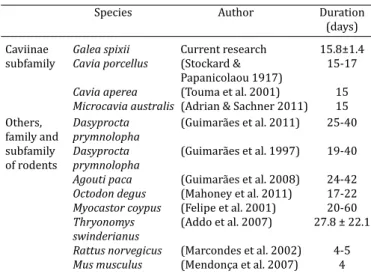
Females of G. spixii have short and regular estrous cycle with duration close to that found in other rodents belon-ging to the Caviinae subfamily, as Microcavia australis (Adrian & Sachser 2011), Cavia aperea (Touma et al. 2001) and Cavia porcellus (Selle 1922, Lilley et al. 1997). To sim-plify comparison, in Table 1 we highlighted the duration of the estrous cycle in different rodents.
The continuous poliestral cycle and short gestational period (Oliveira et al. 2008), associated with short estrous cycles found in G. spixii females in this present study may be related to the reproductive success of this species (Pur-ves et al. 2005) as found in others rodents which belong to the Caviidae family, even though they are the main source of food for many predators in South America, and develo-ping for this reason important ecological function (Zogno et al. 2004).
CONCLUSIONS
By methodology applied in our study, we conclude that the estrous cycle of Galea spixii lasts an average of 15.8±1.4 days. These results may be helpful for breeding in captivity and conservation of the species.
We also noted the formation and rupture of the vaginal closure membrane, and further studies may reveal the im-portance of this fact for the reproductive success of these rodents.
Acknowledgements.- To Federal Rural University of Semi-Arid for su-pplying the animals used in this study; to IBAMA (Brazilian Institute of Environment and Renewable Resources) for license for captive breeding of the same; and to FAPESP (Fundação de Amparo a Pesquisa do Estado de
São Paulo) for financial support.
REFERENCES
Addo P.G., Awumbila B., Awotwi E. & Ankrah N.-A. 2007. Reproductive cha-racteristics of the female grasscutter (Thryonomys swinderianus) and formulation of colony breeding strategies. Livest. Res. Rural Develop. 19(1):28-37.
Adrian O. & Sachser N. 2011. Diversity of social and mating systems in cavies: a review. J. Mammal. 92(1):39-53.
Allison R.W., Thrall M.A. & Olson P.N. 2008. Vaginal cytology, p.378-389. In: Conwelle R.L., Tyler R.D., Meincoth J.H. & Denicola D.B (Eds), Diagnostic Cytology and Hematology of the Dog and Cat. 3rd ed. Elsevier, Toronto.
Table 1. Estrous cycle duration in different rodent species
Species Author Duration
(days)
Caviinae Galea spixii Current research 15.8±1.4 subfamily Cavia porcellus (Stockard & 15-17
Papanicolaou 1917)
Cavia aperea (Touma et al. 2001) 15
Microcavia australis (Adrian & Sachner 2011) 15
Others, Dasyprocta (Guimarães et al. 2011) 25-40 family and prymnolopha
subfamily Dasyprocta (Guimarães et al. 1997) 19-40 of rodents prymnolopha
Agouti paca (Guimarães et al. 2008) 24-42
Octodon degus (Mahoney et al. 2011) 17-22
Myocastor coypus (Felipe et al. 2001) 20-60
Thryonomys (Addo et al. 2007) 27.8 ± 22.1
swinderianus
Rattus norvegicus (Marcondes et al. 2002) 4-5
Binelli M., Pugliesi G., Hoeck V.V., Sponchiado M., Ramos R.S., Oliveira M.L., França M.R., D’Alexandri F.L., Mesquita F.S. & Membrive C.M.B. 2014. The role of proestrus on fertility and postovulatory uterine function in the cow. Anim. Reprod. 11(3):246-253.
Deanesly R. 1966. Pro-oestrus in the guinea-pig: hormonal stimulation of the vaginal epithelium. Reproduction 12(1):205-212.
Domingues S.F.S. & Caldas-Bussiere M.C. 2007. Fisiologia e biotécnicas da reprodução desenvolvidas em fêmeas de primatas neotropicais impor-tantes para a pesquisa biomédica. Revta Bras. Reprod. Anim. 30(1):57-71.
Felipe A.E., Cabodevila J. & Callejas S. 2001. Characterization of the estrous cycle of the Myocastor coypus (coypu) by means of exfoliative colpocy-tology. Mastozool. J. Neotrop. Mammal. 8(2):129-137.
Guimarães D.A., Moreira D. & Vale W.G. 1997. Determinação do ciclo re-produtivo da cutia (Dasyprocta prymnolopha) através do diagnóstico calpocitológico. Acta Amazonica 27(1):55-64.
Guimarães D.A., Bastos L.V., Ferreira A.C.S., Luz-Ramos R.S., Ohashi O.M. & Ribeiro H.L. 2008. Características reprodutivas da paca fêmea (Agouti paca) criada em cativeiro. Acta Amazonica 38(3):531-538.
Guimarães D.A., Ramos L.R., Ohashi O.M., Garcia G.W. & Vale W.G. 2011. Plasma concentration of progesterone and 17-beta-estradiol of black-rumped agouti (Dasyprocta prymnolopha) during the estrous cycle. Revta Biol. Trop. 59(1):29-35.
IUCN 2014. Red List of Threatened Species, version 2013.1. International Union of Conservation of Nature. Available at <www.iucnredlist.org> Access on February 2014.
Kelly G.L. & Papanicolaou G.N. 1927. The mechanism of the periodical
opening and closing of the vaginal orifice in the Guinea-pig. Am. J. Anat.
40(2):387–411.
Lephart E.D., Mathews D., Noble J.L. & Ojeda S.R. 1989. The vaginal epithe-lium of immature rats metabolizes androgens trough an aromatase-like reaction: changes during the time of puberty. Biol. Reprod. 40(2):259-267.
Lilley K.G., Epping R.J. & Hafner L.M. 1997. The guinea pig estrous cycle: correlation of vaginal impedance measurements with vaginal cytologic
findings. Lab. Anim. Sci. 47(6):632-637.
Mahoney M.M., Brooke V., Rossi B.V., Megan H., Hagenauer M.H. & Lee T.M. 2011. Characterization of the estrous cycle in Octodon degus. Biol. Re-prod. 84(4):664-671.
Marcondes F.K., Bianchi F.J. & Tanno A.P. 2002. Determination of the es-trous cycle phases of rats: some helpful considerations. Braz. J. Biol. 62(4A):609-614.
Mendonça F.S., Evêncio-Neto J., Simões M.J., Camargo L.M. & Baratella--Evêncio L. 2007. Aspectos citopatológicos da mucosa vaginal de camun-dongas tratadas com progesterona. Ciênc. Anim. Bras. 8(2):313-318. Oliveira M.F., Mess A., Ambrósio C.E., Dantas C.A.G., Favaron P.O. & Miglino
M.A. 2008. Chorioallantoic placentation in Galea Spixii (Rodentia, Cavio-morpha, Caviidae). Reprod. Biol. Endocrinol. 6(39):1-8.
Oliveira M.F., Vale A.M., Favaron P.O., Vasconcelos B.G., Oliveira G.B., Miglino M.A. & Mess A. 2012. Development of yolk sac inversion in Galea spixii
and Cavia porcellus (Rodentia, Caviidae). Placenta 33(10):878-881. Purves W.K., Sadava D., Orians G.H. & Heller H.C. 2005. Vida: a ciência da
biologia. Vol.2. 6ª ed. Artmed, São Paulo. 1044p.
Reis A.C.G., Gerbasi S.H.B., Martins C., Machado M.R.F. & Oliveira C.A. 2011. Morfologia do sistema genital feminino da paca (Cuniculus paca Lin-naeus, 1766). Braz. J. Vet. Res. Anim. Sci. 48(3):183-191.
Rodrigues M.N., Oliveira G.B., Albuquerque J.F.B., Menezes D.J.A., Assis--Neto A.C., Miglino M.A. & Oliveira M.F. 2013. Aspectos anatômicos do aparelho genital masculino de preás adultos (Galea spixii Wagler, 1831). Revta Biotemas26(1):181-188.
Santos P.R., Oliveira M.F., Silva A.R. & Assis-Neto A.C. 2012. Development of spermatogenesis in captive-bred Spix’s yellow-toothed cavy (Galea spixii). Reprod. Fertil. Develop. 24(6):877-885.
Santos A.C., Bertassoli B.M., Viana D.C., Vasconcelos B.G., Oliveira M.F., Mi-glino M.A. & Assis-Neto A.C. 2014a. The morphology of female genitalia in Galea spixii (Caviidae, Caviinae). Biosc. J. 30(6):1793-1802.
Santos A.C., Olio R.L., Viana D.C., Oliveira M.F., Miglino M.A. & Assis--Neto A.C. 2014b. Morphological description of unusual urinary tract in the female of a rodent, Galea spixii (Wagler, 1831). Pakistan J. Zool. 46(6):1617-1623.
Selle R.M. 1922. Changes in the vaginal epithelium of the Guinea-pig dur-ing the oestrous cycle. Am. J. Anat. 30(4):429-449.
Stockard C.R. & Papanicolaou G.N. 1917. The existence of a typical oes-trous cycle in the guinea-pig with a study of its histological and physio-logical changes. Am. J. Anat. 22(2):225-283.
Touma C., Palme R. & Sachser N. 2001. Different types of oestrous cycle in two closely related South American rodents (Cavia aperea and Galea musteloides) with different social and mating systems. Reproduction 121(5):791-801.
Weir B.J. 1971. The reproductive organs of the female plains viscacha, La-gostomus maximus. J. Reprod. Fertil.25(3):365-373.
Zogno M.A., Miglino M.A. & Oliveira M.F. 2004. Análise bioquímica dos