Internship Report
Master in International Business
THE TURKISH MARKET: CREATING A CUSTOMER
DATABASE FOR POTENTIAL MARKET DEVELOPMENT;
A NEED FOR THE SOCEM MOLDING GROUP
Vahid Masimov
Internship Report
Master in International Business
THE TURKISH MARKET: CREATING A CUSTOMER
DATABASE FOR POTENTIAL MARKET DEVELOPMENT;
A NEED FOR THE SOCEM MOLDING GROUP
Vahid Masimov
Internship Report developed under the supervision of Phd Susana Rodrigues, professor at the School of Technology and Management of the Polytechnic Institute of Leiria and co-supervision of Guida Lourenço co-supervisor, commercial coordinator at the Socem Group.
ii
iii
Biography Note
Vahid Masimov has 26 years old and comes from Mingachevir, Azerbaijan. He graduated in Adjustment of Economics from Mingachevir State University in 2012. He did his military service in 2012 in a year. After military service he started his master degree in Public Administration from Qafqaz University in 2013 and graduated in 2015 with outstanding grades.
Vahid Masimov had experience as project leader and coordinator during 2010-2015 in many well-known NGOs, like UN local projects, USA Embassy’s projects, Peace Corps. He taught Azerbaijan language and Culture to USA citizens in Azerbaijan when he worked Peace Corps. He is a project coordinator one of social project which was “Summer Camp” trainings for teenagers on volunteerism, leadership, project planning, team work, flex and education. He also attended organization process of Peace Corps’s “Social Change through Photography” Project which co-facilitated a series of discussions, community interviews and photographic interpretations of social issues for students of Refugee school. He is author of some UN projects as “Let us know our rights and say STOP to Domestic Violence” in 2013, in his hometown Mingachevir. “How can we study abroad?”, “Peace over the World” which was so important for his society is also his projects which was implemented at the university in 2011 and 2013 years.
After social sector he moved to private finance institutions, and he had started to work as a sales and operations representative in international bank- Bank VTB Azerbaijan. He is a blogger since 2011 and he writes about personal development blogs, human rights, domestic violence, education system, election system, transport system of Europe in comparing with Azerbaijan, study abroad and among other topics. Then he started as a video-blogger on his youtube channel about study abroad. Currently, he is attending the International Business Master of the Management and Technology School of the Leiria Polytechnic Institute, Portugal and expecting to graduate in June 2017.
iv
v
vi
vii
Acknowledgements
I would like to express my deepest appreciation to Professor Susana Rodrigues, my supervisor at IPL, who has shown the attitude and the substance of a genius, she continually and persuasively conveyed a spirit of motivation in regard to research and, an excitement in regard to teaching. Without her insightful comments and corrections, I could not improve the quality of my research. I also would like to thank Mrs. Guida Lourenço, my supervisor at Socem Group, for her unconditionally support at Socem. Additionally thanks to the CEO of Socem Group Mr.Luis Febra, for his insightful comments, advices and suggestions.
Finally, I would thank my family, friends and everyone who helped and gave me motivation, and moral support to accomplish my research.
viii
ix
Resumo (in Portuguese)
A indústria portuguesa é uma das mais importantes para o desenvolvimento económico e social da região centro. O Grupo Socem contribui para o seu valor através da produção e exportação de moldes e serviços relacionados.
Este relatório é baseado num estágio realizado na Socem ED, uma das empresas do grupo Socem. Este relatório pretende dar resposta a um pedido específico da Socem; i.e. potenciar as suas vendas para o mercado Turco. O objetivo é:
a) Compreender o Mercado Turco: culturalmente, politicamente, socialmente e economicamente;
b) Investigar a indústria dos moldes na Turquia e compreender o impacto da indústria automóvel, de pequenos eletrodomésticos e da indústria de plásticos na economia Turca;
c) Segmentar o mercado para estas indústrias e criar uma base de dados de clientes; d) De acordo com a estratégia de marketing e segmentação de mercados, estabelecer
contactos com os potenciais clientes e tentar realizar negócios com a indústria de moldes, automóvel, de pequenos eletrodomésticos e de plásticos na Turquia.
É importante destacar que durante os últimos 10 anos, a indústria de moldes Turca cresceu e melhorou significativamente. O presente relatório criou uma base de dados de clientes que potencia as relações comerciais entre os dois países, i.e. Portugal e Turquia, especificamente para a indústria de moldes. Informação de natureza secundária foi utilizada na constituição da base de dados de clientes, entre 2010 e 2016.
Palavras-chave: Grupo Socem, Marketing esegmentação de mercado, Turquia, indústria de moldes, indústria automóvel, indústria de pequenos eletrodomésticos, indústria de plásticos.
x
xi
Abstract
The Portuguese mold industry is one of the most important industries for the economical and social development of the central region. The Socem Group contributes for its value through the production and exportation of molds and services related.
This report is based on an internship made at Socem ED, one of the firms of Socem Group. It attempts to fulfill a specific requirement of Socem; to potential their sales for the Turkish market. The aim is to:
a) Understand the Turkish market: culturally, politically, socially, and economically; b) Research mold industry in Turkey, and understand the impact of the automotive and
home appliances, and plastics industries in the Turkey economy; c) Make market segmentation and create a customer database;
d) According to marketing strategy and segmentation, contact with the potential customers and try to do business with the molding, the automotive, home appliances and plastics companies in Turkey.
It is worth to note that during the last 10 years Turkey’s mold industry has improving sharply. The current research provided a creation of a customer database that potential the commercial relationships between the two countries, i.e. Portugal e Turkey, specifically for the mold industry. Secondary data source from 2010 to 2016, to build up the database, was used.
Key-words: Socem Group, Market research, Market segmentation, Turkish market, Mold industry, Automotive industry, Home Appliances industry, Plastic industry.
xii
xiii
List of figures
Figure 1: The History of Socem Group………..6
Figure 2: Main bases of market segmentation……….…….15
Figure 3: Geographic Location of Turkey………....22
Figure 4: Growth of Turkey Population (million)...23
Figure 5: GDP of the Republic of Turkey (USD billion)………...28
Figure 6: Top 10 Import Partners of Turkey………..31
Figure 7: Top 10 Export Partners of Turkey………....31
Figure 8: The distribution of Automotive Industry companies in Turkey……...…………....35
Figure 9: Turkish Automotive Industry Production in 2015 by companies…………...…...37
Figure 10: Minimum wages in Turkey (TL)………..……..45
Figure 11: Portugal and Turkey, corruption rating (2012–2015)………..……..53
Figure 12: Illustration of the research process applied in the report……….……..60
xiv
xv
List of tables
Table 1: Group Socem Business Organization………...………8
Table 2: Fact and Figures of Socem Group………...……….9
Table 3: Understanding market segmentation bases and variables (B2C, B2B)…….……….19
Table 4: Exchange rates of Turkish Lira………...………25
Table 5: Foreign Trade Statistics of the Republic of Turkey (Thousand USD)……...………30
Table 6: Portuguese Exports to Turkey (million euros)….………...…………32
Table 7: Major Imported Products Originating in Turkey (million euros)………...…………32
Table 8: Main export products to Turkey (million euros)………33
Table 9: The Distribution of Companies in the Vehicle Production………....……...….37
Table 10: Income Tax Rates………...50
Table 11: The secondary data used in the current research study………64
Table 12: Sample of Database Creation ………...66
Table 13: Segmentation bases and variables used to segment market..……….…...70
xvi
xvii
List of
acronyms
AKP - Justice and Development Party (Turkish: Adalet ve Kalkınma Partisi) CESD - Centre for Economic and Social Development
CHC - Community Health Centers CJSC - Closed Joint Stock Company
EUROFORGE - The European Forging Association FMP - Family Medicine Program
GDP - Gross Domestic Price
GHIS - General Health Insurance Scheme IMD - In Mold Decoration
IMF - International Monetary Funds
ISPAT - Investment Support and Promotion Agency of Turkey JSCs - Joint Stock Companies
OEC - The Organization for Economic Co-operation and Development OEM - Original Equipment Manufacturer
OSD - The Automotive Manufacturers Association of Turkey PAGDER - Plastic Industrialists' Association
SCT - Special Consumption Tax
SGK - Social Security Institution (Turkish: Sosyal Güvenlik Kurumu) TURKBESD - White Goods Manufacturers’ Association of Turkey TL - Local Currency of the Republic of Turkey
USD - United States Dollar VAT - Value Added Tax
xviii TAYSAD - Association of Automotive Parts and Components Manufacturers
xix
xx
Table of Contents
BIOGRAPHY NOTE………..……….III DEDICATION………..V ACKNOWLEDGEMENTS…..………....VII RESUMO…………..……….IX ABSTRACT...……….….XI LIST OF FIGURES…..………..…...XIII LIST OF TABLES……….….………...XV LIST OF ACRONYMS………..……….……...XVII TABLE OF CONTENTS………..…………..………..….…..……..XX 1. INTRODUCTION ………..………..……….…..1 1.1. Introduction……….………..1 1.2. The motivation of the study………....……….………...2 1.3. The aim of the study………..……….2 1.4. The methodological basis of the study....………..…….………....3 1.5. The structure of the Internship Report………..…………...3xxi
2.0. Introduction……….………..……….…….………..5 2.1. The History of the Socem Group………..………..……….……….……5 2.2. Vision, Mission and Values of the Socem Group………..………..……….………10 2.3. The Strategy of the Socem Group………….………..………..11
3. MARKET SEGMENTATION- A LITERATURE REVIEW………12
3.0. Introduction……….……....12 3.1. The concept of market segmentation - market segmentation definitions..………..……..12 3.2. The key elements of market segmentation - main contributions……….14
4. FEATURING THE REPUBLIC OF TURKEY……….……..21
4.0. Introduction………..……….21 4.1. Geographic Location of Turkey……….…….…………..……….……….…….21 4.2. Population of Turkey……….…….…………..……….……….…………...22 4.3. The Currency of Turkey……….…….…………..……….……….…………..24 4.4. The Political System of Turkey……….…….…………..……….……….……..25 4.5. The Economical Review of Turkey……….…….…………..….……….……….……….…27 4.6. The Foreign Trade of Turkey……….…….…………..……….………...29 4.7. A Review of the Mold and Automotive Industry of Turkey………33 4.7.1.The SWOT analysis for Turkish Automotive Industry………...38 4.8. Social System of Turkey……….…….…………..……….………..40 4.8.1. The Social Security System of Turkey….………….…….…………..………....40 4.8.2. The Education System of Turkey……….…………...……….………..….41 4.8.3. The Health Care System of Turkey….……….…….…………..……….….……….…42 4.8.4. The National Minimum wage……….………….…….…………...………..…..44 4.9. History and Culture of the Republic of Turkey……….…….…………..……….………...45
xxii
4.10. Things That You Should Know Before Deal in Turkey……….…….…………..……….……49 4.10.1 Doing Business with Turks………...…….…………..………..………..…………52
5. RESEARCH METHODOLOGY………...59
5.0. Introduction……….58 5.1. Research Proposition ………59 5.2. Research Process……….……….59 5.3. Research methodology - Data Collection methods and techniques……….…61 5.3.1. Critical literature review……….….…..61 5.3.2. Secondary data collection………..61 The advantages and disadvantages of secondary data……….………..61 The Reliability and Validity of secondary data………….……….….63 5.3.3. Sample of Database Creation………..65 5.4. Research methodology strengths and weaknesses……….……….66
6. FINDINGS AND DATA ANALYSIS - CUSTOMER DATABASE CREATION….….68
6.0. Introduction………..…………68 6.1. Target Market…….……….68 6.2. The Customer Database Creation……….……….70 6.3. The Company Contacts with Potential Customers……….………71
7. THE INTERNSHIP ACTIVITIES……….74
7.1. The Internship activities………74
8. CONCLUSION………76
8.0. Introduction………..………..………76
8.1. The purpose of the study……….……….76 8.2. The uniqueness and originality of the research project – fulfilling the company requirement ……...76 8.3. The internship: importance and tasks performed……….…….78 8.3.1 The significance of the research results to Socem Group and the managers………...…………..79 Value to managers………....79 8.4. Future research……….……….80
xxiii
8.5. Limitation of the current study……….……….80
References……….81
Webliography……….……….85
APPENDICES………....………1
Appendix 1A: Literature summary of market segmentation definitions……….…………..1 Appendix 1B: Literature summary of market segmentation variables……….……..2 Appendix 2: Literature summary of the market segmentation studies………..4 Appendix 3: Provinces of the Republic of Turkey……….9 Appendix 4: Map of the 81 Provinces of the Republic of Turkey………..………11 Appendix 5: Map of the 7 regions of the Republic of Turkey………..………12
Appendix 6: Customer Database for the Turkish Mold, Automotive, Home Appliances and Plastics Industries………..13
1
1. Introduction
1.1. Introduction
This report is part of an internship of my master in International Business. The internship took place at the Socem Group’s Commercial Department, Portuguese mold manufacturer. The aim of intersnip was to gather and analyze information about the Turkish market, create a Turkish companies’ database, and to develop communication tools to be sent to those potential customers indentified in the database.
This report is divided in eight chapters. The first chapter reports introduction, the motivation, the aim of the study, the methodology followed and the structure of the study.
The second chapter introduces the Portuguese mold maker – Socem Group. It is shared its history, mission, vision, values, and strategy.
The concept and key elements of market segmentation, and main contributions were presented and discussed on chapter three.
Chapter four describes the Turkey. The Turkish market is characterized: politically, socially, economically and culturally. Additionally the automotive, plastic and home appliances industries are featured.
Turkey, as a nation in transition from an agricultural to an industrial economy, had to wait until the 1970’s, the decade when production numbers increased and mass production was growing steadily, to see advances in the mold industry. In the 70’s, with the help of increasing demand from the newly developing automotive and electronics sectors, the Turkish mold industry intensified its efforts to improve on the technological level for the domestic market and to compete at the international level. As production patterns evolved and quantities increased, the Turkish molding industry exerted solid efforts to catch up with the needs of the manufacturing industry –the automotive, home appliances, and plastic sectors in particular1.
2 Methodology and the data collection methods and techniques were discussed on the chapter five.
The findings and data analysis were illustrated in chapter six.
The activities developed during the internship were presented in chapter seven. Chapter eight presents the main conlusions.
1.2. The motivation of the study
I have been worked in sectors, like Non Government Organizations, finance, embassy, banks, blogger, and personal development trainer. Despite all of it, I have not worked in Europe and in the mold industry. To have the chance to get to know and learn about the mold industry and the Turkish market that allows me to acquire knowledge and competencies that can broad my market understanding and perspectives. Learning unfamiliar things, procedure, will be created additional incentive. It is very necessary that make connection between marketing research and mold industry and believe that this research will be a benefit to my future life, also will help to my peer colleagues who wants to research about Turkey and Turkish molding industry, and will be had comparative advantage in the labor market.
1.3. The aim of the study
The internship took place at Socem Group which is a molding company in Portugal. The main purpose of the study was to make market segmentation and to create customer database of a Turkish market. Another important issue which this research is taking into account is to understand the Turkish market: culturally, politically, socially, and economically; to do marketing research for the Turkish Molding Industry. Furthermore, the research focuses on to find potential customers and also trying to enter Turkish market, contact with the potential
3 customers and to do business with the molding, automotive, home appliances, plastics companies due to Socem Group’s goals.
1.4. The Methodological Basis of the Study
The secondary data was collected from covering 2010-2016 from Governmental Reports, officials and National Statistics Reports, Sectorial Associations Reports, the official websites of Automotive, plastic, home appliances companies of the Republic of Turkey.
1.5. The structure of the Internship Report
The internship report consists of eight chapters.
The first chapter presents the introduction, motivation for this topic, the methodological basisand the aim of the study.
Chapter two focuses on Socem Group’s history, mission, vision, strategy, value, and business strategy.
Chapter three covers market segmentation-litearutre review. The concept and key elements of market segmentation, and main contributions were presented and discussed.
Chapter four features Turkey, presenting figures and facts, history and culture of Turkey, tax legislation, government incentives, religion, and behavior on negotiation, greetings, card presentation, and protocol at table, gifts, and public holidays.
Chapter five describes the research process and methodology, research strategy and purpose, and data collection methods and techniques.
Chapter six illustrates the findings and data analysis. Regarding finding and data analysis customer database creation, market segment filters, fulfill of data base, company contacts with the potential customers were investigated.
4 Chapter seven illustrates the activities developed during the internship.
And finally, chapter eight presents the main conclusions, the purpose and the importance of the study, the implications for managers and future research.
5
2. The Socem Group
2.0. Introduction
As it is important to understand the company in which the internship took place, an historical, financial, hierarchical and strategical information about Socem Group will be presented on this chapter. The mission, vision and values, the specialization area for the company, the number of employees, business trade, turnover statistics, and business organization of Socem Group are also presented.
2.1. The History of the Socem Group
Socem Group’s history begins with the Socem Lda, which was established in 1986. With thirty years of experience Socem Group has managed to develop their own global network of enterprises. The Socem Group today is multicultural and diversified, with a unique and innovative mold manufacturing market approach. Socem Group is in Portugal, Brazil, Mexico, Germany and China, representing the value of a brand across the globe. Socem Group create strong connections with the world and develops their own working environment where words like innovation, design and creativity are part of the company's DNA. Today, Socem is leading the way in mold engineering solutions for several types of molds, such as multi-material In Mold Decoration (IMD), Gas Injection and over molding solutions2.
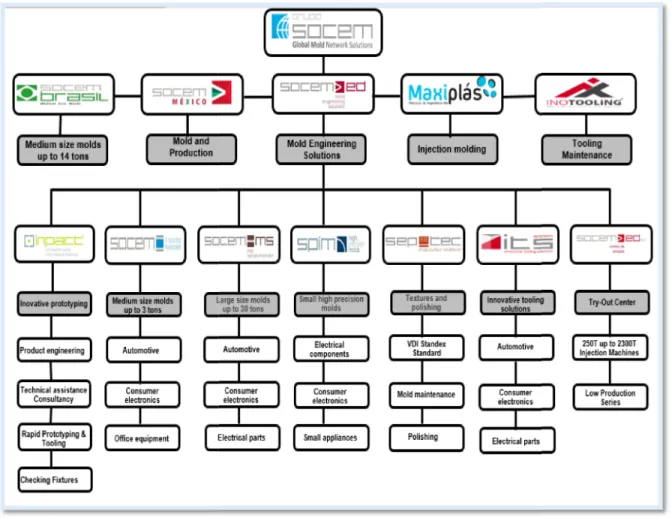
The companies which belong to Socem Group are Socem ED, Socem Inpact, Sep-Tec, Maxiplas, Socem MS, Socem Lda, Maxiplas, Socem ITS, SPIM, Socem Brasil and Socem Mexico (See Figure 1 and Table 1).
Socem ED. Socem ED was established in 1997 with the aim to step aside from an exclusively mold industry, which typifies most of the business units in the sector, aiming to create added
value to their products and offering an integrated range of solutions to its trading partners. In 2001, and to respond to custom barriers
Brazil because of entrance barriers branch abroad, thus was established
internationalization of the construction project of the first electronic ballot boxes used in the election of the President of the Republic of Brazil in 2002. In 2009 Socem Ed started a specific project for the Aerospace Industry
Figure 1: The History of Socem Group
Source: Commercial Department of Socem Group
Socem Inpact. With the high know
proves to be an excellent choice in collaboration with its cust
Inpact’s activity evolves towards to promote concepts and innovating processes, assuring that our products correspond to solutions that meet the demands of the market: Design, Engineering of molds and plastic parts, virtual prototyping, rapid prototyping, prototype molds and measuring jigs. Socem Inpact is responsible for the
simultaneously in training and knowledge to accomplish a support in challenging projects. With the growing technological development, it is unavoidable the search for products
3http://socem.pt/en/socem-ed.html, accessed on 10.10.2016
value to their products and offering an integrated range of solutions to its trading partners. In custom barriers the threats; to the difficulty of exporting molds to e barriers, and tax legislation differences, Socem ED set up its first was established Socem Brazil. This beginning was marked by the internationalization of the construction project of the first electronic ballot boxes used in the tion of the President of the Republic of Brazil in 2002. In 2009 Socem Ed started a specific project for the Aerospace Industry3.
istory of Socem Group
Source: Commercial Department of Socem Group, (2016)
With the high know-how, flexibility and technological skills, Socem Inpact proves to be an excellent choice in collaboration with its customers. It is since 1998 that activity evolves towards to promote concepts and innovating processes, assuring that correspond to solutions that meet the demands of the market: Design, Engineering of molds and plastic parts, virtual prototyping, rapid prototyping, prototype molds and measuring jigs. Socem Inpact is responsible for the multinational firms
ltaneously in training and knowledge to accomplish a support in challenging projects. With the growing technological development, it is unavoidable the search for products
accessed on 10.10.2016
6 value to their products and offering an integrated range of solutions to its trading partners. In ty of exporting molds to Socem ED set up its first Socem Brazil. This beginning was marked by the internationalization of the construction project of the first electronic ballot boxes used in the tion of the President of the Republic of Brazil in 2002. In 2009 Socem Ed started a
how, flexibility and technological skills, Socem Inpact omers. It is since 1998 that activity evolves towards to promote concepts and innovating processes, assuring that correspond to solutions that meet the demands of the market: Design, Engineering of molds and plastic parts, virtual prototyping, rapid prototyping, prototype multinational firms, investing ltaneously in training and knowledge to accomplish a support in challenging projects. With the growing technological development, it is unavoidable the search for products
7 increasingly personalized and with different applications. Having the spirit of innovation and competitive edge, Socem Inpact combines the high know-how with technology, keeping the quality that has always accustomed in sectors such as: Automotive, electronics, home appliances, composites, health care, and medical eco-design4.
Sep-Tec. Founded in 1998, Sep-Tec is a member of Socem Group whose main function is to put finishing touches in the mold manufacturing process:
- Polishing (Finishing touches through technical or optical polish, high-gloss and Nano-finish. Sandpaper and abrasive stones are instruments used by our professionals. Here we handle molds up to 16 tons);
- Engraving;
- Texture (A qualified team supports our customers with final adjustments on surfaces. Sep-Tec is capable to provide chemical and abrasive textures);
- Mold maintenance (This section of service is held in a facility outside this campus). A qualified team ensures any correction and repair that a mold might need. Additionally, as a worldwide service provider, Sep-Tec is able to allocate a team at the customer to support on sight directly. They handle molds up to 10 tons5.
Socem MS (Large injection moldmaker). Socem MS using the best technologies, has in-house capacity to produce molds weighing up to 30 tons; the company is not only equipped with the best possible machinery to ensure product excellence but also boasts specialized workforce. They created a new production control system, enabling the customers to monitor the progress of their projects in real time6.
Socem 3 tons moldmaker (Socem Lda). Socem Lda is oriented for special projects, such as 2 components molds, in mold labeling and overmolding techniques. Equipped with high speed milling machines and robotics. Socem Lda is one of the fastest mold maker in Europe7. SPIM (High precision molds). SPIM is charged with production of sophisticated small- sized molds. Discipline and rigor are the two cornerstones of our company. Modern equipment at SPIM is custom-designed to welcome the challenges that times like these bring, but it is
4http://www.inpact.pt/ing/design, accessed on 10.10.2016 5http://socem.pt/en/sep-tec.html , accessed on 10.10.2016 6http://socem.pt/en/ms.html, accessed on 10.10.2016 7http://socem.pt/en/lda.html, accessed on 10.10.2016
SPIM's highly-qualified staff who answe always having our mission in mind
Table 1: Group Socem Business Organization
Source: Commercial Department of Socem Group, (2016)
Socem ITS. Socem ITS aim is to expand capabilities consistently, provid
Innovation Tooling Solutions, on areas as IMD, low pressure injection and 3K molds, through the mature expertise of their team
trust, with each costumer, which leads to a superior fl Maxiplas founded in 1989, and
components for the automotive and electronic industries. Maxiplas offers a unique capability to support customer needs from concept through
8http://socem.pt/en/spim.html, accessed on 10.10.2016 9http://socem.pt/en/socem-its.html, accessed on 10.10.2016
qualified staff who answers this call daily, with commitment and precision, always having our mission in mind8.
Table 1: Group Socem Business Organization
Source: Commercial Department of Socem Group, (2016)
Socem ITS aim is to expand capabilities consistently, providing outstanding Innovation Tooling Solutions, on areas as IMD, low pressure injection and 3K molds, through f their team. Socem ITS is proud to enhance close proximity and mutual trust, with each costumer, which leads to a superior flexibility and higher performance
founded in 1989, and dedicated to the design, engineering and production components for the automotive and electronic industries. Maxiplas offers a unique capability to support customer needs from concept through production. Maxiplas’s core product lines
, accessed on 10.10.2016 , accessed on 10.10.2016
8 rs this call daily, with commitment and precision,
ing outstanding Innovation Tooling Solutions, on areas as IMD, low pressure injection and 3K molds, through proud to enhance close proximity and mutual
exibility and higher performance9. dedicated to the design, engineering and production components for the automotive and electronic industries. Maxiplas offers a unique capability production. Maxiplas’s core product lines
9 include precision automotive components, mechatronic and decorative solutions based on advanced plastic manufacturing technology. Since its foundation, Maxiplas, innovating and introducing differentiated technologies and skills, has been playing an important role on developing and producing high added value components10.
Socem Brasil. Focused on the manufacturing of technical industrial molds for electronics, household equipment and automobile production. Socem Brasil possesses advanced technology for project management where time and high performance standards are key factors for its success. We are proud to work for companies such as VW, General Motors, Fiat and Whirlpool11.
Socem Mexico and Inotooling works in the big worldwide industry of metallic molds for plastic injection, well known among automotive business. Both are specialized in production of complex metallic molds for plastic injection, engineering services and production of plastic pieces. Inotooling also works in maintenance and repair of metallic molds and in engineering changes. Socem Group expect that after 3 working years, sales of Socem Mexico will be more than 5 million of euros, and 2 millions of euros for Inotooling. Expectation of the 3 years that Mexico will has almost 60 employees and INO will have more than 20.
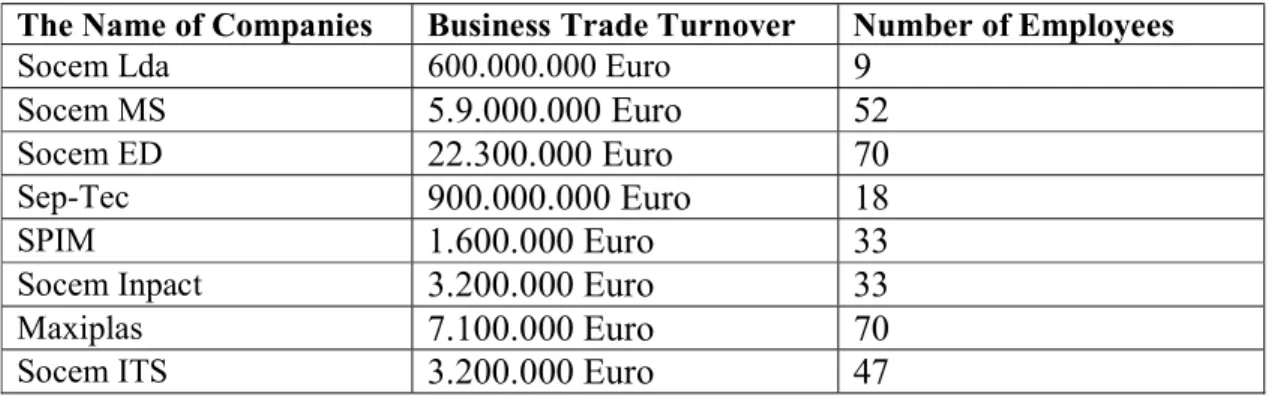
In order to perceive the size and dimension of Socem Group, turnover and the number of employees are illustrated. The following table illustrates business turnover and the number of employees. The total business turnover of the companies of Socem Group in 2015 was 47.900.00 Euro and the number of employees was 365 (Table 2).
Table 2: Fact and Figures of Socem Group (2015)
The Name of Companies Business Trade Turnover Number of Employees
Socem Lda 600.000.000 Euro
9
Socem MS
5.9.000.000 Euro
52
Socem ED
22.300.000 Euro
70
Sep-Tec
900.000.000 Euro
18
SPIM
1.600.000 Euro
33
Socem Inpact
3.200.000 Euro
33
Maxiplas
7.100.000 Euro
70
Socem ITS
3.200.000 Euro
47
10http://maxiplas.pt/maxiplas.html#injecao, accessed on 10.10.2016 11http://socem.pt/en/socem-brasil.html, accessed on 10.10.2016
10
Socem Brasil
3.100.000 Euro
33
Total
47.900.000 Euro
365
Source: Commercial Department of Socem Group, (2016).
2.2. Vision, Mission and Values of the Socem Group
Vision. The vision of the Socem Group is to have a positive attitude for innovation, based on people and on their skills that develop and contribute actively to the dynamic management of change in defining more appropriate strategies. The continuing modernization of the technological means and their integration into the company will create different factors that will make Socem the best in its category. Research and development will increasingly be an active part of Socem’s business model that will enable company's expertise in services where price is not the most critical decision.
Mission. Its mission is to studying, developing and materializing engineering solutions that create high added value. To customers and a lasting relationship, which is able to with stand adverse cyclical factors, thus creating a pleasant and balanced environment among all stakeholders in the business. Another responsibility is value creating, to shareholders, managers and employees providing them with continuous improvement of life quality. The Socem Group is a company focused on project management in any size, whose core business is the molds production for automotive, home appliances, and plastic injection.
Values. The main values for the Socem family are customer satisfaction, humbleness, honesty, accuracy, discipline and responsibility. All of them share these values and are actively involved in the mission and vision of the company. Pride makes Socem a demanding team, in the respect for ethical and moral values, and critical thinking in the dynamism of the employees12.
Socem consider the customer as the epicenter of their business and it is towards him that they focus all of their energy. All of the processes they have developed aim to guarantee their full
11 satisfaction. In the company they cultivate a commitment to the management, employees, customers and suppliers in order to achieve the same objectives in a dynamic manner.
2.3. The Strategy of the Socem Group
The strategy of Socem Group includes creation of added value to the customer by offering integrated solutions, turn-key projects (from product engineering, prototyping production, serial production of molds, to production and marketing of thermo-plastic injection, mutual synergies business, offer of innovative services, human resources, domain and excellent technological processes, flexibility and adaptability to the demands and contingencies of the current market dynamics, time factor: one of the fastest business in Europe, excellent customer relationships leading to good long-term partnerships, excellent know-how, continuous innovation. The combination of specialist teams, a motivated and organized system, an effective quality control, constant communication with Socem clients and the excellence of their product is the main reason for Socem Group success13.
12
3. Market Segmentation- A literature review
3.0. Introduction
In order to identify potential customers, it is necessary to do the market segmentation. First the theories of market segmentation, the definitions of market segmentation, and the main basis of market segmentation is described on this chapter. Additionally the key elements of market segmentation bases and variables related with Turkish market.
3.1. The concept of market segmentation-market
segmentation definitions
Market segmentation is one of the important way to find competitive advantage with its diversity in market analysis. Market segmentation concentrate on market energy and power to gain competitive advantage. Regarding Unger and Fuchs (2005) studies, market segmentation is the basis for a differentiated market analysis. Differentiation is important. One main reason is the saturation of consumption, which exists due to the increasing competition in offered products. Consumers ask for more individual products and services and are better informed about the range of products than before. As a consequence, market segmentation is necessary. As it mentioned one of the importance of market segmentation is to achieve successful marketing strategies. Carefully chosen segments allow tailoring the marketing mix to more individual customer needs. Thus, they help to invest marketing spending more effectively (Recklies 2015).
Armstrong and Kotler define market segmentation as “dividing a market into distinct groups of buyers who have distinct needs, characteristics, or behaviour and who might require separate products or marketing mixes” (Armstrong and Kotler, 2005:54).
13 According to Alien (2010), market segmentation is a marketing strategy and involves dividing a broad target market into subsets of consumers, businesses, or countries that have, or are perceived to have, common needs, interests, and priorities, and then designing and implementing strategies to target them.
It should be also noted that Hunt and Arnett (2004) classified market segmentation as a tactical sense that often refers to such things as the use of particular statistical techniques for identifying groups of potential customers who have different needs, wants, tastes, and preferences. A market segmentation base is simply the factor that is used to define the overall market up into its individual market segments. These factors usually include some sort of description of the costumers, usually relating to their lifestyle, purchasing behavior, goals, or life-stage attributes.
Market segmentation includes a lot of market research, since a lot of market knowledge is required to segment the market. According Bruhn (2009) market segmentation must be done to define the “relevant market”, in order to market structures and processes. The relevant market is an integral part of the whole market, on which the company focuses its activities. To identify and classify the relevant market, a market classification or segmentation has to be done.
Market segmentation is an important way to find competitive advantage with its differentiation in market analysis. Market segmentation concentrates on market energy and power to gain competitive advantage. In other words, market segmentation is the concept tool to get the force (Thomas 2007).
Market segmentation can identity different products for different groups, better match between customers wants and product benefits, maximize the use of available resources, focused marketing expenditures and competitive advantages (Karlsson 2012).
Sum up, market segmentation definitions are illustrated on Appendix 1A in order to better understand the concept.
14
3.2. The key elements of market segmentation-main
contributions
The market segmentation is mentioned as being one of the key elements of modern marketing and is, as mentioned, the process of dividing the market into several groups or segments based on factors such as demographic, geographic, psychological and behavioral factors.
Market segmentation strategies are generally used to classify and further define the target customers, and provide supporting data for marketing plan elements such as positioning to achieve certain marketing plan objectives. Businesses may develop product differentiation strategies, or an undifferentiated approach, involving specific products or product lines depending on the specific demand and attributes of the target segment (Geoff 2012).
There is no only way to segment market but business can follow some rules like geographic, demographic, psychographic, and behavioral. Good market segmentation should be sustainable, accessible, actionable, measurable, and differentiable (Karlsson 2012).
Segmentation bases are the dimensions that can be used to segment a market. Several definitions of segmentation bases are available.
According to Wedel and Kamakura (2000) segmentation basis is defined as a set of variables or characteristics used to assign potential customers to homogeneous groups.In order to Webster (1984) research, segmentation variables are customer characteristics that relate to some important difference in customer response to marketing effort.
As a simple guide, segmentation bases can be classified into four major categories (Armstrong and Kotler 2005): Demographic, Geographic, Psychographic, and Behavioral segmentations (Figure 2, Table 3). It should be also noted that literature summary of market segmentation variables are depicted at the Appendix 1B.
Figure 2: Main bases of market segmentation
Source:https://jtubridy.wordpress.com/marketing accessed on 09.11.2016.
Demographic Segmentation: The demographic segmentation divides customers into segments based on demographic values
education, religion, and nationality (Armstrong and Kotler, 2005: 187). a) Age;
b) Gender; c) Family cycle; d) Income;
Demographic factors are the most popular bases for segmenting the consumer group reason, is that consumer needs, wants, and us
demographic variables. Moreover, demographic factors are easier to measure than most other type of variables:
Age- It is one of the most common demographic variables used to segment markets. consumer’s needs and wants change with age. Therefore some companies use age and life cycle segmentation, where age and the life
companies offer different products, or use different marketing approaches for different age groups. For example, McDonald’s targets children, teens, adults and seniors with different ads and media. Markets that are commonly segmented by age includes clothing, toys, music,
14 Riley, Jim. "Market Segmentation - Demog
s of market segmentation
https://jtubridy.wordpress.com/marketing-concepts/market-segmentation-and-targeting/
The demographic segmentation divides customers into segments based on demographic values such as age, gender, family cycle, income, occupat
ity (Armstrong and Kotler, 2005: 187). e) Occupation; f) Education; g) Religion; h) Nationality.
Demographic factors are the most popular bases for segmenting the consumer group is that consumer needs, wants, and usage rates often vary closely with the demographic variables. Moreover, demographic factors are easier to measure than most other
It is one of the most common demographic variables used to segment markets. ts change with age. Therefore some companies use age and life cycle segmentation, where age and the life-cycle determine the marketing approach.
panies offer different products, or use different marketing approaches for different age xample, McDonald’s targets children, teens, adults and seniors with different ads and media. Markets that are commonly segmented by age includes clothing, toys, music,
Demographics". Tutor2u.net, accessed on 27.11.2016
15 targeting/,
The demographic segmentation divides customers into segments family cycle, income, occupation,
Demographic factors are the most popular bases for segmenting the consumer group14.One
age rates often vary closely with the demographic variables. Moreover, demographic factors are easier to measure than most other
It is one of the most common demographic variables used to segment markets.The ts change with age. Therefore some companies use age and
life-cycle determine the marketing approach. Some panies offer different products, or use different marketing approaches for different age xample, McDonald’s targets children, teens, adults and seniors with different ads and media. Markets that are commonly segmented by age includes clothing, toys, music,
15 automobiles, soaps, shampoos and foods15. Thus, marketers using the age and life-cycle segmentation must be careful to guard against stereotypes. (Armstrong and Kotler, 2005) Additionally the age and life-cycle segmentation are associated with behavioral characteristics and buying patterns. An example of this is single people who have a tendency of purchasing new fashionable items due to the fact that they have no other economic obligations (Gunter and Furnham, 1992).
Gender- Gender segmentation is used in clothing, cosmetics and magazines.Gender segmentation is used to differentiate the needs and wants between men and women due to the fact that men and women have different attitudes toward a product. The gender segmentation has long been applied in connection with clothing, hairstyling, cosmetics and magazines. Furthermore it must be taken into consideration that metro sexuality has become a common gender-factor and thus the marketers must not only define a product as being masculine or feminine (Kotler and Keller, 2012).
Income- is used to divide the markets because it influences the people’s product purchase. It affects a consumer’s buying power and style of living. Income includes housing, furniture, automobile, clothing, alcoholic, beverages, food, sporting goods, luxury goods, financial services and travel. Many companies within the mentioned categories seek to target the high-income customers. Others seek to target the customers with a lower high-income in order to gain consumer loyalty and lessen the competitive pressures. However, companies must consider the fact that the income does not always predict the most suitable customers for a given product due to the fact that some customers may have other preferences and prioritize their money different (Kotler and Keller, 2012).
Family cycle- Product needs vary according to age, number of persons in the household, marital status, and number and age of children. These variables can be combined into a single variable called family life cycle. Housing, home appliances, furniture, food and automobile are few of the numerous product markets segmented by the family cycle stages.
Geographic Segmentation: According to Kotler and Keller (2012), Geographic segmentation refers to dividing a market into different geographical units such as nations, states, regions,
15Smriti Chand, “Top 4 Bases for Segmenting Consumer Market”. www.yourarticlelibrary.com, accessed on 30.01.2017
16 cities, or neighborhoods. For example, national newspapers are published and distributed to different cities in different languages to cater to the needs of the consumers. Geographic variables such as climate, terrain, natural resources, and population density also influence consumer product needs. Companies may divide markets into regions because the differences in geographic variables can cause consumer needs and wants to differ from one region to another (Gunter and Furnham, 1992). Therefore many companies customize their products, advertising, promotion and sales efforts to fit the needs of the geographical variables (Armstrong and Kotler, 2005).
Psychographic Segmentation: Psychographic segmentation pertains to lifestyle and personality traits. In the case of certain products, buying behavior predominantly depends on lifestyle and personality characteristics16. Psychographic segmentation divides people according to their attitudes, values, lifestyles, interests and opinions (Pickton and Broderick, 2005).
Personality characteristics- It refers to a person’s individual character traits, attitudes and habits. Here markets are segmented according to competitiveness, introvert, extrovert, ambitious, aggressiveness, etc. This type of segmentation is used when a product is similar to many competing products, and consumer needs for products are not affected by other segmentation variables.
Lifestyle- It is the manner in which people live and spend their time and money. Lifestyle analysis provides marketers with a broad view of consumers because it segments the markets into groups on the basis of activities, interests, beliefs and opinions. Companies making cosmetics, alcoholic beverages and furniture’s segment market according to the lifestyle. Behavioral Segmentation: Behavioral segmentation is based on the customers’ attitude toward, use of, or response to a product.In behavioral segmentation, buyers are divided into groups on the basis of their knowledge of, attitude towards, use of, or response to a product. Many marketers believe that the behavioral variables such as occasions, benefits, user status, usage rate, buyer-readiness stage, loyalty status and attitude are the best starting points for constructing market segments. Behavioral segmentation includes segmentation on the basis of
17 occasions, user status, usage rate loyalty status, buyer-readiness stage and attitude (Kotler and Keller, 2009).
Occasion- Buyers can be distinguished according to the occasions when they purchase a product, use a product, or develop a need to use a product. It helps the firm expand the product usage. For example, Cadbury’s advertising to promote the product during wedding season is an example of occasion segmentation.
User status- Sometimes the markets are segmented on the basis of user status, that is, on the basis of non-user, ex-user, potential user, first-time user and regular user of the product. Large companies usually target potential users, where is smaller firms focus on current users.
Usage rate- Markets can be distinguished on the basis of usage rate, that is, on the basis of light, medium and heavy users. Heavy users are often a small percentage of the market, but account for a high percentage of the total consumption. Marketers usually prefer to attract a heavy user rather than several light users, and vary their promotional efforts accordingly. Loyalty status- Buyers can be divided on the basis of their loyalty status—hardcore loyal (consumer who buy one brand all the time), split loyal (consumers who are loyal to two or three brands), shifting loyal (consumers who shift from one brand to another), and switchers (consumers who show no loyalty to any brand).
Buyer readiness stage- The six psychological stages through which a person passes when deciding to purchase a product. The six stages are awareness of the product, knowledge of what it does, interest in the product, preference over competing products, conviction of the product’s suitability, and purchase. Marketing campaigns exist in large part to move the target audience through the buyer readiness stages.
Wind and Cardozo (1974) defined a market segment as a group of present or potential customers with some common characteristic that is relevant in explaining and predicting their response to a supplier’s marketing stimuli. Industrial market segmentation has become a necessary and creative process in order to protect and improve competitive positioning. The first normative model to segmentation based on characteristics of the buying organization and the buying situation, proposed by Frank, Massey and Wind (1972), is applicable to industrial market segmentation. A proposed two-step segmentation model involved
18 identifying macro organizational segments followed by dividing the market on decision making unit characteristics. A two-tailed approach to industrial market segmentation, suggested by Wind and Cardozo (1974).
Hlavacek and Reddy (1986) proposed a step process to industrial market segmentation that focused on product application. This process occurred in a competitive andchanging market where the marketer must constantlymonitor the market segments for competitive activity andtechnological change.
Taking the Wind and Cardozo (1974) model, Bonoma and Shapiro extended it into a multi-step approach in 1984. As the application of all the criteria recommended by Wind and Cardozo and subsequent scholars who expanded upon, their two-stage theory became increasingly difficult to be implemented due to the complexity of modern businesses. Bonoma and Shapiro suggest that the similar criteria be applied in multi-process manner to allow flexibility to marketers in selecting or avoiding the criteria as suited to their businesses. They identified five general segmentation criteria as a demographics, operating variables, purchasing approaches, situational factors, and personal characteristics for the industrial markets (Bonoma and Shapiro 1984).
1) Demographics: industry, company size, customer location;
2) Operating variables: company technology, product/brand use status, customer capabilities;
3) Purchasing approaches: purchasing function, power structure, buyer-seller relationships, purchasing policies, purchasing criteria;
4) Situational factors: urgency of order, product application, size of order; 5) Buyers’ personal characteristics: character, approach.
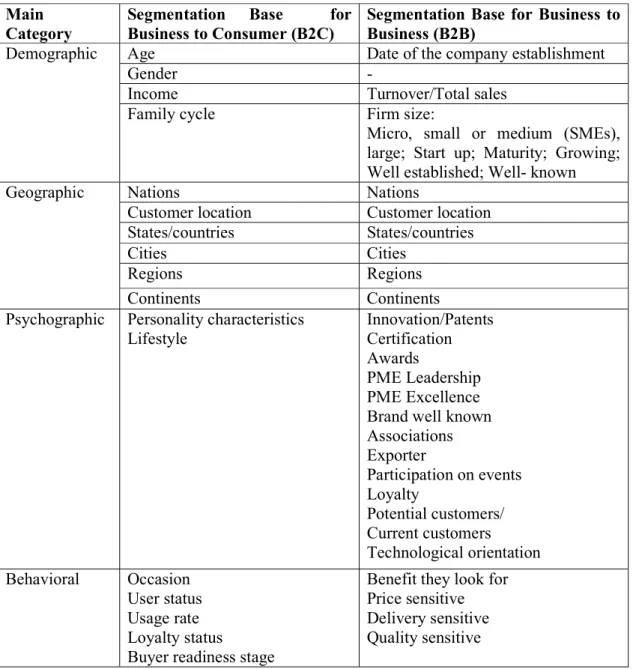
Different ways to segment a market have been identified. Business-to-business (B2B) sellers might segment the market into different types of businesses or countries. While business to consumer (B2C) sellers might segment the market into demographic segments, lifestyle segments, behavioral segments or any other meaningful segment. Taking into consideration the identified theoretical key elements of market segmentation and the characteristics of the mold, automotive, home appliances, and the plastics industries in Turkey the following table
19 was built to illustrate a parallelism between them was established and the key elements of market segmentation were identified (see Table 3).
Table 3: Understanding market segmentation bases and variables (B2C, B2B)
Main Category
Segmentation Base for
Business to Consumer (B2C)
Segmentation Base for Business to Business (B2B)
Demographic Age Date of the company establishment
Gender -
Income Turnover/Total sales
Family cycle Firm size:
Micro, small or medium (SMEs), large; Start up; Maturity; Growing; Well established; Well- known
Geographic Nations Nations
Customer location Customer location
States/countries States/countries
Cities Cities
Regions Regions
Continents Continents
Psychographic Personality characteristics
Lifestyle Innovation/Patents Certification
Awards
PME Leadership PME Excellence Brand well known Associations Exporter Participation on events Loyalty Potential customers/ Current customers Technological orientation Behavioral Occasion User status Usage rate Loyalty status Buyer readiness stage
Benefit they look for Price sensitive Delivery sensitive Quality sensitive
Several researchers investigated on marketing segmentation. Market segmentation studies were outlined on the Appendix 2 regarding the literature review. It should bealso noted that Appendix 2 describes empirically and theoratically studies about market segmentation strategies and variables on special chosen companies.
20 In conclude, in the current chapter it was discussed:
- The concept of marketing segmentation; - The key elements of marketing segmentation;
- Classification of major categories for segmentation bases;
- Key competitive elements that sustain or create competitive advantages, marketing segmentation bases variables.
This chapter allows creating the foundations to build the customer database, within the main topic of the following chapter.
21
4. Featuring the Republic of Turkey
4.0. Introduction
The chapter presents the Republic of Turkey. It should be noted that for better understand the Turkish market: culturally, politically, socially, and economically view of the Republic of Turkey will be presented. Also, geographic location, population, education system of the Republic of Turkey, Turkish currency in order to USD/EUR, the foreign trades, focusing the trade ofgoods between Portugal and Turkey will be discussed on this chapter.
History and culture, religion, values of the Republic of Turkey also is on this chapter. In addition need to specify that identification of market research for the market, to know tax legislation, government incentives and support, behavior on negotiation, greetings, protocol at table, comfort distance, punctuality, and public holidays are important as well.
Research about Molds and Automotive Industry of Turkey with important financial data concluded Turkish Automotive Industry Production by companies and their production quantity focused on mold, Automotive, plastic industry will be illustrated on this chapter regarding to research mold industry in Turkey, and understand the effect of the related industries in Turkey economy. All these valuable information and analysis will be on the same chapter.
4.1. Geographic Location of Turkey
Republic of Turkey is located on the crossroads between Europe and Asia with most of its territory called Anatolia located in Southwest Asia. Turkey is surrounded by three different seas, the Black Sea on the north, the Aegean Sea on the west and the Mediterranean Sea on the south. Turkey is neighbored to the east by Azerbaijan, Georgia, Armenia and Iran while to
22 the south by Iraq and Syria, then to the west by Greece and Bulgaria (Figure 3). Turkey has a total area of 779.452 km² (302.535 sq. miles)17.
The republic of Turkey is made up of 81 provinces, spread out across the following 7 regions: Black Sea, Marmara, Aegean Sea, Mediterranean, Central Anatolia, and Eastern and Southeastern Anatolia (See Appendix 3, 4 and 5).
Figure 3: Geographic Location of Turkey
Population: 79, 9 millions Territory: 779.452 km² (302.535 sq. miles) Neighboring countries: Azerbaijan, Iran, Iraq, Syria, Armenia, Georgia, Greece, Bulgaria Ethnic minorities: Kurds,Ethnic Albanians, Greek Pontics, Kurds, Arabs, Bosniaks, Circassians Capital: Ankara (pop. 5,270,575)18
Other main cities: Istanbul (pop.14,657,434) Izmir (pop.4,168,415) Bursa (pop 2.842.547) Source:http://www.infoplease.com/atlas/country/turkey.html, access on 08.11.2016
4.2. Population of Turkey
The total population in Turkey was estimated at 78.7 million people in 2015, according to the latest census figures (Figure 4). Looking back, in the year of 1960, Turkey had a population of 28.2 million people. The population of Turkey represents 1.07 percent of the world´s total population which arguably means that one person in every 95 people on the planet is a resident of Turkey. The current population of Turkey is 79,957,445 as of Tuesday, November
17Population of Turkey Republic (Statistical Bulletin) 2016, Turkish Statistical Institute 18http://www.nufusu.com/turkiyenin-en-kalabalik-sehirleri, accessed on 08.11.2016
23 8, 2016, based on the latest United Nations estimates.19. The largest city in Turkey is Istanbul, which has a total of 14.65 million people. The second largest city is Ankara, which is also the capital and has almost 5.27 million in population. There are many other major cities in Turkey, but the most important and heavily populated ones include Izmir with 4.16 million and Bursa with 2.8 million populations20 (Figure 3).
Figure 4: Growth of Turkey Population (million)
Source: Turkish Statistical Institute, (2016).
Turkey's population is growing at a slow but steady rate, according to the latest figures from the Turkish Statistical Institute (TurkStat). Figures for 2015 indicate a growth rate of 13.4, higher than the 13.3 of the previous year. The population grew by 1.45 million people in the past year to 78,741,053, according to official records. The most densely populated city in Turkey is, of course, Istanbul, where 18.6 percent of the total population is concentrated with more than 14.6 million people. The city is also the most crowded, with the total number of people per square kilometer of 2,82121.
The population density in Turkey is 104 per km2 (268 people per mi2). 71.6 % of the population is urban (57,251,665 people in 2016). The median age in Turkey is 30.2 years22.The population is mainly comprised of the Turkish people, who make up 75% of the total population, while Kurdish make up 18%. Other ethnic groups take up the remaining 17% of the total population. The languages spoken by the majority are Turkish and Kurdish, while
19http://www.worldometers.info/world-population/turkey-population/, accessed on 08.11.2016 20http://www.nufusu.com/turkiyenin-en-kalabalik-sehirleri, accessed on 08.11.2016
21Population of Turkey Republic (Statistical Bulletin) 2016, Turkish Statistical Institute 22http://data.worldbank.org/indicator/EN.POP.DNST, accessed on 08.11.2016
24 minority groups speak other languages. The main religion, followed by 99.8% of the population, is Islam, while other religions are followed by the minute 0.02% of the population23.
4.3. The Currency of Turkey
The Turkish Lira (TL) is the official currency in Turkey while the exchange rate is set on a daily basis. On January 1, 2009, the Central Bank of the Republic of Turkey introduced a new series of Turkish Lira banknotes which differ from, and replaced, the 2005 series called New Turkish Liras (Yeni Türk Lirası).
There was no change in the value of the Turkish lira. All values and conversions remained the same. The new "E9" series of banknotes are called simply Turkish Lira (Türk Lirası) instead of New Turkish Lira as on the older 2005-series notes. The old 2005 New Turkish Lira (YTL) notes were withdrawn during 2009 as the new "E9" series of TL bank notes were introduced. Beginning on January 1, 2010, old YTL notes were no longer accepted for payment, but until December 31, 2019, they may be exchanged for 2009-series notes at any branch of the Central Bank of the Republic of Turkey (T.C. Merkez Bankası), or the more common T.C. Ziraat Bankası. As of January 1, 2020, the YTL notes will be worthless except as collector's items.
It is easy to find a bank or an exchange office while traveler’s checks can be cashed at in most banks. Foreign currencies (Euro and USD) are accepted at hotels, many shops and restaurants. All major credit cards are accepted in hotels, restaurants and shops. The following table shows the exchange rate of Turkish Lira in order to Euro and USD during last 7 years (Table 4).
25
Table 4: Exchange rates of Turkish Lira (at the end of the year; TL as unit of national
currency)
Foreign Currency 2010 2011 2012 2013 2014 2015 2016
1 USD 1.48 1.78 1.77 2.08 2.36 2.96 2.95
1 EURO 1.94 2.44 2.35 2.84 2.95 3.23 3.5
Source: Central Bank of the Republic of Turkey, (2016).
4.4. The Political System of Turkey
Turkey is a secular democracy with a majority Muslim population. Its Head of State is President Recep Tayyip Erdoğan, who won 52% of the vote in Turkey’s first direct presidential elections in August 2014. Prior to his election as president, Erdogan served as Prime Minister and leader of the Justice and Development Party (Adalet ve Kalkınma Partisi-AKP in Turkish), a Centre-right party with Islamist roots. A president is elected every five years on the principle of universal suffrage according to the current constitution. The president does not have to be a member of parliament, but he/she must be over 40 years old and hold a bachelor's degree. Executive power rests with the president, the Prime Minister (Bashbakan in Turkish) and the Council of Ministers. Most ministers are members of Parliament.
The AKP, which has been in power since 2002, won a new mandate with 49.5% (317 seats) of the vote in November 2015 – after a brief period of hung parliament. Three other main parties are represented in parliament: the Centre left Republican People's Party (Cumhuriyyet Halk Partisi-CHP), with 134 seats; Kurdish-focused The Peoples' Democratic Party (Halkların Demokratik Partisi-HDP in Turkish), with 59 seats and the Nationalist Movement Party (Milliyetçi Haraket Partisi- MHP in Turkish), with 40 seats24.
Since 1950, parliamentary politics has been dominated by conservative parties. Even the ruling AKP, although its core cadres come from the Islamist current, tends to identify itself with the tradition of the Democratic Party. AKP constitutes a ground where the unity and the
26 integrity of the Republic of Turkey, the secular, democratic, social state of law, and the processes of civilianization, democratization, freedom of belief and equality of opportunity are considered essential.25 The leftist parties, the most notable of which is the Republican People's Party (CHP), with a stable electorate, draw much of their support from big cities, coastal regions, professional middle-class, and minority groups26. Nationalist Movement Party (MHP) is a Turkish far-right political party that adheres to Turkish nationalism and Euro scepticism. The Peoples' Democratic Party (HDP) is a pro-Kurdish and pro-minority political party in Turkey. Generally left-wing, the party places a strong emphasis on participatory democracy, minority rights, and egalitarianism27.
The new government (AKP) has set out a program of multi-sectoral reforms which it aims to rapidly progress. It also aims to develop a new Turkish Constitution. The reforms included tax reduces, government support and incentives of small and medium size enterprise, rebuilt social health system, create much more effective agriculture within the agricultures subsidy and etc. One effect of the reforms has been the emergence of a new class of entrepreneurs in central Anatolia, creating an alternative to the industrial class traditionally based in and around Istanbul. The owners of small and medium-sized companies in Central Turkey (Ankara, Kayseri, Gaziantep), who support the AKP, have become the main engine of Turkey's export expansion into the Middle East and North Africa. Over time, the so-called Anatolian tigers amassed sufficient capital to begin competing with Istanbul-based holdings and created alternative economic elite in the country.
The prime minister is appointed by the president and approved through a vote of confidence in the parliament. The Prime Minister of Turkey is the head of government of Turkey. He is the leader of a political coalition in the Turkish parliament (Mejlis in Turkish) and the leader of the cabinet. The current holder of the position is Binali Yıldırım of the Justice and Development Party (AKP), who took office on 24 May 2016 and replaced the former Prime Minister Ahmet Davutoglu (also from Justice and Development Party - AKP).28
Legislative power is invested in the 550-seat Grand National Assembly of Turkey (Türkiye Büyük Millet Mejlisi), representing 81 provinces. The members are elected for a four-year
25http://www.akparti.org.tr/site/akparti/parti-programi#bolum, accessed on 04.11.2016 26https://www.chp.org.tr/Assets/dosya/chp-program-2015-01-12.pdf, accessed on 04.11.2016 27https://hdpenglish.wordpress.com/about/, accessed on 04.11.2016