Organizational Evolution of China’s Third-front Enterprises:
Cases Study on Aosheng Group
GUO Dong
Thesis submitted as partial requirement for the conferral of
Doctor of Management
Supervisor:
Professor Henriques Duarte, Assistant Professor, ISCTE University Institute of Lisbon
Co-supervisor:
Professor JING Runtian, Professor, University of Electronic Science and Technology of China, School of Management and Economics
- Spine –
Organizational Evolution of Chin
a’s Third-front Enterprises:
Cases Study on Aosheng Group
GUO Don
Organizational Evolution of China’s Third-front Enterprises:
Cases Study on Aosheng Group
GUO Dong
Thesis submitted as partial requirement for the conferral of
Doctor of Management
Supervisor:
Professor Henriques Duarte, Assistant Professor, ISCTE University Institute of Lisbon
Co-supervisor:
Professor JING Runtian, Professor, University of Electronic Science and Technology of China, School of Management and Economics
Declaration
I declare that this thesis does not incorporate without acknowledgement any material previously submitted for a degree or diploma in any university and that to the best of my knowledge it does not contain any material previously published or written by another person except where due reference is made in the text.
Signed Date _________________ Name: _____________ 作者申明 本人郑重申明:除了论文致谢中明确说明并致以谢意的部分外,所呈交的论文不 包含任何他人或作者本人已用于获得任何教育机构的学位和证书而使用过的材 料。同时尽我所知,除了文中特别加以标注引用的内容外,本论文不包含任何其 他个人或集体已经发表或撰写的成果作品。 作者签名: 日期: 姓名(拼音)
Abstract
China's "Third-front" enterprises emerged in a specific historical period and specific institutional environment and played an important role in China's national defense construction and Chinese history. Due to changes in the world political and economic situations and domestic economic development, the development of Third-front companies face many challenges: support from central government have changed; they can’t depend only on government and military orders; need to face market-competition. Therefore, a comprehensive study on the pattern of the Third-front enterprises’ conversion of military-oriented technologies for civil will allow to have a theoretical explanation of the internal forces of the organization evolution as well as their interactions with external factors.
Based on the punctuated equilibrium theory, applying case study approach, Aosheng Group is selected as the research case because it is a typical and successful representative of Third-front enterprises. Qualitative analysis is the main method while quantitative evaluation was used as an auxiliary evaluation method. There are four steps included in the process of data analysis. At first, all data come from all possible ways are divided into two groups. One group is about macro environment, the other is about the evolutionary process of Aosheng. Then, the macro environment is analyzed from three facets such as political environment, economic environment, and market environment. Third, the four stages of Aosheng’s evolution are identified. And the changes of organizational structure, performance, strategic positioning, change pressure, and organizational inertia at each stage are analyzed in detail. Finally, the evolutionary patterns emerged from the results of previous analyses are identified. The rules of evolution are proposed as some theoretical propositions.
The current research will advance the researches on Third-front enterprises, changing the perspective from outside of organizations to within organizations. The research also provides appropriate policy-making and business practices recommendations for policy-makers and business executives. Finally, the limitations of the study and future research directions are discussed.
Key words: organizational evolution, Third-front enterprises, case study, military-civilian
integration
Resumo
As empresas chinesas da “Terceira-Frente” surgiram num contexto histórico e institucional específico e jogaram um papel importante na construção da defesa da China e na sua história. Devido a mudanças económicas, políticas e do desenvolvimento económico doméstico enfrentam vários desafios: mudanças no apoio governamental; não podem depender exclusivamente das encomendas do governo e dos militares; necessidade de enfrentar a competição de Mercado. Assim um estudo compreensivo do padrão de conversão das tecnologias militares para civis permitirá uma explicação teórica das forças internas da evolução da organização e das suas interacções com factores externos.
Baseada na teoria do equilíbrio pontuado e aplicando um estudo de caso, seleccionamos o grupo Aosheng por ser típico e representar um caso de sucesso das empresas da Terceira-Frente. A análise qualitativa foi o método principal e a análise quantitativa foi usada apenas de forma suplementar. A análise de dados foi efectuada em quatro fases. Na primeira a informação das diferentes fontes foi dividida em dois grupos. Um grupo relativo a informação externa e outro relativo ao processo evolutivo de Aosheng. Depois o macro ambiente foi analisado em três vertentes como sejam a política, económica e o mercado. Depois quatro estádios de desenvolvimento do grupo foram identificados. Em cada estádio foi analisado em detalhe a estrutura organizacional, desempenho, posicionamento estratégico, pressão para a mudança e o posicionamento estratégico. Finalmente os padrões emergentes das análises anteriores foram identificados. As lógicas de evolução foram apresentadas bem como algumas proposições teóricas.
A presente investigação contribui para as investigações nas empresas da Terceira-Frente, mudando a perspectiva do exterior para o interior das organizações. A investigação também proporcionou recomendações para os decisores políticos e para os gestores. Finalmente foram apresentadas as limitações do estudo e futuras perspectivas de investigação.
Palavras-chave: evolução organizacional, Empresas da Terceira-Frente, estudo de caso,
integração militar e civil
Acknowledgements
I always believe in one ancient Chinese maxim “Read ten thousand books, traveling thousands of miles”. Only by this way, can one improve himself. The experience of studying for a doctorate has changed my world view. And I am sure this appreciated experience will still meaningful for my future life. This is one of the most important and valuable periods of my life!
Facing the thesis draft which is close to be finished, my heart is fully filled with gratitude. I have to remember my respected supervisors and professors from both ISCTE University Institute of Lisbon and School of Management and Economics of UESTC for your selfless and wonderful instruction and teaching, the DBA project members, and my dear classmates and good friends for your selfless help. Below, let me present my gratitude directly to you:
First, I would like to thank my supervisors professor Henrique Duarte and professor JING Runtian. Your profound knowledge, superb teaching level, rigorous studying attitude and modesty character are well worth learning in my lifetime. Your gave me detailed guidance and selfless help during the whole process of my research, such as proposing research, research designing, data collecting, structuring thesis structure, revising the thesis and so on. I can never finish my research without any help from you. You were, are, and will be my respected tutors not only for learning and scientific researching but also for my whole life. Thank you!
I would like to thank teachers from both ISCTE University Institute of Lisbon and School of Management and Economics of UESTC. You gave me wonderful teaching which led me into the hall of management theory to pick up scientific shell beads! They are professor ZENG Yong, professor MA Yongkai, Professor LI Shiming, professor LU Ruoyu, professor YING Lu and other professors who I cannot list all of them here. I would like to thank all members of DBA project! Your hard work is essential for me to successfully complete my study. They are XIAO Wen, SUN Ping and CHEN Yang and others who I cannot list here.
I would like to thank all the leaders and staff of Aosheng Group. Only with your support and help, can I proceed smoothly. You gave me all possible useful information without any reservation. You helped me to do so much evaluation. You spent your holidays on discussing
any needed questions. You exhibited enthusiasm and excellent quality to people around you. Your leadership skills and management experience will be worth my lifelong learning.
I would like to thank all the classmates for the happy and valuable time that we shared together. Thank all good friends for your selfless help without which I would go through much more setbacks. Every discussion with you had brought inspiration to me.
Finally, I would like to pay my respect to the experts and scholars who are going to read and appraise this doctoral thesis.
Thank you all!
Contents
Chapter 1: Introduction ... 1
1.1 Research Background... 2
1.1.1 History of the Third-front... 2
1.1.2 Conversion of Third-front Enterprises ... 5
1.2 Research Questions ... 9 1.3 Research Design... 11 1.4 Relevance ... 12 1.4.1 Theoretical Contribution ... 12 1.4.2 Practical Implication ... 13 1.5 Innovations ... 13 1.6 Thesis Structure... 15
Chapter 2: Literature Review... 17
2.1 Organization Evolution ... 17
2.1.1 Definition of Organization Evolution... 17
2.1.2 Process of Organization Evolution... 18
2.1.3 Punctuated Equilibrium Theory ... 21
2.1.4 Evaluation of Researches on Organization Evolution... 28
2.1.5 Brief Summary ... 28
2.2 Third-front Construction ... 29
2.2.1 Third-front Construction and Third-front Enterprises... 29
2.2.2 Studies on Third-front Construction... 29
2.2.3 Evaluation of Third-front Construction Researches... 33
2.2.4 Brief Summary ... 34
Chapter 3: Research Method... 35
3.1 The Case... 35
3.2 Data Collection... 39
3.3 Analysis Approach and Process ... 42
3.4 Chapter Summary... 45
Chapter 4: Macro Environment Analysis... 47
4.1 Macro Political Environment ... 48
4.1.2 Local Political Environment... 54
4.1.3 Evaluation of Macro Political Environment... 58
4.2 Macro-Economic Environment ... 59
4.3 Changes in Markets... 62
4.3.1 Military Market ... 62
4.3.2 Civilian Market ... 66
4.4 Summary ... 69
Chapter 5: Evolutionary Process Analysis ... 71
5.1 Stage-wise Overview... 72 5.1.1 Stage I (1950-1981)... 72 5.1.2 Stage II (1981-1992) ... 74 5.1.3 Stage III (1992-2003) ... 77 5.1.4 Stage IV (2003-)... 78 5.2 Organizational Structure... 80 5.3 Organizational Performance... 86 5.4 Strategic Orientation... 92
5.5 Pressure for Changes... 96
5.6 Organizational Inertia... 99
5.7 Summary ... 101
Chapter 6: Patterns of Evolution... 103
6.1 Roles of Macro Environment ... 104
6.2 Relationships among Internal Factors ... 108
6.2.1 Strategic Orientation and Organizational Performance... 108
6.2.2 Organizational Performance, Inertia and Change Pressure... 111
6.2.3 Change Pressure and Strategy Orientation... 113
6.2.4 Roles of Leaders... 114
6.3 Evolution Model... 116
6.4 Chapter Summary... 120
Chapter 7: Discussions and Conclusions ... 121
7.1 Findings... 121
7.2 Theoretical Contributions... 123
7.2.1 Theory Testing... 124
7.2.2 Theory Development... 125
7.2.3 Promotion of Researches on Third-front Enterprises... 126
7.3.1 Considering Complexity and Long-term Nature... 127
7.3.2 Leaders Selection and Training ... 130
7.4 Implications for Similar Organizations ... 132
7.4.1 Overcome Blind Pessimism and Optimism ... 133
7.4.2 Change Management Skills... 136
7.4.3 Leaders’ Responsibilities... 137
7.5 Research Limitations and Future Directions... 138
List of Tables
Table 1- 1 Dependability on Military Business of Well-Known Military Enterprises ... 8
Table 2- 1 Research on the Third-front Construction in China ... 30
Table 3- 1 Brief History of Aosheng... 38
Table 3- 2 Interviewees List ... 40
Table 3- 3 Interview Outline... 41
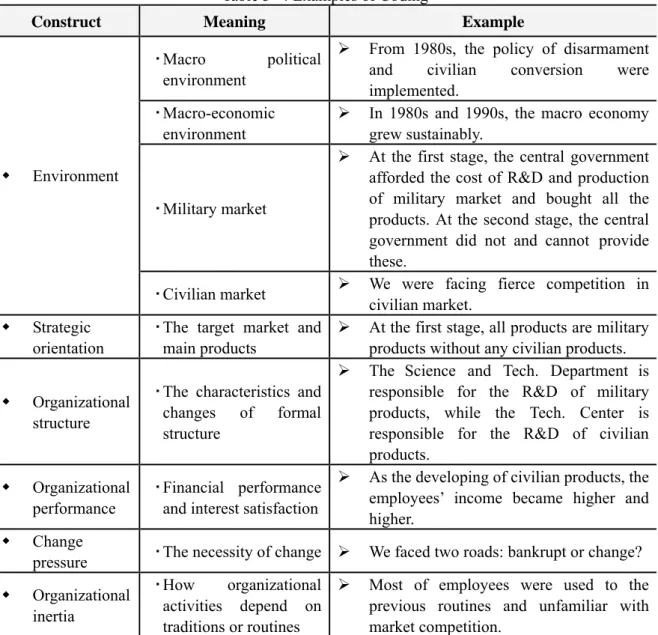
Table 3- 4 Examples of Coding ... 44
Table 4- 1 Four Stages of the “Military-civilian integration” Strategy ... 49
Table 4- 2 Qualitative Analysis of National Political Environment ... 53
Table 4- 3 Qualitative Analysis of Local Political Environment... 57
Table 4- 4 Periodical Evaluation of the Political Environment ... 59
Table 4- 5 Evaluation of Macro Economic Environment... 62
Table 4- 6 Evaluation of Defense Market... 66
Table 4- 7 Evaluation of Civilian Market ... 68
Table 5- 1 Qualitative Analysis of Organizational performance ... 88
Table 5- 2 Performance of Military and Civilian Businesses at Different Stages ... 90
Table 5- 3 Evaluation of Strategic Orientation at Each Stage ... 93
Table 5- 4 Evaluation of Strategic Orientation at Each Stage ... 95
Table 5- 5 Evaluation of Pressure for Changes at Each Stage... 97
Table 5- 6 Evaluation of Pressure for Changes at Each Stage... 97
Table 5- 7 Evaluation of Organizational Inertia at Each Stage... 100
Table 5- 8 Evaluation of Organizational Inertia at Each Stage... 101
Table 6- 1 Evaluation Results for Four Stages of Aosheng Group... 103
Table 6- 2 Stages Comparison between Macro Environment and Organizational Evolution ... 104
List of Figures
Figure 1- 1 “Third-front” Areas in China ... 4
Figure 1- 2 Major Research Process... 12
Figure 2- 1 Simplified Logical Relation within Punctuated Equilibrium Theory ... 22
Figure 2- 2 Punctuated Equilibrium of the Organization Evolution in the Case of only One Time Environment Change... 22
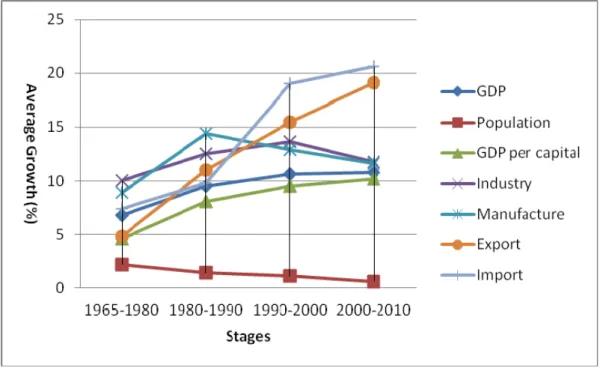
Figure 4- 1 1965-2010 Graph of Changes in Macro Economic Growth Rates of China ... 61
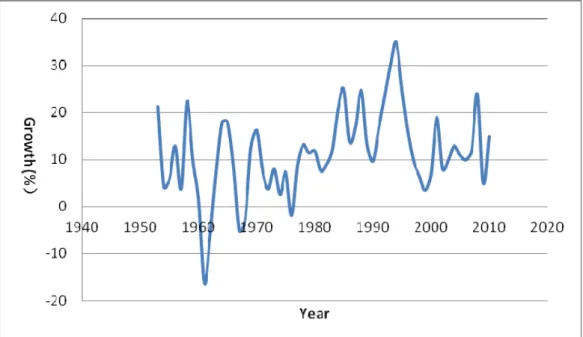
Figure 4- 2 Changes in GDP Growth Rates... 62
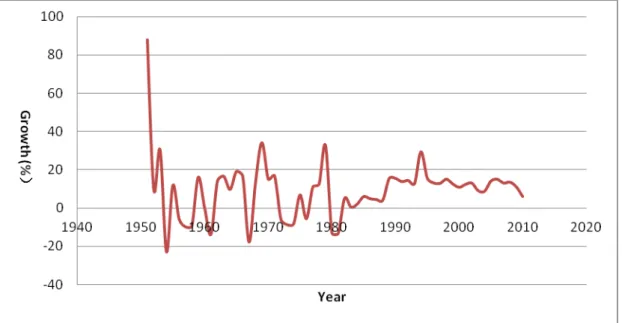
Figure 4- 3 Annual Growth Rate of Military Spending (1951-2010)... 64
Figure 4- 4 Change in Annual Growth Rate of Total Final Consumption... 69
Figure 5- 1 Inverted T-Structure ... 81
Figure 5- 2 M-Structure ... 83
Figure 5- 3 H-Structure... 84
Figure 5- 4 Multi-level M-Structure ... 85
Figure 5- 5 Alternate Changes in Growth Rates of Military and Civilian Output Value... 91
Figure 5- 6 Changes in Annual Amount of Increase of Total Output Value... 91
Figure 5- 7 Proportion of Civilian Products in Annual Total Output Value ... 95
Figure 5- 8 Curve of Changes in Annual Performance Pressure... 98
Figure 6- 1 Comparison of Time Periods ... 105
Figure 6- 2 Military Market and Civilian Market... 107
Figure 6- 3 Performance and Alignment between Environment and Strategy ... 110
Chapter 1: Introduction
The Third-front construction was originated in the 1960s when the central government believed that another massive world war would break out sooner or later due to the global political and military situation at that time. In order to get ready for the coming war, strategic preparation should be made. Therefore, the majority of the national production and resources were placed in war readiness. For security reasons, a decision was made in accordance with Chairman Mao’s strategy to delimitate three regions in terms of geographic location and vulnerability to wars, of which the third is located in the inland and the western regions that are remote and less vulnerable to wars, so that a lot of national-defense-related research and manufacturing institutions could be moved to these regions. Then the third front construction was undertaken with vigor and vitality. Later, the regions were called “the Great Third Front” and the military institutes and factories in it were called "the Third Front" institutions. As the world trend shifted to peace and development, China also entered a new historical stage centering on economic construction. However, enormous challenges were faced by the third front enterprises at the new development opportunity due to the impacts of various factors (both internal and external); many third front enterprises have bankrupted or been on the brink of bankruptcy. Regarding its great significance to the national defense as well as its important role in the national economy, the development of the Third-front enterprises has become a serious problem concerning many stakeholders.
Most researches in China concerning the Third-front enterprises are conducted from the perspectives of historical review, summarizing the decision-making, the implementation, the effects and social impact of the Third-front construction. These researches can provide useful references for the subsequent policy formulation. However, they also have great limitations because they regard the Third-front enterprises as a "black box", and only observe it from a macro perspective while pay little attention to the internal mechanisms. Therefore, they can provide little guidance for the Third-front enterprises, nor can they provide a full theoretical explanation on the evolution of the Third-front enterprises. What’s worse, due to the lack of relevant information, there are only a few studies on the Third-front construction and enterprises of China internationally.
study, will further investigate the successful Third-front enterprises so as to find the possible solution to the following problems: What evolution patterns do successful Third-front enterprises have? What factors affect the evolution of the Third-front enterprises and how do these factors connect and interact with each other? We hope to reveal the organization revolution patterns of the Third-front enterprises through researching these questions so as to provide policy suggestion as well as practice guidance for the reform and development of the Third-front enterprises.
1.1 Research Background
Chinese history has turned over a new leaf since the foundation of the People’s Republic of China. The past decades saw changes in both political and economic policies, which have left unique marks on the history. Along with the implement of the policy of reforming and opening to the outside world, China's economic policy gradually shifted to marketing from planning, which was surely to offer a unique environment to the enterprises. It can be easily seen that a large number of planning economy stuffs, like state owned enterprises (SOEs) and the Third-front enterprises develop in different ways when compared with those under marketing economy of the developed countries (Hu, 2000; Sun and Tong, 2003; Tylecote and Cai, 2004). Combining the universal law and particularity of development, we can get a powerful mental weapon to explore and reconstruct the world.
The Third-front enterprises were of great significance at the early days after the foundation of the People’s Republic of China; however, the strategic status and significance gradually faded away along with the development of the economy and society. In order to survive, the Third-front enterprises have to make a change and the special environment forces them to change in a special way. The history of an organization is of great significance for us to understand the organization and its development (Greiner, 1998; Weber and Dacin, 2011). Likewise, the history of the Third-front enterprises is significant for us to study the Third-front enterprises’ organization evolution as well as its evolution rules too since it can provide us with a chance to access to the essential rules.
1.1.1 History of the Third-front
Based on the relevant literatures, reports and books (Chen, 1997, 2001a, b; Huang, 2007; Li, 2009; Li, 2010; Li, 2011; Naughton, 1988; Shen, 2009; Song, 2012; Wikipedia, 2012; Xia,
2009; Yang, 2005) as well as various information available and history text books, the historical stories of the Third-front gradually unfold before our eyes.
China entered a new development stage in 1949 when the People’s Republic of China was founded. In 1958, the Sino-Soviet relationship broke down and China faced tough strategic situation. The southeast coastal defense system was vulnerable. All these factors awaked the central government to the importance of building the strategic rear in the west. In August, 1964, the Gulf of Tonkin incident led to an intense upheaval, a massive war was very likely to break out. The US expanded the war area in Vietnam, which directly affected south China and posed a threat to China’s security. Meanwhile, The Soviet Union deployed many troops at the border of China (It’s said that there were millions of troops). What’s a worse, Taiwan authority unscrupulously created an atmosphere of tension between the two sides of the Straits. Under such circumstances, the central government believed that a massive war was around the corner and China should make preparation for that. Therefore, Mao Zedong, at the conferences of the Secretariat of the CPC Central Committee on August 17th and August 20th in 1964, pointed out that the economic arteries of China were grouped mainly in coastal regions and big cities, which were not in favor of war preparedness, so that each province should build its own strategic rear to get ready for the severe strategic situation. Thus, the Third-front construction started in order to build a strategic rear before the war broke out.
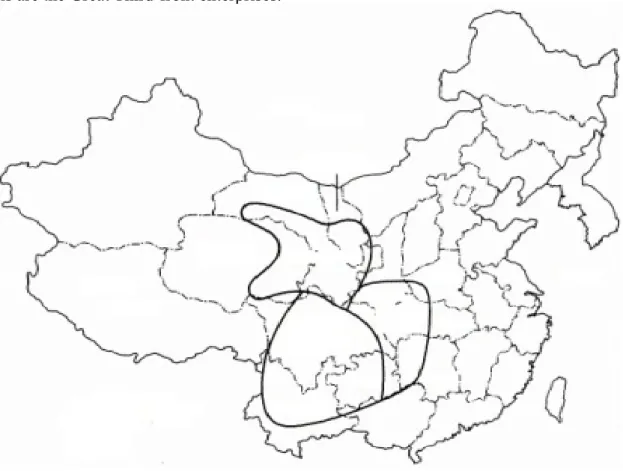
Since the 1950s, according to Mao Zedong's strategic deployment, the “Three Fronts ” strategy (the first front was the coastal front areas, namely, the southeast coastal areas, the northeast areas and Xinjiang Uygur Autonomous Region; the second front was the middle regions between the first front areas and Beijing Guangzhou railway, including Anhui, Jiangxi, Hebei, Henan, Hubei and east Hunan; the third front was the west regions, including three provinces in southwest (Yunnan, Guizhou, Sichuan) and Chongqing which was later designated a municipality directly under the central authority and three provinces in northwest (Shanxi, Qinghai and Gansu) and the western areas of Hebei, Henan, Hubei and Hunan provinces. The Third-front was devised to develop military enterprises. Since the coastal areas were vulnerable to wars, it’s necessary to move the key military enterprises to the remote and less vulnerable inland areas, which were the so called “Third-front” areas. Figure 1-1 shows the “Third-front” areas.
In August, 1964, the National Construction Commission of China held a meeting on the issue of relocation of the military enterprises in the first and second fronts, putting forward that the military enterprises should be scattered generally while grouped at a small scale, and
the most advanced national defense projects should be scattered at the mountain areas that could not be easily found. From the 1960s to the 1980s, more than 1100 medium and large construction projects were examined and approved and many talents were called to the Third-front areas. In 1973, China issued an official document which explicitly claimed to give priority to the development of Guiyang, Chongqing, Anshun and Mianyang, which all became the key areas of the national Third-front enterprises. This is also called the “Great Third-front” construction. In 1963, the gross industrial output value of the seven western provinces (Yunnan, Guizhou, Sichuan, Shanxi, Gansu, Ningxia and Qinghai) accounted for 10.5% of the national gross industrial output value while in 1978 it rose to 13.26%. At the same time, the first and second front provinces developed their own local military enterprises, called the “Small Third- Front”, as the supplement to the Great Third-front in order to enhance their own military power in case there should be wars. The Third-front enterprises discussed in this thesis are the Great Third-front enterprises.
Figure 1- 1 “Third-front” Areas in China
Source of the Data:Naughton, B. (1988). The third front: Defense industrialization in the Chinese interior. China
Quarterly, 115, pp. 351-386.
The special strategic status and the particular locations of the "Third-front" enterprises gave them some unique features. For security reasons, the locations of the Third-front enterprises were usually remote and secluded, most of which were far away from cities. The
objective geographic limit later gradually hindered the development of these enterprises. The frequent natural disasters like flood brought heavy losses to these enterprises from time to time. The geographic features secluded these enterprises from the outside worlds. Therefore, many Third-front enterprises were big and comprehensive, equipped with hospitals, stores, schools and other facilities, which can be called a tiny community. All these hindered their further development.
In late 1980s, with the end of the cold war and the implement of reforming and opening to the outside world, China’s focus was shifted to the economic construction. The “Third-front” enterprises had great difficulties in developing and even in surviving due to their geographic problems. In December, 1983, the Third-front office was set up to direct the relocation and conversion of the Third-front enterprises. In 1984, the first 121 enterprises were made to adjust, 48 enterprises were made to move and merge and 15 enterprises were made to switch to other products; some Third-front enterprises were moving to the near cities one after another. The technology intensive military enterprises and key enterprises were relocated in such big cites as Chengdu, Chongqing and Xi’an; some of these enterprises were reconstructed to some extent, e.g. Chongqing Weapon Industrial Base was reconstructed and became Chongqing Iron & Steel Co. Ltd. and Chang’an Group. A few Third-front enterprises that didn’t move either made changes in order to survive with the local governments’ help (like the 816 project in Chongqing) or gradually went bankrupt.
No agreement on the Third-front construction has been achieved among scholars (Chen, 2004; Li, 2011). As an outcome of the history development, the Third-front construction has brought great impact on China’s politics, economy and history as well as the relevant regions, enterprises and people. The Third-front construction was of great strategic significance because it was an effective counter-measure to the potential massive war. It also boosted the social, political, economic and cultural development of the Third-front areas. However, the massive investment in the third front areas resulted in the reduction of the first and second areas’ accessibility to the resources and the investment in the national economy, which by and large hindered the development of China’s economy.
1.1.2 Conversion of Third-front Enterprises
The Third-front construction was undertaken with vigor and vitality, however, the global situation turned to be not as worse as the central government had expected. The cold war gradually came to an end and peace and development became the common view of each
country.
Most military research institutes and factories in China are located in inland regions, particularly in west regions; that’s why they are called “Third-front” (the Third-front originally means the third front areas and later it was used to refer to the military research institutes and enterprises in inland and west regions). In 1978, the policy of reforming and opening to the outside world was made and the basic line of the central government was determined, which made the economic development the focus and priority of the nation. Under such circumstance, the Third-front enterprises were not as important as before, but still indispensible to a strong national defense. Therefore, how to develop the Third-front enterprises became a significant issue.
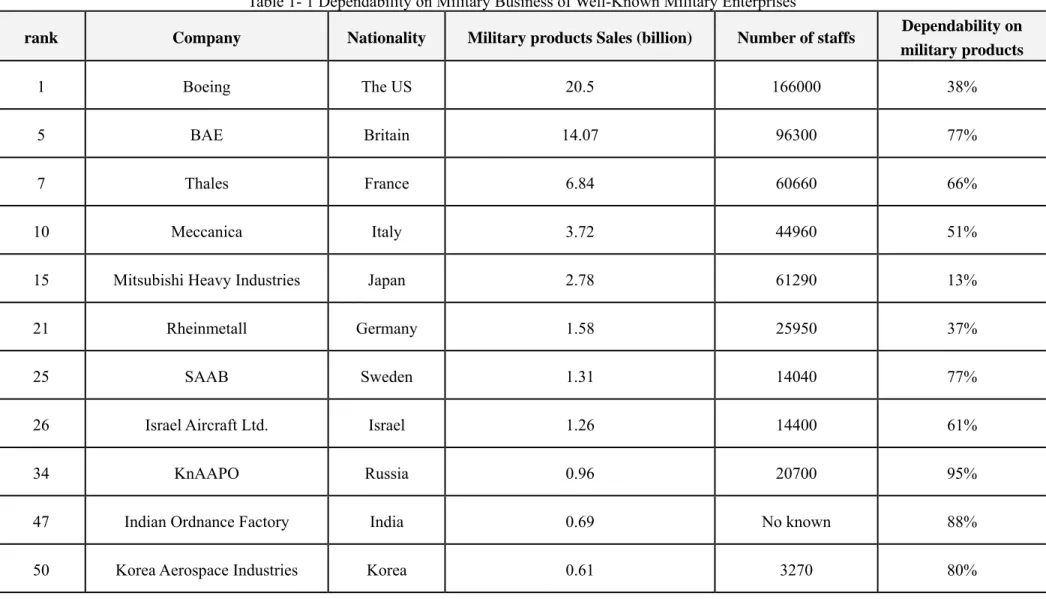
The experience of other countries afford us a lesson that when there are more military resources than we need, we can convert the military-oriented technology into civil use so as to optimize the resource allocation and exploitation (Gholz and Sapolsky, 2000). This is a common strategy for many countries to promote the economic benefits and efficiency after the cold war (Liang, 2004; Markusen and Costigan, 1999). In 1993 , The Clinton administration of the US set the Technology Reinvestment Project (TRP) to encourage military enterprises to develop civilian products (Chu and Waxman, 1998). Enterprises like Lockheed Martin, General Dynamics and McDonnell Douglas all applied their core military technology in relevant civilian fields (Markusen et al., 1999). The chart (figure 1-2) of the dependability on the military business of the well-known military enterprises shows that the harmonious development of military products and civilian products is an important way to make full use of resources and to realize the twin objectives of national defense and economic development. Since the Third-front enterprise are important to the national defense, the conversion of military-oriented technology into civilian use does not mean to transfer these enterprises into civilian enterprises, but to achieve a complimentary development that can both guarantee the strategic need and make full use of the resource to boost the national economic development (Gao, 2011). Here the conversion of military-oriented technology into civilian use is from the standpoint of the Third-front enterprises, which is of the same meaning as "combining military-oriented technology with the civilian use" and “integrating military-oriented technology with the civilian use”. However, it is anything but an easy job, many difficulties and failures are surely on the way forward. The US national defense report pointed out that “the successful conversion of military-oriented technology into civilian use can be hardly found” (Augustine, 1997), the same dilemma will surely be faced by Chinese
military enterprises too (Ren, 2005). China’s system and background are special, so are the difficulties they will meet (Gao, 2011). As for each individual Third-front enterprise, the military products are priced by the government, which is based on the cost of research, development and manufacturing and elastic. Supervised by the government, the military system is in fact exclusive. Only those who meet the requirements (like security, secrecy, product permission and quality) can enter the system. In such an exclusive system, the military enterprises in fact have only one customer (the government) and a few rivals, which have limited their experience and the way of thinking for a long time. To be more specific, the history has estranged these enterprises from the market competition.
From the background provided above, it can be seen that how the third front enterprises perfectly convert its military-oriented technologies into civil use is a significance issue concerning many stakeholders. However, the Chinese government is not experienced in making relevant policies; they have to adjust the policies based on the results. Meanwhile, they are affected by the global political and economic environment, too. The changing political environment hinders the progress of the Third-front enterprises. Besides, the Third-front enterprises are usually comprehensive and big, which is also a disadvantage. A Third-front enterprise is like an aircraft carrier, equipped with schools, hospitals and other welfare facilities, which makes it more difficult to convert. The previous studies show that there are many factors hindering the development of the Third-front enterprises, such as the backward ideas and the weak talents construction (Tian, 2010). Though it has been discussed and studied in political and academic circles, a comprehensive study on the pattern of the Third-front enterprises’ conversion of military-oriented technologies for civil use is hardly seen. A theoretical explanation of the internal forces of the organization evolution as well as their interactions is also needed.
Table 1- 1 Dependability on Military Business of Well-Known Military Enterprises
rank Company Nationality Military products Sales (billion) Number of staffs Dependability on
military products
1 Boeing The US 20.5 166000 38%
5 BAE Britain 14.07 96300 77%
7 Thales France 6.84 60660 66%
10 Meccanica Italy 3.72 44960 51%
15 Mitsubishi Heavy Industries Japan 2.78 61290 13%
21 Rheinmetall Germany 1.58 25950 37%
25 SAAB Sweden 1.31 14040 77%
26 Israel Aircraft Ltd. Israel 1.26 14400 61%
34 KnAAPO Russia 0.96 20700 95%
47 Indian Ordnance Factory India 0.69 No known 88%
1.2 Research Questions
Due to the special historical background, how to convert the Third-front enterprises so as to keep up with the pace of the times is an important issue for governments of all levels as well as the relevant enterprises. In fact, in order to keep up with the new situation and the new strategies, the organization of the Third-front enterprises is bound to change greatly or even to be reformed completely. We tried to explain the phenomenon by adopting the organization evolution theories, only to find that there’re too few researches taking Chinese background into consideration though there’re abundant organization evolution researches around the world. Moreover, the Third-front enterprises in China have their own unique historical background, characterized by unique economical foundation, investment and industrial focuses (Wang and Liu, 2011). Besides, the different culture also matters a lot to the organization and its development (Shane, 1992). What’s more, the transition economic environment is different from the mature marketing economic environment (Tan and Tan, 2005).
As is mentioned in Chapter 2, there are only a few researches on China’s Third-front construction internationally, let alone the researches on its evolution. On the other hand, Chinese researchers generally take a macro and historical perspective to study the Third-front enterprises while pay little attention to the organization evolution (Li, 2011). Organization evolution is affected by its history (Garud and Karnøe, 2001), as well as its circumstance and internal factors, which is a complicated process in nature. The Third-front enterprises have unique historical backgrounds, and currently they are developing in a dynamic and special transitional economy. Therefore, it is necessary to explore their evolution patterns.
Different from the previous researches on the Third-front enterprises, this thesis goes deep into the Third-front enterprises to investigate their organization evolution patterns. Only when accessing the interior of the Third-front enterprises and carrying out a thorough investigation, can we better reveal the process and enhance our understanding of the Third-front enterprises’ organization revolution. As we have seen, some Third-front enterprises went bankrupt, some are having a hard time, but it’s not the whole picture, some Third-front enterprises have achieved great success. How come these differences exist? What evolution have the successful Third-front enterprises experienced? What experience they provide us with? They questions are not only significant to the development of the Third-front
enterprises, but also significant to China’s national economy as well as defense.
What evolution pattern a specific Third-front enterprise has is of great significance to the organization evolution research, policy making and management of the Third-front enterprises. For academic research, the patterns of evolution can give us more thorough understanding of the development of Chinese Third-front enterprises. Patterns are substantial rules of organizational development, so the evolution patterns reflect the development rules of Chinese Third-front enterprises. For policy making, the patterns of evolution can provide good instructions, especially for making those policies which influence the whole defense industry for a long period of time. For Third-front enterprises themselves, the patterns of one successful example can provide good experience which can help them to avoid some avoidable failures and unnecessary wastages. Hence, we put forward the first research question: What is the basic pattern for the Third-front enterprise organization evolution?
It is not enough to find out the patterns of evolution, since organization evolution is a complicated dynamic process with a number of interacting factors. Though the patterns of evolution are of great significance, the factors which drive the emergence of these patterns are of more importance to be explored. In order to understand the evolution process more thoroughly, we should dig deeper to examine those key factors which play important roles in the evolution process and their interactions. When we see an enterprise as a whole system, it is important to understand the internal operation mechanism which provides the dynamic for the evolution process of the system. Going deep into the organizations and investigating the connections and interactions between the factors involved from the vertical perspective can facilitate understanding the pattern of the Third-front enterprises’ organization evolution. Hence, we put forward the second research question: What are the major internal factors in the organization evolution of the Third-front enterprises and how do they interact with each other?
To some extent, the internal factors and their interactions provide the force to drive the evolution process. However, there are not sufficient reasons for us to neglect the role of external environment; this is especially true for Chinese Third-front enterprises. First, Chinese Third-front enterprises provide relevant services for the Chinese People’s Liberation Army. Second, all Chinese Third-front enterprises are very sensitive to the national macro economy. The high growth of national macro economy provides both more market opportunity and government investment for them. Third, Chinese Third-front enterprises are sensitive to the changes of external market. The changes of military market and civilian market direction their
strategy of balancing these two different businesses. All in all, the external environment is important for Third-front enterprises. Therefore, we put forward the third research question: What interactions exist between internal and external factors during the evolution process of Third-front enterprises?
1.3 Research Design
Compared with the statistic based research method, the case study which is good at investigating the chronic changes of the organizations (Pettigrew, 1990) is more suitable for this study because it helps us to better explore the patterns and internal mechanism of China’s Third-front enterprises. Anymore, the purpose of exploring the evolutionary rules of organizations compels us to focus on process-way rather than variance-way (Mohr, 1982).Case study is particularly suitable for answering “how” and “why” questions, because these questions can only be answered by dating back to the past rather than discussing the frequency or probability of a certain time. Case study enables the researchers to collect more information by a variety of ways, such as interviews, internal documents, the Internet, questionnaires, journals and magazines. This is the unique advantages of case study (Yin, 1989, 2009). Case study enables us to get the comprehensive information of the subject, especially some information that is inaccessible to the public, so that we can find out the truth and further to reveal the nature of management. A case in case study is different from a sample in normal research, which is chosen by theoretic sampling (Coyne, 1997). The chosen one should meet the requirements of being an extreme case, based on which the study is more likely to reveal the theoretic nature (Eisenhardt, 1989). This thesis is to explore the organization evolution law in specific history background by adopting the existing theories. The punctuated equilibrium theory (Romanelli and Tushman, 1994; Sastry, 1997; Tushman and Romanelli, 1985) will be adopted as the theoretical framework of this thesis to guide the further case analysis, including data collecting and processing. Theoretical adoption can facilitate the increase of the external validity (Yin, 2009).
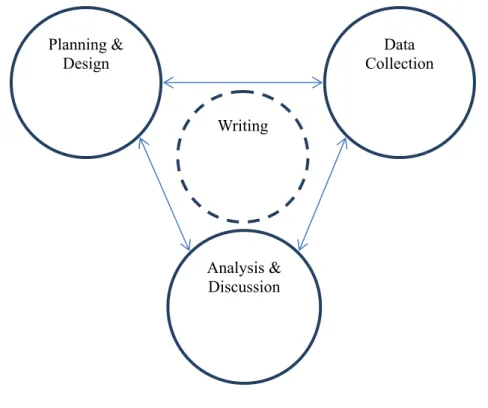
The whole study has been conducted during 1 year and a half, including research proposal and modification, research design, data collection and triangulation process, data analysis, results discussing and thesis writing and revision. The major work and procedures are shown in Figure 1-2 (Data collecting and paper writing are through the whole research). First of all, we reviewed the literatures relating to the Third-front enterprises and discovered the insufficiency of the previous studies; then we proposed the research questions, based on
which we made and perfected the research plan. Next, we reviewed the literatures relating to the organization evolution in order to know the theoretical development as well as the latest status. Then we proposed, perfected and determined the research framework, based on which we chose the cases, collected and analyzed data over and over again; finally, we got the reliable conclusion. In order to guarantee the quality of the thesis, any problem occurred in the research would be discussed with instructors at home and abroad as well as within the team. A detailed statement of the research methods will be introduced in Chapter 3.
Figure 1- 2 Major Research Process
1.4 Relevance
1.4.1 Theoretical Contribution
By means of a depth analysis on the case, we can discover the typical organization evolution pattern of China's Third-front enterprises, which is not only a test on and a development of the punctuated equilibrium theory in China but also a way for people to better understand the organization evolution of China's Third-front enterprises. Besides, the study can facilitate a better understanding of the general law of the enterprise organization evolution in a transition economy.
Though organization evolution is an important research field in which there are a large number of relevant studies and mature theories. Most of the studies are concerned about
Planning &
Design Collection Data
Analysis & Discussion
western countries, particularly in the context of a complete marketing economy. China's Third-front enterprises are the product of its planning economy, which are affected by both markets and policies (Krug and Hendrischke, 2008). Usually, the policies are more influential than the markets. The special institutional context of China brings unique difficulties to the Third-front enterprises (Gao, 2011). Based on the specific context, the research can both help people to better understand the specific knowledge and to make due contribution to the general management theories as well (Tsui, 2004; Van de Ven and Jing, 2011). Study on the organization evolution of such enterprises can help us to understand the impact of the policy control on the organization evolution
In addition, the power of a theory can only be proved after various tests in different contexts. Most management theories at present are based on western countries’ developed marketing economy, which makes it more necessary to be tested in the unique transition economy context (Tan, 1996; Tan and Litsschert, 1994). The case study on Aosheng Group shows that the punctuated equilibrium theory provides a very useful theoretical perspective for us to investigate the dynamic organization evolution. The present research can facilitate the development of the relevant theories.
1.4.2 Practical Implication
Practically, based on the research findings,due suggestions on policy making for the development of the Third-front enterprises can be given to the government; theoretical guide can be provided for the organization change of the Third-front enterprises; in addition, the research can also afford some valuable experience for the enterprises that are on the way of converting the military-oriented technologies into civil use. Finally, the research can help us to better understand the history and explain the difficult economic decisions at present (Naughton, 1988).
1.5 Innovations
1. The previous studies on the Third-front construction are generally historical and macro descriptions of relevant events and experience summary, which are of great significance for us to understand the history of the Third-front construction as well as the development of the Third-front enterprises. However, owing to their emphasis on the history, these researches tend to regard the Third-front enterprises as homogenous
organizations of the same class and neglect the circumstance and the relation of the internal factors in the process of the Third-front enterprises’ organization evolution, which will result in the fact that the research findings can not be applied to a specific Third-front enterprise. Therefore, this thesis, based on the theory of punctuated equilibrium, analyzes the organization evolution of a typical Third-front enterprise----Aosheng Group, finds out its evolution patterns, proposes the five statements concerning the organization evolution of China’s Third-front enterprises and builds corresponding models. Both the statements and the models profoundly reveal how the organizations of the Third-front enterprises evolve in China’s unique historical and cultural background, and identify the changes of the critical external and internal factors as well as their connections. These researches will facilitate advancing the studies on the Third-front enterprises and the Third-front constructions into the micro level----interior of the organizations from the macro and historical level. Such deep researches will be more favorable for identifying the key factors of the Third-front enterprises’ organization evolution; hence we can provide more scientific and targeted advice for the governments who are making relevant policies and the relevant enterprises that are carrying out the strategy of converting the military-oriented technologies into civil use.
2. The previous researches on the organization evolution are generally carried out in mature market economy. The external environment plays a critical role in the evolution of organizations (Romanelli et al., 1994). China’s Third-front enterprises are the result of specific historical stage (Berthélemy and Deger, 1995). The environment is of special significance to the organization evolution (Yin, 2009). Previous researches show that China’s transitional economy is different from the mature market economy of the west, and the enterprises in the two economies may have different behaviors (Tan, 1996; Tan et al., 1994; Tan et al., 2005). This thesis, under the circumstance of transitional economy, studies the typical cases of the planning market stuffs----the organization evolution of the Third-front enterprises, and reveals that the environment plays a special role in the organizations of the Third-front enterprises as well as the measurable impact posed by the institutional changes on the organization evolution of the micro level of an enterprise.
3. Organization evolution is influenced by a number of factors inside and outside. Policies made by the government are important institutional environment, particularly for the
Third-front enterprises. It is shown in the thesis that the stages of the Third-front enterprises’ organization evolution are determined by the policies to a large extent. Furthermore, the policies will influence the Third-front enterprises’ organization evolution through influencing the macro economy and the market. These findings can contribute to understanding how the role played by the government in the transitional economy will influence the organization evolution of the Third-front enterprises.
1.6 Thesis Structure
The thesis may consist of eight chapters which will be adjusted according to the research results:
Chapter one presents the research background, questions and significance; besides, it briefly describes the structure and contents of the thesis.
Chapter two first reviews the definition of and the previous studies on the organization evolution, then reviews the previous studies on the Third-front enterprises, and finally draws a conclusion on the inadequacy of the previous studies.
Chapter three systematically shows the research methods and process of this thesis, including the basic ideas and the fundamental approaches of case study-based research, the selection criteria and process of the cases and the basic information of the subjects. Then it explicitly presents the process of the research, including the way of data collection and analysis.
Chapter four carefully analyzes the changing external environment of Aosheng Group’s organization evolution in terms of macro political climate, economy and markets.
Chapter five, based on the four stages of the organization evolution of Aosheng Group, briefly describes the organization evolution of Aosheng Group, and then analyzes the changes in organization structure, organization performance, strategic orientation, pressures for changes and organization inertia in detail.
Chapter six discusses the relation of the key concepts generated from the cases studied in the previous chapters, including the relation between the external macro environment and the micro organization evolution process and the interactions among the internal factors. Finally, it draws out the organization evolution patterns of the Third-front enterprises.
suggestions generated from the research findings for policy making and management of Third-front enterprises. Finally, it puts forward the limits of the research and the suggestion for the future studies.
Chapter 2: Literature Review
2.1 Organization Evolution
Organization evolution is a development of the evolution theory in organization research. Organic evolution theory and the punctuated equilibrium theory provide an important theoretical foundation for the studies on development and change of things. They have been adopted in the organization research and have advanced people’s understanding of organizations which are special and complex.
2.1.1 Definition of Organization Evolution
Darwin evolution theory (Darwin, 2010) indicates that the evolution of species is a natural process of selection, that is, only the stronger ones can survive. In the competition among species and between species and environment, only the ones with more competitive edges and stronger adaptability can survive and develop. Darwin’s’ arguments laid a foundation for the evolution theory. It must be pointed out that the natural selection in organic evolution is different from human’s conscious selection which is usually based on self-interests. The “natural selection” is usually based on the nature of the organism, affecting the organism both specifically and generally. Human selection can only affect the tangible parts of things while the “natural selection” is based on the internal mechanism. Since Darwin put forward the evolution theory, the idea of evolution gradually soaks into various fields, from micro to macro, from individual to organization, and the organization research is not an exception.
There’re also some ideas about organization evolution in economics (Deng, 2008). Different from neoclassical economics, evolution economy focuses on the innovation and its spread of the economic system and the structure change it causes. The evolution-oriented enterprise research focuses on the generation, spreading and application of knowledge within an enterprise, comprehending enterprises’ heterogeneity and complexity that cannot be explained by the traditional organization theory from the learning perspective. The idea of evolution in economics comes from Adam Smith’s the Wealth of the Nations and the idea of Austria School. Within the theoretical framework of economics developed the enterprise
organization theories, such as enterprise resource theory, enterprise dynamic ability theory and enterprises’ routine behavior theory. Within the theoretical framework of economics, heterogeneous enterprise resources are integrated within one management framework, routine is regarded as an organization technique while the dynamic ability is regarded as the expression of routines. At the same time, the possibility and path dependability of organization study are also emphasized.
The late 20th century saw a significant turn in organization theory study. Scholars began to take interest in organization change; the evolution idea was paid special attention and thus came a lot of theoretical achievements (Singh, 1990; Singh and Lumsden, 1990). Organization evolution theory investigates how an organization evolves, including its establishment, breakdown, development and change, by studying the constant changes within the organization. Drawing on the fruits of other disciplines, the organization evolution theory itself has derived many new theories, like organization ecology, strategic evolution and other theories relating to economics, sociology, organization change and social and cultural evolutions.
Based on the above analysis, we can define the organization evolution as a complicated process caused by the linkage between and the change of the external context or (and) the internal forces of the development of the organization. In the process, many factors are interconnected and interacted and progress featuring a stronger adaptability and sustainable development can be achieved by the organization in the end. The previous studies on organization evolution are inadequate, some are even contradictory (Tushman et al., 1985), which aroused attention among scholars (Aldrich and Pfeffer, 1976; Child and Kieser, 1981; Kimberly and Miles, 1980; March, 1965), they advocate that efforts should be made to study the organization evolution so as to make up the inadequacy of the static and cross-section researches which seldom concern the historical factors and the initial state of an organization, and help us to understand why some organizations can develop sustainably while others failed (Tushman et al., 1985).
2.1.2 Process of Organization Evolution
Generally, the organization evolution consists of four processes, namely, variation, selection, retention and struggle for rare resources (Aldrich and Ruef, 2006a, b, c). Variation is the beginning of the evolution, including the changes of the existing routines, competitive ability and organization forms. This process can either be a conscious plan, like exploring
solutions for a problem, or an unconscious one. Change can occur either inside the organization or among organizations. How the organization selects and eliminates different variations constitutes the second stage of organization evolution. The selection includes two varieties, one is external selection brought by the external causes which influence the organization routines and competitive ability (like markets, competitive stress and institutional stress) and the other is internal selection caused by internal causes that influence the organization routines and competitive ability (like stability stress and the perseverance to the old selection criteria). It is called maintenance that the variation chosen by the organization occurs again or remains (In this process, the variations chosen by the organization remain or even reproduce and spread). The maintenance consists of inside maintenance (like the professional and normalized role play) and inter-organizational maintenance (like the practices in cultural belief and values). The potential selection pressure and the pursuit for the change of effect are all quests for the control over rare resources and the organization legitimacy. When the members of the organization purse their individual dream or organizational goals, struggles for resources occur. To put it into simple words, when there are processes that incur changes or maintenance, the system will have to make a choice, thereby it evolves. The four general processes that constitute the evolution theory are enough for us to explain the organization evolution process. For example, why does a certain organization form exist in a certain environment? When variation and maintenance are in one system, the system will have to make a choice, which leads to the evolution. The evolution mechanism mentioned above can be adopted either in organism or non-organism, like any ecological system or social system. Therefore, the evolution theory has been widely applied in various fields, for example, McPherson applies the evolution pattern in studying the rise and decline of many volunteer organizations, Lomi applies it in analyzing the competitive motivation among groups (Aldrich et al., 2006a). In a word, the evolution theory can be applied in different analyses of all levels, like team, organization, group and so on. The four processes of organization evolution lie in or among every social individual.
Organization evolution is a big topic and it can be studied from many perspectives. However, the logical front end should start from the birth of a new organization. Once the organization set up, the core value, strategy, structure, power and interest distribution, rare resources distribution and control system will be laid down step by step and gradually improved and perfected. The core value of an organization is the in-depth driving force, which determines where, how and why the organization exists and competes. The change in the core
value would cause the changes in all parts of the organization, like strategy, structure, power and interest distribution and control system. Correspondingly, the change in the control system may also lead to the slight changes in structure, power and strategy (Tushman et al., 1985). Organization control system is closely connected with organization structure. Control system can either be an official or unofficial department whose function is to appraise and monitor organization's behaviors, performance, reward and penalty. The core value, strategy, structure, power and interest distribution, rare resource allocation and control system are both inter-connected and independent. They together constitute the organization orientation and they must be coordinated with each other, otherwise, the performance would be poor. The changes in organizations’ strategy, structure, rights and profit distribution, rare resource allocation and control system means a reorientation of the organization, while if the core value changes too, the organization has gone through a re-creation. At the early stage of the organization, the decision was made in response to the context, based on which the organization set up its initial pattern of the organization activities. Because of inertia and institutionalization, the developments of the organization are all simply a continuation of the established patterns. However, the organization is able to and surely to change its strategy orientation.
Organization evolution is a complicated process, on which scholars hold different opinions. The typical ones are: (1) ecological model which emphasizes that the organization change is a result of the natural selection; (2) adaptation model which stresses on the more effective gradual change and balanced move when organizations adapt themselves to deal with crisis and take advantage of opportunities; (3) reform model which focuses on the qualitative changes of the organization, believing that the development of the organization is made of a series of different stages and procedures; (4) the punctuated equilibrium model (Tushman et al., 1985). The punctuated equilibrium model absorbs the rational ideas of the previous three models, considering both the internal and external causes of the organization’s reform and inertia in a comprehensive way. Meanwhile, it admits that the great influence the administrative and decision-making levels have on the long term behaviors of the organization. Punctuated equilibrium theory has emerged as a prominent theoretical framework for investigating organization changes (Romanelli et al., 1994).
Next part will be dedicated to the fundamental ideas and the latest developments of the punctuated equilibrium model.
2.1.3 Punctuated Equilibrium Theory
The punctuated equilibrium theory was originally a theory about biological evolution which hold the idea that the long-term static or balanced situation of a pedigree will be broken by a relatively short but volcanic and enormous evolution, leading to new species with greater adaptability (Gould and Eldredge, 1977). The punctuated equilibrium theory explains why there are so few fossils of evolving organisms in a new and systematic way, which is a development and supplement to Darwin’s evolution theory.
The punctuated equilibrium theory has been paid attention and adopted in many fields ever since it was born, achievements in such disciplines like economics, politics and civil management have been made (Baumgartner et al., 2009; Boushey, 2012; Breuning and Koski, 2006; Jones, Sulkin, and Larsen, 2003; Jordan, 1999; Robinson, 2007). As for organization research, Tushman and Romanelli integrated the research findings on the organization evolution of the time, absorbed the rational ideas of the ecological model, the adaptation model and the reform model and put forward the punctuated equilibrium model (Tushman et al., 1985). They believe that the organization evolution is not linear and forward, but a no-linear and complicated process in which some relatively equilibrium stages with snaillike changes and some sporadic re-orientation stages with essential changes alternately take place. Since then, many researches based on the punctuated equilibrium theory have been conducted (Chimhundu, 2011; Gersick, 1991; Lant and Mezias, 1992; Romanelli et al., 1994; Sabherwal, Hirschheim, and Goles, 2001; Wollin, 1999). Tushman and Romanelli’s model was later improved by Sastry, which is shown in Figure 2-1. The improved model comprehensively reveals how the punctuated equilibrium is realized (Sastry, 1997). It is also the main theoretical framework for the later case studies
Next, the fundamental idea of the punctuated equilibrium organization evolution theory will be reviewed from three aspects: convergent period, re-orientation period and executive leadership.
(1)Convergent period
In convergent period, the organization integrates its social, political, technical and economic activities by means of gradual change mechanism so as to make them preserve consistent in order to support the strategic orientation of the whole organization. Re-orientation period is short and also called change period, in which the structure, interests and system of the organization all change greatly and a new organization strategy shapes. The
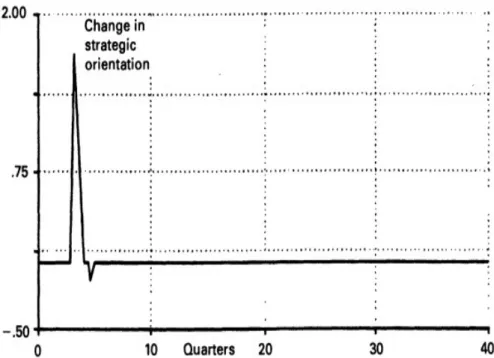
punctuated equilibrium model of the organization evolution means that the development of the organization is made up of a series of convergent periods which are constantly broken by re-orientations and then advance into another convergent period. Figure 2-1 describes the punctuated equilibrium evolution of the organization in the case of only one time environment change.
Figure 2- 1 Simplified Logical Relation within Punctuated Equilibrium Theory
Source:Sastry, M. A. (1997), Problems and paradoxes in a model of punctuated organizational change. Administrative Science Quarterly, Vol. 42, No. 2, pp. 237-275
Figure 2- 2 Punctuated Equilibrium of the Organization Evolution in the Case of only One Time Environment Change
Source:Sastry, M. A. (1997), Problems and paradoxes in a model of punctuated organizational change. Administrative Science Quarterly, Vol. 42, No. 2, pp. 237-275
Initially, the organization was changing gradually, which is called convergent period. Then, the organization’s strategic orientation changed greatly at a point (e.g. 3 or 4). This short period is called re-orientation (change period), when a high coordination is achieved by the re-orientation, the organization advances into another convergent period.
The inertia and system of the organization keeps it behaving in the original pattern, however, if the lack of consistency in organization strategic orientation or the changes in competition, technology, law and the social environment lead to the failure of the original orientation, the pressure for changes will come. The medium and the lower management levels can keep the organization in the convergent period in the case that the organization orientation has already been established. Under the pressure for changes, only the executives can coordinate the convergent period and the re-orientation period, initiate and finish the necessary non-linear changes for re-orientation. The perception of opportunities and constraints leads the executives to decide whether to keep the convergent period or to initiate a change. As a political, economic and social independent structure, the organization must be positive and effective, must have both internal and external rationality so as to sustain the development of the organization. The regularity, techniques, objectives, performance, inertia and the context are closely related to organization evolution. The coordination activities the organization needs, the prediction of the external context of the organization and the responsibilities the organization takes are related to the promotion of the structural clarity and social complexity of the organization (Tushman et al., 1985). The decision-making patterns of the organization and the social intercourse clarify and consolidate the organization strategy over time. The more the two patterns are interconnected and interdependent, the more the inertia will be, which will, either for individual or group, lead to a positive attitude toward the organization strategy and the future gradual change, and decrease the perceptional ability for the need of a revolution.
The development and the size of an organization are related to the improvement of the complexity of the organization to some extent. A larger organization or a longer convergent period means a more complex organization structure, a stronger inter-dependency and inertia, a stress on gradual change and against discontinuous reform. The more unstable the convergent period is, the less complex the social contact and structure of the organization is, and more contradiction inside the organization means less hinders for the reform. Therefore, while the external context remains unchanged, the longer and the more stable the convergent period is, the more positive the organization will be. An efficient organization evolution can
coordinate the external and internal activities of the organization as well as the strategic orientation and the context of the organization. In a word, an organization must adapt itself to the internal and external context, and try to keep the convergent period stable so as to achieve a good performance. However, a high convergence may become a hinder for the change of the organization.
Compared with change period in which the executives don’t change the essential decisions of the organization. The executives’ major task at the convergent period is to set examples and make the strategic orientation more meaningful. In the convergent period, a more positive organization usually has a more stable administrative team with complete, excellent management skills, a dependable internal promotion system and a lot of gradual changes carried out by medium and lower management levels.
(2)Reorientation period
An organization is always under the pressure from both the internal and external contexts. The product demand, technology, users and institutional environment are closed related to the evolution of the lifespan of a product, or rather, the lifespan evolution of a product results from the interaction between the product demand, technology, users and institutional environment. The consistence of the organization strategy will change along with the evolution of the lifespan of the product, result in the need for an organization change (Brown and Eisenhardt, 1995; Romanelli et al., 1994; Tushman et al., 1985). When a discontinuous change occurs in the lifespan of a product, a re-orientation will be caused and a better design, law or social issues will all influence the re-orientation of the organization.
(3)Executive leadership
Executive leadership is a key factor in the punctuated equilibrium model, which coordinates the needs for stability and change. The medium and the lower management levels are just a consolidation to the previous strategy, only the executives are able to initiate a complete change. During the convergent period, what the executives need to do is to set examples and the gradual changes are carried out by the medium and lower management levels. However, in the change period, the executives have to make decision on strategy, interests, structure and control. The environment will not cause a change. The basic mechanism that causes the strategic change is the choice made by the executives.
The executives’ perception and judgment poses important impact on the decision to change, while the inertia will influence their perception of information and judgment of the