Alexandra Fiéis
Faculdade de Ciências Sociais e Humanas da Universidade Nova de Lisboa / Centro de Linguística da Universi-dade Nova de Lisboa (Portugal)
[email protected] Maria Lobo
Faculdade de Ciências Sociais e Humanas da Universidade Nova de Lisboa / Centro de Linguística da Universi-dade Nova de Lisboa (Portugal)
Recibido o 16/09/2016. Aceptado o 15/05/2017
Abstract
Differently from the standard contemporary variety of European Portuguese, in which subject-verb inver-sion is considered categorical in gerund clauses, in Old Portuguese and Dialectal European Portuguese we can find both subject-verb and verb-subject orders in gerund clauses. These variable word orders challenge the generalization that languages with a positive speci-fication of the null subject parameter display obligatory subject-verb inversion in gerund clauses. Therefore, other factors have to be taken into account. This work investigates the factors that condition subject-verb word order in gerund clauses of Old Portuguese and Dialectal European Portuguese, considering data from CORDIAL-SIN, a corpus of spoken varieties of speakers from rural areas of Portugal, and data from a sample of texts from the CIPM, a Computerized Corpus of Me-dieval Portuguese. Corpus data show us that there is a difference in the frequency of subject-verb inversion in both varieties: verb-subject is the predominant word order in Old Portuguese, while subject-verb is the pre-dominant word order in the dialects, regardless of the presence of inflected gerunds. In what concerns the conditioning factors that may trigger one order or the other, we considered the type of verb, the type of sub-ject, and the presence of a connective. In the dialects, regardless of overt inflection, the most important factor for the post-verbal occurrence of the subject is the type of verb. In contrast, in Old Portuguese subject-verb in-version is the dominant pattern and post-verbal sub-jects can be found with all verb classes. We hypothesize that differences between the two varieties may corre-late with the productivity of gerund clauses introduced by a connective, the specification of the C-domain and information-driven movement.
Keywords
Language varieties, Portuguese, gerund clauses, in-flected gerund, word order, subject-verb inversion
Resumo Contrariamente ao que sucede na variedade padrón do portugués europeo, en que a inversión do suxeito se considera categórica en oracións xerundivas, no por-tugués antigo e en variedades dialectais do porpor-tugués europeo encontramos as ordes suxeito-verbo e ver-bo-suxeito nas oracións xerundivas. Esta variación na orde de constituíntes desafía a xeneralización segundo a cal as linguas con especificación positiva para o pa-rámetro do suxeito nulo teñen inversión suxeito-verbo obrigatoria nas oracións xerundivas. Hai, pois, outros factores que deben ser considerados. Este traballo investiga os factores que condicionan a orde suxei-to-verbo nas oracións xerundivas do portugués antigo e do portugués europeo dialectal a partir de datos do CORDIAL-SIN, un corpus con transcricións de fala de in-formantes de áreas rurais de Portugal; e dunha mostra de textos do CIPM, Corpus Informatizado do Português
Medieval. Os datos destes córpora mostran que hai
unha diferenza entre ambas as variedades na frecuen-cia da inversión suxeito-verbo: a orde predominante en portugués antigo é verbo-suxeito, mentres que a orde suxeito-verbo predomina nos dialectos, a pesar da presenza dos xerundios flexionados. Como factores condicionantes que poden producir unha orde ou a ou-tra, consideramos o tipo de verbo, o tipo de suxeito e a presenza dun conector. Nas variedades dialectais, inde-pendentemente da presenza de flexión visible, o factor máis relevante para a posición posverbal do suxeito é o tipo de verbo. Pola contra, en portugués antigo pre-domina a posición posverbal e os suxeitos posverbais aparecen con calquera tipo de verbo. Presentamos a hipótese de que as diferenzas entre estas dúas varieda-des están relacionadas coa produtividade das oracións xerundivas introducidas por un conector, coa especifi-cación do dominio-C e con movemento desencadeado polo estatuto informativo dos constituíntes.
Palabras chave Variedades lingüísticas, portugués, oracións xerundi-vas, xerundio flexionado, orde de palabras, inversión suxeito-verbo
Orde de palabras en oracións xerundivas do portu-gués: unha comparación entre o portugués antigo e o portugués dialectal
1. i
ntroductionThe position of the subject relative to the verb in gerund and participial clauses is subject to crosslinguistic and intralinguistic variation. In French and in English, absolute clauses with –ant and –ing, respectively, always display a preverbal subject:
(1) a. Les enfants étant curieux, … b. *Étant les enfants curieux, … (2) a. The children being curious, …
b. *Being the children curious, …
In Spanish, Italian and Modern Standard European Portuguese gerund clauses, we usually have the opposite word order – the subject follows the main verb or the auxiliary verb:
(3) a. Siendo los niños curiosos,… b. *Los niños siendo curiosos… (4) a. Essendo i bambini curiosi…
b. *I bambini essendo curiosi… (5) a. Sendo as crianças curiosas,…
b. %As crianças sendo curiosas, …1
Classical analyses in the Principles and Parameters Framework assume that verb-subject or-der in gerund clauses of Romance languages is the consequence of T to C movement (Rizzi 1982, Roberts 1994, Ambar 1988, among others), that is movement of verbal inflection (Tense) to the higher functional node C (Complementizer). According to some analyses, T to C movement oc-curs due to the non-finite status of the gerund which cannot license the subject through spec-head agreement. Several authors have established a correlation between word order in abso-lute clauses and the Null Subject Parameter (Roberts 1994, Barbosa 1995, 2002, Santos 1999): null subject languages display verb-subject word order and non-null subject languages display subject-verb word order.
Old Portuguese and dialects of European Portuguese are null subject languages, as shown in (6) and (7).
(6) Porque Ø matando a criação é que Ø não lucram nada. (ALV09)
(7) assi Ø se partirom per cansaço, entrante aa noite, como mui boos cavaleiros (XIV c. NLL)
We would, thus, expect to find verb-subject word order in these varieties. However, this pre-diction is not borne out. Differently from the standard null subject languages mentioned above, in these Portuguese varieties we can find variable word orders in absolute gerund clauses: the subject can precede or follow the verb. These variable patterns challenge the generalization that languages with a positive specification of the null subject parameter display obligatory subject-verb inversion in gerund clauses (cf. also Fiéis / Lobo 2010).
1 We use the symbol % to indicate that there is variation among speakers as to the acceptability of this word order.
Contents
1. Introduction. 2. Methodology. 3. Word order in gerund clauses of Dialectal Portuguese. 3.1. Variation in gerund clauses. 3.2. Word order in the varieties with inflected gerunds. 3.2.1. Presence of connective. 3.2.2. Type of verb. 3.2.3. Type of subject. 3.2.4. Conclusions. 3.3. Word order in the varieties without inflected gerunds. 3.3.1. Presence of connective. 3.3.2. Type of verb. 3.3.3. Type of subject. 3.3.4. Conclusions. 3.4. Com-paring varieties. 4. Word order in gerund clauses of Old Portuguese. 4.1. Presence of connective. 4.2. Type of verb. 4.3. Type of subject. 5. Discussion and conclusions.
Sumario
1. Introdución. 2. Metodoloxía. 3. Orde de palabras en oracións xerundivas do portugués dialectal. 3.1. Varia-ción en oraVaria-cións xerundivas. 3.2. Orde de palabras en variedades con xerundio flexionado. 3.2.1. Presenza de conector. 3.2.2. Tipo de verbo. 3.2.3. Tipo de suxeito. 3.2.4. Conclusións. 3.3. Orde de palabras en variedades sen xerundio flexionado. 3.3.1. Presenza de conector. 3.3.2. Tipo de verbo. 3.3.3. Tipo de suxeito. 3.3.4. Con-clusións. 3.4. Comparando variedades. 4. Orde de pala-bras en oracións xerundivas do portugués antigo. 4.1. Presenza de conector. 4.2. Tipo de verbo. 4.3. Tipo de suxeito. 5. Discusión e conclusións.
(8) a. O gado estando habituado àquilo, conforme ouviam o toque do chocalho, do coiso, (...) ia tudo atrás. (CBV50)
b. Estando a mulher lá, vieram-se embora... (PIC4)
(9) a. E sse pela ventuyra algũũ entrasse en ordẽ ssen outorgamẽto de ssa molh(e)r e ele seendo eno moesteyro q(ui)sesse ella entrar en moesteyro en rreligiõ podeo faz(er) (XIV c. PP)
b. assy q(ue) depoys q(ue) a çea foy feyta (…), sabendo elle q(ue) todalas cousas metera o Padre en ssas mãos e q(ue) del ueera e a elle hya leuãtousse da çea e desuistiusse das vistiduras q(ue) tragia uestidas e tomou huũũ grã pano (XIV c. PP)
How can we account for this variation? In this work, we analyse subject-verb word order patterns in gerund clauses of Old Portuguese and non-standard dialectal varieties of European Portuguese (with and without inflected gerunds) and we investigate which factors condition the word orders.
We will address the following questions:
i. What is the frequency of each word order pattern?
ii. Is word order influenced by the type of verb, the type of subject, the type of clause? iii. Does the availability of inflection on the gerund influence the word order patterns? iv. What is the structural representation of subject-verb inversion in these varieties? v. How can we account for the variable word order patterns?
We will show that there are differences in the frequency of subject-verb inversion in Old Portuguese compared to the dialect varieties and we hypothesize that different varieties have different feature specifications in the C domain which correlate with the productivity of the availability of gerund clauses introduced by connectives. Furthermore, variable word orders seem to be driven by information-driven movement.
2. m
ethodologyOur study is based on two written corpora:
i. CORDIAL-SIN, Syntax-oriented Corpus of Portuguese Dialects, available online at the webpage of Centro de Linguística da Universidade de Lisboa2. It contains selected ex-cerpts of spontaneous and semi-directed speech from interviews made with aged and uneducated speakers living in rural areas from 42 locations within the continental ter-ritory of Portugal and the archipelagos of Madeira and Azores. The corpus comprises approximately 600.000 words.
ii. CIPM – Computerized Corpus of Medieval Portuguese, available at Centro de Linguística da Universidade Nova de Lisboa3. From this corpus, we selected a sample of texts written in prose from the 12th century to the 16th century. These include legal documents, chron-icles and instructive texts, as shown in Table 1.
Text abbreviation century
Documentos Notariais DN XII-XVI c.
Clíticos na História do Português CHP XII-XVI c.
História do Galego-Português HGP XIII-XVI c.
Foro Real FR XIII c.
Primeira Partida PP XIV c.
Livro da Montaria LM XIV c.
Leal Conselheiro LC XV c.
Livro das Três Virtudes LTV XV c.
Crónica dos Reis de Bisnaga CRB XVI c.
Catecismo Cat XVI c.
Table 1. Texts that constitute the subcorpus of Old Portuguese
2 Martins, A. M. (coord.) [2000- ] 2010. CORDIAL-SIN: Corpus Dialectal para o Estudo da Sintaxe / Syntax-oriented Corpus of Portuguese Dialects. Lisboa, Centro de Linguística da Universidade de Lisboa. URL: http://www.clul.ulisboa.pt/en/11- resources/314-cordial-sin-corpus-2
For CORDIAL-SIN, we treated separately locations in which the gerund can bear person inflec-tion and locainflec-tions where gerunds do not show person inflecinflec-tion. We searched the Part of Speech annotated file and retrieved gerund verbal forms. For Old Portuguese texts, the retrieval of ger-und forms was done using the Program Concordance. Gerger-unds within gerger-und clauses were then selected and classified according to the following criteria: i) word order (subject-verb; verb-sub-ject); ii) type of verb (transitive; intransitive; unaccusative; copula); iii) type of subject (personal pronoun; demonstrative pronoun; full DP; clause); iv) presence or absence of connective.
3. W
ordorder ingerund clausesofd
ialectalP
ortuguese3.1. Variation in gerund clauses
In CORDIAL-SIN, some southern and insular varieties may have inflected gerunds, that is, ger-unds with person morphology, similarly to inflected infinitives (10) (Lobo 2008).
(10) Em sendem muitos, já se lhe chama uma vara. (CORDIAL-SIN, AAL 86)
The geographic area of inflected gerunds overlaps with the geographic area where the ger-und is productive in progressive structures (Carrilho / Pereira 2011) (cf. Map 1). In those varieties, in general, gerund adverbial clauses are more productive.
Map 1. Distribution of inflected gerunds in CORDIAL-SIN (adapted from Lobo 2008)
Since the availability of person inflection on the gerund is a factor that might condition sub-ject-verb word order, we decided to analyse separately data from the locations with and without inflected gerunds according to our corpus.
There are 10 locations where we find inflected gerunds in the corpus, distributed across the south of Portugal and the Azores:
AAL = Alto Alentejo (Portalegre) (4); LVR = Lavre (Évora) (17); ALC = Alcochete (Setúbal) (18); MLD = Melides (Setúbal) (35); CBV = Cabeço de Vide (Portalegre) (12); PAL = Porches e Alte (Faro) (5);
CPT = Carrapatelo (Évora) (39); PIC = Bandeiras, Cais do Pico (Horta) (20); LUZ = Luzianes (Beja) (26); STJ = Santa Justa (Santarém) (29).
In the other 32 locations, inflected gerunds were not attested in the corpus.
3.2. Word order in the varieties with inflected gerunds
In the varieties with inflected gerunds, we can find gerund adverbial clauses with null subjects (11), with overt preverbal subjects (12)-(13) and with post-verbal subjects (14):
(11) Agora, em fazendem o resto das outras é que fica tudo ali junto, já. (AAL24) ‘Well, it is when they made the others that everything is held together.’
(12) E então hoje a coisa, estarem a pagar, eles tendem as coisas em casa, fazem a toda a hora, quando querem. (AAL36)
‘And then having to pay when they have the stuff at home they do it all the time, when they want to.’ (13) Em eles tendem a outra, já não querem aquela. (LVR5)
‘When they have the other one, they don’t want that one anymore.’
(14) Dizem que depois, vindem as águas novas, aparecem uns carochinhos. (LVR33) ‘They say that afterwards when the new waters come some little bugs appear.’
Adverbial gerund clauses without overt subjects are by far the most frequent. From a total of 235 adverbial gerund clauses in those 10 locations, only 66 have an overt subject. In most cases the person agreement morpheme is not visible, since there is no overt morpheme in the first and third singular persons, like in inflected infinitives:
(15) eu chegando I arriving tu chegandos you arriving-2Sg ele chegando he arriving nós chegândomos we arriving-1Pl eles chegandem they arriving -3Pl
In the analysis of the position of the subject in relation to the verb we have not included the cases where the subject is in a topic initial position preceding a connective.
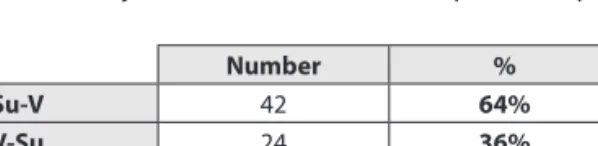
Globally, we observe that subjects occur more often in a preverbal position (Table 2):
Number %
Su-V 42 64%
V-Su 24 36%
Total 66 100%
Table 2. Proportion of Su-V/V-Su orders in gerund clauses in the 10 locations with inflected gerunds In the following sections, we investigate if the different word order patterns are conditioned by specific factors: i) presence of connective; ii) type of verb; iii) type of subject.
3.2.1. Presence of connective
In these varieties gerund clauses may be introduced by different connectives: bem ‘well’ (4 oc-currences), caso ‘case’ (1 occurrence), como ‘how’ (1 occurrence), em ‘in’ (66 ococ-currences), em bem ‘in well’ (7 occurrences), quando ‘when’ (47 occurrences), mesmo ‘even’ (4 occurrences), onde ‘where’ (=when, 1 occurrence). Some of these connectives are usually found only in finite clauses in the standard variety. It seems thus that overt inflection makes gerund clauses closer to finite domains (Lobo 2001, 2008).
The frequency of gerund clauses with a connective is quite high: 48% of gerund clauses with an overt subject have a connective.
(16) Em a perna entrando ali, pronto, já dali não abala.(CBV48)
(17) Quando chegando o tempo das batatas, arranjo um taleiguinho de batata (LVR24)
(18) Onde a gente morrendo, a gente que cá estamos, os velhos, não deve de aparecer já cá mais nenhuns! (MLD21)
Let us observe whether the presence of a connective influences subject-verb word order:
With connective Without connective
Su-V 22/3269% 20/3459%
V-Su 10/3231% 14/3441%
Table 3. Word order and presence of connective
As we can see in Table 3, subject-verb word order is predominant independently of the pres-ence of a connective, although verb-subject word order is a little bit higher without a connective. 3.2.2. Type of verb
As is well known, subjects of unaccusative verbs (such as chegar ‘arrive’ and ir ‘go’) and copula verbs (such as ser and estar ‘be’) have a special behaviour, since they are internal arguments and in many languages may occur more easily in post-verbal position. The type of verb has been shown to be a highly relevant factor for subject position in many varieties.
Let us consider this factor in the word order of adverbial gerund clauses in the locations with inflected gerunds.
Copula and unaccusative verbs Other verbs (transitive and intransitive)
Su-V 24/4257% 18/4243%
V-Su 23/2496% 1/244%
Table 4. Word order and type of verb
Su-V V-Su
Copula and unaccusative verbs 24/4751% 23/4749%
Other verbs (transitive and intransitive) 18/1995% 1/195%
Table 5. Type of verb and word order
As can be seen in Table 4, subject-verb inversion (V-Su) is much more frequent with unaccu-sative and copula verbs (96%). As can be seen in Table 5, subjects of transitive and intransitive verbs occur predominantly in preverbal position (95%). Preverbal subjects, however, can occur with all verb classes, that is, subjects of unaccusative and copula verbs occur both preverbally and post-verbally. The type of verb seems thus to be an important factor that conditions the position of the subject.
3.2.3. Type of subject
There is also some evidence that the type of subject may also correlate with the preverbal or post-verbal position of the subject (Mota 1997; among others). We have thus considered this other factor, distinguishing three types of subjects: i) Personal Pronoun (19); ii) Demonstrative Pronoun (20); iii) DP (21).
(19) Em eles tendem a outra, já não querem aquela. (LVR5)
(20) Quando aquilo estando batido, então armavam os taipais, tiravam as agulhas... (LUZ18) (21) Quando um galo cantando de noite, aquilo é ‘sinales’ ruins. (LUZ45)
As can be seen in Table 6, pronouns are more likely to occur in preverbal position, but DPs occur both in preverbal and post-verbal position. Subject demonstrative pronouns are not very frequent and the 4 cases we found were all preverbal. In preverbal position subjects can be of different types, but post-verbal subjects are predominantly DPs4.
Su-V V-Su Total
Personal Pronoun 33%14 8%2 16
Demonstrative Pronoun 10%4 0 4
DP 57%24 92%22 46
Total 100%42 100%24 66
Table 6. Word order and type of subject 3.2.4. Conclusions
In the varieties with inflected gerunds the post-verbal subject position seems to be a marked option. In post-verbal position, we find mainly subjects that are internal arguments of the verb and subjects that are morphophonologically more complex. Although the presence of a con-nective seems to be a less important factor in the conditioning of subject position, we can ob-serve that, when the gerund clause is introduced by a connective, subject-verb inversion is only found with unaccusative and predicative verbs:
(22) Hoje, em chegando a gente pouco depois de o sol posto, pregam com elas dentro (...) (LVR11)
3.3. Word order in the varieties without inflected gerunds
In the CORDIAL-SIN corpus gerund clauses with uninflected gerunds were found in the follow-ing locations:
AJT = Aljustrel (Beja) (40) MIG = Ponta Garça (Ponta Delgada) (10) ALV = Alvor (Faro) (15) MIN = Arcos de Valdevez/Bade/ S. Lourenço da CDR = Cedros (Horta) (42) Montaria (Viana do Castelo) (13)
CLC = Câmara de Lobos/Caniçal (Funchal) (6) MST = Monsanto (Castelo Branco) (8) CLH = Calheta (Angra do Heroísmo) (38) OUT = Outeiro (Bragança) (11) COV = Covo (Aveiro) (19) PFT = Perafita (Vila Real) (3) CRV = Corvo (Horta) (33) PST = Camacha, Tanque (Funchal) (7) EXB = Enxara do Bispo (Lisboa) (22) PVC = Porto de Vacas (Coimbra) (21) FLF = Fajãzinha (Horta) (9) SRP = Serpa (Beja) (16)
GRJ = Granjal (Viseu) (32) STA = Santo André (Vila Real) (36) LAR = Larinho (Bragança) (25) STE = Santo Espírito (Ponta Delgada) (41)
UNS = Unhais da Serra (Castelo Branco) (30)
Although these are more than the double of the locations with inflected gerunds (22 vs. 10), we found approximately the same number of gerund adverbial clauses (274). The productivity of gerund clauses is thus lower in these varieties compared to the ones with inflected gerunds. Remember that in the 10 locations with inflected gerunds we found 235 gerund clauses.
Contrary to the expectation that overt inflection would play a role in word order, we also find variation between subject-verb and verb-subject word orders in these varieties:
(23) a. Agora, em abalando a senhora ainda quero ter uma conversa, que ele falta-me aqui umas peças do tear, quero saber onde elas estão. (MST16)
b. Agora em eu vindo para baixo, querem ir ver além os molhos (...) como é que são? (MST34) Of the 274 gerund adverbial clauses, only 58 had an overt subject (excluding the 4 cases where the subject occurred in a topic position before the connective). Most clauses had a null subject:
(24) Tendo frio, trabalho, aqueço (CLH26)
When we consider the global results for subject-verb word order, we observe in Table 7 that also in these varieties preverbal subjects are more frequent than post-verbal ones:
Number %
Su-V 35 60%
V-Su 23 40%
Total 58 100%
Table 7. Proportion of Su-V/V-Su word order in gerund clauses (locations without inflected gerunds) In the next sections we will investigate whether these word orders are conditioned by the presence of a connective, the type of verb and the type of subject.
3.3.1. Presence of connective
In the varieties without inflected gerunds, gerund clauses may also be introduced by connec-tives, although not as diverse as in the varieties with inflected gerunds. We find the connectives
em ‘in’ (101 occurrences across the locations), quando ‘when’ (only 1 occurrence) and se ‘if’ (only
2 occurrences). Almost half of the adverbial gerund clauses with an overt subject have a con-nective (43%).
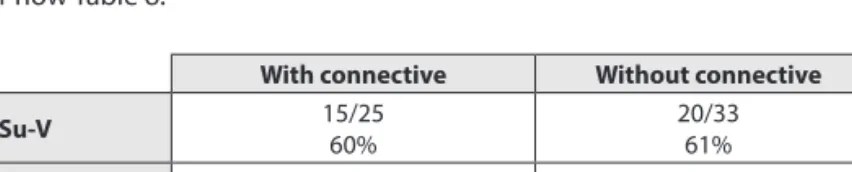
Consider now Table 8:
With connective Without connective
Su-V 15/2560% 20/3361%
V-Su 10/2540% 13/3339%
Table 8. Word order and presence of connective (locations without inflected gerunds)
We observe that preverbal subjects are more frequent than post-verbal ones regardless of the presence of a connective.
3.3.2. Type of verb
Considering the type of verb, we may observe in Tables 9 and 10 that post-verbal subjects are mainly found with unaccusative and predicative verbs. Transitive and intransitive verbs are mainly found with preverbal subjects. In the preverbal position, however, we find subjects of both types of verbs. The preverbal position is then less marked than the post-verbal one.
Copula and unaccusative verbs Other verbs (transitive and intransitive)
Su-V 16/3546% 19/3554%
V-Su 20/2387% 3/2313%
Table 9. Word order and type of verb (locations without inflected gerunds)
Su-V V-Su
Copula and unaccusative verbs 16/3644% 20/3656%
Other verbs (transitive and intransitive) 19/2286% 3/2214%
Table 10. Type of verb and word order (locations without inflected gerunds)
When the gerund clause has a connective, we only find post-verbal subjects with unaccusa-tive and predicaunaccusa-tive verbs:
(25) Isto aqui é muito frio em vindo o Inverno, minha senhora. (GRJ44) 3.3.3. Type of subject
Overt subjects of these gerund clauses can be of different types: i) personal pronouns (26); ii) demonstrative pronouns (27); iii) DPs (28):
(26) Que eu não gostava de arroz de bacalhau, e em ela o fazendo até cheirava! (AJT9)
(27) e depois, em já estando aquilo bem rijo, já estava meio espremido, tinha aqui por baixo ainda outro contrapeso. (PVC10)
(28) O pão (...) não ficando bem cozido, o miolo fica num bolo. (PST18) Consider in Table 11 how the type of subject conditions word order5:
Su-V V-Su Total
Personal Pronoun 40%14 22%5 19
Demonstrative Pronoun 0 4%1 1
DP 60%21 74%17 38
Total 100%35 100%23 58
Table 11. Word order and type of subject
As observed for the locations with inflected gerunds, subject pronouns occur predominant-ly in preverbal position. DP subjects may occur either in preverbal or post-verbal position, but post-verbal subjects are predominantly DPs.
3.3.4. Conclusions
Locations with uninflected gerunds have results similar to the ones we find for locations with inflected gerunds:
5 As above, we have considered the indefinite subject a gente ‘the people’ as a DP, since it is not always clear that it behaves as a regular pronoun.
i. the presence of a connective is not as important as other factors in what concerns word order: both orders are found in gerund clauses with and without a connective;
ii. the post-verbal position is mostly found with subjects that are internal arguments, that is with unaccusative and predicative verbs;
iii. pronouns tend to occur in preverbal position.
3.4. Comparing varieties
As we have seen above, there does not seem to be a significant difference in what concerns subject-verb word order patterns between the locations with and without inflected gerunds. In both cases, preverbal subjects are more frequent than post-verbal ones. Gerund clauses in-troduced by connectives are productive in both cases, although there are differences in what concerns the type of connectives available. Even when the clause does not have a connective, it is the preverbal position that is more frequent and it is not restricted to some verb classes. We can thus conclude that in these varieties the verb does not compete with a lexical connective. In both cases, post-verbal subjects are much more frequent with unaccusative and copula verbs. It is plausible to consider that the connectives occupy the C position, since post-verbal subjects in gerund clauses with a connective are restricted to unaccusative and copula verbs. We can conclude that V-to-C movement in those varieties is only residual, even when the C position is lexically empty. Post-verbal subjects are predominantly internal arguments and they are the only option with overt connectives.
In gerund clauses without a connective, V-Su order is also found mainly with unaccusative verbs. There are 4 cases (out of 56) with transitive verbs (29)-(30), but two of them (30) have a post-verbal pronominal subject that may behave as an expletive6. In these varieties, as described in Carrilho (2008), we find overt expletives associated with specific illocutionary contexts:
(29) a. Dando-se eles bem - que às vezes, aparecem assim e depois aparecem ‘arrevidades’. (SRP12) b. Dando-se eles bem, diz assim (SRP12)
(30) a. Só fazendo-lhe ele assim INQ É que... ele sai... (CBV48)
b. Querendo ele - por exemplo -, querendo (ele) /eu\ fazer uma teia de sacos, tira-se-lhe a estopa... (OUT12)
4. W
ordorder ingerund clausesofo
ldP
ortugueseAs we mentioned in the introduction, in Old Portuguese we could also find both preverbal and post-verbal subjects in gerund clauses:
(31) a. E, estando Elle em nós, reçebemos seus dões. (XV c. Cat)
b. E, elle estando em sua oraçon (...), veeo subitamente sobre elle hũũ grande lume do ceeo (...) (XIV c. CGE)
(32) a. Joham Rrodriguez estando no logar, veo sobrelle o concelho de Ledesma (…) (XV c. CDF) b. Achando os abades ou os priores que sseus mõges auiã feyto algũus erros pero seiã pequenos
podenos castigar (XIV c. PP)
Post-verbal subjects may occur immediately after the main verb (32b) or auxiliary verb (33) or after an object or adjunct (34):
(33) e sse o fezessẽ (contra) seu deffendimẽto auendoos elle ante rrogados e deffendudo q(ue) o nõ ffezessem (XIV c. PP)
(34) quaãdo elle meesmo dá algo a algũũ homẽ q(ue) lho gããhe nõ sabendo esto o p(re)lado. (XIV c. PP) The verb can also be preceded by the object:
(35) Promissom fazẽdo algũũ homẽ a out(ro) de ssa võõtade de cousa dereyta e bõa deuẽna mãteer (XIV c. PP)
In the data analysed so far from the selected texts of CIPM, we found 508 gerund clauses with overt subjects (in a total of more than 3000 gerund clauses). We did not consider ambigu-ous cases. As in the dialectal data, most gerund clauses have null subjects.
The overall proportion of preverbal and post-verbal subjects is given in Table 12:
Number %
Su-V 43 8,5%
(X)-V-(X)-Su 465 91,5%
Total 508 100%
Table 12. Proportion of Su-V/V-Su word order in gerund clauses of Old Portuguese
As we can observe, subject-verb inversion is clearly the dominant pattern. Preverbal subjects are much less frequent than post-verbal ones in gerund clauses. This pattern is clearly different from the one we found in the dialectal varieties. In the following sections, we shall consider whether there are conditioning factors for these different word orders.
4.1. Presence of connective
Gerund clauses with a connective are not frequent in our Old Portuguese corpus. From the 508 gerund clauses with overt subjects only 17 have a connective, which corresponds to 3% of the gerund clauses with overt subjects. This is very different from the frequency of gerund clauses with connectives in the dialects, approximately 50%. The connectives found in this corpus were
em ‘in’ (16 occurrences) and sem ‘without’ (1 example)7:
(36) E q(ue) uos ssem out(ra) Justiça nẽhua possades pẽnhorar no uosso pelo uosso ssem me chamãdo Eu p(or) elo fforçado nẽ A fforça (XIV c. DN138)
(37) muytas vezes o vimos acontescer que, en querendo o monteyro acorrer ao alaão, que, en chegando elle ao porco, o porco se espedia do alaão ou por feridas ou per cansaço (XIV c. LM)
(38) Ca d(eo)s o faz affim que em destrebuíndo tu aos pobres mereças que te de mais . E que os pobres sejam coroados de diadema (XV c. LTV)
In Table 13 we present the number of preverbal and post-verbal subjects in each type of clause:
With connective Without connective
Su-V 0 43
V-Su 17 448
Table 13. Word order and presence of connective (Old Portuguese)
As we can observe, the presence of a connective does not favour preverbal subjects. All the preverbal subjects found in the corpus occur in clauses without a connective. In gerund clauses with a connective we only found post-verbal subjects. This pattern is quite different from the one we find in the non-standard varieties.
4.2. Type of verb
Considering the type of verb, we find gerund clauses with different verb classes, including tran-sitive verbs (39), unaccusative verbs (40) and copula verbs (41):
(39) a. p(er)o elle mostrãdolha u(er)dadeyramẽt(e) cõ omildade, se o cl(er)igo darlhy nõ q(ui)sesse a lecẽça, pódesse el q(ue)relar a sseu mayoral, assy como ao archip(re)ste ou ao arcidiagoo ou ena cima ao b(is)po daq(ue)l bispado onde ffosse o cl(er)igo. (XIV c. PP)
b. E ainda fazendo os cl(er)igos lauoyras algũas enas terras das eyg(re)ias (...) podenas teer en sseu pegulhal ata a ssa m(or)te (XIV c. PP)
(40) et morrendo vos en tenpo q(ue) aq(ue)l q(ue) ouuer de auer a d(i)ta herança nõ aja q(ui)nze an(n) os, q(ue) posad(e)s leyxar titor q(ue) o crie & ensigne p(er) las noujdad(e)s ata q(ue) o herdeyro ouuer q(ui)nze an(n)os (XV c. HGP044)
(41) a. & o dito abb(ade) don Henrriq(ue) estando p(re)sente na dita curtina, o dito Pedro P(er)iz filou vun nabo (con) suas uerssas na mao da dita curtina & meteuo ao dito abade na mao, dizendo q(ue) la ent(re)gaua a dita curtina & as ditas casas com(o) suas por q(ue) son do dito moesteyro dond’ele é abbad(e); (XIII c. HGP101)
b. Tanto que forão acabadas as festas se foy pera a cidade nova, estamdo elrey na cidade nova, dis-erão lhe em como hera entrado hũu embaixador do ydallcão, jaa elle sabia que vinha o embaix-ador, mas desymullava o, que ho não sabya, por quoanto tem de costume não mamdar receber nenhũu embaixador. (XVI c. CRB)
In Tables 14 and 15 we find the relation between word order and type of verb in our corpus of Old Portuguese:
Copula and unaccusative verbs Other verbs (transitive and intransitive)
Su-V 12/43 28% 31/43 72% V-Su 210/465 45% 255/465 55% Table 14. Word order and type of verb (Old Portuguese)
Su-V V-Su
Copula and unaccusative verbs 12/2225% 210/22295%
Other verbs (transitive and intransitive) 29/28110% 252/28190%
Table 15. Type of verb and word order (Old Portuguese)
As we can observe, post-verbal subjects are found with any kind of verb and they are more frequent with every verb type. Preverbal subjects are more common with transitive verbs.
4.3. Type of subject
In what concerns the type of subject, we may find: personal pronouns (42)-(43); demonstrative pronouns (44)-(45); indefinite pronouns (46); DPs (47)-(48); and subject clauses (49):
(42) a. Out(ro)ssy acaeçeu de Sã Soeyro q(ue) elle entrando na jg(re)ia q(ua)ndo os cl(er)igos q(ue)riam faz(er) sa jsliçõ ueo hũa poonba e pousou en sa cabeça e uirom q(ue) era sinal de De(us) e fezerõno logo bispo. (XIV c. PP)
(43) e queremdo elle ver homde estavão os portugueses, deitamdo o corpo amte hũas ameyas, foy mor-to de huma espimgardada que ho mor-tomou pello meyo da testa (XVI c. CRB)
(44) E este cõhocendoo q(ue) era pouco o q(ue) lhe dauã os q(ue) forõ ant(e) a De(us) ssegũdo os bẽẽs q(ue) del rreçebẽ começou elle a dar dizemo demais (PP, s. XIV)
(45) fiq(ue)n todas estas herdades (…) ao p(ri)meyro fillo ou filla (…) sen enbargo dos outros seus yrmaa-os; et morrendo aq(ue)l sen fillo ou filla erdeyro q(ue) fiq(ue) ao segũdo (XV c. HGP)
(46) Mããos iradas metendo algũũ en cl(er)igo ou ẽ molh(e)r ou en homẽ de rreligiõ p(er)a ferilo ou p(er)a matalo ou p(er)a p(re)ndelo cãe en duas peas: a hũa de scomũhõ e a out(ra) q(ue) ha d’ir a Roma q(ue) o asoluã. (XIV c. PP)
(47) Achando os abades ou os p(ri)ores q(ue) sse(us) mõges auiã feyto algũus erros (…) podenos casti-gar (XIV c. PP)
(48) & o dito abb(ade) don Henrriq(ue) estando p(re)sente na dita curtina, o dito Pedro P(er)iz filou vun nabo (con) suas uerssas na mao da dita curtina & meteuo ao dito abade na mao, dizendo q(ue) la ent(re)gaua a dita curtina & as ditas casas com(o) suas por q(ue) son do dito moesteyro dond’ele é abbad(e); (XIII c. HGP)
(49) Out(ro)ssy acaeçendo q(ue) festa algu~a de s(an)to daq(ue)lles q(ue) am vigilias caesse en ssegũda feyra, deuẽ jauuhar (XIV c. PP)
The distribution of subject-verb word order according to the type of subject is given in Table 16:
Su-V V-Su Total
Personal Pronoun 37%16 15%71 87
Demonstrative Pronoun 5%2 2%8 10
DP 58%25 73%339 364
Quantified or Indefinite Pronoun 0 8%38 38
Clause 0 2%9 9
Total 100%43 100%465 508
Table 16. Word order and type of subject
In preverbal position we find both pronouns and DPs, the latter being slightly more fre-quent. In post-verbal position we find mostly DP subjects. Subject clauses and indefinite sub-jects occur only in post-verbal position.
5. d
iscussionandconclusionsIn both varieties considered in this paper most gerund clauses lack an overt subject. When the subject is present, we can find both subject-verb and verb-subject word orders. Both varieties are null subject languages. Therefore, they do not pattern like consistent standard null subject languages in which subject-verb inversion is the norm. We have shown, however, that these varieties differ in the frequency of each word order: subject-verb is the predominant order in the dialectal varieties; verb-subject is the predominant order in Old Portuguese. We have also shown that overt person inflection on the gerund does not influence word order and that dif-ferent factors condition the preverbal or post-verbal position of the subject in each variety. In the dialectal varieties, the post-verbal position is the marked one and post-verbal subjects are predominantly found with unaccusative and copula verbs. In Old Portuguese it is the post-ver-bal position that is unmarked and preverpost-ver-bal subjects are more common with personal pronouns and with transitive verbs.
Since verb-subject inversion in the dialectal varieties is almost exclusively found with unaccu-sative and copula verbs, it is plausible to assume that the verb does not raise to a left peripheral position. Instead, in inversion structures, it is the subject that stays in situ. In Old Portuguese, how-ever, verb-subject inversion is the predominant order with all kinds of verbs. Moreover, we find cases of subject-auxiliary inversion, as in (50), which are generally analysed as V to C movement:
(50) a. auendoos elle ante rrogados e deffendudo q(ue) o nõ ffezessem. (XIV c. PP)
b. Et auẽdo uos ou uosas uoz(e)s de bender ou sopenorar ou allear este d(i)to aforam(en)to (…), q(ue) o façad(e)s ao d(i)to most(eyr)o (XV c. HGP)
It seems, thus, that in Old Portuguese gerund clauses the verb raises to a higher position than in independent clauses and subordinate finite clauses (Martins 2002, Fiéis 2003).
Differently from contemporary non-standard varieties, in Old Portuguese there can be V-Su orders in gerund clauses introduced by a connective with verbs other than unaccusative and copula verbs (e.g. em in examples like (37) and (38)). How can we explain this? Either we assume that the connective fills the C position, thus preventing the verb from moving and the subject remains in situ, or in Old Portuguese the connective has a different status (i.e. it is not a comple-mentizer) and there is always V-to-C movement.
Apart from V-Su orders, we sometimes find Su-V orders in Old Portuguese. Does this imply that the V does not raise to the higher functional domain? Although it is difficult to find clear evi-dence for the structural position of each constituent in these clauses, it is clear that it differs from the position found in the dialectal data. In particular, we observe that the object may precede the verb leading to an OVS word order (51) or, less often, it may follow the verb and precede the subject, leading to a VOS word order (52):
(51) O dereyto do padroadigo auendo muytos homẽẽs en hũa eyg(re)ia (…), aq(ue)l deue a rreçeb(e)r o b(is)po q(ue) p(re)sentarẽ os mays e (con) [melhor] entençõ (XIV c. PP)
(52) quãdo elle meesmo dá algo a algũũ homẽ q(ue) lho gããhe nõ sabendo esto o p(re)lado. (XIV c. PP) We may hypothesize, following previous proposals (e.g. Martins 2011), that the position of the constituents in Old Portuguese is at least partly conditioned by their informational status. We can thus find different word orders in gerund clauses – OVS, SVO, VSO, VOS – depending on the informational status of the subject and of the object. A preverbal subject or object behaves as a topic, the last constituent behaves as a focus and the previous constituent is scrambled or defocused (see Costa 1998 for a proposal of information-driven movement in European Portu-guese). It is clear that some types of subjects are typically post-verbal, such as heavy DPs (e.g. DPs modified by a relative clause) and indefinites. In fact, in gerund clauses with OVS, the sub-ject is usually an indefinite (53). In VSO sentences, the subsub-ject can be a personal pronoun or a definite DP (54):
(53) Mããos iradas metendo algũũ en cl(er)igo ou ẽ molh(e)r ou en homẽ de rreligiõ p(er)a ferilo ou p(er)a matalo ou p(er)a p(re)ndelo cãe en duas peãs (XIV c. PP)
(54) a. E nõ (com)p(ri)ndo uos as d(i)tas cousas ou cada hũa delas q(ue) uos p(er)cades as d(i)tas vĩhas (XIV c. DN)
b. achando os caães aquelle porco e correndo con elle, faria-sse en ello mays fermosa montaria (XIV c. LM)
In SVO sentences, the subject, often a personal pronoun, is usually a topic. In (55), the sub-ject elle is anaphoric with respect to Sã Soeyro, clearly the topic:
(55) Out(ro)ssy acaeçeu de Sã Soeyro q(ue) elle entrando na jg(re)ia q(ua)ndo os cl(er)igos q(ue)riam faz(er) sa jsliçõ ueo hũa poonba e pousou en sa cabeça e uirom q(ue) era sinal de De(us) e fezerõno logo bispo. (XIV c. PP)
The difference in word order patterns between dialectal varieties and Old Portuguese would then be attributable on the one hand to different specifications of the C-domain and on the other hand to the availability of information-driven movement such as topicalization and scram-bling.
a
cknoWledgmentsThis work was supported by FCT-MCTES through the project Subordination in Medieval
Portu-guese - PTDC/MHC-LIN/4564/2012. We thank Cláudia Martins for her help with the data from
r
eferencesAmbar, Manuela (1988): Para uma sintaxe da
inver-são sujeito verbo em português. UL. Doctoral
Dis-sertation. [published 1992. Lisboa: Ed. Colibri]. Barbosa, Pilar (1995): Null subjects. MIT. Doctoral
Dis-sertation.
Barbosa, Pilar (2002): “A propriedade do sujeito nulo e o princípio da projecção alargado”, in Maria Helena Mateus / Clara Nunes Correia (orgs.),
Sa-beres no tempo. Homenagem a Maria Henriqueta Costa Campos. Lisboa: Colibri, 51-71.
Carrilho, Ernestina (2008): “Beyond doubling: overt expletives in European Portuguese dialects”, in Sjef Barbiers et al. (eds.), Microvariation in
syntactic doubling. Bingley: Emerald. 301-323.
10.1163/9781848550216_012.
Carrilho, Ernestina / Sandra Pereira (2011): “Sobre a distribuição geográfica de construções sintácti-cas não-padrão em português europeu”, in
Tex-tos seleccionados do XXVI Encontro Nacional da Associação Portuguesa de Linguística. CD-ROM.
Lisboa: APL, 125-139.
Costa, João (1998): Word order variation. A
con-straint-based approach. The Hague: Holland
Academic Graphics.
Fiéis, Alexandra (2003): Ordem de palavras,
transitivi-dade e inacusativitransitivi-dade. Reflexão teórica e análise do português dos séculos XIII a XVI. Universidade
Nova de Lisboa. Doctoral Dissertation. Fiéis, Alexandra / Maria Lobo (2010) “Aspectos da
sintaxe das orações gerundivas no português medieval e no português europeu contempo-râneo”, in Ana Maria Brito et al. (eds.), Textos
sele-cionados. XXV Encontro Nacional da Associação Portuguesa de Linguística. Porto: APL, 419-434.
Lobo, Maria (2001): “On gerund clauses of portuguese dialects”, in Alexandre Veiga / Víctor M. Longa / JoDee Anderson (eds.), El verbo. Entre el léxico y la
gramática. Lugo: Ed. Tris Tram, 107-118.
Lobo, Maria (2008): “Variação morfo-sintáctica em dialectos do português europeu: o gerúndio flexionado”, Diacrítica 22 (1), 25-55.
Martins, Ana Maria (2002): “The loss of IP-scram-bling in European Portuguese: clause struc-ture, word-order variation and change”, in David Lightfoot (ed.), Syntactic effects of
mor-phological change. Oxford/NY: Oxford
Uni-versity Press, 232-248. DOI:10.1093/acprof:o-so/9780199250691.003.0013.
Martins, Ana Maria (2011): “Scrambling and infor-mation focus in old and contemporary Portu-guese”, Catalan Journal of Linguistics 10, 1-26. Mota, Maria Antónia (1997): “Les traits nombre et
personne/nombre en portugais - l’oral dans ses variétés”, in Mireille Bilger / Karel van den Eynde / Françoise Gadet (eds.), Analyse linguistique et
approches de l’oral. Recueil d’études offert en hom-mage à Claire Blanche-Benveniste (Orbis,
Supple-menta 10). Louvain-Paris: Peeters, 339-345. Rizzi, Luigi (1982): Issues in Italian syntax. Dordrecht:
Foris.
Roberts, Ian (1994): “Two types of head movement in Romance”, in David Lightfoot / Norbert Horn-stein (orgs.), Verb movement. Cambridge: Cam-bridge University Press, 207-242. https://doi. org/10.1017/CBO9780511627705.012. Santos, Ana Lúcia (1999): O particípio absoluto em
português e em outras línguas românicas. UL.