International Journal of Social Psychiatry 2016, Vol. 62(7) 651 –660 © The Author(s) 2016 Reprints and permissions: sagepub.co.uk/journalsPermissions.nav DOI: 10.1177/0020764016668907 isp.sagepub.com
E CAMDEN SCHIZOPH
Effectiveness of Depression–Suicidal
Behaviour Gatekeeper Training among
police officers in three European regions:
Outcomes of the Optimising Suicide
Prevention Programmes and Their
Implementation in Europe
(OSPI-Europe) study
Ella Arensman
1,2, Claire Coffey
1, Eve Griffin
1,
Chantal Van Audenhove
3, Gert Scheerder
3, Ricardo Gusmao
4,
Susana Costa
5, Celine Larkin
1, Nicole Koburger
6,
Margaret Maxwell
7, Fiona Harris
7, Vita Postuvan
8and Ulrich Hegerl
6Abstract
Background: Gatekeeper training for community facilitators, to identify and respond to those at risk of suicide, forms an important part of multi-level community-based suicide prevention programmes.
Aims: This study examined the effects of gatekeeper training on attitudes, knowledge and confidence of police officers in dealing with persons at risk of suicide.
Methods: A total of 828 police officers across three European regions participated in a 4-hour training programme which addressed the epidemiology of depression and suicidal behaviour, symptoms of depression, warning signs and risk factors associated with suicidal behaviour, motivating help-seeking behaviour, dealing with acute suicidal crisis and informing bereaved relatives. Participants completed internationally validated questionnaires assessing stigmatising attitudes, knowledge about depression and confidence in dealing with suicidal persons pre- and post-training.
Results: There were significant differences among countries in terms of previous exposure to suicidal persons and extent of previous training. Post-training evaluation demonstrated significant improvements in stigmatising attitudes, knowledge and confidence in all three countries.
Conclusion: The consistently positive effects of gatekeeper training of police officers across different regions support inclusion of this type of training as a fundamental part of multi-level community-based suicide prevention programmes and roll-out, nationally and internationally.
Keywords
Gatekeeper training, suicide, depression, police, community, prevention
1 National Suicide Research Foundation, University College Cork, Cork, Ireland
2 Department of Epidemiology and Public Health, University College Cork, Cork, Ireland
3 LUCAS (Centre for Care Research and Consultancy), KU Leuven, Leuven B-3000, Belgium
4Instituto de Saúde Pública, Universidade do Port, Porto (ISPUP) 5EUTIMIA, Lisboa, Portugal
6 Klinik und Poliklinik für Psychiatrie und Psychotherapie, Universitätsklinikum Leipzig AöR, Leipzig, Germany
Original Article
7 Nursing, Midwifery and Allied Health Professions Research Unit, Innovation Park, University of Stirling, FK9 4NF, Stirling, UK 8 Slovene Center for Suicide Research, Andrej Marušič Institute,
University of Primorska, Koper, Slovenia
Corresponding author:
Ella Arensman, National Suicide Research Foundation, University College Cork, Room 4.28, Western Gateway Building, Cork, Ireland, T12 XF62.
Introduction
Suicide is the most common type of violent death glob-ally, with over 800,000 suicides occurring each year (World Health Organization (WHO), 2014). There is a lack of consistent evidence to identify the most effective strategy to prevent suicide (Mann et al., 2005; Windfuhr, 2009). However, it is thought that due to the complexity of factors which are associated with suicidal behaviour, evidence-informed interventions which target the prob-lem on multiple levels are the most effective (Althaus & Hegerl., 2003; Ono et al., 2008; Hegerl & Wittenburg, 2009; Van der Feltz-Cornelis et al., 2011). Educational programmes are one of the five evidence-based ventions which also include screening, treatment inter-ventions, means restriction and media and gatekeeper training (Mann et al., 2005; Shim & Compton, 2010). An example of an evidence-based intervention pro-gramme for suicide prevention at community level is gatekeeper training (Cross, Matthieu, Cerel, & Knox, 2007). The term ‘gatekeeper’ refers to people who have primary contact with those at risk of suicide and can identify them by recognising suicidal risk factors (Isaac et al., 2009). Gatekeeper training ‘teaches specific groups of people to identify people at high risk for sui-cide and then to refer those people for treatment’ (Isaac et al., 2009, p. 261). While there is no consistent evi-dence to suggest that gatekeeper training alone decreases existing rates of suicide, such programmes are seen as one of the most important components of broader sui-cide prevention strategies (Hegerl et al., 2009; Isaac et al., 2009; Swanke & Buila, 2010). Gatekeeper train-ing is often integrated into multifaceted strategies aimed at educating community facilitators on identifying signs of depression and suicidal behaviour and referring to appropriate services (Cross, Matthieu, Lezine, & Knox, 2010; Hegerl et al., 2009; Knox, Litts, Talcott, Feig, & Caine, 2003).
Community facilitators represent a heterogeneous group of professionals, including teachers, police offic-ers, social workoffic-ers, pharmacists and clergy. Despite the fact that many of these people are confronted with depressed or suicidal persons in their daily work (Scheerder et al., 2010a, 2010b), they are rarely seen as a target group for public health interventions. Linsley, Johnson and Martin (2007) note that police officers are regularly in contact with those who take their own lives, with one-fifth of suicide cases having a documented con-tact with police in the 3 months leading up to the death. Furthermore, Vermette, Pinals and Appelbaum (2005) underlined the important role that police officers play in relation to mental health. Officers working in law enforcement are often the first to respond to a mentally ill person in crisis and often have to make a decision about appropriate referrals for treatment. According to Borum
(1998), professionals in law enforcement provide up to one-third of all emergency mental health referrals. Although these contacts provide opportunities for inter-vention (Linsley et al., 2007), few professionals receive adequate training for dealing with such situations effec-tively and efficiently (Linsley et al., 2007; Scheerder et al., 2010a). Previous studies which have included police officers as a target group in educational training programmes have addressed attitudes towards mental health, stigma and discrimination in the police force (Pinfold et al., 2003; Vermette et al., 2005; Compton,Bahora,Watson, & Oliva, 2008; Dumesnil & Verger, 2009). Pinfold et al. (2003) introduced an educa-tional intervention to reduce psychiatric stigma and dis-crimination in the English police force. The study observed improvements in stigmatising attitudes, but they found no difference in behavioural intentions, along with a negative change in attitude. Suicide prevention studies in the Canadian police force (Mishara & Martin, 2012), Norwegian military (Mehlum & Schwebs, 2001) and the US Air Force (Knox et al., 2003, 2010) are the only studies which tackle suicide prevention within organisations using a multi-level approach. However, in these studies, mem-bers of the organisations are not trained as community gatekeepers, and the primary aim of these educational pro-grammes was to reduce suicide rates within the organisa-tions themselves. Nevertheless, such studies have highlighted the effectiveness of these programmes in pro-moting awareness of depression and suicide (Mishara & Martin, 2012; Rozanov, Mokhovikov, & Stiliha, 2002), thereby equipping gatekeepers with the knowledge to identify (and the motivation to intervene) with those show-ing signs of suicide risk.
Problems arise when evaluating suicide prevention studies, as the most objective measure of effectiveness is a reduction in the number of completed suicides (Swanke & Buila, 2010). Low incidence rates and resulting low statis-tical power preclude the assessment of suicide as a primary outcome. Therefore, intermediate outcome criteria have become the focus of measurement in a growing number of studies (Walker, Verins, Moodie, & Webster, 2005) such as decreases in risk or increases in protection (e.g. increased knowledge, awareness and perceived competence). This study aimed to examine the effectiveness of a depression and suicide awareness gatekeeper training programme with police officers in improving attitudes and increasing knowledge and confidence in dealing with suicidal per-sons, as part of a multi-centre suicide prevention pro-gramme, Optimising Suicide Prevention Programmes and Their Implementation in Europe (OSPI-Europe; Hegerl et al., 2009). Coppens et al. (2014) previously reported on the effectiveness of this training programme among other types of community facilitators, including teachers, phar-macists, nurses, the clergy, social workers, counsellors, managers and carers for the elderly.
Methods
Design
The research design was a prospective single-group pre-test and post-pre-test evaluation. In order to determine pre-post training changes among participants of the OSPI-Europe gatekeeper programme, a standardised procedure was used to collect data from participants attending the training pro-grammes in three European regions. Semi-structured self-report questionnaires were administered among participants immediately before (pre) and after (post) training. A 4-month follow-up was conducted in order to investigate changes after the post-training assessment and enable investigation of sustainability of training effects. All par-ticipants were invited to participate in the evaluation.
Participants
The standardised Depression and Suicide Gatekeeper training programme was delivered to 828 police officers in three OSPI-Europe intervention regions: Limerick (Ireland, n = 425 trained out of 643 active-duty officers), Amadora (Portugal, n = 260 trained out of approximately 350 active-duty officers) and Leipzig (Germany, n = 143 out of 1380 active-duty officers). The sample of officers in Leipzig comprised mostly of officers-in-training, whereas the Portuguese and Irish participants were already working as police officers.
Study protocol
The OSPI-Europe programme was delivered in regions with diverse social and cultural backgrounds (Hegerl et al., 2009). To ensure a comparable method of implementation between different intervention regions, a collectively developed training programme was used, of which certain elements were defined as core training contents to be applied consistently across all intervention regions. Adaptation of training materials to a regional context was also encouraged. Moreover, in order to meet local needs, the mode of delivery of the training programme was also open to some local flexibility. In Ireland and Germany, peer-led training (train-the-trainer (TTT)) was employed. In Portugal, no TTT sessions occurred, and the training was delivered directly by members of the OSPI team. In Ireland, the personnel delivering training were senior police officers, whereas in Germany, the trainer was a phy-sician who worked within the police force.
In Ireland, an initial 3- to 4-hour standard gatekeeper programme was delivered to senior police officers with a background in general police training. Subsequently, a 9-hour TTT programme was conducted with core training personnel who had attended the standard gatekeeper pro-gramme so that they could then undertake the subsequent roll-out of the ‘standard/model’ gatekeeper training course
to their peers. Based around a detailed resource pack, the TTT programme provided the trainers with the informa-tion and resources needed to deliver gatekeeper training sessions. The training provided trainers with presentation slides, extensive background information, suggested for-mats for the training, guidance and advice on delivery. In Germany, an 8-hour TTT programme was conducted with comparable material by the OSPI-Europe project coordi-nator and a co-worker with extended experience in TTT workshops within the multi-level suicide prevention approach used in OSPI-Europe. These trainers conducted the gatekeeper training programme. Following completion of the TTT programme, in both regions, the trained trainers delivered the 4-hour gatekeeper programme with supervi-sion provided by members of the OSPI-Europe team. In Portugal, all gatekeeper training programmes were deliv-ered by members of the OSPI-Europe team, with expertise in psychiatry and psychology.
The content of the 4-hour OSPI gatekeeper programme is designed to provide participants with an overview of the extent of depression and suicidal behaviour, symptoms of depression, warning signs and risk factors associated with suicidal behaviour, motivating help-seeking behaviour, dealing with acute suicidal crisis and informing bereaved relatives. The programme concludes with gatekeeper role-plays to practise asking an at-risk person about suicide risk factors, responding appropriately to disclosures and refer-ring to appropriate services. The duration of the gatekeeper training was 4 hours in all centres. The group size ranged from a maximum of 15 participants in Limerick to a maxi-mum of 25 in Leipzig and Amadora.
Measures
Evaluation questionnaires included internationally vali-dated items and questionnaires relating to standard socio-demographic information, previous experience of training related areas, previous experience of contact with people at risk of suicide in a professional capacity, stigma towards depression, knowledge about suicide interventions and confidence in recognising suicide risk.
Stigma towards depression was measured utilising the Depression Stigma Scale (DSS; Griffiths, Christensen, Jorm, Evans, & Groves, 2004). The DSS contains 18 items and is made up of two subscales: personal depression stigma and perceived depression stigma. Nine items meas-uring ‘personal depression stigma’ ask respondents to rate how strongly they feel personally about statements relat-ing to depression. Nine items also measure ‘perceived depression stigma’ and require respondents to rate how they think other people feel about the same issues. The scale has been used previously to examine pre-post changes following educational interventions (Finkelstein & Lapshin, 2007; Griffiths et al., 2004) and was shown to have adequate reliability. In this sample, the personal
depression stigma subscale was used and had a Cronbach’s alpha value of .7. The items from the DSS were aggregated to give a total maximum score of 36.
Knowledge in relation to suicide intervention was assessed using a modified version of the Suicide Intervention Knowledge Test (IKT; Tierney, 1994), which is designed to measure knowledge components directly related to suicide intervention. The original test had a split-half reliability of .59 (Pearson), indicating a moderate level of internal consistency and a test–retest Pearson cor-relation coefficient of .67, indicating moderate stability (Tierney, 1994). The items from the IKT were aggregated to give a total maximum score of 9.
Confidence to identify suicide risk was assessed by one item from the Confidence Scale developed by Morriss, Gask, Battersby, Francheschini and Robson (1999) and adapted by Capp, Deane and Lambert (2001): ‘I feel confi-dent that I could iconfi-dentify a person at-risk for suicide’. The item is scored using a 10-cm visual analogue scale. A mini-mum score indicates ‘not being at all confident’, whereas a maximum score indicates being ‘very confident’.
Procedure
At the start of each training session, an introductory letter, regarding the evaluation of the training, a consent form and baseline questionnaires were distributed among the participants by an independent researcher. Immediately after the training programme, the post-training question-naires were distributed. In Ireland and Germany, partici-pants who consented to be contacted for the follow-up received an explanatory letter and follow-up questionnaire 4 months after the post-training assessment either by post or email. For participants who had not returned the 4-month follow-up questionnaire within 3–6 weeks, a reminder email was sent out.
Ethical statement
The study was approved by the relevant research ethical committees in the participating intervention regions (Ethics Commission of the Medical Faculty, University of Leipzig, Germany; Ethics Research Committee of the Mid-West Regional Hospital, Limerick City and County, Ireland; and Ethical Committee of the Faculty of Medical Sciences, New University of Lisbon, Portugal). The study was performed in accordance with the ethical standards laid down in the 1964 Declaration of Helsinki and its later amendments.
Data analysis
Statistical analyses were conducted using SPSS 18.0. Pre- and post-training effects were analysed using mixed-between analysis of variance (ANOVA) tests and to assess associations between the magnitude of change for each of
the outcome measures and socio-demographic characteris-tics. The assumptions for mixed between-within ANOVA were met. The results of the ANOVA tests were adjusted for the following variables: country of the participant, age of the participant and number of years of professional experi-ence (<4 years, 4–10 years and 10+ years). Chi square tests and independent-sample t-tests were used to test for differ-ences in outcome measure scores between participants who had received previous training and those who had not.
Results
Response rate
The overall post-training response rate for police officers was high (90%, n = 748) and consistent across the three countries. However, the 4-month follow-up rate for a postal questionnaire was low across all countries (6%, n = 46), therefore the main statistical analysis is limited to pre-training and post-pre-training scores only.
Socio-demographic characteristics
The majority of the participants were male (80.1%). Portugal had the highest proportion of male participants (91.9%), compared with Germany (81.1%) and Ireland (72.5%; Table 1). This distribution is in keeping with the general prevalence of males among police officers.
Most of the participants were under 45 years of age (82.7%). In Germany, 96.4% of the participants were under the age of 45 years. This is higher than both Ireland (76.4%) and Portugal (85.7%) and reflects the fact that most of the participants were officers-in-training.
Depression stigma, suicide prevention
knowledge and confidence to detect persons at
risk
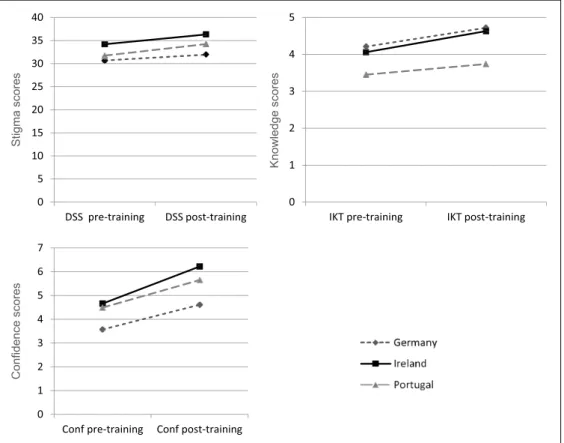
Of the 828 participants, 94.7% (n = 748) completed the personal depression stigma subscale of the DSS both before and immediately after training (pre- and post-training, respectively). Multivariate analysis (Table 2) demonstrated the main effects for the intervention, and country and gender at baseline, on DSS scores. A signifi-cant increase in mean scores on the DSS occurred after the training session (M = 32.99, standard deviation (SD) = 4.6 vs M = 35.18, SD = 4.8; F = 100.23, p < .001). At baseline, participants in Ireland had significantly higher scores on the DSS personal subscale (M = 34.22, SD = 4.4), indicating less personal depression stigma, than participants in either Portugal (M = 31.77, SD = 4.4) or Germany (M = 30.87, SD = 4.3; F = 27.72, p < .001). At baseline, females held less stigmatising attitudes than males (M = 35.36, SD = 4.5 vs M = 32.42, SD = 4.5; F = 31.95, p < .001).
The Suicide IKT was completed by 80.3% (n = 665) of the participants both pre- and post-training. In multivariate analysis (Table 2), there was a significant main effect for the intervention, as well as for country and years of profes-sional experience at baseline, on IKT scores. There was a significant change in mean scores on the IKT (M = 3.88, SD = 1.3; M = 4.35, SD = 1.3; F = 28.27, p < .001), indicat-ing increasindicat-ing knowledge. At baseline, participants in Portugal (M = 3.47, SD = 1.12) had significantly lower knowledge scores than participants in Ireland (M = 4.09, SD = 1.30) or Germany (M = 4.15, SD = 1.25; F = 31.76, p < .001). There was a significant interaction between country and time (F = 4.05, p = .018), suggesting that the effects of training on knowledge scores were greater for Ireland (mean score difference: +0.58) than for Germany (mean score difference: +0.48) or Portugal (mean score difference: +0.31; see Figure 1). At baseline, years of experience was associated with level of knowledge (F = 7.37, p < .001), such that those with >10 years of expe-rience had significantly lower scores, indicating less knowledge (M = 3.88, SD = 1.23), than those with less than 4 years of experience (M = 3.92, SD = 1.3) or those with between 4 and 10 years of experience (M = 4.12, SD = 1.3).
Of the 828 participants, 89.9% (n = 744) completed the Confidence Scale pre- and post-training. There was a sig-nificant main effect for the intervention on confidence scores (M = 4.48, SD = 1.8 vs M = 5.85, SD = 1.8; F = 248.61, p < .001), indicating increasing confidence. Moreover, there were significant main effects for country (F = 28.5,
p < .001) and years of experience (F = 6.34, p < .001). At baseline, Germany (M = 3.64, SD = 1.7) had significantly lower scores than either Portugal (M = 4.49, SD = 1.9) or Ireland (M = 4.69, SD = 1.8). There was a significant inter-action between country and time (F = 4.54, p = .011), sug-gesting that the effects of training on knowledge scores were greater for Ireland (mean score difference: +1.55) than for Germany (mean score difference: +1.09) or Portugal (mean score difference: +1.17; see Figure 1). Baseline confidence was highest for those with <4 years of experience (M = 4.50, SD = 1.8) followed by 4–10 years of experience (M = 4.69, SD = 1.7) and finally >10 years (M = 4.25, SD = 1.9).
Experience, previous training and exposure to
suicidal behaviour
Approximately one-third of the participants (33.1%) had >10 years of experience as a police officer. Given that most of the German participants were officers-in-training, the number of years of experience was lower in the German sample – only 6.7% of the participants had >10 years of experience. In contrast, 35.8% of the Irish participants and 41% of the Portuguese participants had over 10 years of experience (Table 1).
Overall, 42.3% of all participants had received some training in crises and suicidal behaviour in their profes-sional career. Specifically, 33.6% of all participants had previously received training in responding to a crisis,
Table 1. Baseline characteristics of participants in police officer depression–suicidal behaviour awareness training.
Characteristic Germany
(n = 143) Ireland (n = 525) Portugal (n = 260) Overall (n = 828)
Gender Male 81.1% 72.5% 91.9% 80.1%
Female 18.9% 27.5% 8.1% 19.9%
Age <31 years 94.2% 38.1% 43.8% 49.3%
31–45 years 2.2% 38.3% 41.9% 33.4%
>45 years 3.6% 23.6% 14.2% 17.3%
Years in school <13 years 22.9% 33.9% 51.4% 37.7%
13–16 years 71.4% 40.3% 41.7% 46.3%
>16 years 5.7% 25.8% 6.9% 16.1%
Years of professional
experience <4 years4–10 years 87.5%5.8% 24.6%39.6% 27.3%31.6% 35.0%31.9%
>10 years 6.7% 35.8% 41.0% 33.1%
Received previous training Overall 17.7% 57.5% 30.0% 42.3%
Type of previous training Depression 7.7% 20.2% 15.0% 16.6%
Self-harm 1.5% 14.1% 15.0% 12.4%
Suicide 10.8% 29.2% 15.0% 21.7%
Crisis 8.5% 49.2% 21.2% 33.6%
Experienced suicidality in
professional capacity 6.2% 52.6% 24.2% 36.2%
Discussed their concerns with
the distressed person 34.6% 80.9% 63.7% 73.1%
21.7% had attended previous training in suicide awareness and suicide prevention, 16.6% and 12.4% had received training in depression and self-harm awareness, respec-tively. Ireland had the highest percentage of police officers who had received previous training (57.5%), most com-monly crisis training (49.2%).
At baseline, 36.2% of the participants had experience with individuals at risk of suicide in a professional capac-ity in the previous 12 months. Of these, 73.1% discussed their concerns with the individual and 65.0% asked the individual if they had thoughts of harming themselves. Of those officers who had some form of previous training on depression and/or suicidal behaviour, 85.8% had discussed their concerns with the person at risk of suicide, compared with just 59.1% of those with no previous training (χ2 = 29.95, p < .001). Similarly, 73.3% of those with previ-ous training had asked someone about suicidal thoughts, compared with 53.6% of those with no training (χ2 = 16.7,
p < .001). Compared to those without previous training, those with previous training had lower mean baseline
scores on depression stigma (M = 32.28, SD = 4.64 vs M = 33.65, SD = 4.51, t = 4.13, p < .001), higher scores on knowledge (M = 4.11, SD = 1.28 vs M = 3.71, SD = 1.27, t = 4.10, p < .001) and higher scores on confidence to detect persons at risk (M = 4.80, SD = 1.67 vs M = 4.15, SD = 1.85, t = 5.16, p < .001).
Four-month follow-up
The response rate for 4-month follow-up for a postal ques-tionnaire was just 6% (n = 46). These responses were received from German (n = 37) and Irish (n = 11) partici-pants only. At follow-up, mean scores on the personal depression stigma subscale of the DSS (M = 31.57, SD = 5.1) were lower than recorded at both baseline (M = 33.01, SD = 5.6) and post-training (M = 35.15, SD = 4.8). Scores on the Suicide IKT (M = 3.95, SD = 1.3) were lower than those recorded post-training (M = 4.27, SD = 1.3), yet higher than those recorded at baseline (M = 3.82, SD = 1.3). Similarly, confidence scores (M = 4.58, SD = 1.8) at follow-up were
Table 2. Effects of the training on DSS, IKT and confidence measures, adjusted for country, gender and years of professional experience.
Outcome Mean score
baseline (SD) Mean score follow-up (SD) F statistic p-value Effect size
DSS 32.99 (4.62) 35.18 (4.81) 100.23 <.001 .123 Country 27.72 <.001 .072 Ireland 34.22 (4.44) 36.38 (4.48) Portugal 31.77 (4.42) 34.30 (4.60) Germany 30.87 (4.29) 32.34 (5.03) Gender 31.95 <.001 .043 Male 32.42 (4.48) 34.71 (4.78) Female 35.36 (4.45) 37.10 (4.47) Suicide IKT 3.88 (1.27) 4.35 (1.34) 28.27 <.001 .043 Country 31.76 <.001 .091 Ireland 4.09 (1.30) 4.44 (1.22) Portugal 3.47 (1.12) 3.72 (1.16) Germany 4.15 (1.25) 3.83 (2.19) Time × country 4.05 .018 .013
Years of professional experience 7.37 <.001 .023
<4 years 3.92 (1.31) 4.38 (1.38) 4–10 years 4.12 (1.25) 4.56 (1.35) 10+ years 3.61 (1.18) 4.12 (1.27) Confidence Scale 4.48 (1.82) 5.85 (1.80) 248.61 <.001 .259 Country 28.47 <.001 .074 Ireland 4.69 (1.75) 6.24 (1.64) Portugal 4.49 (1.90) 5.66 (1.80) Germany 3.64 (1.69) 4.73 (1.89) Time × country 4.54 .011 .013
Years of professional experience 6.34 .002 .018
<4 years 4.50 (1.83) 5.71 (1.90)
4–10 years 4.69 (1.72) 6.12 (1.67)
10+ years 4.25 (1.89) 5.74 (1.80)
lower than those recorded post-training (M = 5.84, SD = 1.8) but higher than those recorded at baseline (M = 4.48, SD = 1.8).
Discussion
This study shows that the effectiveness of a depression and suicidal behaviour awareness gatekeeper training pro-gramme with police officers improves outcomes relating to awareness of and attitudes towards depression and sui-cidal behaviour. After completing the training, police officers in all three centres had significantly lower levels of stigmatising attitudes. In addition, they had significantly increased levels of knowledge around suicidal behaviour and depression and felt significantly more confident in dealing with these issues. The study findings indicated that using gatekeeper trainings with police officers may lead to positive changes in the future behavioural responses of participants when confronted with an individual in crisis.
Previous research in this area is limited. Recent find-ings from the OSPI-Europe study found that this training programme improved the competencies of a range of other community facilitators (including teachers, pharmacists, nurses, the clergy, social workers, counsellors, managers and carers; Coppens et al., 2014). Where suicide aware-ness training has been undertaken with police officers, the aim has often been to reduce suicide within the police
force itself, rather than recognising the potential gate-keeper role that police officers can play within the com-munity. This gatekeeper role is particularly supported by our finding that over a third of the participants had experi-enced suicidal behaviour in a professional capacity as well as recent research indicating that a significant proportion of those who die by suicide have had recent contact with the police (Arensman et al., 2013; Linsley et al., 2007). There are many possible scenarios of encountering sui-cidal behaviour in the course of police work, including assisting psychiatric hospitalisations (Llewellin, Arendts, Weeden, & Pethebridge, 2011), encountering suicidal behaviour among those in police custody (McDonald & Thomson, 1993) and rare cases of ‘suicide by police’ (Best, Quigley, & Bailey, 2004), as well as the general finding that those with mental health problems are more likely to be victims and perpetrators of crime (Choe, Teplin, & Abram, 2008).
Therefore, equipping police officers with the knowl-edge and confidence to deal with such acute situations effectively should form part of broader efforts to engage community facilitators in recognising and responding to suicide risk. The current training programme has several added benefits. It was standardised across several inter-vention centres as part of OSPI-Europe, is sustainable in its peer-led approach and was subject to a rigorous evalua-tion. The OSPI-Europe project facilitated the recruitment 0 5 10 15 20 25 30 35 40 DSS pre-training DSS post-training 0 1 2 3 4 5
IKT pre-training IKT post-training
0 1 2 3 4 5 6 7
Conf pre-training Conf post-training
Stigma score
s
Knowledge scores
Confidence scores
of a large sample of police officers, which supports the external validity of the current findings. However, due to the absence of a controlled design, we cannot assume a direct link between the implementation of the training and its impact on evaluation outcomes. Nevertheless, qualita-tive feedback on the questionnaire underlined the benefits to officers, indicating appreciation of the training, percep-tion of the training as being of high quality and acknowl-edging the usefulness and necessity of such training.
Our findings demonstrate cross-national differences on several characteristics of police officers. Over half of the police officers in the Irish centre had been exposed to sui-cidal behaviour, compared with just over 6% of those in the German centre. The participants in the training in Germany were officers-in-training, which might help to explain coun-try differences that emerged. There may also be differing expectations and roles associated with police work in differ-ent countries. Bayerl et al. (2014) reported within- and between-country differences in police officers’ views of their roles. For example, police in the Netherlands viewed their role as ‘professional service-providers’, and police in the United Kingdom viewed it as ‘hands-on enforcers’. Such cross-cultural differences have important implications for the roll-out of community-based suicide prevention pro-grammes, as the intervention may need to be tailored to the local context depending on how police are expected to respond to suicidal behaviour in the community. Similarly, intervention centres varied greatly in the proportion of police officers who had received previous training, which again could be a reflection of the type of participants recruited. Despite the strengths of the current approach in terms of its effectiveness, standardisation and sustainability, there were some challenges in this intervention programme.
There was a 4-month follow-up of community facilita-tors but the follow-up rate was just 6%, so it was not feasi-ble to examine the long-term attitude and behavioural changes associated with the intervention. The follow-up results showed a decrease in mean scores across all three measures compared to post-training. However, scores on the Suicide IKT and confidence measures were still higher than baseline scores. A previous study using different com-munity facilitators found that the training effect was sus-tained at both 3- and 6-month follow-up (Coppens et al., 2014). It may be that the low response rate is attributable to the fact that the training was implemented through trained trainers, rather than the research team which conducted the follow-up. Certainly, response rates appear to be higher when the previous contact with the participants is more extensive (Scott et al., 2011). Therefore, further research is required to evaluate whether the positive changes in atti-tudes are sustained in the longer term. While it is a positive outcome that attitudes improved after the intervention, the ultimate aim of such a programme is to reduce suicide by changing behaviour, namely, increasing intervention and referral of suicidal persons by police officers.
This study demonstrates the effectiveness of gatekeeper training for police officers, echoing similar effects of multi-level interventions with the Norwegian military (Mehlum & Schwebs, 2001) and the US Air Force (Knox et al., 2003, 2010). The police force is a key part of the community in terms of their exposure to the most vulner-able and distressed persons in the community. Consequently, any intervention that is intended to encour-age gatekeeping among community facilitators should include police officers as a target group. By equipping them to recognise and respond to suicidal behaviour, sui-cide prevention programmes create additional pathways to services for those who may be otherwise reluctant to seek help. Moreover, the training increased the police officers’ confidence in dealing with suicidal crises, helping them to identify effective ways of dealing with these situations or validating how they had responded in the past (Harris et al., 2013). In addition to positive effects on police offic-ers’ ability to respond to suicidal behaviour among mem-bers of the public, supporting police officers in this way is also likely to have positive effects on police officers’ abil-ity to respond to suicidal behaviour among colleagues within the police force. An additional process evaluation of the intervention (Harris et al., 2013) suggested that the police officers valued the additional skills and confidence arising from the training.
The overall positive outcomes of the current interven-tion opens the door for further training of police officers on a variety of mental health issues likely to be encountered in the professional sphere. The consistent pattern of the train-ing effects in Germany, Portugal and Ireland supports the feasibility of implementing the OSPI-Europe Depression– Suicidal Behaviour Gatekeeper Training programme among the police force in different countries.
Acknowledgements
The authors would like to thank the National Office for Suicide Prevention. In Ireland for supporting the implementation of OSPI-Europe in Limerick, Ireland. They are grateful for the excellent co-operation with An Garda Siochána in County Limerick and Ms Bernie Carroll from the National Office for Suicide Prevention They acknowledge the excellent co-operation of the police officers in Leipzig (Germany) and Amadora (Portugal), as well as the Ministério de Administração Interna (Portugal). They also thank Christina Dillon (Ireland) for her helpful comments and suggestions on the draft manuscript.
Conflict of interest
The author(s) declared no potential conflicts of interest with respect to the research, authorship and/or publication of this article.
Funding
The OSPI-Europe project was co-funded by the European Commission’s Seventh Framework Programme (FP7/2007– 2013) under grant agreement 223138.
References
Althaus, D., & Hegerl, U. (2003). The evaluation of suicide prevention activities: State of the art. World Journal of
Biological Psychiatry, 4, 156–165.
Arensman, E., Wall, A., McAuliffe, C., Corcoran, P., Williamson, E., McCarthy, J., & Perry, I. (2013). Second report of the
suicide support and information system. Cork, Ireland:
National Suicide Research Foundation.
Bayerl, S. P., Horton, K. E., Jacobs, G., Rogiest, S., Reguli, Z., Gruschinske, M., & Gascó, M. (2014). Perspectives on the police profession: An international investigation.
Policing: An International Journal of Police Strategies & Management, 37, 728–745.
Best, D., Quigley, A., & Bailey, A. (2004). Police shooting as a method of self-harming: A review of the evidence for ‘sui-cide by cop’ in England and Wales between 1998 and 2001.
International Journal of the Sociology of Law, 32, 349–361.
Borum, R. (1998). Police perspectives on responding to mentally ill people in crisis: Perceptions of program effectiveness.
Behavioral Sciences & the Law, 16, 393–405.
Capp, K., Deane, F. P., & Lambert, G. (2001). Suicide preven-tion in Aboriginal communities: Applicapreven-tion of community gatekeeper training. Australian and New Zealand Journal of
Public Health, 25, 315–321.
Choe, J. Y., Teplin, L. A., & Abram, K. M. (2008). Perpetration of violence, violent victimization, and severe mental illness: Balancing public health concerns. Psychiatric Services, 59, 153–164.
Compton, M. T., Bahora, M., Watson, A. C., & Oliva, J. R. (2008). A comprehensive review of extant research on Crisis Intervention Team (CIT) programs. Journal of the
American Academy of Psychiatry and the Law Online, 36,
47–55.
Coppens, E., Van Audenhove, C., Iddi, S., Arensman, E., Gottlebe, K., Koburger, N., & Hegerl, U. (2014). Effectiveness of community facilitator training in improving knowledge, attitudes, and confidence in relation to depression and sui-cidal behavior: Results of the OSPI-Europe intervention in four European countries. Journal of Affective Disorders,
165, 142–150.
Cross, W., Matthieu, M. M., Cerel, J., & Knox, K. L. (2007). Proximate outcomes of gatekeeper training for suicide prevention in the workplace. Suicide & Life-Threatening
Behavior, 37, 659–670.
Cross, W., Matthieu, M. M., Lezine, D., & Knox, K. L. (2010). Does a brief suicide prevention gatekeeper training pro-gram enhance observed skills? Crisis: The Journal of Crisis
Intervention and Suicide Prevention, 31, 149–159.
Dumesnil, H., & Verger, P. (2009). Public awareness cam-paigns about depression and suicide: A review. Psychiatric
Services, 60, 1203–1213.
Finkelstein, J., & Lapshin, O. (2007). Reducing depression stigma using a web-based program. International Journal of
Medical Informatics, 76, 726–734.
Griffiths, K. M., Christensen, H., Jorm, A. F., Evans, K., & Groves, C. (2004). Effect of web-based depression literacy and cognitive–behavioural therapy interventions on stigma-tising attitudes to depression. British Journal of Psychiatry,
185, 342–349.
Harris, F. M., Maxwell, M., O’Connor, R. C., Coyne, J., Arensman, E., Székely, A., & Cserháti, Z. (2013). Developing social capital in implementing a complex inter-vention: A process evaluation of the early implementation of a suicide prevention intervention in four European coun-tries. BMC Public Health, 13, 158.
Hegerl, U., & Wittenburg, L. (2009). Focus on mental health care reforms in Europe: The European alliance against depres-sion: A multilevel approach to the prevention of suicidal behavior. Psychiatric Services, 60, 596–599.
Hegerl, U., Wittenburg, L., Arensman, E., Van Audenhove, C., Coyne, J., McDaid, D., …, & Bramesfeld, A. (2009). Optimizing Suicide Prevention Programs and Their Implementation in Europe (OSPI Europe): An evidence-based multi-level approach. BMC Public Health, 9, 428– 435.
Isaac, M., Elias, B., Katz, L. Y., Belik, S.-L., Deane, F. P., Enns, M. W., & Sareen, J. (2009). Gatekeeper training as a pre-ventative intervention for suicide: A systematic review.
Canadian Journal of Psychiatry, 54, 260–268.
Knox, K. L., Litts, D. A., Talcott, G. W., Feig, J. C., & Caine, E. D. (2003). Risk of suicide and related adverse outcomes after exposure to a suicide prevention programme in the US Air Force: Cohort study. British Medical Journal, 327, 1376.
Knox, K. L., Pflanz, S., Talcott, G. W., Campise, R. L., Lavigne, J. E., Bajorska, A., & Caine, E. D. (2010). The US Air Force suicide prevention program: Implications for public health policy. American Journal of Public Health,
100, 2457–2463.
Linsley, K. R., Johnson, N., & Martin, J. (2007). Police contact within 3 months of suicide and associated health service contact. British Journal of Psychiatry, 190, 170–171. Llewellin, P., Arendts, G., Weeden, J., & Pethebridge, A. (2011).
Involuntary psychiatric attendances at an Australasian emergency department: A comparison of police and health-care worker initiated presentations. Emergency Medicine
Australasia, 23, 593–599.
Mann, J. J., Apter, A., Bertolote, J., Beautrais, A., Currier, D., Haas, A., & Marusic, A. (2005). Suicide prevention strate-gies: A systematic review. Journal of the American Medical
Association, 294, 2064–2074.
McDonald, D., & Thomson, N. J. (1993). Australian deaths in custody, 1980-1989. 2. Causes. The Medical Journal of
Australia, 159, 581–585.
Mehlum, L., & Schwebs, R. (2001). Suicide prevention in the military: Recent experiences from the Norwegian armed forces. Revue Internationale Des Services De Santé Des
Forces Armées, 74, 71–74.
Mishara, B. L., & Martin, N. (2012). Effects of a comprehensive police suicide prevention program. Crisis: The Journal of
Crisis Intervention and Suicide Prevention, 33, 162–168.
Morriss, R., Gask, L., Battersby, L., Francheschini, A., & Robson, M. (1999). Teaching front-line health and volun-tary workers to assess and manage suicidal patients. Journal
of Affective Disorders, 52, 77–83.
Ono, Y., Awata, S., Iida, H., Ishida, Y., Ishizuka, N., Iwasa, H., & Nakamura, J. (2008). A community intervention trial of multimodal suicide prevention program in Japan: A novel multimodal community intervention program to prevent
suicide and suicide attempt in Japan, NOCOMIT-J. BMC
Public Health, 8, 315.
Pinfold, V., Huxley, P., Thornicroft, G., Farmer, P., Toulmin, H., & Graham, T. (2003). Reducing psychiatric stigma and dis-crimination: Evaluating an educational intervention with the police force in England. Social Psychiatry and Psychiatric
Epidemiology, 38, 337–344.
Rozanov, V. A., Mokhovikov, A. N., & Stiliha, R. (2002). Successful model of suicide prevention in the Ukraine mili-tary environment. Crisis: The Journal of Crisis Intervention
and Suicide Prevention, 23, 171–177.
Scheerder, G., Audenhove, C. V., Arensman, E., Bernik, B., Giupponi, G., Horel, A.-C., & Hegerl, U. (2010a). Community and health professionals’ attitude toward depression: A pilot study in nine EAAD countries.
International Journal of Social Psychiatry, 57, 387–401.
Scheerder, G., Reynders, A., Andriessen, K., & Audenhove, C. V. (2010b). Suicide intervention skills and related factors in community and health professionals. Suicide &
Life-Threatening Behavior, 40, 115–124.
Scott, A., Jeon, S.-H., Joyce, C. M., Humphreys, J. S., Kalb, G., Witt, J., & Leahy, A. (2011). A randomised trial and economic evaluation of the effect of response mode on response rate, response bias, and item non-response in a survey of doctors. BMC Medical Research Methodology,
11, 126.
Shim, R. S., & Compton, M. T. (2010). Pilot testing and prelimi-nary evaluation of a suicide prevention education program
for emergency department personnel. Community Mental
Health Journal, 46, 585–590.
Swanke, J. R., & Buila, S. M. D. (2010). Gatekeeper training for caregivers and professionals: A variation on suicide preven-tion. Advances in Mental Health, 9, 98–104.
Tierney, R. J. (1994). Suicide intervention training evalua-tion: A preliminary report. Crisis: The Journal of Crisis
Intervention and Suicide Prevention, 15, 69–76.
Van der Feltz-Cornelis, C. M., Sarchiapone, M., Postuvan, V., Volker, D., Roskar, S., Grum, A. T., & Hegerl, U. (2011). Best practice elements of multilevel suicide prevention strat-egies: A review of systematic reviews. Crisis: The Journal
of Crisis Intervention and Suicide Prevention, 32, 319–333.
Vermette, H. S., Pinals, D. A., & Appelbaum, P. S. (2005). Mental health training for law enforcement professionals.
Journal of the American Academy of Psychiatry and the Law Online, 33, 42–46.
Walker, L., Verins, I., Moodie, R., & Webster, K. (2005). Responding to the social and economic determinants of mental health: A conceptual framework for action. In H. Herman, S. Saxenia, & R. Moodie (Eds.), Promoting mental
health concepts emerging evidence practice (pp. 89–108).
Geneva, Switzerland: World Health Organization.
Windfuhr, K. (2009). Issues in designing, implementing, and evaluating suicide prevention strategies. Psychiatry, 8, 272–275.
World Health Organization. (2014). Preventing suicide: A global