Suicidal ideation and chronotype assessment in nurses
and police oicers
Verônica de Medeiros AlvesI, Mayra Bruna de Farias SantosI, Layse Mayane Silva NascimentoI, Gicilene Cavalcante
FerroI, Lucas Kayzan Barbosa da SilvaI, Fabian Eloi TenórioII, Antônio E. NardiIII
DOI: 10.5935/MedicalExpress.2015.03.05
I Universidade Federal de Alagoas, Arapiraca, Alagoas, Brazil II Batalhão de Polícia Militar, Arapiraca, Alagoas, Brazil
III Universidade Federal do Rio de Janeiro, Instituto de Psiquiatria, Rio de Janeiro, Brazil
BACKGROUND: Nurses and police oicers are professionals that work in shifts and have jobs that require attention and responsibility. They work under conditions that can cause stress, anxiety and changes in sleep patterns.
OBJECTIVE: This study aims to identify symptoms of anxiety and depression, chronotype and the presence of suicidal ideations in nurses and police oicers in the city of Arapiraca/Alagoas, Brazil.
METHODS: This is a descriptive and quantitative study. The interviews were conducted using (i) identiication records and general data, (ii) the Beck Anxiety Inventory, (iii) the Center for Epidemiologic Studies Depression Scale and (iv) the Horne-Östberg Questionnaire.
RESULTS: Fifty-three nurses and 111 police oicers participated in the research. Nurses and police oicers exhibited indiferent to moderate matutinal chronotypes. Most of the nurses and police oicers reported minimal to light levels of anxiety. Nurses and police oicers presented elevated risk for depression. Five nurses and six police oicers had considered attempting suicide at the time of the research. There were no signiicant diferences between the study groups with respect to anxiety and depression symptoms, chronotype and suicidal ideations.
CONCLUSION: The nurses and police oicers examined presented high risk for symptoms of anxiety and depression; a considerable number of nurses and oicers had lifetime suicidal ideations. Implementation of preventive measures is necessary for the early diagnosis of anxiety and depressive disorders in order to prevent complications, including possible suicide.
KEYWORDS: Nursing, Police, Anxiety, Depression, Suicidal ideation, Chronobiology phenomena.
Alves VM, Santos MBF, Nascimento LMS, Ferro GC, Silva LKB, Tenório FE, Nardi AE. Suicidal ideation and chronotype assessment in nurses and police oicers. MedicalExpress (São Paulo, online). 2015;2(3):M150305
Received for Publication on April 25, 2015; First review on May 4, 2015; Accepted for publication on May 11, 2015
E-mail: [email protected]
■
INTRODUCTIONConditions in the workplace influence workers’ health; these changes may generate a conflict in the relationship between the bodily functions and work requirements, resulting in alterations in health.1
One of the ways of organizing workis through the introduction of night shift work; this organization is performed in order to meet the demands of the population and establish uninterrupted services to the community.1
Work performed in shifts, mainly at night, may harm the health of workers from the perspective of chronobiology, because damage can be caused by
temporary changes in organic function.2 Fast-paced work,
excessive journeys and work shifts are factors that can induce occupational stress.3
Chronotype relates to the adaptability and
performance of daily activities when changes in sleeping habits cause deprivation or deficit of this important functional state.4 The human population can be divided
into three basic chronotypes: matutinal, vespertine (both of which can be extreme or moderate) and indifferent.5
Work performed in shifts relates not only to the
The Committee of Ethics in Research at the Federal
University of Alagoas approved this study.
Instruments used in the data collection of this study were Identification Records and General Data, Beck Anxiety Inventory, CES-D (Center for Epidemiologic Studies Depression Scale) and the Horne-Östberg Questionnaire (Matutinal types - Vespertine).
Data collection in the hospital occurred from January to August 2013. Data collection in the battalion occurred from October 2012 to February 2013. Data analysis was performed using the Epi Info 2000 program
(
Atlanta, Georgia, USA). The chi-squared test was used to evaluate the differences between the groups. The level of significance for this study was p < 0.05.■
RESULTSFifty-three nurses participated in the study, 51 (96%) of them were female and two (4%) were male. Most of nurses were between 21 and 30 years of age (n = 22; 41%), as shown in Table 1.
One hundred and eleven police officers were interviewed from different ranks; 93 (84%) were male and 16 (14%) were female. Most of police officers were between 21 and 30 years of age (n = 46; 41%), as shown in Table 1.
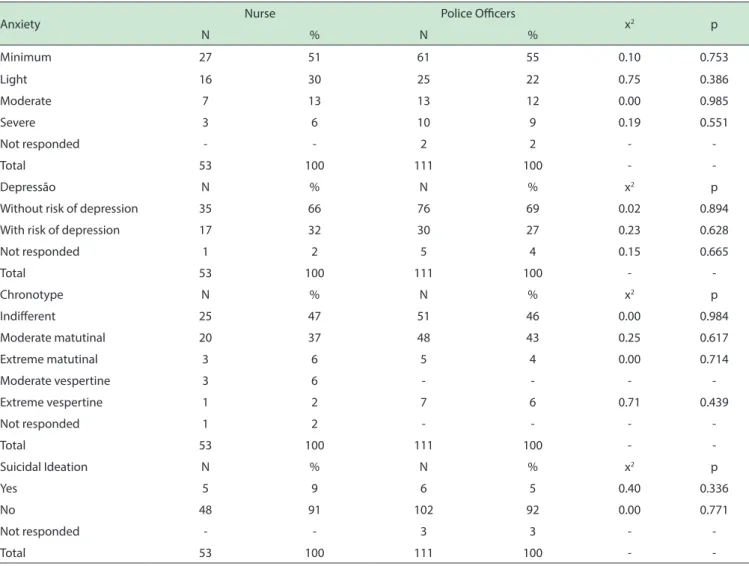
When evaluated on the predictive signs and symptoms of anxiety, it was found that most of the nurses presented minimal levels of anxiety (n = 27; 51%), followed by light (n = 16; 30%), moderate (n = 7; 13%) and severe (n = 3; 6%), as shown in Table 2. Most of the police officers (n = 61; 55%) presented minimal level of anxiety, followed by ligth (n = 25; 22%), moderate (n = 13; 12%) and severe (n = 10; 9%) as shown in Table 2. The evaluation of anxiety between the groups was conducted using the chi-squared test. There were no significant differences (p > 0.05) between the groups.
Among the nurses in our study, 17 (32%) presented elevated risk for depression (Table 2). Among police offi
-cers, 30 (27.0%) presented elevated risk for depression (Table 2). The evaluation between the groups was conduc
-ted using the chi-squared test. There were no significant differences (p > 0.05) between the groups.
With regard to the chronotype of study participants, most of the nurses interviewed presented indifferent chronotype (n = 25; 47%), followed by the moderate matutinal chronotype (n = 20; 38%) as shown in Table 2. Among the police officers, 51 (46%) presented indifferent chronotype, followed by the moderate matutinal chronotype (n = 48; 43%), moderate vespertine chronotype (n = 7; 6%) and extreme vespertine chronotype (n = 5; 4%), as shown in Table 2. The evaluation between the groups was conducted using the chi-squared test. There were no significant differences (p > 0.05) between the groups.
Police personel are subject to specific challenges. In Brazil, public safety suffers from a continuous growth of va
-rious forms of violence and crime.8 Intensification of violence requires more effective public security policies, resulting in a physical and emotional overload for police officers. In addition, to dealing with the pressure of society to provide efficient policing, the often precarious working conditions in Brazil interferes with the performance of these professionals, affec
-ting their health and genera-ting dissatisfaction, which in turn results in symptoms of stress and psychological suffering.9-11
Nursing personel are likewise subject to specific challenges. Hospital environments are unhealthy places that can be painful and dangerous and may subject workers to an increased risk of illness. Hospital work is often characterized by long commuting, contact with stressful situations, and high levels of tension; these factors can lead to physical and mental health problems such as repetitive strain injury, anxiety, anguish and stress, to name a few.12
The intense pace of activity in the nursing profession infringes upon the human biological rhythm. In addition, absenteeism, long distances covered during workdays, inadequate provisioning of security, large amounts of work information and vigilant attitudes can cause physical wear as well as mental fatigue and stress. These factors predispo
-se nursing professionals to physical and mental illnes-ses.13
The importance of studies examining psychiatric co-morbidities in these two populations lies in the need to generate contributions which may alert authorities, society, health professionals and public safety experts about the occupational risks and in the need for mental health care in these two professions.
Because the professional routines of nurses and po
-lice officers involve an overload of activities and inadequate work shifts, this study aims to identify symptoms of anxiety and depression, chronotype and the presence of suicidal ideations in nurses in a hospital emergency service and in police officers in the city of Arapiraca (population: 214 thousand), in the state of Alagoas, Brazil.
■
METHODSThis study was conducted at the Hospital of Urgency and Emergency and at the Police Battalion, in Arapiraca.
The hospital staff included 70 nurses, 53 of which participated in this study. The inclusion criterion was: nur
-ses that worked at the emergency hospital unit. Exclusion criterion: nurses that were on vacation or on license from the hospital service for any reason.
Table 1 - Age of the included police oicers and nurses
Age (Years) Police Oicers Nurse
N % N % p
21 - 30 46 42 22 41 0,872
31 - 40 26 23 17 32 0,323
41 - 50 37 33 10 19 0,083
+ 50 2 2 2 4 0,595
Indeterminate - - 2 4
-Total 111 100 53 100
-Table 2 - Evaluation of anxiety and depression, chronotype and suicidal ideations in included police oicers and nurses
Anxiety Nurse Police Oicers x2 p
N % N %
Minimum 27 51 61 55 0.10 0.753
Light 16 30 25 22 0.75 0.386
Moderate 7 13 13 12 0.00 0.985
Severe 3 6 10 9 0.19 0.551
Not responded - - 2 2 -
-Total 53 100 111 100 -
-Depressão N % N % x2 p
Without risk of depression 35 66 76 69 0.02 0.894
With risk of depression 17 32 30 27 0.23 0.628
Not responded 1 2 5 4 0.15 0.665
Total 53 100 111 100 -
-Chronotype N % N % x2 p
Indiferent 25 47 51 46 0.00 0.984
Moderate matutinal 20 37 48 43 0.25 0.617
Extreme matutinal 3 6 5 4 0.00 0.714
Moderate vespertine 3 6 - - -
-Extreme vespertine 1 2 7 6 0.71 0.439
Not responded 1 2 - - -
-Total 53 100 111 100 -
-Suicidal Ideation N % N % x2 p
Yes 5 9 6 5 0.40 0.336
No 48 91 102 92 0.00 0.771
Not responded - - 3 3 -
-Total 53 100 111 100 -
-Among the nurses, five (9%) reported suicidal ideation by the time of the interview (Table 2), reporting reasons such as relationship problems or losses. When asked about the time at which the suicidal ideations occurred, four (80%) mentioned that the ideations occurred more than 3 years ago. Psychotherapy (n = 2; 40%) was the solution that was most cited as the reason for resolution of the suicidal ideations.
Among the police officers, six (5%) reported suicidal ideation by the time the interview (Table 2). The police officers cited the following reasons for suicidal ideations: problems with stress, anxiety, and/or depression (n = 1; 17%), finances (n = 1; 17%), as well as other reasons.
(33%) reported that it occurred less than one year ago and one (17%) reported that occurred between one and two years ago. Regarding the reason for the resolution of their suicidal ideations, two (33%) reported that they had taken no action, one (17%) reported having had medical follow-up, one (17%) reported that he sought religious assistance and with a professional psychologist, one (17%) sought religious assistance and one (17%) simply tried to stop thinking about it. Evaluation between the groups was conducted using the chi-squared test. There were no significant differences (p > 0.05) between the groups.
■
DISCUSSIONMost nurses in this study were females (96%); this result is consistent with the predominance of this gender in the nursing profession. In Brazil, in spite of the admission of men into the nursing labor market, nursing is still a predominantly female profession (87%).14 A study
has shown that, among women, the risk for mental health problems was relatively high when they were exposed to continuously occurring stressors at work.15
The police officers participating in our study reflects the fact that police duty is typically a male profession in Bra
-zil. We find that 84% of officers are male; this finding may be related to the traditional philosophy of the police force, which are influenced by the National Army. The same study cited above has shown that, among men, a recent episode of stress at work is associated with a high risk of developing mental health problems such as anxiety and depression.15
A study examining the chronobiology, sleep-wake cycle and anxiety level of nurses working in different shifts showed that 47% had between 31 and 40 years of age.2
Another study evaluating the correlation between everyday stress levels and chronotype in nurses found that 87% of nursing professionals had between 20 and 39 years of age,16
similar to the data found in the current study. The age of the majority of police officers in our study is between 21 and 30 years of age (41%). A study described in a military report shows an average age of 33.5 years.8 Depression is more evident in the younger than in the older age groups.17 This finding may have influenced the higher frequency of depressive symptoms seen among police officers.
Nurses are the professionals that most interact with people in of need help.18 Studies of nurses and nursing assistants in a public hospital in São Paulo show the increased mental health demands of nurses, reporting that the diseases most referred to by workers, without a medical diagnosis, were emotional disorders including depression, anxiety and insomnia.19
A study of nursing professionals showed that situa
-tions within the work environment could cause anxiety.20 These situations include instability or deterioration of the state of health of patients; lack of materials, equipment
and/or personnel; relationships with the patient’s family; difficulties with the systematization of nursing care and high-complexity procedures.20
A Study of nurses involved in perioperative care showed that these professionals require greater attention to mental health care because of the intensity of physical and mental work, professional liability, complexity of care, shift work and urgent/emergency situations that can create anguish and anxiety.21
A study used the Beck Anxiety Inventory to evaluate anxiety in nursing professionals and found 49% of nurses with moderate to severe anxiety symptoms.22
A study conducted in Rio de Janeiro23 examined the
impact of professional activities on the physical and mental health of uniformed and civilian police and noted that 34% of police in the study reported psychological suffering (psychosomatic symptoms, depression and anxiety) compared to a rate of 20% among other civilians.
When referring to the association between
psycho-pathology and sleep disorders, some have reported that this relationship is bidirectional.24 Mental disorders affect the
occurrence of sleep disorders, as disruptions in sleep pat
-terns are related to the occurrence of mental disorders. It is
widely recognized that night shift work alters the circadian
rhythm of individuals, causing an increase in stress, which in turn changes sleep patterns, promoting a feedback loop of the situation.16 Daytime sleep does not have the same
restorative quality as nighttime sleep, causing night shift workers to develop a cumulative sleep debt, which results in decreased productive capacity.16 Thus, the schedule of daily
activities should focus on the schedule that is most com
-patible with the degree of alertness for each chronotype, with the aim of improving performance and quality of life.1
A study about chronotype and sleep deprivation status of nurses on the night hospital service showed that most presented an indifferent chronotype (64%), followed by moderately vespertine (24%) and moderately matutinal (12%) chronotypes. Extremes of matutinal and vespertine chronotypes were not seen.25 In the current study, 25
(48%) nurses presented indifferent chronotype, 20 (38%) moderate matutinal chronotype.
A similar study was conducted in the city of Oporto, Portugal.26 Gender differences are significantly related to
the chronotype, with afternoon chronotypes being more prevalent in men compared with women.4 This information
may explain the fact that nurses are predominantly of the moderate matutinal chronotype because most of the sample was composed of women.
Chronotype classifications in the police officers of this study revealed that 46% police had indifferent chrono
RESULTADOS: Cinquenta e três enfermeiras e 111 policiais militares participaram do estudo. Militares e enfermeiras apresentaram cronotipo matutino indiferente e moderado. A maioria das enfermeiras e militares relatou níveis mínimos e leve de ansiedade. As enfermeiras e os policiais militares apresentaram um risco elevado para depressão. Cinco enfermeiras e seis policiais militares pen
-saram em tantar suicídio até o momento da pesquisa. Não houve diferenças significativas (p > 0,05) entre os grupos de estudo com relação aos sintomas de ansiedade e depressão, cronotipo e ideação suicida.
CONCLUSÃO: As enfermeiras e policiais militares estudados apresentaram um alto risco de sintomas de ansiedade e depressão. Um número considerável de enfermeiras e policiais militares tiveram ideação suicida ao longo da vida. A implementação de medidas de prevenção é necessária para o diagnóstico precoce de ansiedade e transtornos depressivos para evitar complicações, dentre estas, o suicídio.
UNITERMOS: Enfermagem. Polícia. Ansiedade. Depressão. Ideação suicida. Fenômenos de Cronobiologia.
■
REFERENCES1. Silva R, Beck CLC, Magnago TSBS, Carmagnani MIS, Tavares JP, Prestes FC. [Night shift and the repercussion in nurses’ health]. Escola Anna Nery (Impr). 2011;15(2):270-6.
2. Campos MLP, De Martino MMF. [Chronobiologyc aspects of sleep-wake cycle and anxiety levels of nurses working on different shifts]. Rev Esc Enferm USP. 2004;38(4):415-21.
3. Rocha MCP, De Martino MMF. [Stress and sleep quality of nurses working different hospital shifts]. Rev Esc Enferm USP. 2010;44(2):280-6. 4. Alam MF, Tomasi E, Lima MS, Areas R, Menna-Barreto L. [Characteri
-zation and distribution of chronotypes in southern Brazil: gender and season of birth diferences]. J Bras Psiquiatr. 2008;57(2):83-90. 5. Horne JA, Ostberg O. A self-assessment questionnaire to determine
mornigness-evenningness in human circadian rhythms. Int J Chrono
-biol. 1976;4(2):97-110.
6. Palma BD, Tiba PA, Machado RB, Tufik S, Suchecki D. [Immune outco
-mes of sleep disorders: the hypothalamic-pituitary-adrenal axis as a modulatory factor]. Rev Bras Psiquiatr. 2007;29 Suppl 1:S33-8. 7. Dorrian J, Tolley C, Lamond N, Van Den Heuvel C, Pincombr J, Rogers
AE, et al. Sleep and errors in a group of Australian hospital nurses at work and during the commute. Applied Ergonomics. 2008;39(5):605-13.
8. Oliveira KL, Santos LM. Percepção da saúde mental em policiais mili
-tares da força tática e de rua. Sociologias. 2010;25:224-50.
9. Minayo MCS, Souza ER. Missão investigar: entre o ideal e a realidade de ser policial. Rio de Janeiro: Garamond. 2003.
10. Couto HA. Stress entre executivos: os 10 agentes estressantes mais frequentes e os 13 fatores de maior potencial agressivo. In: Anais do Congresso da Associação Nacional de Medicina do Trabalho. Florianó
-polis: Associação Nacional de Medicina do Trabalho. 1987;5:747-57. 11. Patis K. Stress e isolamento social versus stress e atividade de resgate
ao público: nota prévia. In: Anais do Congresso da Associação Nacio
-nal de Medicina do Trabalho. Florianópolis: Associação Nacio-nal de Medicina do Trabalho. 1987;5:785-9.
12. Elias MA, Navarro VL. A relação entre trabalho, a saúde e as condições de vida: negatividade e positividade no trabalho das profissionais de Enfermagem de um hospital escola. Rev Latino-Am Enfermagem. 2006;14(4):517-25.
associated with an increased risk for problems related to
health, performance and security.27
In this study, five nurses reported they had had suicidal ideations at the time of the study; the majority related that these ideations had occurred more than three years before. Depression sometimes represents the link between frames of anxiety and the risk of suicide.28 A report on depressive symptoms and suicidal ideations among hospital nurses and doctors revealed that 4% attempted suicide.18
A study conducted with 24 tactical force police officers found that 92% always or sometimes felt stressed and that 21% reported having thought about suicide at some point.8 Current study differs from these results, because only 5% admitted to having suicidal ideations.
Summary
Nurses and military have high risk of anxiety and depression. Presence of suicidal ideation in their lives was relatively low. Indifferent and moderate matutinal chronotypes showed the highest prevalence in nursing and police.
Implementation of preventive measures is necessary for the early diagnosis of anxiety and depressive disorders in order to prevent complications, including suicide.
The limitation of this study is related to the fact that the measurement instruments were applied during the rou
-tine of work. This may have compromised the answers. To partially alleviate this situation, the interviews were made in a reserved place.
Acknowledgements
The authors thank the support of the National Council of Scientific and Technological Development (CNPq).
IDEAÇÃO SUICIDA E AVALIAÇÃO DE CRONOTIPO EM ENFERMEIRAS E POLICIAIS MILITARES
INTRODUÇÃO: Enfermeiros e policiais militares são profissionais que trabalham em turnos e têm empregos que exigem atenção e responsabilidade. Eles trabalham sob condições que podem causar estresse, ansiedade e mudanças nos padrões de sono.
OBJETIVO: Este estudo visa identificar sintomas de ansiedade e depressão, cronotipo e a presença de ideação suicida em enfermeiros e policiais militares de Arapiraca/ Alagoas, Brasil.
MÉTODO: Este é um estudo descritivo e quantitativo. As entrevistas foram realizadas usando registros de Identi
13. Miquelim JDL, Carvalho CBO, Gir E, Pelá NTR. [Stress among nursing professionals at an HIV-AIDS unit] DST - J Bras Doenças Sex Transm. 2004;16(3):24-31.
14. COFEN. Conselho Federal de Enfermagem. Comissão de Business Intelligence. Análise de dados das inscrições dos profissionais de En
-fermagem existentes nos Conselhos Regionais no ano de 2011. Versão 3.0. 2013.
15. Godin I, Kittel F, Coppieters Y, Siegrist J. A prospective study of cumulati
-ve job stress in relation to mental health. BMC Public Health. 2005;5:67. 16. Ferreira LRC, De Martino MMF. Stress no cotidiano da equipe de en
-fermagem e sua correlação com o cronótipo. Estudos de Psicologia. Campinas. 2009;26(1):65-72.
17. Akhtar-Danesh N, Landeen J. Relation between depression and socio
-demographics factors. Int J Ment Health Syst. 2007 Sep 4;1(1):4. 18. Barbosa KKS, Vieira KFL, Alves ERP, Virginio NA. Sintomas depressivos
e ideação suicida em enfermeiros e médicos da assistência hospitalar. Revista de Enfermagem da UFSM 2012;2(3):515-22
19. Fischer FM, Bellusci SM, Teixeira LR, Borges FNS, Ferreira RM, Gon
-çalves MBL, et al. Unveiling factors that contribute to functional aging among health care shiftworkers in São Paulo, Brazil. Exp aging Res. 2002;28(1):73-86.
20. Barros ALBL, Humerez DC, Fakih FT, Michel JLM. Situações geradoras de ansiedade e estratégias para seu controle entre as enfermeiras: Estudo preliminar. Rev Latino-Am de Enferm. 2003;11(5):585-92.
21. Cruz AJC. Desgaste Profissional em Enfermeiros do Bloco Operatório. [Dissertação de Mestrado]. Açores, Portugal. Universidade dos Açores; 2001.
22. Montfort RMM. Ansiedade e depressão em profissionais de enfer
-magem e sua relação com o reconhecimento das expressões faciais. [Dissertação de Mestrado]. João Pessoa: Universidade Federal da Paraíba. 2010.
23. Minayo MCS, Assis SG, Oliveira RVC. [The impact of professional activi
-ties on the physical and mental health of the civil and military police of Rio de Janeiro (RJ, Brazil)]. Ciênc Saude Colet. 2011;16(4):2199-209. 24. Sateia MJ. Update on sleep and psychiatric disorders. Chest.
2009;135(5):1370-9.
25. Manhães VMS. Cronotipo e privação do sono nos trabalhadores do serviço noturno hospitalar de enfermagem [Dissertação de Mestrado]. Rio de Janeiro: Universidade do Estado do Rio de Janeiro, 2009. 26. De Martino MMF, Abreu ACB, Barbosa MFS, Teixeira JEM. The rela
-tionship between shift work and sleep patterns in nurses. Revista Ciênc saude colet [online]. 2013;18(3):763-8.
27. Rajaratnam SMW, Barger LK, Lockley SW, Shea SA, Wang W, Landrigan CP, et al. Sleep Disorders, Health, and Safety in Police Officers. JAMA. 2011;306(23):2567-78